

The Live-on-Tape podcast for the
conversation series of the
Forum Recht Foundation
Legal topics that concern everyone: The Live-on-Tape podcast of the Forum Recht Foundatio makes them audible here and on the major podcast platforms.
In the monthly conversation series "Let's Talk About Recht," the Forum Recht Foundation discusses current and fundamental questions about our legal system, from tenancy law to freedom of expression.
"Let's Talk About Recht" offers insights into various areas of law, the Rechtsstaat (constitutional state) and the rule of law and uses real-world examples to show where and how they play out in everyday life and what they mean for our society.
Individual conversations are recorded and made available as podcasts afterward. Tune in now!
#LetsTalkAboutRecht


You are currently seeing a placeholder content of YouTube. To access the actual content, click on the button below. Please note that data will be passed on to third-party providers.
More informationPlease note that the video is embedded via YouTube. By playing the video, you agree to the data processing by YouTube/Google. More about this in the Privacy Policy.
#14 Law and Emotions—From a Sense of Justice to the Protection of Feelings
Law is supposed to be objective; emotions are personal—but the two can no longer be so clearly separated. So how much emotion is there in the law—and how much emotion can a constitutional state tolerate? Historian Dr. Sandra Schnädelbach and legal scholar Prof. Dr. Johannes Eichenhofer discussed these and other questions during „Let’s Talk About Law“ at the Forum Recht Foundation. The conversation was moderated by Susann Böttcher.
We recorded the conversation during the live event on September 9, 2026, in Leipzig.
Our guests
Dr. Sandra Schnädelbach studied history, theater, film, and television studies, and German language and literature in Cologne and Rome. In her dissertation „Decisive Emotions: The Sense of Justice and Legal Emotionality from the German Empire to the Weimar Republic,“ she examined the legal culture of the early 20th century and analyzed the significance of emotions in theories and practices of judgment. After working at the Max Planck Institute for Human Development in Berlin and at the University of Strasbourg, she was a Gisela Eisenreich Fellow at Heinrich Heine University Düsseldorf. From 2012 to 2026, she worked as an editor and served as the managing editor of *Philosophie Magazin*; she currently works at the German Institute for International and Security Affairs (SWP).
Prof. Dr. Johannes Eichenhofer is a professor of public law at the University of Leipzig. His research focuses on public law issues related to digitalization, migration and integration law, and security law. He also studies the relationship between law and emotions.
This year, the journalist and host will be hosting the Leipzig editions of „Let’s Talk About Law“ Susann Böttcher. She is a host on the news radio station MDR aktuell, but also appears in podcasts and on stage. A law graduate, she covers a wide range of topics—from politics and health to business and sports. She can be heard regularly on the Bundesliga program and on ARD’s discussion show „Mitreden! Deutschland diskutiert.“ Most recently, she hosted the ARD Olympic Evening.
Shownotes
Here's what this episode is about
Law is rational; emotions are subjective—for a long time, the distinction seemed that simple. But are law and emotions really opposites? Research in legal studies and cultural studies is increasingly examining their interactions. This is because emotions shape how people perceive the law, how decisions are made, and which rules gain social acceptance.
So what does our „sense of justice“ mean? What role do emotions play in the creation and application of law? And in what ways does the law already recognize emotions—for example, by protecting them or shielding people from the consequences of emotional reactions?
The panelists will examine the tension between emotion and the law from historical and legal perspectives.
Moderation: Susann Böttcher
Concept: Sina Ness, Felicia Stahnke
Recording: Romy Klemm
Post-production & Transcript: Stefan Klemm
Why We're Talking About This
Legal topics often have a reputation for being difficult to understand and highly complicated. Yet many legal issues affect us all. Take freedom of expression, for example: It is a fundamental right to which all citizens in Germany are entitled under our Constitution. Why, then, do laws sometimes get passed that restrict this Fundamental right restrict it under certain conditions?
Held alternately at the Foundation’s two locations in Leipzig and Karlsruhe and covering a constantly changing range of topics, we invite anyone interested to learn more about Legislation, Administration of Justice, and Legal Protection to discuss. „Let’s Talk About Law“ offers insights into various areas of law and the rule of law, and uses real-life examples to show where and how they play a role in everyday life and what significance they have for our society.
Photo: Nils Bornemann (Eichenhofer)
Further links and sources
The conversation covered a wide range of topics—we've put together some exciting book recommendations for you on the various subjects:
You can find more information about our guests on our website: https://stiftung-forum-recht.de/kalender/lets-talk-about-recht-karlsruhe/
Legal Tribune Online has published a good article on the concept of a sense of justice: https://www.lto.de/recht/feuilleton/f/rechtssoziologie-gefuehle-juristen-rechtsempfinden-rechtsfindung-gerichte-justiz
Regarding the historical development of overcoming the dichotomy between reason and emotion, this article quotes, among others, our guest Ms. Schnädelbach: https://www.rsozblog.de/der-emotional-turn-und-die-rechtswissenschaft/#_ftnref10
For more information on the book *A Sense of Justice and Legal Emotionality from the German Empire to the Weimar Republic* by Sandra Schnädelbach, please visit the German Digital Library: https://www.deutsche-digitale-bibliothek.de/item/QZRVYZVPBWVNZKR7FWG3TYR47BZ6YV7R
The law evaluates emotions differently. Paul Stenner has written a detailed essay on this topic: https://www.kritische-psychologie.de/files/FKP_47_Paul_Stenner.pdf
Would you like to join the discussion live during the talk series? On the Event Page You can find more information and upcoming dates there.
Transcript for the episode
[You can download the transcript of the episode as a PDF here]
Let's Talk About Law – The ‘Live-On-Tape" Podcast for the Discussion Series
Transcript
Episode #14: Law and Emotions—From a Sense of Justice to the Protection of Feelings
00:00:01:17 – 00:00:22:21
Introduction
Let’s Talk About Law. The “Live on Tape” podcast based on the Foundation Forum Recht’s series of discussions. We talk with our guests about current and fundamental legal issues that affect us all.
00:00:22:23 – 00:00:52:19
Susann Böttcher (Host)
Law and Emotions: At first glance, these two might seem somewhat mutually exclusive. By the end of this event, you’ll walk out thinking, “Yes, they’re not.” Here’s a sneak peek: From a sense of justice to the protection of feelings—what role do emotions play in lawmaking and the application of the law? What do we mean by a “sense of justice”? When—and in what form—has emotionality been or is it currently recognized as important, and in which areas might it be rejected?
00:00:52:19 – 00:01:28:10
Susann Böttcher (Host)
And is that justified? And what role do emotions play in the law when it comes to social acceptance? And, of course, we’ll also examine where our legal system already addresses emotions—does it recognize them, protect them, or even protect people from them? A quick note on the schedule: this series, “Let’s Talk About Law,” is called an invitation for a reason. We’ll start by spending 60 minutes here on this panel discussing this topic, and afterward, you’re invited to spend half an hour asking questions, making comments, or posing questions from the audience.
00:01:28:12 – 00:01:54:04
Susann Böttcher (Host)
But we’d like to actively involve you during the discussion. You’ll find these cards on your chairs. They’re pretty easy to understand: yes and no. So I’ll ask a few questions here and there and act surprised. We’re recording the whole thing today as a podcast. That’s why I’ll be moderating the results of the vote accordingly. The audience segment—that is, the half-hour that follows—won’t be part of the podcast.
00:01:54:06 – 00:02:18:06
Susann Böttcher (Host)
This might make you feel more comfortable asking a question. And I’d also like to explicitly mention that this event is open to non-lawyers as well. That means we’ll explain any technical terms here so that we’re all on the same page and can learn alongside our guests: Sitting to my right is Dr. Sandra Schnädelbach.
00:02:18:06 – 00:02:39:10
Susann Böttcher (Host)
She studied history, theater, film and television studies, and German language and literature in Cologne and Rome. And here is the title of her dissertation: “Crucial Emotions, the Sense of Justice, and Legal Emotionality: From the German Empire to the Weimar Republic.” In other words, her dissertation essentially laid the groundwork for this evening’s event. Good evening.
00:02:39:12 – 00:02:41:03
Dr. Sandra Schnädelbach
Hello! I'm happy to be here.
00:02:41:05 – 00:02:54:11
Susann Böttcher (Host)
And Johannes Eichenhofer is here—he is a professor of public law here at the University of Leipzig, and his research focuses on public law issues related to digitalization, migration and integration law, and security law.
00:02:54:11 – 00:02:59:20
Susann Böttcher (Host)
And he, too, explores the relationship between law and emotion. Good evening, both of you!
00:02:59:22 – 00:03:05:04
Prof. Dr. Johannes Eichenhofer
Thank you very much for the invitation.
00:03:05:06 – 00:03:26:20
Susann Böttcher (Host)
I’m Susann Böttcher, a journalist and host; I also studied law here in Leipzig. That was ages ago. But I did end up completing my first state exam. It’s great to have you all here—and to see so many of you. I’m looking forward to this evening, and let’s start by hearing about your backgrounds and your very personal perspectives on tonight’s topic.
00:03:26:22 – 00:03:34:01
Susann Böttcher (Host)
Ms. Schnädelbach, as a historian, you have studied law and the sense of justice. Why?
00:03:34:03 – 00:03:51:09
Dr. Sandra Schnädelbach
Well, like so many things, it started out as a coincidence. I was part of a research group made up of representatives from various disciplines. There were philosophers, legal scholars, and I—as a historian—was actually the only one there. And this research project deals with questions of judgment in a very broad sense.
00:03:51:09 – 00:04:13:11
Dr. Sandra Schnädelbach
In the arts, too. But also in the legal field. And as a historian, I didn’t know much about it, so I asked some curious questions. Like, “So how does that work?” And a lot of it had to do with a sense of justice and what’s also called “judicium” in the legal world. “And what is that, exactly? What do you mean by that? What’s going on there?” And then the conversations largely revolved around the fact that we didn’t really know what was meant by it.
00:04:13:11 – 00:04:48:06
Dr. Sandra Schnädelbach
And that’s when I realized there was a kind of… a contradiction became apparent: that in the legal world, we operate a lot with these terms, but people themselves often don’t really know exactly what they mean, and that in methodology—that is, in the practical application taught in the training of lawyers—it doesn’t play such a big role, but people always say, “In practice, it’s very important”—and I wanted to get to the bottom of that, which is how I came up with the blue emotional movements; Mr. Eichenhofer will have more to say about that as well. But then, as a historian, I naturally turned to history and was totally surprised to see that
00:04:48:06 – 00:05:04:23
Dr. Sandra Schnädelbach
This idea that we should actually engage more deeply with emotions in law—that is, that we should reflect more on the fact that this debate has already taken place. Around 1900, specifically regarding the concept of a “sense of justice” and the significance of emotions in law. And that’s what I explored in my dissertation.
00:05:05:00 – 00:05:12:03
Susann Böttcher (Host)
Professor Eichenhofer conducting research on emotions as a legal scholar. How did that come about, and how was it received by his colleagues?
00:05:12:04 – 00:05:36:09
Prof. Dr. Johannes Eichenhofer
Yes, very important. That question. So you’ve already mentioned the three areas in which I work. Practically speaking, there’s the law of digitalization—and the topic of emotions actually comes up more often than you’d think. Take, for example, the whole issue of hate speech and hate crimes. Yes, everything that goes on in that area, including things like emotional targeting—that is, the deliberate manipulation of emotions.
00:05:36:11 – 00:05:55:11
Prof. Dr. Johannes Eichenhofer
Of course, there’s also been the recent emergence of AI-based emotion recognition, so it’s a topic you’re bound to come across from time to time. In security law, we’re familiar with the sense of security on the one hand, but we’re also aware of something called the “chilling effect”—that is, the fear that one might, for example, be subjected to some form of police action.
00:05:55:11 – 00:06:30:20
Prof. Dr. Johannes Eichenhofer
And the Federal Constitutional Court has already addressed this issue on several occasions. So this means the matter isn’t entirely devoid of legal considerations. And what about migration? I know that’s obviously one of the most emotionally charged topics there is, but beyond that—in terms of immigration law, for example—there’s also the fear of persecution. It plays a role there, too. And to give a positive example: I wrote my doctoral dissertation on issues of integration, and that also has an emotional component—the sense of belonging, for example. As we’ll surely get to in a moment, it’s not exactly easy for legal scholars to get a handle on this topic.
00:06:30:20 – 00:06:37:16
Prof. Dr. Johannes Eichenhofer
However, I believe that it is very important and that we live in a time when emotions are becoming increasingly important.
00:06:37:18 – 00:07:08:04
Susann Böttcher (Host)
Well, they’ve already spoiled quite a bit. I’d still like to bring this topic up with our audience, though. What role do emotions play in the law? Just off the top of your head? Go ahead and grab your card. Are emotions allowed in the law? And the results are… Yes, we’re here—oh, I’m so bad at estimating—I’d say there are 70 or 80 of us, and we’ve gotten “No” as the answer 4, 5, 6, or 7 times.
00:07:08:06 – 00:07:15:01
Susann Böttcher (Host)
All right, let's move on. Let's… oh, lawyers love to define things. I don't even know how it is with historians. Do they, too?
00:07:15:01 – 00:07:17:22
Dr. Sandra Schnädelbach
Not quite that much.
00:07:17:24 – 00:07:24:24
Susann Böttcher (Host)
Then I'll let Mr. Eichenhofer go first. What are emotions? What are feelings? Is there a difference? How do you define them?
00:07:25:01 – 00:07:45:21
Prof. Dr. Johannes Eichenhofer
Oh yes, that’s a very good and important question. In fact, a sort of consensus has emerged on this. So, feelings are, first and foremost, subjective sensations of perhaps a certain intensity. For example, if I feel a very slight twitch in my left toe, it might not even be a “feeling” yet, but it does have a certain intensity.
00:07:45:21 – 00:08:21:06
Prof. Dr. Johannes Eichenhofer
And that’s what defines our relationship with the outside world, so to speak—in other words, a … a stimulus that arises and is then perhaps processed in some way. And with emotions, we can pinpoint very precisely where they actually come from. So there’s, so to speak, a relational object of reference—for example, I’m afraid of a dog running around without a muzzle, foaming at the mouth or something like that—and then it’s very easy to imagine that you’d be experiencing the emotion of fear, and that is actually something that could already be worked with in legal scholarship.
00:08:21:06 – 00:08:45:07
Prof. Dr. Johannes Eichenhofer
This—this relational structure—is something you might be able to get a good handle on; but trying to, in a general sense, regulate the feelings that people have, so to speak, in some way—I don’t know—protecting them would probably be even more difficult. That’s very, very difficult. But emotions, I believe, are something that can be made visible in some form through legal means.
00:08:45:09 – 00:08:51:13
Susann Böttcher (Host)
Then the concept of the "postulate of rationality" keeps coming up. What does that mean, anyway?
00:08:51:15 – 00:09:14:19
Prof. Dr. Johannes Eichenhofer
Yes, well, Dr. Schnädelbach could certainly elaborate on that at length. On the one hand, this relates to what expectations we have—so to speak—of legal decisions. That’s quite clear. For example, that judges should make decisions as rationally as possible. But of course, we expect the same from the legislature, as well as from the executive branch and the law itself.
00:09:14:19 – 00:09:55:21
Prof. Dr. Johannes Eichenhofer
If you think of this in practical terms as a system in which various legal entities are involved—for example, as consumers—then people are expected to behave rationally in many respects, and if they don’t, then they simply face certain disadvantages—such as sanctions or consequences under consumer protection law. So, for example, one could say that while irrational behavior might be protected to some extent, if you act irrationally, you generally face disadvantages—and that’s, so to speak, an interesting perspective on the topic of law and emotions, one that’s worth exploring.
00:09:55:21 – 00:09:57:16
Prof. Dr. Johannes Eichenhofer
And it is increasingly being done.
00:09:57:18 – 00:10:02:24
Susann Böttcher (Host)
In what context did you come across this term in connection with Ms. Schnädelbach?
00:10:02:24 – 00:10:26:06
Dr. Sandra Schnädelbach
Well, as an ideal, of course. And, well, there’s a very enduring narrative about the rationality of the law for the reasons already mentioned. At the same time, however, people have forgotten that there’s also a counter-narrative… one that has existed for a very long time and still exists today. If you think about what emotions actually are—and that has changed throughout history as well.
00:10:26:06 – 00:10:56:10
Dr. Sandra Schnädelbach
So the concept we have today of feelings and emotions—the distinction you’ve drawn—is not something that goes without saying; rather, it is a product of our time, including the modern era. And the concept of rational law developed primarily during the Enlightenment, when reason once again gained a great deal of significance. But at the same time, there have always been notions of a certain emotionality in law and, above all, objections to the idea that rationality and emotionality are opposites.
00:10:56:10 – 00:11:23:13
Dr. Sandra Schnädelbach
So when you say something is irrational, it implies that there can really only be one or the other. But particularly in the 18th century—and even into the 19th century—there were very different conceptions of feelings; namely, that the concept of “feeling,” for example, was originally conceived as a sensory faculty—so a “feeling” … actually referred to the sense of touch as late as around 1800.
00:11:23:15 – 00:11:47:03
Dr. Sandra Schnädelbach
This was conceived—just as with the parallels to hearing and taste—as the perception of something through sensation; in other words, something tactile is something entirely different. And the sense of justice was also very strongly linked to this; it wasn’t until much later that something internal somehow became institutionalized. Accordingly, there were also very different ideas about how emotion and reason might be interconnected in certain emotions—though not in all of them.
00:11:47:04 – 00:12:08:19
Dr. Sandra Schnädelbach
So the question there was really: What exactly do we mean by that—how intense is this feeling? There are so many, many nuances, and what’s fascinating is tracing the history of what changed, how, and when—as well as why—and how we actually arrived at this modern conception of law as a rational application of rules.
00:12:08:19 – 00:12:20:06
Dr. Sandra Schnädelbach
So, in a way, it’s also a bit like the idea of “legal mathematics.” Of course, these are often exaggerations, but this concept has been around for a very long time. And yet, around 1900, it was called into question very, very strongly.
00:12:20:08 – 00:12:28:13
Susann Böttcher (Host)
Let's stay with the history for just a moment. In your dissertation, you focused specifically on the period between the German Empire and the Weimar Republic.
00:12:28:13 – 00:12:31:05
Susann Böttcher (Host)
Why wait until then?
00:12:31:07 – 00:12:53:00
Dr. Sandra Schnädelbach
That was the period when the concept of a “sense of justice”—which had existed for some time, having emerged around 1800—was, for the first time, truly examined in a systematic way, and people explored it from a wide variety of perspectives and disciplines as well. And there was a major debate—a societal debate, too. So this wasn’t just a legal matter in and of itself, but one that truly permeated society.
00:12:53:01 – 00:13:17:08
Dr. Sandra Schnädelbach
There was also a lot of criticism of the judiciary at the time… all of that played a role, and it happened particularly intensely in the wake of judicial crises in the German Empire and the Weimar Republic. And the reason I ended it there is simply because so much shifted and changed again with the rise of National Socialism that I had to draw the line there in order to bring the narrative to a close.
00:13:17:10 – 00:13:31:01
Susann Böttcher (Host)
Was there ever a different ideal than the one that prevailed during that period between the German Empire and the Weimar Republic? In other words, was the emphasis on emotion… greater or lesser?
00:13:31:03 – 00:13:45:04
Dr. Sandra Schnädelbach
I think it depends on where you look. I believe that the importance of emotions in the law, in public life, and in interactions with the public grew during the period of the German Empire and the Weimar Republic because this was also recognized as a problem.
00:13:45:04 – 00:14:10:14
Dr. Sandra Schnädelbach
Or rather, both the postulate of rationality and the danger of emotionalization were perceived as problems. Both. But this came up much more frequently—not least because disciplines such as sociology and legal psychology had emerged, which approached the issue from a completely different angle, and people were still asking: What exactly is it? How do people function? How do judges function?
00:14:10:16 – 00:14:33:09
Dr. Sandra Schnädelbach
What’s actually going on there? And suddenly people started to have certain expectations about how to deal with the inner self or the darkness that lies within human beings—that there were feelings—which, after all, has been a subject of reflection since ancient times, but here we’ve tried once again to take a fresh approach, to explore what’s actually happening there using new methods, and to somehow get a handle on it in a different way.
00:14:33:11 – 00:14:57:10
Susann Böttcher (Host)
Well, there are many aspects to the law where a great deal is at stake. Let’s imagine a court case. There are two parties whose job this is—they’re professionals. And then there might be someone who’s on trial. From your perspective, do you think there needs to be a certain degree of differentiation in terms of which emotions you attribute to or allow for in each person? Exactly.
00:14:57:12 – 00:15:29:02
Prof. Dr. Johannes Eichenhofer
Oh, that’s a good question—one I haven’t really thought about in much detail yet—but I do think that in this trial, there are certain role models, so to speak, and that one might say certain expectations are initially directed at the judge—that they should be impartial, maintain a certain distance, and perhaps also exhibit a certain—well, rationality or detachment from emotion, let’s say. In criminal trials, witnesses and defendants are actually allowed to show certain emotions—that’s quite clear.
00:15:29:02 – 00:15:49:10
Prof. Dr. Johannes Eichenhofer
There are limits, of course; at that point, a call to order or something similar is issued. But being very nervous, for example, or something like that—that’s perfectly normal. And I think it’s perfectly normal for emotional turmoil to arise during a trial like that. And here, I can perhaps only draw on my own practical experience from my legal clerkship or something like that.
00:15:49:12 – 00:16:03:21
Prof. Dr. Johannes Eichenhofer
That always depends a bit on who’s leading the proceedings. Some are a little more lenient, while others want things to be very calm and businesslike. But I do think that, above all, there are special expectations placed on the judge, so to speak. Yes.
00:16:03:23 – 00:16:31:05
Susann Böttcher (Host)
I’d like to pass this question on to our audience: Are judges allowed to show emotion? What do you think? … There seem to be a few more “yes” answers than “no” ones, but still quite a few “no” answers—I’d say about 30 % say “no.” In that case, keep the card in your hand. Are lawyers allowed to show emotions? There are significantly more “yes” answers here.
00:16:31:08 – 00:16:34:01
Susann Böttcher (Host)
Yes.
00:16:34:03 – 00:16:39:10
Susann Böttcher (Host)
They say yes, too. Why Ms. Schnädelbach?
00:16:39:12 – 00:16:59:10
Dr. Sandra Schnädelbach
Um. Well, I mean, … but that’s also an advocacy group. So, in a way, it actually makes sense. So this postulate of rationality is primarily imposed on judges, rather than on lawyers—though historically, that wasn’t always the case. And I found that really interesting.
00:16:59:12 – 00:17:20:23
Dr. Sandra Schnädelbach
And there was actually a huge debate about this at the end of the 19th century because of the role expectations people had. And I think for female judges—though back then there were only male judges—it was clear that, first and foremost, they were expected to adopt a rational demeanor. But there was criticism of that, too. I’ll say a bit more about that in a moment—but this applies especially to lawyers as well.
00:17:21:00 – 00:17:57:13
Dr. Sandra Schnädelbach
First of all, people didn’t think she had a particularly strong sense of justice, given her background and education—and, so to speak, yes, there were certain reservations. But originally, lawyers were also committed to seeking the truth within the legal profession. That changed at the end of the 19th century, shifting toward the representation of clients’ interests. And what I found truly astonishing was that, previously, professional ethics dictated that one was not allowed to plead “not guilty” against one’s better judgment—and in extreme cases, one was even required to resign from the case.
00:17:57:15 – 00:18:25:10
Dr. Sandra Schnädelbach
If—if the client hadn’t confessed and the case was postponed—that naturally led to very significant moral questions and new problems, including, of course, regarding the authenticity of the emotions expressed in court. And in this regard, there was a sharp distinction drawn from practices in other countries, because, of course, this whole… and thus also the question of what actually constitutes appropriate emotions—as well as the question: Are judges allowed to show emotions?
00:18:25:10 – 00:18:59:05
Dr. Sandra Schnädelbach
I’ve said yes now. But the question is also what kind of feelings and how many. I think, in the end, it’s always a matter of quantity and degree. And there were certain ideas about what’s considered appropriate in Germany and what happens elsewhere, and there were—and still are—some truly, truly illuminating comparisons with France, especially regarding how defense attorneys conduct themselves there, the level of pathos they employ, and how that’s absolutely not done here—yet the manuals then specify exactly that a defense attorney—well, he can sometimes just break off mid-sentence with a trembling voice and a choked tone.
00:18:59:05 – 00:19:17:14
Dr. Sandra Schnädelbach
That’s all fine. But tears? Under no circumstances should a defense attorney cry—that would go against German notions of propriety. And that’s definitely not going to happen. So it definitely wouldn’t happen—we’ll see about that. I mean, a choked-up voice and stuff like that—that was all fine. But there were also these gradual shifts where, somehow, it suddenly wasn’t possible anymore.
00:19:17:19 – 00:19:43:18
Dr. Sandra Schnädelbach
Exactly. There was a lot of criticism later on about that, and also regarding how judges handled their emotions—namely, that people felt it had become too rational. So, you don’t want bureaucrats sitting there; you don’t want any. So it’s always this spectrum between cool reason or coldness on one hand, and warmth versus heat or passion on the other.
00:19:43:18 – 00:20:07:20
Dr. Sandra Schnädelbach
So you really have to look very closely at this barometer. And there was actually a very large, broad movement that said, “We need more warmth, more emotionality from the judges.” You can’t hide behind your robe. You have to look people in the eye; you have to understand the context. And that’s exactly where there was a massive reform movement driving it all.
00:20:07:22 – 00:20:11:13
Susann Böttcher (Host)
Professor Eichenhofer, you have also acknowledged that judges have emotions.
00:20:11:13 – 00:20:21:10
Susann Böttcher (Host)
I just saw that on the card. The person making the judgment there isn't supposed to be a machine. What emotions do you allow yourself to feel? Would it be anger?
00:20:21:12 – 00:20:55:01
Prof. Dr. Johannes Eichenhofer
So I think anything that, so to speak, impairs the acquisition of knowledge in any way is probably bad for all judges. Certain biological—let’s say—dispositions that just happen to arise. For example, there’s the “Hungry Judge”—that’s a phenomenon that’s been identified in “Law and Emotions” research, which takes a partly empirical approach and simply observes that that just before the lunch break, judges want to wrap things up and say, “We’re not going to hear this witness anymore,” or something like that.
00:20:55:01 – 00:20:55:15
Susann Böttcher (Host)
… just like prison.
00:20:55:18 – 00:21:23:11
Prof. Dr. Johannes Eichenhofer
Exactly, for example. So that. Well, I think that might not be entirely avoidable. Of course, the judiciary has a duty to fulfill, and in that context, you have to consider that, in a certain sense, empathy—for example—is a skill that judges possess which is conducive to fulfilling that duty. If, for example, you can really put yourself in that person’s shoes, then maybe you can still manage to coax a bit of information out of them.
00:21:23:13 – 00:21:45:19
Prof. Dr. Johannes Eichenhofer
Exactly one. On the other hand, a heated atmosphere during a hearing can be counterproductive. So, as I said, that’s one approach. Yes, on the topic of what you might call this broad research on law and emotions. Empirical research, so to speak. What do people who make legal decisions do? And that’s exactly what strikes me as….
00:21:45:21 – 00:21:58:15
Susann Böttcher (Host)
We'll go into more detail on that in a moment. Is there perhaps a certain expectation—when I have someone defend me, like a lawyer—that I also want them to be emotional, to give it their all in court?.
00:21:58:17 – 00:22:21:12
Prof. Dr. Johannes Eichenhofer
So, in this case, too, I can only share an anecdote that someone told me. So there’s an acquaintance of mine who also completed her legal clerkship and works at a very large law firm where a very renowned and high-profile attorney practices. And she once told me about a hearing here at the Federal Administrative Court where, apparently, the party she was representing lost spectacularly.
00:22:21:12 – 00:22:41:02
Prof. Dr. Johannes Eichenhofer
But she was still completely satisfied with her lawyer’s performance because he really went all out and delivered that closing argument with such verve. And then they probably thought, well, if even this lawyer can’t help us win, then no one can—and they were still satisfied, even though they’d lost, so to speak.
00:22:41:04 – 00:22:52:15
Prof. Dr. Johannes Eichenhofer
Well, I'm sure that's the case there, too—Ms. Schnädelbach has already explained quite a bit about how her expectations have changed over time, and in that sense, I'm sure that's true there as well.
00:22:52:17 – 00:23:07:09
Susann Böttcher (Host)
I have two more questions for the audience and for you: Are people seeking justice—that is, those without a legal background—allowed to show emotion, or should they also behave rationally in court? So, are people seeking justice allowed to show emotion?
00:23:07:11 – 00:23:33:21
Susann Böttcher (Host)
Absolutely not—no exceptions—precisely for the reasons mentioned. There’s a lot at stake. Last question for now: Do you distinguish between men and women in all these roles—judges, attorneys, and people seeking justice? Absolutely not. Does history distinguish between men and women? Are men always so emotional? We know how it is.
00:23:33:23 – 00:23:40:10
Dr. Sandra Schnädelbach
Yeah, definitely. Although I'd also say that we're just describing ideal scenarios here.
00:23:40:11 – 00:24:06:22
Dr. Sandra Schnädelbach
The more interesting question would be whether courts do, in fact, make a distinction as to who is more likely to be believed. For example, when a woman presents a case, doesn’t she try to come across as more rational anyway, in order to counter certain prejudices? So that’s something different from our personal assessment of how things should be. Once again, it’s a matter of ideal versus reality—as is so often the case in legal matters.
00:24:06:24 – 00:24:33:12
Dr. Sandra Schnädelbach
But especially from a historical perspective, this is of course a very fascinating topic—how contradictions actually came to light there and yet were able to persist. Take the sense of justice, for example: how it was attributed differently to very different people, just as with many other emotions. So, that too. There’s also the question of who is speaking and who they’re speaking about.
00:24:33:12 – 00:25:04:22
Dr. Sandra Schnädelbach
And it was quite clear that, within the legal world, it was taken for granted that a sound sense of justice is also a matter of upbringing, family background, bourgeois sensibilities, and bourgeois values—and that this must go hand in hand with a certain sensitivity, compassion, and so on. And the very same concepts that male judges had elaborately emphasized in their autobiographies were found in dictionaries and public encyclopedias as attributes ascribed to women and, thus, to gender characteristics.
00:25:04:22 – 00:25:33:18
Dr. Sandra Schnädelbach
Those terms existed back then, too, and yet women still weren’t admitted. It was a long time before they were allowed to study law, a very long time before they were allowed to practice, and a very, very long time before they were fully accepted—because people still said, “You just don’t have a good sense of the law.” “You may be masters of intuition—you women are perfectly equipped for everything—but there’s still that final missing piece, and you can really see how things were linked to certain gender stereotypes.”.
00:25:33:21 – 00:26:01:20
Dr. Sandra Schnädelbach
Simple. Well, for example, emotions—like anger in men—have always been associated with strength. That was also what was needed to enforce the law; women didn’t have that. At the same time, women are seen as lacking in energy. But when a woman shows or experiences emotion, it was always viewed as excessive—in the sense of being quick-tempered. So a woman’s intense emotional life was never equated with strength, but only with excess and hysteria.
00:26:01:20 – 00:26:31:21
Dr. Sandra Schnädelbach
So, a discrepancy. On the one hand, she was listless; on the other, quick-tempered—and the same traits in a man were seen as assertiveness, a certain reserve, and gentleness. Thus, the same things were evaluated differently, and this illustrates very clearly that there isn’t really such a thing as “feeling” or even a “sense of justice”—rather, these were always very strongly context-dependent—and, of course, from a middle-class perspective, for example, female and male workers weren’t believed to possess good emotional control or even the capacity for emotional regulation.
00:26:31:21 – 00:26:59:19
Dr. Sandra Schnädelbach
It’s always so much about controlling emotions, about regulating emotions, isn’t it? And that’s why I find it so fascinating that emotions aren’t just biological—they’re also something that’s heavily socially constructed. I mean, you learn how to feel and in which situations you’re supposed to feel a certain way. As a woman, you learn to express and perceive emotions differently than a man, and so on—and this runs throughout the entire story and is portrayed in such a way that people actually say, “A farmer can’t feel the same way as an officer.”.
00:26:59:21 – 00:27:09:06
Dr. Sandra Schnädelbach
That is indeed how it has been phrased in the legal world, and it was subsequently incorporated into legal theory; in that respect, it is quite different.
00:27:09:08 – 00:27:21:11
Susann Böttcher (Host)
If I weren't to include so much of that in the past… of what you just said. Professor Eichenhofer has already mentioned the Law and Emotions movement twice. Let's explain it again for everyone.
00:27:21:11 – 00:27:24:24
Susann Böttcher (Host)
What is that? What is it for, and what exactly are you researching there?
00:27:25:01 – 00:27:54:02
Prof. Dr. Johannes Eichenhofer
Yeah, well, it’s not that easy to say exactly what the “Law and Emotions” movement is, so to speak. I’d say it’s just a whole bunch of individual pockets where people around the world are dealing with emotions in different ways, so to speak. I can try to organize it a bit. So there’s a relatively large strand that deals with what we’ve already discussed today—the application of the law, so to speak, especially judicial application—and specifically the question of to what extent emotions play a role, so to speak.
00:27:54:04 – 00:28:26:20
Prof. Dr. Johannes Eichenhofer
That’s exactly what I haven’t really looked into that much so far. To be honest, it’s not my primary area of interest, because I think it’s actually a separate field. If you want to figure that out, you really need some prior knowledge of psychology—it’s, so to speak, simply a behavioral science, so to speak, where you work empirically. It’s just not really my approach, so to speak. So, in addition to the application of the law, there’s the question of what role emotions play in lawmaking—for example, to what extent is a particular piece of legislation motivated by political sentiment?
00:28:26:20 – 00:28:39:17
Prof. Dr. Johannes Eichenhofer
Yeah, something like that—I don't know. There's a terrorist attack, and shortly afterward, gun laws are tightened. Or, as we often see, immigration laws are changed or tightened in some way. That's usually how it goes.
00:28:39:19 – 00:28:43:11
Susann Böttcher (Host)
And there is a debate over whether to lower the age of criminal responsibility.
00:28:43:11 – 00:29:11:24
Prof. Dr. Johannes Eichenhofer
Exactly, and that’s a question that’s probably more of a concern for political science. To what extent, then, do these—so to speak—societal sentiments influence legislation? But I think it’s actually a rather different approach than the one I have in mind, so to speak. And that brings us to the third point. It’s the question of what role emotions play in the law, so to speak. In other words, to what extent would you, as legal scholars, discuss legal doctrine?
00:29:12:04 – 00:29:42:15
Prof. Dr. Johannes Eichenhofer
Imagine the law as a vast system in which there are various levels of hierarchy. Yes, the Basic Law stands at the very top. Article 20 guarantees human dignity—that is, the Basic Law, the rule of law, and so on—but where, within this system of rules, is “emotion,” so to speak, situated? And I’ve tried to explore this using the example of a few particularly prominent figures, all of whom have something to do with fundamental rights.
00:29:42:15 – 00:30:09:24
Prof. Dr. Johannes Eichenhofer
And fundamental rights have the advantage, so to speak, that they permeate the entire legal system. That’s what the Federal Constitutional Court says, and so we suddenly find the judiciary attempting—in one way or another—to take emotions into account, for example, or, conversely, to deliberately disregard them. And that, so to speak, is the question that interests me. And that was precisely my entry point, so to speak, into the topic of emotions in law.
00:30:10:01 – 00:30:24:06
Susann Böttcher (Host)
That means, like everything else, there’s a flip side—so there’s an opportunity to use emotion and the law to your advantage. But there are also dangers and risks. Let’s take a look at the dangers and risks. You just mentioned—what was it called?—the “Hungry Syndrome.”
00:30:24:06 – 00:30:26:06
Prof. Dr. Johannes Eichenhofer
hungry judge
00:30:26:08 – 00:30:35:14
Susann Böttcher (Host)
… a hungry judge—um, well, of course there’s always the risk of running into a hungry judge. Yeah, but what other examples are there …?
00:30:35:16 – 00:31:00:06
Prof. Dr. Johannes Eichenhofer
Yes, well, you just have to realize that whenever the law takes into account circumstances that are specific to a particular person, that’s, so to speak, an exception to the rule. So I’d like to use an example, perhaps from criminal law: if you commit a crime—that is, if you’ve fulfilled the elements of the offense, let’s call it a criminal statute—and have acted unlawfully and culpably, then you’re generally punished.
00:31:00:06 – 00:31:29:00
Prof. Dr. Johannes Eichenhofer
Only if you can actually prove that in court—in that case, there’s an exception. For example, if you commit the act in self-defense—and there’s another exception for that as well. Namely, if you say you exceeded the limits of self-defense, so to speak, and you did so in a state of fear—for example, “I was truly terrified of this attacker,” even though it turned out he was actually quite harmless—and it was, so to speak, just the neighbor who somehow wandered into the doorway by mistake.
00:31:29:00 – 00:31:49:08
Prof. Dr. Johannes Eichenhofer
And I’ve just brought that up… for example, that case. Exactly, and there’s this legal concept—it’s even codified in law and very, very old. So, 1874—that takes us almost back to… yes, that’s when, during the German Empire, they specifically addressed excessive self-defense and so-called asthenic affects—that is, states of fear and terror, so to speak.
00:31:49:10 – 00:32:19:13
Prof. Dr. Johannes Eichenhofer
This then leads to people receiving somewhat more lenient punishments. And that may, in turn, lead to greater fairness in individual cases. At least, that is the hypothesis my two colleagues and I have put forward. In the essay, “What actually happens when emotions are, so to speak, taken into account in substantive law in a way that is supposed to lead to justice in individual cases?” But at the same time, this conflicts with another very important function that we also have in our legal system—namely, that of connecting things, so to speak.
00:32:19:15 – 00:32:52:15
Prof. Dr. Johannes Eichenhofer
That, so to speak, is the idea of legal certainty and reliability. After all, we’re all supposed to be able to rely on the fact that the same rules apply to everyone, so to speak. And just imagine, so to speak, if that weren’t the case in traffic. And now, let’s say, we want to take all road users into account—and, so to speak, their emotional sensitivities. Could road traffic even function at all under those circumstances? And if we have to assume—well, maybe this person isn’t doing so well, and so on—I’m exaggerating a bit, but I actually think that’s the central conflict that legislation, so to speak, has to keep addressing over and over again.
00:32:52:15 – 00:32:58:21
Prof. Dr. Johannes Eichenhofer
And it's very, very fascinating to see how this has unfolded historically, so to speak, and how it's happening right now.
00:32:58:23 – 00:33:19:21
Susann Böttcher (Host)
We also have a few examples today that aren’t from criminal law, but that played such a central role in our preliminary discussion as criminal law. Ms. Schnädelbach, why do you think it’s precisely this aspect—is it because it touches on the dark side of humanity or of living together, because people are particularly sensitive to it, or because it involves protected interests?.
00:33:19:21 – 00:33:26:14
Susann Böttcher (Host)
Like physical integrity, life, right? Do you have any thoughts on that?
00:33:26:19 – 00:33:44:05
Dr. Sandra Schnädelbach
Well, I think that for the general public, criminal law is the most straightforward and the first thing that comes to mind. But civil law is much more complex, and yes, of course, those are the cases of wrongdoing that—at least in criminal law—are the easiest to recognize and the ones people talk about the most.
00:33:44:05 – 00:34:07:21
Dr. Sandra Schnädelbach
Of course, these are often major scandals, etc., so they make quite an impression and get much more press coverage than other legal cases. But of course, it also goes back to this very simple mechanism: the law is violated, my rights are restricted, and one reacts to that. So there’s this sense of justice that’s being served—someone does something wrong, and they’re punished for it.
00:34:07:21 – 00:34:20:05
Dr. Sandra Schnädelbach
So this penal system is, of course, something very fundamental that people somehow associate with justice. Exactly. I think it really has a lot to do with that, and yes.
00:34:20:07 – 00:34:27:01
Susann Böttcher (Host)
We've now covered the dangers and risks. But what potential do emotions hold in the legal field?
00:34:27:03 – 00:34:51:01
Prof. Dr. Johannes Eichenhofer
In that regard, I might actually start again with the concept of “case-by-case justice,” so to speak. Of course, it’s an attempt—not only, so to speak, on the part of the courts in applying the law, but also on the part of the legislature—to create rules that adequately take individual cases into account. It’s also, in a sense, an attempt to capture reality—a difficult concept that, so to speak, lawyers struggle with.
00:34:51:01 – 00:35:22:20
Prof. Dr. Johannes Eichenhofer
After all, one usually doesn’t know what actually happened, and a reality that is then supposed to be guided, so to speak, ex ante by the law, is even more difficult. But if we assume for a moment there is such a thing as reality, then perhaps we should also say—in this context—that the law might also have this claim: that it must, so to speak, process reality correctly—that is, that we truly proceed from the assumption of what actually happened, and emotions are simply part of being human.
00:35:22:20 – 00:35:45:02
Prof. Dr. Johannes Eichenhofer
That’s right—as we’ve already heard, it’s not always possible to draw a clear line between reason and emotion. And I believe that emotions are also a very important driver of our motives and so on. And yes, if one is going to say that a law that attempts to properly capture its subject matter might also have to try to get these emotions under control somehow.
00:35:45:04 – 00:36:08:18
Prof. Dr. Johannes Eichenhofer
And as I said, this is sometimes done in criminal law as well. As I mentioned, I could imagine it’s also because this is, so to speak, the most severe legal consequence the state is allowed to impose—that someone is actually punished. Imagine a case of manslaughter—or even murder—carrying a life sentence. What happened must be weighed very carefully, and so must the appropriate legal response.
00:36:08:18 – 00:36:12:16
Prof. Dr. Johannes Eichenhofer
And in that regard, you have to imagine that there is already great potential there as well…
00:36:12:18 – 00:36:35:11
Susann Böttcher (Host)
And yet it’s very difficult to categorize emotions like that in any way. So let’s take a look at civil law anyway. There’s an employee who sues his employer and says, “I didn’t win the case because the judge was hungry.” I’m going to keep harping on this example all evening. Still, no one is going to say, “Yeah, can’t we just reopen the case anyway?”
00:36:35:11 – 00:36:48:15
Susann Böttcher (Host)
First of all, we have to be able to prove somehow that hunger was the cause of her decision, one way or another. Or are there approaches for how we could—I don't know—formulate a theory about that?
00:36:48:16 – 00:37:13:19
Prof. Dr. Johannes Eichenhofer
Yes, well, I can imagine that there might even be judges among us—in the audience, so to speak—who might already have some ideas. I think one could certainly try to raise this in some form in an appeal—perhaps by arguing that there were procedural errors, such as a witness not being heard or something similar. That’s, so to speak, a matter of the trial itself—essentially how emotions might or might not have been handled there.
00:37:13:21 – 00:37:39:12
Prof. Dr. Johannes Eichenhofer
Um, yes. But there might also be other examples where, for instance, you say, “Well, someone has once again viewed me through that kind of substantive legal lens—for example, by bullying me.” That’s also the case with all these—so to speak—legal positions that are at stake here; for a long time, I think, it was hard to really put that into words. Then people sort of said, “Yeah, well, the general right of personality—that’s such a broad, so to speak, a really broad framework of rights, as they say.”.
00:37:39:12 – 00:38:06:05
Prof. Dr. Johannes Eichenhofer
And that we try, first of all, to determine where someone’s rights are actually being infringed upon. I mean, if no rights were violated—or, so to speak—then from a legal standpoint, that might not have been all that clear for a long time. We’ve made a lot of progress on this front in the meantime, and there are discussions—for example, in criminal law—about whether legal interests such as, um, yes, sexual self-determination—which, of course, has been around for a while—and also a kind of right not to be harassed should be recognized.
00:38:06:05 – 00:38:14:18
Prof. Dr. Johannes Eichenhofer
That’s also an issue in criminal law—that, so to speak, those boundaries I mentioned earlier are perhaps constantly being shifted in one direction or the other.
00:38:14:18 – 00:38:36:07
Susann Böttcher (Host)
Exactly—and this brings us to the next point—there needs to be a certain level of societal acceptance for the legal sphere. Ms. Schnädelbach addressed this both in the historical context and now in the present. What role do emotions play in the law when it comes to ensuring that these institutions are accepted by society? Let’s first take a look at the past.
00:38:36:09 – 00:38:38:15
Dr. Sandra Schnädelbach
Well, I guess there are a lot of factors at play here.
00:38:38:15 – 00:39:08:16
Dr. Sandra Schnädelbach
So one thing is the postulate of rationality—which is, in a way, the idea that emotions are also perceived as a danger; yes, it’s always partly about what you believe emotions do to a person. And that’s already come up in the discussion of criminal law, which goes back to the idea that, for example, you might receive mitigating circumstances because you were so afraid or acting in self-defense or something like that—that you feel emotions have an effect, rendering you incapable of acting or, above all, unable to think clearly.
00:39:08:17 – 00:39:39:09
Dr. Sandra Schnädelbach
So they affect you in some way, and that’s why you can no longer act normally. At the same time, there are also assumptions about how emotions affect judges. So the question is, if I’m hungry or something like that, it tends to go hand in hand with that sort of thing. This came about in the 21st century because there was a demand that judges engage in deep self-reflection—that is, that they really need a systematic cycle of reflection on their own emotions. And this wasn’t just about hunger; that actually didn’t come up.
00:39:39:15 – 00:40:12:19
Dr. Sandra Schnädelbach
It did indeed come up that judges were underpaid back then, which had damaged their professional pride, leading to discontent and, consequently, poor rulings. But above all, the issue was that—as we would say today—judges were too isolated in their own bubble. So there was a certain kind of criticism of the elite, which is, of course, naturally linked to the fact that judges at that time came exclusively from the middle classes, yet presided over cases across the entire spectrum of society—a situation that created significant disparities, leading people to say that this needed to be examined closely.
00:40:12:21 – 00:41:02:22
Dr. Sandra Schnädelbach
The people who administer justice really have no idea about the real world, and that’s why the law can’t gain acceptance. So this stems largely from class-based justice and the judges’ detachment from reality. And then training programs were actually established to help people truly step out of their bubble of distinction and somehow break through a kind of ingrained habit of separation, in order to take judges to factories, show them other ways of life, and also to demand that they reflect on the judgments they hand down—judgments that may stem from their own socialization—that is, to reflect on feelings they may have because they harbor prejudices against women, prejudices against Jews, reservations—in short, that one truly confronts these prejudices that one brings with oneself,
00:41:02:22 – 00:41:12:06
Dr. Sandra Schnädelbach
actively reflects on it rather than letting intuitions, feelings, or a sense of justice influence it without one realizing it.
00:41:12:08 – 00:41:26:02
Susann Böttcher (Host)
Right now, one might get the impression that this trend is occurring to some extent. Efforts are being made to counteract it through certain media and public relations campaigns—the idea being that judges are people, too. Do you see any parallels there?
00:41:26:04 – 00:41:32:03
Dr. Sandra Schnädelbach
Absolutely. So, back in the 1920s, there was what was called a major crisis of confidence in the justice system.
00:41:32:03 – 00:41:51:16
Dr. Sandra Schnädelbach
And the main point was that people said—well, this was also due to the circumstances and is, of course, complex, just as it is today—that demands were simply being placed on the law that it actually couldn’t meet. Especially right after World War I. That’s how people envisioned it: that the law is a social shaping force that can truly be used to….
00:41:51:18 – 00:42:24:15
Dr. Sandra Schnädelbach
can redress injustices. And none of that worked anymore after the war. And that, of course, led to major debates, and as a result, a major transformation of the media occurred in parallel. For the first time, mass-circulation tabloid magazines and newspapers emerged, which completely transformed the public debate. And suddenly, middle-class judges—who had never been accustomed to being in the public eye and had never actually faced criticism from below, only from above—found themselves in the spotlight.
00:42:24:15 – 00:42:44:07
Dr. Sandra Schnädelbach
So, you really have to understand that there used to be a completely different professional ethic, a completely different mindset. It was actually forbidden to be criticized from below. And then suddenly the tabloid press came along and started writing about individual people and judges and criticizing them. And for a very long time, people refused to give interviews—they didn’t do that in the American style.
00:42:44:09 – 00:43:20:21
Dr. Sandra Schnädelbach
After 1907, it was a huge scandal for a judge to give an interview. Judges simply didn’t speak publicly, and that system had to be completely rethought. And then, well into the 1920s, attempts were made to establish the first press offices in order to actively promote their own position or the rulings they had handed down, and also to foster to engage in much more dialogue and to cultivate a certain capacity for self-criticism—to open up, in a sense, beyond certain notions of professional conduct and propriety within one’s own class.
00:43:20:23 – 00:43:26:13
Susann Böttcher (Host)
Professor Eichenhofer, you're not a judge, but you're still one in the fields of research and teaching, aren't you?
00:43:26:13 – 00:43:32:22
Susann Böttcher (Host)
Type of legal institution. How much trust do you need to inspire?
00:43:32:24 – 00:44:18:24
Prof. Dr. Johannes Eichenhofer
Oh, good question. Well, that’s a question people always ask themselves, especially in these political times. How? What kind of image should one actually project, so to speak? Sure, there are civil service obligations, like neutrality. That’s being emphasized a lot right now. I actually try to convey that in my lectures and classes, too, because I believe it’s important that there’s a certain level of trust from the students—similar to the trust society the public in an independent judiciary, so to speak—so that they think, “This is a person who is trying, so to speak, to present the material neutrally at first,” though I’ll say this deliberately, knowing full well that in individual cases this is, of course, difficult, that one
00:44:18:24 – 00:44:44:05
Prof. Dr. Johannes Eichenhofer
I can't say with 100 percent certainty that there aren't actually difficult legal questions involved—like, how far can you go in this regard? But in any case, I do believe that, in principle, this expectation exists. And I also try, as best I can, to live up to it—and I certainly won’t immediately impose my personal opinion on everyone, so to speak. At least, that’s not what I’m trying to do. Yes.
00:44:44:07 – 00:45:10:05
Susann Böttcher (Host)
We’ve already talked a lot today about criminal law and fear. One point I also find very interesting is aesthetics or aesthetic sensibility in building law. Um, so from your perspective, is it a value worth protecting? Or should building law perhaps have specific, sort of check-list-style criteria? And who decides that, and based on what criteria?
00:45:10:07 – 00:45:39:19
Prof. Dr. Johannes Eichenhofer
That’s a curious example. In fact, it’s actually an example of what we were discussing just now—that is, a few minutes ago—when we posed the question: “Let’s imagine the following scenario: a person wants to build a house, and a neighbor objects to it.” Not necessarily because, for example, there’s no light on the property anymore, but simply because it’s a sight that’s hard to tolerate from an aesthetic standpoint.
00:45:39:21 – 00:46:07:23
Prof. Dr. Johannes Eichenhofer
Is such a legal position protected? Yes—the neighbor who feels disturbed by this would say so. At the same time, it’s clear that the builder would say, “Wait a minute—I have to take into account how others feel about this.” And this shows that when the law resolves these conflicts—depending on how the balance is struck—the protection of one party is, so to speak, the disadvantage of the other.
00:46:08:00 – 00:46:13:01
Prof. Dr. Johannes Eichenhofer
And that's something you really have to think through very carefully. Let's just say, how do you strike that balance?.
00:46:13:03 – 00:46:27:02
Susann Böttcher (Host)
Are there any emotions that, from both of their perspectives, do not need protection or are not worth protecting? Ms. Schnädelbach, is there anything in history that people have rejected,
00:46:27:04 – 00:46:42:07
Dr. Sandra Schnädelbach
… what has been rejected? I’ll have to think about that for a moment. I think, in any case, there’s been a shift in what people feel they need to protect. For example, I believe that a sense of honor is much less important today than it was back then.
00:46:42:09 – 00:46:44:19
Dr. Sandra Schnädelbach
So, in the 19th century, it had.
00:46:44:21 – 00:46:47:22
Susann Böttcher (Host)
That's a good example. Where do you still see that these days?
00:46:47:24 – 00:47:14:04
Prof. Dr. Johannes Eichenhofer
Yes, well, there are written provisions, so to speak. Yes, so as a restriction on freedom of expression, for example, it’s actually mentioned in the Basic Law. But you’re right—it’s no longer about that honor one might imagine, so to speak, where two men, naturally, duel, and it’s about a claim to social respect, so to speak; rather, it’s actually a shift, I’d say, toward a kind of emotional integrity that’s at stake.
00:47:14:04 – 00:47:35:16
Prof. Dr. Johannes Eichenhofer
So when you’re insulted, well, it’s no longer a matter of thinking, “Oh my God, now everyone knows I’m a whatever,” but rather it’s more like a kind of pain that’s triggered, and in that sense, it does happen. And that’s exactly what leads, so to speak, to the question: What about hate? So, should hate be protected?
00:47:35:18 – 00:48:00:16
Prof. Dr. Johannes Eichenhofer
The Federal Constitutional Court says yes. In short, within the framework of freedom of expression—at least, so to speak, at the level of the so-called scope of protection—the question arises: Should such behavior—where someone is really just expressing their hatred toward another person or group of people—perhaps be excluded from protection from the outset? Does that still have anything to do with opinions? The Federal Constitutional Court says, in any case, that there are no exceptions.
00:48:00:18 – 00:48:28:22
Prof. Dr. Johannes Eichenhofer
However, it will then play a role in a later step—as part of the balancing of interests, so to speak—in the sense that freedom of expression carries less weight, so to speak. But even here, the Federal Constitutional Court states that the freedom of expression also includes the right to make, for example, emotional or heated statements; and in this respect, there are actually very few emotional reactions that are not protected by our fundamental rights in one situation or another.
00:48:28:22 – 00:48:33:00
Prof. Dr. Johannes Eichenhofer
And then simply through specific legal provisions. Yes.
00:48:33:02 – 00:48:43:13
Susann Böttcher (Host)
Do we grant certain groups of people the right to feel different emotions compared to—I'm thinking of families, for example, or minors—? Are there any examples of this?
00:48:43:13 – 00:49:23:07
Prof. Dr. Johannes Eichenhofer
I’d say minors, definitely—in any case. They’re kind of exempt from responsibility. It’s like this: when you’re very young—up to the age of six, so to speak—you’re essentially not a legally competent person. Then there’s this stage from 6 to 18, where you have limited legal capacity, as they say, and they still have a certain level of protection through their legal representatives—their parents—who can then, for example, either approve or reject any legal transaction carried out by the minor. And in that sense, it also prevents hasty purchasing decisions where they’ve spent all their allowance on something like that.
00:49:23:08 – 00:49:48:19
Prof. Dr. Johannes Eichenhofer
If the parents don’t agree to it, you can reverse the decision. So in that sense, for minors, I’d say it does exist. Otherwise, I’d say not so much. I think it really depends on the role being addressed. And in that context, you no longer pay attention to—so to speak—which demographic group someone belongs to—whether old or young, woman or man, or background in various respects—you just don’t consider those factors anymore.
00:49:48:19 – 00:50:00:20
Susann Böttcher (Host)
Does that roughly correspond to the attitudes of the period you’ve studied in particular? That people were more accepting of children back then as well?
00:50:00:21 – 00:50:14:23
Dr. Sandra Schnädelbach
I can't really say for sure—especially when it comes to children, I honestly wouldn't know. I think it's more of a possibility. I mean, I think it was much more about class and status back then than it is today.
00:50:14:23 – 00:50:44:16
Dr. Sandra Schnädelbach
So, even if we go back—maybe not just to the 19th century, but even further—of course, things like a wounded sense of honor or something like that really did have an impact on social life, to the point where it actually put people at a disadvantage in social life—or even further back. Yes, and regarding social status, witness testimony became more important. So the higher one’s status, the more credible one naturally became.
00:50:44:16 – 00:51:13:01
Dr. Sandra Schnädelbach
And that really had concrete consequences—such as a loss of status or an affront to one’s honor. But in the 19th century, there was also this idea—which I’ve already mentioned—that certain occupational groups or social classes fostered certain emotional dispositions; for example, that farmers tended to be litigious. It’s such a big thing—the way people just kind of get so hung up on things, right?
00:51:13:03 – 00:51:54:00
Dr. Sandra Schnädelbach
Yes, so women getting carried away into certain emotional outbursts or something like that. And that’s then reflected in case law as well. And what is, so to speak, to be expected—and what tends to be more excusable, and perhaps what tends not to be excusable. So one example might be, say, a crime of passion—there are legal categories for that, including the notion that, of course, men were often punished less severely because they tended to operate under the idea—which is, of course, a social construct—that it’s legitimate or excusable to take someone’s life in the heat of the moment.
00:51:54:00 – 00:52:12:16
Dr. Sandra Schnädelbach
And of course, that also applied—much more frequently—to women. I think the social context plays a major role here; it’s not so much about emotion, but rather what people consider excusable in certain situations and with certain people. And I think that’s a great example—one that was quite popular back then.
00:52:12:18 – 00:52:14:19
Susann Böttcher (Host)
We still have three feminists left.
00:52:14:21 – 00:52:21:18
Susann Böttcher (Host)
So, one last question for Ms. Schnädelbach: Where do you think things are headed when it comes to emotion and the law?
00:52:21:19 – 00:52:25:19
Dr. Sandra Schnädelbach
Well, I'm no psychic. I believe what I…
00:52:25:21 – 00:53:03:16
Dr. Sandra Schnädelbach
What I find interesting, then, is a situation in which society is struggling to reach a consensus. I believe that was the case back then. Just like today, it suddenly takes on great significance and has to meet a great many expectations. And I think that’s a challenge, and I— I would hope that we’d think less in terms of polarities—including those between emotions and rationality—and instead understand that even “performed rationality” is always a kind of emotional detachment; that doesn’t mean that, deep down, intuitive judgments or social contexts don’t play a role after all.
00:53:03:18 – 00:53:17:13
Dr. Sandra Schnädelbach
So, conversely, you should intertwine these ideas, think them through, reflect on them carefully, and—yes—engage in a discussion about what actually motivates certain emotional attitudes.
00:53:17:15 – 00:53:20:22
Susann Böttcher (Host)
Professor Eichenhofer, where do you think this is headed? Emotions and the law?
00:53:21:00 – 00:53:48:00
Prof. Dr. Johannes Eichenhofer
Good question. In the essay we mentioned earlier, we sort of put forward the thesis that we may be facing an “Emotiv Turn” or perhaps a “Factive Turn”—“turns” are always major shifts in academia, because you suddenly realize you have to look at things in a completely different way. So perhaps something like that is happening right now, albeit on a modest scale, in the social sciences, where greater attention is being paid to emotions.
00:53:48:03 – 00:54:23:23
Prof. Dr. Johannes Eichenhofer
There are various sociologists—sociologists who are looking into this. Yes, it’s also been a relatively big topic in philosophy for the past ten or 15 years, and in law it comes up very selectively, in a very grassroots way, from the bottom up, so to speak. So I could imagine that there actually is a certain trend—perhaps even a stronger one—toward thinking in such emotional terms. For example, I’m currently working on a paper about freedom of speech, which I’m trying to analyze from both a democratic-functional and an individual-emotional perspective.
00:54:24:00 – 00:54:43:14
Prof. Dr. Johannes Eichenhofer
You can actually see that the Federal Constitutional Court has always, in a way, argued from both sides—that is, it has looked at freedom of expression from two perspectives, so to speak—but it’s never really drawn any conclusions from that, has it? Yes, well, a few, but not that many. And there, for example, one could ask: Is it worth delving even deeper into this, given the times we’re living in right now?.
00:54:43:17 – 00:55:15:12
Prof. Dr. Johannes Eichenhofer
We didn’t really want to talk about the state election, but now, at the very end, we might have to after all—by recognizing, for example, that emotions drive our actions, even in politics. So people make voting decisions for emotional reasons, and emotions are mood amplifiers that have a wide, wide range of effects on our political community. And against that backdrop, I can imagine that it might also be interesting—even for legal scholarship, so to speak—to delve deeper into this topic.
00:55:15:12 – 00:55:24:13
Prof. Dr. Johannes Eichenhofer
Do we need to address this in some way? Is that even possible? How would we go about it? Well, I imagine this will keep us busy for a little while longer—after all, we're already working on it.
00:55:24:15 – 00:55:48:21
Susann Böttcher (Host)
It will continue to do so for the next half hour. Many thanks in advance to Professor Johannes Eichenhofer and Ms. Dr. Sandra Schnädelbach. Thanks to the foundation team for organizing this, and thanks to the audience for coming. Also, just a heads-up: on the Forum Recht Foundation’s website, there’s a feedback form with five questions. It takes about three minutes. I’ve tried it out, and the next event, “Let’s Talk About …”
00:55:48:21 – 00:56:04:19
Susann Böttcher (Host)
That’s right—on November 11 at the Federal Administrative Court. So, that’s all for now, and this concludes the podcast recording. There’s still a public discussion to come in Leipzig. Thank you very much!
00:56:04:21 – 00:56:22:17
OUTRO
That was "Let's Talk About Law." Thanks for joining us.
If you enjoyed this conversation, be sure to check out our other episodes. For more information and fascinating insights into the law, follow us on Instagram or visit our website. See you next time.
© Forum Recht Foundation, 2026
„Let's Talk About Law“ at the Subscribe to your favorite podcast player and never miss an episode again!
You are currently seeing a placeholder content of YouTube. To access the actual content, click on the button below. Please note that data will be passed on to third-party providers.
More informationPlease note that the video is embedded via YouTube. By playing the video, you agree to the data processing by YouTube/Google. More about this in the Privacy Policy.
#13 Who Owns the Moon? A Legal Perspective on Outer Space
Moon landings, private space companies, and plans to mine raw materials in space are increasingly bringing space into the spotlight. But while technical capabilities are growing, fundamental legal questions arise: Who owns the Moon? Is it permissible to claim territory in space? And what rules apply beyond Earth? Political scientist Prof. Dr. Kai-Uwe Schrogl and legal scholar Prof. Dr. Marcus Schladebach discussed these questions on „Let’s Talk About Recht“ in Karlsruhe. The conversation was moderated by Alena Lagmöller.
We recorded the conversation during the live event on July 15, 2026, in Karlsruhe.
Our guests
Prof. Dr. Kai-Uwe Schrogl is a political scientist and an expert on space policy and space law in Europe. He is a special advisor on political affairs at the European Space Agency (ESA) and an honorary professor of international technology policy at the Department of Political Science at Eberhard Karls University of Tübingen.
Dr. Marcus Schladebach is a legal scholar and professor of public law, media law, and aviation and space law at the University of Potsdam. He has also served as the German delegate to the UN Committee on the Peaceful Uses of Outer Space in Vienna since 2024.
The evening will be hosted by Alena Lagmöller. The lawyer has been an editor and reporter in the ARD legal news department for television, online, and radio since 2023, and has also served as a moderator for panel discussions on legal topics since 2025. This year, she will moderate all five „Let’s Talk About Law“ events in Karlsruhe and will therefore also be featured on the podcast of the same name.
Shownotes
Here's what this episode is about
The legal framework governing outer space is one of the key issues of our time. For a long time, outer space was considered the common heritage of humanity, intended solely for peaceful purposes, and its use was primarily envisioned by government entities. But this understanding is long gone: Private companies are building their own satellite networks and preparing for the race to exploit the Moon’s resources. Countries are using space for strategic military purposes. And looming over it all is the question: „Are they allowed to do that?“ Who owns space? What limits does international law place on the use of the Moon, asteroids, and other celestial bodies? Do we need new rules for space? And how can space law be effectively enforced?
The experts take a look at the legal challenges beyond Earth's atmosphere and take the audience on a journey through the major legal issues of space.
As always, the audience was warmly invited to join the discussion and influence the course of the conversation with the latest poll results.
Moderation: Alena Lagmöller
Concept: Sina Ness, Felicia Stahnke
Recording: Laura Pozatto
Post-production & Transcript: Stefan Klemm
Why We're Talking About This
Legal topics often have a reputation for being difficult to understand and highly complicated. Yet many legal issues concern us all. Take freedom of expression, for example: It is a fundamental right to which all citizens in Germany are entitled under our Constitution. Why, then, are laws sometimes enacted that restrict this fundamental right under certain conditions?
Held alternately at the Foundation’s two locations in Leipzig and Karlsruhe and covering a constantly changing range of topics, we invite anyone interested to join us in discussing legislation, the administration of justice, and legal protection. „Let’s Talk About Law“ offers insights into various areas of law and the rule of law and uses real-life examples to illustrate where and how they play a role in everyday life and what significance they hold for our society.
Photos: Studioline Photography Berlin-Charlottenburg (Schladebach) / private collection (Schrogl)
Further links and sources
Video message from ESA astronaut Matthias Maurer to view.
DLF Culture report on Dennis Hope
RND article on Starlink Usage in Germany
WDR report on the Arms Race in space
SZ article about the Shooting Down Our Own Satellites through Russia
Would you like to join the discussion live during the talk series? On the Event Page You can find more information and upcoming dates there.
Transcript for the episode
[You can download the transcript of this episode as a PDF here]
Transcript: Let's Talk About Law – The "Live-on-Tape" Podcast for the Discussion Series
Episode #13: Who Owns the Moon? A Legal Perspective on Outer Space
[00:00:01]
Introduction
Let’s Talk About Law. The “live-on-tape” podcast accompanying the Forum Recht Foundation’s series of discussions. We talk with our guests about current and fundamental legal issues that concern us all.
[00:00:25]
Alena Lagmöller (Host)
Welcome! It’s so great to have you all here, even though the foundation hasn’t even advertised its air-conditioned rooms yet. “Let’s Talk About Law” is aimed at everyone, regardless of whether they have a legal background or not. That’s why we’ll explain legal terms from time to time as needed, so that everyone can really follow along. And yes, it’s an interactive format.
[00:00:47]
Alena Lagmöller (Host)
You’ve probably already noticed the cards on the chairs. They’re great for fanning yourself to get a little fresh air. But they’re also there so you can vote. I’ll be asking you yes-or-no questions from time to time, and I’d appreciate it if you could hold up the card depending on your answer. And today we even have some estimation questions as well.
[00:01:06]
Alena Lagmöller (Host)
I’ll explain how that works when we get to that point. In any case, I’ll always explain the results of these votes as well. You just heard it. This event will also be a podcast that you can recommend afterward. You can listen to it anywhere podcasts are available—it’s called “Let’s Talk About Law.” Exactly, and that’s it.
[00:01:23]
Alena Lagmöller (Host)
Now I’d like to introduce our guests. Yes, sitting in the middle is Prof. Kai-Uwe Schrogl. He is a political scientist and an expert on space policy and space law in Europe. He also serves as a special advisor on political affairs at the European Space Agency (ESA). He is also an honorary professor at the University of Tübingen. I hope I’ve thought of everything now. And sitting across from me is Professor Marcus Schladebach from the University of Potsdam, a professor of public law specializing in media law, aviation law, and space law.
[00:01:53]
Alena Lagmöller (Host)
And since 2024, he has also been the German delegate to the UN Committee on the Peaceful Uses of Outer Space. I suggest we start with a question about audience participation—please take a look at your cards. Had you ever heard of space law before this event? And it’s perfectly fine if you’re completely unfamiliar with the subject. I’d say a little more than half of you have heard something about space law at some point.
[00:02:18]
Alena Lagmöller (Host)
A few, but not at all. We’re glad to hear that. Mr. Schladebach: What’s the situation like for you, actually? Since this is a relatively niche field, do you have many colleagues? Are there many lawyers who deal with this subject matter?
[00:02:35]
Prof. Dr. Marcus Schladebach
No, there isn’t one. For a long time, there was someone in Cologne—Professor Grube—who headed the Institute for Air and Space Law at the University of Cologne and organized many great projects there. He is now retired, and others—including, of course, Mr. Schrogl, who has also been very involved in space law and published an excellent introductory textbook as early as 2002.
[00:03:03]
Prof. Dr. Marcus Schladebach
But the scientific community that’s actually conducting in-depth research on space law is very, very small. I find that a shame, because the realization that we need legal regulations not only right here on our planet, but also in space—which, after all, has been explored and flown to since the 1950s—is something I recognized even 20 or 25 years ago, when I first began to look into this. I already realized that 20 or 25 years ago, when I first started looking into the subject.
[00:03:35]
Prof. Dr. Marcus Schladebach
But it’s an incredibly appealing and very, very modern field. And that’s why I looked into it and realized that there aren’t actually that many space law experts in Germany.
[00:03:47]
Alena Lagmöller (Host)
Let’s perhaps sketch out a little scenario, since this is arguably a niche area of legal scholarship. But space does, after all, have a relatively significant impact on all of our lives. Mr. Schrogl, what would our—yes, our—everyday life look like if we had never been to space? If we had never engaged with space?
[00:04:06]
Prof. Dr. Kai-Uwe Schrogl
Yes, at the agencies—whether it’s the National Space Agency or the European Space Agency—we occasionally make videos intended to show: What would a day without space exploration look like? And it’s truly impressive. Above all, you come to appreciate the diversity of the things we encounter through space exploration and satellite applications—things that help us navigate our daily lives.
[00:04:41]
Prof. Dr. Kai-Uwe Schrogl
Whether it’s weather, long-term climate monitoring, telecommunications, navigation and positioning, or even the various issues we don’t really notice. For example, when we withdraw money from an ATM, a navigation signal that provides a particularly precise time is incorporated into these transactions. These are all things we wouldn’t have—and without which we wouldn’t be able to live our lives the way we do now.
[00:05:29]
Prof. Dr. Kai-Uwe Schrogl
And that would be quite significant.
[00:05:32]
Alena Lagmöller (Host)
So, we realize that if it weren’t for space exploration, we might not have known this morning whether we needed an umbrella. Maybe we wouldn’t have found our way here. Maybe we’d be having trouble withdrawing money. We’d know less about climate change, if you want to put it that way. You just mentioned a video, and you also brought one with you from the ESA.
[00:05:51]
Alena Lagmöller (Host)
Here’s a video that—well, first of all, it was actually filmed in space, as you’ll see in a moment. Let’s take another look at it now. Unfortunately, it’s only available in English. But if you’re not very familiar with English, that’s no problem at all, because Mr. Schrogl has kindly offered to summarize what this video is about right after we watch it.
[00:06:13]
VIDEO: Matthias Maurer
Source: https://dlmultimedia.esa.int/download/public/videos/2022/04/001/2204_001_AR_EN.mp4
Dear members of the International Institute of Space Law (IISL),
and the European Center for Space Law (ECSL),
Dear Space Lawyers,.
I’m ESA astronaut Matthias Maurer, currently living and
working on the International Space Station (ISS) for my six
months-long mission since November 2021.
Human outpost 400 kilometers above
our beautiful planet Earth.
I want to convey to you the message that my colleagues
and I are aware of how important space law is for
the exploration and peaceful uses of outer space.
as the Outer Space Treaty of 1967 states
Outer space is the domain of
all of humanity, and the astronauts are humanity’s envoys.
We are proud that this is enshrined in international law,
and we strive to achieve this in our daily work, and
in particular in our research, in fields such as physiology,
materials science, or climate change.
The astronauts in space are also very much aware
that you are currently discussing the issue of sustainable use
of outer space, and I can assure you that this is
extremely important to us.
We can even say that it is essential for us to establish good rules for
debris mitigation and debris remediation.
And one step further is space traffic management,
We need to better coordinate space operations for
the safety of all space activities and also for
our safety here in space
And soon we humans will return to the moon,
and it will be useful to have some good rules for this as well
that avoid conflicts and that meet the
in the interest of all early and late flyers.
These are just a few things that come to mind
when thinking about how space law affects and helps us.
I would like to thank the members of IISL and ECSL
for their efforts to promote the rule
of law in outer space.
I wish you the best of luck in your efforts.
Bye bye, take care.
[00:08:26]
Alena Lagmöller (Host)
Mr. Schrogl.
[00:08:26]
Prof. Dr. Kai-Uwe Schrogl
Yes, we’re already right in the thick of the question: What’s the status of space law? What still needs to be done? Matthias Maurer—when he flew to the space station two years ago—kindly agreed to share his perspective on things from space directly with us. So that’s a great example of authentic representation. He highlighted two points, namely: We need greater sustainability in space—that means less space debris—and perhaps even the establishment of a space traffic management system, primarily to ensure safety and to guarantee that safety for the astronauts.
[00:09:14]
Prof. Dr. Kai-Uwe Schrogl
And the second point—which we’ll be discussing anyway—is that we must address the inevitable issue of resource extraction in space, given that space is, after all, a stateless domain. That’s essentially what Matthias Maurer shared with us—and when I say “us,” I mean that he addressed the International Institute of Space Law and the European Center for Space Law.
[00:09:42]
Prof. Dr. Kai-Uwe Schrogl
Mr. Schladebach said it: There just aren’t that many space law experts. I myself served as president of the International Institute of Space Law for over nine years, including at the time Mr. Maurer made that remark. And we had around 500 members from more than 50 countries. That shows just how small the community of space law experts actually is.
[00:10:13]
Alena Lagmöller (Host)
Maybe we should just start from the beginning. I’ve brought along an anecdote. I’m sure you know it by heart. I found it quite amusing. Basically, an American named Dennis Hope had the Moon and all celestial bodies registered as his property with the California Land Registry. Apparently, the California Land Registry went along with it. And then he started busily selling plots of land on the Moon, even having notarized certificates of ownership issued for them.
[00:10:40]
Alena Lagmöller (Host)
And now, of course, the big concern for all of us is: Does this moon actually belong to Dennis Hope and his customers? And do we have absolutely no say in the matter anymore? Mr. Schladebach?
[00:10:53]
Prof. Dr. Marcus Schladebach
It’s actually a pretty funny story, but Dennis Hope is indeed marketing it as a business model for success because the plots—the small plots of the Moon that he sells for about 30 U.S. dollars—aren’t so expensive that anyone would get too upset if they found out that what he’s doing is actually illegal, Why? Because, as Mr. Schrogl mentioned, we regard outer space—including the Moon and other celestial bodies—as a common space outside the jurisdiction of any sovereign state.
[00:11:26]
Prof. Dr. Marcus Schladebach
That is the absolute foundation. Outer space belongs to everyone collectively, but not to any single person or state individually. And yet, the Outer Space Treaty does contain a provision—namely, the prohibition on appropriation—which essentially expresses this self-evident truth. No one is allowed to appropriate anything—obviously, otherwise this sovereign-free communal space wouldn’t work. But the wording in Article 2 is such that, in 1967, it was stipulated that only states are prohibited from appropriation—in other words, no national appropriation may take place.
[00:12:08]
Alena Lagmöller (Host)
And nobody asked us.
[00:12:09]
Prof. Dr. Marcus Schladebach
No one asked us—the private citizens. And Dennis Hope, who has an interesting name, is taking this as an opportunity. That’s not a stage name; I believe it’s his real name. He’s seizing the moment and saying, “Well, if only national appropriation is prohibited.” As a private individual, I’m not a state, so as a private individual with my company lunarambacy.com—you can Google it—I’m allowed to do that, aren’t I?.
[00:12:36]
Prof. Dr. Marcus Schladebach
So, these small plots of the moon that I’ve registered with a California land registry—I can claim them as my own, right? And anyone who’d like to buy one—whether to hang a certificate on the wall or above their bed, or maybe because they’re looking for a Christmas gift—is welcome to purchase one from me—all stamped and registered—for about 29.99, not even 30 US dollars—29.99.
[00:13:04]
Prof. Dr. Marcus Schladebach
And that’s basically a curiosity that, of course, isn’t recognized under space law—it isn’t recognized. But that hasn’t stopped Dennis Hope from continuing his business model since the early 1980s.
[00:13:18]
Alena Lagmöller (Host)
You just mentioned the Space Treaty. That was completely new information to me. What exactly is this Space Treaty?
[00:13:26]
Prof. Dr. Marcus Schladebach
The Outer Space Treaty is an international treaty that was concluded in the 1960s primarily by the United States and the former Soviet Union under the auspices of the United Nations. The Outer Space Treaty was a response to the fact that, by the late 1950s, humanity had figured out how to fly into space. First came the Sputnik 1 satellite on October 4, 1957, followed by other satellites—and, sadly, a small dog named Laika.
[00:14:03]
Prof. Dr. Marcus Schladebach
Maybe you’ve heard of this before? Yes, I’m from Berlin, the dog capital of the world. I can never say that there. Yes, that the dog basically burned up on its way into space. But then the first humans—like Gagarin on April 12, 1961, and Alan Shepard on May 5, 1961—also flew into space and demonstrated that humanity is capable of exploring this new frontier.
[00:14:29]
Prof. Dr. Marcus Schladebach
Whatever people did out on the high seas before, whatever they did in the skies, was constantly met with the question: Can humanity do that? And at first, the answer was always: No, that’s not possible. I can’t sail the seas 400 years ago. I can’t fly through the skies. I’m not a bird, after all. But humanity is hungry.
[00:14:51]
Prof. Dr. Marcus Schladebach
It can do it. It can do it even in the face of tremendous hardships. Just think back to the Columbia disaster, the Challenger disaster in the ’80s, and then in the early 2000s. But humanity is hungry. It won’t be deterred, and after it—I’ll wrap this up in a moment—after it saw, in the late ’50s and early ’60s, that “We can explore space,” the question arose, Ms. Lagmöller,
[00:15:19]
Prof. Dr. Marcus Schladebach
Do we need rules for that, too? Do we need a framework there, just as we did for the high seas? With space law—just as we did 100 years ago for the air with aviation law—space, too, should not be overburdened with legal regulations, but it should certainly be given careful consideration. That is why I am very happy to say: Space law is not a curiosity, but rather a consequence—a consequence of humanity’s drive for exploration.
[00:15:50]
Prof. Dr. Marcus Schladebach
And that culminated in the 1960s in this regulatory instrument, the Outer Space Treaty.
[00:15:56]
Alena Lagmöller (Host)
So it was absolutely the right decision to sign that space treaty at that time. I think we all understood that. But if we look back, the 1960s weren’t exactly the smoothest period in U.S.-Soviet relations. Mr. Schrogl, that was certainly a unique historical situation. How did it all work back then?
[00:16:15]
Prof. Dr. Kai-Uwe Schrogl
Yes, that was the Cold War. But the Cold War also had the advantage that the two superpowers had to work things out. Think about it—or just imagine this situation. There was a race. Mr. Schladebach mentioned it. Who would launch the first satellite? Who would send the first male astronaut, the first female astronaut, or the first female cosmonaut into space? Who would be the first to land a probe on the moon?
[00:16:40]
Prof. Dr. Kai-Uwe Schrogl
With just one person? It was a race. And it was by no means clear who would come out on top each time. Often enough, it was the Soviet Union; more rarely, the Americans—who, however, did manage to put Armstrong on the moon first. In that situation, the question arose: Should one, can one, divide up space—or should one open the door so that one can access space or parts of space, satellite positions, orbits, or even resources—that one is allowed to claim them? And that’s the advantage that arose from the Cold War situation, because the two superpowers didn’t know who would be first or who would prevail.”.
[00:17:38]
Prof. Dr. Kai-Uwe Schrogl
A moratorium of sorts has been agreed upon, as in Antarctica—a precursor to the Outer Space Treaty. A moratorium was agreed upon, and it was decided: For now, we’ll adhere to the principle of non-appropriation; no one should be allowed to claim it as their own. Then at least we’re on the safe side if we’re too late. And so this historic situation led to something we still gratefully embrace today—that we have space as a stateless realm, as a global commons, which has proven to be a stroke of luck over the past 50 or 60 years, because now truly anyone is allowed to go into space and cannot be held back by anyone else—and consequently, this entire range of spaceflight activities that I mentioned at the beginning in response to your question has been made possible.”.
[00:18:40]
Alena Lagmöller (Host)
Now that we’re talking about space, maybe we should briefly discuss what space actually is and where it actually begins. I already mentioned at the beginning that we’ve prepared some guessing games. We’ll be using a digital tool for that now. Don’t worry—you don’t have to sign up for anything. You also don’t have to subscribe to a newsletter.
[00:18:58]
Alena Lagmöller (Host)
All you have to do is scan the QR code here. That will take you to a webpage where you can enter your guess as to how high up space begins. It says “how many kilometers” there, right? Whether you answer “beyond the horizon” or type in your response, that’s fine too. We look forward to your estimates and are really excited to see them.
[00:19:23]
Alena Lagmöller (Host)
25 kilometers, 60 kilometers, 180 kilometers. Mr. Schladebach, Mr. Schrogl, which one of you would like to give the answer?
[00:19:31]
Prof. Dr. Marcus Schladebach
So the number in the upper right corner—100 kilometers—is probably correct. If I may just add one quick thing about that.
[00:19:41]
Alena Lagmöller (Host)
Definitely.
[00:19:43]
Prof. Dr. Kai-Uwe Schrogl
… Even if I have to disappoint you. There is no legally valid distinction between airspace and outer space. The Outer Space Treaty is, after all, a treaty of principles; so if you pick up the Outer Space Treaty and read it, you might be disappointed to find that it’s not like the traffic code, where one section after another lays out in the greatest detail exactly what to do and what not to do.
[00:20:16]
Prof. Dr. Kai-Uwe Schrogl
The Outer Space Treaty is only ten pages long and is more of a kind of legal philosophy—but a good one. A beautiful one. I invite you to just give it a read, because it’s almost—even if that sounds ridiculous—uplifting, since it has a certain ethical quality to it, particularly the part about the global commons. But to get back to the point: it contains only principles.
[00:20:45]
Prof. Dr. Kai-Uwe Schrogl
The distinction between airspace and outer space isn’t determined by a demarcation line. It has evolved—and that brings us to 100 kilometers, roughly—that the general consensus is: as soon as a satellite can maintain an orbit without falling back down—and that’s at least 100, maybe a little more, it’s considered a space activity. Some national laws simply accepted this right away!
[00:21:21]
Prof. Dr. Kai-Uwe Schrogl
Let’s imagine, then, a boundary line at 100 kilometers or 120 kilometers. South Africa started doing this—way back—15 years ago. But—and this is also very important—there is no internationally binding definition of where outer space begins. Surprisingly, it’s actually worked—so far.
[00:21:45]
Prof. Dr. Marcus Schladebach
I'd like to add just one more little thing: the question, "Why do we wonder about the beginning of the universe?"
[00:21:52]
Prof. Dr. Marcus Schladebach
Because, of course, Ms. Lagmöller is right when she says that space law begins there. When I think about space, it’s actually logical for me to ask: Where does it begin? And even more interesting—and there’s almost nothing on this subject—is: Where does it end? After all, space is space, and the real point is that when we look down at Earth here, we first encounter the atmosphere.
[00:22:20]
Prof. Dr. Marcus Schladebach
Airspace, by its legal nature, is a state-controlled space; that is to say, the national territory I possess does not merely have a length and a width—rather, every national territory is a three-dimensional entity. It extends up to a certain altitude as national territory. That is airspace. The state… national territory is a rectangular prism: length, width, and height. Outer space, as it is defined in the Outer Space Treaty,
[00:22:49]
Prof. Dr. Marcus Schladebach
In Article 1, it has an entirely different legal status. As Mr. Schrogl points out, it is a non-sovereign common space that belongs to everyone; it is, therefore, the exact opposite of state-owned—that is, it is free of state control. That is why, from the perspective of a space law expert or even an aviation law expert, it is interesting to know: Where exactly does this legal status change? Where does the state’s jurisdiction over airspace end? And where does the “free” status—that is, the status that characterizes outer space—begin, so to speak?
[00:23:20]
Prof. Dr. Marcus Schladebach
Just to add a quick note on why this is being considered: there are many people—even here in Germany now—though internationally, space law is studied much, much more extensively than in Germany, which I always find a bit sad—who say we don’t need such a policy at all. There have never been any conflicts there. That may well be true, but nevertheless, every state needs to know: where does my own national territory end, where can I exercise my sovereignty, and where does that end?
[00:23:51]
Prof. Dr. Marcus Schladebach
And it turned out that it's about 100 kilometers.
[00:23:55]
Alena Lagmöller (Host)
So Germany can decide which airplanes fly in its airspace, but it can't decide which satellites—who knows what kind—are flying back and forth over our airspace. Is that the right way to understand it?
[00:24:04]
Prof. Dr. Marcus Schladebach
You can think of it something like that.
[00:24:06]
Prof. Dr. Kai-Uwe Schrogl
However, this was also decided at the international level, specifically through secondary legislation. During the 1980s and 1990s, the Committee on the Peaceful Uses of Outer Space drafted various resolutions for the General Assembly, including a resolution on Earth observation. The question was: Are Earth observation satellites permitted to fly over the territory of another country, and are they allowed to collect photographs or data about that territory?
[00:24:44]
Prof. Dr. Kai-Uwe Schrogl
That was by no means clear back in the 1980s. And it sparked bitter disputes not only at the UN, but also at UNESCO and other international organizations. It wasn’t until they reached an agreement—in a 1986 General Assembly resolution—that it was declared permissible for Earth-observation satellites to fly over countries and collect data, provided that the data is then made available to those countries on an international basis.
[00:25:18]
Prof. Dr. Kai-Uwe Schrogl
Otherwise, we wouldn't have weather data, Earth observation for resource management, or disaster prevention and management. However, that was decided at the time only under secondary legislation.
[00:25:36]
Alena Lagmöller (Host)
Secondary legislation—what is it?
[00:25:38]
Prof. Dr. Kai-Uwe Schrogl
Within the framework of binding space law, as set forth in treaties that are binding under international law. And that will or could—I don’t know if we agree on this—constitute customary international law and, accordingly, contribute to clarifying that a space activity, namely operating a satellite, implicitly answers precisely this question. If it takes place in space, it is a space activity and, accordingly, falls under space law.
[00:26:20]
Alena Lagmöller (Host)
As we just heard at the beginning, there are many different ways we’re already using space today. And I can imagine that probably sparks some interest. And anyone who’s been following the news closely over the past few weeks and months will have seen, for example, that Elon Musk plans to expand his Starlink system—which consists of satellites that Elon Musk has placed high up in Earth’s atmosphere.
[00:26:46]
Alena Lagmöller (Host)
Mr. Schladebach, what is he up to? And is he actually allowed to do that just like that?
[00:26:52]
Prof. Dr. Marcus Schladebach
What’s he up to? He plans to create an internet service that’s truly nearly global in scope, and to do so, he’s relying on satellite constellations—so-called “mega constellations.” That’s the technical term for launching them into space, and of course he has his own capabilities in terms of rockets and launch sites, so he can do this largely on his own. What the law says about this is very interesting and hasn’t been explored all that much yet.
[00:27:23]
Prof. Dr. Marcus Schladebach
At least as far as Elon Musk is concerned. Because I have to—I have to—register the satellite positions where I want to place my satellites; I don’t want to say “acquire” them, but I have to register them beforehand. So, I do that through an international organization in Geneva—the International Telecommunication Union, that’s what it’s called—and I have to demonstrate that I’d like to place them there.
[00:27:49]
Prof. Dr. Marcus Schladebach
So, and then—and this hasn’t really been explored that much yet—you’d have to ask yourself: Doesn’t this international organization, which is responsible for allocating these satellite positions where Elon Musk is placing his satellite constellation, have the authority to say: “Enough is enough—that’s enough for now; you’ve already put so many things up there.”.
[00:28:12]
Prof. Dr. Marcus Schladebach
Why not give others a chance, too? Because if Elon Musk takes over the entire market, it could be that other countries or private companies—which may not yet have the capacity to do something like this or haven’t even considered such ideas yet—might end up being too late.
[00:28:31]
Alena Lagmöller (Host)
So that means there's only a limited amount of space for satellites up there. At some point, there won't be any more room.
[00:28:36]
Prof. Dr. Marcus Schladebach
Actually, there’s only a limited amount of space. It might be hard to imagine right now, because you think of the infinite vastness of space—look, on a beautiful summer evening just before the moon landing, it’ll soon be July 21 again… don’t forget the date—look up and say: “Everything here is infinite.” No, it’s certainly not infinite in Earth’s orbits either.
[00:28:57]
Prof. Dr. Marcus Schladebach
And here, international law has devised an interesting framework, which, as early as the late 1970s, defined Earth’s orbits as so-called limited natural resources. This is not merely a term or a code phrase; rather, it means that this very limited space must also be available to everyone. After all, that is the principle of shared access that we have in space law.
[00:29:29]
Prof. Dr. Marcus Schladebach
Still have. That’s exactly right! And that also means that no one—whether a private company or an individual nation—can simply take everything for themselves in those lower, medium, and geostationary Earth orbits. That’s not possible; instead, there must be space where others—who may not currently be considering launching anything into space—can also gain access.
[00:29:57]
Prof. Dr. Marcus Schladebach
And that’s a really intriguing question—how this allocation process works and, above all, whether this international organization in Geneva can’t just say, “Stop!” at some point. Or perhaps this is an abuse of the system; perhaps others are being left behind. And I’d like to raise that again here as an interesting issue of distribution.
[00:30:16]
Prof. Dr. Kai-Uwe Schrogl
It is important to note that only states are legal entities in outer space and, accordingly, if private individuals from their country wish to conduct space activities, the state must authorize and continuously monitor those activities.
[00:30:38]
Prof. Dr. Kai-Uwe Schrogl
This means that even someone like Elon Musk, just like a satellite operator in Germany, must approach the government and ask it to grant him a license. At the same time, the government must, of course, have a national space law in place.
[00:30:59]
Alena Lagmöller (Host)
So Germany has a national space law, too?
[00:31:02]
Prof. Dr. Kai-Uwe Schrogl
We’ve been wanting that for 20 years. But now, I think, we’re in the home stretch, after being overtaken by Austria, Finland, and Slovenia. They all already have national space laws; we don’t yet. Sometimes it’s surprising how we implement international obligations, isn’t it? The fact is that even Elon Musk has to get approval from the U.S. government. And if the U.S. government were to say what we’d actually been hoping for:
[00:31:37]
Prof. Dr. Kai-Uwe Schrogl
No, that's a bit too much. It also restricts the rights of others, including other American companies. And you won’t be surprised to hear that the fiercest opponent of this licensing was Amazon, which has the same plans. So something like this shouldn’t be approved in the first place. And then—and here’s something else about Germany—it has to broadcast, too.
[00:32:05]
Prof. Dr. Kai-Uwe Schrogl
When he deploys his satellites, he must also obtain operating licenses in every country. And within the European Union, he must do so in every single member state. And we in Germany simply waved this through without even asking the question: Could these tens of thousands of satellites interfere with or hinder our own activities? And to be clear from the outset: This is not the end of the story; data centers in space are currently being planned.
[00:32:45]
Prof. Dr. Kai-Uwe Schrogl
And that could mean 1 million satellites or more. So if we just let that slide—and fail to use the means at our disposal to prevent or slow it down—then later on, we’ll have to face the question: Why didn’t you intervene back then?
[00:33:08]
Alena Lagmöller (Host)
You just mentioned tens of thousands of satellites. Maybe we should check right now how many active satellites are currently in space, so we can get an idea of where we stand and where things are headed. And as you can see, things are happening up here. You’ve received a new QR code that you can scan again and then try to estimate how many active satellites are currently missing.
[00:33:30]
Alena Lagmöller (Host)
Unfortunately, right now—and I don’t mean the ones that are broken. So, how many active satellites are currently in Earth’s orbit? I don’t think anyone’s taking bets on this anymore. There’s a statistic like that on the ESA website. It mentioned 16,000 active satellites, as of—if I remember correctly—2024. That’s about right, isn’t it? But where is this all headed?
[00:33:56]
Alena Lagmöller (Host)
So if you're talking about tens of thousands, then it will definitely be significantly more than that.
[00:34:00]
Prof. Dr. Kai-Uwe Schrogl
16,000. However, if you subtract this Starlink Mega Constellation, that number drops to just 6,000 to 7,000, while Starlink grows to 40,000 to 50,000. And then you can see how this single project is already cramming everything full and cluttering it up. We’ve now heard announcements from several operators that they want to build data centers in space. After all, we’re already facing difficulties locating data centers on Earth.
[00:34:41]
Prof. Dr. Kai-Uwe Schrogl
We need energy, we need water for cooling, we need space. We don’t have any of that. And then people came up with the idea: Why not do it in space and put 1 million satellites up there so that our photos and other important data can be stored up in space? But this also comes with major challenges that we’ll face regarding data security and our own data sovereignty.
[00:35:13]
Prof. Dr. Kai-Uwe Schrogl
But just imagine 1 million satellites. Maybe it’s feasible, but it’s irresponsible. And at some point, we simply have to say, “Enough!” and sit down together to figure out how to deal with this.
[00:35:29]
Alena Lagmöller (Host)
But that’s actually a relatively pessimistic picture you’re painting here, because this very non-sovereign space, as originally envisioned in the 1967 Outer Space Treaty, is increasingly falling into the hands of, so to speak, individual entrepreneurs, who are gaining more and more power there, are able to extract more and more resources, and are gaining more and more access—or rather, just enough—to the point where they’ve become the bottleneck for very important resources.
[00:35:55]
Alena Lagmöller (Host)
If Elon Musk is really focused on mobile communications, then one day he might just decide to press the button and say, “Mobile communications are no more.” How on earth do we get out of that situation? How can we work toward ensuring—politically or legally—that this noble ideal, this inspiring passage we have in the Outer Space Treaty—namely, the “non-sovereign common space”—is preserved, and that it’s available to everyone—including nations and, for that matter, companies that may not join in until 50, 60, or 70 years from now and wish to explore and utilize space?.
[00:36:30]
Prof. Dr. Marcus Schladebach
So I can only agree with Mr. Schrogl that, under international law, we would of course have the option to say: This International Telecommunication Union, which allocates the frequencies I need to actually transmit as a satellite operator, would have to be granted far, far more authority. These days, one gets the impression that everything is just waved through. So, that’s one thing—we need to catch up there—and it’s absolutely right that we also consider at the national level: Who do I grant access to?
[00:37:04]
Prof. Dr. Marcus Schladebach
Yes, who am I subjecting to a so-called reliability check—in the broadest sense—to determine whether they are now permitted to fly into space? because this isn’t just a favor to the private company that wants to fly there—under international law and space law, the state that grants this authorization is responsible for any damages that may arise. In other words, it is in my own best interest to find out who is flying into space on my behalf as a private company.
[00:37:36]
Prof. Dr. Marcus Schladebach
So, here’s a second way to put it: We need to be careful—after all, we also have an international responsibility. We can’t just go around littering the entire universe, so to speak; instead, we have to make sure that other countries also get a chance. So, that’s just the authorization—access to space—and who’s allowed to do what there.
[00:37:57]
Prof. Dr. Marcus Schladebach
As you can surely understand, the more technology I send into space, the more debris and trash accumulates after about 5 to 10 years. And that, in and of itself, is already a problem. Yes, because space, too, in the broadest sense, is an environment and deserves to be kept free of any pieces of debris.
[00:38:21]
Prof. Dr. Marcus Schladebach
But even from a purely logistical and organizational standpoint, it should actually be a pleasure for a space company—a private company, after all—to fly into space. But if I then have to fly in a zigzag pattern because there are so many satellite debris out there, then that also poses a certain risk to the use of space—which, after all, is what the Outer Space Treaty is intended to facilitate. So allowing more and more of this—sending more and more into space—also raises a great many problems, not only in terms of environmental policy but also environmental law, to which the international community has, at least so far, turned a blind eye.
[00:38:58]
Alena Lagmöller (Host)
So I'd like to ask one more question: From a legal standpoint, who is responsible for removing space debris? Is there a regulation governing that?
[00:39:06]
Prof. Dr. Kai-Uwe Schrogl
There is a regulation from 2010 stipulating that the responsible party must ensure that satellites are either placed in so-called “graveyard orbits”—or, as it’s called in German… “Friedhofsorbits”—or that they are brought down into the atmosphere to burn up there. At the time, people thought that 10 to 20 satellites per year would burn up that way. Now, with this mega-constellation, hundreds of satellites are burning up every month, and—while this hasn’t been thoroughly researched yet—there’s strong evidence suggesting that this is damaging the ozone layer.
[00:39:54]
Prof. Dr. Kai-Uwe Schrogl
We saved the ozone layer, so to speak, in the 1990s through the Montreal Protocol. Things were starting to look up again. And now it’s being destroyed again by a company—that just can’t be right. But there’s one more thing I wanted to quickly mention: You asked, Ms. Lagmöller, how should we respond to this? Unfortunately, the response is exactly the same as the response to the dangers and—how should I put it?—the relatively brutal effects of artificial intelligence from these telecommunications companies and the like: We have to do that, too.
[00:40:43]
Prof. Dr. Kai-Uwe Schrogl
If someone does something crazy—say, to keep up—we have to do it right away and then do it even better. But we should also take a step back and say, “Stop—maybe we shouldn’t do that.” Maybe we should also use our “Fortress Europe” to stop blindly following every foolish idea and instead really think about it: What do we need?”
[00:41:11]
Prof. Dr. Kai-Uwe Schrogl
What is a European path? How can we also make our own vision of society a reality? By not simply either allowing everything that comes from America in particular—from the big tech companies—or saying, “No, those just aren’t coming in here.” But no one dares to do that. Perhaps that’s understandable. But if we continue like this, we’ll end up in a situation where, as Mr. Schladebach said, have to fly in a zigzag pattern with the few satellites we have—the ones we need, truly need—to conduct Earth observation: for what we need on a daily basis, what we also need in the event of disasters, what we need for resource development, and above all, what others no longer care about.
[00:42:08]
Prof. Dr. Kai-Uwe Schrogl
Climate monitoring. And that’s when I’m allowed to take a brief detour or make a sharp turn, just like in space. A few years ago, the Federal Constitutional Court once again made it clear that the state has a responsibility to combat climate change. In other words, to actually do something about climate change. The International Court of Justice echoed this sentiment in its advisory opinion last year—albeit from the perspective of international law—and also stated: States, you have an obligation to take action against climate change.
[00:42:55]
Prof. Dr. Kai-Uwe Schrogl
The basis for this, of course, is that we understand how climate change works. And in this regard, satellites—our satellites, particularly the Copernicus system—are capable of providing data to support 18 out of 20 climate variables—that’s what we call the variables used to monitor the climate. So without the satellites, it simply wouldn’t be possible. And if we end up with a space filled with junk that no longer allows us to conduct our Earth observation—our climate monitoring—from space, then we can forget about everything we’ve fought for in court.
[00:43:42]
Prof. Dr. Kai-Uwe Schrogl
And that, of course, is a tragedy that will affect all of us—and future generations in particular. So there you can see what’s actually at stake—as the Americans say—what this is really about, and what the broader, overarching perspective is if we were to simply consign space law to the dustbin of history, as some would like to see happen.
[00:44:15]
Alena Lagmöller (Host)
That’s another thing, for example, that I hadn’t even considered at all—just how important this public domain is for our understanding of our environment and our climate. Fascinating. I have one more topic on my notes, and it’s just as disheartening as everything we’ve covered so far. I hope you’ll bear with me. It’s the militarization of space.
[00:44:35]
Alena Lagmöller (Host)
That’s something people were already thinking about back in the 1960s, during the era of the Outer Space Treaty. Can we use space for military purposes? And right now, that all sounds a bit like sci-fi and *Star Wars*. But the fact is that space is already being used extensively for military purposes, isn’t that right, Mr. Schladebach?
[00:44:53]
Prof. Dr. Marcus Schladebach
Yes, so there are indeed many ways to use space for military purposes. As you know, satellites can be used for civilian purposes. But the majority—and this is something we’re typically not very familiar with—are used for military purposes, such as reconnaissance and espionage satellites. That’s because such achievements made by humanity are typically first evaluated for their military relevance, and only then is it determined whether there are any civilian applications as well.
[00:45:32]
Prof. Dr. Marcus Schladebach
You won’t be able to stop certain people from doing that, so to speak. That’s probably true, but satellite technology in particular is, of course, ideally suited for this because of the broad overview it provides. I read this 20 years ago: from a satellite, you can see the newspaper someone is reading while standing on Earth. And that level of precision—that was 20 years ago, 20 years ago.
[00:46:01]
Prof. Dr. Marcus Schladebach
We’ve made progress now. This precision, of course, makes it possible to conduct a great deal of reconnaissance. Think about the images you see—whether or not the tankers are in the Strait of Hormuz, or whether something has been destroyed in Iran. What did the image look like before? Something was there, and afterward? There’s nothing there anymore. It’s absolutely terrible. The anniversary of Srebrenica was recently observed again.
[00:46:27]
Prof. Dr. Marcus Schladebach
What happened there? In July 1995? Yes, that was the area before. That was it afterward. So military satellites have a resolution that probably can’t be improved any further. And that’s one of the really big issues about which we—as, let’s say, civilian scientists—know only a limited amount. I just want to say very briefly: Of course, back in the ’60s, the governments thought about it—again, sort of as if to say, “Let’s put a moratorium on this.”.
[00:47:00]
Prof. Dr. Marcus Schladebach
We don’t want—we know that everyone is working on these issues—but for now, for a certain period of time, I’d say we should keep things low-key so that as little as possible happens, and then we’ve agreed on a provision in the Outer Space Treaty, Article 4—which is symbolically placed relatively early on; in legal documents, the important points are typically placed at the beginning—but which only very limitedly rules out militarization.
[00:47:27]
Alena Lagmöller (Host)
In what way? Mr. Schrogl, you're welcome to as well.
[00:47:32]
Prof. Dr. Marcus Schladebach
I'll pass this along to Mr. Schrogl.
[00:47:33]
Prof. Dr. Kai-Uwe Schrogl
I listened with fascination. It’s what you’d call an arms control treaty. Article 4 prohibits—and this is the only specific prohibition in the Outer Space Treaty—as I mentioned earlier, the Outer Space Treaty is a set of principles. But here, in a single provision, it becomes precise: namely, that it is prohibited to station weapons of mass destruction in orbit. You’re probably thinking to yourselves right now: What kind of madness is this?
[00:48:05]
Prof. Dr. Kai-Uwe Schrogl
However, if you include something like that in the treaty, you can imagine that more than one person worked on it. So, one is not allowed to deploy nuclear, biological, or chemical weapons in space—and this is the second paragraph, and this is where it gets interesting because it sheds light on what is actually the case—it states that the Moon may not be used for military purposes.
[00:48:38]
Prof. Dr. Kai-Uwe Schrogl
This also means that near-Earth space may be used for military purposes, because that is simply a reality. Mr. Schladebach said it: Space travel is inherently dual-use—that is, it can be used for both civilian and military purposes—simply by virtue of the technologies involved. A rocket—starting with the V2—can carry satellites, but also nuclear warheads. Telecommunications can be used for both civilian and military purposes. GPS navigation was originally a military system and only later became available for civilian use.
[00:49:20]
Prof. Dr. Kai-Uwe Schrogl
Earth observation, spy satellites. On the other hand, there are many opportunities for environmental monitoring. This is dual-use technology, and it is accepted as such. What’s new now is that space weapons or some form of space militarization is taking place—namely, that satellites are being used to threaten or disrupt other satellites—that we don’t know who is flying where, observing what, or whether someone might be tampering with their own satellite 40,000 kilometers above Earth?
[00:50:04]
Prof. Dr. Kai-Uwe Schrogl
That is the immediate danger: the militarization of space. And we find ourselves in a situation where, once again, everyone is jumping on board—because the government has it now, we want the same thing, too. And so, after 50 years—almost 50 years—of relative calm, it escalates into an arms race in space.
[00:50:35]
Prof. Dr. Marcus Schladebach
If I may add one more thing.
[00:50:37]
Prof. Dr. Marcus Schladebach
This is particularly evident in the fact that individual spacefaring nations—and we’re no longer just talking about Russia and the U.S., but we must also recognize that India, for example, is a very strong player that, of course, time and again, driven by certain animosities toward China, wants to do what China is doing—for example, like this. We see the Middle East, which is making a strong push with Saudi Arabia; however, what has really highlighted this fragmentation—this piecemeal nature of Article 4—are so-called anti-satellite tests. That is to say, I believe it was in 2007 or 2009 that China shot down one of its own satellites for the first time.
[00:51:24]
Prof. Dr. Marcus Schladebach
So, why? For what reason? Surely also to demonstrate strength and say: “Look, we can do this—thank goodness, using only our own satellites, of course.” India followed suit later and said: “Yes, we can launch our own satellites, too. We’re doing that as well.” Things got dramatic, and we saw Mathias Maurer here when Russia did the same in 2021—just five days before Mathias Maurer flew to the ISS in mid-November 2021.
[00:51:55]
Prof. Dr. Marcus Schladebach
He also shot down a large Russian satellite. And if you read this fascinating book, *Cosmic Kiss*—that was the name of Maurer’s mission; it’s a wonderful biography, and of course I know it by heart—it begins on page 1 with the fact that the first mission of the new ISS crew, *Cosmic Kiss*, required Matthias Maurer, among others, to enter the so-called rescue units first. These are escape capsules located outside the ISS, designed to prepare the crew in case they need to return to Earth relatively quickly.
[00:52:33]
Prof. Dr. Marcus Schladebach
Yes, why is that? Because five or six days earlier—Mr. Lavrov had announced this—um, Russia also shot down its own satellite. And such cases do not fall under Article 4, because this does not involve weapons of mass destruction. Nor is it about weapons of mass destruction—which is the second element—being placed into Earth orbit; rather, these are targeted strikes, targeted strikes intended to demonstrate a bit of grandstanding.
[00:53:06]
Prof. Dr. Marcus Schladebach
What could we do if we wanted to? And up until recently, almost every major spacefaring nation has proven that it can do it—with consequences, with risks as well—and I’ll take this personally with Matthias Maurer, who suddenly said: “Yes, there’s space debris on its way—these tiny particles. They’re only 10, 15, sometimes even fewer centimeters in size, and they reach speeds of over 28,000 kilometers per hour when they’re approaching the ISS.”.
[00:53:38]
Prof. Dr. Marcus Schladebach
They shatter the outer hulls; they shatter the solar sails. Yes, that also poses an immediate danger to the astronauts' lives and to other operations.
[00:53:48]
Prof. Dr. Kai-Uwe Schrogl
Surprisingly, this did end up leading to something positive: various countries declared a unilateral moratorium on conducting tests. Granted, these were countries that, more or less, will never be in a position to do so anyway, but still: that’s diplomacy.
[00:54:12]
Prof. Dr. Kai-Uwe Schrogl
This is more than just symbolic politics. And I’m proud that Germany declared such a moratorium so early on. It can be done. That’s all there is to say. And these are the signs that show we’re thinking beyond the immediate concerns of day-to-day politics and security policy—and that we’re actually living up to the responsibility we have. Even in the face of those who conducted the satellite tests.
[00:54:50]
Prof. Dr. Kai-Uwe Schrogl
So from that perspective, one can only congratulate the countries and governments that dare to take such steps in the face of the superpowers, because these are the kinds of precedents that must be set in order to shape space law as a whole.
[00:55:08]
Alena Lagmöller (Host)
I'll skip my closing question because that was such a nice way to wrap things up. And thank you very much for listening and participating so far.
[00:55:19]
Outro
That was "Let's Talk About Law." Thanks for joining us.
If you enjoyed this conversation, be sure to check out our other episodes. For more information and fascinating insights into the law, follow us on Instagram or visit our website. See you next time.
© Forum Recht Foundation, 2026
„Let's Talk About Law“ at the Subscribe to your favorite podcast player and never miss an episode again!
You are currently seeing a placeholder content of YouTube. To access the actual content, click on the button below. Please note that data will be passed on to third-party providers.
More informationPlease note that the video is embedded via YouTube. By playing the video, you agree to the data processing by YouTube/Google. More about this in the Privacy Policy.
#12 Crisis and Law – The Legal Analysis of the COVID-19 Pandemic
What role does the law play in coming to terms with the COVID-19 pandemic? Host Susann Böttcher discusses this topic with Prof. Dr. Andrea Kießling, professor of public law, Social and Health Law, and Migration Law at Goethe University in Frankfurt am Main, as well as journalist Malte Spitz, co-founder and secretary general of the Society for Civil Liberties (Gesellschaft für Freiheitsrechte e.V.), how the legal system in Germany and internationally has responded to the pandemic.
We recorded the conversation at the live event on June 17, 2026, in Leipzig.
Our guests
Since May 2022, Andrea Kießling Professor of Public Law, Social and Health Law, and Immigration Law at Goethe University Frankfurt am Main. Since February 2023, she has served as Executive Director of the Institute for European Health Policy and Social Law (ineges) there. During the COVID-19 pandemic, she was regularly invited by the German Bundestag to serve as an expert on amendments to the Infection Protection Act. She is active in numerous academic and public committees, including the German Bundestag’s Enquete Commission on „Assessing the COVID-19 Pandemic and Lessons for Future Pandemic Events,“ the Leopoldina’s scientific commission „Healthcare System in Transition,“ and the Health Advisory Board of the City of Frankfurt am Main. In addition, she is a member of several professional associations, including the Association of German Professors of Constitutional Law, the Migration Law Network, and the German Association for Social Law.
Malte Spitz is an author, activist, privacy advocate, and politician. He is the secretary-general of the Society for Civil Liberties (GFF), a nonprofit organization that advocates for fundamental and human rights through strategically planned, managed, and communicated processes. Since 2022, Malte Spitz has also been a member of the Federal Government’s National Regulatory Review Council. In addition, he has been a member of the Party Council of BÜNDNIS 90/DIE GRÜNEN since 2013. Prior to that, he served for seven years on the six-member Federal Executive Board of BÜNDNIS 90/DIE GRÜNEN. In October 2017, his book *Data—The Oil of the 21st Century? Sustainability in the Digital Age* was published. Three years earlier, Malte Spitz published the book „What Are You Doing with My Data?“.
This year, the journalist and host will be hosting the Leipzig editions of „Let’s Talk About Law“ Susann Böttcher. She is a host on the news radio station MDR aktuell, but also appears in podcasts and on stage. A law graduate, she covers a wide range of topics—from politics and health to business and sports. She can be heard regularly on the Bundesliga program and on ARD’s discussion show „Mitreden! Deutschland diskutiert.“ Most recently, she hosted the ARD Olympic Evening.
Shownotes
Here's what this episode is about
The COVID-19 pandemic has shaped our daily lives for several years. The consequences of the pandemic and the legal measures taken to address it continue to be felt to this day. In some cases, infection control measures have led to hardships that courts have subsequently deemed unreasonable. The discourse surrounding the pandemic has led to social upheaval. There are still ongoing administrative and judicial proceedings seeking to resolve legal conflicts from that period. In a joint discussion with moderator Susann Böttcher, Prof. Dr. Andrea Kießling and Malte Spitz will examine, among other things, how the legal system in Germany and internationally has responded to the pandemic. In addition, the panel discussion examines the principle of proportionality—often invoked during the crisis—and seeks to explain what role the law plays and can play in coming to terms with the COVID-19 pandemic.
As always, the audience was warmly invited to join the discussion and influence the course of the conversation with the latest poll results.
Moderation: Susann Böttcher
Concept: Sina Ness, Felicia Stahnke
Recording: Romy Klemm
Post-production & Transcript: Stefan Klemm
Why We're Talking About This
Legal topics often have a reputation for being difficult to understand and highly complicated. Yet many legal issues concern us all. Take freedom of expression, for example: It is a fundamental right to which all citizens in Germany are entitled under our Constitution. Why, then, are laws sometimes enacted that restrict this fundamental right under certain conditions?
Held alternately at the Foundation’s two locations in Leipzig and Karlsruhe and covering a constantly changing range of topics, we invite anyone interested to join us in discussing legislation, the administration of justice, and legal protection. „Let’s Talk About Law“ offers insights into various areas of law and the rule of law and uses real-life examples to illustrate where and how they play a role in everyday life and what significance they hold for our society.
Photos: Frank Hisam, Bernhard Leitner
Further links and sources
You can learn more about the Enquete Commission here: „Analyzing the COVID-19 Pandemic and Lessons for Future Pandemic Events“
More information about the Society for Civil Liberties can be found here.
The Act on Prevention and Control of Infectious Diseases You can read about it online when it comes to humans.
The article is also worth reading The Basic Law and Fundamental Rights During the COVID-19 Pandemic from the State Agency for Political Education in Baden-Württemberg.
Would you like to join the discussion live during the talk series? On the Event Page You can find more information and upcoming dates there.
Transcript for the episode
[You can download the transcript of this episode as a PDF here]
Transcript: Let's Talk About Law – The "Live-on-Tape" Podcast for the Discussion Series
Episode #12: Crisis and the Law – The Legal Analysis of the COVID-19 Pandemic
00:00:01:17 – 00:00:25:21
Introduction
Let’s Talk About Law. The “Live on Tape” podcast based on the Foundation Forum Recht’s series of discussions. We talk with our guests about current and fundamental legal issues that affect us all.
00:00:25:23 – 00:00:54:15
Susann Böttcher (Host)
Thank you very much! Let’s Talk About Law! That’s the call to action for this evening—and perhaps also a promise for the next hour and a half. I’m Susann Böttcher, and I’ll be moderating tonight’s event. I studied law here in Leipzig and passed my first state exam, and I’m looking forward to today’s topic: Crisis and the Law—the legal analysis of the COVID-19 pandemic. Joining me up here is Professor Andrea Kießling from the University of Frankfurt, and Malte Spitz by the Society for Civil Liberties.
00:00:54:17 – 00:01:19:17
Susann Böttcher (Host)
With these two, we have two fantastic experts, both of whom I’ll introduce in more detail in a moment. First, regarding the schedule: Our event is designed to last 90 minutes. We’ll be speaking up here for an hour, and after that, there will be half an hour for questions from the audience. However, we’d also like to actively involve the audience—you—during the discussion. To that end, you’ll find cards on your chairs.
00:01:19:17 – 00:01:40:07
Susann Böttcher (Host)
On one side is a “yes,” and on the other, a “no.” You’ll have a chance to weigh in on this when the time comes. And one more note: This discussion here, the first 60 minutes, is part of a “Live on Tape” podcast. That means I’ll be presenting the results of our vote for those who are listening but, unfortunately, can’t see us.
00:01:40:09 – 00:02:10:10
Susann Böttcher (Host)
Comprehension test: Since the pandemic began, have I been wearing a mask in public when I have a cold—yes or no? The majority says no. There are five people who answer “yes.” You’ve understood the question. That’s the good news, at least. And I’d also like to mention that this event is explicitly aimed at non-lawyers as well. That means we’ll be explaining technical terms—including legal ones—again here so that everyone can follow along.
00:02:10:11 – 00:02:39:13
Susann Böttcher (Host)
Today’s discussion will focus on how our legal system is prepared for crises, how it responds to them, and how it has responded in the past. We would also like to address the legal principle of proportionality and, finally, examine the options available for coming to terms with the past. Andrea Kießling, Professor of Public Law, Social and Health Law, and Immigration Law at Goethe University in Frankfurt am Main. Her research focuses on police and public order law.
00:02:39:13 – 00:02:56:04
Susann Böttcher (Host)
During the COVID-19 pandemic, she was regularly invited by the German Bundestag to serve as an expert witness during amendments to the Infection Protection Act. She has also been serving as an expert on the Enquete Commission since 2025. It’s great to have you here in Leipzig tonight.
00:02:56:09 – 00:03:01:19
Prof. Dr. Andrea Kießling
I'm looking forward to it. Thank you for the invitation.
00:03:01:21 – 00:03:31:04
Susann Böttcher (Host)
And to my right: Malte Spitz, Secretary General of the Society for Civil Liberties and its co-founder, as well as the author of books on data protection and digital transformation in government, business, and society. Member of the National Regulatory Review Board. He previously served on the federal executive committee of Alliance 90/The Greens for seven years and subsequently on the party council for eight years. It’s great to have you here. Good evening.
00:03:31:06 – 00:03:58:08
Susann Böttcher (Host)
Today is June 17, 2026. Let’s take a moment, though, to look back at March 18, 2020. That was when then-Chancellor Angela Merkel gave her address on the spread of the coronavirus. She said: “This is serious.” Take it seriously, too.” She then added: “Our idea of normalcy, of public life, of social interaction—all of that is being put to the test like never before.”.
00:03:58:08 – 00:04:09:13
Susann Böttcher (Host)
Before we really dive into the legal aspects, can you recall what thoughts were going through your mind in March 2020, given your professional background, Ms. Kießling?
00:04:09:15 – 00:04:29:15
Prof. Dr. Andrea Kießling
Yeah, we’d already heard about the first COVID-19 cases back in February, and then things just kept getting worse in early March. And I remember that back in March, it was the break between semesters. You don’t have classes, so you have time to travel to conferences—and that’s when the worry set in: Can I even go there? It was still allowed before the announcement came.
00:04:29:17 – 00:04:48:04
Prof. Dr. Andrea Kießling
Yes, you found yourself wondering, “Is this reasonable?” When I’m sitting with 200 people in a lecture hall or conference room like that, and then later, once that directive was issued, from a professional standpoint at least, the question arose: “Where is this actually regulated? Can we do it this way?” Who’s in charge of this? Of course, that came up here as well.”.
00:04:48:06 – 00:04:52:11
Susann Böttcher (Host)
Mr. Spitz, what were your thoughts back in February and March 2020?
00:04:52:13 – 00:05:23:10
Malte Spitz
Well, I also wanted to say that you could kind of see it coming from the international context, so to speak. And actually, it was pretty clear to me then that, uh, we had to handle it calmly somehow, because you kind of already suspected—based on what had already happened in China—that it would have a major impact. I had absolutely no idea about the time frame—whether this would be a short-term thing lasting two or three months, or, as it turned out, something lasting two or two and a half years?
00:05:23:12 – 00:06:08:16
Malte Spitz
Um, and I actually started thinking about this pretty early on—back then, the GFF was almost five years old. What exactly is our role in a situation like this? After all, we were still a relatively young civil rights organization at the time—not to say we’d ever faced a crisis situation like this before. But we first had to think about what the role of civil society actually is at a time when it became clear that fundamental rights were coming under pressure. And that this isn’t just something abstract, but is becoming very concrete—and it’s not just something that affects a few people, but, in the worst-case scenario, 82 million people.
00:06:08:16 – 00:06:16:12
Malte Spitz
That's why we started thinking about it very early on: What, so to speak, is our take on this?.
00:06:16:14 – 00:06:23:11
Susann Böttcher (Host)
What legal tools are available for managing crises, or is the term “crisis” even legally defined anywhere?
00:06:23:13 – 00:06:48:12
Prof. Dr. Andrea Kießling
Yes, well, we don’t have any emergency health legislation. People are now considering whether that would make sense in some way; what we do have that goes in that direction is disaster management law—that is, legislation where “disaster” is defined. We have 16 different state laws—that is, each federal state has its own legislation. But when it comes to a crisis or a disaster—as the laws refer to them—there aren’t really different scenarios for their application.
00:06:48:12 – 00:07:05:16
Prof. Dr. Andrea Kießling
And then, for example, there’s a pandemic—and these are primarily the kinds of disasters, those short-term crises—that aren’t really something we can effectively manage over weeks, months, or years, even though, of course, we didn’t know at the beginning that it would last that long. These are also tools that didn’t really fit the situation at that point.
00:07:05:16 – 00:07:17:22
Prof. Dr. Andrea Kießling
That means you actually have to look directly at the so-called specialized legislation—in this case, the law on infection control. And if you’re facing a different crisis, then you have to ask, “What is this now?” And then look for something in another specific law?
00:07:18:03 – 00:07:23:14
Susann Böttcher (Host)
So, under the law, there isn't a distinction between normal circumstances and emergencies?
00:07:23:16 – 00:07:44:24
Prof. Dr. Andrea Kießling
In any case, we have to… well, under disaster management law, we would… In principle, that’s not really the standard scenario. Instead, it states that in the event of a disaster, we can, for example, deviate from those responsibilities. So, in cases where the local municipality can no longer handle the situation, the responsibility can be transferred to the next higher level within the administration, which—because it has different resources—can then take action.
00:07:45:01 – 00:08:05:10
Prof. Dr. Andrea Kießling
But otherwise, that wasn’t really something we had back then—especially in terms of infection control law. In fact, the law actually provided for us to address individual outbreaks—like a measles outbreak at a school or an outbreak of diarrhea at a nursing home—on a case-by-case basis. So it wasn’t really prepared for a pandemic like this at all.
00:08:05:15 – 00:08:13:00
Susann Böttcher (Host)
What role did the Infection Protection Act play in training up through 2020?
00:08:13:02 – 00:08:43:18
Prof. Dr. Andrea Kießling
So, up until then, none at all—at most, something that had been done once before, which I’d also covered in a course previously: in constitutional law, we look at specific issues—for example, there’s now a measles vaccine, so that was introduced in 2020—we looked at that beforehand, but not the law on infection control itself, and ultimately it’s still the case—at most at individual universities—that maybe in courses where students can specialize a bit in that area, something might be offered, but it’s not something that’s part of the required curriculum.
00:08:43:20 – 00:08:56:13
Susann Böttcher (Host)
The measures we’ll be discussing—mandatory mask-wearing, social distancing rules—are they already provided for in the Infection Protection Act, or would they need to be worked out in the event of a crisis or a pandemic?
00:08:56:15 – 00:09:28:06
Prof. Dr. Andrea Kießling
So, 2020 or earlier? Back in March 2020, none of that was in there. The only things we had in there back then—and these are three measures—are quite old because they don’t require any special technology or even medical equipment of any kind. The first is quarantine. I mean, that’s really, really old—isolating people so they can’t infect others, and so that while they’re in quarantine, they can be monitored. So basically, the health department calls and asks, “Do you have a fever now or anything like that?”
00:09:28:08 – 00:09:59:05
Prof. Dr. Andrea Kießling
Or, you could keep a symptom log, so that if people are infected, have symptoms, or might be infected, they’re not allowed to go to work—just for that period of time. This isn’t a permanent ban on working, but only for that specific time. Those three measures have always been included. And then we also have a so-called general clause, which states that if people are infected—or possibly infected—anywhere, then the authorities can take the necessary measures, and of course that could mean all sorts of things.
00:09:59:05 – 00:10:04:21
Prof. Dr. Andrea Kießling
But all those things you just mentioned—some were there, some weren't, and that was changed later on.
00:10:04:23 – 00:10:11:11
Susann Böttcher (Host)
When did that happen? I mean, it was six years ago. None of us can remember exactly how it all went down.
00:10:11:13 – 00:10:32:08
Prof. Dr. Andrea Kießling
That took until November 2020. I mean, that might sound like—in hindsight, you think, “Well, okay, that was sort of three-quarters of a year,” and that’s the case in other situations too. So we’ve also noticed in the legal field that when, oh, there are some new measures—in police law, for example, some new technology—and then it really takes years to create a specific legal basis for it.”.
00:10:32:10 – 00:10:54:07
Prof. Dr. Andrea Kießling
But in this case, it was something that a lot of people in the legal community... It started very early on—back in March—and then, early in the summer, they said, “You need to be a bit more specific in the law now and clarify which measures are permissible and under what conditions.” Because it’s all very vague when people are infected somewhere.
00:10:54:07 – 00:11:01:03
Prof. Dr. Andrea Kießling
That was definitely always the case during the COVID-19 pandemic, and that's why I thought the period up until November was actually relatively long.
00:11:01:05 – 00:11:03:04
Susann Böttcher (Host)
Were the measures implemented on a temporary basis?
00:11:03:06 – 00:11:27:15
Prof. Dr. Andrea Kießling
Do you mean the law? Well… yes, the law—so there’s a new provision, an additional provision that’s been added. The provision itself isn’t time-limited—meaning we’d still have it now—but its scope of application is limited to COVID-19, or rather SARS-CoV-3… I mean, that’s nonsense… SARS-CoV-2—I was just about to say that—because if SARS-CoV-3 comes along, well, then it won’t apply anymore.
00:11:27:15 – 00:11:39:19
Prof. Dr. Andrea Kießling
That's why the Corona or COVID-19 pandemic is mentioned there in some way. If a COVID-27 pandemic were to happen now, it wouldn't work, and that's why, in a case like that, you already have … that area.
00:11:39:21 – 00:11:46:21
Susann Böttcher (Host)
You mentioned the 16 federal states. Were there any shifts in jurisdiction between the federal government and the states during that time?.
00:11:46:23 – 00:12:09:13
Prof. Dr. Andrea Kießling
So, regarding jurisdiction? First, in very general terms… the federal government has… what’s known as “concurrent legislative authority.” But because it enacted this Infection Protection Act—which is a federal law—the states are actually no longer allowed to regulate anything else in this area. So that’s also a question of jurisdiction. The federal government makes the law, but the states implement it.
00:12:09:15 – 00:12:44:04
Prof. Dr. Andrea Kießling
And where we did see a shift in that sense was with the—you’re probably all familiar with the term “federal emergency brake”—a regulation we had in 2021 for a few weeks or two to two and a half months. Right after the provision I just mentioned, another one was inserted where the federal government, that is, the Bundestag, stipulated in the law that if the seven-day incidence rate—you may still be familiar with these terms—exceeds 100, certain measures would automatically take effect without the states having to take any further action.
00:12:44:06 – 00:13:09:22
Prof. Dr. Andrea Kießling
So we had lockdown restrictions, school closures—in other words, everything. That was the federal “emergency brake,” which was essentially the most far-reaching measure, and in that respect, it was, of course, fine—the federal government has the legislative authority to do that, but that was a departure from the usual practice, where the states are actually responsible for implementing this law. There was nothing left to implement because, wherever we exceeded that 100-case threshold, the measures were already in effect—and they were temporary.
00:13:10:01 – 00:13:16:05
Prof. Dr. Andrea Kießling
It said something like, "We're now at the end of June..."—I'll have to check again—so 21, that was just a few weeks.
00:13:16:05 – 00:13:37:13
Susann Böttcher (Host)
Okay, this event is called “Let’s Talk About Law,” and it sort of aims to give us a glimpse into the inner workings of the constitutional state. You served as an expert witness in the German Bundestag. How did you perceive the atmosphere there? Was it more hectic—like, “We have to do something now”—or was it more level-headed? How would you describe that for us?
00:13:37:15 – 00:13:57:17
Prof. Dr. Andrea Kießling
… If you’re talking about the Bundestag—well, now that I’m on the fact-finding commission, I’m at the Bundestag once a month. You really get a feel for the whole atmosphere that way. Back then, everything was online—the hearing—so I was just sitting at home, partly in lockdown, too. I have two kids; my son was two at the time, and he was still around somewhere nearby.
00:13:57:17 – 00:14:08:05
Prof. Dr. Andrea Kießling
I was sort of there with one ear, so I didn't really pick up on that atmosphere at all. I'd talk on the phone with someone now and then, I'd write emails, but I was just never really there.
00:14:08:07 – 00:14:28:02
Malte Spitz
Maybe—if I may interject here. I think it was, because I was still on the Green Party Council at the time. Of course, it was also a special situation in the Bundestag, because many members of parliament had joined the meeting remotely. Something that was never possible before—participating digitally—because you always had to be there in person, and they’re all completely interconnected there.
00:14:28:03 – 00:14:54:06
Malte Spitz
It was still … many members of parliament said at the time—for whatever reason—that they wouldn’t necessarily come in person, but that they would, at the very least, participate digitally in many of the regular sessions that normally take place during the week, just to be on the safe side. So it was also a completely new situation for the Bundestag as a whole. And many procedures have shifted to some extent since then as well.
00:14:54:06 – 00:15:05:20
Susann Böttcher (Host)
We’ve already mentioned the Infection Protection Act. The word “protection” is right there in the title. What duty to protect does the government have in this context during a pandemic like this?
00:15:05:20 – 00:15:30:15
Prof. Dr. Andrea Kießling
Yes, you can’t really break that down to anything specific right now. So you have to talk about it in relatively abstract terms, from a broad perspective. It’s a matter of fundamental rights. Traditionally, fundamental rights are understood as rights that protect individuals against the state. In other words, I can say that the state should please refrain from doing something, that it shouldn’t prohibit me from doing something or order me to do something. So, fundamental rights can also serve as the basis for duties to protect; in that case, it works exactly the other way around.
00:15:30:17 – 00:15:56:20
Prof. Dr. Andrea Kießling
The government has to protect me from something—that is, from something else that neither the government does nor comes from me in any way. Um, and we have that—I always use this example because it’s so obvious—with the protection of non-smokers, for example. Even when it comes to protecting non-smokers, it’s not about me not smoking so I don’t get lung cancer, but so that I can protect everyone here from the substances in secondhand smoke.
00:15:56:22 – 00:16:16:20
Prof. Dr. Andrea Kießling
And that’s exactly how it works when it comes to infection control. So the government has a duty to act. And what does protecting non-smokers mean? There’s a smoking ban in certain public facilities—that’s where it starts—and later it was extended to many other places, or basically everywhere indoors by now. The government simply has to enact laws that specify where, what, and how these rules apply.
00:16:16:20 – 00:16:39:20
Prof. Dr. Andrea Kießling
And that’s how it is in infection control law and in infection control in general. The state has a duty to protect its population from health hazards—to put it in very abstract terms—especially in situations where people cannot adequately protect themselves. And since infection control deals with contagious diseases, there’s only so much I can do to prevent others from infecting me.
00:16:39:22 – 00:16:48:22
Susann Böttcher (Host)
For example, protection through social distancing and masks. Mr. Spitz, which restrictions in particular caught your attention right away?
00:16:48:24 – 00:17:28:13
Malte Spitz
Yes, I think that, as the Society for Civil Liberties, for example, especially in that early phase of 2020, all those restrictions regarding the right of assembly were, of course, a relatively drastic curtailment. The idea was simply that no gatherings were allowed to take place at all—which was, in part, the stance at the time—meaning, essentially, no demonstrations, so to speak. Fortunately, there was a clarification very early on that this approach wouldn’t work—that a balance had to be struck, so to speak, and that other measures had to be found to fulfill this duty to protect.
00:17:28:13 – 00:17:58:06
Malte Spitz
That people say, “Okay, a gathering can take place, but keep a distance of 2 meters, for example, or the number of participants can’t be 10,000—maybe only 2,000.” Or, “You shouldn’t hold it in one spot; instead, spread out a bit.” And I think that was a very key point, because that was—or rather, it remains—a concern: the idea of a state of emergency where people say that fundamental rights no longer apply. But fortunately, we don’t have anything like that in German law.
00:17:58:06 – 00:18:22:22
Malte Spitz
There’s no such thing as a situation where a government agency can simply declare, “This is a crisis—fundamental rights no longer apply”; instead, a balance must always be struck. And I think that was the issue—which, of course, sometimes led to certain situations. As I said, there were severe restrictions on the freedom of assembly, but it quickly became clear that those measures were excessive and that different approaches were needed.
00:18:22:22 – 00:18:44:12
Malte Spitz
That requires less intrusive interference with fundamental rights. In other words, even during this period, it’s essentially been a constant process of negotiation, and through court proceedings, people have been trying to figure out what’s still acceptable and where the government might have already gone too far.
00:18:44:14 – 00:18:48:03
Susann Böttcher (Host)
How does that kind of legal balancing of interests take place?
00:18:48:05 – 00:19:11:19
Prof. Dr. Andrea Kießling
Traditionally, this question of weighing options is actually always related to a specific measure and then to a specific goal. So, for example, the mandatory vaccination I mentioned earlier—or, if we take the mask mandate as an example—I simply look at the mask mandate in isolation and have to assess whether this measure I’m reviewing is proportionate. How burdensome is it for those affected?
00:19:11:19 – 00:19:27:06
Prof. Dr. Andrea Kießling
So what kind of fundamental right is that, anyway? But even within the same fundamental right, restrictions can go very, very far. Or it’s something where I say, “Yeah, I don’t really like that, but it doesn’t really, really bother me that much.” There are different levels to this—it’s not just about how I feel about it personally, but it can also be discussed in abstract terms.
00:19:27:06 – 00:19:44:19
Prof. Dr. Andrea Kießling
And on the other hand, there’s the goal—and there, too, it makes a difference whether I’m protecting people from health risks that are only temporary, or whether lives are truly at stake. And even with infectious diseases, it makes a difference—for example, whether it’s just a common cold. We don’t have any regulations for that at all.
00:19:44:19 – 00:20:04:05
Prof. Dr. Andrea Kießling
COVID-19 or Ebola—which is what we’re currently seeing again in the Congo, where the death rate and infection rate are much, much higher—in that case, very different measures would be permissible. And I have to weigh those factors against one another. So how serious is the situation, and what is the purpose? And then I have to determine—in principle, to put it simply—whether the two are compatible. During the COVID-19 pandemic…
00:20:04:05 – 00:20:21:13
Prof. Dr. Andrea Kießling
… that was still a bit of a challenge, and ultimately, we haven’t really found a solution yet. We don’t just weigh the pros and cons of a single measure. Actually, I always have to check what’s currently in my prescription—that is, in the state where I’m currently staying—and then there might be 15 measures listed there that you’re currently combining with one another.
00:20:21:15 – 00:20:46:14
Prof. Dr. Andrea Kießling
Or later on, there were ten left, or maybe just three. And actually, I have to figure out this set of measures somehow—I can, in theory, compare it to another conceivable approach that combines different measures. And it’s not that easy to say whether one approach is more proportionate than the other. So that’s really the thing—there isn’t really a clear answer yet on how to do this properly.
00:20:46:16 – 00:20:49:04
Susann Böttcher (Host)
Which is just as unique.
00:20:49:06 – 00:21:02:17
Prof. Dr. Andrea Kießling
Yes, because… when you group measures together into a bundle, you can never really say for sure. Which of these measures actually has exactly what effect? You can really only look at the bundle as a whole, right? And how do I compare bundles with one another?
00:21:02:19 – 00:21:35:10
Susann Böttcher (Host)
Then I’d like to bring the audience back into the discussion. We were just talking about the proportionality of the measures. Did you think it was proportionate to wear a mask at the supermarket? The majority says yes. Did you think it was proportionate to close schools, and the vast majority says no. Would you like to comment on that, Mr. Spitz? What’s your take on school closures? Of course, it’s easy to assess that now, in 2026.
00:21:35:10 – 00:21:39:07
Susann Böttcher (Host)
But since it was such an ad hoc decision, it was probably a different measure altogether.
00:21:39:09 – 00:22:19:12
Malte Spitz
I think the length of the school closures was too much. I mean, looking at it now—and I believe this especially given my own situation with school-age children—it varied by state, and of course there were periods here and there when there were no restrictions at all. But ultimately, this went on for almost a year and a half, with intermittent breaks, and the fact that they didn’t prioritize this sooner—for example, with rapid tests—and say, “Okay, maybe this could be done alongside that.”.
00:22:19:14 – 00:22:47:10
Malte Spitz
From a medical standpoint, it’s simply a high priority for us to test students in schools early on so that traditional in-person classes can resume—I found that particularly challenging. I think it was the right call in that early phase, because it doesn’t do any good—the kids are well aware of the whole situation, after all. So you can’t assume that just because a child is six or seven years old and is playing happily, they don’t notice what’s going on around them.
00:22:47:10 – 00:23:22:09
Malte Spitz
And of course, when it comes to social distancing—you might not always visit Grandma and Grandpa every single time, or or or. So naturally, you can’t just go to school and think, “I can do PE here in a small gym, sitting shoulder-to-shoulder with 32 other kids.” But the fact that—especially with an eye toward proportionality—they didn’t come up with an alternative set of activities more quickly to make that possible sooner—I found that difficult even back then, and looking back now, I think in some cases the priorities were misplaced, yes.
00:23:22:11 – 00:23:27:06
Susann Böttcher (Host)
Did your civil liberties organization intervene at that time? How did that go?
00:23:27:08 – 00:23:49:24
Malte Spitz
Regarding compulsory education, regarding school closures? No. Well, we started very early—actually as early as Easter 2020. Actually, right after that speech you just mentioned by Angela Merkel, we set up a basic monitoring system because we quickly realized that a lot of people had questions—which is completely normal in situations like this.
00:23:50:01 – 00:24:14:15
Malte Spitz
Very few people work in the medical field, and even fewer are familiar with infection control laws and able to provide answers right away. That’s why our work in this area is really very detailed, and we’ve seen from the inquiries and requests that a great many people have taken this on. And then we actually had two lawsuits.
00:24:14:17 – 00:24:57:08
Malte Spitz
One was against the curfews imposed as part of the federal “emergency brake” measures. Back then, there were curfews from 10 p.m. to 5:00 a.m., and we said that was disproportionate. Unfortunately, in Karlsruhe—I’d say we sort of lost, even though the court very clearly said, “Stop!” So there are very clear limits to this, and as a result, the court has once again made it very clear—which will also be important for the future—that for such measures, you need very, very, very strong arguments, and a second case was more of a technical nature, which perhaps wasn’t such a major intrusion on an individual level, but we’ve also seen, for example, in the school context.
00:24:57:08 – 00:25:28:22
Malte Spitz
In that case, it was universities that deployed a great deal of technology in an effort to make the situation as manageable as possible. In that case, the issue was that many exams were being held digitally. And then people were supposed to actually install spyware on their computers so that officials could monitor them during the exam to see if… they were cheating. And we said, that’s kind of weird. So, basically, okay…
00:25:28:22 – 00:25:55:02
Malte Spitz
It’s understandable that you wouldn’t be taking a test with 200 people in a lecture hall right now, but the idea that they’d actually use spyware that scans you the whole time, to see if I’m glancing to the side and looking at my cheat sheet—we were fortunately vindicated at the end of last year that this went too far, because we were simply concerned that such practices would become established and then become the norm.
00:25:55:04 – 00:26:00:10
Susann Böttcher (Host)
Do you have any other examples of measures that you believe were disproportionate?
00:26:00:12 – 00:26:15:16
Prof. Dr. Andrea Kießling
Oh, that’s really hard, because you always have to specify exactly which time period you’re referring to. So you can’t really make a blanket statement like that. I’d also say that when it comes to school closures, that’s something completely different. What happened in March 2020 and what then dragged on and on—and how is that going to be addressed?
00:26:15:16 – 00:26:33:24
Prof. Dr. Andrea Kießling
Is there such a thing as good distance learning, or isn’t there? That also makes a big difference when it comes to fundamental rights—and then there’s the question of what happens to the children, which is something else that needs to be examined. I mean, I was also—or these curfews—that’s not just another measure because… it just doesn’t make any sense to me at all.
00:26:34:01 – 00:26:53:19
Prof. Dr. Andrea Kießling
I’m not allowed to go out on the street, and that doesn’t prevent any infections at all. Actually, they’re always saying we should go out. They were only introduced to make it easier to monitor and enforce contact restrictions. Because if I don’t go out, I can’t meet anyone else. But the idea that I might go out for a walk was very limited.
00:26:53:19 – 00:27:16:20
Prof. Dr. Andrea Kießling
In these regulations. Always laid out. Yeah, that’s why. Otherwise, I think that’s it. I’d rather say that some regulations were there, just as they were laid out in the law. Maybe not that crazy. So, the way I imagine it—how you lay something down in law or describe it, or even just tell the administration what they can do about it—is always something different.
00:27:16:21 – 00:27:39:05
Prof. Dr. Andrea Kießling
Of course, as disproportionate… Yes, exactly—the wording itself raises questions of specificity, but also, from the perspective of those affected, of legal certainty: What does that even mean, and how far can it go? I mean, there were words in there like “travel restrictions.” What exactly is a travel restriction? What is that? I mean, sure, we can think of things that fall under that category, but where does it actually end?
00:27:39:05 – 00:27:57:08
Prof. Dr. Andrea Kießling
So what exactly counts as a trip? Is it always a vacation trip or a business trip, and so on? Does it have to include an overnight stay or not? These are the kinds of things—and I think, for various reasons, it would make sense—not as a legal standard, but you could break it down like that according to different purposes, so that it could somehow be regulated better.
00:27:57:12 – 00:28:12:10
Prof. Dr. Andrea Kießling
Otherwise, there’s this one example that always seems to come up—but I’m sick and tired of it—about sitting on a park bench, which was actually forbidden. But there’s no one who says, “I don’t know anyone who did that.” Yeah, that was a good idea. So we don’t need to talk about that anymore.
00:28:12:12 – 00:28:18:13
Malte Spitz
And I also have to say that I found it difficult that we had to wear masks outside. We were in a situation where…
00:28:18:18 – 00:28:20:04
Prof. Dr. Andrea Kießling
We had that in Düsseldorf, too.
00:28:20:04 – 00:28:42:19
Malte Spitz
Berlin: Yeah, I’d say—well, I used to be pretty strict about wearing masks, and I still like to wear them in certain situations today. But I actually thought it was overkill to wear one outside, and I only recently found it again while I was cleaning up. I’d really pushed it out of my mind. I even had to pay 60 € because I didn’t wear one once.
00:28:42:21 – 00:29:04:17
Malte Spitz
Um, and that’s when it all came back to me—I thought, “What a load of nonsense, really.” I mean, maybe in that situation at the time. I don’t want to blame anyone for that, because it was a unique situation, and I’m glad I wasn’t responsible for certain things back then. But that’s what I found myself thinking again today when I saw that note there.
00:29:04:19 – 00:29:13:24
Malte Spitz
What a load of nonsense—that I wasn't wearing a mask outside, and that I was actually supposed to pay 60 €. And I paid it.
00:29:14:01 – 00:29:15:08
Susann Böttcher (Host)
And subsequently filed a lawsuit against it.
00:29:15:14 – 00:29:33:12
Malte Spitz
No, I didn't do that, because I... I just said, "So that's how it is now?" Of course, I would have had a big advantage if I'd said that I had a few lawyers on my team, but I also said that this isn't necessarily the fundamental rights issue I want to raise at this point.
00:29:33:18 – 00:29:37:11
Susann Böttcher (Host)
What role have the courts played in managing the COVID-19 pandemic?
00:29:37:11 – 00:29:54:14
Prof. Dr. Andrea Kießling
Yes, the courts were involved from the very beginning—so what do you mean by “involved”? That sounds as if… it’s not as though the legislature just says something, like we’re discussing it with the court, but rather that the public has been opposing the measures from the very beginning. Of course, not always, and not against everyone.
00:29:54:14 – 00:30:25:14
Prof. Dr. Andrea Kießling
But that was something that happened right from the start and continued all the way to the end—and regarding the federal “emergency brake,” there are these two decisions: the one just mentioned, and there was also one regarding the lockdown restrictions and school closures. And ultimately, that’s something that, in principle, still hasn’t stopped. So at some point, the Federal Administrative Court—which is right around the corner here—even after COVID was essentially over, still ruled on the main proceedings; Before that, it was always in summary proceedings—where they don’t examine everything quite as thoroughly and sometimes only superficially, not quite as intensively as in the main proceedings…
00:30:25:14 – 00:30:44:17
Prof. Dr. Andrea Kießling
And that’s what ultimately determined, in retrospect, what had happened before that November 2020—when the law was amended—and whether it was lawful. That’s something that was a constant issue throughout the process and continued to come up from time to time. But that wasn’t the majority view. Still, every now and then, people would say, “That’s not how it works.”.
00:30:44:17 – 00:30:49:00
Prof. Dr. Andrea Kießling
For example, the mask mandate outdoors in Düsseldorf was immediately overturned.
00:30:49:02 – 00:31:21:09
Malte Spitz
And I’d also say that the rule of law itself worked, but of course… the legal system, so to speak, naturally reaches its limits as well; for example, people who were in prison during that time had a really hard time—that’s something you don’t think about. But there were even stricter visiting rules back then, because, of course, certain measures couldn’t be implemented there either—you can’t just release half the inmates from a prison on a whim to create more space for social distancing.
00:31:21:09 – 00:31:46:17
Malte Spitz
So I’m not just thinking about what the role of the courts was, but also how the procedures under the rule of law function within our system—I think in many cases, the question of who can be allowed to participate in a court hearing was also a bit of a challenge. Spectators—well, that’s actually a classic fundamental rights issue in itself, so it’s almost no surprise that restrictions were repeatedly imposed.
00:31:46:17 – 00:31:56:15
Malte Spitz
But I'd say, on the whole, it still worked out. But you could also tell that, at one point or another, things did get a little difficult.
00:31:56:17 – 00:32:30:14
Susann Böttcher (Host)
In the run-up to this evening, we decided relatively quickly to also examine how legal information is communicated. So, once again, a question for the audience: Did that work during the COVID-19 pandemic? So: I felt well-informed during the pandemic. Pretty clearly. No—the majority, three “yes” answers. Leading up to the event, there was a call on social media—you can follow the Forum Recht Foundation on Instagram and LinkedIn—to submit questions.
00:32:30:14 – 00:32:51:16
Susann Böttcher (Host)
And one of them was this: During the COVID-19 pandemic, politicians often changed their rules. Why was that, and how can people still trust politicians? Mr. Spitz, how might they have communicated more effectively? How could they have gotten everyone on board somehow? Or do you think they actually succeeded?
00:32:51:18 – 00:33:23:23
Malte Spitz
No, I don’t think it’s been successful in many areas, because—as we’ve already seen in this example—the measures contain unclear terminology, and that’s not something that can be resolved quickly and effectively enough to keep making proposals. What does that mean in practice? Or take the situation where, at the state border, for example, you immediately ran into that kind of difficulty again.
00:33:24:00 – 00:33:44:16
Malte Spitz
What rules apply here, what rules apply there? Well, I do believe that the communication efforts—including access to certain information—and, of course, this regular update—in cases of uncertainty, I wouldn’t say on a weekly basis, but still—sometimes the regulations were updated every 2, 3, 4…
00:33:44:18 – 00:34:04:24
Malte Spitz
The weeks were adjusted in some cases. Back then, they tended to base their decisions on incidence rates to build in a certain degree of automation. I think they had to set up a lot of things from scratch, especially in 2020. Yes, they were also able to track the entire infection situation.
00:34:05:01 – 00:34:31:19
Malte Spitz
It was very hard to wrap my head around it at first. It also took a few months before we actually had good documentation—from the Robert Koch Institute and so on. And I think we really needed more accessible resources back then. A Minister of Justice could have set an example by going on social media and saying, “Come on, let’s just set up a way for people to ask questions here.”.
00:34:31:19 – 00:34:48:15
Malte Spitz
That’s true there, too. And I think that this kind of dialogue actually didn’t take place in many cases. And it was often this top-down approach: “This is what’s been decided; these are the rules now; we’re letting you know.” Period. And I think in many cases, it came too late to establish even simpler ways to access the information.
00:34:48:17 – 00:35:08:13
Prof. Dr. Andrea Kießling
Maybe one more thing about this time frame, because it’s starting to sound a bit as if this short time limit were something negative. Sure, two weeks is very short, but back in November 2020, the law was amended to stipulate that such regulations must be limited to four weeks or one month. I don’t remember exactly, but that was—and it was actually controversial during the legislative process, wasn’t it?
00:35:08:13 – 00:35:29:06
Prof. Dr. Andrea Kießling
Or maybe it wasn’t included at first, and then several experts—I was one of them—said that you also have to include a time limit in the law. Dear states, if you’re going to enact this regulation now, it must be limited to this month or four weeks from the very beginning, because otherwise one could say, “We’ll just pass the regulation for now, and no one knows when it will end.”.
00:35:29:06 – 00:35:53:00
Prof. Dr. Andrea Kießling
So that forces the people in charge to check every few weeks: Is this even necessary anymore? And if not, then… and especially because it also triggers that obligation to provide justification—you have to explain why it’s still necessary. Then I have to justify why I’m keeping it in place, so yes, it’s a double-edged sword. Of course, this has sometimes led to rules changing more quickly, but that might actually be important, too.
00:35:53:02 – 00:36:11:15
Prof. Dr. Andrea Kießling
And when I think I know what “half a year” means now—because, after all, with the changing seasons, things have changed so quickly. But communication—it wasn’t just about communicating the rules themselves, but also about how we deal with this in general. What does “crisis” even mean then?
00:36:11:15 – 00:36:29:14
Prof. Dr. Andrea Kießling
Is this even a crisis? Or what exactly is the crisis? How do we solve this now? What are our goals? Our goals have also changed over the course of the two or three years of the pandemic. At the beginning—at least that’s how it sounded in political circles—the idea was that, in principle, we had to change every single infection—well, not every single one, but we’re already looking at the individual in this way.
00:36:29:15 – 00:36:54:17
Prof. Dr. Andrea Kießling
We’re preventing individual infections. And at some point, it became all about maintaining the functionality of the healthcare system—especially the intensive care units—to ensure they weren’t overwhelmed. I’ve always wondered: Okay, does that mean that if we had twice as many ICU beds, we’d also allow twice as many infections? What about, for example, Long COVID or other issues—other limitations that this disease might cause for me?
00:36:54:19 – 00:37:12:21
Prof. Dr. Andrea Kießling
Things have changed so much, and no one has ever really explained it. And that would be the first thing to ask: Why are we doing this now? What’s our goal? That might also help us figure out when to stop. So that’s where it starts, and then, of course, you have to explain the relevant rules as well—but how exactly? Through social media or something like that.
00:37:12:21 – 00:37:15:07
Prof. Dr. Andrea Kießling
Formats—it's not that easy.
00:37:15:13 – 00:37:20:03
Susann Böttcher (Host)
How much effort did you have to put into educating your friends and acquaintances?
00:37:20:03 – 00:37:46:19
Prof. Dr. Andrea Kießling
Yeah, I mostly just started. Then, well, I don’t know. In September 2020, I created a Twitter account; I’ve since deactivated it for reasons that have nothing to do with COVID-19, but rather with the platform itself. And I started using it to talk about changes—not to comment on every single regulation, for heaven’s sake, but rather changes to the law, major court rulings, or minor legal issues.
00:37:46:19 – 00:38:03:21
Prof. Dr. Andrea Kießling
And then journalists started writing to me: that’s really valuable. We’d check it out every now and then, and then at some point I started doing it on purpose. At first, it was more like a hobby—something that was kind of fun—and I thought I might even be able to make a difference. But that’s a different kind of communication altogether.
00:38:03:21 – 00:38:07:14
Prof. Dr. Andrea Kießling
So, with a different goal, maybe.
00:38:07:16 – 00:38:30:13
Susann Böttcher (Host)
We have just under 20 minutes left of the 60, and we’d like to look a little bit into the future—or rather, at the process of coming to terms with the past. Jens Spahn said back then, very presciently, that we’ll have to forgive a great deal. I believe that’s also what he called his book… which he went on to write. Ms. Kießling, what exactly is a fact-finding commission, and how does it differ from an investigative committee?
00:38:30:15 – 00:39:09:15
Prof. Dr. Andrea Kießling
A fact-finding commission also conducts investigations. That’s where the term comes from … it’s a parliamentary commission. We currently have one in the Bundestag. But many states also have a fact-finding commission or have had them in the past. Some also have investigative committees, and some have both. And an investigative committee looks more into the past. There, you can actually question witnesses—it’s not exactly like a criminal trial, but in terms of how it handles these witnesses, it’s similar in that it can summon them and tries to shed light on certain things from the past, and then also tends to focus on, well, specific or isolated incidents that may have occurred in some way.
00:39:09:15 – 00:39:27:16
Prof. Dr. Andrea Kießling
It’s not so much about the big events—what, what, where—that make you look in different directions. And a fact-finding commission is more open-ended in that regard. The Bundestag’s COVID-19 Fact-Finding Commission, for example, also aims to draw lessons for the future. It looks back and forward—in other words, to be able to make recommendations for the future.
00:39:27:18 – 00:39:29:02
Susann Böttcher (Host)
What is its composition?
00:39:29:04 – 00:39:55:04
Prof. Dr. Andrea Kießling
There are 14 members of the Bundestag on the committee and 14 permanent experts, who will serve on the committee full-time until June 27; these experts were appointed by the parliamentary groups. So the parliamentary groups are represented on the committee in proportion to their size. For each member of the Bundestag, there is one expert, so… that’s 14 plus 14, which makes 28. Host: And are they all lawyers?
00:39:55:06 – 00:40:11:08
Prof. Dr. Andrea Kießling
No, no, well, I think there are some among the members of parliament, too. I know for sure there are three or four, and maybe even five or six. I can't remember off the top of my head, but among those with a legal background and the experts, there are only two. If I'm not mistaken, though, there have been a few changes there… just recently.
00:40:11:12 – 00:40:12:08
Prof. Dr. Andrea Kießling
Yes.
00:40:12:10 – 00:40:18:17
Susann Böttcher (Host)
And is there a specific goal? Is there a report or an expert opinion on this? What? What should be done with it?
00:40:18:18 – 00:40:40:14
Prof. Dr. Andrea Kießling
Yes, we’re drafting—or, in some cases, we’ve already started, but in others, it’s all still ahead of us—a report that’s scheduled to be presented at the end of June 27, which will, of course, also mention and evaluate events from the past. The question is just how thoroughly we can actually go through all of that. Of course, and these are very different issues—they’re not just legal ones.
00:40:40:16 – 00:40:51:10
Prof. Dr. Andrea Kießling
After all, there are so many other disciplines—so many other or very different areas of life—that we look at. And then, in the end, recommendations are supposed to be made.
00:40:51:12 – 00:40:53:17
Susann Böttcher (Host)
In the event of another pandemic?
00:40:53:17 – 00:41:18:11
Prof. Dr. Andrea Kießling
Well, to be very specific, that’s where I see my role in this—making recommendations on how to amend the law, or rather, first of all, whether the law should be amended at all. That hasn’t been done yet, and even the traffic-light coalition, for example, hasn’t wanted to tackle it so far. And now this new coalition—it’s not exactly a major issue, but they’ve included in their coalition agreement that they would amend the law based on this report.
00:41:18:11 – 00:41:25:08
Prof. Dr. Andrea Kießling
That's why the timeframe isn't actually that long. It's supposed to fall within this legislative session.
00:41:25:10 – 00:41:30:18
Susann Böttcher (Host)
How does the Society for Civil Liberties monitor the work of the Enquete Commission?
00:41:30:18 – 00:41:35:01
Malte Spitz
To be honest, not that intense at all—sorry.
00:41:35:04 – 00:41:36:02
Prof. Dr. Andrea Kießling
…
00:41:36:04 – 00:42:14:02
Malte Spitz
Um, I think, in that sense, the process of coming to terms with the past started too late. I think it was simply—how should I put it—we don’t have that legal dimension where we’re still seeing and feeling the effects of the main proceedings to some extent, but a commission like that also sends a signal that we’re addressing the issue. But I think we simply lost 23, 24, 25 years because, aside from all the legal implications, I’m convinced that the COVID-19 pandemic has also had very profound societal impacts on so many levels.
00:42:14:02 – 00:42:40:21
Malte Spitz
On the one hand, we have the healthcare sector, but also how people view the government, and so on—and I believe that a commission like this, or perhaps a different format than a fact-finding commission, could have played a role at an early stage. Now I get the impression that this was done somewhat out of a sense of duty, since several federal states had already taken the lead.
00:42:40:23 – 00:43:16:21
Malte Spitz
But overall, I think it’s worth a great deal. And I believe that’s simply a major weakness in German politics—that, especially after crisis situations like these, people just want to get back to business as usual without taking the time to reflect on what lessons we can actually learn from this and carry forward into the future. That’s why I still think it’s great that it still exists and is now presenting something for 2027—to show what issues we should still be addressing now so that we might be better prepared for such situations in the future.
00:43:16:23 – 00:43:22:24
Susann Böttcher (Host)
Do you agree with the criticism of the timing of the investigation, or of the specific point in time at which it was conducted?
00:43:23:01 – 00:43:39:21
Prof. Dr. Andrea Kießling
Yes, they certainly could have done that earlier. I think—since there already are, or rather there were, other investigative commissions—I’m not entirely sure, in principle, if that’s what they actually mean. But I wouldn’t say there’s any kind of reluctance there; I just think that with COVID-19, the problem is that…
00:43:39:21 – 00:44:01:09
Prof. Dr. Andrea Kießling
So it really comes down to framing; if you just say, “That’s just another matter of communication.” Do we now want to amend the Infection Protection Act—not just for SARS-CoV-2, but for other pandemics as well—to somehow reintroduce measures that people would then be required to follow? That sounds like we’re going back to the way things were, or would our freedoms be curtailed in the future?
00:44:01:11 – 00:44:31:15
Prof. Dr. Andrea Kießling
And so my theory—and I’m just speculating here—is that as long as the FDP was part of this “traffic light” coalition, that was simply the reason why they didn’t do it, because it would look like we’re allowing further encroachments on civil liberties. But that overlooks the fact that if we include in the law—and I’m just pulling a number out of thin air here, so don’t pin me down on this specific number— if we list 15 measures that are permitted, then we’re also saying that the other ten—which might still exist—are not allowed.
00:44:31:15 – 00:44:47:03
Prof. Dr. Andrea Kießling
That would also have a restrictive effect, for example—measures we’re already familiar with, and of course measures we don’t even know what they might be yet. You couldn’t rule that out. But if we take, for example, these stay-at-home orders—I wouldn’t include them there; if I were drafting the law, they wouldn’t be included, for instance.
00:44:47:08 – 00:45:03:12
Prof. Dr. Andrea Kießling
And as for school closures, I’d add that I wouldn’t rule them out entirely. But I’d say, for example, we need to distinguish: What kind of pathogen is it? Who is particularly affected by it—for example, if it’s children? A doctor once told me about bird flu: since children are what we’d call the “at-risk group,” there shouldn’t be any school closures at all in that case.
00:45:03:12 – 00:45:22:18
Prof. Dr. Andrea Kießling
If they’re the ones facing the greatest risk. I mean, it’s not really that abstract anymore. People might not say that, but it can be structured that way in the law. But that would then pose a risk to yet another pathogen that particularly endangers entirely different risk groups. On the other hand, it would serve as a limiting factor in the case of school closures. Now we have a general clause.
00:45:22:20 – 00:45:45:18
Prof. Dr. Andrea Kießling
That’s the same one we had in early 2020, which simply says, “If people are sick somewhere, the authorities can take the necessary measures.” So that’s not even a huge paraphrase. That’s pretty much what it says. Um, and that, and then, yeah, what actually happens then? Well, it’s not limited, and that’s why—so now the question was… how do I get back to the form…
00:45:45:18 – 00:45:53:18
Prof. Dr. Andrea Kießling
I think that was the reason why they didn't do it with the last coalition. And they also had to back that up with communication.
00:45:53:20 – 00:46:01:13
Susann Böttcher (Host)
So the Enquete Commission is more of a political body—does our legal system still offer a way to address something like this?
00:46:01:15 – 00:46:26:08
Prof. Dr. Andrea Kießling
I’d say the courts are still working through these cases. And we’ve been talking here the whole time about these kinds of measures—the protective measures, the containment measures. But what the courts are still dealing with, for example, is fraud involving COVID-19 testing centers and economic aid. There’s… there’s a member of the German Bundestag who was convicted of subsidy fraud involving COVID-19 economic aid, and he sits on the AfD’s fact-finding committee, for example.
00:46:26:08 – 00:46:46:19
Prof. Dr. Andrea Kießling
Just saying… but that’s also a little fun fact on the side—it’s a form of coming to terms with the past, and a form of coming to terms with the past in other contexts as well, where the courts are still doing that to some extent, and that’s important, of course—as is their role in that regard.
00:46:46:21 – 00:47:03:00
Susann Böttcher (Host)
Since you serve on this special committee once a month, and as we look back on that time tonight, are there any lessons you’ve learned from that experience—things you might do better in the future or ways you’re better prepared now?
00:47:03:02 – 00:47:30:01
Prof. Dr. Andrea Kießling
You mean specifically in relation to the pandemic? … Yes, but we also had a hearing recently that focused on disaster management law, disasters, and people who are very involved in this issue, for example. All of a sudden, everyone’s talking about stockpiling. I mean, none of this is new, but the idea that you should have a certain supply of food, flashlights, blankets, candles, and so on at home—that’s something that might make you start thinking along those lines.
00:47:30:01 – 00:47:41:10
Prof. Dr. Andrea Kießling
But that has less to do with the pandemic itself and more to do with the general tendency to prepare for certain things—things that, just like with the pandemic, you might not think about until they’re actually here, because they otherwise seem so far away.
00:47:41:10 – 00:47:43:15
Susann Böttcher (Host)
Or when there's no more toilet paper.
00:47:43:17 – 00:47:45:17
Prof. Dr. Andrea Kießling
You can store that, too.
00:47:45:19 – 00:47:57:20
Susann Böttcher (Host)
That was kind of the case anyway, but it’s also something I’ve noted down for the audience during the COVID-19 crisis: Yes or no? Since the pandemic began, I’ve been planning ahead differently and keeping different supplies on hand.
00:47:57:22 – 00:48:00:22
Prof. Dr. Andrea Kießling
Oh, that's... that fits really well.
00:48:00:24 – 00:48:16:03
Susann Böttcher (Host)
No, no. One, two, three, four—they’re better prepared, and they’re doing things differently. Mr. Spitz, have you learned any lessons from the COVID-19 pandemic? In your work, but especially in your personal life?
00:48:16:05 – 00:48:44:09
Malte Spitz
In our work, I think we’ve already drawn the conclusion that we find ourselves in this situation time and again—because, as I said at the beginning, what is our role as civil society in such a situation? And that we’ll continue to reflect on this time and again in such situations—fortunately, we haven’t had another comparable crisis since then that has truly affected the entire population.
00:48:44:09 – 00:49:15:10
Malte Spitz
But we’ll see—2026 is simply a different time than 2010. But what’s happening all around the world and looking at how we can protect fundamental rights as early and as effectively as possible—that’s definitely an issue for us, because, as I said, the demand— is evident now in all the armed conflicts we’re currently seeing around the world—and we’re simply facing a state of unrest, so to speak, and that, of course, could very quickly spill over to us as well.
00:49:15:10 – 00:49:57:02
Malte Spitz
And we’re having debates right now about the draft, and I don’t know what else is coming up again. So thinking about it again—okay, what does the protection of fundamental rights actually entail in crisis situations like these? And where do we have to acknowledge that, while it’s necessary, it’s not something we deal with on a day-to-day basis. For us in our work, this regularly calls for a different mindset—one where we look very clearly at where we need to take action right away and where we might also wait a short while, maybe wait a week or two to see how a situation develops—and personally, I’d definitely say my approach to stockpiling supplies is different now.
00:49:57:02 – 00:50:27:04
Malte Spitz
We have. So, that’s actually changed for me too, but that really stems from the pandemic period, and I think—to put it very, very bluntly—I’m taking that freedom differently now. Even though I never felt restricted during the pandemic—and I want to make that clear— I never had that extreme feeling of “I’m locked up here,” but I have felt that way in other situations.
00:50:27:04 – 00:50:44:00
Malte Spitz
But the overall situation in the world right now is also having such a strong impact that I’m just happy that we can somehow go for a walk outside and, well, basically enjoy the summer here and now—and that’s something that’s really changed over the last five years.
00:50:44:02 – 00:51:05:08
Susann Böttcher (Host)
We had the last event here—I don’t know which of you were there. It was about tax law; Thomas Eigenthaler was there—he’s headed several tax offices—and I asked him if there was a myth about his profession. And then he told us that he’s often asked about this by people who think that if you work at a tax office, you don’t have to pay taxes.
00:51:05:10 – 00:51:12:10
Susann Böttcher (Host)
So, Professor Kießling, are there any myths that you have to debunk more often in your role as a professor than as a lawyer?
00:51:12:12 – 00:51:29:03
Prof. Dr. Andrea Kießling
Yes. So the question is, how often as a lawyer? That’s probably calmed down a bit now. But back then, that was always the case—the assumption that “you’re just learning legal provisions.” What do you mean, “just”? “You’re just memorizing legal provisions?” That’s kind of the idea. That’s what you do in law school. And then, of course, you know all the provisions by heart. But that’s not how it is at all.
00:51:29:03 – 00:51:52:21
Prof. Dr. Andrea Kießling
So, I might know 1, 2, 3, and 5 by heart, but not a whole lot of them—you just know what’s in them and can look them up if you need to. And as a professor—though I haven’t encountered this all that often yet—I’ve had students ask during the break between lectures, or what’s also called semester break, whether we get a vacation too, maybe a little bit like they do in school.
00:51:52:23 – 00:52:07:24
Prof. Dr. Andrea Kießling
Although, even with teachers, it’s not really true that they’re always completely off during vacation… or so they say, anyway. There are still exams that need to be graded… no, of course we do that sometimes, too—or that’s when you finally get to really get down to work.
00:52:08:01 – 00:52:35:03
Susann Böttcher (Host)
Well, that wraps up the first part for now. Thank you to our guests: Professor Kießling, Malte Spitz, to the Foundation team, and to the audience who were here today. One more note: The Forum Recht Foundation offers a way to provide feedback on this event via QR codes, which are also posted here. There are five questions. It takes about three minutes. As I mentioned earlier, you can follow the work of the Forum Recht Foundation on Instagram, LinkedIn, and our website.
00:52:35:05 – 00:52:55:17
Susann Böttcher (Host)
And the next event? It’ll take place here on September 9. And before you have a chance to ask any questions, we’ve already received some in advance—I’d like to bring those up now so we can include them in our discussion. Let’s start with you: What did you consider the greatest injustice during the COVID-19 pandemic, and how could it have been avoided?
00:52:55:19 – 00:53:01:05
Malte Spitz
The greatest … injustice.
00:53:01:07 – 00:53:40:02
Malte Spitz
Like I said, it’s easy when you have kids. I found some things—like playground closures and so on—to be, well, easy. I’d say it’s convenient for those who have a big apartment. But for those living with two kids in a three-room or two-and-a-half-room apartment, it’s a whole different story. I think there have been some injustices—not that I’ve experienced them personally—but I’ve heard many accounts from a wide circle of acquaintances about these rules, like visitation bans at nursing homes and so on. On the one hand, I can totally understand them, but at the same time—or even in hospitals—they still really stick with me.
00:53:40:02 – 00:54:14:19
Malte Spitz
So when friends weren’t able to really be there together as a married couple or a couple for the birth—and things like that just happen—they really stick with you, even if you were only allowed into the delivery room for the last three minutes. Something like that. And these are things that I don’t necessarily find that extreme in terms of a major injustice. But I can just feel and see that, even five years later, it still resonates deeply with many people because they were personally affected by it in a very profound way.
00:54:14:19 – 00:54:22:17
Malte Spitz
Somehow because of this—because of this limitation—and especially in a very specific situation like that.
00:54:22:19 – 00:54:43:11
Prof. Dr. Andrea Kießling
Moderator: Can you think of an example? Yes, I don’t really want to pin this down to specific individual measures, but rather to the structural aspects, perhaps. You asked earlier about the mask requirement in the supermarket, and there’s another question to consider: were they referring to us as customers, or to the people who work there? I think that aspect has sometimes been overlooked a bit.
00:54:43:11 – 00:55:04:12
Prof. Dr. Andrea Kießling
Or even in nursing homes, the hospital staff—those who were simply expected to just keep working as usual—they have to wear masks all day there, and in the hospital, they have to wear a whole different set of protective gear. And on the other hand, maybe sometimes people got frustrated by restrictions that didn’t really affect them that much, because they were always so short-lived.
00:55:04:12 – 00:55:29:20
Prof. Dr. Andrea Kießling
Maybe they’re nervous, which sometimes doesn’t quite add up. And as for the others—that was, has always been the case—it was just taken for granted that they’d simply do their jobs despite the dangers that do exist. Or that families—or even people who don’t have a garden—can just happily spend time there, so that maybe, in that regard, we’ve forgotten a bit about social groups.
00:55:29:22 – 00:55:45:14
Susann Böttcher (Host)
In times of crisis, people often say that safety comes first, and then surveillance cameras, data analysis, or restrictions are introduced. Where do you personally draw the line—at what point do you feel too much freedom is being sacrificed?
00:55:45:16 – 00:56:21:13
Malte Spitz
I’d say especially when it comes to changes in policy. That’s why I gave that example earlier, where I said that university exams taking place digitally aren’t the most extreme thing right now, even though they naturally affect many students. But the concern—and it’s a very legitimate one—is that this simply establishes a new standard. We wouldn’t have any idea what it’s like in some other countries, where this definitely happens at airports or elsewhere—where there are now video cameras everywhere that measure body temperature, for example, to check if someone has a fever.
00:56:21:13 – 00:56:49:17
Malte Spitz
And especially during a pandemic, that might be the classic sign of an infection—but I’d say, “No, that’s going too far.” So especially when we’re really upgrading technology in such a way that we’re not just saying, “I’m setting up a testing station here, but it’s only temporary because it’s just set up right here at the entrance,” but rather establishing technology that, of course, generally isn’t taken down again.
00:56:49:17 – 00:57:18:08
Malte Spitz
That’s often the case—once you’ve made the investment in this kind of technology, it just kind of keeps going. Even if you say, “Maybe we won’t store data for half a year anymore, but only for a month or something like that.” I think you basically have to take action very early on—even if legal proceedings might take several years to resolve the matter once a dispute arises—in order to reach a definitive resolution.
00:57:18:10 – 00:57:28:00
Susann Böttcher (Host)
The issue of fairness is being raised again here. We’ve already discussed this, particularly in relation to social groups. Is it part of the Enquete Commission’s mandate to consider such matters as well?
00:57:28:02 – 00:57:45:06
Prof. Dr. Andrea Kießling
Yes, I’d even say that’s part of it, and that’s actually been a recurring point of criticism over the years—that certain groups have been overlooked. And we’ve already had a session on Long COVID and on those affected, who simply say, “If no one is wearing a mask anymore, I can’t go to the supermarket.”.
00:57:45:06 – 00:58:06:15
Prof. Dr. Andrea Kießling
So, for example, in the area of caregiving. So it’s also a focus area, and as for the children, there was a special initiative—an event at the Bundestag—where a large number of children and young people were interviewed on this topic. It just wasn’t held in the Enquete Commission’s meeting room. Instead of interviewing individual children there, the interviews took place in a child-friendly setting.
00:58:06:15 – 00:58:18:05
Prof. Dr. Andrea Kießling
There was also a time when they were asked, “What bothered you?” and all of that was posted for us to see. So they filled out those slips of paper themselves and were then able to take part in discussion groups. I’d definitely say that’s something. Yeah, well.
00:58:18:05 – 00:58:21:22
Susann Böttcher (Host)
Were you surprised by anything the children said?
00:58:21:24 – 00:58:50:05
Prof. Dr. Andrea Kießling
Yes, so in part… this assumption that all children suffered from these school closures and all the restrictions and would now say, “It was all really bad”—that’s not how it was. It was very nuanced, very nuanced, in terms of that. And it’s also broken down by age group. And of course, there’s also the question of how old they were back then—the 17-year-olds, for example, naturally remember much more than if you were to ask 10-year-olds or even younger children today.
00:58:50:07 – 00:58:53:00
Prof. Dr. Andrea Kießling
But it really was a very nuanced picture.
00:58:53:02 – 00:59:01:21
Susann Böttcher (Host)
8:32 p.m. Thank you very much for the conversation. Have a wonderful evening! Maybe I'll see you on September 9.
00:59:01:23 – 00:59:21:11
Outro
That was "Let's Talk About Law." Thanks for joining us.
If you enjoyed this conversation, be sure to check out our other episodes. For more information and fascinating insights into the law, follow us on Instagram or visit our website. See you next time.
© Forum Recht Foundation, 2026
„Let's Talk About Law“ at the Subscribe to your favorite podcast player and never miss an episode again!
You are currently seeing a placeholder content of YouTube. To access the actual content, click on the button below. Please note that data will be passed on to third-party providers.
More informationPlease note that the video is embedded via YouTube. By playing the video, you agree to the data processing by YouTube/Google. More about this in the Privacy Policy.
#11 (In)dependent Judiciary – How Do We Protect Our Courts?
What is the state of our judicial system? Where is it at risk, and how can we protect it?
Host Alena Lagmöller (ARD Legal News Desk), together with Stefanie Otte, President of the Higher Regional Court of Celle, and Prof. Dr. Malte Graßhof, President of the Constitutional Court of Baden-Württemberg and the Administrative Court of Baden-Württemberg, takes a look at the state of the courts in Germany.
We recorded the conversation during the live event on May 6, 2026, in Karlsruhe.
Our guests
Stefanie Otte She is a lawyer and the president of the Higher Regional Court of Celle; she previously served as State Secretary in the Lower Saxony Ministry of Justice. She is also a mediator, a permanent member of the Lower Saxony State Constitutional Court, and co-editor of various professional journals. In addition, Stefanie Otte advocates for the digitization of the judiciary on various committees.
The Lawyer Prof. Dr. Malte Graßhof He is President of the Administrative Court of Baden-Württemberg and also President of the Constitutional Court of Baden-Württemberg. Since 2018, he has been teaching as an honorary professor at the School of Law at Eberhard Karls University in Tübingen.
The evening will be hosted by Alena Lagmöller. The lawyer has been an editor and reporter in the ARD legal news department for television, online, and radio since 2023, and has also served as a moderator for panel discussions on legal topics since 2025. This year, she will moderate all five „Let’s Talk About Law“ events in Karlsruhe and will therefore also be featured on the podcast of the same name.
Shownotes
Here's what this episode is about
Guaranteeing judicial independence is a fundamental pillar of the rule of law, without which a liberal democracy is inconceivable. Only where judges can render decisions independently of directives or other influences—and bound solely by the law—can an effective check be placed on the repressive exercise of power by political actors. For several years now, we have increasingly observed that the independence of the judiciary is being called into question and weakened by political reforms in formerly liberal democracies. In Germany, too—particularly at the level of individual federal states—there are efforts to weaken the judiciary.
As always, the audience was warmly invited to join the discussion and influence the course of the conversation with the latest poll results.
Moderation: Alena Lagmöller
Concept: Sina Ness, Felicia Stahnke
Recording: Laura Pozzato
Post-production & Transcript: Stefan Klemm
Why We're Talking About This
Legal topics often have a reputation for being difficult to understand and highly complicated. Yet many legal issues affect us all. Take freedom of expression, for example: It is a fundamental right to which all citizens in Germany are entitled under our Constitution. Why, then, do laws sometimes get passed that restrict this Fundamental right restrict it under certain conditions?
Held alternately at the Foundation’s two locations in Leipzig and Karlsruhe and covering a constantly changing range of topics, we invite anyone interested to learn more about Legislation, Administration of Justice, and Legal Protection to discuss. „Let’s Talk About Law“ offers insights into various areas of law and the rule of law, and uses real-life examples to show where and how they play a role in everyday life and what significance they have for our society.
Photo: Jan Pries (Otte)
Further links and sources
The conversation covered a wide range of topics—we've put together some exciting book recommendations for you on the various subjects:
To the Independence of the Constitutional Court The Verfassungsblog has a
A comprehensive analysis was conducted.
On the election of judges and Judicial Reform in Mexico You can find out more on *Tagesschau*.
For more information on immigration judges, we recommend this article in *The Guardian*.
To the Reform of the Polish Judicial System according to the Federal Agency for Civic Education.
To the Judicial Bias (in the ordinary courts) can be found on the Bundestag's website.
To the Influencing Judges There is an interesting interview with Erna Xalter, president
of the Berlin Administrative Court.
The Federal Ministry of Justice and Consumer Protection provides information on the Pact for the Rule of Law (BMJV).
To the Digitization of the Judiciary The BMJV article is worth reading.
To the Overburdening of the Social Court System The LTO reports that this is due to AI-generated legal briefs.
Would you like to join the discussion live during the talk series? On the Event Page You can find more information and upcoming dates there.
Transcript for the episode
[You can download the transcript of the episode as a PDF here]
Let's Talk About Law – The ‘Live-On-Tape" Podcast for the Discussion Series
Transcript
Episode #11: (In)dependent Judiciary – How Do We Protect Our Courts?
00:00:01:17 – 00:00:25:09
Introduction
Let’s Talk About Law. The “Live on Tape” podcast based on the Foundation Forum Recht’s series of discussions. We talk with our guests about current and fundamental legal issues that affect us all.
00:00:25:11 – 00:00:44:10
Alena Karina Lagmöller (Host)
Thank you very much, and welcome! It’s so wonderful to have you all here. My name is Alena Lagmöller. I’m a lawyer and a journalist. I work for the ARD Legal News Department. That means my job involves a lot of making the law understandable. And before we dive right into the discussion with Mr. Graßhof and Ms. Otte, I have a couple of instructions.
00:00:44:12 – 00:01:10:09
Alena Karina Lagmöller (Host)
First of all, when you sat down, you were asked to set these little cards aside from your chair. Please don’t put them too far away. They’re meant for the participation questions. So during the event, I’ll ask you a question every now and then, and you can vote on it—either yes or no. Depending on which one applies. Second point: This is a “Live on Tape” podcast, which means the discussion up here is being recorded and will later be published as a “Let’s Talk About Law” podcast.
00:01:10:11 – 00:01:35:06
Alena Karina Lagmöller (Host)
That means I’ll also have to briefly explain these issues related to shareholder rights for the listeners who aren’t in the room. So don’t be surprised. And my third point at this juncture, before I forget: This event is aimed at anyone interested, not just legal professionals. That means it’s also about explaining certain legal terms and making them understandable. If you happen to be a legal professional, please bear with us.
00:01:35:08 – 00:01:57:20
Alena Karina Lagmöller (Host)
Then I can turn my attention to introducing my guests: sitting right here in the middle is Stefanie Otte, she is the president of the Higher Regional Court of Celle, and sitting across from me is Malte Graßhof, president of the Administrative Court of Baden-Württemberg and also president of the Constitutional Court of Baden-Württemberg. A warm welcome to the Forum Recht Foundation. I thought we might just start off tonight with a question about participation.
00:01:57:22 – 00:02:30:09
Alena Karina Lagmöller (Host)
Well, here’s the thing. Do you personally have anything to do with law? If you have no trouble distinguishing between the Constitutional Court and the Administrative Court, then the answer would be yes. And I’d say that’s a mixed result—perhaps with a slight tendency toward educated lawyers or trained lawyers. Mr. Graßhof, could you please explain for those who may have just voted “no”: What exactly is a Constitutional Court, and what is an Administrative Court?
00:02:30:11 – 00:03:02:13
Prof. Dr. Malte Graßhof
It sounds very similar. It might help to imagine that a few years ago, the Constitutional Court was still called the State Court—which sounds so solemn and dignified. And in fact, the Constitutional Court is the state constitutional court that rules on the interpretation of the state constitution. And many of these cases involve what’s known as the law of state organization. For example, if there’s a dispute among the presidents of the state parliament, that can be resolved before the State Constitutional Court as a constitutional dispute under the law of state organization.
00:03:02:15 – 00:03:41:03
Prof. Dr. Malte Graßhof
So the State Constitutional Court is sort of like the “little brother” of the Federal Constitutional Court. The Federal Constitutional Court interprets the Basic Law and has jurisdiction over Berlin—just as the State Constitutional Court has jurisdiction over the state’s constitutional bodies. Administrative Court? Exactly. Don’t forget that we have different types of courts. There’s the general court system, which handles civil and criminal law. Then there are the specialized courts—very specialized jurisdictions—including the administrative courts, which are responsible for disputes between citizens and the government.
00:03:41:05 – 00:04:01:00
Prof. Dr. Malte Graßhof
For example, if a building permit is not granted, you can file a lawsuit seeking the issuance of that permit. The Administrative Court is the first instance, and the Administrative Court of Appeal is the second instance in the state of Baden-Württemberg; above that is the Supreme Administrative Court. But above that, there is still the Federal Administrative Court, which can be appealed to in certain cases.
00:04:01:02 – 00:04:12:06
Alena Karina Lagmöller (Host)
We were just talking about the general courts. You are now also the president of a particularly large Higher Regional Court district. There are 800 judges working there. What do they do?
00:04:12:08 – 00:04:35:12
Stefanie Otte
Broadly speaking, it can be divided into the areas of civil law, criminal law, and family law, and at the local courts, there are many other areas that you’re familiar with from your everyday life. The issuance of certificates of inheritance, land registry entries, foreclosure proceedings, bankruptcy proceedings, guardianship—the broad field of guardianship. All of this falls under the ordinary jurisdiction.
00:04:35:14 – 00:04:56:22
Alena Karina Lagmöller (Host)
So, really? The good life. But today we’re not talking about the good life—we’re talking, above all, about the independence of the judiciary. And that sounds pretty abstract at first. But maybe let’s start with this: When you talk to a lot of laypeople about the judiciary, you sometimes get that “aha” moment—court proceedings take a long time and are incredibly expensive.
00:04:57:03 – 00:05:05:23
Alena Karina Lagmöller (Host)
And even if the justice system may sometimes seem unreasonable, why don't you make a case for it? Why should we still stand up for the justice system?.
00:05:06:00 – 00:05:47:03
Stefanie Otte
What if we didn’t have independent judges? What would our society be like then? Would the law of the strongest prevail? Beatings, violence—the more powerful would get their way. That’s why we need independent judges. An independent judiciary is a guarantee of democracy—ensuring that everyone, that society as a whole, has its problems resolved in accordance with the law. And I believe that for many years, we in the courts haven’t been very good at reaching out to society and to citizens to explain what we do.
00:05:47:05 – 00:06:12:00
Stefanie Otte
For anyone who finds themselves in court, this is, of course, an overwhelming experience at first. You’re in these big, old, stately buildings, and you don’t really know your way around. Then there are people sitting there in black robes, and you might not even understand what they want from you or exactly what the case is about. After all, the law is complicated. And that’s why it certainly helps when we explain what we’re doing.
00:06:12:00 – 00:06:23:11
Stefanie Otte
So that society can continue to have lasting confidence that this is the right approach—that it is not the law of the strongest that prevails, but rather that conflicts are resolved in accordance with the law.
00:06:23:13 – 00:06:45:16
Alena Karina Lagmöller (Host)
At this point, simply because it fits so well right now, I’d like to throw in another question about trust. Don’t worry—they won’t be coming up this frequently throughout the entire event. But here’s the question: Do you actually still have confidence in the justice system? In a very fundamental sense. This is super easy to explain for our podcast listeners. Everyone in the room is nodding in agreement.
00:06:45:18 – 00:07:02:19
Alena Karina Lagmöller (Host)
That’s certainly a welcome outcome. So let’s dive right in. We’re talking about the judiciary now. But we’re referring primarily to the courts. The term “judiciary” used to include the public prosecutor’s office as well. Then there’s also the issue of enforcement—for example, bailiffs and the correctional system. But today’s focus is on the courts.
00:07:02:19 – 00:07:15:22
Alena Karina Lagmöller (Host)
And if you take a look at our Basic Law, Article 97 states: “Judges are independent and subject only to the law.” Mr. Graßhof, what does that actually mean?
00:07:15:24 – 00:07:36:23
Prof. Dr. Malte Graßhof
This means that judges make their decisions without anyone interfering. As the president of a court, I have repeatedly received—and continue to receive—submissions from citizens who are involved in legal proceedings. They think the president might see things differently and can tell the judges, “You must decide this way or that way.” I try to explain to them: No, that’s exactly not how it works!
00:07:36:23 – 00:08:02:05
Prof. Dr. Malte Graßhof
Not even the president of a court can interfere with judicial independence. That is a completely protected area. As a judge, you make decisions without anyone being able to interfere. If I’m part of a panel—for example, three judges—then decisions are made by majority vote. You can be outvoted. But that’s the only way your independence can be restricted in any way.
00:08:02:07 – 00:08:29:15
Prof. Dr. Malte Graßhof
And this understanding of independence is incredibly important. That’s also what I hope people mean when they talk about trust—the trust that this independence works. I believe it works very, very well. But we have to explain it because fewer and fewer people believe us. Unfortunately, even among my close circle of acquaintances, there are people who say to me, “Oh, that whole independence thing—it’s not really like that. Someone just calls and tells you what to do, even at the Federal Constitutional Court, right?”
00:08:29:15 – 00:08:45:19
Prof. Dr. Malte Graßhof
Then someone calls—the chancellor calls and says, “This is how it’s going to be now.” No, that’s not how it works; that would be completely unthinkable. And if something like that were to happen, it would be more than just an affront. It would be a scandal. It wouldn’t go unnoticed. That’s not how the justice system works.
00:08:45:21 – 00:08:55:13
Alena Karina Lagmöller (Host)
Ms. Otte, let's look at it the other way around: If no one calls to tell you what to decide, how do you make your decisions then?
00:08:55:15 – 00:09:24:15
Stefanie Otte
Yes, judges are subject only to the law, and only to justice. And we may well come back to the AI debate later—and the question of whether AI could also save us the trouble of reading case files. That is precisely why the administration of justice first and foremost requires that the facts of a case be properly understood, that the case files be read, and that one knows what these legal disputes are about.
00:09:24:19 – 00:10:01:07
Stefanie Otte
That may sound trivial, but when I’m dealing with civil courts, for example, it’s anything but trivial. It’s about resolving conflicts fairly, solely in accordance with the law and based on the statutory rules of evidence. And then you just work your way through it. You’ve studied law in the abstract and now apply it to the facts of the case. And I believe that’s just as true in the general courts as it is in the specialized courts.
00:10:01:09 – 00:10:19:19
Alena Karina Lagmöller (Host)
Could you perhaps explain that process a little more clearly for us? Does that mean that once you’ve grasped the facts of the case at hand in the proceedings, you look at the law and realize that the solution isn’t laid out there word for word? How do you proceed from there? Can you simply decide on your own? Or are there still rules you’re bound by?
00:10:19:21 – 00:10:43:05
Stefanie Otte
So, of course, one could also imagine making a decision in a similar way—that is, taking facts that have already played a role in the past, looking at how they were decided back then, and asking, “Should I do the same now?” However, that is not the case in our legal system. Ideally, legal education should teach you how to classify specific facts under abstract legal norms.
00:10:43:05 – 00:11:08:17
Stefanie Otte
And there are certain methods involved that you acquire and learn during your studies and legal clerkship. And of course, when you’re reviewing case files, you don’t yet have the full picture—which means that evidence is often still being presented during the hearings. You frequently refer to the rules of procedure. There are, after all, a wide variety of different codes of civil procedure, so I’ll keep my comments somewhat general here.
00:11:08:19 – 00:11:38:08
Stefanie Otte
One often reads from the record of the proceedings, and this is intended to enable judges not only to decide on the basis of written statements, but also to take the people into account, to consider the evidence before them, to assess the evidence, and then to reach a decision—not as if they were all-powerful and above the law, but rather in full accordance with the statutory rules of evidence.
00:11:38:08 – 00:12:06:04
Stefanie Otte
That isn’t always easy, but it is a struggle—a struggle grounded in the law. And that is the great value we possess, one that does not come out of nowhere. No personal opinions that do not find their basis and foundation in laws, but rather are based exclusively on laws enacted by the legislature—that is what we then decide upon.
00:12:06:06 – 00:12:22:22
Alena Karina Lagmöller (Host)
You say it’s not always easy, and that’s probably a feeling many people here share. When I think about it, your work really does sometimes involve important matters—like whether someone will be deported, or whether someone might have to spend the rest of their life in prison. It might be about that—or simply about a great deal of money.
00:12:22:24 – 00:12:32:14
Alena Karina Lagmöller (Host)
Do you sometimes have personal difficulties making decisions, or how do you approach such difficult decisions? After all, law isn't an exact science, is it?
00:12:32:16 – 00:12:59:05
Stefanie Otte
Um, that’s true. But as for confidence… For me, the laws and the methodology I’ve learned give me a great deal of confidence. And then, of course, a professional distance as well. I focus on the facts of the case. I’m a civil judge—I want to reiterate that here. So I’m not just a president with administrative duties, but also the chair of a panel.
00:12:59:07 – 00:13:35:20
Stefanie Otte
And from a professional distance, using the right tools of the trade. That is why it is so important that we discuss quality legal education—and ensure its continued availability in a digitalized society. With these tools—and, of course, a great deal of empathy for the matters at hand—we can then reach sound outcomes. And it’s a good thing that judges wrestle with these issues, because every judge bears a great responsibility to the rule of law and to democracy to handle the cases entrusted to them with the utmost care.
00:13:35:22 – 00:13:38:14
Alena Karina Lagmöller (Host)
Mr. Graßhof, would you like to add anything?
00:13:38:16 – 00:13:58:14
Prof. Dr. Malte Graßhof
I actually start out with a certain gut feeling about a case and let that sink in for a while. The facts of the case—that feeling—how could that be? And then the legal aspects come into play, and I actually enjoy just letting myself go with the flow for a bit. I read one side’s brief and say, “Yeah, that sounds good. They’re definitely right.”.
00:13:58:20 – 00:14:21:13
Prof. Dr. Malte Graßhof
The other side’s brief, too—oh yes, it has strong points as well—and you find yourself being tossed back and forth a bit, which then leads to research and reflection, a legal position, and then that gut feeling from the beginning comes back. If I’m lucky, it all fits together, and then the legal analysis aligns with that gut feeling. If not, I try to think it through again.
00:14:21:13 – 00:14:43:15
Prof. Dr. Malte Graßhof
And then there are two possibilities: I might be able to get creative with the law again. Maybe I overlooked something, or my gut feeling—that initial sense of justice—is wrong. That can certainly change, because you come to understand that the rules I derive from the standards—or the requirements of the standards—actually make more sense to me than what I had initially thought, quite without bias.
00:14:43:17 – 00:15:08:20
Prof. Dr. Malte Graßhof
It’s a constant process of exploration. That’s what I find so appealing about it. You don’t deal with fixed, unquestioned truths. Those are pretty rare in our field. On top of that, of course, the law is complex. Legal systems in modern society are complex systems. It’s not as easy to solve as one might sometimes imagine.
00:15:08:22 – 00:15:25:14
Alena Karina Lagmöller (Host)
We’re also talking about independence today, and I assume that everyone has a certain set of attitudes, opinions, and perspectives. But how—how does a judge actually deal with that? You’re not allowed to include them in the ruling; as a judge, you have to be objective and neutral. So how do you just set them aside?
00:15:25:14 – 00:15:30:00
Alena Karina Lagmöller (Host)
The moment you put on the robe—or how do you do that? Tell us about it.
00:15:30:02 – 00:15:53:08
Prof. Dr. Malte Graßhof
That doesn't work. I can't just shed my values and beliefs simply by putting on a disguise. I believe that what’s important as a judge is that I’m aware of where my biases lie—where do I have certain views that I need to be careful about, since they might influence my decision? I need to know what triggers me.
00:15:53:13 – 00:16:14:22
Prof. Dr. Malte Graßhof
And that’s where I’m careful. I think this self-reflection is important for saying: “Ah, watch out!” Here we’re entering an area where I’m more sensitive than perhaps others. I have certain ideas about this, and so I’m especially careful when balancing my initial gut feeling and sense of justice with what I ultimately determine to be legally sound. I believe this self-awareness is the key.
00:16:14:24 – 00:16:20:08
Prof. Dr. Malte Graßhof
We don't turn into machines that subsume everything. That's not possible.
00:16:20:10 – 00:16:24:09
Alena Karina Lagmöller (Host)
Ms. Otte, would you like to add anything? Otherwise, I have another question about participation.
00:16:24:11 – 00:16:57:01
Stefanie Otte
I’d just like to draw attention to the extreme case: if we feel we are biased—that we cannot decide on a matter independently—then we also have the option of recusing ourselves. So there’s an option to recuse oneself in the event that one realizes one has biases or has a relationship with the parties involved, etc.—in which case one can say, “Let’s let other judges decide this.”.
00:16:57:03 – 00:17:16:24
Alena Karina Lagmöller (Host)
I was just about to bring that up with the next question on participation. Are judges actually allowed to be politically active—for example, by joining a political party? What do you think? There are many “yes” votes and a few “no” votes. Mr. Graßhof, would you like to break it down for us?.
00:17:17:01 – 00:17:55:11
Prof. Dr. Malte Graßhof
In the Federal Republic of Germany. That could almost be described as the guiding principle for judges who are not depoliticized. So it’s perfectly fine for judges to be active in a political party. This is also a reaction to the Weimar Republic. That wasn’t the case back then—but behind this pseudo-neutrality lay a judiciary that was in fact highly partisan—and the view, I believe, was that it’s better to have a judiciary—even one that isn’t democratic—that is politically engaged but still exercises a certain degree of restraint.
00:17:55:17 – 00:18:27:06
Prof. Dr. Malte Graßhof
So it’s not a matter of judges having, so to speak, a second life as highly political actors, but rather that they are allowed and able to be politically active within certain limits. Of course, one must always determine for oneself where those limits lie in each individual case. Incidentally, this isn’t something that’s set in stone by natural law. There are also countries elsewhere in Europe where judges are not permitted to engage in party politics.
00:18:27:08 – 00:18:50:17
Prof. Dr. Malte Graßhof
But as I said, the problem could be that it simply slips into the background. My personal view is that one shouldn’t be overly politically active. I don’t think it’s a good idea for people involved in a case to see judges on the bench whom they’ve otherwise encountered during a very intense, perhaps heated, election campaign. I’d be a bit cautious about that myself. But that’s just my personal opinion.
00:18:50:19 – 00:19:03:07
Alena Karina Lagmöller (Host)
And for Ms. Otte, that might perhaps constitute a case of bias if one were a member of a political party while serving as a judge, and then a particular case involved that very party. Or it’s also a matter of weighing the factors.
00:19:03:09 – 00:19:23:09
Stefanie Otte
I think this is a matter of weighing the pros and cons—one that, given the limited information available, might not be possible to decide in advance. Overall, there are many different scenarios where you have to ask yourself, “Am I really in a position to make an independent decision in this situation?”
00:19:23:11 – 00:19:46:17
Alena Karina Lagmöller (Host)
We’re talking today about the independence of the judiciary, and this is a debate that has changed significantly over the past few years—at least in terms of legal policy—simply when we look at other European countries. We see extremist parties in the governments of Hungary and Poland, in particular, reaching into the judiciary. Let me put it this way: in Germany, this still seems very, very far off for now.
00:19:46:17 – 00:20:16:24
Alena Karina Lagmöller (Host)
But there is a lot of discussion, particularly in legal scholarship, about how to deal with this abstract threat. And one example of this was the amendment to the Basic Law. I’m referring to the end of 2024, when certain procedures and provisions were incorporated into the Basic Law via the Federal Constitutional Court—precisely to prevent an extremist government from, for example, simply appointing a new senate to the Federal Constitutional Court that would then be required to follow very specific procedures.
00:20:16:24 – 00:20:42:16
Alena Karina Lagmöller (Host)
And that’s perhaps the backdrop against which we’re having this discussion. We’re not talking about the Federal Constitutional Court here; we’re talking about the ordinary courts, the administrative courts, and also the state constitutional courts. But now, perhaps from your personal experience, Mr. Graßhof, are there areas within this judicial system that are particularly vulnerable to encroachments, for example, by an extremist ruling party?.
00:20:42:18 – 00:21:04:12
Prof. Dr. Malte Graßhof
You’ve already listed the examples from other countries. What really struck me—because it’s so closely related to our field—was an article I read in The New York Times. Administrative judges deal extensively with asylum law and immigration law. That’s part of our daily work, and in the U.S., it’s apparently the case that immigration judges aren’t full-fledged judges, but rather have a distinct status.
00:21:04:14 – 00:21:35:14
Prof. Dr. Malte Graßhof
And the report stated that immigration judges in the U.S. are now being dismissed in large numbers or having their contracts not renewed, and are being replaced by judges. I say “judges” in quotes because this is essential. After all, there is obviously a lack of personal independence in terms of status. But they are being replaced. And that shows just how important our safeguards are—that we guarantee judicial independence, including in personal matters.
00:21:35:14 – 00:21:56:08
Prof. Dr. Malte Graßhof
As a judge, I cannot be removed from office. I cannot be transferred. I have job security for life. That may sound like a luxury at first, but it is a pure necessity. And we’re seeing that very clearly right now in the U.S. As soon as there’s an opportunity to replace someone in a judicial role because they’re politically unpalatable, that opportunity is exploited.
00:21:56:10 – 00:22:21:18
Prof. Dr. Malte Graßhof
That’s why we need this independence. Of course, this shows where the pain can lie. From the perspective of an extreme political movement—and this could come from any side, left, right, whatever; national, international, whatever—but precisely where the judiciary can hurt them. Administrative courts, in particular, because we hold the state to account.
00:22:21:20 – 00:22:26:00
Prof. Dr. Malte Graßhof
And that is why we need these institutional safeguards.
00:22:26:02 – 00:22:31:20
Alena Karina Lagmöller (Host)
Specifically, what kinds of institutional measures might be involved here?
00:22:31:22 – 00:23:13:18
Stefanie Otte
If I turn my attention to the state justice administration—we had just mentioned the example of the Federal Constitutional Court. But in the ordinary courts, most courts are, after all, under the direction of the state justice administration. Perhaps by way of explanation: the ordinary courts—or the judiciary as a whole—are managed by the state ministries of justice as the supreme administrative authority; that is, the budget and the highest decisions regarding personnel matters are made by a minister in the Ministry of Justice.
00:23:13:20 – 00:23:53:08
Stefanie Otte
But this minister is not elected by the judges; rather, she or he is appointed by the Minister-President and is therefore, to a very significant extent, part of the executive branch. We have an interlocking of powers that has functioned well for many decades because there was a democratic, societal understanding that this interlocking of powers was handled with great sensitivity and respect for the independence of the judiciary.
00:23:53:10 – 00:24:22:15
Stefanie Otte
But that means we have an agreement; we share the understanding that the judiciary—the administration of justice—should be independent. We haven’t enshrined this in institutional structures; in my view, we don’t have any more robust structures—or at least not significantly more robust ones—than, for example, at the time of the 2015 judicial reform in Poland. And that means we must focus not only on the federal courts but also on the state judicial administration.
00:24:22:15 – 00:24:56:16
Stefanie Otte
This isn’t exactly a trivial matter, because the question of “How should it work instead?” elicits very controversial responses even among judges. Someone has to conduct negotiations with the state budget legislature. Someone has to oversee the process of enshrining this in law. That could involve, for example, greater self-governance through a judicial committee. If you look at the two of us here on the panel today, you’ll see that we represent completely different jurisdictions.
00:24:56:16 – 00:25:28:00
Stefanie Otte
So. Even within a single state, there are many different court presidents—sometimes even several higher regional courts and specialized courts. And who, then, conducts negotiations with the state legislature on the budget? Who represents the interests of the judges? Is it the court presidents? Are there elected committees? So there needs to be a lot of discussion about how to make the judiciary—including the state judiciary and the various judicial systems—more resilient. And I believe this discussion must also be conducted in a way that strikes the right balance.
00:25:28:02 – 00:25:55:14
Stefanie Otte
Neither system is the right one. But we must keep in mind that we are currently in a situation where we can no longer be certain that the political parties or caucuses in government are based on this democratic understanding of judicial independence, as we have experienced it in recent decades. And we should have that discussion.
00:25:55:16 – 00:26:14:04
Alena Karina Lagmöller (Host)
Do I detect a subtle call here to make the judiciary a bit more independent from the … state administration—perhaps by involving committees of additional judges in the budget planning process? I’ve just tried to summarize your presentation a bit, and I hope I’ve done so correctly.
00:26:14:06 – 00:26:37:09
Stefanie Otte
Yes, that would be one possibility, for example; let’s stick with the budget negotiations. As courts—as higher courts—we have the opportunity to submit our estimates of budgetary needs. And this isn’t always just about staffing needs; in an increasingly digitized world, it’s also about the question: What are the foundations of our work, and what digital tools can we use to do our work ourselves?
00:26:37:11 – 00:27:07:02
Stefanie Otte
This is a very resource-intensive issue. And holding hearings with the judicial branches in the budget committees would be one way to hear their perspectives—and thus for policymakers to hear them as well. What are the needs of the judiciary? At the moment, this is mostly handled by the state justice administrations in all federal states, regardless of the political affiliation of the government. And, as I’ve said, this has worked well so far.
00:27:07:02 – 00:27:17:01
Stefanie Otte
I just believe that the judiciary needs to become a little more independent and also a little more self-assured in representing its own interests.
00:27:17:03 – 00:27:27:00
Alena Karina Lagmöller (Host)
Mr. Graßhof, what’s your take on this? You’re looking at the whole issue through the lens of Baden-Württemberg. Things are still organized a little differently there. But wouldn’t a little more self-governance for the judges be a good thing?
00:27:27:02 – 00:28:02:23
Prof. Dr. Malte Graßhof
As I said, the “Baden-Württemberg perspective” is one that isn’t exactly rose-colored, but I don’t think it gives an overly negative impression either. I believe that, fortunately, we have a system in Baden-Württemberg that works quite well. I’m referring primarily to personnel management. We have a system here where the judiciary exercises very strong co-determination over the professional staff—the so-called “presidential constitution”—which consists of presidential councils, co-determination bodies elected by the judiciary that hold a very, very strong position.
00:28:03:00 – 00:28:30:07
Prof. Dr. Malte Graßhof
You could say they effectively have a veto right here. The ministry can hardly make personnel decisions that go against the judicial governing bodies. This is the case nationwide—I’d almost say it’s unique. I consider this an extremely well-functioning system because it creates a balance. You have to reach an agreement. I’ve been a state judge for quite some time now and feel quite at home in that role. Of course, it’s also important to mention judicial self-governance—
00:28:30:09 – 00:28:54:14
Prof. Dr. Malte Graßhof
That’s why this is such a controversial issue—it doesn’t mean that just because decisions are made solely by judges, everything is fine; even members of the Presidential Council can sometimes make an unlawful decision, at least in my view. Judges aren’t necessarily better people, especially when it comes to their own cases. So checks and balances are needed there as well, and that’s why I think our system—
00:28:54:14 – 00:29:27:09
Prof. Dr. Malte Graßhof
Actually, very good. To add to that: Administrative courts are also a very important institutional safeguard, because many of these decisions are subject to judicial review—that is, personnel decisions are heavily based on performance evaluations. Performance evaluations can be challenged and reviewed by the administrative courts within existing limits. But their legality can be scrutinized. Selection and promotion decisions can be reviewed by the administrative courts in the context of a dispute between competing candidates.
00:29:27:09 – 00:29:58:06
Prof. Dr. Malte Graßhof
This happens quite often. It’s sometimes overlooked in the discussion that we have another layer of very, very rigorous legality checks built into our system. This is also what sets us apart from some of our European neighbors. And when you take all of that into account and look specifically at Baden-Württemberg, I believe we’re in a very favorable position, and I don’t actually see any significant need for reform in this area.
00:29:58:08 – 00:30:07:24
Alena Karina Lagmöller (Host)
We've caught up a bit now. Still, I'd like to ask one more naive question: How does one actually become a judge? Ms. Otte, please go ahead.
00:30:08:01 – 00:30:14:08
Stefanie Otte
Okay, I'd be happy to, but I'm going to do this like a politician and answer something else—something you didn't even ask about.
00:30:14:10 – 00:30:16:06
Alena Karina Lagmöller (Host)
Wonderful.
00:30:16:08 – 00:30:42:11
Stefanie Otte
I’d like to put two suggestions out there for discussion. As I just mentioned, I wanted to encourage the judges—and all citizens—to engage in this discussion. How can we actually begin to move away from the intertwining of the branches of government? I’m just throwing that out there. In the Netherlands, court presidents are elected by the judges.
00:30:42:13 – 00:31:11:09
Stefanie Otte
To be honest, it’s not exactly a cut-and-dried election—it’s more of a “hit or miss” situation. You’re nominated, and then your colleagues vote. And from my perspective, it does make a difference whether you receive a very high level of support or a somewhat lower one. Can you imagine what the demands of the office would be? So why shouldn’t people vote for me—or why shouldn’t they be able to vote for me—as court president?
00:31:11:11 – 00:31:44:22
Stefanie Otte
And the second question is: Why are court presidents appointed for life? So, why don’t we also have terms of office that can be combined? Or a third question: Why aren’t performance evaluations also overseen by elected judicial committees, similar to how case assignments are decided in courts? Currently, court presidents are the ones who decide on the quality of judges in the performance evaluation process.
00:31:44:24 – 00:32:03:12
Stefanie Otte
Why can't this also be done by an elected body of judges? These were just meant to be a few thought-provoking ideas. Let's think together about how the judiciary could evolve to become a little more independent from the executive branch.
00:32:03:15 – 00:32:17:21
Alena Karina Lagmöller (Host)
But am I correct in understanding the basic idea—that such electoral decisions, in particular, would simply give court presidents or their decisions greater legitimacy, and that they would therefore have a stronger standing vis-à-vis the judicial administration?
00:32:17:23 – 00:32:53:14
Stefanie Otte
Absolutely. And now I’d like to address your question regarding the appointment of judges. This, too, varies somewhat across Germany and depending on the jurisdiction. I can speak for Lower Saxony. Judges are selected through a rigorous screening process—you might call it an “assessment center”—or an interview that includes role-playing and various other components. They are interviewed for several hours, so to speak, and must participate in role-playing exercises.
00:32:53:14 – 00:33:25:02
Stefanie Otte
In Lower Saxony, the committee consists of a representative from the ministry, someone from the Higher Regional Court, and a person from the State Attorney General’s Office. Because in Lower Saxony, we have a flexible system for hiring probationary judges
have. Everyone goes through the entire process, which is why there are different perspectives on the candidates; the selection and the final decision are ultimately based on suitability, performance, and careful consideration.
00:33:25:02 – 00:33:59:22
Stefanie Otte
That is what the Basic Law stipulates. We have it a little easier than perhaps those in other professions, because we have at least demonstrated our ability to think legally and reach decisions through the two state examinations. And that is why the selection process also focuses on qualities such as resilience, legitimacy, a personal commitment to decision-making, adherence to law and justice, and identification with the mission of the judiciary.
00:33:59:23 – 00:34:20:08
Stefanie Otte
So it’s about—perhaps you could call them “softer factors” as opposed to the hard facts, the legal aspects; qualifications are demonstrated by passing the state bar exams, and then a uniform decision must be made. A representative from the District Judicial Council also participates in our selection interviews.
00:34:20:10 – 00:34:40:14
Alena Karina Lagmöller (Host)
But then there’s another special hurdle—one you might normally encounter when applying for a job at a regular company or business. In that case, everyone makes a decision and says, “Yes, let’s hire this person.” With judges, it’s a little different. Once the people involved have reached an agreement, there’s still the official appointment of the judge—what exactly is the appointment of a judge?.
00:34:40:16 – 00:35:11:14
Stefanie Otte
So—and I’m speaking only for Lower Saxony here; I want to make that very clear—this is essentially a certificate that is then presented. In Lower Saxony, the decision is actually made by this committee, with formal confirmation by the minister. This marks the beginning of the probationary period; as Mr. Graßhof just explained, the probationary period does not yet grant full independence—that is, the inability to be dismissed or transferred, or the status of a judge for life—but rather
00:35:11:14 – 00:35:40:00
Stefanie Otte
Here, young people undergo a probationary period of at least three years, during which they are assigned to all areas of the public prosecutor’s office, the municipal court, and the regional court, and are frequently evaluated. They are evaluated through supervision, mentoring programs, job shadowing, and participation in court sessions, and only after this probationary period—this trial period—has concluded does the appointment by the Chief Justice take place, which is a particularly significant event.
00:35:40:00 – 00:35:47:04
Stefanie Otte
For some, the application process takes precedence. And then there's another decision from the Ministry of Justice as well.
00:35:47:06 – 00:36:12:00
Alena Karina Lagmöller (Host)
Yes, I’m harping on this judge appointment a bit because it’s a bit of a challenge in Thuringia right now. In Thuringia, here’s how it works: there’s a judicial selection committee. The members of this committee are elected by the state parliament with a broad two-thirds majority. So many parties have to agree. And that consensus isn’t being reached right now because the AfD holds a blocking minority, and people simply won’t—or can’t—reach an agreement with the AfD.
00:36:12:02 – 00:36:29:02
Alena Karina Lagmöller (Host)
That’s the background to the Judicial Selection Committee. For now, it will continue to operate as it did during the previous legislative session, but it can’t go on like this forever. So sooner or later, an agreement will have to be reached in order to bring new judges into the judicial system again. It’s a bit of a bottleneck, but it works a little differently everywhere.
00:36:29:04 – 00:36:37:09
Alena Karina Lagmöller (Host)
Mr. Graßhof, you’ve already touched on this briefly. Could you explain it to us again—how does this work in Baden-Württemberg? It is, after all, a very unique procedure.
00:36:37:11 – 00:37:05:15
Prof. Dr. Malte Graßhof
Yes, so when it comes to the probationary period, we again see this strong role played by the presidential council members, who must approve continued employment during the probationary period after 24 months. That’s just the first step in the co-determination body’s involvement; they must also give their approval when an employee applies for a permanent position—that is, for a tenured appointment. So the council plays a role in two areas, acting as two key levers, and holds this strong position.
00:37:05:15 – 00:37:31:07
Prof. Dr. Malte Graßhof
The bottom line is that, in the event of a disagreement between the Presidential Council and the Ministry of Justice, a judicial selection committee will make the decision here as well. But only in the event of a disagreement. Half of this Judicial Selection Committee consists of elected members of the state legislature—that is, drawn from the state legislature—and the other half consists of judges elected by their peers from the judiciary. It also includes representatives of the bar.
00:37:31:12 – 00:38:04:11
Prof. Dr. Malte Graßhof
Now, one can imagine a situation where the ministry and the judges on this co-determination body are at odds. The whole matter ends up being contested before this judicial selection committee, where the opposition state legislators and the judges—the elected members—might then join forces against the ministry for political reasons. In other words, we could easily end up with a structural majority there—albeit one composed of non-government members. For a ministry, this means there is a high risk in not going through the selection committee.
00:38:04:13 – 00:38:29:11
Prof. Dr. Malte Graßhof
That’s why the Presidential Council members have what amounts to a de facto veto. If, in the end, the Judicial Election Committee does not support the ministry’s proposal. It’s a bit complicated. But it’s a very clever system because it’s based on balance—on checks and balances. That’s why I quite like it. I don’t think it’s perfect by any means, but it’s quite successful.
00:38:29:13 – 00:38:55:21
Prof. Dr. Malte Graßhof
I’m a bit skeptical about using the Judicial Selection Committee as a standard mechanism for appointing probationary judges as well. This is done in many federal states. Of course, it’s completely, completely legitimate—there’s nothing wrong with it. But I’ve always had a slight concern that this could also open the door to politicization. If the Judicial Selection Committee is politically composed of members of the state parliament, they naturally often have a certain political platform.
00:38:55:21 – 00:39:03:21
Prof. Dr. Malte Graßhof
I don't want to imply that, but when I look at the Baden-Württemberg system now, I feel a little more at ease.
00:39:03:23 – 00:39:13:23
Alena Karina Lagmöller (Host)
And Ms. Otte, how does that work in your case? I know there’s also committee involvement there, but I mean, in Lower Saxony, the Ministry of Justice ultimately has the final say. Would you like to change that?
00:39:14:00 – 00:40:06:06
Stefanie Otte
That’s an interesting question, and not an easy one to answer. We’ve just seen in Thuringia how difficult things can get with an election committee. In Lower Saxony, one might ask: what if we have a government that doesn’t adhere to democratic principles, that doesn’t uphold them? Then one might ask, “What happens then?” Could decisions be made within the ministry that prevent a balanced judiciary from being established? And if we pause to consider this, we must first acknowledge that the judiciary naturally requires legitimacy through election by all eligible voters in a state.
00:40:06:08 – 00:40:41:19
Stefanie Otte
If we didn’t have democratic majorities in the country, we couldn’t expect a ministry to be governed with democratic legitimacy. I believe we must realize that the responsibility lies with all citizens to ensure that democracy continues to be supported by the majority, and that the system—in which there is no presidential council that can set limits, as in Baden-Württemberg, nor an electoral committee—naturally carries its own risks.
00:40:41:21 – 00:41:01:06
Stefanie Otte
All systems have advantages and disadvantages. I believe the crucial question is: How do we choose, and to what extent are we committed to democracy? And does democracy have majority support in this country? We must ensure that it does. We must promote it, and that will lead to an independent judiciary and the preservation of the rule of law.
00:41:01:08 – 00:41:22:10
Alena Karina Lagmöller (Host)
That was almost a nice closing remark, but I still have a little more to add—it’s your turn now. And I do have one more question about participation: in Mexico, the process for selecting judges is done quite differently—they actually take it literally. And since last December, judges there have in fact been elected by the citizens, by the people. What do you think—is that a good solution, or not really?
00:41:22:10 – 00:41:32:02
Alena Karina Lagmöller (Host)
So, it seems that most of our audience here in the room thinks that's a bad solution. Ms. Otte, what do you think?
00:41:32:04 – 00:41:55:02
Stefanie Otte
Maybe I’ll come back to the election committees after all. As someone who likes to strike a balance, I’d say: All right, then let’s set up an election committee, involve the citizens, and make the decision through that body. Democratic legitimacy in a democracy—through the parliament and thus ultimately through the people—must be ensured. That’s why I hesitate when it comes to these decisions.
00:41:55:02 – 00:42:32:11
Stefanie Otte
And I think many people hesitate because we see that legal decisions don’t always align with public opinion. So there’s often an emotional reaction from people who say the decision should go one way or the other, but emotion isn’t always a good guide if we want to uphold law and order in a democracy. We have to accept that decisions are sometimes uncomfortable or don’t turn out the way we—or some people—instinctively think they should.
00:42:32:13 – 00:42:53:24
Stefanie Otte
And that is why I hesitate to say, “Yes, the people should elect them”; individual merit and competence must be the primary considerations. And, of course, we must reflect society as a whole. So, I’m all for public participation, but only if it involves all democratic stakeholders.
00:42:54:01 – 00:42:57:21
Alena Karina Lagmöller (Host)
Mr. Graßhof, would you like to run for office?
00:42:57:23 – 00:43:25:23
Prof. Dr. Malte Graßhof
No, it’s actually quite interesting to see where this leads. I’ve looked into it—in the U.S., this is also the case in some states, where judges are elected by the people. At the very least, one could say that this leads to greater transparency. For example, there are public evaluations of judges by attorneys. These are made public. You can immediately find the parties involved in a case online—and information on Judge X at the court is, in any case, very, very detailed.
00:43:25:23 – 00:43:50:04
Prof. Dr. Malte Graßhof
Methodologically well done, you might say. The entire repertoire—that is, criteria such as how user-friendly the process is, how convincing the legal expertise is, and so on—is all available to read; for us, this is a completely foreign concept, but of course it serves an important function in terms of oversight and transparency. In the U.S., a great deal of money is now being spent on election campaigns, which leads to a problem with campaign contributions—and has resulted in certain groups exerting influence over judges.
00:43:50:04 – 00:44:26:03
Prof. Dr. Malte Graßhof
Extremely problematic. And now, once again, from the perspective of administrative justice: We are the branch of the judiciary that structurally protects minority rights. As a general rule, we protect fundamental rights. Fundamental rights are rights against the state. They protect something that the democratically legitimized majority organized by the state would like to have, but which is not possible under fundamental rights. That is our position. This is precisely where the problem stems from: that we then have to make decisions—often correct decisions—against the majority.
00:44:26:05 – 00:44:30:12
Prof. Dr. Malte Graßhof
Direct elections do not necessarily go hand in hand with this.
00:44:30:14 – 00:44:50:09
Alena Karina Lagmöller (Host)
There’s one last set of issues I’d like to address. Time and again, we read in the newspapers and hear from all sorts of sources that the judiciary is severely understaffed. We’ve talked about this. Who actually becomes a judge? Now the question for you is: How many people actually become judges? And is that enough? Ms. Otte, what’s the situation in Lower Saxony?
00:44:50:11 – 00:44:52:19
Alena Karina Lagmöller (Host)
Do you have enough coworkers?
00:44:52:21 – 00:45:19:05
Stefanie Otte
If the question is meant to ask whether there are still enough young people who want to become judges, when do I answer with a resounding “yes”? We’ve noticed that among young people there are many—and I say this quite affectionately—idealists who want to stand up for justice, who are committed to fair adjudication, and who champion democracy and the rule of law.
00:45:19:07 – 00:45:53:16
Stefanie Otte
That’s why this is great. It’s great to see how many young people want to become judges. If they’re asking about it, we could use more of them. This brings me back to my opening point, where I said that we need to explain things more clearly and that we also need to foster transparency and acceptance—including through prompt decisions and, of course, consistently high-quality work. Perhaps there isn’t a one-size-fits-all answer for every area as to whether we need even more judges in every position.
00:45:53:16 – 00:46:39:18
Stefanie Otte
But we must consider the situation, the courts, the context, and the jurisdiction to ensure that we have a sufficient number of judges so that we can render decisions quickly, with a high degree of empathy, and in a way that explains our reasoning to society. Because if we depend on public trust—and that trust suffers when a court system is overburdened, leading to unacceptable compromises in quality or speed—then our system breaks down and crumbles. That is why I would say, I cannot make a blanket statement for the ordinary courts that we now need exactly this or that many more judges.
00:46:39:18 – 00:46:56:08
Stefanie Otte
But this must be closely monitored, and adjustments must be made promptly to ensure a good, high-quality, yet efficient and swift judicial system, and budgetary funds must be made available quickly to enable the hiring of judges.
00:46:56:10 – 00:46:59:04
Alena Karina Lagmöller (Host)
And is that the case right now?
00:46:59:06 – 00:47:32:03
Stefanie Otte
There is an ongoing debate regarding the Rule of Law Pact at the federal level. And even though I am here as a representative of the ordinary courts and cannot speak on behalf of the public prosecutor’s office or the specialized courts, I believe that the request by the state and federal ministers of justice to allocate a certain number of positions nationwide is very reasonable. This must not remain a one-time measure; rather, we will have to continue to react quickly and keep an eye on how many people we need.
00:47:32:05 – 00:48:09:19
Stefanie Otte
These days, that’s not so easy to answer, because it naturally depends on what digital capabilities we have—in other words, how well are we equipped digitally? Can we use technology to respond to AI-generated legal briefs? By being able to review, cluster, and sort them? Or do we simply lack the technical means to do so? That’s why the issue of resources is currently intertwined not only with staffing but also with the digital aspects that have also influenced the Rule of Law Pact.
00:48:09:21 – 00:48:25:03
Alena Karina Lagmöller (Host)
Mr. Graßhof, if I may follow up on the question about digitization—there was, after all, a huge, huge debate about the long-awaited introduction of the electronic case file. Does the administrative judiciary in Baden-Württemberg now work exclusively with electronic case files? Are there no more mountains of paper files—huge ones?
00:48:25:09 – 00:48:25:20
Prof. Dr. Malte Graßhof
Yes.
00:48:25:22 – 00:48:26:11
Alena Karina Lagmöller (Host)
Yes.
00:48:26:13 – 00:48:53:02
Prof. Dr. Malte Graßhof
Yes, actually Baden-Württemberg. We do have a bit of a tendency to always present ourselves in such a positive light. But there’s no getting around it. The fact is, we were actually the first court to use the e-file system. That was the Stuttgart Labor Court; now the entire judicial system in Baden-Württemberg operates completely digitally. It works quite well. There were some teething problems at the beginning. I was president of the Sigmaringen Administrative Court.
00:48:53:02 – 00:49:21:19
Prof. Dr. Malte Graßhof
In 2017, we implemented the e-file system there, just as we were experiencing the largest influx of asylum seekers in history. That pushed us to our limits. But now it’s a system that really works well. You can truly say that people don’t want to go back to a paper-based system. It has brought significant advantages. And the justice system is always seen as old-fashioned and slow to adapt.
00:49:22:00 – 00:49:54:14
Prof. Dr. Malte Graßhof
We were the first in Baden-Württemberg to use this kind of electronic file in the public sector. The other government agencies are far, far behind. So, technically speaking, we’re really on the right track and at a good level. So we don’t always fit the stereotype—and to put it very vividly, that’s what drives us. When it comes to… journalists covering the justice system always want that photo of mountains of files. We don’t have mountains of files anymore. It’s not that we don’t have cases—the cases are there—but they’re not visible; they’re stored on computers.
00:49:54:20 – 00:50:21:12
Prof. Dr. Malte Graßhof
And now we’re looking for images in courtrooms. How can we illustrate our situation—we actually have too few judges in the administrative courts? But how can we depict this in a vivid way? If anyone has any ideas, please share them. It’s very difficult to take photos of our virtual inboxes on the computer. That wouldn’t be permissible under data protection laws, either. But it’s true—you won’t find those paper files here anymore.
00:50:21:12 – 00:50:35:20
Alena Karina Lagmöller (Host)
Actually, I’m familiar with that—I sometimes have to search for images too, for example for an article—and what you see quite often is the judge’s gavel. It’s just a problem. It’s a great symbol, but it doesn’t exist in the German-speaking world. It comes from the Anglo-American world. Ms. Otte.
00:50:36:00 – 00:51:01:16
Stefanie Otte
So today, Lower Saxony, too, is operating entirely digitally. This is because it is enshrined in law that the judiciary has been operating entirely digitally since January 1, 2026—and this is by way of explanation for everyone in the room or listeners who have nothing to do with the judiciary. Do you sometimes wonder why there’s actually so much talk about the introduction of the e-file?
00:51:01:18 – 00:51:33:03
Stefanie Otte
You often hear that in the private sector, this happens quietly as well. So I’d like to explain once again, with regard to the ordinary courts, that we have so many different sets of procedural rules. A land registry case proceeds quite differently from a family law case, a criminal case, a civil proceeding, or an enforcement proceeding; and that is why, even though I don’t like to talk about the introduction of the e-file—because I think that’s our internal matter, which we don’t necessarily have to communicate to the outside world.
00:51:33:03 – 00:52:01:24
Stefanie Otte
It goes without saying that we work digitally. That said, I’d still like to ask for your understanding at this point: we don’t have a single case file, which is one reason why court proceedings are sometimes complicated and why delays have occasionally occurred. Of course, this isn’t the case in Baden-Württemberg, but I believe it is elsewhere in Germany. This is because business processes vary so much depending on the type of proceeding within the ordinary courts, and we have to adapt accordingly.
00:52:01:24 – 00:52:09:03
Stefanie Otte
And it needs to be adapted—it's not just an introduction, but perhaps 10 to 15 different documents.
00:52:09:05 – 00:52:33:22
Alena Karina Lagmöller (Host)
Now, just to wrap things up, I’d like to touch on a sore spot one last time. It sounds wonderful—albeit a bit flippant—that the judicial system has been fully digitized nationwide since January 1, 2026. It was certainly a major undertaking, but now the judiciary is facing entirely new digital challenges. One might well ask: Shouldn’t a court also have AI to assist it in handling its cases?
00:52:34:03 – 00:52:48:16
Alena Karina Lagmöller (Host)
I’m assuming that if we start this now—especially since the e-file system actually took a while to get off the ground—we’ll be starting completely from scratch, and it’s going to take a very long time and be very expensive. And then there’s the issue of data protection, and maybe the judiciary will never work with AI at all.
00:52:48:17 – 00:53:13:08
Prof. Dr. Malte Graßhof
We have to decide: In what form will we ourselves work with AI? We can think of it as a form of support—a way to structure things in advance, a tool to help. It is completely undisputed that, ultimately, people make the decisions in the justice system. But what’s even more relevant right now is that the parties to a lawsuit are working with AI. And that’s already happening. … The judicial system itself, however, is struggling with this due to data protection concerns.
00:53:13:10 – 00:53:32:22
Prof. Dr. Malte Graßhof
AI usually means that data ends up on a server in the U.S. We can’t do that—we’re not allowed to. And we don’t want to. But what we’re already seeing on a larger scale—and increasingly so—is that we’re receiving AI-generated legal briefs, especially for natural persons. That’s a very interesting development. And not an easy one, either.
00:53:32:22 – 00:53:36:18
Alena Karina Lagmöller (Host)
… The "Natural Party" is the person who appears in court without a lawyer.
00:53:36:18 – 00:54:01:06
Prof. Dr. Malte Graßhof
"Ist so und so" is a strange phrase, I’ll admit. So, people who aren’t lawyers—and aren’t represented by an attorney—can appear in court. They’re allowed to do that in our courts of first instance. And now, of course, we have an advantage with AI. It can suddenly produce truly outstanding briefs. They’re perfectly worded, with better spelling than what comes from the court.
00:54:01:08 – 00:54:22:22
Prof. Dr. Malte Graßhof
It’s just that sometimes what’s written there isn’t true. And they don’t know that because they trust it. And now, from a judicial perspective, the problem is that the briefs are also very extensive. You just have to find the errors. Something was cited there, and after a relatively extensive search, you realize it. That decision doesn’t even exist. It’s a hallucination—that takes work, potentially a lot of work, if it gets very long.
00:54:22:22 – 00:54:43:19
Prof. Dr. Malte Graßhof
So then we also have the recusal motions—where a request is made to declare the judge biased because they are said to be prejudiced—which in and of themselves run 30 to 40 pages long; all of that has to be reworked, and then there’s the call once again for judicial AI, which we’re supposed to use to generate AI-generated pleadings—pleadings that have been artificially inflated by the AI.
00:54:43:21 – 00:55:09:05
Prof. Dr. Malte Graßhof
Should we then scale back on AI again? And that’s where I see a bit of an arms race—AI on the parties’ side and AI on the judicial side. I’m still a bit at a loss as to what the solution is. To be honest, because in the end, they might just cancel each other out. So I think we just need to give it some more thought and also see how things develop—how extremely rapidly things are moving forward right now.
00:55:09:07 – 00:55:36:04
Stefanie Otte
I’ll take it a step further and say that the introduction of the e-file is a given for us. So this is an internal task we’ve undertaken so that we can then engage with society, with citizens, and with those seeking justice—and do so in a modern way. We live in an increasingly digital world, and courts can therefore no longer be accessible only through analog means in the future.
00:55:36:06 – 00:56:06:07
Stefanie Otte
We must not forget the importance of traditional access, but if we want to maintain the public’s trust, we need to work differently. We must have digital legal filing systems. People seeking justice must be able to file claims digitally. Legal systems must evolve toward collaborative work—not the back-and-forth exchange of massive briefs, but working together on cases within the civil justice system.
00:56:06:07 – 00:56:34:06
Stefanie Otte
There are many changes we must set in motion to ensure that the rule of law and the courts remain relevant in the future. This requires modern work practices not only internally, within the courts, but especially in our interactions with those seeking justice. And to achieve this, we urgently need electronic case files and digitization. And Mr. Graßhof quite rightly pointed out that the introduction or use of AI will present us with additional challenges.
00:56:34:11 – 00:57:05:02
Stefanie Otte
There’s no stopping the use of AI in society. And in my view, judges, too, must have access to state-of-the-art technology—that is, the latest technology. But we must then discuss this within the judiciary, with the judiciary, and with society. What does it mean for humans to make decisions? In other words, where are the limits of AI, how much human involvement does the rule of law require, and at what point can AI provide support?
00:57:05:02 – 00:57:17:07
Stefanie Otte
But interaction—digital interaction with society—is, in my view, the even more important factor in digitalization, which is urgently needed.
00:57:17:09 – 00:57:33:19
Alena Karina Lagmöller (Host)
I think that was a good closing remark. Many thanks to the Forum Foundation. Thank you very much to all of you in the audience for coming, listening, and asking questions, and of course, many thanks to our panelists: Professor Malte Graßhof and Stefanie Otte.
00:57:33:21 – 00:57:51:17
Outro
That was "Let's Talk About Law." Thanks for joining us.
If you enjoyed this conversation, be sure to check out our other episodes. For more information and fascinating insights into the law, follow us on Instagram or visit our website. See you next time.
© Forum Recht Foundation, 2026
„Let's Talk About Law“ at the Subscribe to your favorite podcast player and never miss an episode again!
You are currently seeing a placeholder content of YouTube. To access the actual content, click on the button below. Please note that data will be passed on to third-party providers.
More informationPlease note that the video is embedded via YouTube. By playing the video, you agree to the data processing by YouTube/Google. More about this in the Privacy Policy.
#10 Who Pays? Who Receives? – How Our Tax Law Works
With a new edition of our interactive discussion series „Let’s Talk About Law,“ the program is now kicking off the new season at our Leipzig location as well.
In the “Live-on-Tape” podcast covering the April 15 event, Thomas Eigenthaler, Honorary Chairman of the German Tax Union, and Dr. Eugen Mehlhaf, a lawyer specializing in tax law, discuss tax returns and tax revenue, as well as the work of the tax offices. Together with host Susann Böttcher, they take a close look at the tax system.
Böttcher is our new host for this year's events in Leipzig.
We recorded the conversation during the live event on April 15, 2026, in Leipzig.
Our guests
Thomas Eigenthaler As a lawyer, he worked for many years as the head of a tax office in the tax administration. He also served as the national chairman of the German Tax Union and advised the Bundestag’s Finance Committee as an expert on various topics related to tax law.
Dr. Eugen Mehlhaf is a certified tax law attorney, tax consultant, and partner at the law firm Streck Mack Schwedhelm. There, he advises clients primarily on international tax law, corporate tax law, and disputes with tax authorities. Mr. Mehlhaf is also an adjunct lecturer in tax law at the University of Osnabrück.
This year, the journalist and host will be hosting the Leipzig editions of „Let’s Talk About Law“ Susann Böttcher. She is a host on the news radio station MDR aktuell, but also appears in podcasts and on stage. A law graduate, she covers a wide range of topics—from politics and health to business and sports. She can be heard regularly on the Bundesliga program and on ARD’s discussion show „Mitreden! Deutschland diskutiert.“ Most recently, she hosted the ARD Olympic Evening.
Shownotes
Here's what this episode is about
From value-added tax to inheritance tax to tobacco tax—hardly any other topic permeates our daily lives as thoroughly as taxes. They serve to finance the national budget, but are also used specifically to influence behavior. Societally, the primary concern is often that tax dollars are misused or even wasted. The tax system is frequently perceived as opaque and unfair. In a joint discussion with host Susann Böttcher (MDR Aktuell), two legal experts took a closer look at the tax system: What guidelines does the Constitution set for tax law, and what fundamental principles shape it? What does „tax justice“ mean from a legal perspective? Would a wealth tax be constitutionally permissible or even necessary, and if so, is there a constitutional upper limit on the tax burden? These and other fascinating questions were discussed in a joint panel discussion. As always, the audience was warmly invited to join the discussion and influence the course of the conversation with the results of current polls.
Moderation: Susann Böttcher
Concept: Sina Ness, Felicia Stahnke
Recording: Romy Klemm
Post-production & Transcript: Stefan Klemm
Why We're Talking About This
Legal topics often have a reputation for being difficult to understand and highly complicated. Yet many legal issues affect us all. Take freedom of expression, for example: It is a fundamental right to which all citizens in Germany are entitled under our Constitution. Why, then, do laws sometimes get passed that restrict this Fundamental right restrict it under certain conditions?
Held alternately at the Foundation’s two locations in Leipzig and Karlsruhe and covering a constantly changing range of topics, we invite anyone interested to learn more about Legislation, Administration of Justice, and Legal Protection to discuss. „Let’s Talk About Law“ offers insights into various areas of law and the rule of law, and uses real-life examples to show where and how they play a role in everyday life and what significance they have for our society.
Photo: Christoph Kassette (Mehlhaf), Falko Simon (Böttcher), private (Eigenthaler)
Further links and sources
What does amnesty mean? Amnesty means that a state or its government refrains from punishing people who have committed a specific crime. More on the definition in the glossary of the Federal Agency for Civic Education (redirects to an external website).
You can find background information on the Uli Hoeneß case here, among other places, at the Deutschlandfunk (Redirect to external website).
Would you like to join the discussion live during the talk series? On the Event Page You can find more information and upcoming dates there.
Transcript for the episode
[You can download the transcript of the episode as a PDF here]
Let's Talk About Law – The ‘Live-On-Tape" Podcast for the Discussion Series
Transcript
Episode #10: Who Pays? Who Receives? – How Our Tax Law Works
00:00:02:04 – 00:00:25:02
Introduction
Let’s Talk About Law. The “Live on Tape” podcast based on the Foundation Forum Recht’s series of discussions. We talk with our guests about current and fundamental legal issues that affect us all.
00:00:25:04 – 00:00:45:18
Susann Böttcher (Host)
Let’s Talk About Law. That’s the call to action tonight and a promise for the next hour and a half. My name is Susann Böttcher; I’m the moderator, and I’ll be guiding you through the event here today. By the way, I studied law in Leipzig and took the first state law exam—I just looked it up again—and scored seven points. But I ended up going in a different direction anyway.
00:00:45:18 – 00:00:48:16
Susann Böttcher (Host)
I had the opportunity to host two events here two years ago.
00:00:48:16 – 00:00:51:06
Susann Böttcher (Host)
On the one hand, it was about civil disobedience
00:00:51:11 – 00:00:54:00
Susann Böttcher (Host)
and in an event about the
00:00:54:02 – 00:01:10:10
Susann Böttcher (Host)
The political system in Poland, which has undergone another transformation since the election, and I’m looking forward to discussing this topic today: Who gives, who gets? That’s how our tax law works. That’s the topic I’ll be covering today with Thomas Eigenthaler and Dr. Eugen Mehlhaf can discuss. Two amazing experts.
00:01:10:10 – 00:01:33:06
Susann Böttcher (Host)
I’ll introduce them both in a moment. Just a quick note on the schedule: Our event will last a total of 90 minutes. There will be a 60-minute discussion here with the three of us, followed by time for questions from the audience—though we’d also like to actively involve the audience during the discussion itself. Ah, does that look like fear on your face? No, you’ll find more information on your
00:01:33:06 – 00:01:37:08
Susann Böttcher (Host)
Seating cards labeled "Yes" and "No.".
00:01:37:08 – 00:01:42:02
Susann Böttcher (Host)
So these are voting cards. And when the time comes, you can use them to
00:01:42:05 – 00:01:42:20
Susann Böttcher (Host)
contribute.
00:01:42:21 – 00:01:52:03
Susann Böttcher (Host)
I’d also like to mention that the event is specifically aimed at non-lawyers as well. That’s why we’ll try to explain as much as possible and put as much as possible into context,
00:01:52:05 – 00:01:52:17
Susann Böttcher (Host)
for you
00:01:52:21 – 00:02:02:14
Susann Böttcher (Host)
to take with you here tonight as well. And a quick note: This conversation is part of a “Live on Tape” podcast, so you’ll also be able to listen to “Let’s Talk About Law” later.
00:02:02:14 – 00:02:29:08
Susann Böttcher (Host)
And that explains why I’m going to go over the voting results a bit more, for example—for those who aren’t here right now and don’t want to see how they voted. And let’s do a quick test with the cards right away. The statement is: I like paying taxes—yes or no? So here in the front, we all say yes. And then, of all people, the head of the Leipzig tax office is the one who says no.
00:02:29:08 – 00:02:56:18
Susann Böttcher (Host)
All right, let me just leave it at that for now: Who gives, who gets. That’s how our tax law works. I’ve already mentioned Thomas Eigenthaler—a lawyer and graduate in public finance who worked for many years in the tax administration of Baden-Württemberg. Most recently, he headed the tax office in Stuttgart. But he is best known as the national chairman of the German Tax Union and as an expert witness at hearings before the Finance Committee of the German Bundestag.
00:02:56:18 – 00:02:57:17
Susann Böttcher (Host)
And in preparation for
00:02:57:17 – 00:03:08:10
Susann Böttcher (Host)
During our conversation, I heard that you are the champion of tax fairness, that you even stood up to former Finance Minister Wolfgang Schäuble and said, “No,”,
00:03:08:12 – 00:03:12:18
Susann Böttcher (Host)
Tax loopholes in Switzerland and Liechtenstein—that needs to be addressed.
00:03:12:18 – 00:03:18:18
Susann Böttcher (Host)
And that’s when you didn’t exactly make any friends—Uli Hoeneß, among others. Good evening. It’s great to have you here today.
00:03:18:20 – 00:03:48:24
Susann Böttcher (Host)
Of course, we’ll also be looking into the issue of tax fairness. But I’d also like to Dr. Eugen Mehlhaf Let me introduce myself. Good evening, I’m an attorney and tax advisor at the law firm Streck Mack Schwedhelm, one of Germany’s leading law firms specializing in tax law and criminal tax law. And I was particularly struck by this statement: that you focus on contentious disputes with the tax authorities. That’s quite an explosive combination right there.
00:03:49:01 – 00:03:50:14
Susann Böttcher (Host)
Good evening.
00:03:50:16 – 00:03:51:13
Dr. Eugen Mehlhaf
Hello!
00:03:51:15 – 00:03:57:12
Susann Böttcher (Host)
Then I'll pick up on that point right away. How would you describe this dispute? What is the nature of the collaboration?
00:03:57:12 – 00:04:05:20
Susann Böttcher (Host)
Is there really such a fundamental difference between tax law and criminal tax law firms and the tax authorities? Let's start with you. Dr. Mehlhaf?
00:04:05:22 – 00:04:33:05
Dr. Eugen Mehlhaf
Sure. Thank you very much for the invitation. Well, I have to say, when you’ve grown up in a legal environment and, perhaps during your legal clerkship, have gotten a taste of civil litigation and seen how, in civil proceedings, the plaintiff and defendant sometimes throw arguments at each other— sometimes even below the belt, a dispute with the tax office is actually a situation where you can have a very constructive dialogue on equal footing, isn’t it?
00:04:33:07 – 00:04:38:10
Dr. Eugen Mehlhaf
We really do have an exceptionally well-trained financial administration in Germany; that much is clear,
00:04:38:10 – 00:05:05:06
Dr. Eugen Mehlhaf
which are also open to arguments and open to discussion, but which, of course, are in some cases also subject to a certain degree of binding effect. To the position taken by the tax administration, as frequently stated in BMF documents. So we have a separation of powers: on the one hand, the judiciary, which ultimately makes the final decision, and on the other, the executive branch, of which the tax administration is a part.
00:05:05:06 – 00:05:39:05
Dr. Eugen Mehlhaf
And the tax administration has its own criteria for interpreting certain laws, standards, and guidelines. Tax officials are bound by these criteria—they’re essentially official directives. And the tax administration’s interpretations often don’t align with what the taxpayer actually wants. So, people often first meet with the tax office during tax audits to discuss the issues, and if that doesn’t lead to a satisfactory solution, the matter frequently ends up in tax court, so that, at the end of the day, the judiciary has the final say.
00:05:39:05 – 00:06:01:21
Dr. Eugen Mehlhaf
Whether the tax authority’s perspective or the taxpayer’s will ultimately prevail. Perhaps a quick note here as we discuss the dispute. How promising are such dispute proceedings, really, when you’ve actually received a tax assessment from the tax office? As a taxpayer, you might initially feel, “Oh my God, there’s nothing I can do about it now.”.
00:06:01:23 – 00:06:26:22
Dr. Eugen Mehlhaf
The success rate in the appeal process—that is, when I receive a tax assessment and file an appeal against it—is approximately 60 % nationwide for cases where I receive at least a partial relief, meaning the tax office meets me halfway to some extent, and this applies to virtually all appeals. If I haven’t received a partial relief at this stage but decide to pursue the matter further and take it to the tax court—which is essentially the court of first instance—
00:06:26:24 – 00:06:57:01
Dr. Eugen Mehlhaf
The chances of success there are also definitely in the range of about 30 %. And if I still haven’t gotten a favorable ruling there and I appeal to the Federal Fiscal Court—that is, the court of second instance—the chances of success are in some cases even better than at the Fiscal Court. The success rate in appeals proceedings is currently 44 %. So, what I’m saying is, I can only encourage you: if your own point of view doesn’t align with that of the tax authorities, you should definitely pursue the matter.
00:06:57:03 – 00:07:04:18
Susann Böttcher (Host)
Dr. Mehlhaf also hands out business cards afterward. Mr. Eigenthaler, how have you found your professional life?
00:07:04:18 – 00:07:12:19
Susann Böttcher (Host)
Were disputes really always, well, on equal footing and respectful, as just described? Or have you experienced them differently?
00:07:12:21 – 00:07:28:05
Thomas Eigenthaler
Well, I've seen a lot of "yes" cards here, and that made me happy. But the reality on the ground is quite different. There are actually many, many more—no, cards—that you show to the tax office. And that's just the way it is,
00:07:28:07 – 00:07:40:24
Thomas Eigenthaler
Taxes are a form of taxation. That means I have to give something up, and people simply don't like doing that when they have something to give up—that's the fundamental problem.
00:07:40:24 – 00:07:46:00
Thomas Eigenthaler
Here at the tax authorities, the situation is this: we have no vested interest in taxes.
00:07:46:06 – 00:08:20:01
Thomas Eigenthaler
So we’re not involved in that—not through commissions or anything like that. And the head of the tax office and his staff are simply enforcing the tax laws established by the government. And that’s what we’re trying to do. We’re not the type to get into disputes or lawsuits. We’re neutral; we respect the Constitution, and we respect tax laws. But of course, we also see that many taxpayers don’t understand tax law at all because it’s very complicated—that’s a huge problem.
00:08:20:03 – 00:08:24:02
Thomas Eigenthaler
And if you then decide to seek professional counseling,
00:08:24:02 – 00:08:39:00
Thomas Eigenthaler
Then it becomes clear that the situation is very complicated. And then there’s an exception here, and something else there, and an argument quickly breaks out. And when a lot of money is at stake as well, we have the classic conflict of interests.
00:08:39:02 – 00:08:46:19
Susann Böttcher (Host)
Let's get started! I promised we would. We're going to explain a lot of the basics. Dr. Mehlhaf, what exactly are taxes?
00:08:46:21 – 00:09:13:05
Dr. Eugen Mehlhaf
By definition, taxes are public-law levies imposed by the state without the taxpayer receiving any specific, concrete consideration in return. So this is different from a fee—such as tuition fees, which are actually contributions, or a fee you pay to receive a new ID card or something similar. In other words, you make a payment to the government.
00:09:13:06 – 00:09:39:23
Dr. Eugen Mehlhaf
Citizens are required by law to pay these taxes, and the state is not obligated to allocate this money to a specific purpose. The only purpose that must exist is the purpose of financing; that is, these contributions or tax payments serve to finance the state, although the purpose of financing may also be a secondary purpose. This means that the government may also levy such taxes to encourage taxpayers to adopt a certain behavior.
00:09:40:01 – 00:09:42:00
Dr. Eugen Mehlhaf
I'll just say that right now.
00:09:42:02 – 00:09:45:12
Susann Böttcher (Host)
So, don't smoke so much. That's why we have the tobacco tax.
00:09:45:14 – 00:10:08:17
Dr. Eugen Mehlhaf
Yes, although that does raise the question again: Does the government really not want this? That would also be because the tobacco tax is currently being used to help finance the program. In other words, the expectation is being fostered that we’ll keep smoking so that they can finance that €1,000 tax-free employer subsidy.
00:10:08:19 – 00:10:12:14
Susann Böttcher (Host)
A plate. Would you like to add anything else about the basis for taxes?.
00:10:12:16 – 00:10:37:20
Thomas Eigenthaler
So, of course, the government has changed the purposes of these taxes over the course of history. I once did some research on the dog tax, which was introduced in Prussia in 1810 after being adopted from England, and back then it was all about coal. Napoleon had defeated Prussia, and now they needed coal. So they taxed just about everything that crossed their borders. Later, the focus shifted to controlling rabies.
00:10:37:20 – 00:11:03:05
Thomas Eigenthaler
People didn't want to have so many dogs because it was just dangerous. At some point, the issue turned to dog waste. Yes, because the local governments were interested in having everything “screwed up” here, and so on. Suddenly, the “dangerous dogs” issue came up, and then they wanted even more. So the state isn’t shy about changing the purpose of taxes, and in fact, the state hasn’t even defined taxes in the Basic Law.
00:11:03:05 – 00:11:25:24
Thomas Eigenthaler
Incidentally, there’s nothing in the Basic Law that says they have to pay taxes; it’s just somehow taken for granted. And the definition of tax—which was so brilliantly presented here as a model—was invented in 1893 by the Prussian Higher Administrative Court. And this definition has been carried along for over 100 years now.
00:11:26:01 – 00:11:34:08
Susann Böttcher (Host)
That means, if it's not stipulated in the Basic Law, where is it stipulated that I have to pay taxes? Dr. Meyer: I'm onto something really big here.
00:11:34:10 – 00:12:11:05
Thomas Eigenthaler
You really are on the trail of something truly significant. Take, for example, the Weimar Constitution of 1919. It actually laid this out. Everyone must contribute taxes to the common good according to their ability to pay. Weimar Constitution. The Basic Law merely defines areas of jurisdiction. Who is authorized to enact tax laws? Who receives the money, and who is responsible for administration? In other words, the Basic Law takes it for granted that citizens and businesses must pay taxes—no questions asked.
00:12:11:07 – 00:12:39:04
Dr. Eugen Mehlhaf
Perhaps we should revisit the question: Where exactly is that written? And does it actually have to be explicitly stated anywhere at all? That’s quite interesting, too. We’re dealing with tax law and the right to intervene. This means the state comes along and wants something from the taxpayer—in other words, it interferes with rights protected by the Constitution. And the principle of the rule of law must be upheld in Germany. This principle recognizes the so-called “reservation of law,” meaning the state may only intervene if there is actually a law in place.
00:12:39:09 – 00:13:05:10
Dr. Eugen Mehlhaf
It does not have to be the Constitution, but rather a simple law. And this simple law must set forth very clearly and unequivocally what kind of tax may be levied and under what conditions. If, on the other hand, the state levies a tax that is not provided for by law, or if it interprets the law in a way that is not at all permissible, then there is no legal basis for it, and such a tax may not be levied.
00:13:05:11 – 00:13:11:11
Dr. Eugen Mehlhaf
In other words, it needs to be regulated, but not in the Constitution—rather, in ordinary law.
00:13:11:13 – 00:13:21:00
Susann Böttcher (Host)
Government financing goes beyond the stated purpose of taxes. There are also countries that finance themselves without taxes, where everything has a price tag attached to it.
00:13:21:02 – 00:13:54:17
Thomas Eigenthaler
I mean, I’ve heard this about Saudi Arabia. So these oil-rich countries, of course, finance themselves through their wealth of fossil fuels. I think the tax system there has been largely scaled back because the state simply finances itself differently—just as was actually common practice back in the Middle Ages. Yes, they used to finance themselves through agricultural produce, forests, forestry, and so on, and only when wars were looming did they resort to collecting money—that is, tax revenue.
00:13:54:19 – 00:14:05:11
Thomas Eigenthaler
This was essentially a form of supplementary financing for the princes in the Middle Ages. Initially, it focused on agriculture, viticulture, and forestry.
00:14:05:13 – 00:14:19:03
Dr. Eugen Mehlhaf
Yes, I believe the United Arab Emirates is an example of a country that hasn't had any taxes for a long time. Now, for the past few years, there has been a corporate tax rate of, I believe, 9 %. But other than that, there are no taxes levied there.
00:14:19:05 – 00:14:26:16
Susann Böttcher (Host)
Are there any principles or core values that shape our tax law system?.
00:14:26:18 – 00:15:05:20
Thomas Eigenthaler
He’s already hinted at it. Under the Basic Law, the point is that the state safeguards freedom and property. That’s why fundamental rights serve as a limitation—a constraint on the state’s right to tax—for example, preventing it from taxing everything away. That wasn’t possible. Confiscation—that wasn’t allowed. So there is a limit somewhere that has never been fully exhausted. The famous Professor Paul Kirchhof once said that the “half-division principle” means it has to stop at about half.
00:15:05:22 – 00:15:31:15
Thomas Eigenthaler
But then it was realized that, with 47 different taxes, it’s impossible to accurately calculate where exactly the halfway point should lie. And the Constitutional Court later abandoned this principle of equal division. So while the exact limit cannot be determined, the standard for assessing whether the state is overstepping its bounds with regard to taxes is the protection of fundamental rights.
00:15:31:17 – 00:15:58:16
Dr. Eugen Mehlhaf
And at this point, perhaps Article 3 of the Basic Law is most relevant. In principle, this is not a fundamental right to freedom, but a fundamental right to equality. This fundamental right states that everyone should be treated equally—that is, similar things should be treated similarly, and dissimilar things should be treated differently. And from this principle of equality, we derive the principle of taxation according to economic capacity for tax law.
00:15:58:18 – 00:16:26:08
Dr. Eugen Mehlhaf
In principle, this means that when it comes solely to the purpose of financing a tax, a person should pay in accordance with their personal, individual ability to pay. And that means that if a person has limited financial means, they should be treated differently than a person with substantial financial means. That is, so to speak, the fundamental principle laid down for us by the Constitution.
00:16:26:13 – 00:16:58:11
Dr. Eugen Mehlhaf
And this fundamental principle is then implemented in various ways in the individual tax laws. For example, the objective net principle is derived as a sub-principle from the principle of taxation according to economic capacity; this principle is, so to speak, constitutionally grounded, even if it does not itself have constitutional status, But this “objective net principle” essentially means that taxes are paid only on the income that is actually available to me as profits.
00:16:58:12 – 00:17:16:11
Dr. Eugen Mehlhaf
And the consequence of this is that I can, in turn, deduct the expenses I incur to generate this income from my taxable income; for example, this is how the ability-to-pay principle is implemented at the statutory level in income tax law.
00:17:16:13 – 00:17:34:16
Susann Böttcher (Host)
So that covers the revenue side. Let’s take a look at expenditures. What does the law say about how tax revenues should be spent? In other words, how much goes to defense, and how much goes to education? Is there complete freedom in this regard, or does the law dictate it? Are there any guidelines?.
00:17:34:18 – 00:18:02:15
Dr. Eugen Mehlhaf
The law itself? If we look at it purely from a tax perspective and examine the Financial Constitution, the Financial Constitution does not specify in any way how tax revenues may actually be used. Of course, it does specify which tax revenues go to the federal government and which go to the states. There is a specific entitlement to surtaxes and certain revenues that are granted to the municipalities.
00:18:02:17 – 00:18:22:03
Dr. Eugen Mehlhaf
But there isn’t really a simple, clear principle of distribution or anything like that at this point. But when we talk about the distribution of the whole—perhaps also to help us grasp the overall picture of what we’re actually discussing—if we keep in mind what the total revenue is, how much money are we actually talking about here?
00:18:22:05 – 00:18:56:10
Dr. Eugen Mehlhaf
If you add up the total budget—that is, the budgets of the states, municipalities, the federal government, and social security agencies—the total in Germany comes to 2 trillion euros, or 2,000 billion, just to give you a rough idea of the scale. Of that amount, approximately 900 billion comes from tax revenue. Other sources of revenue include social security contributions, fees, levies, etc. And that might help you get a sense of the individual types of taxes, which we’ll perhaps discuss in a moment.
00:18:56:13 – 00:19:05:11
Dr. Eugen Mehlhaf
So we're talking about a total tax revenue of 900 billion, which can then be allocated to a wide variety of programs according to political criteria, and how much the
00:19:05:11 – 00:19:16:17
Dr. Eugen Mehlhaf
It might be quite interesting to consider what the respective tax—which we may discuss in a moment—amounts to, and what the broader budgetary implications of the whole thing are.
00:19:16:19 – 00:19:20:11
Susann Böttcher (Host)
Let's talk about the different types of taxes. For us, these are probably the
00:19:20:14 – 00:19:32:00
Susann Böttcher (Host)
The most annoying one—income tax—but what else is there? How can we boost the government’s revenue?
00:19:32:02 – 00:20:01:16
Thomas Eigenthaler
So we have an entire system of various taxes, all of which affect taxpayers in one way or another. I think there are well over 40 different taxes. But the biggest one—which is why it’s often called the “queen of taxes”—is income tax and payroll tax. They’re basically the same thing. And they also generate the highest revenue. The federal government gets a cut, the states get a cut, and the municipalities do too.
00:20:01:20 – 00:20:06:19
Thomas Eigenthaler
And the EU, too—we mustn’t forget it on this occasion. Ladies and gentlemen,
00:20:06:22 – 00:20:28:22
Thomas Eigenthaler
40 billion in German taxes also go to the EU every year. That’s not all that much compared to the total tax revenue of one trillion. But 40 billion euros is no small amount either when you have to explain the tax laws—the ones we have now—to people in very simple terms.
00:20:28:22 – 00:20:59:13
Thomas Eigenthaler
There are direct taxes—these are the ones where you receive a tax assessment notice from the tax office. It specifies what you have to pay. These are direct taxes, which account for about 60 % of total tax revenue—60 %. 40 % are what are known as indirect taxes. You don’t receive a tax assessment notice for these; instead, you pay these indirect taxes through the prices at the stores where you shop, for example:
00:20:59:13 – 00:21:07:15
Thomas Eigenthaler
Value-added tax is a clear-cut example. When you buy a car, the dealer charges 19 %
00:21:07:19 – 00:21:11:16
Thomas Eigenthaler
as a temporary employee for the tax office, and
00:21:11:22 – 00:21:35:12
Thomas Eigenthaler
transfers the 19 % to the tax office. You buy the car anyway because you want it and might not even think, “Wow, now I’ve got another 19 % on income I’ve already paid taxes on,” and so on—there’s 19 % on every medicine, 7 % on newspapers, and 7 % on groceries when you go to the gas station.
00:21:35:12 – 00:21:58:09
Thomas Eigenthaler
Here’s a very recent example. Of course, sales tax and energy tax are included in the price. These are all taxes that you pay indirectly through the prices, without even noticing it. But you pay 60 % of it directly through tax bills, and 40 % at the counter or at the gas pump.
00:21:58:11 – 00:22:19:20
Dr. Eugen Mehlhaf
Yes, you’re absolutely right to point out that there is such a wide variety of taxes. But to perhaps bring this back to the basic principle we started with—namely, the ability-to-pay principle. How does the government actually arrive at this abundance, when we essentially say, “Well, we have to proceed according to ability to pay,” and the government or the legislature, in principle, selects indicators of ability to pay?.
00:22:19:20 – 00:22:42:19
Dr. Eugen Mehlhaf
Yes, what can I use as an indicator of one’s ability to pay? Well, for one thing, it’s my income—and income is the indicator of one’s ability to pay. That’s why we have income tax, corporate income tax, business tax, the solidarity surcharge, church tax, and all these other taxes. When it comes to inheritance and gift taxes, one could argue whether they truly reflect income, since you don’t actually do anything to earn them.
00:22:42:21 – 00:23:14:23
Dr. Eugen Mehlhaf
That is one factor. The other factor that can indicate economic performance is consumption—that is, the sales tax, excise taxes, and consumption taxes just mentioned. And then, as the final component of the whole, there is the stock of wealth. So I have a net worth, and this is also taxed in Germany—for example, through property tax; and in the case of inheritance tax, one could argue whether it also belongs in this category.
00:23:15:00 – 00:23:28:18
Dr. Eugen Mehlhaf
There is the wealth tax, which is still on the books but is not enforced; it falls into this category, so in principle we have these three clusters into which we can classify all the individual types of taxes.
00:23:28:20 – 00:23:41:13
Susann Böttcher (Host)
Now, the term “tax justice” is often a political issue. Is a tax on the wealthy or a wealth tax—in other words, “tax the rich”—constitutionally permissible?
00:23:41:15 – 00:24:11:14
Thomas Eigenthaler
So, is it constitutionally permissible? In my view, absolutely. My colleague Mehlhaf pointed out that we have a wealth tax law, and I believe the wealth tax was actually introduced in 1919—a product of the aftermath of World War I, because a lot of money was needed at that time. And up until 1995, there weren’t any problems with the wealth tax at all. It must be said, however, that there was also a bit of
00:24:11:16 – 00:24:12:23
Thomas Eigenthaler
Here's the trick.
00:24:13:00 – 00:24:20:01
Thomas Eigenthaler
Some assets have been valued at low amounts, such as real estate, which is real estate
00:24:20:03 – 00:24:43:18
Thomas Eigenthaler
In 1995, the values were actually based on figures from 1964. Yes, and that’s when the Federal Constitutional Court said: This can’t go on; it’s not right that you’re valuing real estate based on figures that are completely outdated while, for example, simply valuing a block of stock or cash at their normal market values.
00:24:43:18 – 00:25:04:19
Thomas Eigenthaler
This is not fair from a tax perspective, and for 30 years—since 1995; it is now 2026—no political consensus has been reached to eliminate this shortcoming caused by this unfair valuation. This could be done on a daily basis if there were a political majority
00:25:04:21 – 00:25:17:10
Thomas Eigenthaler
That was the case. But there was no longer any political will to revitalize it. Nor, however, was there any political will to remove the wealth tax from the law entirely.
00:25:17:12 – 00:25:55:23
Thomas Eigenthaler
The wealth tax is in a deep slumber. The wealth tax—I believe it kicks in at around 250 € for single people and 500,000 income for married couples—means you have to pay about 45 %, but in the final bracket, it’s no longer 42 %. This is commonly referred to as the “wealth tax.” Of course, there are others who say we need some kind of wealth tax on the rich, but even there, if there isn’t a political majority for a standard wealth tax, then there probably wouldn’t be one for such a scheme either.
00:25:56:00 – 00:25:58:16
Thomas Eigenthaler
But it would be possible.
00:25:58:18 – 00:26:25:23
Dr. Eugen Mehlhaf
The fact is that, from a legal standpoint, the wealth tax is actually quite an interesting issue here, because we’re dealing with concurrent jurisdiction. That means concurrent jurisdiction. In other words, the federal government can enact laws, and the states can enact laws. However, once the federal government has enacted a law, the states are barred from doing so. In other words, the states can no longer enact laws in this area regarding this specific tax.
00:26:26:00 – 00:26:48:22
Dr. Eugen Mehlhaf
And at the federal level, there’s still the wealth tax—that is, the only thing the federal government would have to do. And that’s also a clear political decision. It would simply have to repeal the unconstitutional law with a single stroke of the pen. And then each individual state could decide on the matter and would once again have the authority to introduce a corresponding wealth tax at the state level.
00:26:48:24 – 00:27:02:16
Dr. Eugen Mehlhaf
So don't get me wrong—I'm not a supporter of the wealth tax—but from a legal standpoint, I find the whole thing interesting: the fact that it's actually a federal decision, that you can't really get around it, so to speak, and that the states are blocked on this issue.
00:27:02:18 – 00:27:24:21
Thomas Eigenthaler
Well, the Bavarian Minister-President is never short on suggestions. He’s calling for this, for example, with regard to the inheritance tax—there’s a certain connection between the two taxes. In the case of one tax, it’s always about assets on an ongoing basis, while for the other, it’s about death or a gift. But the Bavarian Minister-President says we’d like to have jurisdiction over the inheritance tax.
00:27:24:21 – 00:27:43:01
Thomas Eigenthaler
And in a second step, we’ll abolish it in Bavaria. Naturally, in the hope that many wealthy people will come to Bavaria—at least to spend their retirement—and then, so to speak, leave this world free of inheritance tax.
00:27:43:03 – 00:28:09:20
Dr. Eugen Mehlhaf
That is indeed the case, but perhaps it’s worth mentioning here as well. The wealth tax is, of course, a tax that is highly, highly polarizing because it is a social policy issue for which there is also a definite need. But if we place the discussions surrounding it back into the context of budgetary policy—that is, even if we were to introduce the wealth tax now—the expected revenue or the expected budget size would be...
00:28:09:20 – 00:28:37:11
Dr. Eugen Mehlhaf
The revenue this would generate would be somewhere between 10 and 15 billion euros; compared to the 900 billion euros in total tax revenue alone, that is a negligible amount. This stands in stark contrast to the scale at which this issue is often perceived by the public. By comparison, raising the value-added tax by just one percentage point would generate significantly more revenue than the wealth tax would in total.
00:28:37:11 – 00:28:46:22
Dr. Eugen Mehlhaf
And so, the last time the value-added tax was raised, it happened with virtually no discussion at all. Just like that—by three percentage points. Within a few days.
00:28:46:24 – 00:28:56:18
Susann Böttcher (Host)
Dr. Mehlhof is winning people over, and Mr. Söder—perhaps that’s also based in part on the perception that Bavaria and Germany are two distinct entities.
00:28:56:20 – 00:29:33:05
Thomas Eigenthaler
It’s perhaps worth noting at this point that the Bavarian Minister-President hasn’t properly studied his own state constitution, because Article 123 of the Bavarian State Constitution explicitly states—it’s not even in the Basic Law —but it does state that the super-rich are required to contribute to tax revenue here through an inheritance tax. That’s in the Bavarian State Constitution. But the Minister President there doesn’t seem to care much about it.
00:29:33:07 – 00:29:36:06
Susann Böttcher (Host)
I'll explain this very briefly for our podcast listeners:
00:29:36:06 – 00:29:46:00
Susann Böttcher (Host)
We're sitting here in downtown Leipzig, right next to the university cafeteria, and a bratwurst stand just drove by—it obviously needs a little oil.
00:29:46:00 – 00:29:48:18
Susann Böttcher (Host)
We're moving forward; we've already addressed the issue of tax fairness
00:29:48:18 – 00:30:03:15
Susann Böttcher (Host)
We’ve started—and Mr. Eigenthaler brought it up—to impose harsh penalties on tax evaders. No amnesty. That’s probably the issue you’ll be asked about most often.
00:30:03:17 – 00:30:12:05
Susann Böttcher (Host)
Would you mind taking us through that again briefly? The period when the question was whether the federal government would purchase the tax CDs, and if so, what would happen next?
00:30:12:07 – 00:30:56:19
Thomas Eigenthaler
So, over the course of my professional career, I’ve noticed that taxpayers’ compliance with tax laws declines when they feel that the honest pay their fair share while the dishonest get away with it. This is very dangerous for tax compliance, and that’s why I—together, of course, with many colleagues, and certainly here in Saxony as well—really fought against the situation at the time, where wealthy people simply stashed money—and it was usually illicit money—in Switzerland, in Liechtenstein, and in Luxembourg—and essentially got away with it tax-free.
00:30:56:21 – 00:31:26:03
Thomas Eigenthaler
And that’s why something had to be done. You mentioned Federal Minister Schäuble earlier—he was the finance minister at the time—and he wanted a German-Swiss tax agreement. And under that agreement, the Swiss banks were supposed to pay a lump-sum levy—of course, far below what should actually have been demanded. But they wanted to push ahead. And that’s when I said, “This is a red carpet for tax evaders, and it won’t fly.”.
00:31:26:05 – 00:31:52:06
Thomas Eigenthaler
In a tax-based society, honest people shouldn’t be the ones who get the short end of the stick. That’s not right, and it’s neither a sin nor a minor offense. These are terms that downplay the issue. No, Mr. Mehlhaf certainly deals with this every day. This is a crime; it’s comparable to fraud—not theft, but fraud. It’s fraud against the state.
00:31:52:08 – 00:32:18:21
Thomas Eigenthaler
And the state betrays them all when someone goes off the deep end. That’s why it was so important. And that’s what ultimately brought down Zumwinkel, the head of Deutsche Post at the time, and Uli Hoeneß as well. They’d all thought, “Here comes this Schäuble amnesty, here’s the agreement with Switzerland”—and then it just didn’t happen. And then Uli Hoeneß had a problem.
00:32:18:23 – 00:32:26:04
Susann Böttcher (Host)
But the problem was that he filed the voluntary disclosure, which wasn't complete, right?
00:32:26:06 – 00:33:01:08
Thomas Eigenthaler
The government takes a relatively hard line, stating that tax crimes must be punished and that large-scale tax evasion is punished particularly severely. In cases of serious tax evasion—and once a certain threshold is crossed—you’ll end up behind bars. In certain cases, probation is no longer an option. That was the Hoeneß case, and in that regard, it was simply important to take a firm stand. But the tax authorities do show leniency in one respect.
00:33:01:10 – 00:33:38:19
Thomas Eigenthaler
This is what’s known as a voluntary disclosure. So, if you show remorse on your own initiative—the offense must not yet have been discovered—you must come forward voluntarily. I evaded taxes. The declaration must then be submitted in full. Nothing can be left out. That was the problem with Hoeneß. Nothing can be left out. And then, of course, interest must also be paid. And something like this has to be handled properly with professional advice to ensure that no mistakes are made.
00:33:38:24 – 00:34:08:08
Thomas Eigenthaler
That was his fate, and mine—that was all there was back then; it was all over the press. I think he initially reported an additional 2 million in taxes. A few days later, it was 3 million, and by the time the trial came around, it had suddenly jumped to 28 million. So that’s not a valid voluntary disclosure, and that’s why Uli Hoeneß ended up in prison.
00:34:08:10 – 00:34:10:21
Susann Böttcher (Host)
Have you ever met him?
00:34:10:23 – 00:34:47:00
Thomas Eigenthaler
I didn’t get to meet him, but that was back in 2014. I remember it well. I was really inundated with media requests back then—sometimes as many as 30 a day—because, of course, he was a controversial figure. Yes, I was also harshly criticized back then by hardcore FC Bayern fans—that has to be said. And I also received nasty messages from Switzerland, because the Swiss, of course, said, “What business is it of yours, Germans, if people invest money here?”.
00:34:47:02 – 00:35:14:01
Thomas Eigenthaler
Back then, the finance minister at the time—before Schäuble—said, “Let’s send the cavalry into Switzerland.” The Swiss still hold that against us to this day, because they say it was an overreach: “Do whatever you want, but please don’t attack our tax system!” Switzerland eventually gave in. Today, we have an exchange of information. Hidden money is no longer possible; instead, 100 countries,
00:35:14:01 – 00:35:33:17
Thomas Eigenthaler
And that includes Switzerland, which now automatically reports account balances and capital assets electronically to the German tax authorities. This represents progress compared to the time before this data exchange began. And I’m a little proud that I was able to play a part in that.
00:35:33:22 – 00:35:39:12
Susann Böttcher (Host)
But Mr. Eigenthaler will never be allowed to enter the Allianz Arena, will he?
00:35:39:14 – 00:35:48:20
Thomas Eigenthaler
I think things have settled down. And Uli Hoeneß is, I believe, still a controversial figure. But more so in the world of soccer.
00:35:48:22 – 00:35:54:13
Susann Böttcher (Host)
Dr. Mehlhaf, how much of your work involves voluntary disclosure? Is that an issue?
00:35:54:15 – 00:35:58:12
Dr. Eugen Mehlhaf
It's a big issue. It's certainly true that we
00:35:58:14 – 00:36:22:02
Dr. Eugen Mehlhaf
at our law firm. I think we file about 100 voluntary disclosures—roughly 100 voluntary disclosures per year. That’s quite a large number, though I would say these aren’t typically cases where someone has deliberately and very, very aggressively chosen a tax structure in order to evade taxes or.
00:36:22:02 – 00:36:47:05
Dr. Eugen Mehlhaf
not only that something was concealed, but also a large portion of these subsequent explanations—which I would also classify under this category—do not fall under the classic case of fraud; rather, you realize later, “Oh, something went wrong here,” and that happens—it’s only human—and of course, as a lawyer, you’re then required to handle the case accordingly.
00:36:47:07 – 00:37:14:05
Dr. Eugen Mehlhaf
Well, it could be that the tax authorities or the tax investigation unit might now assume malicious intent in this situation. That means that if you then respond and disclose the case to the tax authorities, you have to apply exactly the same methodology as you would in a voluntary disclosure, with the requirement of completeness. And that actually requires a great deal of experience in this area and is also a clear part of our work.
00:37:14:07 – 00:37:22:00
Susann Böttcher (Host)
We'll take a closer look at the topic of participation requirements in a moment. A quick follow-up question: Restaurants where you can't pay by card,
00:37:22:00 – 00:37:24:23
Susann Böttcher (Host)
Do these make you skeptical?
00:37:25:00 – 00:38:14:12
Thomas Eigenthaler
Well, first of all, it’s important to note that tax evasion isn’t, of course, limited to the wealthy. I would never claim that. There are many honest people, including many honest wealthy individuals. But of course, in certain commercial sectors where a lot of payments are made in cash, we also find that money is being collected without going through the register. And that’s a problem costing billions. And I also know that there are many small-scale businesses—such as restaurants or hair salons—that are naturally struggling, especially in these tough economic times, but tax law can’t address that.
00:38:14:14 – 00:38:44:18
Thomas Eigenthaler
So we have to insist that revenue is recorded and collected correctly. And we also know that this can often spell the end for a restaurant, for example, if a tax audit is conducted at some point, the auditors realize something isn’t right, and it then leads to a tax investigation and penalties. And these are usually very, very unpleasant situations. That’s why honesty is the best policy.
00:38:44:20 – 00:38:59:24
Thomas Eigenthaler
My advice is that whenever problems arise, please seek advice early on—which, of course, comes at a cost—or talk to the tax office early on, so that you don't end up in a difficult situation in the first place.
00:39:00:01 – 00:39:04:08
Susann Böttcher (Host)
Here's a question for you, too: Does "cash only" make you skeptical or not?
00:39:04:10 – 00:39:17:01
Dr. Eugen Mehlhaf
You just had to treat me to a coffee because I didn't have any cash on me. I mean, I only ever carry a card and rarely have cash. So in that sense, I do actually prefer restaurants that accept card payments, without wanting to cast any blanket suspicion on anyone.
00:39:17:03 – 00:39:54:15
Susann Böttcher (Host)
All right, let’s get the audience involved. We’re talking about the obligation to cooperate, and I’ll go ahead and grab the card where we also say “Yes, absolutely!” First statement: “I enjoy filing my taxes.” I don’t see a “yes”—not a single “yes”—okay, um. I fully understand what I’m doing here. Mr. Eigenthaler is giving a “yes.” You have a “no.” Okay, and the head of the Leipzig tax office also has a “yes”—you fully understand it, too.
00:39:54:20 – 00:40:17:19
Susann Böttcher (Host)
But that already highlights, to some extent, the problem that the requirement to file a tax return is too much for many people to handle. That’s why I’d like to briefly move on to the next statement: “I have someone else file my tax return.” Mr. Eigenthaler files his own; Dr. Mehlhaf files his own as well. Most people file their own—fine.
00:40:17:21 – 00:40:25:09
Dr. Eugen Mehlhaf
Of course, there’s a certain advantage to having someone else do it. You have more time—a longer period—and you don’t have to file your tax return until much later.
00:40:25:11 – 00:40:42:07
Susann Böttcher (Host)
Um, and regarding the last statement: “I’m afraid of doing something wrong or forgetting something.” And you can see that the majority answers “yes”—Mr. Eigenthaler also says “yes”—and that’s on purpose, because there’s just so much income coming in.
00:40:42:09 – 00:41:14:02
Thomas Eigenthaler
That’s a very big responsibility, because when you’re a tax official—and, as I was back then, also the union president of the tax workers’ union—and you advocate for honesty and tax fairness, and you have to make sure everything is correct, you naturally have to lead by example. That means you really double- and triple-check to make sure you haven’t made a mistake. Because if someone like me, who also deals with the media, makes a mistake, it ends up in the *Bild* newspaper.
00:41:14:02 – 00:41:24:12
Thomas Eigenthaler
On page one: The head of the tax union is in the clutches of the tax office; if that happens, you can hand over the office—and then you're finished.
00:41:24:14 – 00:41:30:11
Susann Böttcher (Host)
What do you think? Dr. Mehlhaf, why does it still always seem a little vague?
00:41:30:13 – 00:41:42:03
Dr. Eugen Mehlhaf
Well, my answer was "No," because I'm really just very meticulous about this—I go over my bank statements and all my various sources of income several times, and by then I'm actually pretty sure that everything has been accounted for.
00:41:42:07 – 00:41:51:22
Susann Böttcher (Host)
Can you still understand that for many people—from the average person to even college graduates—filing a tax return is simply too complex?
00:41:51:24 – 00:42:05:17
Dr. Eugen Mehlhaf
Yes, of course. So if you don't have any prior training, and you're dealing with standard forms—even if you're using tools to help you—there are certain pieces of information where you simply don't know what they mean. That's perfectly clear.
00:42:05:19 – 00:42:17:22
Susann Böttcher (Host)
So why, then, does the tax administration still rely on everyone cooperating? Why exactly is that the basis for its approach?
00:42:17:24 – 00:42:22:19
Thomas Eigenthaler
Well, that's a deal between the government and the taxpayer. The deal goes like this:
00:42:22:21 – 00:42:43:03
Thomas Eigenthaler
We won't send anyone over to check on you right away. We're counting on you to be honest. We're approaching you with a certain basic level of trust and aren't jumping to conclusions right away. But that means you're obligated to declare your own affairs. And we won't start snooping around right away.
00:42:43:04 – 00:43:11:18
Thomas Eigenthaler
Yes, that’s the basic deal. It’s also clear that things can sometimes work out differently. But that’s a long-standing tradition for us—to declare things ourselves first. After all, back in the day—100 years ago—there weren’t really tax agencies as we know them today. Back then, the system relied on taxpayers cooperating. And only when something goes wrong does the government step in with criminal law.
00:43:11:18 – 00:43:38:14
Thomas Eigenthaler
So it's a matter of give and take—first, a leap of faith. But if that doesn’t work, then tougher measures are taken—and in between, there’s still the option of voluntary disclosure. If you realize you’ve messed up somehow, you still have a chance to set things right. But it can’t have been discovered yet—by the tax office.
00:43:38:16 – 00:44:04:06
Dr. Eugen Mehlhaf
And perhaps to add to that: Of course, it also has to be manageable for the government in some way. It would be unrealistic to to imagine that the government would now calculate taxes for all 82 million citizens here and verify each individual’s situation; rather, it is simply a mass process in which—in my view—a presumption of good faith, which is also constitutionally required, is indispensable.
00:44:04:08 – 00:44:14:06
Susann Böttcher (Host)
Are there thresholds for minor offenses when it comes to criminal prosecution, or at what threshold does criminal prosecution even begin?
00:44:14:08 – 00:44:45:19
Thomas Eigenthaler
Well, I’m not aware of any specific limit, but of course it’s clear that this is the case with every district attorney’s office—there are capacity issues, and priorities have to be set. And a high-profile case has to be handled differently than one involving, say, 100 euros or something like that. So in that regard, the office has its own way of setting priorities. It depends on whether half the department is out sick, and so on.
00:44:45:21 – 00:44:52:05
Thomas Eigenthaler
But there isn't really a specific threshold for tax evasion—not in that sense, anyway.
00:44:52:07 – 00:44:53:14
Susann Böttcher (Host)
Noted.
00:44:53:16 – 00:44:55:09
Dr. Eugen Mehlhaf
Yes, maybe it's not just
00:44:55:09 – 00:45:20:16
Dr. Eugen Mehlhaf
It’s not a question of the amount, but a question of the facts. Where is the situation such that someone may have simply forgotten or overlooked something, and where might there be a case where the amount of money involved isn’t particularly large, but where it’s clear that there’s truly criminal intent behind it? Naturally, a case like that is much more likely to be prosecuted than one that’s borderline—where it could be dismissed as an oversight or an accidental mistake.
00:45:20:18 – 00:45:24:14
Susann Böttcher (Host)
File your tax return with a single click—that's the promise
00:45:24:16 – 00:45:47:06
Susann Böttcher (Host)
A new feature in the Elster app, set to launch in July, is expected to apply to approximately 11 million taxpayers. A pre-filled tax return—this new feature was developed in Bavaria and is available nationwide. And Bavaria’s Finance Minister sees it as a milestone in terms of digitization and user-friendliness. Mr. Eigenthaler, is this the future?
00:45:47:08 – 00:46:14:11
Thomas Eigenthaler
So, first of all, an app is just a tool. The law doesn’t change because of it—yes, your tax obligations are the same—and I’d like to maybe motivate this group a little bit. Looking around at everyone here, I’m convinced that most of your tax returns are actually really easy. You just think they’re complicated because the forms are so complicated.
00:46:14:13 – 00:46:41:00
Thomas Eigenthaler
The forms are worded in such a way that everything has to fit under them, and maybe only 1 % applies to your situation. But you also see the 99 % options that are listed, and that’s what makes you feel uneasy. And this app turns that around a bit. The app says: First, we’ll take care of the one % that applies to you.
00:46:41:02 – 00:47:00:19
Thomas Eigenthaler
We already have that data in our IT systems because employers have provided it, health insurance companies have provided it, and third parties have also provided it. I’ll go ahead and enter that for you on the app or through other channels.
00:47:00:19 – 00:47:09:20
Thomas Eigenthaler
That's more of a technical issue—it's called pre-filling. But your job, dear taxpayers—and that's the point—is to keep an eye on it.
00:47:09:22 – 00:47:43:01
Thomas Eigenthaler
Is that right or wrong? And above all, is it complete, since the tax office obviously doesn’t know everything? So if an employee—and this is the typical scenario in Germany—has somehow taken on a side job during the current year that the tax office has no way of knowing about, then that taxpayer can’t say, “Well, if the tax office doesn’t report that side job, then I won’t say anything either,” that’s not how it works—the law remains the same.”.
00:47:43:03 – 00:48:05:01
Thomas Eigenthaler
And the responsibility for the app—including what’s already recorded in it—still lies, and this must be made very clear, with the taxpayer and not with the tax authorities. It’s just a suggestion. We’re identifying ourselves as the tax office—we got that from you—but you need to check it. Is it complete, and is it correct?
00:48:05:03 – 00:48:28:17
Dr. Eugen Mehlhaf
Hmmm, maybe as a follow-up to that. So what does the tax return require of you? Based on the forms, the tax return initially only expects information in aggregate figures. That means I’m just supposed to enter amounts there. What were my income-related expenses this year? What were my travel expenses? In some cases, you can break it down a bit further, but basically, they’re expecting specific figures.
00:48:28:17 – 00:48:48:12
Dr. Eugen Mehlhaf
From the taxpayer—even though the taxpayer might not be 100 percent sure. Can I deduct the whole amount now, or am I already committing tax evasion if I just write that number down? And here’s the recommendation: you always have the option, regardless of how you file your tax return—whether you print it out, fill it out with a click, or complete it online.
00:48:48:12 – 00:49:11:03
Dr. Eugen Mehlhaf
You can always provide additional details if you’re not sure. Okay, so was this educational trip actually closely related to my professional field—enough that I can claim it as a tax deduction or not? If so, then you can easily report it, including the amount spent. But then you’ll need to use the “Free Text” fields and explain the situation to the tax office. What exactly did I report here?
00:49:11:03 – 00:49:28:04
Dr. Eugen Mehlhaf
In critical situations where you are not certain that you are simply enabling the tax office to review the case. And if you have included this statement of facts in your tax return, then you have nothing to fear from a criminal law perspective in that regard.
00:49:28:06 – 00:49:51:02
Susann Böttcher (Host)
Are there a lot of young people here—probably law students? I’m not getting any response. Oh, right. A nod. Um, I’d like to briefly wrap up by breaking down your professional fields a bit. Dr. Mehlhaf, you mentioned that, as a tax attorney, voluntary disclosure is part of the job, for example. But what is the main area you deal with on a daily basis?
00:49:51:04 – 00:50:21:08
Dr. Eugen Mehlhaf
My practice focuses primarily on international tax law. This means I frequently deal with cross-border issues, such as employees who work across national borders. Another area—which has become a very significant part of my practice in recent years—is exit tax planning. This is because Germany also imposes an exit tax, and in recent years we have indeed seen a significant trend of people emigrating from Germany.
00:50:21:13 – 00:50:49:16
Dr. Eugen Mehlhaf
It’s clear that in recent years, approximately 260,270 German citizens have been emigrating each year. Ten or 15 years ago, that number was 100,000 fewer per year. And the German tax authorities are trying to put a stop to this by saying: Before you can actually leave Germany, you must first pay up—that is, pay an exit tax on fictitious profits that you haven’t actually earned at all.
00:50:49:16 – 00:50:55:06
Dr. Eugen Mehlhaf
And I'm also interested in the issues that arise in connection with this taxation.
00:50:55:08 – 00:50:57:15
Susann Böttcher (Host)
Would you choose this job again?
00:50:57:17 – 00:50:59:13
Dr. Eugen Mehlhaf
Yes.
00:50:59:15 – 00:51:08:24
Susann Böttcher (Host)
On financial management. So, you once said—I found that part of the interview really interesting. It’s not exactly a party conversation starter when you talk about what you do.
00:51:09:01 – 00:51:11:15
Thomas Eigenthaler
I'll have to ask our colleagues in Leipzig about that…
00:51:11:15 – 00:51:16:08
Susann Böttcher (Host)
Did he just laugh, too? Knowing full well, probably.
00:51:16:10 – 00:51:51:15
Thomas Eigenthaler
Well, it’s true that every profession is associated with a certain image, and the image of tax officials isn’t exactly at the top of the list—it’s more on par with dentists and the like. So that’s just the way it is, and of course we have a long history behind us. After World War I, the government needed a lot, a lot of money, so they told the tax officials, “You are now the soldiers of the law.”.
00:51:51:15 – 00:52:15:08
Thomas Eigenthaler
Yes, you have to make sure the German Empire gets back on its feet. And there was a finance minister named Luther. Incidentally, he was distantly related to Martin Luther, and he championed this cause in a special way. So he said, “Folks, you have to squeeze every pfennig out of the taxpayers.” And the taxpayers—there was a famous saying about that.
00:52:15:08 – 00:52:59:08
Thomas Eigenthaler
They used to say: “Wait, just wait a little while. Even Luther will come after you with the tax screw and turn you into bone meal.” That’s how things were back then. And that image has persisted to some extent. Over the last 20 years or so, things have become a bit more liberal. We’re more service-oriented, but I would have liked to see us—as an administration, my dear colleague Holzhey—perhaps work a little harder to cultivate a more positive image: that we’re guardians of tax fairness, that we’re doing something for this country—that’s what we need to explain to people.
00:52:59:12 – 00:53:32:17
Thomas Eigenthaler
Anyone who wants to give. Anyone who wants adequate government benefits must also take first. This connection—that everything comes at a price—isn’t, isn’t properly portrayed. We could do more in that regard, and we could also—let me just put it this way—sometimes speak a little more, well, let’s say, a little more normally in our language, rather than so technically and terribly Prussian-bureaucratically and all that—so there’s still quite a bit to be done there.
00:53:32:17 – 00:53:59:10
Thomas Eigenthaler
And then I’m convinced we’d have a better image, too. But it is what it is. We’re tax law enforcers, and for the most part, we enjoy doing that. We could imagine earning a bit more in some cases. That’s certainly true—Mr. Mehlhaf, for example, probably charges more on his invoices than the average tax official. But we don’t want to become millionaires at the tax office.
00:53:59:12 – 00:54:05:09
Thomas Eigenthaler
We want to work for the community, and the vast majority of people are quite satisfied.
00:54:05:11 – 00:54:25:20
Dr. Eugen Mehlhaf
I might be able to add a few words here, precisely because we have lawyers here. During my legal clerkship, I did my administrative rotation at the Osnabrück Land Tax Office, and that was an excellent opportunity to see things from the other side and gain some insight. I highly recommend it to everyone.
00:54:25:22 – 00:54:41:07
Susann Böttcher (Host)
That means the first 60 minutes are almost up. So, two final questions: Dr. Mehlhaf, what would make your daily work easier? What would you like to see? Perhaps for the future? Do you even want things to be easier?
00:54:41:09 – 00:55:06:10
Dr. Eugen Mehlhaf
So, all in all, I’m actually satisfied. AI is, of course, a major topic right now—one that promises to make daily work much easier, but it’s not quite as far along as people think it is. And so we can actually look to the future with optimism and look forward to the opportunities that AI will bring for consultants.
00:55:06:12 – 00:55:16:03
Susann Böttcher (Host)
And Mr. Eigenthaler, which tax law myth would you like to debunk here today, at the very least? Or a tax office myth?
00:55:16:05 – 00:55:49:04
Thomas Eigenthaler
So my hope is that we won’t be seen as a greedy government agency or a bloodthirsty administrative unit, but rather that we’ll be seen as working for the common good. You can’t do anything without money. We live in a tax-funded state. We can only finance all of this if everyone does their part. And there are different political views on which tax or which tax to use. But at the end of the day, the community’s expenses have to be covered.
00:55:49:06 – 00:56:20:10
Thomas Eigenthaler
And that’s something we simply want to work on. And of course, we realize that we’re probably the government agency—the administration—where the state interacts with businesses very, very frequently throughout the year: monthly with tax returns, once a year with the annual tax return, with advance payments, with tax audits, and so on. So the tax office is the agency where the government interacts with citizens very, very closely.
00:56:20:12 – 00:56:54:15
Thomas Eigenthaler
And of course we notice when the mood out there is bad—this sense of unease, especially in today’s society. We see the dissatisfaction right here in the tax offices. And that makes our work more difficult. After all, we didn’t hire ourselves, and we didn’t come up with the tax laws. We’re just carrying out our duties because we’ve taken an oath of office to do so. And sometimes we wish there were fewer verbal attacks, fewer insults—and sometimes even physical assaults.
00:56:54:17 – 00:57:15:12
Thomas Eigenthaler
So that’s pretty much what everyday life is like these days, and I’m afraid that might discourage some young people from going into public administration. But give it a try. You can do internships anywhere, and if you want to do something for the community, you’ll be in good hands at the tax administration.
00:57:15:14 – 00:57:37:21
Susann Böttcher (Host)
That was the appeal from Thomas Eigenthaler. Many thanks also to Dr. Eugen Mehlhaf. That was quite an illustrious group. I might not have expected that going in, especially for a discussion on tax law. But of course I’m always happy to be surprised, and I’d also like to thank the audience, who can ask questions right away. To the foundation team. Of course. And a quick note about the “Stiftung Forum Recht” online program.
00:57:37:21 – 00:58:02:09
Susann Böttcher (Host)
And there are also ways to provide feedback when it comes to praise. Of course. No, you can certainly offer criticism as well. Thank you very much for your attention.
00:58:02:11 – 00:58:07:05
Outro
That was "Let's Talk About Law." Thanks for joining us.
00:58:07:07 – 00:58:20:07
Outro
If you enjoyed this conversation, be sure to check out our other episodes. For more information and fascinating insights into the law, follow us on Instagram or visit our website. See you next time.
© Forum Recht Foundation, 2026
„Let's Talk About Law“ at the Subscribe to your favorite podcast player and never miss an episode again!
You are currently seeing a placeholder content of YouTube. To access the actual content, click on the button below. Please note that data will be passed on to third-party providers.
More informationPlease note that the video is embedded via YouTube. By playing the video, you agree to the data processing by YouTube/Google. More about this in the Privacy Policy.
#9 Federalism: How Much Diversity Can the Law Tolerate?
The „Let’s Talk About Law“ series continues! After a winter break, the Forum Recht Foundation is back with a new podcast episode—this time taking a closer look at federalism.
In the “Live-on-Tape” podcast covering the March 11 event in Karlsruhe, political scientist Dr. Martin Große Hüttmann from the University of Tübingen and Prof. Dr. David Roth-Isigkeit, professor of public law at the University of Administrative Sciences in Speyer, discuss the topic with Alena Karina Lagmöller. She is our new host for this year’s events in Karlsruhe.
We recorded the conversation during the live event on March 11, 2026, in Karlsruhe.
Our guests
Dr. Martin Große Hüttmann is a research associate at the Institute of Political Science at the University of Tübingen. For many years, he has been conducting research on the political systems of the Federal Republic of Germany and the European Union, focusing in particular on issues of European integration, political parties, and federalism.
Prof. Dr. David Roth-Isigkeit is a professor of public law, specializing in the law of digitalization, at the University of Administrative Sciences in Speyer. He recently served as an expert for the National Council for the Review of Regulations, examining the constitutional possibilities for the consolidation of responsibilities in a federal state.
The evening will be hosted by Alena Karina Lagmöller. The lawyer has been an editor and reporter in the ARD legal news department for television, online, and radio since 2023, and has also served as a moderator for panel discussions on legal topics since 2025. This year, she will moderate all five „Let’s Talk About Law“ events in Karlsruhe and will therefore also be featured on the podcast of the same name.
Shownotes
Here's what this episode is about
People often say that „federalism“ makes things complicated. In Germany, the rules can vary from one federal state to another—and many people find this impractical, confusing, or even unfair.
Together with our guests, we discussed why there are so many different rules in Germany in the first place—and what that means for our daily lives. What problems arise when each federal state has its own laws? But also: What advantages does this diversity offer? What happens when rules contradict each other? And how can political developments in the federal states—such as the state election in Baden-Württemberg on March 8—have a concrete impact on the law? As always, the audience was warmly invited to join the discussion and influence the course of the conversation with the latest poll results.
Moderation: Alena Karina Lagmöller
Concept: Sina Ness, Felicia Stahnke
Recording: Laura Pozzato
Post-production & Transcript: Stefan Klemm
Why We're Talking About This
Legal topics often have a reputation for being difficult to understand and highly complicated. Yet many legal issues concern us all. Take freedom of expression, for example: It is a fundamental right to which all citizens in Germany are entitled under our Constitution. Why, then, are laws sometimes enacted that restrict this fundamental right under certain conditions?
Held alternately at the Foundation’s two locations in Leipzig and Karlsruhe and covering a constantly changing range of topics, we invite anyone interested to join us in discussing legislation, the administration of justice, and legal protection. „Let’s Talk About Law“ offers insights into various areas of law and the rule of law and uses real-life examples to illustrate where and how they play a role in everyday life and what significance they hold for our society.
Photo: Alexander Kobusch (Große Hüttmann), University of Speyer: DUV-Speyer (Roth-Isigkeit)
Further links and sources
You can learn more about the European Center for Federalism Research in Tübingen (EZFF), where Dr. Martin Große Hüttmann works, at the University of Tübingen website.
Prof. Dr. David Roth-Isigkeit was involved in the Report by the Council for the Review of Regulations on an Efficient Administration in a Federal State.
During the conversation, Bavarian Minister-President Markus Söder’s remark regarding the number of German federal states was mentioned. In the Article from BR24 This statement is explained and put into context.
Would you like to join the discussion live during the talk series? On the Event Page You can find more information and upcoming dates there.
Transcript for the episode
[You can download the transcript of this episode as a PDF here]
Transcript: Let's Talk About Law – The "Live-on-Tape" Podcast for the Discussion Series
Episode #9: Federalism – How Much Diversity Can the Law Tolerate?
00:00:02:04 – 00:00:25:22
Introduction
Let’s Talk About Law. The “Live on Tape” podcast based on the discussion series by the Forum Recht Foundation. We talk with our guests about current and fundamental legal issues that affect us all.
00:00:25:24 – 00:00:45:17
Alena Karina Lagmöller (Host)
Hello and welcome to “Let’s Talk About Law.” My name is Alena Lagmöller, and I’ll be moderating tonight’s discussion. I’m a lawyer and a journalist, which means that a big part of my job is making the law understandable to everyone. I’m very excited to moderate not only tonight’s session of the Forum Recht Foundation’s discussion series, but also the upcoming sessions.
00:00:45:17 – 00:01:12:10
Alena Karina Lagmöller (Host)
And here in Karlsruhe, to talk and discuss legal topics with you and our guests. With that in mind, it’s wonderful that you’ve all come to our event tonight to discuss the topic of federalism with our experts, Dr. Große Hüttmann and Professor Dr. Roth-Isigkeit. We’d like to actively involve you, the audience, during the discussion. That’s why you’ll find voting cards at your seats, which you can use to participate when the time comes.
00:01:12:12 – 00:01:42:00
Alena Karina Lagmöller (Host)
I’d also like to mention that, like all our events, this one is open to anyone interested—not just legal professionals. While we’re of course thrilled to have legal experts among you, we’ll be explaining technical terms throughout the discussion to ensure everyone can follow along. And finally, I’d like to point out that this discussion is also part of our “Live on Tape” podcast, “Let’s Talk about Law,” through which we hope to give a wider audience the opportunity to listen to the discussion even after our event has concluded.
00:01:42:02 – 00:01:49:11
Alena Karina Lagmöller (Host)
I'll briefly summarize the results of our poll—which, of course, our podcast listeners can't see—for our listeners.
00:01:49:13 – 00:02:07:01
Alena Karina Lagmöller (Host)
Today we’d like to discuss federalism, and our guests have already been mentioned; I’d now like to introduce them in detail. First, we have here in the middle Dr. Martin Große Hüttmann. He is a political scientist and senior lecturer at the University of Tübingen. He is particularly knowledgeable about the political science aspect.
00:02:07:01 – 00:02:31:17
Alena Karina Lagmöller (Host)
And sitting across from me is David Roth-Isigkeit, professor of public law at the German University of Administrative Sciences in Speyer. So there we have the legal perspective. The topic of the evening is federalism. How much diversity can the law accommodate? And before we begin our discussion up here, we’d like to ask you first: What’s your take on this? Do you consider federalism a good thing?
00:02:31:19 – 00:02:41:12
Alena Karina Lagmöller (Host)
You've probably seen these turquoise or orange cards everywhere by now. Turquoise means, "Federalism is pretty good." And orange means, "Nah, it could be even better.".
00:02:41:14 – 00:02:57:03
Alena Karina Lagmöller (Host)
Please raise your hand. There are no wrong answers. Well, I'd say the supporters of federalism are in the majority. But there are also some who say, "Nah, not such a good idea.".
00:02:57:05 – 00:03:01:18
Alena Karina Lagmöller (Host)
Let's see how things might look at the end of the evening.
00:03:01:20 – 00:03:10:23
Alena Karina Lagmöller (Host)
Maybe we should start with the basics—the question that probably always comes up at this point. Mr. Große Hüttmann, what exactly is this federalism?
00:03:11:00 – 00:03:44:22
Dr. Martin Große Hüttmann
Yes, federalism is a very old idea. So you could go back a long way with that. Basically, it’s the fundamental biblical concept—the covenant between God and humankind. Anyone who isn’t particularly religious won’t accept this definition. That’s okay, but I think it’s important to make it clear once again that federalism is a very, very ancient model—or rather, an idea—for organizing human coexistence.
00:03:44:24 – 00:04:15:12
Dr. Martin Große Hüttmann
We’re in the 21st century today. So, of course, we have to consider whether federalism is still appropriate. And I would have picked the “yes” card, too. But someone here also held up the “no” card. So, of course, we always have to consider the negative aspects as well. What is federalism? Federalism, in a political science definition, simply assumes the existence of at least two levels of administration and governance.
00:04:15:13 – 00:04:37:19
Dr. Martin Große Hüttmann
So, we have the federal government and we have the states, and, for example, this past Sunday—as you all followed very closely—we had that election-night thriller. I don’t know how you all felt about it, but election night was more exciting than some episodes of *Tatort*, if I may say so. But that just means there are two levels.
00:04:38:00 – 00:05:00:24
Dr. Martin Große Hüttmann
And the most important thing about federalism is that both levels have their own responsibilities, and one level must not interfere with the other. That’s absolutely crucial. And that’s exactly what we see in practice: the federal government trying to push its ideas through the states and the municipalities. Sometimes it succeeds; sometimes it doesn’t.
00:05:01:01 – 00:05:22:20
Dr. Martin Große Hüttmann
But those are precisely two very important points—two levels: the administrative level and the political level. And there is a government at each level—there is a state parliament, there is the Bundestag, there is a state constitutional court, and there is the Federal Constitutional Court here in Karlsruhe—and that is very important. And the states do have their own sovereignty. And the states really don’t like it when people refer to them as “federal states.”.
00:05:22:20 – 00:05:45:02
Dr. Martin Große Hüttmann
Because they aren’t federal states, but rather independent states. They have their own statehood, and the statehood of some—one last point—some states, like Bavaria, which boasts “1,000 Years of Bavaria,” has this deeply rooted in its identity, so to speak. Baden-Württemberg isn’t quite as old; it was founded only after the Basic Law was enacted. But we see that, too.
00:05:45:05 – 00:05:50:15
Dr. Martin Große Hüttmann
Regional diversity—the term has already been mentioned—plays a very, very important role for me when it comes to federalism.
00:05:50:17 – 00:05:57:16
Alena Karina Lagmöller (Host)
Mr. Roth-Isigkeit, would you like to add anything? What about the federalism enshrined in the Basic Law? Mr. Große Hüttmann has already mentioned a few things.
00:05:57:18 – 00:06:28:10
Prof. Dr. David Roth-Isigkeit
Exactly. So the federalism enshrined in the Basic Law is essentially the one described by Mr. Große Hüttmann. This follows from the fact that the Constitution prescribes a specific type of federalism, namely the federal state principle; that is, Article 20, Paragraph 1 of the Basic Law states that Germany is a democratic and social federal state. So the word “federalism” doesn’t actually play a central role here; rather, it is the principle of the federal state that provides the legal framework.
00:06:28:10 – 00:07:02:24
Prof. Dr. David Roth-Isigkeit
And this then has certain consequences, such as the division of the federal territory into states. This leads to consequences such as the states’ autonomy; it means that the states must play a certain role in lawmaking and a certain role in the implementation of federal laws; and because of this specific model, this specific distribution of various tasks within the community is what can be described as German federalism—that is, a very specific type of federalism.
00:07:03:01 – 00:07:21:05
Alena Karina Lagmöller (Host)
Let’s see—maybe you can understand the concept of federalism, even if you’ve never really thought about it that deeply before, if you just take a moment to consider what its opposite actually is. The opposite would probably be centralism. How does that differ from federalism? Mr. Große Hüttmann, please go ahead—I’ve been staring at you insistently.
00:07:21:09 – 00:07:56:00
Dr. Martin Große Hüttmann
I’d be happy to. Yes, centralism—that is indeed the opposite model. You’re very familiar with centralism in France, where, essentially, all the major decisions are made at the Élysée Palace in Paris. The French president, of course, has much, much more political power than the German chancellor, let alone the German president. As you know, the latter has only ceremonial duties. And, of course, on the one hand, it can be an advantage to have, so to speak, only one political authority that can govern decisively.
00:07:56:00 – 00:08:32:13
Dr. Martin Große Hüttmann
In the broadest sense, it might be possible to react more quickly. But of course, it could also have disastrous consequences. Of course, we don’t know who is in the Élysée Palace, what political ideas are entrenched there, and which of those are then reflected in political practice. In this regard, federalism—and the term “Basic Law”—has rightly been mentioned several times already. The framers of the Basic Law were also guided by the directive of the Allies—the Western Allies—to enshrine federalism as a fundamental, essentially strong principle, and statehood as an essential element in the Basic Law.
00:08:32:13 – 00:08:57:21
Dr. Martin Große Hüttmann
And that’s precisely the idea: federalism also means the separation of powers. That means there isn’t just one central political authority that can decide everything; instead, matters must be organized in coordination with the states, the state legislatures, and the Bundesrat. And that’s a very, very important point. And we’re seeing that right now in the U.S. with the Trump administration.
00:08:57:21 – 00:09:16:05
Dr. Martin Große Hüttmann
That’s where the states have an opportunity to moderate and mitigate these efforts by the Trump administration—which have been somewhat successful—as much as possible. And I think that’s a very, very important point.
00:09:16:07 – 00:09:36:00
Alena Karina Lagmöller (Host)
That’s the kind of thing that always reminds me of my college days. There’s a so-called “perpetuity clause” in the Basic Law—it’s Article 79, Paragraph 3. It states that certain things in our Constitution may not be changed—for example, human dignity, the principle of democracy, or the rule of law. And I’ve always wondered: Why can’t federalism be changed?
00:09:36:00 – 00:09:54:20
Alena Karina Lagmöller (Host)
After all, there is actually a legitimate alternative. After all, the world hasn’t come to an end just because countries like France are governed centrally. But it was so important to the framers of the Basic Law—and, evidently, to the Allies—to include this additional form of separation of powers that they went out of their way to ensure it was firmly enshrined.
00:09:54:22 – 00:10:22:07
Prof. Dr. David Roth-Isigkeit
Yes, that. Right. So if you put it that way, then it’s possible. What’s interesting is that federalism appears three times in the perpetuity clause of Article 79, paragraph 3. So there are three elements of federalism that play a role in the perpetuity clause. First of all, the guarantee itself—to clarify this once more, the “eternity clause” means that the legislature amending the Constitution is bound by certain principles and cannot simply abolish federalism.
00:10:22:07 – 00:10:52:12
Prof. Dr. David Roth-Isigkeit
We can change many things in our Constitution, provided we have the necessary majority. But there are certain things that simply cannot be changed. And these things are set forth in the Eternity Clause. If, speaking in abstract terms, the constitutional legislature were to address something like federalism, then such a constitutional amendment would be inadmissible and could not be enacted, and Article 79, Paragraph 3 of the Basic Law—the “clause of perpetuity”—contains three distinct guarantees of federalism.
00:10:52:12 – 00:11:21:03
Prof. Dr. David Roth-Isigkeit
First, the very structure of the federal territory into states. That does not, however, rule out the possibility of changing the boundaries of the states, as is sometimes called for. Then there is the issue of the states’ participation in the legislative process. That should not be abolished. And finally, the federal principle is mentioned in very abstract terms in the Eternity Clause. Among legal scholars, there is considerable debate as to what this actually means in concrete terms.
00:11:21:05 – 00:11:31:12
Prof. Dr. David Roth-Isigkeit
However, the fact is that what we understand as federalism—the specifically German form of federalism as we know it—could not be changed.
00:11:31:18 – 00:11:33:22
Alena Karina Lagmöller (Host)
So it's firmly enshrined in the Constitution.
00:11:33:22 – 00:11:35:04
Prof. Dr. David Roth-Isigkeit
That's how it looks.
00:11:35:06 – 00:11:52:13
Alena Karina Lagmöller (Host)
You just mentioned the U.S. and the vertical separation of powers. But we’ll come back to that in a moment. First, though, I’d like to clarify a few basics. Specifically, how does it actually work—how are responsibilities distributed between the federal government and the states in a federal system? We’ve already touched on this. But to be more specific: Who is actually responsible for what?
00:11:52:19 – 00:11:53:20
Alena Karina Lagmöller (Host)
Mr. Roth-Isigkeit
00:11:53:22 – 00:12:19:19
Prof. Dr. David Roth-Isigkeit
Yes, well, the German federal state is characterized by the fact that its legislative system has a relatively large number of centralist elements. It’s no coincidence that federalism and centralism aren’t terms found in the Constitution; rather, the German federal state—basically, imagine it as a slider between federalism and centralism. And when it comes to legislation, the reality is that we have a relatively large number of centralist elements.
00:12:19:19 – 00:12:42:19
Prof. Dr. David Roth-Isigkeit
The states keep complaining that they have little leeway of their own when it comes to legislation. The federal government holds a lot of power in this area. Why did this happen? We have a tendency to use a vague term. So there are legislative powers outlined in the Basic Law. And when the federal government enacts these laws, someone else would have to step in and say, “Hey, federal government, you’re not allowed to pass these laws.”.
00:12:42:23 – 00:12:55:20
Prof. Dr. David Roth-Isigkeit
And that usually happens relatively rarely. It’s relatively rare for state laws to be struck down on the grounds that the federal government lacks the necessary authority. The Constitutional Court allows for a great deal of leeway in this regard.
00:12:55:22 – 00:13:02:23
Alena Karina Lagmöller (Host)
But here's the thing: when you flip through the Constitution—that is, the Basic Law—you'll find a sentence stating that, in principle, the states are responsible for legislation.
00:13:03:00 – 00:13:29:05
Prof. Dr. David Roth-Isigkeit
Exactly. So the Basic Law contains a presumption in Article 30. Essentially, all governmental functions are the responsibility of the states, unless the Basic Law provides otherwise. And if you take a look at the Basic Law, specifically the section on legislative powers, you’ll see that these are the longest articles in the Basic Law—some with as many as 20 or 30 subparagraphs—detailing the individual legislative powers vested in the federal government.
00:13:29:05 – 00:13:50:06
Prof. Dr. David Roth-Isigkeit
And as you can see, for example, there is this kind of open legislative authority, which is called “the right of the economy.” And if you consider what kinds of regulations you can justify simply by referring to the “right of the economy,” then I think it becomes relatively clear that the federal government can make very, very good use of this legislative authority to play a relatively strong role in the legislative process.
00:13:50:07 – 00:14:10:08
Prof. Dr. David Roth-Isigkeit
The situation is quite different, however, when it comes to law enforcement—that is, the implementation of laws. In fact, the norm is that the states implement federal laws in a highly centralized manner, a practice that is also highly valued; the federal government may only deploy its own agencies to carry out tasks if this is explicitly stipulated in the Constitution.
00:14:10:10 – 00:14:16:13
Alena Karina Lagmöller (Host)
Can you give a specific example of this—how do you imagine countries enforcing federal laws?
00:14:16:15 – 00:14:43:12
Prof. Dr. David Roth-Isigkeit
Well, there you go—take your ID card, for example; there’s a Federal ID Card Act. And where do you get your ID card? From a local municipality. And since the municipalities are part of the states, that’s where you get it. It’s actually the case for almost all government services as we know them that there’s always exactly one federal law governing them, and the states then implement it on behalf of the federal government.
00:14:43:14 – 00:15:02:17
Alena Karina Lagmöller (Host)
Let’s take a quick detour to talk about the European Union. Mr. Große Hüttmann, is that actually a problem? After all, the European Union essentially has legislative powers. So the European Union, too, can enact laws through regulations or directives. Does that mean they’re further undermining the states’ authority?
00:15:02:19 – 00:15:30:13
Dr. Martin Große Hüttmann
So that was the major concern of the German states right from the start. European integration dates back to the 1950s, after all. Back then, it was the so-called European Coal and Steel Community, and the German states—there’s a famous quote from the then-Minister President of North Rhine-Westphalia, Arnold, who said, “We’re concerned that we’ll be reduced to mere administrative units.”.
00:15:30:15 – 00:16:00:14
Dr. Martin Große Hüttmann
This dates back to the 1950s, and it’s essentially the concern that the states still have today—that their leeway is being restricted by the federal government, and at the same time by the European Union as well. And the states have always suspected that the federal government does not protect their own state rights well enough. This has led the states to set up offices directly in Brussels as well.
00:16:00:17 – 00:16:36:18
Dr. Martin Große Hüttmann
Perhaps someone here has happened to visit the Baden-Württemberg regional office before. The regional office is essentially like a small embassy, staffed by civil servants who are essentially seeking direct contact with the European Commission. And we saw this with the so-called internal combustion engine phase-out, where the German states—Mr. Kretschmann here in Baden-Württemberg, along with Mr. Söder and others—approached the Commission and helped ensure that a phase-out of internal combustion engines is now being discussed and has been partially implemented.
00:16:36:18 – 00:17:05:13
Dr. Martin Große Hüttmann
So in that sense, the federal states are part of the system; in political science, we refer to a multi-level system, and I think it’s very important that we always keep these four levels in mind. We have Brussels, we have Berlin, we have Stuttgart in the case of Baden-Württemberg, and we have Karlsruhe, for example, at the local level. And European policy really only works if the interaction between these four levels is well organized.
00:17:05:13 – 00:17:35:09
Dr. Martin Große Hüttmann
To give a concrete example: Take an environmental directive. That would then lead to the installation of corresponding monitoring stations somewhere in Karlsruhe. And only by collecting data can we determine whether an EU environmental directive actually helps reduce CO2 emissions. And it’s also very important to keep in mind that the member states are part of this EU system.
00:17:35:09 – 00:18:05:05
Dr. Martin Große Hüttmann
It’s not a matter of Brussels on one side and Stuttgart on the other; rather, Stuttgart and Brussels must, in a sense—or ideally—work together very well and very closely, otherwise politics won’t function. And one last point: a large portion of the legislation enacted by the state parliament in Stuttgart or the Bundestag in Berlin is essentially EU law. There is no such thing as German consumer law; rather, it is European law, and that makes perfect sense in a European single market.
00:18:05:07 – 00:18:16:05
Dr. Martin Große Hüttmann
The difference is that there are 27 different consumer protection models, which of course need to be organized in a uniform manner, and this naturally applies to the German states as well, where applicable.
00:18:16:07 – 00:18:30:12
Alena Karina Lagmöller (Host)
During our preliminary discussion, you mentioned a cable car directive. That was sort of an example of how the European Union might need to keep an eye on federalism in Germany as well. Could you elaborate on that again? I thought that was very funny.
00:18:30:17 – 00:19:02:13
Dr. Martin Große Hüttmann
Yes, that is indeed a bit curious. So, many years ago, the European Union adopted what’s known as the Cableway Directive. Essentially, it’s about establishing a uniform safety standard for cableways. As a result, not only does the German Bundestag have to transpose this directive into national law, but—since the federal states are autonomous—the respective state legislatures—all 16 of them—must also transpose this Cableway Directive.
00:19:02:13 – 00:19:29:10
Dr. Martin Große Hüttmann
That it could then apply locally as well. As is well known, the state of Schleswig-Holstein is very flat. The state parliament in Kiel assumed as much. We don’t have to implement that. It doesn’t make sense. It has no significance for us. They simply let it slide. What happened? The European Commission then checked whether EU law had actually been implemented everywhere and found that Kiel hadn’t done so.
00:19:29:12 – 00:20:03:15
Dr. Martin Große Hüttmann
So what happens then? The call from Brussels doesn’t go to Kiel—it goes to Berlin—because the country of Germany is responsible for the timely and complete implementation of EU law. And then the call from Berlin came to Kiel, asking, “What’s going on over there?” So the people in Kiel double-checked and realized, “Oh, there are actually a few cable cars in amusement parks in Schleswig-Holstein, so it makes sense to apply the safety standards consistently there as well.”.
00:20:03:15 – 00:20:34:22
Dr. Martin Große Hüttmann
And then they made up for it very, very quickly because—last point—if EU law isn’t implemented on time, it can get very expensive. Depending on the significance of the EU legislation, that could amount to tens of thousands or even 100,000 euros per day—an amount that Germany, as an EU member state, would then have had to pay to Brussels; this proceeding made it possible to prevent that.
00:20:34:22 – 00:20:40:14
Dr. Martin Große Hüttmann
But this is such a typical example of how one thing spills over into another.
00:20:40:16 – 00:20:54:13
Alena Karina Lagmöller (Host)
I don't want to dwell on the cable car issue forever, but let's assume for a moment that no cable car had been found in Schleswig-Holstein and that this law or directive simply wouldn't have made sense there. Would Germany still have had to fear infringement proceedings?
00:20:54:15 – 00:21:25:08
Dr. Martin Große Hüttmann
No, not in that case. I mean, that would indeed be absurd, of course. Then the state parliament in Kiel could have rightly concluded that this is irrelevant here. But that could have been summed up in a single sentence. But once it was established that there actually are cable cars—and not just in Bavaria, in the Alpine foothills, but also in the flat region of Schleswig-Holstein—then the text had to be corrected accordingly.
00:21:25:10 – 00:21:44:15
Alena Karina Lagmöller (Host)
We just heard that the states may be responsible for enforcing federal laws. But what about funding? I mean, it costs money to maintain the staff needed so that people can pick up their ID cards, have their photos taken, and provide the necessary information. How does that work?
00:21:44:17 – 00:21:50:04
Prof. Dr. David Roth-Isigkeit
Yes, I think that's one of the most complicated things—if you will—in our state.
00:21:50:07 – 00:21:52:23
Alena Karina Lagmöller (Host)
Explain it to me as if I were ….
00:21:53:00 – 00:22:15:03
Prof. Dr. David Roth-Isigkeit
Well, I don't think I could even explain it to you if I tried to explain it to you as if you were a colleague. It really is very, very, very complicated. Basically, because of their sovereignty and their non-state structure, the states are entitled to a fair share of tax revenue—enough to enable them to fulfill their responsibilities.
00:22:15:05 – 00:22:38:08
Prof. Dr. David Roth-Isigkeit
They can use these funds to finance their own responsibilities. However, federal laws then assign them additional responsibilities. In such cases, the federal government is generally obligated to provide cost-covering contributions. This means that when the federal government assigns new responsibilities, it must, in principle, also pay for them. The problem is that these funding formulas are often inaccurate. There are some responsibilities from which the states actually turn a profit.
00:22:38:08 – 00:23:01:21
Prof. Dr. David Roth-Isigkeit
There are some responsibilities that result in significant losses. That also explains why discussions about responsibilities within a federal state often involve a bit of bickering that outsiders don’t really understand… So why does a state insist on keeping a certain responsibility while giving up another? Often, it’s not entirely clear, and sometimes it has to do with the fact that they make money from one specific task but lose a lot of money on the other.
00:23:01:22 – 00:23:34:09
Prof. Dr. David Roth-Isigkeit
Then, of course, they lobby on their own behalf. And that, so to speak, ultimately means there’s more money in the coffers—the state coffers, if you will. And that is actually one of the major—I’d say—difficulties of federalism that we face today: first of all, it’s very, very difficult to even understand this at all, because these federal financial relationships have become so complex that even people who deal with them practically full-time all day long have trouble explaining it to a 5-year-old or anyone else.
00:23:34:11 – 00:24:00:08
Prof. Dr. David Roth-Isigkeit
And secondly, the fact is that these structures are so entrenched, and they’re all based on legal norms that would have to be changed themselves for anything to change. It’s also not at all easy to even begin to address the possibility of change there. So if we’re talking about how we want to change our federalism, for example, then fiscal relations would certainly be a very good place to start.
00:24:00:08 – 00:24:24:18
Prof. Dr. David Roth-Isigkeit
But it’s incredibly difficult. Well, politicians are working on it every day. They also have to deal with a third level—the municipalities—which, in turn, have their own financial relationships with the states. They receive funding from the federal government for certain tasks, as well as funding from the states for certain tasks, and it’s a challenge to make sense of this whole system and ask:
00:24:24:20 – 00:24:31:09
Prof. Dr. David Roth-Isigkeit
If I change something here right now, what effect will that have? That's really quite challenging.
00:24:31:11 – 00:24:48:09
Alena Karina Lagmöller (Host)
It’s not exactly encouraging, but you can probably imagine that, for starters, all 16 states might not always see eye to eye with one another. The task that Bavaria wants to take on might be one that Schleswig-Holstein doesn’t want to handle. And then there’s the federal government, which has to decide which tasks to delegate to the states.
00:24:48:11 – 00:24:50:13
Alena Karina Lagmöller (Host)
Will I probably have to report this to the states?
00:24:50:15 – 00:25:14:16
Prof. Dr. David Roth-Isigkeit
Yes, exactly. So, regarding what we were talking about earlier with the cards—I think we need to make it very clear that federalism is something we’ve chosen to have, something we’ve chosen for other reasons, but not because these financial relationships are such a great thing. I mean, the fiscal equalization system among the states is another issue that’s always the subject of a great deal of controversy—namely, the varying capacities of the states to fulfill their responsibilities.
00:25:14:18 – 00:25:42:14
Prof. Dr. David Roth-Isigkeit
My personal background: I do quite a bit of work in the field of administrative digitization, and we often find ourselves in a situation where states like Baden-Württemberg or Bavaria have set up functioning IT systems. When other federal states—such as Saarland—need to provide the same services for their own regions, it’s quite obvious that a system developed for the entire state of Bavaria or Baden-Württemberg can scale very differently than a system designed for a smaller area.
00:25:42:14 – 00:25:51:18
Prof. Dr. David Roth-Isigkeit
This is being developed for the entire state of Saarland. And, of course, that creates comparability issues in a federal context—issues that aren't so easy to resolve.
00:25:51:23 – 00:26:00:21
Alena Karina Lagmöller (Host)
But couldn't Baden-Württemberg then say, "Here, you can buy my system from me for a pittance"? That would be nice.
00:26:00:23 – 00:26:07:13
Prof. Dr. David Roth-Isigkeit
Yes, that would be a kind of charitable federalism. I don't know if that would be a good proposal; the idea hasn't really caught on yet.
00:26:07:13 – 00:26:16:01
Alena Karina Lagmöller (Host)
But would it be possible for the countries to cooperate with one another in this way, or, for example, to work together on a system—a computer system like this—next time?
00:26:16:01 – 00:26:36:08
Prof. Dr. David Roth-Isigkeit
Yes, that’s a good point. So, actually, something like that does exist. There is cooperation between the states. Especially with IT systems like this, it would be relatively easy to set up—so it would definitely work. But it would be more along the lines of, “Why don’t you come along with me?”—which, as I’ve observed, doesn’t happen very often in practice.
00:26:36:08 – 00:26:55:11
Prof. Dr. David Roth-Isigkeit
There are collaborations between the states, including in the performance of their duties, which is quite interesting. This is facilitated by the instrument of inter-state treaties, which is very, very complicated—and sounds very complicated, too—because, first of all, all the states must agree to such a treaty in order to carry out their duties together. A prime example of where this has been attempted is in the gambling sector.
00:26:55:11 – 00:27:31:21
Prof. Dr. David Roth-Isigkeit
You may have already heard about this. So, there’s the State Treaty on Gaming, which has been renewed, and there’s now also a joint state gaming authority. This joint state gaming authority consists of members from all the states, where all the states come together. So it’s a kind of council that determines the states’ gambling policies, and it turns out that this doesn’t work very well either, because the states then have to agree on specific policies in the gambling sector—which they generally don’t.
00:27:31:23 – 00:27:46:08
Prof. Dr. David Roth-Isigkeit
Yes, and these are the kinds of dilemmas that come with implementing federalism—you can think about them a lot, or hardly at all, but either way, you end up in a pretty bad spot, since this is a dismal outcome.
00:27:46:10 – 00:27:57:06
Alena Karina Lagmöller (Host)
I was just thinking about how to approach this, but I think I’d have to take a step back in terms of understanding. Why did they choose gambling, of all things, to come up with some kind of joint recommendation?
00:27:57:09 – 00:27:58:01
Dr. Martin Große Hüttmann
Yes, that area.
00:27:58:01 – 00:28:22:16
Prof. Dr. David Roth-Isigkeit
The areas where the states actually still have the authority to do something like this are relatively limited—that is, the ones they need. The states need legislative authority in this area so they can make binding decisions at all, and the states’ legislative powers are becoming increasingly limited. The State Media Treaty is another example where one might say that, at least from an outsider’s perspective, many things actually work quite well.
00:28:22:16 – 00:28:34:20
Prof. Dr. David Roth-Isigkeit
Exactly. Once you're actually in that line of work, things might look different. I mean, I think those are the kinds of questions that come up. International treaties mean reaching a mutual agreement—at least initially—without the federal government. It's not that simple in a federal system.
00:28:34:22 – 00:28:47:22
Alena Karina Lagmöller (Host)
And then you just mentioned another term: “fiscal equalization among the states.” I think we’ve all heard that term pop up in the news from time to time. But what does it actually mean? What exactly is it? What’s the point of it?
00:28:47:24 – 00:29:16:18
Prof. Dr. David Roth-Isigkeit
To put it very briefly, the fiscal equalization system means that states with particularly strong finances support the weaker states in fulfilling their responsibilities through transfer payments, amounts of money calculated using an incredibly complex formula that is a constant source of controversy—perceived by many states as unfair, and by others, who benefit more, as fair. But it must be said that without the fiscal equalization system—I don’t know what
00:29:16:22 – 00:29:43:22
Prof. Dr. David Roth-Isigkeit
If Mr. Große Hüttmann were to comment on this—if federalism as it exists in Germany, which works toward uniform living conditions—because that is, after all, the core of our federalism: that we try to ensure uniform living conditions throughout the country— —that is, the opportunity to lead a life worth living even in, let’s say, structurally weaker federal states—this form of federalism probably wouldn’t exist.
00:29:43:24 – 00:29:46:05
Alena Karina Lagmöller (Host)
Mr. Große Hüttmann, what do you think?
00:29:46:07 – 00:30:25:07
Dr. Martin Große Hüttmann
I see it exactly the same way as my colleague—Saarland or Bremen, for example, would not be viable without these forms of fiscal equalization among the states. The important thing is that we’re always talking about fiscal equalization among the states, and that plays an extremely important role. There’s this horizontal form of solidarity, which is rightly practiced here and is very important. But of course there’s also a vertical dimension. So the federal government can also provide support through so-called federal supplementary grants; basically, the Saarland is only viable precisely because of these federal grants.
00:30:25:09 – 00:30:53:18
Dr. Martin Große Hüttmann
And it really is a highly complex system. There’s this little joke: Apparently, there are only three people—and I’m not one of them, though maybe my colleague is—who can explain the inter-state fiscal equalization system. One of them has since passed away, the second one has gone mad, and the third one has somehow gone into hiding. You don’t even know where to find them. So, from that perspective, it’s really very, very difficult.
00:30:53:18 – 00:31:20:05
Dr. Martin Große Hüttmann
It's not easy, and I believe that. Well, I can explain it to you very clearly now. Once you really get into it, it gets pretty nerdy pretty fast. I think this is something for connoisseurs. I know colleagues who can explain this much better, but I think, as you rightly said, that this is a specific model, and federalism also means solidarity.
00:31:20:07 – 00:31:36:20
Dr. Martin Große Hüttmann
It is diversity, but also a form of unity. And I believe that is something that distinguishes the German people—indeed, the federal state itself—through this federal structure. That is something I would also like to emphasize.
00:31:36:22 – 00:32:00:02
Alena Karina Lagmöller (Host)
So, when it comes to fiscal equalization among the states, there’s often a sense of involuntary solidarity—Markus Söder, for example, frequently complains about this and recently suggested that individual states could be merged to achieve this kind of economic parity. You’ll notice I’m turning to you. That means I have another question about audience participation. So pull out your signs.
00:32:00:04 – 00:32:01:19
Alena Karina Lagmöller (Host)
Do you think that's a good idea?
00:32:01:22 – 00:32:27:23
Alena Karina Lagmöller (Host)
What if there were fewer federal states? Yes, or rather: I don’t think that’s a good idea. So, no. I’m seeing mostly “yes”—I hadn’t expected that at all. And a few “no”s here and there. So, among our audience, many find Markus Söder’s idea appealing—to merge certain federal states—and perhaps Rhineland-Palatinate would then get the Saarland thrown in as a bonus. That’s one way to imagine it, Mr. Roth-Isigkeit,
00:32:28:00 – 00:32:29:16
Alena Karina Lagmöller (Host)
Would that actually be possible?
00:32:29:18 – 00:32:58:15
Prof. Dr. David Roth-Isigkeit
Legally speaking, there is a constitutional provision—Article 29 of the Basic Law—that stipulates how such a process would proceed: the reorganization of the federal territory, that is, the realignment of the states. First, we need a federal law, and then a referendum in the affected states. This is one of the very few cases in Germany where referendums are directly provided for in the Basic Law—it’s the exception here—and then it wouldn’t be a legal problem.
00:32:58:17 – 00:33:20:01
Prof. Dr. David Roth-Isigkeit
And I think there are good reasons to support it, even though—and I think this has to be a bit surprising—the proposal comes from Markus Söder. After all, federalism always implies federal autonomy. Yes, so that means if a proposal like this were to come from the states affected themselves, then I think it would definitely be worth supporting.
00:33:20:03 – 00:33:23:06
Alena Karina Lagmöller (Host)
Mr. Große Hüttmann, do you think that's a good idea?
00:33:23:08 – 00:33:38:11
Dr. Martin Große Hüttmann
Well, I agree with you—in principle, it’s possible. I’m skeptical, though, because there was a successful attempt—as you all know, the state of Baden-Württemberg is the result of a reorganization.
00:33:38:12 – 00:33:43:08
Alena Karina Lagmöller (Host)
But for anyone who doesn't know yet, I'd be happy to explain it again.
00:33:43:10 – 00:34:10:22
Dr. Martin Große Hüttmann
The state of Baden-Württemberg is basically like other states—North Rhine-Westphalia, for example—it was a state formed from historical subregions. And then there was that referendum in 1952, which was very, very... A few of the older people here in the room may still remember it. It was a very difficult vote, and the results varied.
00:34:10:22 – 00:34:42:13
Dr. Martin Große Hüttmann
And that just showed that something like a regional identity definitely exists. And you can see it, too, in the recent administrative reorganizations—for example, if you take North Rhine-Westphalia as a so-called “hyphenated” federal state. I think that’s become established. But there was also a campaign over the course of decades—we in North Rhine-Westphalia—to foster and create a regional identity that didn’t yet exist, one that hadn’t developed historically.
00:34:42:13 – 00:34:58:07
Dr. Martin Große Hüttmann
So in that respect, I'm torn. I think there are many good reasons to do that. And if we look at public broadcasting—like MDR, where several states work together, more or less effectively—there are certainly examples of that.
00:34:58:09 – 00:35:02:08
Alena Karina Lagmöller (Host)
I'd like to take a moment to promote my stable. So, on SWR, we also cover Baden-Württemberg and Rhineland-Palatinate …
00:35:02:09 – 00:35:03:20
Dr. Martin Große Hüttmann
Exactly, so to speak.
00:35:03:22 – 00:35:04:12
Alena Karina Lagmöller (Host)
Responsible.
00:35:04:13 – 00:35:35:01
Dr. Martin Große Hüttmann
Right, exactly that. That would be yet another example. And there was, after all, an attempt in 1996. Maybe some of you still remember it. Berlin–Brandenburg, to be precise. That would be the classic example. So merging those two would make the most sense. That failed, as you may know. The people of Brandenburg didn’t want to merge with Berlin. That also had to do, of course, with Berlin’s difficult financial situation.
00:35:35:01 – 00:36:07:03
Dr. Martin Große Hüttmann
And they just figured it wouldn't be good business for them. And here’s another little fun fact: Of course, there was also a campaign in the run-up to the vote to promote a “yes” vote, and there were large posters featuring the Brandenburg Alleys—which were meant, in a sense, to make the surrounding area attractive to Berliners as well—but it was later discovered those weren’t Brandenburg avenues at all, but Tuscan avenues.
00:36:07:05 – 00:36:36:06
Dr. Martin Große Hüttmann
Of course, that wasn’t exactly ideal. It didn’t have a decisive impact on the election results, but I just want to say—well, I believe there is definitely a regional identity, and sure, you could merge Saarland with its neighboring states. But we’ve seen how that went. After all, there’s also been a major wave of municipal reform in Germany over the past 1970 years. Even those—just say Donaueschingen, Villingen-Schwenningen.
00:36:36:06 – 00:37:05:06
Dr. Martin Große Hüttmann
And I believe that’s something that still exists among the general public and is also being passed on to the younger generation. So in that respect, my thesis would be that we’ll have to continue working with this system for a very, very long time. Which doesn’t mean that reforms aren’t needed in many, many areas. I think that’s very important. And if I may add one more point: European policy is actually a good example of where cooperation works well.
00:37:05:06 – 00:37:31:06
Dr. Martin Große Hüttmann
So that includes the other examples you mentioned as well. There are major problems there. But when it comes to European policy—that is, in Brussels—the German states work together quite well, including through a division of labor. I think that might be another model for success. When the European Union adopts a new wine-growing regulation, it’s of no interest at all to Schleswig-Holstein or Hamburg. That means Baden-Württemberg and Rhineland-Palatinate are, of course, particularly involved.
00:37:31:08 – 00:37:53:01
Dr. Martin Große Hüttmann
They can then … bring their own interests to the table—the issues they consider particularly important. And when it comes to other topics, other countries are involved, and that’s very, very well organized—this division of labor. And perhaps we should also break this down more effectively, so to speak, to the domestic policy level—this division of labor.
00:37:53:02 – 00:38:14:21
Alena Karina Lagmöller (Host)
As we’ve just heard, it’s not all that easy to reach agreement on the details. But so far, we’ve discussed a great many negative aspects of federalism. There are, of course, advantages beyond the vertical separation of powers. What are some examples of these? What are some typical selling points that federalism can—or should—claim for itself?
00:38:14:23 – 00:38:46:04
Dr. Martin Große Hüttmann
So, in political science literature, there’s the concept of the “catalog of virtues” of federalism. That sounds very, very promising, and a whole list of such virtues of federalism is outlined. This means that, ideally, federalism or the federal state functions according to this model—and part of that, for example, is that the federal state allows for problem-solving to be organized at the local level.
00:38:46:04 – 00:39:14:21
Dr. Martin Große Hüttmann
It’s not Berlin, and it’s not the federal government that’s managing certain problems here on the ground. You all remember the pandemic. That period certainly revealed both the good and the bad sides of federalism—that’s perfectly clear. But in Paris, of course, things were organized completely differently. In France, Paris decided how the pandemic would be handled nationwide, and that’s perfectly clear.
00:39:14:21 – 00:39:36:23
Dr. Martin Große Hüttmann
So the information isn't stored at headquarters—it's on-site. And when there’s leeway to organize problem-solving on-site, that’s usually—in an ideal scenario—a more effective and efficient way to solve problems. That’s one point. Then there’s the other point: it also promotes more democracy here.
00:39:37:01 – 00:40:09:06
Alena Karina Lagmöller (Host)
Let’s focus on this one point for a moment: To the casual news reader, the pandemic may not necessarily be remembered as a shining moment for federalism, because at times one got the impression that individual state leaders were somehow rushing ahead on their own—and it does seem somewhat absurd that, in the midst of a pandemic that spreads through the air, there are still differences across state borders when it comes to curfews, shopping restrictions, and so on. Why do you say that there were, in fact, some advantages to federalism in this situation?
00:40:09:08 – 00:40:30:14
Dr. Martin Große Hüttmann
Yes, I did say that—the downsides and the advantages really came through very, very clearly. And of course, it’s hard to understand why, in one case, the home improvement store was open right at the state border while it was closed in the neighboring city—in Ulm or Neu Ulm or something like that—that’s clear. But on the other hand, I’m from Tübingen.
00:40:30:16 – 00:41:09:19
Dr. Martin Große Hüttmann
Tübingen has followed its own model in this regard and has done so in close cooperation and coordination with local businesses, civil society, and the president of the Red Cross in Tübingen, Ms. Federle, and the mayor—who had the flexibility, so to speak, to address local needs; that wasn’t decided by Stuttgart. It wasn’t decided by Berlin; rather, as I said, the local government in Tübingen was able to respond and implemented a specific testing strategy, which many others then emulated.
00:41:09:21 – 00:41:34:18
Dr. Martin Große Hüttmann
And in that regard, that would be a third point: federalism also offers the opportunity to try out certain things in small political units; if it works well—ideally—other states can adopt it, and if it doesn’t work well, to put it bluntly, the damage is also limited. So that would be another point. And a fourth point: federalism also offers more opportunities for democracy.
00:41:34:18 – 00:41:58:10
Dr. Martin Große Hüttmann
We have local elections, we have state elections, we have federal elections, and we have European elections. So in that respect—and that’s exactly the point—local citizens must also have a say, and the important thing, of course, is that it makes a difference. It really does make a difference whether a mayor comes from one party or another. And that, as I said, isn’t just about implementation.
00:41:58:10 – 00:42:09:13
Dr. Martin Große Hüttmann
What is prescribed in Paris—if I may again use France as an example—is not just, not just a matter of administrative implementation to a large extent, but there is also some leeway.
00:42:09:15 – 00:42:36:24
Alena Karina Lagmöller (Host)
And it’s exactly that—as we just mentioned—this vertical federalism, which ensures once again that a single person—a chancellor—cannot rule unchecked at all levels. So let’s say, for example, If there were a federal state governed by a far-right party, a fascist party, or something like that, the consequences wouldn’t be quite as severe… as they would be in a centralized state, for example.
00:42:37:01 – 00:43:08:23
Dr. Martin Große Hüttmann
Yes, that’s another point. So, as you know, there will be presidential elections in France in 2027. It’s a scenario in which a candidate from the Rassemblement National could win—or might win—a majority of the votes. That would, of course, have massive repercussions. It would also have repercussions, of course, if a certain party were to win a majority of the votes in the federal elections—that much is clear.
00:43:08:23 – 00:43:42:08
Dr. Martin Große Hüttmann
But of course we have the opportunity here, and such a state government would naturally—precisely because federalism in Germany is organized as laid out in the Basic Law—have to coordinate with the other 15 state governments and the Bundesrat —there are many academic studies on this—the Bundesrat is a consensus-building body. That means you can only make political progress there if you align yourself with the common policy.
00:43:42:08 – 00:44:11:19
Dr. Martin Große Hüttmann
And these are precisely the kinds of situations where you see that, yes, federalism is a kind of—well, a tool for moderation—so, in a sense, it also helps to defuse the extremes a bit. And this isn’t limited to just one political party; it can also take on certain other dimensions. And it’s no coincidence that under National Socialism, it was precisely the powers of the states that were curtailed first, or…
00:44:11:19 – 00:44:44:14
Dr. Martin Große Hüttmann
We had that in the GDR; the states were abolished and replaced by districts, so in that sense, authoritarianism and federalism don’t mix well. And in my view, that’s perhaps one of the most important factors right now. And we see this, too, when we look at the U.S. This is often overlooked—namely, the states in the U.S. Precisely because it’s a very unique form of federalism, where the states have much greater authority, it can also help cushion many impacts.
00:44:44:16 – 00:45:05:02
Alena Karina Lagmöller (Host)
So, the Bundesrat—which you just mentioned, the “consensus-building body”—is where the states participate in federal lawmaking. For example, there are certain laws that affect the states, and the Bundestag has to approve them—just to clarify. Mr. Roth-Isigkeit: How does that actually work? What happens if, for instance, a state simply refuses to go along with it?
00:45:05:03 – 00:45:20:02
Alena Karina Lagmöller (Host)
So if it doesn't abide by the rules, what options do the other states and the federal government have to influence this country, which may now be led by a government that doesn't act in accordance with democratic principles or the rule of law?
00:45:20:04 – 00:45:50:08
Prof. Dr. David Roth-Isigkeit
Yes, the beauty of federalism is that the safeguards work both ways. So, as we just discussed—and as Mr. Große Hüttmann pointed out—federalism plays a moderating role at the federal level. In other words, because regulations affecting the states always have to be agreed upon through the Bundesrat, a single, particularly powerful party has relatively few opportunities to impose its will, as you said—and that’s an advantage.
00:45:50:10 – 00:46:35:05
Prof. Dr. David Roth-Isigkeit
At the state level, there is exactly the same advantage. First of all, there is the principle of homogeneity. This means that the constitutional order of the states cannot simply be arbitrary; rather, it must essentially conform to the principles of state structure set forth in the Basic Law. This is set forth in Article 28, Paragraph 1 of the Basic Law, which is quite interesting because, if you think about it, if a far-right party were to secure a constitutional majority—one that would also enable it to amend the constitution in a state, which isn’t entirely out of the question— then that simply wouldn’t work, because the state itself is also bound by certain criteria prescribed by the federal constitution—such as democracy, the social welfare state, the rule of law, and all of that, which
00:46:35:05 – 00:46:49:05
Prof. Dr. David Roth-Isigkeit
as we discussed earlier in relation to the “eternity guarantee.” So, the question now is: if the state simply says, “I’m going to do it anyway…”—what happens then? There’s Article 37 of the Basic Law, which deals with so-called “federal compulsion.”.
00:46:49:07 – 00:46:59:11
Alena Karina Lagmöller (Host)
Up until now, it's actually always been purely hypothetical—kind of like the Brexit clause in the EU Treaty. It's something that, up until now, people couldn't really imagine—and they still can't—what it actually means.
00:46:59:13 – 00:47:26:19
Prof. Dr. David Roth-Isigkeit
So federal coercion is actually more of a theoretical possibility; it means that in certain situations required by the state, the federal government—to put it very broadly—can compel the state to perform certain functions. And this coercion goes relatively far. It even goes so far as to allow the federal government to assume certain executive or legislative functions in that state.
00:47:26:19 – 00:47:33:09
Prof. Dr. David Roth-Isigkeit
But that’s not going to work. For example, it would be like us saying, “Hey, the Bundeswehr is going to—wherever…”
00:47:33:10 – 00:47:33:21
Alena Karina Lagmöller (Host)
That's what comes to mind when you hear the word "federal coercion.".
00:47:34:01 – 00:48:00:04
Prof. Dr. David Roth-Isigkeit
That’s how it is, but it’s not quite like that. So what that means is that federal authority has a very clear limit: the use of the military within the country, which is not permitted in Germany. That wouldn’t work. So that means, when it comes to the decision—do we force the country to fall in line, or do we risk civil war, to put it bluntly…—does the Constitution then say, “Okay, let’s just leave it at that; that’s too harsh for us.”.
00:48:00:06 – 00:48:21:07
Alena Karina Lagmöller (Host)
I have another specific topic I’d like to bring up. And that is judicial federalism. As part of my job, I deal with various courts quite a bit. And that raises the question: How are the courts actually equipped? What software do they use? … How well does it work? How many staff members do they have? That’s also a matter for the states.
00:48:21:09 – 00:48:35:24
Alena Karina Lagmöller (Host)
Are there actually significant differences depending on whether you file your case with the Arnsberg Local Court in North Rhine-Westphalia or the Traunstein Regional Court in Bavaria, for example?
00:48:36:01 – 00:48:56:22
Prof. Dr. David Roth-Isigkeit
Yes, there are very clear differences—including differences that have been studied sociologically. So, first of all, regarding what you mentioned at the beginning: the resources available to the courts, the number of judges, and the judges’ qualifications. All of us who studied law and went on to pursue a career in public service—that is, those who want to become judges or prosecutors—know that in some federal states, it’s significantly easier.
00:48:56:22 – 00:49:20:05
Prof. Dr. David Roth-Isigkeit
You can get in with significantly lower grades. As a result, in the federal states where you need a higher score on the state exam to become a judge, those judges ultimately have higher qualifications within the judiciary as a whole—we mustn’t forget that. Better resources are one thing. And then there are regional differences.
00:49:20:11 – 00:49:50:22
Prof. Dr. David Roth-Isigkeit
However, these regional differences are really more regional in nature than differences between the states. Let’s take the judicial system in Hesse, for example. Yes, when we’re talking about petty crime—like, I don’t know, drug possession—we see a completely different approach to sentencing in Kassel compared to Frankfurt am Main, where the Bahnhofsviertel is right on our doorstep. So in that case, these aren’t so much federal differences as they are, in my view, regional differences.
00:49:50:24 – 00:50:13:16
Prof. Dr. David Roth-Isigkeit
So that means that certain types of offenses are prosecuted more strictly in Bavaria or in other southern federal states than others. That’s the way it is. It’s true, but that’s not a bad thing, because it’s simply a reflection of certain preferences held by the individual states, which are then reflected in such decisions.
00:50:13:18 – 00:50:33:05
Alena Karina Lagmöller (Host)
But the small-time dealer in Bavaria who received a three-month suspended sentence might see things differently if he knew that in Berlin he might, well, Berlin—I did my legal clerkship there; I don’t remember exactly, but I’d say about 60 or 70 daily fines, depending on the amount—but he would have been given a fine instead.
00:50:33:07 – 00:50:59:16
Prof. Dr. David Roth-Isigkeit
That’s exactly where we’d say: Yeah, then just do it in Berlin. I mean, that’s it. Honestly, I wouldn’t have any reservations at all about that. Yeah, because ultimately—well, it’s always about… I’m no criminal law expert, but it’s always about… determining the specific element of wrongdoing, ultimately when it comes to sentencing. And you’d say that if I do that in a peaceful village in Bavaria, it might be different than doing it at Kottbusser Tor.
00:50:59:18 – 00:51:03:22
Prof. Dr. David Roth-Isigkeit
Well, yeah, I think that's fine.
00:51:03:24 – 00:51:08:02
Alena Karina Lagmöller (Host)
I'm not going to make this a matter of ownership now.
00:51:08:04 – 00:51:29:05
Alena Karina Lagmöller (Host)
I’d like to ask one last question on this topic while you’re on the line. I’ve brought up another thought experiment. Not necessarily right now. What? When do we bring in federal coercion? But rather, what’s the situation with these secessionist movements? We see this especially in other European countries. Spain, for example. There, the region of Catalonia—or many people in Catalonia—want to become independent.
00:51:29:07 – 00:51:55:08
Alena Karina Lagmöller (Host)
In the United Kingdom in 2014, there was a referendum on Scottish independence, and in Germany the issue isn’t quite as prominent. I believe there’s the Bavarian Party there. I don’t know how seriously the Bavarian Party should be taken with its efforts to secede from Bavaria. But would that even be possible under the Basic Law? Could a small Bavaria decide: “We don’t want to be part of this anymore, and we’re leaving the Federal Republic of Germany”?
00:51:55:10 – 00:52:23:14
Prof. Dr. David Roth-Isigkeit
Well, speculatively speaking, I’d say that if it were possible, it would have happened by now. But it isn’t possible, because Bavaria is, after all, an integral part of the constitutional order. And the Basic Law simply does not provide for such a secession. So a reorganization of the federal territory does not mean that a state would no longer be part of the federal territory; rather, federal coercion would then be permissible against such efforts.
00:52:23:16 – 00:52:28:08
Alena Karina Lagmöller (Host)
Wouldn't someone eventually bring up the right of peoples to self-determination?
00:52:28:10 – 00:52:53:24
Prof. Dr. David Roth-Isigkeit
Well, yes, that’s a much-overused term. In international law, one would say—I think you’d first have to define what a “people” is—and then the Franks would probably say, “Wait a minute.” So I actually believe I think it’s very difficult to argue along those lines; even the right of peoples to self-determination, if I recall correctly, only justifies secession in cases of systematic human rights violations.
00:52:54:01 – 00:52:56:12
Prof. Dr. David Roth-Isigkeit
I'd rather not discuss that just yet.
00:52:56:14 – 00:53:13:00
Alena Karina Lagmöller (Host)
I lied to you. I do have one more question, though: I’d like to ask you again, Mr. Große Hüttmann: You’re so involved with federalism and clearly have a certain passion for it. If you could change something—perhaps come up with a small, pragmatic solution—where would you make adjustments?
00:53:13:02 – 00:53:45:23
Dr. Martin Große Hüttmann
Yes, I think there’s quite a bit to be done. There are many surveys that ask how the public views federalism, and they reflect exactly what we’ve seen here. There are also good reasons why federalism is viewed with skepticism—and, for many, even negatively. So if I could change something, that’s where I’d start, and tonight’s event here is a great example of how we should discuss this topic openly, critically, and with empathy.
00:53:46:02 – 00:54:21:00
Dr. Martin Große Hüttmann
And I think we once had the idea at this research institute where I’m involved—if you look at how extensively the topic of federalism is discussed in schools, my impression is that it’s very, very rarely even brought up for discussion. And if you look at how this is reflected in the curricula and educational plans, I’ve just heard that the topic of state politics is to be newly included in the new curriculum for the subject of social studies.
00:54:21:00 – 00:54:36:05
Dr. Martin Große Hüttmann
I think that's a very good approach. I believe we need to discuss this issue much more openly and in greater depth. And if I may say so—and if I were allowed to express a wish—that would be an area where I would strongly advocate for change.
00:54:36:07 – 00:54:39:23
Alena Karina Lagmöller (Host)
Mr. Roth-Isigkeit: Would you like to add anything else?
00:54:40:00 – 00:55:07:13
Prof. Dr. David Roth-Isigkeit
Yes, I think I would say something completely different. Well… the basic idea behind our federal state is that there is room for local flexibility in the implementation of services. But here’s the thing: When we look at digitization, there are certain types of government services that leave absolutely no room for local discretion—such as the issuance of ID cards. And some states are clinging to these services and saying, “But we absolutely want to do everything ourselves.”.
00:55:07:15 – 00:55:34:08
Prof. Dr. David Roth-Isigkeit
And as we often see—yes, we’ve talked about Saarland and so on—they’re also overwhelmed by this, and we’re a bit at a loss as to how to turn federalism into a framework for shaping our society. This means that the states can truly shape local conditions and cultivate their regional characteristics, while at the same time ensuring that certain other aspects of the federal government simply function effectively.
00:55:34:10 – 00:56:01:14
Prof. Dr. David Roth-Isigkeit
And I think that’s, to some extent, what’s fueling the skepticism toward federalism right now—the realization that there are certain key issues that simply aren’t working, and federalism is being blamed for them. But ultimately, it’s just a small part of federalism—a specific set of responsibilities that haven’t yet been properly sorted out. It has to do with financial relations, as we’ve already discussed, and that’s where I’d start—trying to smooth things out.
00:56:01:16 – 00:56:04:20
Alena Karina Lagmöller (Host)
First of all, thank you very much for the interesting conversation.
00:56:04:20 – 00:56:12:14
Alena Karina Lagmöller (Host)
First of all, thank you very much for listening, and I look forward to your questions.
00:56:12:16 – 00:56:30:13
OUTRO
That was “Let’s Talk About Law”—thanks so much for joining us. If you enjoyed the conversation, be sure to check out the other episodes. For more information and fascinating insights into the law, follow us on Instagram or visit our website. See you next time.
„Let's Talk About Law“ at the Subscribe to your favorite podcast player and never miss an episode again!
You are currently seeing a placeholder content of YouTube. To access the actual content, click on the button below. Please note that data will be passed on to third-party providers.
More informationPlease note that the video is embedded via YouTube. By playing the video, you agree to the data processing by YouTube/Google. More about this in the Privacy Policy.
#8 The Legal Year 2025 – A Legal Review of the Year
2025 was also an eventful year in legal terms—from the heated debate on migration to the failed election of a constitutional court judge, from the reform of basic income support to the question of how the state can reduce excessive bureaucracy. Amid populism, pragmatism, and legal provisions, it became clear once again just how closely law, politics, and social reality are intertwined.
We recorded this conversation at the live event on December 10, 2025, in Leipzig. Give it a listen and join the discussion about your own experiences right here on our Engagement Platform (in German)..
Our guests
Pauline Endres de Oliveira is a professor of law and migration and director of the Berlin Institute for Empirical Research on Integration and Migration (BIM) at Humboldt University in Berlin. She heads the Law and Migration Research Division at BIM as well as at the Law and Society Institute the School of Law. In addition, as academic director, she coordinates the curriculum of the Refugee Law Clinic at HU. Since June 2025, she has been an associate member of the Herman von Helmholtz Center for Cultural Engineering at Humboldt University in Berlin. Her interdisciplinary and internationally oriented research focuses on the connections between migration law and international law, as well as the protection of human rights under international law. Since 2022, she has represented Humboldt University on the Berlin Senate’s Advisory Council on Migration.
Dr. Markus Sehl has been since 2018 LTO-Editor and, since 2022, Deputy Editor-in-Chief. His areas of focus are legal policy, the judiciary, constitutional law, and internal security. He also works as a freelance journalist, writing for publications such as *Die Zeit*. Markus Sehl studied law in Freiburg, Istanbul, and Berlin. After passing his first state examination, he served as a research assistant at Humboldt University in Berlin under Martin Eifert, who is currently a judge on the Federal Constitutional Court, where he also earned his doctorate. He then studied at the German Literature Institute in Leipzig and completed a training program at the Henri Nannen School of Journalism.
Shownotes
Here's what this episode is about
As the year comes to a close, „Let’s Talk About Law“ will focus on the key legal issues of the year: What were the major reforms, landmark court decisions, and social debates surrounding the law and the rule of law? What is the current status of reforms ranging from administrative modernization to universal basic income? What are the implications for trust in the democratic rule of law following the failed confirmation of a Constitutional Court justice? How has migration policy changed from a legal perspective—and what do the European asylum reforms and their implementation in Germany actually mean?
Prof. Dr. Pauline Endres de Oliveira, an expert in immigration law at Humboldt University in Berlin, focuses on the ongoing debates surrounding immigration and asylum law, explaining why the year 2025 marked a turning point in legal policy in this area. Dr. Markus Sehl, Deputy Editor-in-Chief of Legal Tribune Online, provides a comprehensive legal overview, contextualizing the most important legal developments and their political implications—and highlighting the issues that will continue to occupy us in the coming year. The audience was warmly invited to join the discussion and ask their own questions. The discussion took place live on December 10 in Leipzig and can be heard here as a “Live-On-Tape” podcast!
Moderation: Dr. Cord Brügmann, Forum Recht Foundation
Concept: Marie-Elisabeth Mirsch, Dr. Anna Nübling
Post-production & Recording: Romy Klemm
Transcript: Romy Klemm
Why We're Talking About This
Legal topics often have a reputation for being difficult to understand and highly complicated. Yet many legal issues concern us all. Take freedom of expression, for example: It is a fundamental right to which all citizens in Germany are entitled under our Constitution. Why, then, are laws sometimes enacted that restrict this fundamental right under certain conditions?
Held alternately at the Foundation’s two locations in Leipzig and Karlsruhe and covering a constantly changing range of topics, we invite anyone interested to join us in discussing legislation, the administration of justice, and legal protection. „Let’s Talk About Law“ offers insights into various areas of law and the rule of law and uses real-life examples to illustrate where and how they play a role in everyday life and what significance they hold for our society.
Photo by A. Thiele: Bogdan Hinrichs
Further links and sources
What does refugee status mean? Learn more on the Federal Government Commissioner for Migration, Refugees, and Integration.
What is subsidiary protection? Learn more on the page at Federal Office for Migration and Refugees.
Definition of „catch-all provision“: A catch-all provision is a statutory provision that covers all cases not governed by another, more specific provision (often in the same law). (See: https://wiki.llz.uni-halle.de/Auffangtatbestand).
Definition: „Base motives“ (Section 211(2) of the German Criminal Code (StGB)) exist when the motives for a homicide are considered despicable according to general moral standards. Emotions such as jealousy, revenge, anger, and disappointment can constitute base motives if they are unfounded or, objectively speaking, no longer comprehensible. Whether base motives are attributed to a homicide depends on an assessment of the overall circumstances of the offense.
Definition of „obstruction“: This term comes from medicine and refers to a blockage that partially or completely impedes the flow of air, blood, urine, or food.
Would you like to join the discussion live during the talk series? On the Event Page You can find more information and upcoming dates there.
Transcript for the episode
[You can download the transcript of this episode as a PDF here]
Let's Talk About Law – The ‘Live-On-Tape" Podcast for the Discussion Series
Transcript
Episode #8: A Year in Review from a Legal Perspective
00:00:02:05 – 00:00:36:01
Introduction
Let’s Talk About Law – The “Live-On-Tape” podcast based on the Foundation Forum Recht’s series of discussions. We talk with our guests about fascinating legal topics they encounter in their daily work and that concern us all. [Music, applause]
00:00:36:03 – 00:01:08:22
Dr. Cord Brügmann (Forum Recht Foundation)
Good evening, hello, and it’s great to have you here. A warm welcome to the “Let’s Talk About Law” 2025 Year in Review. I’m very pleased that we’ve gathered here, and I’d like to start by introducing our two guests. I’d like to introduce Professor Pauline Endres de Oliveira, Professor of Law and Migration at HU Berlin.
00:01:08:24 – 00:01:41:04
Dr. Cord Brügmann (Forum Recht Foundation)
You are a professor of law and migration and the director of the Berlin Institute for Empirical Integration and Migration Research at Humboldt University. There, at the Law and Society Institute within the School of Law, you head the entire Law and Migration research division. As the academic director, you coordinate the curriculum for the Student Refugee Law Clinic. There is a similar program in Leipzig as well. Since June 2025, you have been working at the Hermann von Helmholtz Center for Cultural Technology at HU Berlin.
00:01:41:06 – 00:02:10:00
Dr. Cord Brügmann (Forum Recht Foundation)
Her research focuses on the intersection of international law and European Union law with immigration law, as well as international human rights protection. You studied law in Berlin and Paris, and as part of your legal clerkship—which I found particularly interesting—you completed placements in the legal department of the UN High Commissioner for Refugees, UNHCR Berlin, as well as at the Permanent Mission of the Federal Republic of Germany to the United Nations in Rome.
00:02:10:02 – 00:02:43:23
Dr. Cord Brügmann (Forum Recht Foundation)
After completing your legal training, you did not immediately become a university professor, but instead worked as an attorney—among other roles. You serve on numerous supervisory and advisory boards and publish frequently and regularly on your areas of expertise. In addition, since 2022, you have represented Humboldt University on the Berlin Senate’s Advisory Board on Migration. A warm welcome, Ms. Endres de Oliveira! You are here today as an expert in asylum and immigration law—and perhaps also, to some extent, as a voice for what truly matters: people and their fundamental rights. A warm welcome.
00:02:50:01 – 00:03:14:16
Dr. Cord Brügmann (Forum Recht Foundation)
I’d also like to welcome Dr. Markus Sehl, deputy editor-in-chief of Legal Tribune Online. You studied law in Freiburg, Istanbul, and Berlin. You were a research assistant at Humboldt University in Berlin under Martin Eifert, who is currently a judge on the Federal Constitutional Court. You also earned your doctorate there with a fascinating thesis title: „What Does the Legislator Want?“ Did you find an answer?
00:03:14:18 – 00:03:22:24
Dr. Markus Sehl
Yeah, I think so. But you'll have to read those three hundred and fifty pages. I don't want to give too much away.
00:03:23:01 – 00:03:52:01
Dr. Cord Brügmann (Forum Recht Foundation)
Wonderful. Maybe we can talk a little bit about that right now, since we also want to discuss legal policy. You also trained at the Henri Nannen School of Journalism in Hamburg, have been with LTO since 2018, and have served as deputy editor-in-chief since 2020. You write about legal topics for *Die Zeit*, and as deputy editor-in-chief, you oversee the selection of topics for *Legal Tribune Online*, keeping a daily eye on which legal issues are making headlines.
00:03:52:03 – 00:04:19:24
Dr. Cord Brügmann (Forum Recht Foundation)
For those who aren’t familiar with LTO—if there are any—LTO is an online publication that’s been around for more than 15 years now; it’s run by a major publishing house and is linked to an online news portal, the daily press digest. In my view, it’s a must-read for anyone interested in legal topics, and it has its own podcast, which you also co-host. It’s definitely relevant for lawyers. [Applause]
00:04:20:02 – 00:04:26:14
Dr. Cord Brügmann (Forum Recht Foundation)
It's great to have you here, Mr. Sehl.
00:04:22:08 – 00:04:26:14
Dr. Markus Sehl
Yes, thank you very much.
00:04:26:16 – 00:04:53:24
Dr. Cord Brügmann (Forum Recht Foundation)
My name is Cord Brügmann; I am the director of the Forum Recht Foundation, and as I mentioned earlier, today we’ll be presenting the “Legal Review 2025.” We’d like to look back at the highlights—and perhaps some lowlights as well—and, more broadly, at developments in the law and the rule of law in the year 2025. Our event will last about 90 minutes. We plan to spend about an hour discussing these topics, and then we’ll set aside time for your questions.
00:04:54:01 – 00:05:16:06
Dr. Cord Brügmann (Forum Recht Foundation)
Like all of our events, this one isn’t aimed at the “legal bubble,” but rather, above all, at those of you who aren’t yet lawyers—or who aren’t lawyers at all. That’s why we make an effort—and this is part of my role—to explain legal terms and concepts. And I might interrupt you at some point and ask, “What exactly was that term again?”
00:05:16:08 – 00:05:44:14
Dr. Cord Brügmann (Forum Recht Foundation)
Perhaps at the end, let us know if we’ve succeeded in being as clear as we intended. We’re curious to hear your opinions and questions, which we’ll discuss up here. You’ll find voting cards marked „Yes“ and “No” at your seats. You can participate when we ask questions for a vote during the events. Also, please note that we’ll be recording this discussion and broadcasting it as an episode of our podcast “Let’s Talk about Law.”.
00:05:44:14 – 00:06:13:18
Dr. Cord Brügmann (Forum Recht Foundation)
So I may end up explaining to our podcast listeners everything we can see here—things they might not be able to see themselves. So please don’t be surprised by that. And that’s also the reason for the podcast recording—we’re taking questions after our conversation, rather than during it. Let’s start with the 2025 year in review.
00:06:13:18 – 00:06:23:01
Dr. Cord Brügmann (Forum Recht Foundation)
Mr. Sehl, which article in the LTO actually got the most clicks in 2025?
00:06:23:03 – 00:06:55:06
Dr. Markus Sehl
So, for those who aren't familiar with LTO, it's worth noting that some people refer to it as the "BILD of the legal community" and sometimes as the "Spiegel Online of the legal community." So I wouldn’t want to rule out the possibility that an article about kittens or something like that—combined with some legal issues—might actually be the most-clicked one. But looking back, I would say that, for example, articles that—I think—reflect the major issues that have occupied us this year have generated a great deal of interest.
00:06:55:07 – 00:07:27:19
Dr. Markus Sehl
Well, one thing is certainly the failed election of Frauke Brosius-Gersdorf to the Constitutional Court this summer. We might talk about that later as well. I think this is an incident that raises a great many questions, even for the future. Other topics, I’d say, include criminal law and freedom of speech—specifically, the expression of opinions on social media that subsequently led to searches. Where are the boundaries of what one is allowed to say? These are also topics that, as we can see from the regular LTO readership, have really stirred up a lot of concern among a broad audience. I think these are topics we’ll definitely be discussing again.
00:07:27:19 – 00:07:49:23
Dr. Cord Brügmann (Forum Recht Foundation)
I'm curious—how do you actually choose the topics you cover in the LTO? After all, in a state governed by the rule of law, almost every political issue is, in some way, subject to legal regulation and has some connection to the law.
00:07:50:00 – 00:08:47:21
Dr. Markus Sehl
I would definitely say that there is a certain trend here. And that probably brings us right to the next point of our discussion: wherever politicians might be trying to test boundaries and somehow push measures forward, but where legal and constitutional questions then arise—is that actually allowed? Yes, I think that’s a recurring pattern where we can identify key issues. That’s certainly been the case a lot with migration. Beyond that, we’re naturally also looking at what moves people. What’s happening on social media? Where are legal questions arising? Where can we, as a legal media outlet, offer people a new perspective? And that’s where we might actually be on the same page. We see it as part of our mission to serve as a bridge—to explain to people what this actually means from a legal standpoint.
00:08:47:23 – 00:09:11:19
Dr. Cord Brügmann (Forum Recht Foundation)
Before we move on to the individual topics, I’d like to remind everyone of something that happened months ago. 2025 was an election year. We witnessed an election campaign, and we saw a new government take office. In that regard, Ms. Endres de Oliveira, I’m curious: which issues from the coalition agreement have been relevant to you, your work, your thinking, and your research?
00:09:11:21 – 00:10:01:14
Prof. Pauline Endres de Oliveira
The issues that have been relevant to me—not surprisingly—relate to immigration law. And there’s one very relevant point—something that was already included in the coalition agreement—the suspension of all humanitarian admission channels, that is, all the programs we have or have had for the safe and regulated entry of people seeking protection. And this complete suspension of all programs—family reunification, all these pathways—is something that has never happened before in recent years, since these programs have existed. I’ve never experienced anything like it. I’ve also done a lot of research on this, and it was very surprising to me to read that in the agreement. And it’s already been implemented. Other than that, there wasn’t much else on the subject, but the implementation of the Common European Asylum System—that is, the European regulations governing our asylum procedures—is a major focus of immigration law.
00:10:01:16 – 00:10:58:23
Dr. Cord Brügmann (Forum Recht Foundation)
Let’s start with two key points for our discussion. Mr. Sehl, what is the issue in the coalition agreement that you believe we really need to keep an eye on and also assess to see whether the coalition has kept its promise? Specifically, among the legal policy issues.
00:10:16:22 – 00:10:58:23
Dr. Markus Sehl
Yes, well, one topic that’s currently very much in the spotlight—and one that’s probably on all of our minds—is the issue of mandatory military service and its future. Of course, this is also closely linked to security issues in Europe that will be on our agenda in the near future. And then I always find it interesting to take a look at what’s missing from the coalition agreement—things you might have thought should be included. After all, the Federal Constitutional Court already pointed out back in 2020 that lawmakers really need to give serious thought to regulating assisted dying. And that, for example, isn’t included as such. The decriminalization of abortion is another such issue—one that naturally raises ethical questions about the end and beginning of life, which are major concerns for society—yet it’s mentioned only in passing, so to speak, and isn’t explicitly addressed. I find that quite significant from both a sociopolitical and a legal-policy perspective.
00:10:59:00 – 00:11:22:03
Dr. Cord Brügmann (Forum Recht Foundation)
In the run-up to this event, we conducted a street survey on the topics for 2025. And if I’m not mistaken, that street survey has just gone live on Instagram. And in fact, when asked which legal issues have been on your minds, the topic of mandatory military service came out way on top. Maybe we should jump right into the topic of mandatory military service.
00:11:22:05 – 00:12:08:08
Dr. Cord Brügmann (Forum Recht Foundation)
According to the German government’s threat assessments and NATO alliance commitments, the Bundeswehr must expand, the German government says, to about 260,000 active-duty soldiers. There is currently a shortfall of about 80,000. The reserves are also to be expanded. So there is a law. And this law is intended to reactivate part of the previously suspended compulsory military service. All 18-year-old men must once again undergo a physical examination. Actual military service remains voluntary. If too few volunteers are found, a needs-based draft may be activated. Mr. Sehl, what provisions does the Basic Law actually set forth regarding compulsory military service?
00:12:08:10 – 00:13:47:13
Dr. Markus Sehl
Well, I felt exactly the same way. I had to remind myself of it, too. Conscription is kind of something that sounds a bit old-fashioned. But in fact, even three years ago, we wouldn’t have imagined that we’d be discussing things like this again. There are several provisions in the Basic Law that are interesting in this regard. Article 12a of the Basic Law states that the state enters into a kind of pact, so to speak. It says, in effect, that the state protects its citizens, but in return also expects all citizens to be willing to help out, even as soldiers or in combat. Then, of course, Article 4, Paragraph 3 is also very important; it deals with freedom of conscience. But it also states that one has this very right to conscientious objection. And now the question is: conscription is, in principle, meant to apply universally and generally. But what is now meant by “selective conscription” implies, as the term suggests, that it is based on need—that is, on selection. How do you select them? And what would a fair selection process look like?
00:13:47:15 – 00:14:09:10
Dr. Cord Brügmann (Forum Recht Foundation)
Before we get to the possible methods for conscripting people into military service in a fair manner, I’d like to ask you: What’s the situation regarding men and women and the draft? Are both men and women conscripted, or just men? And where is this regulated?
00:14:09:12 – 00:16:51:18
Prof. Pauline Endres de Oliveira
As for the future—to be honest, I haven’t really looked into this issue in detail yet. I’m not familiar with it. I still approach the issue of mandatory military service from the opposite perspective—when people come here who have fled for reasons of conscience. That is, the question of when people here can invoke this to obtain asylum because they refused to perform military service? And that depends on conscientious objections, as well as on whether the war into which they are to be drafted violates international law or not. It’s a common reason cited, but not necessarily a common basis for recognition, because these factors play a role. In some cases, these people are then denied refugee status—which is specifically linked to this refusal—but may still be granted subsidiary protection status. And statistically, this affects more men than women, because in many countries, conscription tends to apply to men. As for the credibility of the claim: Both the Federal Office for Migration and Refugees and the courts can dig deep to determine whether it is convincing.
00:16:51:18 – 00:17:56:11
Dr. Cord Brügmann (Forum Recht Foundation)
In the debate over conscription, there was also discussion of the possibility of drafting young men into military service by lottery if the number of conscripts exceeds the Bundeswehr’s needs. That’s essentially the concept of needs-based conscription. That’s how Denmark does it, and the U.S. used to draft its conscripts that way, too. People would actually sit in front of their TVs on a regular basis and watch the publicly televised lottery to see if they had been drafted into military service. And now I’d like to ask the audience the first question using their “yes” and “no” cards. Who among you thinks that a process of determining who is subject to military service by lottery is a fair and just process? [Vote] We’re seeing significantly more “no” votes than “yes” votes, but we’re also seeing quite a few “yes” votes.
00:17:56:13 – 00:22:21:21
Dr. Cord Brügmann (Forum Recht Foundation) / Dr. Markus Sehl
Let’s try to approach this issue from a legal perspective. Mr. Sehl, have you considered whether something like a lottery is actually a fair and lawful procedure, and what legal criteria might apply in such a case? To my knowledge, there is no case law on this, but there is a discussion. This is indeed a relatively unresolved issue in Germany. One could argue that selecting people at random might be the fairest way, precisely because it isn’t arbitrary. However, there are some preliminary legal opinions on the matter. One legal argument that could be raised against this is that the question of who should be called up for military service should not actually be a matter of chance; rather, the goal is to select the people who are the fittest and most capable. This means that, from a legal perspective, there are essentially two opposing arguments at play. One is the selection of the most suitable candidates, and the other is an argument based on equality. We’ll now move on to the next topic, namely the failure to elect Constitutional Court Justice Frauke Brosius-Gersdorf.
00:22:21:23 – 00:30:46:10
Dr. Cord Brügmann (Forum Recht Foundation) / Dr. Markus Sehl / Prof. Pauline Endres de Oliveira
Actually, the selection of candidates for the position of Federal Constitutional Court justice tends to take place behind the scenes. In the case of Ms. Brosius-Gersdorf, the scholar nominated by the SPD, we had a public, highly contentious debate about her legal and legal-policy positions, which ultimately led to the election of someone else. The parties have the right to nominate candidates: the SPD and the Union each have three nominations, while the FDP and the Greens each have one. In the end, candidates must be elected by a two-thirds majority. [Poll: Should the election be more transparent? A clear yes.] What happened in this debate, however, was a very strong polarization against one candidate, a politicization of the entire process, and ultimately a smear campaign. [Vote: Should the system be changed? A clear “No.”]
00:30:46:12 – 00:38:16:06
Dr. Cord Brügmann (Forum Recht Foundation)
Before we move on to the section on immigration and asylum law, I have two more topics to cover: criminal law in 2025, and proposals for reforming sexual offense laws and addressing the issue of freedom of expression and criminal law. One of the key legal policy issues in 2025 was the protection of victims of sexual violence. The SPD is calling for the criminalization of so-called “catcalling.” Federal Minister of Justice Hubig also wants to take stronger action against sexual harassment and voyeuristic recordings of women. [Poll: Is stricter criminal law needed? A clear majority voted “yes.”] I’d like to address one more criminal law topic: freedom of expression and criminal law. What were the major issues you covered in the area of freedom of expression and criminal law?
00:38:16:08 – 00:43:43:08
Dr. Markus Sehl / Prof. Pauline Endres de Oliveira
As this coarsening intensifies, we’re also seeing more of these kinds of phenomena—specifically, on social media, where far more people now have the chance to be heard. There have been a few cases that caused a stir—such as the one where someone called then-Vice Chancellor Robert Habeck a “moron” and subsequently had his home searched. And the right-wing columnist Norbert Bolz, who retweeted a tweet containing a Nazi slogan. I think we need to find more complex solutions here, such as through platform regulation or civil law. Criminal law isn’t the only answer—there are other areas of law that play a role here.
00:43:43:10 – 00:45:28:09
Dr. Cord Brügmann (Forum Recht Foundation) / Prof. Pauline Endres de Oliveira
To take a very brief breather before we move on to the section on asylum and immigration law, I’d like to ask: Who do you think was the most important figure in the legal world in 2025? Off the top of my head, two people come to mind: First, my colleague from Humboldt University, Susanne Baer, a law professor and former constitutional court justice, who published a book this year titled *Rote Linien* (*Red Lines*). And second, Maximilian Steinbeis and the lawyer from the Verfassungsblog, who initiated the justice project.
00:45:28:11 – 00:47:41:09
Dr. Cord Brügmann (Forum Recht Foundation) / Dr. Markus Sehl
Thank you very much. Mr. Sehl, who was your “Person of the Law” or “In the Right” for 2025? I think I was particularly impressed this year by the president of the Berlin Administrative Court, Erna Xalter. She stood up for the bench after the judge who made the decision on deportations and border controls was personally targeted on social media. I believe this kind of ad hominem attack represents a new dimension of threat. The president responded exactly as she should have by defending the bench in a communicative and highly principled manner.
00:47:41:11 – 00:54:24:04
Dr. Cord Brügmann (Forum Recht Foundation) / Prof. Pauline Endres de Oliveira / Dr. Markus Sehl
And with that, you’ve ultimately built the perfect bridge—thematically as well—to our topic of asylum and immigration law. The Berlin Administrative Court’s ruling on turnbacks and border controls was, in my view, a very important decision in two respects. First, because it once again made clear that permanent border controls violate European law. And second, because of the way the court was treated—namely, how it was attacked and defamed, and how politicians then responded to that. This raises fundamental questions about the separation of powers. As journalists, are we actually seeing more instances where the executive branch does not abide by the law or refuses to do so? I wouldn’t say that there was a troubling level of obstruction back in 2025.
00:54:24:06 – 01:02:40:10
Dr. Cord Brügmann (Forum Recht Foundation) / Prof. Pauline Endres de Oliveira
Is there an explicit right to a review of the proceedings enshrined in national or international law? There is no right to be granted asylum in a specific country, but there is a right to a fair hearing, which can be derived from fundamental and human rights. Let’s take a brief look at the reality of the situation. When we examine the situation at the external borders, it is indeed the case that we already have border centers there. People are housed in border centers where access to justice is, in some cases, effectively suspended. The courts in the area of migration have played a very, very important role in ensuring legal protection—and civil society and the legal profession also play a huge role in this regard.
01:02:40:12 – 01:11:05:22
Dr. Cord Brügmann (Forum Recht Foundation) / Prof. Pauline Endres de Oliveira / Dr. Markus Sehl
What does GEAS stand for, and what does it mean today? GEAS is the Common European Asylum System. It has been undergoing reform for eight years, from 2016 to 2024. The reform is set to take effect by next summer. The reform relies heavily on outsourcing—that is, externalization—including border camps, preventing onward migration within the EU, and shifting responsibility to third countries. From the perspective of individual rights, this entails massive restrictions on rights, fundamental rights, and procedural rights. The Dublin distribution system is considered a failure and flawed—and not much will change in that regard.
01:11:05:24 – 01:16:08:19
Dr. Cord Brügmann (Forum Recht Foundation) / Dr. Markus Sehl / Prof. Pauline Endres de Oliveira
If you were to summarize the legal year 2025—in a way, 2025 was the year of legal communication. We need to work much harder to build trust in institutions where that isn’t a given. In the past, people always said that the court speaks through its rulings. That’s no longer enough. In immigration law, this reform and the implementation of the reform of European regulations will, of course, keep us busy. And taking a broader view: the role of the law—that is, what the law can achieve in light of the question of just how resilient our democracy is—the law isn’t everything here either.
01:16:08:19 – 01:17:20:00
Dr. Cord Brügmann (Forum Recht Foundation)
Thank you very much. Thank you very much for this exciting and inspiring discussion, Pauline Endres de Oliveira and Markus Sehl. Thank you very much!
01:17:20:02 – 01:17:35:08
Outro
That was Let’s Talk About Law. Thanks for joining us. If you enjoyed the conversation, be sure to check out the other episodes. For more information and fascinating insights into the law, follow us on Instagram or visit our website. See you next time.
© Forum Recht Foundation, 2025.
„Let's Talk About Law“ at the Subscribe to your favorite podcast player and never miss an episode again!
You are currently seeing a placeholder content of YouTube. To access the actual content, click on the button below. Please note that data will be passed on to third-party providers.
More informationPlease note that the video is embedded via YouTube. By playing the video, you agree to the data processing by YouTube/Google. More about this in the Privacy Policy.
#7 Youth in Court: The Purpose and Limits of Punishment
In the public debate on juvenile crime, there are frequent complaints that sentences handed down to juvenile offenders are too lenient. But what are the goals of punishment—deterrence, rehabilitation, or prevention? And what distinguishes juvenile criminal law from adult criminal law?
We recorded the conversation on November 12 in Karlsruhe. Give it a listen and join the discussion about your own experiences right here on our Engagement Platform (in German)..
Our guests
Dr. Alessandro Bellardita is the chair of the Juvenile Lay Judges„ Court in Karlsruhe. As a journalist and author, he navigates the tension between law and society—for example, in his latest crime novel, *The Sicilian File*, which explores the Mafia in Germany, or in his legal-political treatise *Democracy and Pluralism*, published earlier this year. Bellardita is familiar with both sides of the criminal justice system: After earning his doctorate and spending his first few years as a lawyer, the native of Sicily worked as a prosecutor specializing in organized crime before becoming a judge in 2017.
Shownotes
Here's what this episode is about
At the live event on November 12, 2025, in Karlsruhe, the „Let’s Talk About Law“ session with Dr. Alessandro Bellardita focused on the purpose and limits of punishment for young offenders. The juvenile court judge and author provided insights into his daily work as a judge, discussed the limitations and opportunities of the system, and addressed current debates, such as lowering the age of criminal responsibility or the criticism that sentences are too lenient. Together with Anna Nübling from the Forum Recht Foundation, Alessandro Bellardita opened the courtroom to the public on November 12—both to provide insights into judicial practice and to address the fundamental question of what the purpose of punishment actually is. The audience was warmly invited to join the discussion and ask their own questions. The conversation is now available to listen to here on the Live-On-Tape podcast!
Moderation: Dr. Anna Nübling, Forum Recht Foundation
Concept: Marie-Elisabeth Mirsch, Dr. Anna Nübling
Post-production & Recording: Felicia Stahnke
Transcript: Laura Pozzato
Why We're Talking About This
Legal topics often have a reputation for being difficult to understand and highly complicated. Yet many legal issues affect us all. Take freedom of expression, for example: It is a fundamental right to which all citizens in Germany are entitled under our Constitution. Why, then, do laws sometimes get passed that restrict this Fundamental right restrict it under certain conditions?
Held alternately at the Foundation’s two locations in Leipzig and Karlsruhe and covering a constantly changing range of topics, we invite anyone interested to learn more about Legislation, Administration of Justice, and Legal Protection to discuss. „Let’s Talk About Law“ offers insights into various areas of law and the rule of law, and uses real-life examples to show where and how they play a role in everyday life and what significance they have for our society.
Further links and sources
The complete Study by the University of Cologne on Juvenile Delinquency You can read about the incidents in North Rhine-Westphalia that we discuss in this episode on the North Rhine-Westphalia Police website.
This episode also featured the Discussion on Lowering the Age of Criminal Responsibility in Sweden ... If you'd like to learn more about this, this Deutsche Welle article provides detailed information on the topic and an overview of the regulations in other EU countries.
Would you like to join the discussion live during the talk series? On the Event Page You can find more information and upcoming dates there.
Transcript for the episode
[You can download the transcript of the episode as a PDF here]
Let's Talk About Law – The ‘Live-On-Tape" Podcast for the Discussion Series
Transcript
Episode #7: Juveniles in Court: The Purpose and Limits of Punishment
Marie-Elisabeth Miersch:
‚Let’s Talk About Law‘ is the Life-on-Tape podcast based on the discussion series organized by the Forum Recht Foundation. We talk with our guests about wide-ranging legal topics they encounter in their daily work—topics that concern us all.
Anna Sophia Nübling:
We’re glad you were able to join us here at the Forum Recht Foundation on this dark and cold November day. My name is Anna Sophia Nübling. I head up the Programs and Events department here, and today I’m standing in for my colleague Marie-Elisabeth Miersch, who normally moderates the discussions in this series—Let’s Talk About Recht—and who, unfortunately, is unable to be here today. In today’s episode of „Let’s Talk About Recht,“ we’ll be discussing criminal law, juveniles in court, and the purpose and limits of punishment. And we’re able to do so with a guest who knows this field very well from his daily practice and who manages not only to speak the law but also to explain it, describe it, and make it accessible. I’d like to warmly introduce to you the presiding judge of the Juvenile Lay Judges’ Court at the Karlsruhe Local Court, Dr. Alessandro Bellardita. Welcome. We’re delighted to have you with us this evening.
Alessandro Bellardita:
Thank you very much.
Anna Sophia Nübling:
Before we get into the discussion, a few brief words to help you get oriented. We often mention this. Like all our programs at the Forum Recht Foundation, this event is not intended for a specialized legal audience, but for anyone interested in the topic. That’s why, in my role as moderator—even though I’m not a lawyer myself—I’ll occasionally ask for clarification on legal terms and potentially complex issues, though I don’t think that will be as necessary with today’s guest as it has been with some others. And because we’d like to actively involve you during our conversation, you’ll find voting cards marked “Yes” and “No” at your seats, and I’ll invite you to use these cards to participate in the discussion when the time is right.
Before we begin our conversation, I’d first like to introduce Mr. Bellardita to you in a bit more detail. Mr. Bellardita, you were born in Modica, Sicily. Your parents emigrated in the early 1980s. You moved to Karlsruhe and grew up there. You later studied law in Mannheim and Heidelberg. In 2010, you earned your doctorate with a dissertation on a topic in the field of international trade law; you then worked as an attorney for several years before joining the judicial service in 2012. Among other roles, you served as a prosecutor specializing in organized crime, and since 2017 you have held various judicial positions; currently, and for some time now, you have been presiding judge of the Juvenile Lay Judges„ Court at the Karlsruhe District Court. And it might be interesting to note that this is a unique situation in which you administer justice—namely, alongside non-lawyers, alongside citizens who, so to speak, work with you to resolve the cases. And I’m not quite done with the introduction yet, because your activities are diverse. You also write as a freelance journalist for Italian and German newspapers and magazines. You appear on TV and radio shows and podcasts, give lectures, teach, and write books, including crime novels. Just last year, your crime novel *The Sicilian File* was published, which deals with the topic of the Mafia in Germany—one of your major themes. And in our preliminary conversation, you mentioned that you were particularly pleased this year to have recently been appointed a member of PEN Germany—a writers“ association that is especially committed to supporting exiled and persecuted authors.
Yes, we’ve heard that you’ve held many different positions. You know the courtroom from every angle—as a lawyer, as a prosecutor, and as a judge. Perhaps you could briefly explain to the audience, so to speak, on a functional level, what these different roles entail—and perhaps what they’ve meant to you personally. And then I’d be interested to know—when you think back to your first case as a juvenile court judge—was there a particular case, moment, or story that you still remember vividly to this day?
Alessandro Bellardita:
Yeah, so the story. It’s actually… you can’t forget it, because it’s also the reason why I wrote my first crime novel, which is actually about truth in the law. It was a story that really, really weighed on my mind because I actually almost made a huge mistake. We were dealing with a very young woman who had made one of the most serious accusations imaginable—against her father, no less. And it was, in fact, an accusation of rape. And the question I had to resolve in that context was: Do I issue an arrest warrant or not? And when, in principle, the only way to verify this is to question the girl—and you end up with the impression that, okay, it could very well have happened that way,” but then you realize that on certain points—especially when it came to describing body parts—the girl said, “I don’t know,” or “I can’t describe it,” and that very fact actually almost suggests that what she said is true. And then you take a step back and think about how you can still somehow mitigate this tragedy in the end. You think and think, and in the end you say, “Okay, the only option is to separate the alleged victim from her family for now.” And that’s what we did. It was a concerted decision. Fortunately, there’s the Youth Welfare Office with the appropriate institutions. And in the end, it turned out that, unfortunately, it was all made up. What do I mean by “unfortunately”? Well, the fact that this incident didn’t happen was a good thing. But of course, that was the tragedy following the tragedy. And for me, this case was important because it was the first time I was confronted with the question: How can I actually determine whether a witness is telling the truth or not? And when you realize that you believed a fourteen-year-old girl and almost issued an arrest warrant—that stays with you for a long time. In the end, I came to the conclusion that there is a science of testimony, there is a science of interrogation techniques, but for all my love of science, yes, there’s never any certainty that you’re actually right, and the risk remains. That was essentially my realization in this case, and it wouldn’t let me go—so I actually worked it into this novel. Of course, it’s different; the story in the novel has nothing to do with the actual events, but that was indeed the inspiration.
Anna Sophia Nübling:
Yes, I think there's a lot to it—or at least a few things—that we'll come back to as the conversation progresses.
Alessandro Bellardita:
That was a pretty cold start.
Anna Sophia Nübling:
Exactly, now you know what tonight is about. You haven't answered my first question about the different roles yet. Would you like to say a few words about that, so to speak, just to give us a quick overview?
Alessandro Bellardita:
I always have to get my bearings, too—yes—because I’ve actually played all the roles, so to speak: judge, prosecutor, and defense attorney. And they really are roles—I mean, what we do isn’t acting in the traditional sense, but in fact, if you look down at the courtroom from above, it’s just like a theater. We even have an audience. The only difference is that our audience expects the truth. That’s different in the theater, and that’s exactly what we can’t deliver. Yes, and the different roles were important to me because they help me always try to see things from the other person’s perspective. A defense attorney has a defense strategy. A prosecutor, of course, wants to fulfill the state’s mandate not only—so to speak—to ensure that someone is punished, but also to establish the facts of the case, to simply set the record straight about what happened. And then, fortunately, for us—the juvenile court judges—there’s an institution that’s incredibly important. That’s the Juvenile Court Assistance Service. I haven’t been involved with it so far, but it’s very important because the Juvenile Court Assistance Service helps us immensely in forming an impression of the defendant. And the groundwork that the Juvenile Court Assistance Service does is simply incredibly important for the entire proceedings. You actually have to be a little schizophrenic when you have so many roles in one room. But that’s part of the job.
Anna Sophia Nübling:
Yes, then I have an opening question for you as well. I’d like to get to know you a little better and find out whether any of you have ever encountered the issue of juvenile delinquency, either professionally or personally. Please feel free to use your voting cards for this. The question is intentionally open-ended—what does „encountered“ mean? Of course, exactly. So “yes” means, “Yes, I’ve encountered it before.” “No” means, “No, I haven’t.” And I need to briefly explain this for the podcast listeners and perhaps also for those present in the room. We’re seeing a clear trend toward “yes,” which leads me to suspect that some of you may have come here today with a specific interest in this topic, so to speak, or with certain experiences. That’s something we might be able to explore further in our discussion later on. Thank you very much.
Yes, we said we wanted to discuss, among other things, the purpose and limits of punishment. Can you explain to us what juvenile criminal law is actually intended to achieve? I mean, there is a difference between it and adult criminal law. What is that difference, and why is it made?
Alessandro Bellardita:
To put it very simply, the difference lies in the fact that, unlike in adult criminal law, in juvenile criminal law we try—and I say this quite deliberately—to We don’t always succeed, but we try to have an educational impact on those involved—on the defendants. And that only works if we engage with the defendant—and sometimes with the victim as well, but in any case with the defendant—in such a way that, in the end, we feel, “Okay, we’ve now truly formed a personal impression”—and that is, in a sense, the consequence of the distinction between juvenile criminal law and adult criminal law.
In adult criminal law, the individual’s background—their personal history—naturally plays a role, but not as significant a one as it does here, where we really start from the very beginning. Here, it also matters—in fact—whether there were already problems during pregnancy or in preschool. And we don’t ask those questions without good reason. Yes, so there’s a reason for it, and that’s precisely the role of youth welfare services in criminal law—to gather and organize that information beforehand. Yes, and we receive a report in advance; otherwise, we’d never be able to clarify these matters during a trial. Yes, and that’s a very, very significant difference. As I said, it’s an attempt—it doesn’t always succeed. But the good thing is that in juvenile criminal law, there’s also a small difference—one that’s more of a formal nature at first glance—which is that we juvenile criminal judges actually handle the enforcement as well. That means the case file remains with us once the judgment becomes final. And then, with the help of probation officers, social workers, and youth welfare services, we really do try to oversee the enforcement process. With adults, the case file goes to the district attorney’s office, and the judge actually has nothing more to do with the file at that point. That’s a very, very significant difference.
Anna Sophia Nübling:
You’ve already touched on how this works in practice, including which actors and institutions play a role. Could you tell us a little more about—so to speak—the tools available under juvenile criminal law to take this educational approach into account? What does that look like in practice?
Alessandro Bellardita:
So, the options are varied. That’s also a key difference from adult criminal law. In adult criminal law, you can basically think of it this way—I’m simplifying it, but that’s essentially how it works. At the end of the day, if an acquittal isn’t an option, you can either impose a prison sentence or a fine. And in the case of a prison sentence, the question is usually whether the sentence will be suspended. That means the court is giving the defendant another chance to prove themselves—or not. That’s it; there’s nothing more to it. Except for a very few exceptions. We don’t need to go into those now—such as cases where someone is not criminally responsible and requires institutionalization, and so on. But those are essentially the key points.
In juvenile criminal law—and you can really boil it down to this—there is indeed a wide range of measures, all of which, of course, have one goal: at best, rehabilitation and educational influence. And this really ranges from very low-threshold measures—such as a simple conversation in which a warning is issued—all the way to actual juvenile sentences, which are essentially no different from prison sentences for adults. However—and this is a subtle distinction—these sentences are not served in adult prisons but in separate correctional facilities that specialize in the enforcement of juvenile sentences. But this broad range gives us the opportunity—and this is the important point—to tailor the justice we administer, in the formal sense, to the defendant in such a way that we end up with a framework that is, so to speak, very specifically tailored to that individual. And if that weren’t the case—if we didn’t have this flexibility—we would fail in that regard. And that’s why I think it’s very good that we have this broad range of options.
Anna Sophia Nübling:
And what role do these actors—the ones you’ve already mentioned, such as the juvenile court assistance service—play in this process, alongside the judiciary, in order to be able to tailor this “custom-fit framework,” so to speak?
Alessandro Bellardita:
In principle, the Juvenile Court Assistance Service has two key roles to play in the proceedings, aside from, of course, gathering a tremendous amount of information about the defendant. In principle, it must make a recommendation as to whether, for example, in the case of a young person standing trial—just to clarify: a juvenile—someone who, in principle, is not yet 18, that is, between the ages of 14 and 18. And then there are adolescents, where we do not necessarily have to apply juvenile criminal law, but can apply it if the adolescent is, so to speak, still equivalent to a juvenile. And this assessment, so to speak, is initially carried out by the youth welfare services, which then recommends whether they believe we are dealing with someone who can still be influenced through educational measures. That’s the first part, and then there’s a second element. They make a recommendation regarding the sanction that will ultimately be considered. Unless, of course, there’s an acquittal. There’s always that possibility. But if there is a conviction, then—essentially at the end, that is, shortly before the conclusion of the presentation of evidence—we still have the recommendation from the youth welfare service, which states: “From our perspective, it makes sense to proceed with this person as follows.” For example, community service, a fine, or perhaps an integrative measure—here in Karlsruhe, we call it “Bingo.” There are an incredible number of integrative measures as well, where we support the young people—for example, helping them write job applications, establishing a daily routine, ensuring they feel they have a point of contact, and so on. And this second important role of youth welfare services is fundamental to the proceedings because, to be honest, it’s the institution that knows the defendants best and may even have been supporting them for months, if not years, before the trial begins.
Anna Sophia Nübling:
And once the young people have gone through a process like that—they may pay closer attention to it, not only during the process itself but possibly afterward as well. How do you assess the effectiveness of the measures available under juvenile criminal law? I mean, all these options that exist, in light of the fundamental educational principles you outlined. So where might there be limits that you encounter in your day-to-day work?
Alessandro Bellardita:
Let’s put it this way: when we impose a sanction, we know what we’ve imposed, but we don’t know how it will be received. My personal ideal scenario is that we all pull together—the prosecution, the defense, and youth welfare services. Why? What does “education” mean? Above all, it means reaching the person who, in principle, is the one the verdict is ultimately intended for. It doesn’t help at all if youth services says A, the prosecution says B, and then the defense comes along and says C. And in the end, I say D. The young person can’t really keep up at first because they think, “Everyone’s saying something different.” What’s important, then? Now imagine you have a child, a dad, and a mom. Dad says A, Mom says B, and the child thinks, “What am I supposed to do now?” Yes, and that’s exactly what happens in a courtroom. And that’s why the ideal scenario is actually for us to reach a concerted decision. That means a decision that we all support and stand behind, and where the young person feels that everyone has their best interests at heart—and then it’s bound to work. And now comes the unique aspect of juvenile criminal law. We’re also responsible for enforcement. If it doesn’t work out, we’ll relatively quickly receive a report from probation officers, social workers, youth welfare services, and all the relevant agencies indicating that it simply isn’t working. And then we can respond. There are various ways to respond. This could include deprivation of liberty or detention for insubordination. But it’s also possible that we’ll hold another hearing and then, perhaps, simply need to adjust the sanction in one area or another until it works. But the important thing is that, in principle, the person leaves the hearing room feeling, “Okay, they have my best interests at heart, and actually, now I’m convinced this is the right thing to do.”.
Anna Sophia Nübling:
And how often do you think that works out?
Alessandro Bellardita:
Actually, it may come as a surprise, but it really doesn't happen all that rarely—in fact, it happens quite often—and in my experience, when it does work out—that is, when this ideal scenario plays out—we encounter fewer problems during enforcement.
Anna Sophia Nübling:
Perhaps it’s more or less a shift from an internal perspective to an external one. Juvenile crime is, after all, a topic that repeatedly sparks media and political controversy. In the press, a study conducted at the University of Cologne and commissioned by the state of North Rhine-Westphalia has recently caused quite a stir, particularly in the last few days. The background to this is that in North Rhine-Westphalia, it was observed that cases of juvenile crime suddenly rose significantly in the 2020–21 crime statistics, and the state commissioned a study to investigate the cause. And the study has now confirmed this. The press has described the findings as alarming or shocking. However, other studies also show that the actual trend since the 1990s has been a decline in juvenile crime.
Before I ask you to help us make sense of these differing findings from your perspective, I’d be interested to hear how you perceive the situation. So, in your view, is juvenile crime a growing problem? I’d like to ask for a show of hands again. Yes or no? Yes, that’s the result. So I’d say the trend leans toward “no”—there are a few isolated and visible “yes” votes, but the overall trend is toward “no.”.
Well, what would you say, Mr. Bellardita?
Alessandro Bellardita:
That’s difficult because it also has a lot to do with emotions; when you try to objectify it, science becomes very important again—and in that regard, you’re absolutely right. The trend shows that, in the long term, we have less youth crime. It’s a bit like that—and the perception, too, when you’re dealing with young people—that there’s less conflict than there used to be. I mean, if you think back to the ’70s—young people back then—and look at the universities from that era. I studied in Mannheim, and the university was being renovated at the time, but not until I was almost done with my degree. And during those first few years, it was still in that typical ’70s state of disrepair—if you looked at the restrooms and saw what people left behind there—compared to how young people behave today, for example at the College of Judicial Studies in Schwetzingen. New buildings—now seven or eight years old. Nothing. That willingness to confront conflict that used to exist—we actually have it, we really can do it—but you can really see that it’s less prevalent now.
But what’s naturally there—and this is just the way it is with juvenile delinquency—is, so to speak, a reflection of society’s problems, or rather, of the problems of adults. What we as adults see as a problem, young people pick up on. They’re like sponges. And if we have the problem that we live in a meritocracy—where we have to achieve more and more, prove ourselves more and more, and are under ever-increasing pressure—well, then it’s no surprise that we have more and more children and adolescents who, for example, have ADHD and struggle to concentrate. This is essentially nothing more than a reflexive reaction. Or when we observe that we have an aging society, where people may also be withdrawing into themselves, where people are developing a certain social anxiety—not yet pathological, but a certain social anxiety. You can’t go out anymore—given this uncertainty—so it’s no surprise to find that many adolescents are now actually withdrawing into themselves. The Japanese have coined a term for this: hikikomori. It’s a phenomenon that essentially leads children and adolescents to more or less construct their own inner world and actually shut themselves away in their own bedrooms, no longer going out or doing so only very reluctantly. And that, too, is a reflexive reaction. Yes, that means both phenomena are interconnected. You can’t separate juvenile delinquency from the adult world. They aren’t two different parallel worlds; rather, one world merges into the other—and vice versa.
Anna Sophia Nübling:
So you’ve basically described how the causes of juvenile crime have also changed in recent years? After all, the phenomena you’ve described are all relatively new. Can we also observe changes in the nature of the crimes, or more specifically, in practice?
Alessandro Bellardita:
So if you believe what the media says, you kind of get the feeling that there’s really nothing but knife-wielding attackers out there anymore. And actually, that’s something you can certainly analyze objectively and, to a certain extent, confirm—but the statistics don’t yet reflect it the way it’s generally portrayed in the media. So actually, I don’t see what’s written time and again—that young people today are more violent—I really don’t see that. If you look at the numbers, one of the most violent periods for young people was when I was 13 or 14. Back then, the number of incidents—including acts of violence—really did skyrocket. And I have to say, I’m a bit biased here, but even as a 13-, 14-, or 15-year-old back then, I didn’t feel like we were out and about in the Bronx. In other words, often these are just phenomena that get recorded and then blown out of proportion a bit in the media. And then, in turn, many people feel: Yeah, that’s it. “Yes, that’s what I wanted. That’s what I’ve always thought.” Whether that’s actually the case will become clear when these stories can actually be found in the files. I don’t really share that perception in that form.
Anna Sophia Nübling:
So what kinds of crimes do you actually deal with in your practice?
Alessandro Bellardita:
It really is the broadest range. So everything is covered—from assault, verbal abuse, and threats, all the way to aggravated robbery, including rape, which, fortunately, is rather rare. There’s no offense where you’d say, for example, that fraudulently obtaining services—what’s colloquially known as fare evasion—is a very common case, but it tends to fall under the jurisdiction of juvenile courts, not before a juvenile lay judge. One could debate whether it might be time to gradually phase out this offense. In my view, it’s high time we did so, but that’s a different topic.
Sure, in schoolyards—insults, physical assault—mostly minor stuff, thankfully. So not dangerous or even serious physical assault. So, dangerous bodily harm would be if I had a weapon with me—for example, a knife in the worst-case scenario—or if I had, I don’t know, an object that I threw at the other person. It could also be a beer bottle or something like that. Serious bodily injury, on the other hand, would be if the injuries were actually so severe that you’re left with visible scars, or if, I don’t know, you lost an eye or something like that. That’s not really the case, thankfully. But otherwise, it really covers a wide range, yeah. You see all kinds of things there.
Anna Sophia Nübling:
In situations like the one I described earlier regarding media coverage, there is always a recurring debate about how to address juvenile crime. And the positions on this issue range from a tougher approach on one hand to providing more support on the other. A common call that comes up time and again is to lower the age of criminal responsibility. This issue has also come up in North Rhine-Westphalia in the context of this study over the past few days. And in Sweden, for example—if we broaden our perspective a bit—it was recently decided to actually lower the age of criminal responsibility to 13 for serious crimes such as murder and major bombings. So prison spaces are currently being created in Sweden for 13- and 14-year-olds. Before I ask you what you think of such proposals and approaches, I’d like to ask you for one final sense of the mood: specifically, what do you think about lowering the age of criminal responsibility? Are you for or against it—yes or no? Here, too, the trend is leaning toward “no,” though there are a few isolated “yes” votes.
What do you think—is that a productive way to solve the problem? What do you think of suggestions like that? I mean, speaking from your own experience and professional practice, is the solution stricter laws and longer prison sentences, or do we perhaps need better prevention measures?
Alessandro Bellardita:
To be honest, I have the feeling that’s actually the case. It’s more of a suggestion born out of impulse, out of a gut feeling, yes, because a certain sense of justice leads you, time and again—it’s a bit like a roller coaster ride—to feel the need every now and then to advocate for more penalties, for harsher penalties. Do you really feel that we live in a society where younger people—let’s say 11-, 12-, or 13-year-olds—have achieved a certain degree of independence, to the point where we say, ’Okay, they’re already more mature, so that it would actually be justified to lower the age of criminal responsibility. I believe that’s not the case—that it would be a major contradiction to the fact that young people today grow up much more sheltered, in a much narrower context, so to speak, and are given less responsibility; and are less often told, ‘Now you have to take on this or that task’—even within the family—but rather, for example, it’s also said that from the parents’ perspective, yes, it’s important for children to grow up well-protected. Take the protection of minors, for example—labor regulations in that area. It would never occur to anyone to say, “Yes, it’s justified for children as young as twelve to be allowed to work.” But then it’s justified to lock up twelve-year-olds.
I actually think this is a major contradiction in the assessment, and we really need to ask ourselves: Aren’t children today not only more advanced cognitively, but also more mature and capable of understanding than they were perhaps two or three generations ago? And I honestly can’t see that. I actually think the process of becoming independent has even been delayed. Because—and this is a good thing—many more people are going to college, staying at home longer, and so on. And then, in my opinion, it would be a huge contradiction to say, ’No, but…‚ And why do people come up with such ideas? Because it doesn’t affect them personally. Because those are isolated cases where you say, ‘Yes, that needs to be handled differently; he needs to go to jail.‚ But if you think about it—what’s it like at home with us, my kids—how are they growing up? That’s the real question we should be asking ourselves. And would it then be justified to say that if my child does something wrong, he’ll actually end up in jail at age 12? And I think many people would say, ‘No, better not.”.
Anna Sophia Nübling:
Earlier, when discussing the causes, you mentioned a few that are more in line with the current climate. I’d like to come back to a possible cause that you haven’t mentioned yet. We often hear that youth with a background of migration are overrepresented in the juvenile justice system. Is that your observation as well, and if so, how do you explain it? What are some specific causes of juvenile delinquency in this context?
Alessandro Bellardita:
Background is certainly a part of our lives. There’s no denying that. But we mustn’t make the mistake of reducing life to one’s background. And that would be a mistake—if we were to actually say that the mere fact of having an immigrant background is, so to speak, a factor that makes someone more likely to commit crimes. In other words, that you’re more likely to commit crimes or more willing to break the rules. That would be a huge mistake.
You really do have to ask yourself what kind of life this person led and what other factors might actually contribute to criminal behavior. And then we realize that it actually has nothing to do with their background at all. I’m in the middle of this right now—I’ve almost reached case number 100. I keep track of my cases statistically, so to speak, in a way that allows me to identify factors that are important to me, because crime statistics are always location-specific. Karlsruhe, for example, is different from Berlin, Leipzig, or—I don’t know—Munich. And the factors that keep recurring are different. Yes, and they’re completely independent of nationality, of origin, or of whether there’s actually a migrant background or not. These factors are very, very strongly linked to the question: What’s the situation like in the family? How stable are the family structures? Is there a father who may have separated from the mother? That’s something that’s absolutely normal, even in a big city. But is the father still present despite the separation? Is he, so to speak, present in his absence? Even as a father figure? Conversely, what about the mother—are there problems or bonds there? How are relationships outside the family? Are there significant others, such as grandparents or the like? The more difficult the family structures are, the more likely we are to face the problem that people tend toward deviant behavior—and indeed, toward criminal acts. At first, this might manifest as minor offenses, which can then actually become entrenched. And that is one of the most important factors.
Of course, another major factor is the issue of school—that is, schooling. Is the child attending school? In what context? Is it working out? Is the relationship with the teachers good or not? Are there any gaps in the child’s educational history?
There’s also something that can be summed up very, very succinctly with a single word. I’m doing this deliberately because it’s actually very complicated, but that word is “perspective.” So, is there a perspective for the young man or the young woman? In other words, does she have a goal—does this person have a goal in life? It’s very, very important, because having a goal in life means having a solid daily routine and being more inclined to say “no” to certain temptations that are just out there. It means saying, “Okay, I definitely want to finish my vocational training, so I have to behave myself.” “Prospects” is a very, very essential word.
And why am I saying this? Because we do indeed have a problem if this prospect cannot take shape simply because, for some people, their prospects for staying here are unclear. As a result, we then have the issue of migration, because especially for these people, if they don’t know whether they’re even allowed to stay here, it’s difficult to convince them that it’s worth building a future for themselves even before that future is certain. It takes an enormous amount of persuasion, and unfortunately, we end up losing these people. And I’m afraid I have to admit that we’re actually failing a bit in this regard. The language barrier, of course, also plays a role, because educational measures naturally require that a level of communication and trust exists and develops—and that can only happen if there’s no language barrier, if people understand each other well. And that’s where we need support from our institutions, so to speak, so that we have any chance at all. And as I said, “prospect” is actually one of the most important words.
Anna Sophia Nübling:
I’d like to touch on one last topic, because I mentioned at the beginning that organized crime is also an important issue for you. We mentioned Sweden earlier; one factor contributing to the rise in youth crime—which has now been addressed in such a drastic manner—is that more and more young people there are committing crimes in the context of organized crime, meaning they’re actually being recruited by gangs to commit crimes. Perhaps you could briefly explain to us: what do we mean when we talk about organized crime? And how do you see the future when it comes to juvenile crime and organized crime? In other words, is this—taking Sweden as an example—something we’re also dealing with in Germany, or something we may have to deal with in the future?.
Alessandro Bellardita:
What I’m saying applies in general. Organized crime—which includes, for example, the Mafia or Mafia-like clans—is the very foundation of crime. In other words, organized crime is the foundation of the underworld. And that’s something you have to process first, because organized crime itself—especially Mafia-like and Mafia-related crime—is a plague that’s invisible. Because, in principle, it exploits structures that already exist here for its own purposes. Others do the dirty work. And our young people get caught up in this work that others are doing. And that’s where we need to step up our game, because we’re entering uncharted territory, so to speak, when it comes to organized crime—since the issue of organized crime is fundamentally about trust in society.
In other words, why do young people fall into—or, so to speak, get caught up in—organized crime? Because, in principle, it exploits their distrust of society. They offer young people prospects by saying, “With us, you can build a career, so to speak, if you play along.” And that’s where we need to step in. And we actually still have a lot of work to do in this area, because we don’t really have much experience with these structures yet. And we have to ask ourselves: How have other countries that have been dealing with this problem for a long time actually tried to rein in this phenomenon—take Italy, for example, where organized crime is a long-standing tradition, where there really is a deeply rooted, strongly entrenched organized crime network? And there, we really need to start grappling with the question—from the level of social workers all the way up to the judiciary and the courts—of how we can make this work.
And why is this important? Because, as I said, these organized structures are masters at exploiting the gaps left by the state—and they do so ruthlessly. Where there are no prospects—where young people basically see no way to find their place in government institutions or in society—these people are immediately there, offering a path that essentially leads nowhere, because eventually these young people end up in jail, and we don’t want that.
Anna Sophia Nübling:
I get the impression that you’ve already given at least a partial answer to my last question. I’ll ask it anyway: In your book *Democracy and Pluralism*, which is a very clear plea for the rule of law and for diversity, how has your view of democracy and the rule of law changed as a result of your work on the front lines in the courtroom?
Alessandro Bellardita:
So, my perspective has actually become even stronger, because, in principle, the Youth Lay Judges’ Court is practically one of the most pluralistic judicial systems there is—since multiple interests work together to achieve a common goal, and that’s actually an ideal scenario. I actually believe that it’s no longer a matter of being able to justify diversity or wanting to justify it—diversity is our reality. We can no longer deny that we are a diverse—a word that already gives many people high blood pressure—multicultural society. That’s a fact. That’s how it is. So, when you walk out of here and look at people, when you need a tradesperson, or when you’re at the train station looking for a service… You’re constantly dealing with people who weren’t born here or who perhaps weren’t fully socialized here. It’s a reality; the ones in denial are those who believe that, in principle, we can turn back the clock and end up somewhere in the ’50s or ’60s. But those people need to explain to me what was so wonderful and beautiful about the ’50s and ’60s. Yes, in a society where there was no equality between men and women, where we had an equality law that was a joke—from 1957—and where gay people were punished simply for being gay. Where corporal punishment was still allowed in schools until 1974, and where disciplinary measures could be used at home. It wasn’t until 2001 that we realized that wasn’t acceptable, and where rape was still absolutely permitted—even within marriage. So if you really want to go back, you have to know where you’re going back to. And I believe you have to see reality as it is and work with reality. And we have an enormous amount of work to do in that regard, but we can do it. And above all, we can do it because we have to.
Anna Sophia Nübling:
That would be a nice way to wrap things up. We’ve come to the end of our conversation. Thank you very much, Mr. Bellardita, for this insightful discussion about juveniles in court, the purpose and limits of punishment, and for sharing insights into your work and your perspectives. Thank you very much to all of you for joining us again tonight—I believe some of you were with us once more. Please come back again, but for now, have a safe trip home and see you next time.
Marie-Elisabeth Miersch:
That was ‚Let’s Talk About Law,‘ the “Life-on-Tape” podcast based on the Forum Recht Foundation’s series of discussions. Thanks for joining us. If you enjoyed the conversation, be sure to check out the other episodes. For more information and fascinating insights into the law, follow us on Instagram or visit our website. See you next time.
„Let's Talk About Law“ at the Subscribe to your favorite podcast player and never miss an episode again!
You are currently seeing a placeholder content of YouTube. To access the actual content, click on the button below. Please note that data will be passed on to third-party providers.
More informationPlease note that the video is embedded via YouTube. By playing the video, you agree to the data processing by YouTube/Google. More about this in the Privacy Policy.
#6 Who, How, and What Is Family? Living Together Between the Law and Reality
When it comes to child support, custody, issues of parentage, or even gender identity, disputes can arise quickly—family law affects almost everyone and runs deep into societal conflicts. This often leads to discussions about what seems clear at first glance: Who, how, and what actually constitutes a family—and who decides that?
We recorded the conversation on October 8 in Leipzig. Give it a listen and join the discussion about your own experiences right here on our Engagement Platform (in German)..
Our guests
Laura Kleiner has been working as an attorney specializing in family and inheritance law at the Raue law firm in Berlin since 2021. Since 2023, she has been a member of the djb’s Commission on Family, Inheritance, and Civil Law, with a focus on maintenance law. Laura Kleiner studied German-French law in Berlin and Paris and subsequently earned an LL.M. in international law from Utrecht University, specializing in international human rights protection. She completed her legal clerkship at the Berlin Court of Appeal, with placements including the Department of Fundamental Rights and Constitutional Disputes at the Federal Ministry of the Interior and the Department of Human Rights and Peace at Brot für die Welt. (Source: djb website)
Dr. Susanna Roßbach is a research fellow and postdoctoral candidate at the Max Planck Institute for Foreign and International Private Law in Hamburg. Her research there focuses on family and personal status law, private international law, and legal gender studies. Her dissertation, completed in 2024, deals with the recording of gender in birth records. She has been a member of the djb since 2018 and has been active since 2021 on the Commission on Family, Succession, and Civil Law as well as on the Training and Career Working Group, which she took over as chair in 2023. She also volunteers at Arbeiterkind.de to promote educational equity. (Source: djb website)
Caroline Greb is an attorney at „Kind & Recht – The Law Firm for Visitation and Custody Rights.“ She studied law and European law at Julius Maximilian University in Würzburg and at the University of Groningen (Netherlands). She specialized in international family and inheritance law. During her studies, she volunteered primarily in the field of child protection. She then completed her legal clerkship at the Higher Regional Court of Schleswig-Holstein, including placements at the Youth Welfare Office of the Hanseatic City of Lübeck, the law firm Kind & Recht in Hamburg, and the ARD legal editorial department in Karlsruhe. Since 2023, she has been working as a family law attorney at the law firm Kind & Recht in Hamburg and is a member of the Family Law Commission of the German Women Lawyers’ Association. Her practice focuses on the areas of parent-child relationships and protection against domestic violence. She has also been a certified procedural representative since 2025.
Shownotes
Here's what this episode is about
Whether paternity should be easier to contest, how care work can be fairly taken into account in cases of separation and divorce, or whether domestic violence must also restrict access to children—these issues are currently the subject of intense debate in family law. These debates highlight just how much the law and societal notions of family are changing—and how urgently reforms are needed to eliminate discrimination and strengthen justice. This is the view shared by the panelists on „Let’s Talk About Recht,“ who were guests in Leipzig on October 8, 2025—family law attorneys Laura Kleiner and Caroline Greb, as well as scholar Dr. Susanna Roßbach. The Forum Recht Foundation spoke with the family law experts from the German Women Lawyers’ Association about where the law protects families, where it fails them, and what reforms are truly necessary. The discussion centered on the question: How can family law help make coexistence more equitable—between parents and children, between generations, and between the genders? You can now listen to the conversation here in the Live-On-Tape podcast!
The event was held in cooperation with the German Association of Women Lawyers (djb) takes place.
Moderation: Marie-Elisabeth Miersch, Forum Recht Foundation
Concept: Marie-Elisabeth Mirsch, Dr. Anna Nübling
Post-production & Recording: Romy Klemm
Transcript: Oliver Estay Arndt
Production and Editing: The team at the Forum Recht Foundation
Why We're Talking About This
Legal topics often have a reputation for being difficult to understand and highly complicated. Yet many legal issues affect us all. Take freedom of expression, for example: It is a fundamental right to which all citizens in Germany are entitled under our Constitution. Why, then, do laws sometimes get passed that restrict this Fundamental right restrict it under certain conditions?
Held alternately at the Foundation’s two locations in Leipzig and Karlsruhe and covering a constantly changing range of topics, we invite anyone interested to learn more about Legislation, Administration of Justice, and Legal Protection to discuss. „Let’s Talk About Law“ offers insights into various areas of law and the rule of law, and uses real-life examples to show where and how they play a role in everyday life and what significance they have for our society.
Further links and sources
More information about the Association of German Women Lawyers You can find it on their website.
Here you'll find the one mentioned Wikipedia article on Richard Alan Gardener and his theory of „Parental Alienation Syndrome.“.
From the perspective of the Deutscher Juristinnenbund e.V., so-called „parent-child alienation“ is one of the „scientifically untenable myths“ of family law. Details on this can be found in the Statement on the „Key Points of the Federal Ministry of Justice for a Reform of the
Family Law: Modernizing Custody, Visitation Rights, and
Read the article “Adoption Law” dated January 16, 2024.
Similarly, the Federal Constitutional Court also addressed the issue of „Parental Alienation Syndrome“ in its decision of November 17, 2023. You can find the exact wording here in the Decision of the Federal Constitutional Court dated November 17, 2023 read more.
One of the characteristics of the German constitutional state is the so-called. „Principle of Proportionality“. It is intended to protect citizens from excessive encroachments by the state on their fundamental rights and is therefore also referred to as the „prohibition of excessive interference.“ The Juraforum provides a comprehensive definition.
Would you like to join the discussion live during the talk series? On the Event Page You can find more information and upcoming dates there.
Transcript for the episode
[You can download the transcript of the episode as a PDF here]
Let's Talk About Law – The ‘Live-On-Tape" Podcast for the Discussion Series
Transcript
Episode #6: Who, How, and What Is Family? Living Together Between the Law and Reality
Marie-Elisabeth Miersch:
My name is Marie-Elisabeth Miersch. I am a research associate here at the Forum Recht Foundation, and I will be moderating tonight’s discussion, which I am very much looking forward to. On the one hand, because so many of you have come here tonight, and on the other hand, because I believe that most of you also have a personal connection to the topic we’ll be discussing today: family law.
We will explore the question of who or what actually constitutes a family, where the law protects families, and where there may be room for improvement. This event is organized in collaboration with the German Association of Women Lawyers. The Association of German Women Lawyers is an independent, nonpartisan organization composed primarily of female lawyers that has been advocating for a gender-equitable society through the advancement of the law for over 75 years.
I have here three true experts who will help us better understand the law in family conflicts from both a scientific and a very practical perspective: first, the two family law attorneys Laura Kleiner and Caroline Greb and the scientific advisor Dr. Susanna Roßbach. Hello and welcome, all three of you. It's great to have you here.
Laura Kleiner, Caroline Greb, Dr. Susanna Roßbach:
Hello!
Marie-Elisabeth Miersch:
First off: Like all our events, this one is open to anyone interested—not just legal professionals. And I want to emphasize this point once again, because that is our mission, and we will continue to have certain technical terms explained and will explain them ourselves from time to time. And to ensure that today’s session is a genuine discussion, we’d like to actively involve you, the audience. You’ll find voting cards at your seats that you can use to participate when the time comes.
Before we dive right into the conversation, I'd like to take a moment to briefly introduce our guests so you can get to know them as well.
Exactly. Let's start with you, Susanna. Since last year, you've been a research fellow and a postdoctoral researcher at the Max Planck Institute for Foreign and International Private Law in Hamburg. Please correct me if I say anything wrong here.
Dr. Susanna Roßbach:
So far, everything is correct.
Marie-Elisabeth Miersch:
Your resume states that you studied law in Marburg and completed your legal clerkship in Schleswig-Holstein, including placements at Norddeutscher Rundfunk and the Ludwig Boltzmann Institute for Human Rights in Vienna. Starting in 2020, you worked as a research assistant at Bucerius Law School and at the University of Flensburg. It was during this time that you also wrote your doctoral dissertation on the topic of Gender in Civil Status Records—On the Past, Present, and Future of Gender Entries in Civil Status Registers.
That also gives us an idea of your main areas of research. These lie in family and personal status law, with all the constitutional and human rights implications that go along with them—in civil status law, comparative law, private international law, and legal gender studies. So there’s quite a lot that falls under that umbrella.
I'd be interested to hear directly from you: What made you decide to continue your academic work on these topics beyond your studies, especially family law?
Dr. Susanna Roßbach:
Yes, thank you very much—that’s a really great question. First of all, thank you again for letting me be here today. I’m absolutely thrilled, and of course I’m also delighted that we have such a large and wonderful audience.
What led me to continue focusing on family law? I find family law absolutely fascinating. I mean, of course, capital markets law and partnership law are also all really, really great, but even back in college, the area of law that always excited me the most was the one that dealt with real people—and especially with new family dynamics. I think family law is a great example because it’s something that affects us all. I find it incredibly exciting to be able to explore this area academically—which is also a huge privilege.
Marie-Elisabeth Miersch:
Thank you very much. Let's continue with you, Caro. You've been working as a family law attorney at the firm since 2023. Children and the Law in Hamburg. And that also shows what your areas of focus are—namely, family law and protection against violence. Since last year, you’ve also been a certified guardian ad litem.
You studied law and European law in Würzburg and Groningen, specializing in international family and inheritance law, and were already involved in volunteer work—particularly in the area of child protection—while you were still a student. Afterward, you completed your legal clerkship in Schleswig-Holstein, including placements at the Youth Welfare Office in Lübeck, at your current law firm, and at the ARD legal editorial department in Karlsruhe.
I'd be interested to hear from you: As a lawyer, you often find yourself caught between the court and the parents. What motivates you the most personally about this line of work?
Caroline Greb:
Yes, hello from me, too! I’m also very happy to be here today. I’m glad you’ve all come and are here today to discuss such an important topic.
What moves me? Well, of course, I’m particularly moved by child protection cases—situations where, for example, families are overwhelmed and the children might slip under the radar a bit. There are also cases where parents have difficulty caring for their children—for example, when neglect is an issue. But there are also cases where parents feel overwhelmed by the task of raising their children and resort to parenting methods that don’t align with what we’d like to see in families.
These are, of course, the cases that move me the most and that define my work as a lawyer. But it’s important to me that we don’t demonize this; rather, we recognize that many families know they have issues to work on and that they need to address them. If you approach these situations with the necessary empathy and support the families, then as a lawyer you can make a huge difference—not just legally, but in real life as well. Because no one wants their children to be happy more than the parents themselves. And if I can help ensure that things turn out well for the family in the end, then I’ve done something meaningful in my job.
Marie-Elisabeth Miersch:
Thank you very much. I think we'll have a lot more to talk about on this later.
Last but not least, you, dear Laura: You’ve been working as an attorney specializing in family and estate law at the law firm since 2021 Rough I work in Berlin and have been a member of the Family, Inheritance, and Civil Law Commission of the Juristinnenbund since 2023, with a focus on maintenance law. I should mention again that all three of you are also members of the commission.
You studied German-French law in Berlin and Paris and then earned a master’s degree in international law in Utrecht, with a focus on international human rights protection. You completed your legal clerkship in Berlin, with placements in the Division of Fundamental Rights and Constitutional Disputes at the Federal Ministry of the Interior and in the Division of Human Rights and Peace at Brot für die Welt.
I’d be interested to hear from you: Since you advise people going through breakups every day, what surprises your female clients most often when they first come into contact with family law?
Laura Kleiner:
Yes, I’d also like to extend my heartfelt thanks for the invitation, and thank you very much for coming out in such large numbers and for your interest in today’s fascinating topic.
It’s hard to say what surprises my clients the most. Most of the time, they come to me in the midst of a separation without a clear idea of what to expect, and their first question is: “What’s going to happen now? What claims might I have, or—conversely—what claims might be brought against me?”
Then the first step is to work together to get the facts straight: What exactly is the situation? There are issues related to child custody—which I’ll set aside for now, since that’s primarily Caro’s area of expertise—and then there are all these financial matters, which I deal with most of the time.
A conversation like this usually goes something like this: We start by providing a brief overview of what kinds of claims may arise after a separation or when a divorce is on the horizon. This covers spousal support, as well as assets and pension rights. After this overview, we dive in and clarify what factors might actually be relevant in the situation.
We then talk with our clients about what to do next. And most of the time, the bulk of the conversation comes as a bit of a surprise, because even though so many people start families, enter into relationships, and get married, very few are aware of the legal consequences that come with it.
Marie-Elisabeth Miersch:
Yes, thank you. I think we’ll need to go into that in more depth later. And Susanna, you just mentioned again that family law actually affects everyone in some way—even if they aren’t currently involved in a legal dispute. You just said that too, Laura: specifically, when I’m already starting a family or am actually already part of a family.
We see this in public debates as well—whether the topic is care work, the „marriage for all“ movement we all still remember, domestic violence (which is a particularly current issue), or simply these ideas about what a family should be like. And that’s where I’d like to start.
When we talk about family, there are still such fixed images in our society, and as a rule, they are called mother, father, and child. But the law probably also has its own idea of who constitutes a family—and sometimes, who does not—and what rights and obligations may arise from that.
Before I ask you this question, I’d like to ask you, dear audience: Do you think family law allows a child to legally have, for example, two mothers or two fathers?
Oh, I always have to say this for the podcast: It's fifty-fifty.
Susanna, please explain: Who can the law recognize as a family? Who counts as a family under family law?
Dr. Susanna Roßbach:
I have some good news for everyone who voted: Given the way the question was phrased, you’re all right—in a way. The right does indeed—as you just said—stem from a certain image of the family. And on the surface, that image is still father, mother, and child.
There is a provision in family law, in the German Civil Code (BGB): It states that the mother of a child is the woman who gave birth to the child. That is how one becomes the primary parent—in other words, one way to become the legal parent of a child. And then there is a second parental status, which is attained, first of all, by being a man. The law explicitly states: The father of a child is the man who is married to the woman or who acknowledges the child—that is, who makes a declaration stating that he is the child’s father.
So that's how the initial assignment works after birth. There are also some special cases, which we'll set aside for now, but that's the basic idea.
If we ask ourselves now: Well, can a second mother actually be a father under this standard? After all, it says right there: “The father of a child is the man.” And in legal German—in legal jargon—we talk about a literal interpretation. That brings us to the limits of the wording relatively quickly.
In fact, it’s also true that mothers or women cannot become mothers under this standard. And that’s why even those who voted „yes“ are, in a way, right. The courts have developed a model that allows women to become mothers despite this—and that is through what’s known as stepchild adoption.
That means that, as the second parent—which also happens in heterosexual relationships—I can adopt my partner’s child and then become a full-fledged parent. So then I have the same rights and responsibilities as parents who become parents immediately after the birth.
The bottom line is that it is indeed possible—but the process is different. And many people find it unfair that the process is different, because, of course, an adoption procedure like this is relatively time-consuming. Many families find this very burdensome: You have to file an adoption petition with the family court, the family court brings in child protective services, and child protective services conducts a home visit. As part of this adoption process, the second mother has to disclose a great deal about her life—such as how much she earns, whether she’s healthy, and how well she cares for the child. These are all questions that nobody asks in heterosexual relationships.
This blatant unequal treatment has drawn heavy criticism from legal experts.
Marie-Elisabeth Miersch:
Yes, I’d like to take that idea a step further. So it’s not just two mothers and two fathers. There’s always this argument you hear so often: that the law must be based on biological parentage because we need certainty. And that the child also has a constitutionally protected right to know their origins.
As I was preparing for the event, I wondered: What other realities do I actually know in my own environment? And when I was doing my teaching internship in Leipzig, I had a colleague there who was almost always late—almost every day. That’s where we taught our classes. But one day a week, he was always especially punctual, especially well-prepared, and brought a huge lunchbox. So I asked him once, “Why is it always this one day a week?” He replied, “I live in a shared apartment, and there’s a baby there—a small child.” And that was the day it was his turn.”.
Of course, that also comes with a lot of responsibility—getting the child ready for daycare, even when there’s a doctor’s appointment. And that’s when I asked myself: Susanna, can’t I say—as a friend, as a grandma, as a roommate—that I want to take responsibility for this child, with all the rights and obligations that come with it? Because I think I could be a good surrogate parent. Is that possible? What does the law say about this? Or are there also good reasons, for the child’s protection, to say: “No, there have to be limits somewhere—this child probably can’t have twenty parents.”.
Dr. Susanna Roßbach:
Exactly. So that's a line you've already drawn—the law is very clear on that. Every child has two parents, and really, only two parents. There are no more than that.
So your story illustrates really well that legal parenthood and social parenthood—that is, the question of who takes care of the child and who actually takes responsibility—don’t necessarily have to align. And that this isn’t really all that decisive for how we perceive who we consider to be our family. Many of you may have also heard of the concept of Chosen Family I’ve come to realize—as an adult—that I also consider my friends to be family. These are relationships that we ourselves perceive as familial and just as important as genetic ties.
From a legal standpoint, there may well be a need to recognize such situations.
But to answer your question about the legal situation: Basically, aside from the scenarios we just discussed, there’s no way to automatically become a parent. I am either the person who gives birth to the child—in which case I am the primary parent—or I am married to the child’s mother, or I have acknowledged paternity, or—and we haven’t discussed this yet—I have had paternity established through the courts.
And the court ruling is the first time that biology really comes into play. In the court proceedings to determine paternity, what matters is whether I am genetically related to the child.
For other situations, the law does not provide a way to establish a legal relationship from birth. Of course, there is the option of adoption. So if I were to actually take on responsibility for a child, I could also become a legal parent through that process. However, the requirements for this are relatively strict. For example, it would require the consent of those who are already the child’s parents.
As I just mentioned, we only ever have two parent spots. And if a new person is to join, someone else has to leave. So the others have to agree to that. Once the child reaches a certain age, they also have to give their consent.
Regardless of one’s parental status, there are, of course, ways to take responsibility for a child without being a legal parent—for example, through agreements with the custodial parents, etc.
Marie-Elisabeth Miersch:
Does that mean Grandma has to sign an agreement with her children so she can pick up her grandchildren somewhere, right?
Dr. Susanna Roßbach:
No, Grandma doesn’t have to do that. The arrangement the parents make with Grandma is probably a kind of informal contract—if we want to put it in legal terms. But of course, none of us would view it as a contract. So it’s not a contract in the sense that I could claim damages if Grandma doesn’t do it.
Marie-Elisabeth Miersch:
Okay, yes, thank you very much. And you’ve brought up a topic so casually—and I know we won’t be able to do it full justice by covering it in just one question, but we’ll also have the opportunity to include questions from the audience afterward. And the topic is Challenge to Paternity. I'd like to just briefly bring this up because it really illustrates the different interests that exist within families.
This year, the Federal Ministry of Justice published a draft bill on challenging paternity that aims to strengthen the position of biological fathers. And—correct me if I’m wrong—under current law, the biological father of a child cannot contest another man’s paternity if there is a social and familial relationship between the child and that other man.
And the Federal Constitutional Court ruled that this constitutes a violation of the biological father’s fundamental right as a parent, so the law needs to be amended. The Association of Women Lawyers has also criticized this.
Susanna, what problems do you see with this reform? Couldn’t one actually say—for people who don’t deal with family law every day—that it’s great that they want to strengthen the rights of the biological father or respect fundamental rights, or whatever?
Dr. Susanna Roßbach:
Yes, respecting fundamental rights is definitely a good thing. I think I need to break it down a bit more so that everyone here can follow along.
A paternity challenge refers to the following scenario: If we imagine we have a child who was born into a marriage—let’s take that as a simpler case—then no one asks whether the man, that is, the mother’s husband, is actually genetically related to the child. You don’t have to prove that at the registry office. It would be pretty absurd, after all, if you had to submit a DNA report.
The husband is therefore automatically registered as the father. This is based on the assumption that the husband is likely to be the child's father.
However, it may be the case—in situations involving open marriages, polyamorous relationships, or even traditional affairs—that this is not the case. In that situation, there is another man who is the child’s biological father but not the legal father, because the legal father is, of course, the husband.
That would result in a discrepancy between genetic and legal paternity. And up until now, the law has provided that only the biological father—but not the legal father—has the right to contest paternity. So if he wishes to do so, he can contest the other man’s paternity.
Incidentally, this also applies to all other parties involved—including the child, the mother, and the legal father. However, until now, a challenge to paternity has not been upheld if the legal father already had a very close relationship with the child—a “social-familial relationship,” as the law puts it. The idea behind this is to protect existing relationships.
If the child has already formed a relationship with a man, the law does not seek to destroy that relationship. For the biological father—who was not the legal father—this did not mean complete exclusion; he had visitation rights, and he also had the right to information. In other words, he could see the child and learn about the child.
But he couldn't have custody, for example—that's reserved for legal parents.
The Federal Constitutional Court has stated: If there is a social-family relationship, it always takes precedence over biological paternity. And that may not be a fair balancing of all rights, because it is possible that there are two social-family relationships—that is, that the child has already established a relationship with both fathers. In that case, the relationship with the legal father is not automatically the one that deserves greater protection.
That is the Federal Constitutional Court’s position. There is absolutely nothing wrong with that.
However, the bill that has now been presented leans very one-sidedly toward the rights of the biological father in some areas. And we say: Well, there are more people involved in a family situation like this. There’s also the child, and there’s the mother, too. Their rights must also be taken into account.”.
What is truly desirable is a balance among all these legal positions. In all fairness, this can likely only be achieved through case-by-case decisions.
Marie-Elisabeth Miersch:
I think that sums it up well—it’s a huge topic. But maybe I’ll ask you again, Caro and Laura: What’s it like for you in your day-to-day practice? Where do families perhaps reach their limits because their living arrangements or life circumstances aren’t recognized by the law? What have you observed in this regard? Whichever of you would like to share.
Caroline Greb:
Yes, well, many families actually aren’t aware of exactly how visitation and custody work—especially custody or legal parenthood. Many people don’t know that if you’re not married, you’re not automatically the child’s father or granted custody, but rather that you have to come to an agreement—meaning you should acknowledge paternity or submit a declaration of joint custody.
I always get the feeling that many people aren't really aware of family law issues. And I think it's important to have events like the one today, where we can discuss these kinds of topics.
Laura Kleiner:
Well, in my practice, I’d say that when it comes to the financial aspects, that doesn’t really matter much anymore, because the relationship is established, the situation is clear, and it’s clear who is legally responsible for the child. But even there—as Caro already mentioned—there’s a lot of confusion about what entitlements people have.
These issues—such as starting a family, who is considered part of it, and who has what rights and responsibilities—are usually already settled by then—except for the details regarding visitation and custody, where much remains unclear.
Marie-Elisabeth Miersch:
Then we’d be happy to stay right with you. After all, a breakup doesn’t always just mean heartbreak—it often has tangible economic consequences as well. And especially since women still do nearly half as much unpaid care work—that is, tasks like raising children, housework, caregiving, and shopping—as men do, the question always arises after a breakup: Who actually bears which burdens? Not just emotionally, but financially as well.
And I’d like to start by bringing you, dear audience, back into the discussion and asking you: What do you think? Do you believe that family law fairly compensates for this inequality between unpaid work—that is, care work, raising children, and providing for others—and earned income following a separation?
Well, maybe it's phrased a little suggestively, but we haven't just gotten "no" answers—we've also gotten some "yes" responses that are actually quite positive.
Yes, Laura, maybe you could briefly clarify this for us and explain: What happens legally after a breakup? What kinds of issues do people who’ve just broken up bring to you? There are always so many terms floating around—from spousal support to child support, this and that…
Laura Kleiner:
Yes, I might give a brief overview for anyone who doesn't usually deal much with family law. When it comes to financial matters, there are claims between the partners and claims on behalf of the child. And then a distinction is made based on whether the couple was married or not.
For a married couple, there is spousal support—specifically, “separation support,” which is paid between separation and divorce, and “post-divorce support,” which is paid after the divorce. Then there is the equalization of marital gains. Here, the growth of each spouse’s assets during the marriage is assessed, and any difference is compensated for in cash. And there is the pension rights equalization—pension entitlements acquired during the marriage are divided equally between the spouses.
In cases involving unmarried parents, the process is much quicker. There is only one type of child support claim, and it is very limited—this is what’s known as “childcare support.” It is paid when a parent is unable to work, or can only work on a limited basis, due to childcare responsibilities, generally until the child turns three, though in some cases it may be paid for longer.
There is no equalization of marital gains or pension rights. And then there is child support for the child. This is a claim that the child has against the parents—generally against both of them. However, if custody is arranged so that one parent provides the majority of care, the child support is usually paid by one parent to the other, who then uses the money for the child.
Marie-Elisabeth Miersch:
Can you briefly explain to us again what pension rights equalization means?
Laura Kleiner:
So, “pension rights equalization” means that during divorce proceedings, the court sends out a questionnaire. On it, you list all the places where you have accrued pension entitlements—that is, your German Pension Insurance number, your company pension (if you have one), and any private retirement savings.
The court then requests information from these pension providers. They specify the pension entitlements accrued during the marriage. For example, the statement might read: From the month of marriage until the month in which the divorce petition is pending, pension entitlements totaling 10,000, 50,000, or 100,000 euros were accrued. The court then rules that all of these pension entitlements are to be divided equally—to put it simply.
Marie-Elisabeth Miersch:
And you just mentioned unmarried mothers—of course, it could also be fathers who have done most of the caregiving. If I understand correctly, they’re completely left out of this pension rights equalization, even though they’re often in the same situation. Isn’t that actually a glaring injustice, or are there valid reasons why the law makes this distinction?
Laura Kleiner:
Yes, exactly—they’re left out of the pension rights equalization, and they’re also left out of the equalization of accrued gains. Maybe I can explain that in more detail later.
They also look at what assets each spouse had on the date of the marriage and what they had on the date the divorce proceedings were filed. And it may also be important to know this: Assets acquired during the marriage initially belong to each spouse individually—from a civil law perspective. It may be a common misconception that property is automatically acquired jointly and that things belong to both spouses—but that’s not the case. Each spouse retains what they own.
Then this comparison takes place: All assets are taken into account—that is, the house, stock portfolio, car, whatever else is there. And if there’s a difference, half of that difference is settled in cash. If you’ve been married for a long time, that can of course be a substantial amount. But you don’t get that if you’re not married.
And you are no longer entitled to child support even if the children have left home by that point—that is, if they no longer need to be cared for—meaning there are currently no longer any restrictions on your ability to work. But of course, if you haven’t worked for five, ten, or fifteen years—or have worked only sporadically—then you naturally don’t earn nearly as much as you would have if the division of labor had been different.
So there’s a significant gap there, and it’s also dangerous when the trend is that fewer and fewer people are getting married but are still starting families, yet they don’t share caregiving and paid work equally.
And that’s actually exactly as you said: Statistically, about 70 percent of women with minor children work part-time, while for men the figure is—I believe—less than ten percent. There really is a significant difference there, and urgent action is needed to address this.
Marie-Elisabeth Miersch:
I think a lot of people don't realize this when they start a family, don't get married, and take care of their children—sometimes for a very long time. Thank you.
What do I need to be aware of here? Well, as a lawyer, I sometimes say to my boyfriend, „You’ll only get me with a prenup!“—and then I laugh briefly, but I mean it. These are the kinds of things that concern a lot of couples. But I think most couples don’t even think about it, do they? You just don’t give it any thought beforehand.
So what do you think: Should you actually sign a prenup when you get married? It always sounds so unromantic. Or maybe a better question is: What should you actually talk about before starting a family?
Laura Kleiner:
So you should definitely talk about money before starting a family. You should be aware of the difference between being married and not being married. And if in doubt, if you’re not married, you shouldn’t take on the bulk of the caregiving responsibilities or significantly cut back on your paid work—at least not unless you agree that the other person’s salary will be shared equally from day one and that you can still build up your own assets.
Of course, the disadvantages in terms of career development still remain.
When it comes to getting married, I wouldn’t necessarily say that you have to sign a prenuptial agreement. We’ve just touched on what the law provides for. Of course, that’s a bit of a generalization—the legislature has created a solution that provides a reasonably fair settlement in most cases.
He certainly gave it some thought, and so marriage is a definite improvement over being single.
When it comes to prenuptial agreements, you can, of course, establish provisions that are better suited to your specific situation by asking: What is our life situation like? How do we divide everything up? What are our income and assets? Does one spouse own a lot of real estate, in which case it might seem unfair to have to compensate for the increase in value even though the money isn’t actually available? Or is one spouse self-employed, and would the business be at risk if the value had to be compensated for?
Then you can make up for it elsewhere—in other words, you can work out good arrangements on a case-by-case basis.
But I would say: When in doubt—rather than signing a bad prenup, it’s better not to sign one at all.
Unfortunately, in practice it is often the case that prenuptial agreements are sometimes entered into at the initiative of only one party and, as a result, fail to provide the equitable settlement that would be better for the specific case than the statutory system; instead, they may impose very restrictive limits on claims—without, however, crossing the line into invalidity.
And as a result, most of my clients are women who, after the separation, are very unhappy with the prenuptial agreement they signed—but there’s nothing they can do about it anymore.
Marie-Elisabeth Miersch:
I want to take a step back here, because we were discussing the issue of unmarried mothers—or fathers, for that matter—who end up getting shortchanged. The Association of Women Lawyers actually has a clear position on this—primarily to strengthen spousal support, meaning to give greater consideration to cases where someone has cared for the children for years and was therefore unable to work as much.
And then, of course, there are critics who say: “Yes, this will turn child support law into an ‘all-inclusive’ package for the custodial parent, who will receive more as a result.” What is the position of the Association of Women Lawyers on this? From the Association of Women Lawyers?
Laura Kleiner: So you’re talking about spousal support for unmarried women? Exactly—that wouldn’t be spousal support in the traditional sense, but rather a form of partner support. There was actually a bill in the last legislative session that was intended to strengthen this—to ensure that claims would persist longer in such marriage-like arrangements, to change the calculation method, and—perhaps also worth noting—this “care-related support,” which is always based on what the mother earned before the birth. So it’s always limited to that, and it’s capped at half of the jointly available income, whereas spousal support is always half of the jointly available income. This means that, in cases of doubt, if the standard of living was such that it was characterized by the other spouse’s high income, spousal support will be significantly higher than this child-care support. And the draft bill was intended to eliminate these disadvantages. So, in that regard, it was already— So it was a step in the right direction. It may not have gone far enough—for example, because pension rights equalization wasn’t taken into account—but it was a good first step. Unfortunately, however, that has now been put on hold for the time being due to the change in government. We don’t know if it will come back. And I would never describe spousal support as an “all-inclusive, worry-free package,” because it’s always a system of compensation for a way of life that the couple chose together. So it’s always a decision that was made and supported by both parties, even if, in hindsight, both are somehow dissatisfied with that decision and feel like they were somehow forced into it. But that’s how you have to look at it. That’s how they lived for years, and so, in my view, it’s only the logical consequence if alimony claims exist.
And perhaps to address your question again about this distinction—why that is the case. Legally speaking, of course, it’s because under the Basic Law, marriage—and the family—enjoy special protection, but we simply have this traditional image that a family typically consists of two married parents with a child. So—and from a legal-theoretical perspective, one could certainly argue—perhaps a distinction must be made between married and unmarried couples. And that is precisely what this special legal protection entails. The question, of course, is whether this still does justice to the reality of our lives today.
Marie-Elisabeth Miersch: Thank you! I think we’ve covered a lot for now, and I believe the rest can be addressed through questions from the audience. I’d also like to talk about children—with Karo. What does family law actually deal with? What kinds of cases do you handle?
Caroline Greb: Yes, as I mentioned earlier. So most people come to our law firm with some kind of issue involving visitation or custody. Then there are also child protection proceedings, which I’ll get to in a moment. Visitation and custody. Most people think they’re basically the same thing. It’s about seeing the children. People don’t really know exactly what custody means. Legally speaking, they’re actually two very distinct things. Because visitation rights basically boil down to the question: Who gets to see the child, and how often? So there’s the classic “shared custody” arrangement—in which both parents see the child equally. That is, the child spends one week with one parent and the next week with the other. Or there’s the classic “residential custody” model. In other words, the child spends every other weekend with Dad, as was perhaps common in the past. In between, however, there are all kinds of arrangements that suit the family and that can be ordered by the court. This means there aren’t just these two extremes. You might see each other every other weekend, or custody might be split evenly—but really, anything is possible as long as it fits the family’s daily life. Of course, you shouldn’t overwhelm the child. That doesn’t mean they have to pack their bag every day. For example, I know a dad for whom it’s really important to be at his kids’ soccer games every weekend. So, he ended up getting every Saturday because there’s always a soccer tournament then, and he also attends practice during the week. So it was much more important for the family to work out the Saturday arrangement. By the way, Mom was also glad she didn’t have to go to soccer every Saturday. And so Dad basically always had one day of the weekend to himself. Mom had the other day, and that made everyone happy.
The issue of custody must be strictly distinguished from this. The issue of custody deals with the question of who is actually allowed to make important decisions for the child. It’s not about minor issues like: “When do you have to do your homework?” But rather about major decisions such as: Which school will the child attend? Will the child be vaccinated? Will the child undergo surgery, such as having their wisdom teeth removed? In other words, everything that involves these kinds of major decisions. When it comes to custody, the general rule is that if parents are married, they share custody. In other words, the law assumes it’s a good idea: since the parents are married and had the child together, they should share the responsibility and make decisions for the child together. When parents separate, of course, this issue can be renegotiated. Because sometimes parents are so at odds that it’s simply not foreseeable that they’ll ever be able to make important decisions for the child together again in the future. And honestly, it’s not a good solution for the child either when parents are completely at odds. And then the question arises: Which school should the child attend? This often leads to a major conflict, which also takes a toll on the child. In such cases, the court may indeed decide to revoke joint custody and transfer it to one parent. So these are the kinds of cases involving visitation and custody that end up on my desk.
Another issue—which I’d say is a bit more serious—is child protection. These are cases where, for example, an anonymous report is filed with Child Protective Services, or where the school contacts Child Protective Services. A doctor contacts Child Protective Services and says: “Something isn’t right in this family. Something isn’t right with the children.” For example, if a child comes to school and never has a lunch, or their clothes are dirty. Those would be signs that point to neglect, for instance. Or even more serious cases: A child comes to school with a black eye. Naturally, the school staff is alarmed. Then the Child Welfare Office is notified, and the first step is always for the Child Welfare Office to reach out to the parents and ask them: “Hey, what’s actually going on with you guys?”
When Child Protective Services shows up at the door, alarm bells go off for the parents. After all, Child Protective Services is clearly the “child-snatching mafia.” They’re definitely going to take my child away. That’s why it’s always very important to me to clarify that the Youth Welfare Office is actually primarily intended—or that its job is—to support families in difficult situations. People always think of the “Assi-Family” on RTL2 when they hear “Youth Welfare Office.” But there are also simply situations where families are overwhelmed. I mentioned that earlier. For example, it could be that one parent is sick—say, the parent who usually takes care of the kids. Yeah, and then suddenly the dad—or even the mom—who hasn’t taken care of the kids before is left to figure it out and has no idea how to do the laundry or how to make a school lunch. Does my child even need a school lunch? No idea. I’ve never had to do that before. And now, all of a sudden, the other parent is in the hospital, and then Child Protective Services can quickly arrange good support, such as family support services. They can also provide household help if it’s simply a matter of the household not running as smoothly as it used to. Or even specialized support for the children, such as parenting support services. That’s someone who supports a child who might otherwise have no neutral person to turn to or no one to do fun things with outside of everyday family life.
That’s exactly why it’s always very important to me to first get to the bottom of these cases. Of course, I also have more serious cases where children have severe injuries and Child Protective Services rightly steps in—and where you then have to tell the parents clearly: Things can’t go on like this; you need to make some changes. And I have parents who are understanding, and parents who aren’t so understanding. That’s all part of my job, too.
Marie-Elisabeth Miersch: Yes, and if the parents aren’t exactly understanding, how does a case like that even get started? You’ve already mentioned who usually gets the ball rolling. Sometimes it might be teachers or early childhood educators who catch wind of it. And how does a child protection proceeding like that work? Who actually decides what’s best for the child?
Caroline Greb: As I just mentioned, the Youth Welfare Office usually starts by visiting the parents—they typically make a home visit, take a look at what’s actually going on, and talk to the parents. If red flags arise—and especially if the parents aren’t cooperative—the Youth Welfare Office may file a petition with the family court and initiate what’s known as child protection proceedings. This means the family court will review whether the conditions are met for it to impose measures. In other words, the parents are given requirements they must fulfill to better protect the child’s well-being.
And the prerequisites for imposing such measures are, first, that there is a risk to the child’s well-being and that the parents are unwilling or unable to avert this risk. And ultimately, the intervention must also be proportionate. As is so often the case in legal discussions, the focus is on the child’s best interests. Then, of course, one might ask: What exactly are a child’s best interests, or what constitutes a risk to a child’s well-being? The concept of a risk to a child’s well-being, in particular, is defined quite precisely in case law. And not just any bruise—in quotation marks—is enough to meet that standard. After all, a child can get a bruise while playing. But let me say this: even a slap isn’t enough, for example, to remove a child from the family. That’s what I mean by proportionality. To reach that first threshold—to establish that a risk to the child’s well-being exists at all—it must be established with a high degree of certainty that the child’s well-being is at risk. That is, their emotional, psychological, or physical well-being. And it must be in a significant way. As I said, a minor incident—in quotation marks—isn’t enough to meet that standard.
In the second step, the family court actually approaches the parents again and says: “Your child is at risk. The child’s well-being is at risk. Why won’t you agree?” For example, to have the child undergo therapy, or in cases where the home situation is complete chaos, to say: “Yes, maybe the best solution for the child right now is simply to live somewhere else for a while—whether with relatives or at a professional facility run by the Department of Children and Family Services, such as a foster family or what is traditionally known as a children’s home.” Sometimes it really is a very good temporary solution for families, so that everything can get back on track and life can move forward afterward.
But if the parents still say during the proceedings, “No, we don’t see any danger here; we’re not involved in any of this,” We won’t file any requests with the Youth Welfare Office for help.” Then it’s actually possible that the family court will impose measures from above that the parents must comply with. And the most severe intervention one can imagine in this context is the partial or even complete withdrawal of custody. This means that the parents are no longer allowed to decide what happens to the child or make important decisions for the child; instead, custody is withdrawn and transferred to the youth welfare office as the official guardian or, as a legal technicality, as a supplementary guardian.
Marie-Elisabeth Miersch: Is it over for good then? Or could the parents also say, “Things are fine between us again now—we’ve gotten our act together, or something like that?”
Caroline Greb: Yeah, that’s actually kind of funny, because the decisions I make in family court regarding child custody cases are never permanent. After all, it’s clear that children develop so quickly, and families can change very quickly, too. So, for example, with a two-year-old, you might say, “Well, it might still be pretty tough for them to sleep somewhere else three nights a week,” whereas you wouldn’t say that about a five- or six-year-old. And it’s also clear that toddlers are concerned with very different issues than teenagers. I’d say this: With younger children, you’d also say, “Yeah, they love spending every weekend with Mom and Dad.” But if you ask a fourteen- or fifteen-year-old, they don’t think it’s so cool to have to go somewhere else every two weeks for visitation; naturally, they’d rather spend the weekend with their friends. And that’s how it is in child protection cases, too. Of course, it’s clear that the ultimate goal is always for children to be able to grow up in their own families. And only when that’s simply not possible are measures justified. And if the parents’ situation improves—for example, if their living conditions improve, or if they bring more structure to their daily lives by getting jobs themselves. Sometimes you also have situations where parents are addicted to drugs and manage to get that under control, for example, or where they have a mental illness. It can happen to anyone. Any one of us could walk out of here and have a psychotic episode. Of course, at that moment, you’re not really in a position to take care of the child, but that can improve over time. That’s what I meant earlier when I said: Sometimes it’s also a good temporary solution if the child stays with Grandma, for example. As a parent, you just have to be willing to accept help and cooperate—and maybe also focus on your own health until things get better and the child can come back home again.
And regardless of these child protection proceedings, the court may also decide, for example, to grant the grandmother visitation rights or custody.
Marie-Elisabeth Miersch: Is visitation really possible?
Caroline Greb: Yes. That’s because visitation rights aren’t limited to parents—close relatives also have visitation rights. This includes, for example, grandparents and siblings, as well as other people who have a close relationship with the child. For example, this applies when parents separate and, say, the mother has a new partner and they’ve been living together for ten years. The child grows up with this new partner for ten years. Naturally, they’ve built a relationship, and under certain circumstances, the new partner may also have visitation rights. However, this right of visitation is subject to more conditions than the right of visitation held by the parents. In the case of parents, it’s generally assumed that they automatically have a right of visitation. The law presumes, as a starting point, that it is in the child’s best interest to have contact with both parents. But it’s different with other significant adults; in those cases, a more detailed assessment is conducted, and the situation is examined closely: Is it truly in the child’s best interest—that is, does it serve the child’s well-being—for visitation to take place? And if it’s the grandmother, there usually aren’t many arguments against it at first. Or so one might think. But sometimes parents are so deeply at odds with the grandparents that one might say: Okay, it would be such a huge strain on the child to be constantly exposed to this conflict; in that case, it might be the better solution for the child not to see Grandma anymore, so they don’t have to deal with the constant arguing.
Marie-Elisabeth Miersch: You just said that the law currently provides that, in the best-case scenario, the child has contact with both parents—and that’s when we’re already talking about domestic violence. Against children. But it also happens often enough between partners—that is, intimate partner violence. I think last year there were over two hundred sixty thousand cases or so of that sort. And the children are often at the center of those situations. And especially in this area, there are cases where children are forced to have contact with the abusive parent on the grounds that the mother would otherwise alienate the child. That also raises some fundamental questions: How does the law take the child’s best interests into account? What’s your take on this?
Caroline Greb: Yes, of course, the family court also handles cases that explicitly deal with domestic violence. These are known as domestic violence protection proceedings. And if you’ve been a victim of domestic violence, you can actually file a petition through this process and, for example, have the abuser evicted from the home. By the way, you can also do this immediately by contacting the police, so if this applies to anyone here. If you’re a victim of violence, you can always call the police in an emergency situation, and they’ll temporarily remove the abuser from the home for ten days—giving you enough time to then apply for the appropriate measures with the family court. There, among other things, you can have the apartment assigned to you and have a restraining order issued. And so on and so forth. Whether that’s ultimately effective is, of course, open to debate. If you’re a victim of violence, you can always call the police in an emergency situation, and they would then order the abuser to leave the home for ten days, giving you enough time to apply to the family court for the appropriate measures. Among other things, you can seek to have the residence assigned to you and to have a restraining order issued, and so on and so forth. Whether that’s ultimately effective is, again, open to debate. I don’t know if you’ve noticed, but there’s also a lot of discussion right now about the so-called ankle monitor. But that’s a different topic. Today we’re talking about child custody law, and for family courts, it really is a different matter. So even if a domestic violence protection proceeding is underway, and even if I present detailed evidence in child custody proceedings that domestic violence has occurred, it’s actually difficult to be heard on that point. It’s also often the case that children who have witnessed one parent hitting the other—on the one hand, of course, they love both parents—but they also see that one parent has caused the other a great deal of pain. And they find themselves in a difficult situation. Simply witnessing domestic violence puts children at high risk of developing behavioral problems later in life, experiencing emotional difficulties, and so on. That’s why it’s really tough—even just witnessing violence.
And some children simply refuse to have contact with the parent who committed the abuse. In family courts—or at least in some family courts—there’s a bit of a narrative that the mother’s situation was terrible, assuming it even happened that way, and assuming it can even be proven. But I mean, that was a conflict between the couple. And now the parents are separated. But they’re still parents. And I have to let that be resolved at the parental level, because after all, the child has a right to visitation with both parents, and both parents also have a right to visitation with the child. That’s why some family courts—as well as the professionals involved in family court proceedings, such as child welfare services and legal guardians ad litem— insist that even though there has been domestic violence between the parents, the child can still have contact with the abusive parent, even if the child refuses that contact.
Because that surely can’t be the child’s own will—after all, a child always wants to have contact with both parents—but rather, this must be instilled in the child by the parent who is the victim of the violence—which, unfortunately, is often the mother. In other words, people say that the mother must have actively influenced the child, manipulated the child, and alienated the child so that the child no longer wants to see the father or the abuser. But perhaps this is also partly the responsibility of the abusive parent, and the child no longer wants to see that parent because he or she has caused great pain to the other parent, whom the child also loves. That aspect tends to get overlooked, and for a very long time, this was a dominant narrative in family courts. It was also often discussed under the term “parent-child alienation” or PAS—Parental Alienation Syndrome. This concept was developed by a highly controversial scientist from the U.S. Anyone interested is welcome to read the Wikipedia entry on Richard Gardner. Among other things, he believed that sexual abuse of children within families could not occur. After all, one must also consider that the victim—that is, the child—might have initiated it. He claimed that whether it was bad or not was somehow a matter of social attitude. It would only be bad if someone were to convince the child of that. That, he argued, would be the main factor contributing to the child’s trauma—not the sexual abuse itself. So he had all sorts of questionable theories, but this particular one actually made its way into the family courts. And fortunately, the Federal Constitutional Court has since made it very clear that this is a scientifically untenable concept and that it must therefore not be applied in family courts. In reality, however, this still happens sometimes, and that’s precisely where my role as a lawyer comes in—to educate people about it and say: Things can’t go on like this.
Marie-Elisabeth Miersch: So what else can be done? Maybe some kind of training for judges, or something? What other options are there?
Caroline Greb: But a practice like that, once it’s become so ingrained, isn’t lost that easily. Yes, you’re actually raising a very important point there—it’s a matter close to my heart, too. The issue of training for family court judges. Because according to the law, family court judges—and I’ll put that in quotes here for everyone listening—are supposed to undergo continuing education or training and demonstrate knowledge in the areas of child custody law and, for example, psychology—but they aren’t required to. That’s an important distinction, because it’s not precisely defined what this knowledge should entail. Nor is it precisely defined to what extent, for example, family court judges must undergo training or continuing education. This means that in family court proceedings involving parent-child relationships—or even child protection cases—you might end up facing a judge who, to put it bluntly, has no idea about the concept of a child’s best interests; someone who, for example, is required to hear the child’s testimony but may have no idea how to talk to that child. So when I talk about my job with family and friends, people don’t believe me, but that’s just how it is. Family law is simply an emotional subject, which is why many people don’t want to do it. And even in the courts, it’s a rather unpopular field, which is why you’re sometimes forced into it through the case assignment schedule. Especially when you’re still in your probationary period as a judge—that is, at the very beginning of your career. And sometimes, as I said, you have a brand-new family court judge sitting there, and that person is then expected to make the important decision about where the child will have their primary residence in the future, or whether the child will be separated from the family in child protection proceedings. And I think that’s an incredibly daunting task that shouldn’t be entrusted to someone who hasn’t been trained in this area. That’s why, in my view, there’s a clear need for more explicit guidelines regarding mandatory training and continuing education. And, in my opinion, there should also be oversight to ensure that this is actually being done.
Marie-Elisabeth Miersch: Thanks, Caro. I just looked at my watch. I think that was the fastest hour in the history of our „Let’s Talk About Law“ series. One last quick question for all of you: If you could change one rule in family law today, what would it be?
Laura Kleiner: All right, I'll get started. For me, it's simply based on what I said earlier: I would introduce a child support entitlement for unmarried parents.
Susanna Roßbach: Thank you. Yes, I think it’s actually relatively simple for me, too. I would advocate for a gender-neutral law of descent or a gender-neutral law governing the parent-child relationship.
Caroline Greb: Yes, there are many issues I care about, but perhaps one in particular: What is truly closest to my heart is that domestic violence finally be given greater consideration in family court proceedings. And as I hinted at earlier: Under international law, Germany is actually obligated to give sufficient consideration to violence in child custody proceedings. This is not yet explicitly the case in family courts, which is why I would like to see the German Civil Code simply clarify that family courts must take this into account.
Marie-Elisabeth Miersch: Dear friends, I would like to thank you very much for this conversation and for sharing your perspectives, and of course a heartfelt thank you to you, our dear audience, for your interest in us as a foundation and in the topic that brought you here. And, of course, this event could not have taken place without the entire team at the Forum Recht Foundation. My heartfelt thanks to them as well. And all that’s left for me to say is: Have a safe trip home. Talk to your family and your partners—and hopefully we’ll be able to do this again very soon. That was „Let’s Talk About Recht,“ the live-on-tape podcast accompanying the Forum Recht Foundation’s discussion series. We’re glad you joined us. If you enjoyed the conversation, be sure to check out the other episodes. For more information and fascinating insights into the law, follow us on Instagram or visit our website. See you next time!
„Let's Talk About Law“ at the Subscribe to your favorite podcast player and never miss an episode again!
You are currently seeing a placeholder content of YouTube. To access the actual content, click on the button below. Please note that data will be passed on to third-party providers.
More informationPlease note that the video is embedded via YouTube. By playing the video, you agree to the data processing by YouTube/Google. More about this in the Privacy Policy.
#5 The Far Right and the Law: How Ethno-Nationalist Thinking Undermines the Rule of Law
What does it mean when the state is supposed to grant fundamental rights only to certain groups—such as those who belong to an ethnically defined „German people“? Such views are no longer a marginal phenomenon but have become part of public debate. They represent a nationalist legal ideology that calls into question the core principles of the democratic rule of law.
We recorded this conversation at the live event on September 10, 2025, in Karlsruhe. Give it a listen and join the discussion about your own experiences right here on our Engagement Platform (in German)..
Our guests
Prof. Dr. Uwe Puschner is a historian and professor of modern history at the Friedrich Meinecke Institute at Freie Universität Berlin. His research focuses, among other things, on the völkisch ideology and movement in the 19th and 20th centuries. He is a permanent member of the „Centre d’Études Germaniques Interculturelles de Lorraine“ (CEGIL) at the Université de Lorraine and a visiting lecturer at the Universities of London (Canada), Metz, and Montpellier.
Prof. Dr. Alexander Thiele He is a professor of political theory and public law at the university faculty of the BSP Business & Law School in Berlin, where he also serves as vice rector for research and interdisciplinarity. In recent years, he has focused his research primarily on issues of democratic theory and political theory and has published numerous books and articles in this field.
Shownotes
Here's what this episode is about
On September 10, 2025, on „Let’s Talk About Law,“ with historian Prof. Dr. Uwe Puschner and legal scholar Prof. Dr. Alexander Thiele about the ideological and legal foundations of a way of thinking that not only calls individual rights into question but also challenges the legal foundations of our democratic order. You can listen to the conversation here in the Live-On-Tape podcast. What characterizes ethno-nationalist legal thinking, both historically and today? And how are legal concepts strategically reinterpreted to undermine or invert principles of the rule of law, such as equality and human dignity? A particular focus is on the often-overlooked impact of such reinterpretations in ordinary law—such as labor law or tenancy law—that is, those areas of law that structure our daily coexistence. This is not merely about attacks on the relationship between citizens and the state, but about far-reaching attempts to legitimize social inequality through the law. At the same time, we examined the question of how the law actually works. Why does it allow for room for interpretation? How do these interpretations enable individual justice? And how can they be abused?
Moderation: Marie-Elisabeth Miersch, Forum Recht Foundation
Concept: Marie-Elisabeth Mirsch, Dr. Anna Nübling
Post-production & Recording: Felicia Stahnke
Transcript: Laura Pozzato
Why We're Talking About This
Legal topics often have a reputation for being difficult to understand and highly complicated. Yet many legal issues concern us all. Take freedom of expression, for example: It is a fundamental right to which all citizens in Germany are entitled under our Constitution. Why, then, are laws sometimes enacted that restrict this fundamental right under certain conditions?
Held alternately at the Foundation’s two locations in Leipzig and Karlsruhe and covering a constantly changing range of topics, we invite anyone interested to join us in discussing legislation, the administration of justice, and legal protection. „Let’s Talk About Law“ offers insights into various areas of law and the rule of law and uses real-life examples to illustrate where and how they play a role in everyday life and what significance they hold for our society.
Photo by A. Thiele: Bogdan Hinrichs
Further links and sources
You can read Article 116 of the Basic Law, which is discussed in this episode, here read it aloud word for word.
What exactly lus sanguinis The meaning of the term is explained on the website of the Federal Agency for Civic Education (bpb).
What exactly Ethnopluralism The bpb provides a brief and concise description of what the term means and how it is used today.
In 2016, Frauke Petry wanted to give the word „völkisch“ a positive connotation. How? You can read about it here.
Mr. Thiele refers to Ernst-Wolfgang Böckenförde's theory of the chain of legitimacy. Find out what this theory describes!
You can find background information on the Lüth decision in the WDR article.
What exactly the „Commission for an Effective State“ does and what its goals are, Read more on the website of the Federal Agency for Civic Education.
Would you like to join the discussion live during the talk series? On the Event Page You can find more information and upcoming dates there.
Transcript for the episode
[You can download the transcript of the episode as a PDF here]
Let's Talk About Law – The ‘Live-On-Tape" Podcast for the Discussion Series
Transcript
Episode #6: The Far Right and the Law: How Ethno-Nationalist Thinking Undermines the Rule of Law
Marie-Elisabeth Miersch:
A quick note before we begin: Unfortunately, we encountered some technical difficulties while recording this conversation. As a result, the audio quality in this episode is not up to our usual standard. We appreciate your understanding and hope you’ll listen anyway. By the way, like all our other episodes, this one is also available in text form.
Let’s Talk About Law: The “Life on Tape” podcast based on the Foundation Forum Recht’s series of discussions. We talk with our guests about fascinating legal topics they encounter in their daily work—topics that concern us all.
Hello and welcome to Let’s Talk About Law. My name is Marie-Elisabeth Miersch. I’m a research associate here at the Forum Recht Foundation. And I’m delighted to see each and every one of you here today, because I’m personally looking forward to today’s event—I’ve been quite absorbed in getting up to speed on this topic over the past few weeks.
And the topic has already been mentioned. We’re talking about ethno-nationalist legal thinking. So, how this way of thinking has once again found its way into the mainstream of our society, how it reinterprets the law, how it distorts it, how it empties it of meaning, and yes, also how we can recognize this “völkisch” character in statements and political demands, and where this way of thinking actually has its origins. Fortunately, I don’t have to tackle this topic alone; I have two renowned experts by my side who will help us identify ethno-nationalist thinking through examples and classify it from a legal perspective. And that is why I’d like to welcome Prof. Dr. Uwe Puschner and Prof. Dr. Alexander Thiele to our event. Hello, and thank you very much for joining us.
Like all of our events, this one is open to anyone interested—not just legal professionals. I mention this because we’ll also be explaining some terms again. We really try to explain everything, even though we’re happy to have legal experts among you today. And we’re especially pleased that this discussion is also part of our „Live-on-Tape“ podcast, “Let’s Talk about Law,” so that we can share the insights from these conversations with an even wider audience. And since we’re already recording this “live-on-tape,” I’d say let’s get right to it. But first, I’d like to briefly introduce our guests in more detail.
Let’s start with you, Mr. Puschner. You are a historian and professor of modern history at the Friedrich Meinecke Institute at Freie Universität Berlin, and until 2020 you served as co-director of the Center for French Studies at Freie Universität. You always nod slightly to let me know I’m saying it right—you studied German language and literature and history at Ludwig Maximilian University and earned your doctorate there as well. And you completed your habilitation at Freie Universität in 1998 with the study ‚The Völkisch Movement in the Wilhelmine Empire: Language, Race, Religion.‘ I mention this because it may provide our first clue to the roots of the ideas we’ll discuss later on. Your main areas of research include, among other things, the völkisch worldview, movements in the 19th and 20th centuries, the Lebensreform and youth movements, the culture of remembrance, and German-French history. You are also a permanent member of the Centre d’Études Germaniques Interculturelles de Lorraine at the Université de Lorraine. That was the most challenging part of preparing these titles, and you have served as a visiting lecturer at the universities of London (Canada), Metz, and Montpellier. Perhaps as a personal opening question for you: How did you come to work on this topic, especially for your habilitation?
Uwe Puschner:
It all started during my college years. While I was in college, I studied Jewish history—and by the end of my studies, I was focusing on Jewish history in the Middle Ages and anti-Judaism—and I then wanted to continue my research on antisemitism in the 19th century. But then, while preparing my research and reading through sources, I came across the term ‚völkisch‘ in the 19th century. That made me pause and think. So I brought it up with one of my mentors, who was from an older generation—born in the 1920s. And he said, “Everything has already been said on that subject.” And that spurred my ambition. I believed that nothing had been said—that we know nothing about it. So I began my research, and it has been a part of my work ever since the late 1980s.
Marie-Elisabeth Miersch:
It’s wonderful to have you here today. Now, perhaps a few words from you, Mr. Thiele. Since 2021, you have been a professor of political theory and public law at the Business and Law School in Berlin—a simpler name than “the Center”—where you also serve as vice rector for research and interdisciplinarity. You studied law at Georg-August University in Göttingen and earned your doctorate there as well. And after completing your habilitation on financial supervision, you held numerous temporary professorships, including in Bochum, Jena, Osnabrück, Göttingen, Munich, Augsburg, Berlin, and Hanover. And since we’re talking about the German state today, I believe you’re quite well—very well—informed on the subject. In recent years, you’ve primarily researched issues of democracy and political theory and have also published numerous books and articles in this field. How did you come to that? I mean, when people who aren’t usually involved in law think of it, I imagine criminal law or family law might still be familiar. Why did you think, “No, that doesn’t really interest me; I’d rather focus on the state and the law behind it”?.
Alexander Thiele:
In fact, like so many who study law, I had a certain lack of awareness about what I was actually getting myself into—and in my case, it was certainly quite pronounced. And I also thought constitutional law—or rather, I thought criminal law—would be my focus: murder and manslaughter, you know, the gory stuff, like the crime scene from the weekend’s TV show that you can finally get to work on. But I quickly became hooked on constitutional law because the political aspect of it really appealed to me. And I stayed true to it—I even worked with a professor, Werner Hoyen, who took a very interdisciplinary approach to political theory, constitutional law, and the study of the state—and I really stayed true to that until the very end. Now, of course, I’m very happy to have a professorship in Berlin. That really makes a difference for day-to-day business—I don’t want to say it’s easy, but it makes a lot of things easier, because then you can meet up for a beer every now and then, outside of public forums.
Marie-Elisabeth Miersch:
That’s great. Yes, thank you again for being here. Now, on to the main topic: Who actually belongs to the German people? This question is highly topical—more so than ever—not least because the Office for the Protection of the Constitution now classifies the AfD as a federal party, and now also its state chapter in Brandenburg, as definitively far-right, citing, among other things, its ethno-cultural definition of “the people.” And we see that “völkisch” thinking manifests itself not only in party platforms, but also in eco-friendly housing projects, in conspiracy theories, or sometimes even in everyday situations—such as a return to traditional gender roles, vaccine refusal for eugenic reasons, or even animal welfare. And that is why we would like to begin by clarifying, Mr. Puschner, what “völkisch” means and what the core of “völkisch” thinking is.
Uwe Puschner:
May I go back a little bit?
Marie-Elisabeth Miersch:
Sure, I've already factored that into my plans for today.
Uwe Puschner:
Well, you don’t have to expect a lecture right now, but this is important to me. So, the term “Völkisch” is a neologism from the late 19th century and stems from the linguistic movement of that time—namely, the “Germanization” movement in the fight against foreign words. And that perhaps also builds a bridge to the present. The fight against foreign words is still very much a current issue today, because foreign words were also associated with foreign ways of thinking and a foreign mindset.
And that’s when the adjective ’national‘ became ‚völkisch.‘ And it very quickly turned into a political battle cry. But not in the German Empire at that time; although a German invented it, he popularized it in the Habsburg Monarchy, specifically within the Pan-German movement. These were the people who, after 1866, advocated for German-speaking Austria to join the Empire. And that was a particularly radical movement. From there, the term was then reimported into the German Empire in the late 19th century—that is, at the turn of the 20th century—where it also became a political catchphrase and battle cry.
So, what exactly is this term all about? ‚Völkisch‘ is not merely the adjective form of ‚Volk‘ (people); it also characterizes “Volk” in a very specific way—namely, a people defined by ethnic, and in particular biologically racist, notions. And that, of course, has far-reaching consequences: Who belongs, and who doesn’t? And that is also a distinctive feature of “Völkisch” thought. It is structured in dual terms, in an antagonistic framework. That is to say, there is good and evil, right and wrong. Let’s return to the question. Who belongs? This question is much harder to answer than: Who does not belong? In other words, exclusionary criteria are established, and anti-Semitism plays a central role in this. This can be described as the “integration ideologies” of the “Völkisch” movement. This has been the case since the late 19th century—and, as we are sadly forced to observe on a daily basis, it continues into the present day—and initially reached its peak under National Socialism. During the German Empire, it was also directed very strongly against the Slavic population. This continued even after World War I. Furthermore, the German Empire was a colonial empire. Naturally, this was also directed quite explicitly against the colonial populations. And then, central to this is the creation of a citizenship law designed to exclude. The principle of jus sanguinis was strongly supported by these “Völkisch” thinkers, and it subsequently became the foundation of German citizenship law. And it’s about exclusion—that’s the essential point. On the other hand, it’s also—though to a much lesser extent—about integration and the formation of a “people’s community” on a racist basis. Those are a few of the fundamental principles.
In that context, history plays a central role—specifically, the creation of a genuine history. Germanic elements play a very significant role here, as does the interpretation of history in general—something we’re seeing again today, not just in Germany—namely, that I create my own history and interpret and attribute it in a way that fits particularly well into my narrative. Also as a justificatory ideology. What I had forgotten to mention regarding racism is, of course, also quite essential… if we start by assuming two genders, we have a gender dichotomy. The man stands above the woman. There was a famous eugenicist around 1900 who viewed women as a separate race. So, the principle of inequality is also established and emphasized between the genders. And this, of course, is then also directed against other sexualities, which are portrayed as abnormal. And this becomes particularly noticeable in the context of eugenics. It is regarded as unnatural and is combated. And we see this manifested in the discourse on euthanasia and in the euthanasia measures themselves. Another very significant aspect—which we won’t be discussing in detail here today—is religion. This “völkisch” way of thinking is highly charged with religious connotations. First, in the sense of an actual religion, there are two models. One is based on an “Aryanized” Christianity, as we see it in National Socialism with the German Christians, or on so-called “neo-paganism” with a Germanic foundation, which we can still observe today. But what is absolutely essential is the sacralization of the ideology and worldview. In other words, committed “völkisch” adherents see themselves as acting out of religious conviction, and this gives rise to a particular form of extremism and radicalism in their actions. So, perhaps that’s enough for now.
Marie-Elisabeth Miersch:
I think we actually needed that, though—as an introduction for all of us. And you’ve already covered so much ground that I thought maybe our poll question wouldn’t be necessary. But I’d still like to ask the audience: Do you consider “völkisches Denken” to be a problem in our democracy? Please feel free to answer “yes” or “no,” just so we can get a sense of the mood. This is quite interesting. I always have to explain this a bit for our podcast listeners. So, actually, apart from one “no” vote, we’ve had nothing but “yes” votes—or wait, there was one “no” vote after all.
That’s why, Mr. Thiele, perhaps we should take a look at the legal aspects of this. What, then, does “ethnic-based legal thinking” mean? What distinguishes this “ethnic-based law” from a legal system based on the rule of law and human rights?
Alexander Thiele:
So, I’ll just briefly elaborate on that. No, no—in fact, the problem with ‚völkisch” thinking is, to some extent, its compatibility with the democratic constitutional state—at least in terms of terminology, for starters. After all, the term “people” appears in the Basic Law as well, and we quote it with particular fervor when we say that democracy is, after all: “All state power emanates from the People ‘…‚. Yes, and in the Basic Law, the ‘German people" is mentioned in various places—in the preamble and in Article 20, as I just mentioned, and in Article 146: "The German people may adopt a new constitution.".
And the term ’Völkisch’ is very cleverly chosen in this respect, because it can initially simulate a certain kind of innocence by appearing to be compatible even with the most liberal system we know—namely, the democratic constitutional state. Of course, for the reasons my colleague just mentioned, it is not, in reality. For the democratic constitutional state makes several promises to itself. And one promise that essentially underpins the entire legal order is the promise of mutual political equality. Citizens promise one another that we view each other as critically equal, based on a formal criterion that even the democratic constitutional state cannot do without for historical and theoretical reasons—namely, a specific criterion of belonging: citizenship. We do need this—even the democratic constitutional state does—and that’s why, at first glance, this ’Völkisch” concept seems somewhat compatible. The democratic constitutional state, too, relies on demarcation—not on exclusion, but on demarcation. After all, if all state power emanates from the people, it is a trivial realization that I must know who belongs to the people. Otherwise, I cannot determine at all whether it emanates from the people. So criteria of belonging are necessary. But in the democratic order as we know it—and this is the first major fundamental difference—membership, too, is not predetermined; that is, it is not natural, not something to be found, but rather malleable. It is not absolute but open to discourse. And that means that, as a democratic order, I can and must… Incidentally, this is one of the paradoxes of a democratic system: that one cannot actually determine exactly how to determine who belongs, because, in order to determine it, one would already have to know who belongs. That is why, so to speak, the “natural unity of the people”—historically evident, for example, in the French Revolution—also contributed to the fact that democracies were able to develop and emerge in the first place.
During the French Revolution, the question of “Am I French?” was really an intellectual one, wasn’t it? It was attributed to the realm of ideas. Schiller, too, was considered French by the French because he thought so revolutionarily—yes, and others as well. They later turned away from that, but it was necessary at the beginning—a kind of given, so to speak—so that democracy could be built in the first place. But today’s modern constitutional state—where this historical process of formation has, of course, been completed—is based on the idea that I am free to decide my own sense of belonging and that it is not something that is simply given. And that is the fundamental difference; that is precisely what is incompatible with “Völkisch” ideology—with the democratic constitutional state, which, as you just correctly pointed out, is based not only on this quasi-natural given, but even on a historical unambiguity toward which it essentially converges, so to speak. Yes, history is—as we’re seeing now with Putin—essentially interpreted in a way that essentially converges on a specific outcome and supposedly defines clear criteria for exclusion.
And in a democratic constitutional state, the idea of “völkisch” thinking leads to the very central criterion of belonging—which we recognize as the only acceptable one, namely citizenship—becoming a primary criterion of belonging, even though it is not at all decisive. To put it another way, one can be a citizen—that is, a German—but not part of the people, because one is unaware of the other criteria that actually matter. Conversely, one can just as easily lack citizenship yet still belong to the German people, according to the view of ethnic ideologues. This means that citizenship—the formal criterion, the passport—becomes a secondary matter, so to speak. And of course, for us, if we take this “völkisch” way of thinking to its logical conclusion, this automatically leads to the creation of first- and second-class citizenships. Namely, those who meet all the criteria—they are, of course, German, “ethnic” German, and hold German citizenship. And then there are those who, in so-called “German citizenship,” have only that. And then we come to the terminology—perhaps it’s worth noting that these individuals are often disparaged today as “passport Germans,” and that is precisely what is meant. And this hierarchy within citizenship is simply incompatible with the fundamental idea of political equality for all. And that is why ethnic thinking is in fact antithetical to the democratic constitutional state as we understand it today—but because of terminology and the necessities of democratic constitutional states, which cannot always be entirely dismissed, —keyword: “characteristics of belonging”—it appears compatible at first glance, and that is precisely why it is so dangerous.
Marie-Elisabeth Miersch:
Thank you again for the introduction. Yes, but take Frauke Petry, for example—she’s calling for us to finally restore a positive connotation to the term ‘völkisch.‘ Mr. Puschner, was the term always associated with negative connotations from the very beginning? You said it became politicized relatively quickly, but was that perception really so negative?
Uwe Puschner:
Yes, not for the ‘Völkische.‘ I need to back up a little here and clarify that distinction. So, during the phase when I was establishing the term, it was striking that people didn’t take these “Völkische” seriously—they even ridiculed them—because they considered this way of thinking absurd. Take, for example, what you just mentioned about citizenship. They simply wanted to revoke citizenship for those who, from a “Völkisch” perspective, were not considered part of the German people. And certain ideas—such as how to create this “people’s community”—were ridiculed. After World War I, that changed as the term also became popular. And people began to take it seriously as well. But the serious voices—they aren’t really heard. That’s quite astonishing. Intellectuals and many—yes, educated people—can at least come to terms with some aspects of “ethnic” thinking, not the radical parts, but that’s accepted. To put it bluntly, it was always a political catchphrase, and you can’t sugarcoat it, as Frauke Petry tried to do back in 2016 with great naivety. So, what can be said is that, historically speaking, “völkisch” isn’t the adjective form of “Volk” (people); it should actually be “volklich,” but… These are technicalities we don’t need to discuss here.
Alexander Thiele:
If I may pick up on that—if I can follow right on from there—the strategy of the New Right has, accordingly, also changed, I believe, at least in terms of language. Given the history of National Socialism, it’s hard to frame ’völkisch’ in a positive light and hope that a large majority—especially in Germany—will ultimately identify as “völkisch.” But the concept of ethnopluralism today is essentially an attempt to find a different term for essentially the same ideology—one that supposedly sounds much more harmless and is perhaps much, much more accessible. After all, who would have anything against pluralism, right? And “ethnic pluralism”—at first glance, that almost sounds trendy, doesn’t it? Well, what it means, so to speak, is that there are certain ethnic groups, certain cultures, that have to stand on their own, but now it’s being framed in a positive light. You’re essentially protecting your own as well as others. Pluralism—yes, like other peoples and so on. So they’re trying to frame it in language that might be easier to spin into something positive these days. I think there are only a few left who openly and really loudly proclaim that they’re following a “völkisch” agenda. In any case, I’d say—I don’t have any statistics on hand, but I believe the attempt has been recognized as having failed with Frauke Petry. That didn’t work, but the ideology hasn’t gone away; it’s now lying dormant under the term “ethnopluralism.”.
Uwe Puschner:
May I add that you’ve pointed out two important issues here? It’s struck me that, within this right-wing populist spectrum, the term is in fact not used—or is used only very rarely—in part to sidestep the issue of National Socialism. I didn’t elaborate on that earlier. Hitler rejected the concept of “völkisch” for various reasons, but it became synonymous with National Socialism, and that association has stuck with the term to this day. And we could take a vote right now: if I had asked you at the beginning whether there is a difference between “Völkisch” and “National Socialist,” most of you would probably have said no. That is the problem. Incidentally, from the perspective of the history of ideology, there is no difference either, but one can, so to speak, sidestep National Socialism today by not using the term. And regarding ethnopluralism, there is another very important point—if I may add—which is, of course, that a people is assigned a specific territory. People and territory—which brings us to “blood and soil”—form a unity, and while one has nothing against other peoples, they’d better stay where they belong. Yes, that’s the gist of it.
Marie-Elisabeth Miersch:
Yes, if we look at this again from a legal perspective: there are, after all, some constitutional law experts—and not just from the right-wing spectrum, but also renowned scholars—who argue that such an ethnically defined concept of “the people” is not per se or unequivocally unconstitutional. And since the report from the Office for the Protection of the Constitution draws its own line here, stating that the line is drawn at the point where human dignity is made contingent on ethnic affiliation, where exactly does that line lie? In other words, at what point does this concept become unconstitutional?
Alexander Thiele:
Yes, so this is the infamous Article 116 of the Basic Law, which sometimes causes a bit of confusion—even among some of my colleagues, or rather, just my male colleagues. Regardless of what Article 116 says, I’d like to make this very clear once again: A democratic constitutional state that does not treat the question of belonging as a democratic issue is not a constitutional state—I want to make that absolutely clear. So that is a central aspect of belonging. A democratic constitutional state must be a central component of democratic debate, and a state that increasingly defines itself in ethnic terms will have difficulty realizing this fundamental principle.
Article 116 also states this quite clearly: a German is anyone who holds German citizenship. That is, so to speak, the criterion—which I must allow, and which they also need. You can’t do away with it. The idea that a democratic constitutional state could function without criteria for citizenship—as is sometimes implied by such cheap ideas—simply doesn’t work; at any rate, that would no longer be a democratic order. However, Article 116 also contains—and I’ll say this, though it might sound too harsh—passages with a somewhat ethno-nationalist tinge, which were simply due to the fact that, after World War II, we naturally lost large swaths of territory where there were people who had been stripped of their citizenship by the Nazis, yes, but who were there now and perhaps wanted to return—and the question of how we deal with such people: Do we really want to let them come here first, and then make them live here for eight years before they might eventually be able to obtain German citizenship, or do we need to find a solution that somehow that injustice done to them is immediately rectified—by saying, ’You come back, and then you’re German”—it’s obvious, isn’t it? It’s just that they couldn’t use their citizenship—it had been taken away from them, they no longer had it—and that’s why we have to find some kind of criterion for making them German citizens again. But that was, if you will, a transitional problem; yes, it’ll resolve itself eventually—it’s simply a matter of time, yes.
To conclude from this that our law is open to the concept of ’ethnic people’ is completely off the mark. And we see this as well in our current nationality law. Under nationality law, there are traditionally three ways in which citizenship can be granted. You mentioned this. The ’Völkisch” movement has a clear preference for ius sanguinis—the “right of blood,” so to speak, or the right based on descent. Then there’s ius soli, which is particularly widespread in immigration-based countries like the U.S., something that even colleagues like Trump now find troubling. He’s increasingly changing his mind on this and would therefore like to see that constitutional amendment repealed. And then there’s the combination of both, and finally, there’s traditional naturalization—the kind that isn’t based on birth at all, but on other criteria, such as a certain length of residence plus specific knowledge, language skills, and so on. Those are the three classic options. But they’re negotiable—and they’re negotiable in Germany as well. So we have a mix of ius soli and ius sanguini. We have that kind of combination, and we also have naturalization options that are repeatedly controversial. We’re seeing this in the political arena right now, too. It was a major priority for the CDU to repeal the so-called “fast-track naturalization” law and insist that things must be done a certain way. We need to discuss—it doesn’t have to be exactly as the CDU says—but rather the question of who belongs here. But the very fact that we can discuss this at all is something that ethno-nationalists would completely reject. That is to say, I can’t discuss it—we’ll get to this in another section—who belongs to the people; I can only recognize it. Yes, I can only recognize who belongs to the people based on certain markers—which, ironically enough, are of course set in advance by someone who determines what those markers are supposed to be, and most often they’re historical events that I then twist to make them fit. But I cannot shape it, and the Basic Law unequivocally rejects this inability to shape it in this matter. Citizenship is politically malleable—and yet, within certain limits, it is not malleable after all, because it stops where it would violate human dignity.
Marie-Elisabeth Miersch:
Yes, thank you very much. I’d like us to gradually work our way into these concepts—we’ve already mentioned a few of them, such as “Passdeutsche” and “remigration”—perhaps I’ll turn to you again on that last one, Mr. Puschner. As you said in our preliminary discussion, you obviously can’t provide an analysis of the present situation here right now, but you’re also observing—and based on your many years of research and expertise—where “Völkisch” ideology might be reemerging today. Can you share these observations with us? Aren’t these the same exclusionary logics that we’ve already observed throughout history?.
Uwe Puschner:
Yes, well, what’s caught my attention recently are terms like ‚Lügenpresse‘ [“lying press”]. I’m familiar with that from the period before World War I. Back then, there were broad attacks against the press and against certain media outlets—specifically, liberal and social democratic media. And what played a major role among the “Völkisch” movement before World War I was a very strong anti-Catholic sentiment. So the attacks were also directed against the Catholic press. So there we have a pattern of thinking.
What also strikes me are the conspiracy narratives. People often use the term “conspiracy theory,” which is nonsensical. “Theory” is associated with science and ovulation. These are narratives—something deeply ingrained that we see time and again among the “Völkisch” movement, at every possible level. And it’s very easy to use them to sway the population, to ensnare individuals, because they’re simplified narratives. They follow the pattern of good versus evil. And related to that—this is another observation—is that such narratives always take hold very intensely during times of upheaval and crisis, which generate fears—personal fears that we all have. And when enemy stereotypes are described and reinforced by such narratives, then apparent divisions are created that are, however, disastrous for societies—because they sow discord, because they tear societies apart, and, as we saw in the 1920s, have also led to the destruction of the state. The state—the democratic state.
And I can add one more thing: before World War I, these “Völkisch” groups still refused to to form parties and enter parliaments; but once they did enter the Reichstag and the state parliaments, they did so with the aim of destroying the parliaments, parliamentary democracy, and the democratic state. That was the motivation—those were the driving forces—and that’s what National Socialism ultimately took up after 1925. Just a few observations.
I can also point to today’s settlement movement—which you mentioned—that is very pronounced in parts of Germany. This was also a genuine phenomenon as early as the first half of the 20th century, and the leading thinkers of one wing of this movement fantasized that one would have to establish Gallic villages from which the renewal of Germany would begin; so I see a connection here—at least in terms of the history of ideas and worldview.
Marie-Elisabeth Miersch:
Now that you mention it, it would actually be interesting to see how these terms—this interpretation—are being introduced into the law. And I might have to go into a little more detail on that today, just briefly.
A key to this reinterpretation lies in so-called general clauses or open-ended legal concepts—such as ‘public policy‘ and ‘good faith,‘ which, as you know, are also found in our laws. And they do actually make sense, because the law can’t regulate every single case—say, if you have a problem with your neighbor or something like that—but these general clauses do give the courts leeway to decide fairly and in a manner appropriate to the situation. And it is precisely this leeway that makes them so dangerous. And even if we can’t always draw these parallels to National Socialism so easily, I think it’s perhaps quite appropriate here, because that’s precisely where it became clear that while many laws changed, it didn’t have to be that way. The laws didn’t have to change. The Nazis, after all, made use of a multitude of these reinterpretations—some of which were hard to bear—to serve their ideology.
Take terms like ‘healthy public sentiment,‘ for example. That might sound quite harmless at first—especially if you don’t have the context and are judging solely by the terminology itself—yet it served as the standard by which judges—I don’t think I need to use gender-neutral language here—determined what was right or wrong. There are even more examples of such harmful justifications for imprisonment. Take Carl Schmidt, for instance—he was a constitutional law scholar at the time, and remains controversial to this day—who also held many high-ranking positions in the Nazi judiciary back then. In 1934, he put it this way: ’The entire legal system is indeed changing without a single law needing to be amended. I am therefore convinced that I can establish a new legal way of thinking through these general clauses.„
And that’s exactly what happened. This is particularly striking in the case of Alice Bioff, a Jewish woman from Frankfurt. She had entered into a perfectly normal loan agreement, which was declared contrary to public policy in 1938. We are familiar with the concept of “contrary to public policy” in our laws today as well. And the reason given was that she was in a relationship with an Aryan. And not because any law had been changed, but because a judge reinterpreted the open-ended concept of “contrary to public policy”—this vague legal presumption of what actually falls under that category—in line with National Socialist ideology. And there are countless examples like this.
So, interpretation—this legal interpretation of legal terms—actually found its way into everyday life and destroyed lives without the need to actually change any laws. That’s my introduction to the question I’d like to ask you. Could you explain this to us again in general terms? It’s always difficult—especially for non-lawyers—to understand how we work, how such laws and legal terms are interpreted, and when, at what point, it ceases to be an interpretation and instead becomes a reinterpretation or a redefined interpretation.
Alexander Thiele:
If we knew that, it would be great. Unfortunately, we don’t know. Because legal methodology generally has a weak spot in that area. It still does today, and we see this even in controversial Constitutional Court rulings, where one might sometimes ask, “Where on earth does all this come from?” Now, I certainly don’t want to compare this to anything you just said. But to illustrate the problem of legal interpretation, I think you can see this if you take a look at the Basic Law. May I conduct a quick poll? Who among you has actually read the entire Basic Law?
Marie-Elisabeth Miersch:
Murmurs. Oh, I'll say it again—just for the podcast—that it's actually very balanced, I'd say.
Alexander Thiele:
Yes, and which of you think the Basic Law is good? I mean, who would say it's a good constitution?.
Marie-Elisabeth Miersch:
Can we vote, too?
Alexander Thiele:
That's something I do very often to show that it's actually a good way to gauge the state of a country.
Marie-Elisabeth Miersch:
Oh, right, I forgot to mention that most people voted "yes.".
Alexander Thiele:
Almost everyone—for the first question, it was about fifty-fifty, I’d say—and for the second, it was actually almost 100 percent. Which is interesting when you think about it, because some of the people who voted “yes” have never even read it, right? It’s actually interesting to take note of that.
But that’s actually a good sign. It’s actually a good sign for a constitutional order, because a good, functioning constitutional order doesn’t require everyone to be constantly preoccupied with it. We’re already doing that, and sometimes it might even be a bit much. People simply have a sense that it’s a good constitution—and that’s enough. The fact that I’m now constantly being asked to explain what’s actually in the Basic Law—specifically, what exactly Article 116 says about the free democratic basic order—is, in and of itself, already a warning sign. Because we’re only talking about it now—because there’s obviously a reason to talk about it. So, I just want to say that up front; we should be clear on that. That’s why it’s perhaps even more important now to familiarize ourselves with the Basic Law once again. There’s a short Reclam introduction—I’d just like to mention that here—which will soon be published in its second edition.
So, how do we go about this? What I was simply trying to say is that if you had read the Basic Law—which many of you have, and some of you will do so now—you would see that it contains very open-ended terms, far more so than in the areas you just mentioned. We’re talking about broad, overarching concepts like democracy, the welfare state, the rule of law, and the “normal situation” regarding the debt brake—areas where I’m completely out of my depth. In other words, many areas that are entirely open-ended and completely unclear. And how do lawyers actually handle this? I mean, how am I supposed to know what’s actually in there?
And that’s really a tough question, to be honest. We look into the history of how the norm came to be—what it tells us, what people might have been thinking back then. But that hardly matters in constitutional law here; in the U.S., it’s different because we say, “Yes, but that’s the Constitution as it stands today.” I have to find some kind of framework for today’s society. It’s not very helpful to rely on the value system of the 1950s, because, as we know, things are completely different now. That’s why we, as lawyers in Germany, don’t actually place that much emphasis on it. In the U.S., it’s different for many reasons, and we see the results of that—perhaps in the Supreme Court.
We tend to focus on what’s known as the teleological interpretation—that is, the meaning and purpose of the norm. That helps you with some norms, but with many others, it’s actually of very little use. So, if you say, “Democracy”—well, is it really democracy? And there, with democracy for example, how I, as the interpreter, conceive of democracy plays an enormous role in the interpretation. That’s simply unavoidable. You can’t, so to speak, approach a legal norm neutrally; rather, you must—you always have some preconception and an idea, a conception. And that always shocks many non-lawyers—and many lawyers, for that matter—when you see what a special degree of freedom this naturally affords the Federal Constitutional Court, for example.
Today we have what is known as the “dominant theory of democracy,” but it is not enshrined in the Basic Law; rather, it traces back to Ernst Wolfgang Böckenförde, who—with his “chain theory”— effectively interpreted a draft into Article 20—one that we’ve been able to live with quite well to this day, one that has its problems, but one that we’ve essentially learned to work around, so to speak.
This means that the courts’ discretion when dealing with undefined legal terms is, after all, quite extensive, and we need to have a great deal of confidence in the courts that they will not exercise this power—this ability—in a way that is problematic. But this happens time and again—and, incidentally, it’s supposed to happen every now and then. This makes the matter even more complicated, because as a society in flux, we also want these undefined legal terms to be interpreted in different ways. After all, when it comes to “contrary to public policy”—as you mentioned—we don’t want to impose the 1950s understanding of what is contrary to public policy onto today’s standards when it comes to how we evaluate relationships, for example, or behavior within relationships, or anything like that. For heaven’s sake, we certainly don’t want that. So, without changing the law itself, we must dynamically adapt the concept of “contrary to public policy” to reflect the views of the majority society—without, however, indiscriminately suppressing minorities or disregarding their perspectives.
So, here’s an example of a violation of public policy. In the late 1950s, there was a Mr. Lüth—the famous ruling, the Lüth ruling, which you can take with you today—yes, the Lüth ruling. A Mr. Lüth who had called for a boycott of a film—a film by Veit Harlan, a director who would have made a career for himself during the Nazi era. And one of his absolutely dreadful films was his propaganda hate film *Jud Süß*. So, a truly dreadful director who, once German democracy arrived, so to speak, in 1949, simply said, ‚I’m just going to carry on,‘ and then went on to make films like that and kept right on doing it. Mr. Lüth found this outrageous and said, “That can’t possibly be true,” and called for a boycott of a film produced by Veit Harlan in the 1950s. And, of course, Veit Harlan wasn’t too happy about that. He went to the regional court, and the question there was: Is calling for a boycott an intentional, immoral act of harm against Veit Harlan? And the lower courts, in keeping with their tradition, said, “Well, so you’re causing commercial harm here, deliberately to this person—he wants to sell and market his film, and you’re preventing that—that’s contrary to public policy. So Lüth lost in the court of first instance, lost at the Federal Court of Justice (BGH) as well, and in the end, the BGH ruled that it was contrary to public policy. And then the Federal Constitutional Court stepped in—and it must be noted that even back then, the Court was composed of judges with no Nazi ties—and interpreted the concept of “contrary to public policy” entirely differently against the backdrop of the changed democratic conditions. It ruled that free intellectual debate and the call to decide freely whether or not to go see a film are, of course, a fundamental prerequisite of a free democratic order, and stated that this is protected by freedom of expression, which is absolutely constitutive of the free democratic basic order; and in any case, such conduct can under no circumstances be regarded as contrary to public morality under ordinary law. Boom—a fundamental shift from the past. Lüth won in the end, yes.
And yet it all hinges on a concept we’ve probably known for hundreds of years—namely, the concept of ‚contrary to public policy‘—which, however, is constantly changing. And we might say, “Yes, it’s good that the court did that.” But of course, conversely, this highlights the major problem and the loopholes that arise when one approaches the matter with a different perspective and interprets these concepts differently once again. This possibility exists; it’s not wrong per se, but it’s a way to turn a legal system upside down in certain areas without it being methodologically objectionable to view that as inadmissible from the outset. And that is the major problem; this methodological uncertainty remains, we will not resolve it, and as lawyers, we must learn to deal with it.
Marie-Elisabeth Miersch:
Thank you for that striking example. I’d just like to briefly touch on the danger once again, because these reframings—we’ve already seen a few examples of them today—are something we’re experiencing right now, in this very debate. I don’t know if you remember the debate about the „strong state.“ That was a major demand in the election platform during the last election. And so, politicians, so to speak, campaigned for more police, faster proceedings, and tougher crackdowns.
Today, a ’strong state” still sounds like it means shorter legal proceedings. So, who could possibly be against that at first glance? But here, too, when we view this under the umbrella term of the “rule of law,” the very concept of the rule of law is being reinterpreted. We’re giving it a completely different meaning—moving away from the actual limitation of state power toward, in fact, more power for the state—which is so twisted. And the insidious thing is, as I understand it, that such reinterpretations rarely happen all at once. And while we might say, “Today we have this new concept, and the rule of law now sounds more like an exercise of power,” the reality is that this shift happens gradually. Yet the question remains—and I know it’s difficult to pinpoint exactly—at what point does the balance tip, but at what point does this focus shift so much that, in the end, we no longer have the freedom to discuss it or even sit here, but rather that this power takes center stage—and perhaps you have some ideas about which Examples—which terms still serve as gateways? You mentioned citizenship earlier in relation to this very ideology, so that we know when we need to be on our guard.
Alexander Thiele:
So perhaps a few words on the rule of law. This is a phenomenon that, for now at least, has relatively little to do with “Völkisch” ideology. It’s simply an observation that’s actually been valid for 40 or 50 years. The rule of law is always misinterpreted by the public. People always say we need to take a hard line in the name of the rule of law, and that punishment must exploit the rule of law. That’s a complete distortion of what the rule of law actually means—namely, acting as a check on state power. The rule of law is expressed in particular through fundamental rights, which are specifically intended to prevent the state from overstepping its bounds. In public debate, the term is used completely out of context, but this is not a new development—we’ve had this almost from the very beginning.
I’d say we need to be on our guard when… well, we’re facing the same problem again, namely that this debate is only partially relevant. We can see this in the fact that we currently have a commission called Commission for an Effective State, yeah, and staffed by Mr. Voßkuhle and Ms. Jäckel and Mr. de Maizière and so on—yeah, the ones who say, ’No, we need to reform the state a little bit too,” and the right-wingers would say, “That’s exactly what we want.” And that means there’s a bit of truth to it. But this is where we need to prick up our ears—where the zeal for reform reveals that the real aim is to undermine typical parliamentary and democratic structures, because they’re supposedly useless anyway.
Yes, well, the typical ‚Völkisch‘ perspective is also about the will of the people—which isn’t formed in Parliament, but rather, I just need to recognize the will of the people; it’s out there on the streets—what the people want. We’re familiar with this debate, yes, where the people are constantly pitted against Parliament. So, people say that the people actually want X, and that’s why the AfD is supposedly in favor of all sorts of referendums and such—because the people finally need to have their say, and the will of the people isn’t formed in parliament anyway; instead, there are just these elites sitting there and so on. And that’s why, in the context of this “modernization of the state” and these ideas, there’s an attempt to somehow belittle Parliament—because, as was already said back in the Nazi era, it’s just a “chatterbox” that basically only distorts the truth. Yes, the will of the people doesn’t need to be formed at all—I just have to recognize it. That was also the reason why the Führer basically didn’t need a parliament, because the Führer had recognized what the people wanted. Yes, Mr. Huber, a leading constitutional scholar at the time, said: “Yes, and he recognizes this so well—he even knows it better than the people. So if, in a vote, the people say X and the Führer says Y is better, then the Führer wins, because he understands it even better.” Yes, that’s right—which means we need to be on our guard when it comes to these parliamentary structures, this institutionalized slowness, which we simply cannot abandon in favor of supposedly effective, rapid decision-making. We can improve in this area, and we must improve—absolutely. But the moment we start to let that slip—saying, “It’s all so cumbersome, it’s all so slow, it’s all so incredibly stifling”—then we have to say, “Wait a minute, that’s the very idea of a democratic system.” It’s not a nimble speedboat; it’s a tanker—and that’s annoying sometimes, no question. But, as I always tell my students, things only move quickly in Beijing. Things happen very fast there. Then the business community asks, “How were they able to build a Transrapid so quickly over there?” Well, because nobody was asked. They just built it, and you don’t seriously believe that if someone had sat down on the street, chained themselves to the tracks, the train would have stopped. I mean, it would have just kept going. It wouldn’t even have made the news.”.
We need to communicate that. That doesn’t mean we can’t improve—this state that’s capable of taking action. Of course, we have to change things there, but the fact that we hold onto this fundamental idea of what democracy is all about—with all its hardships—Christoph Möllers from Berlin likes to talk about the „unreasonableness of democracy“—that’s exactly right; it really is unreasonable, because I know, after all, everything else is always so much better—yes, sometimes even paid for, yes. But putting up with others and their differences is—well, it’s an unreasonable imposition, you have to say. It’s hard to endure, but it’s a necessity for the democratic order to function. And they want to overcome these unreasonable demands—without offering any alternatives—because they say it simply has to be done this way. That’s why I’m not happy with Mr. Linnemann’s saying, „just do it,“ to be honest. When people just promote something like that—because “just do it”—we actually don’t want that anymore.
Marie-Elisabeth Miersch:
Yes, and even as a Democrat, a lot is expected of you. So that’s the flip side of it, then. Here’s another example: Jean-Pascal Hohm, a far-right politician in the Brandenburg state parliament who’s currently in the news because he might be set to lead the new AfD youth wing, recently said in an interview with a major weekly newspaper: „People can criticize the fact that I advocate an ethnic-cultural concept of the people, but I don’t see myself as a right-wing extremist because of that.“ And I happened to read that while I was in the bathtub, and it just kind of stuck with me. So, Mr. Hohm himself addresses the connection between the concept of a “people” defined by ethnicity and culture—as an integral part of “völkisch” thinking—and right-wing extremism. That’s why I’d like to turn right back to you. First of all, dear audience, what do you think: can we say that anyone who advocates an ethno-cultural concept of the “people” is automatically a right-wing extremist? Earlier, the discussion went by faster when we were talking about the Basic Law. Yes, it’s been on my mind, too. Yes, many of you—perhaps some abstentions as well? No.
Alexander Thiele:
After all, there can be no abstention.
Marie-Elisabeth Miersch:
A long pause. I’d say mostly yes, but there were also some negative reactions here and there. Perhaps directed at you, Mr. Puschner. Is that, so to speak, a defining characteristic of right-wing extremists?
Uwe Puschner:
That brings us to another problem. What exactly is a right-wing extremist? Well, I’m no expert on that. It would be nice if my colleague Gideon Botsch were here—he could explain it better. So if this politician from Brandenburg wants to talk his way out of this… Still, I might not go so far as to say he’s a right-wing extremist, but I would say that this is part of right-wing extremist thinking when someone articulates and advocates an ethnic-cultural definition of “the people.” I’m firmly convinced of this, even given this seemingly open ethnopluralism, because it essentially amounts to a process of exclusion. It excludes those who currently live here but don’t “belong” here.
Marie-Elisabeth Miersch:
It’s also difficult in that sense because the Office for the Protection of the Constitution is also trying to draw boundaries using this terminology. Do you have a position on this as well?
Alexander Thiele:
I would agree with that, but I would say that if you share an ethnic—or, in any case, far-right—ideology, if you use that term… Yes, I’d say that the far right is, of course, particularly characterized by this exclusion, this devaluation of the ’other’—whatever that “other” may be; it doesn’t always have to refer solely to a people, but could also, so to speak, be a religion that’s devalued, or a specific background—without necessarily being an ethnic group per se.
Uwe Puschner:
Values, too.
Alexander Thiele:
Values, certain value systems—exactly, that, so to speak, the West—we might see this in, in, in the Asian region, that is, in China, but also, so to speak, in Russia—is devalued as a supposedly homogeneous group. So I would say that anyone who advocates an ethnic conception of “the people” is, according to this definition, probably already a right-wing extremist, because it necessarily involves the denigration of other populations, other ethnic groups, other nations.
The question is, what do we actually gain from this terminology in the end, right? I mean, what does it really get us? Sometimes the debate focuses too much on terms like these, which—when viewed historically—can’t be clearly distinguished from one another anyway. So we have this big debate going on in the U.S. right now—which is spilling over here, too—about whether Trump is a fascist or not. And the question is, what do we actually gain from a debate like this, because, of course, the concept of fascism itself is so complex and multifaceted that you can always argue both for and against it—since there are always new elements being introduced into the discussion. And that’s why this debate doesn’t seem productive to me—trying to slap a label on him, saying, ’He’s not far-right yet, so he’s still okay.” That’s what’s implied in that quote, right? Because he’s not far-right yet, it’s still acceptable. That’s an attempt to normalize something that cannot be normalized under the Basic Law—by essentially juxtaposing it with an even worse form of right-wing extremism and saying, “I’m not there yet,” but it starts earlier, and it begins with certain ideas—and those are already present here. That’s why, to be honest, I don’t care at all whether he’s a right-wing extremist or not. He advocates an ethnic concept of the people, and that puts him—in quotes—outside the constitutional order.
Uwe Puschner:
Yes, so that brings us to a point that is also quite essential to nationalist action, namely obfuscation. The obfuscation of ideas through the use of terminology—or, as in this case, „I may hold cultural or ethnic views, but I am not a right-wing extremist.“ These are diversionary tactics. You have to take a close look at these individual people and examine the complexity of their thinking and what other patterns of thought emerge—only then can you judge them. But that’s part of it—“the monument of shame.” It allows me to address very specific individuals, and I think that was the driving force here as well. Exactly: you can vote for me—after all, I’m not a right-wing extremist.
Marie-Elisabeth Miersch:
Yes, how things have shifted. To wrap up, I’d like to ask each of you one more question—as a look ahead. So, if we want to understand these mechanisms—how certain terms have already been instrumentalized to exclude people and deprive them of their rights—that has also had consequences for the economy, for social life, for education, and for our coexistence. And here I’d like to shift our focus to the present. If this kind of ethnic-nationalist thinking were to continue to gain ground in modern society and modern politics—if we were to take this a step further and consider what is actually being demanded, what is being read into certain terms and reinterpreted, even from a far-right perspective— Mr. Puschner, what impact would that have—and this is perhaps a big question—on society, on our social interactions? Perhaps, as we asked earlier, you could also share your perspective on where we need to be particularly vigilant.
Uwe Puschner:
It’s very important that we’re always addressing this issue here—and tonight, once again, we’ve quite rightly focused on this way of thinking and on certain groups and proponents of it. But I think we need to focus above all on the entire community and on all those who are confronted with this way of thinking and ask themselves, “Isn’t there something to it?” And we need to reach those people. So in that regard, I am an incorrigible advocate of the Enlightenment—where my scientific career once began.
Marie-Elisabeth Miersch:
Yes, thank you very much. Mr. Thiele, from a legal perspective, how can we support and strengthen the modern constitutional state?
Alexander Thiele:
Well, first of all, I’d like to echo what you said. I think it’s important to point out, given the gravity of the situation, what the consequences would be if things continue this way—but we’re still a long way from that, right? And I’m, so to speak, the last person here who’s already taking a culturally pessimistic view and essentially bidding farewell—no, not like that—but we know what happens when ethnic nationalism gets out of hand; once a certain threshold is crossed—we’ve just experienced that in the 20th century—things will unfold differently than they normally do; we actually know that. This “friend-or-foe” mentality can’t be reconciled with a harmonious society; it just doesn’t work. It’s simply a structural—ideological, so to speak—problem that cannot be resolved.
The question is, what do we do? First of all—as you quite rightly said—we simply have to stay on top of this, we have to explain, and we have to be open toward segments of the population who might be more receptive to it—absolutely. But what sometimes strikes me as a bit lacking in the debate—or rather, what’s sometimes too much—is that we focus too much on those people who espouse “Völkisch” ideology. We did that tonight as well—I think that’s good, and it’s important, yes—but I sometimes feel we’re missing the counter-narrative, the positively framed counter-narrative that’s told independently of any specific actors.
We always frame it in terms of what we’re against; we have to stop the AfD from… that’s why we have to do X now. We have to stop the AfD from doing this or that. It’s the same in the U.S.—the Democrats and the Republicans sometimes get really nasty—yeah, it’s all true, but somehow it doesn’t really help us.
You said something very important earlier: the willingness to succumb to nationalist thinking, far-right thinking, right-wing populism—whatever you want to call it—is linked to the crisis-ridden state of society. In other words, we’re obviously going through some kind of crisis right now—we all feel it—and that’s why, once again, this narrative resonates: because we have the sense that something isn’t quite right—particularly when it comes to economic performance, social equality, and so on—in our democratic constitutional state. It is currently failing in certain areas. So what we need to focus on is establishing a narrative—and then taking action—that truly tackles the problem at its root and restores the democratic constitutional state to the legitimacy it needs. Legitimacy understood as acceptance of the existing system as fundamentally just. The number of people who feel this way must not fall below a certain threshold, and we’re slowly approaching that point. And that’s where we need to start moving in the opposite direction, so to speak, so that people start saying again, ’Hey, it’s actually pretty nice here.’ So, yeah, it’s actually not bad. We can do better, and we should do better, but in principle, it’s okay.
And that’s where the government has been sending a clear signal in recent years on such mundane issues as infrastructure—which then fuels nationalist thinking. There’s a brand-new study out from the Friedrich Ebert Foundation that showed me the connection between local infrastructure, public services, and their functionality, on the one hand, and the AfD’s election results, on the other. And to be honest, as a political theorist, I’m not surprised— yes, when everything is shut down—when democracy reveals itself in the fact that swimming pools are closed, theaters are shutting down, the roads are in disrepair, and the schools are in a state of disarray—then it doesn’t surprise me that people say, “Well, then let the others handle it.” That means we need a positive trend again, and that’s why I’m particularly concerned about what’s happening in Berlin right now, because it seems to me that the realization hasn’t really sunk in yet that the willingness to compromise and take responsibility must now increase in order to get this problem under control. And if today the judge who might be elected has been named, and if something like this fails now—and fails yet again—then we’re not on the right track.
Marie-Elisabeth Miersch:
That's the closing line. Should we leave it like that?
Alexander Thiele:
If it doesn't fall through, we're on the right track.
Marie-Elisabeth Miersch:
Thank you, thank you very much. That was ‚Let’s Talk About Law,‘ the Life and Tail podcast based on the Forum Recht Foundation’s discussion series. We’re glad you joined us. If you enjoyed this conversation, be sure to check out the other episodes. For more information and fascinating insights into the law, follow us on Instagram or visit our website. See you next time.
„Let's Talk About Law“ at the Subscribe to your favorite podcast player and never miss an episode again!
You are currently seeing a placeholder content of YouTube. To access the actual content, click on the button below. Please note that data will be passed on to third-party providers.
More informationPlease note that the video is embedded via YouTube. By playing the video, you agree to the data processing by YouTube/Google. More about this in the Privacy Policy.
#4 Click Your Way to Your Rights! Digital Access to the Law
Whether it's a flight cancellation, a train delay, or data theft—for all these situations, there are online portals, chatbots, or other digital tools that help individuals assert their rights. These applications are known as Legal Tech In summary: Why might this be important not only for businesses? Does the digitization of the legal system live up to its promises?
We recorded the conversation at the second live event in the series, held in Leipzig on June 11, 2025.
Our guests
Alisha Andert is an attorney, founder, and chairwoman of the board of the Legal Tech Verband Deutschland e.V.
Shownotes
Here's what this episode is about
Digitalization has long since made its way into the legal field. Under the umbrella term “Legal Tech,” a wide range of solutions have been developed over the past few years to digitize the law and legal work. Law firm software, document-creation software, and collaboration tools make legal work easier. Other applications allow individuals to file standardized claims—for example, against companies or landlords—with the click of a mouse. Flight cancellations, train delays, data breaches, rent increases, utility bill audits, appeals against traffic tickets, or help with canceling a subscription—there are digital and automated solutions for all of these. Does Legal Tech hold the promise of making it easier for consumers to assert their rights?
Moderation: Marie-Elisabeth Miersch, Forum Recht Foundation
Concept: Marie-Elisabeth Mirsch, Dr. Anna Nübling
Post-production & Recording: Romy Klemm
Transcript: Oliver Estay Arndt
Why We're Talking About This
Legal topics often have a reputation for being difficult to understand and highly complicated. Yet many legal issues concern us all. Take freedom of expression, for example: It is a fundamental right to which all citizens in Germany are entitled under our Constitution. Why, then, are laws sometimes enacted that restrict this fundamental right under certain conditions?
Held alternately at the Foundation’s two locations in Leipzig and Karlsruhe and covering a constantly changing range of topics, we invite anyone interested to join us in discussing legislation, the administration of justice, and legal protection. „Let’s Talk About Law“ offers insights into various areas of law and the rule of law and uses real-life examples to illustrate where and how they play a role in everyday life and what significance they hold for our society.
Further links and sources
You can read the articles of the Basic Law discussed in this episode here Read the exact wording.
Would you like to join the discussion live during the talk series? On the Event Page You can find more information and upcoming dates there.
Transcript for the episode
[The transcript of this episode is available for download here as a PDF.]
Let's Talk About Law – The ‘Live-On-Tape" Podcast for the Discussion Series
Transcript
Episode #5: Click Your Way to Your Rights. Legal Tech with Alisha Andert
Marie-Elisabeth Miersch (MaM): Hello and welcome to „Let’s Talk About Law.“ My name is Marie-Elisabeth Miersch. I’m a research associate at the Forum Recht Foundation, and I’m delighted that you’ve taken the time today to join us here and talk with our expert about how the digitization of the legal system is changing access to justice and how we can explain and communicate legal information as clearly as possible—especially to consumers—so that they, too, can better understand their rights and, as a result, better assert them.
Our event today will last about ninety minutes, with roughly one hour devoted to the presentation and the rest set aside for your questions.
We’d also like to add that, like all our events, this one is open to anyone interested—not just a specialized legal audience. Although, of course, we’re delighted if there are legal experts among you. I just want to mention this so that you’ll bear with me if I ask follow-up questions from time to time and also ask our guest to explain certain terms.
And to make sure today’s discussion is a real conversation, we’d like to involve you, the audience, as well. You’ll find “Yes/No” voting cards at your seats, which you can use when the time comes.
Another thing we’re excited about: This conversation isn’t just taking place here on-site—it’s also part of our „Live-on-Tape“ podcast, “Let’s Talk About Law.” This allows an even wider audience to take away insights from our conversations.
And now I am especially pleased to welcome our guest today, who—and I believe we share this goal with the foundation—is working to make the topic of law more understandable and accessible.
And you’re also rethinking the law—not just from the perspective of the statutes, but also from the perspective of those who use the law. Today, we’ll talk about what that might look like and why it affects all of us.
Hello and welcome, Alisha Andert.
Alisha Andert (AA): Thank you very much. I'm really glad to be here.
MaM: Thank you. We're really excited, too. And for the audience, I'd like to introduce you very briefly so we know who we're dealing with here.
You have a law degree, are a licensed attorney, and have also completed a degree in design thinking. You are a co-founder and managing director of a corporate and innovation consulting firm specializing in the legal sector. This is legal design. The company primarily advises legal departments on legal tech and legal operations.
You are also the Chairwoman of the German Legal Tech Association, and in this role, you advocate for digitalization and innovation in the German legal market. You have gained experience in the legal tech sector primarily through your roles as Head of Legal Innovation at Flightright and at Chevalier, a digital employment law firm.
I hope I pronounced it correctly. And you also host a podcast—namely, the Talent Rocket Podcast: New Lawyers, and in this role, you'll also have the opportunity to speak with fascinating people both within and outside the legal field.
MaM: How would you explain to someone you've just met—maybe here at this event or at a party—what you do for a living?
AA: Oh, that's a good question. Okay, when I'm dealing with lawyers, it doesn't necessarily make things any easier when I have to explain it. If I were to break it down very simply, I'd say: I'm just a pretty boring management consultant—a business and innovation consultant.
MaM: That's a lot of people, though.
AA: That’s why I always try to ask: What, so to speak, are my clients’ problems? Specifically, these are corporate legal departments. A common issue is that the legal department isn’t exactly the most popular department in the company. This usually has to do with the fact that they communicate in a way that’s hard to understand and that they work very slowly—at least from everyone else’s perspective—because contracts aren’t getting finished, because legal inquiries are answered so slowly, and so on. We help legal departments provide these services more efficiently, in a more user-friendly way, and with better results.
MaM: So that's what you actually do. But when it comes to your company, we're talking about Legal Design.
AA: Exactly. We’re trying to make the law and legal processes more accessible and user-friendly. That might involve redesigning how we communicate. But it could also mean optimizing processes. It could involve the use of digital tools—in short, anything that helps bring the law and people closer together.
MaM: You mentioned that legal departments, in particular, often communicate in a way that's hard to understand. Why is that?
AA: First of all, this has a lot to do with studying law. In legal education, you learn a completely new language that everyone else refers to as “legal German.” And if there’s such a thing as “legal German,” that alone shows it’s not normal German. We’re trained in this from the start—a particularly emphatic, specific way of expressing things that has little to do with normal language.
That’s point one. Point two is covering our bases. Because in law, everything is considered on a case-by-case basis; everything is very individual. „It depends“ is every lawyer’s favorite phrase. It could be one way, or it could be another—and we want to cover our bases.
Those are the two main reasons why communication is often a pain point.
MaM: We also often see completely different worlds collide here—especially since we’ve already covered topics like Legal Design and Legal Operations… which sound futuristic and might seem very intimidating at first. Even though they’re always about concrete, everyday problems: termination of an employment contract, high utility bills, cell phone contracts, flight cancellations, and so on.
But before we dive deeper into these topics, it would be helpful if you could explain to us again: What do you mean by “legal tech”? Is there a generally accepted definition?
AA: It’s always best to ask lawyers for definitions. The term “legal tech” can encompass many things. On the one hand, it refers to specific legal services that have been digitized, automated, or partially automated—typical consumer issues that are now resolved more cost-effectively and easily.
This includes software solutions in the legal sector—law firm software, practice management software, and new products that use AI to automate and support processes. Such tools are also used in the judiciary, such as digital case files or tools to support decision-making.
So "legal tech" is a very broad term. Here at the Legal Tech Association, we define it as the digitization and transformation of the legal market in general.
MaM: Does Legal Design fall under that category, or is it something else?
AA: Legal Design is not Legal Tech, but rather a methodology that has evolved from Design Thinking. The goal is to design user-friendly solutions through an iterative and prototyping process, incorporating feedback from users.
It could be communication, process optimization, or digital tools. Most often, people think of communication: conveying legal content in a more user-friendly way. But in the tech sector, methodology plays a major role, because there are many ways to get digitization wrong.
Here’s an example: A project by the Federal Employment Agency that cost millions was scrapped because the future users weren’t consulted. This also happens in legal departments or law firms when tools are selected that don’t meet their needs.
MaM: During our preliminary discussion, you told me that Legal Design can be explained using an analogy with an IT system: the backend—laws, institutions, courts—functions reliably, but many people feel powerless when they try to assert their rights. Why is that?
AA: Because the front end—that is, the user interface—isn’t designed for the people who are supposed to use it. Only those who can navigate the legal system can develop trust in the rule of law. Those who do not know their rights or are afraid of costs, lengthy proceedings, or forms cannot assert them. This problem is often exploited.
MaM: What is the greatest systemic weakness of our legal system? What would need to change for the legal system to serve all of us?
AA: I’d like to use an example from the IT field: In the past, you had to know a lot to program computers. Today, there are user-friendly interfaces. In the legal system, however, things remain at the „programming language level“—only professionals can use the systems.
The problem: Citizens have rights, but access to those rights—and ensuring they are enforced—is not being addressed. Service providers are stepping in to fill this gap, but the government should also consider how people can easily exercise their rights.
MaM: Or it's a very good question. I'd have to take another look at our Constitution to see to what extent it actually addresses this issue. Do you have an answer? Have you looked it up?
AA: […] I’d just like to refer again to Article 19, which states that one has the right to enforce one’s rights and to pursue legal remedies. I would interpret this to mean that the institutions must be structured—and the necessary frameworks established—in such a way that this is actually possible. And that raises the question of where the line is drawn—whether I shy away from it out of fear or because it’s too complicated for me. But you have to take that into account. You have to factor that into the assessment of whether people are able to…
MaM: And you can see that in existing studies—there’s been a decline in the number of cases filed, including in the courts. But that applies primarily to the courts, to legal proceedings, for example. I think that’s a really fascinating question—using Article 19 as an argument in this context. But I believe that, strictly speaking, everyone has the opportunity to assert their rights. We do, in fact, have a strong rule of law. No one turns you away and says, „Nope, you, please don’t. I don’t like your nose.“ That’s not how it is in Germany! We have a rule of law that is, in and of itself, very, very strong institutionally.
AA: But that’s exactly my point: from my perspective, we’re not thinking this through far enough; we basically always get stuck at the stage of „You can do anything—theoretically, you can do anything. You have the right to assert your rights.“ I don’t think it’s a constitutional issue, but we could still improve access to the law so much overall if we were to think this through as an accessible user experience and ask ourselves: Who are these people, what are their different needs, and to what extent? What kinds of services do they need?”
For example: Not everyone has the same amount of money. That means we need to provide some people with the opportunity—so they can still assert their rights—to have certain costs associated with legal proceedings advanced to them or even covered in full. Of course, we have legal aid in Germany. But does everyone know about it? No. Does everyone know how to apply for it? No. Is it super easy to access? No.
MaM: And what does that mean?
AA: We’re already thinking along these lines to some extent, so to speak, but we never take it any further. And there are many more issues to consider. Not everyone speaks German; people have different needs. Not everyone lives in cities and has the opportunity to consult all kinds of different lawyers. So ultimately, we have a very diverse range of users in this system, and adapting more to them and trying to understand where their barriers to access actually lie is specifically a task for the government—to understand where legal needs exist and where barriers to access stand in the way of better access to justice. We don’t actually know that much about this. We know far less than one would expect.
MaM: Perhaps this would also be a good time to talk again about your role with the Legal Tech Association. What does the association advocate for? In other words, what are the prospects for the industry you represent?
AA: The Legal Tech Association represents a wide range of companies, all of which are involved in the digitization of the legal sector in the broadest sense. As I mentioned earlier: What exactly falls under “legal tech”? It encompasses many things, and the Legal Tech Association represents virtually the entire spectrum of companies in this field. Ultimately, however, we are still a trade association. Our members aren’t judicial bodies, but rather companies and law firms, and yet we still address issues such as the digitization of the judiciary because we see it as our social mission to drive digitization and innovation in the legal market and the legal sector as a whole.
We have companies that offer software products for law firms, which are more interested in internal digitization issues. But we also have companies that offer software products for the judiciary, which naturally have an interest in seeing the judiciary continue to evolve. And then we have legal service providers that offer various consumer products and have an interest in ensuring that this is legally feasible, since the legal services sector is heavily regulated. We also have legal departments that are interested in how they can implement digitization, make processes more efficient, and so on. Overall, we have an interest in helping to shape a legal field that is open to innovation, because everyone benefits from this—our members and society.
MaM: Could you walk us through the process again? From the initial discussions with companies—identifying the problems and developing solutions—all the way to making recommendations to the government or the Bundestag? What does your typical workday look like?
AA: On a volunteer basis, yes. We always say that our association has two main pillars. First is the networking pillar, which is about learning from one another. Legal departments, law firms, and companies exchange ideas. The other pillar is the political one. That’s about identifying our industry’s interests and figuring out how we can make those interests clear to policymakers.
Some issues come from members—specific political concerns on which they want us to take a stand. Most of the time, however, it’s the other way around: Politicians approach us because they find our perspective valuable, especially when it comes to the digitization of the justice system. We receive emails or circulars, review draft legislation, coordinate internally, and draft position statements. Or we’re appointed by political parties as experts when legislation is being considered. In those cases, one person speaks on behalf of the association and represents the digital voice of the legal community.
MaM: Have there been any successful examples of this yet?
AA: Yes, one of the most successful ones was early on, when we were founded. It concerned the Legal Services Act and legal tech consumer portals. Many providers are not law firms but debt collection service providers because they need freedoms that law firms do not have—for example, the ability to bring investors on board. They pursue consumer claims, whereas debt collection typically involves pursuing claims by businesses against consumers. The Legal Tech Act strengthened this framework, clarified what is permitted, and regulated certain ancillary services. We contributed by submitting comments.
MaM: Law enforcement is already becoming more digital, thanks to AI, chatbots, and deep learning. In this context, the new legal AI tool Noctua—developed by a Berlin-based startup—is particularly interesting. It’s designed to make lawyers’ work easier, automate complex processes, and is trained using data from C.H. Beck. Many say it could become one of the most important legal tech tools in Europe.
AA: I'd like to ask the audience: Could you imagine an AI taking over your legal problem?
Audience: Very balanced—yes, no—surprisingly balanced.
MaM: Would you say that's surprising?
AA: Yes. I had expected more skepticism—perhaps because most people in the legal field say, „Of course that’s not possible.“ Obviously, you can’t just hand your legal problem over to an AI. I would have expected more skepticism.
MaM: How do you view the role of AI?
AA: Rather, as a supportive tool for lawyers and judges. At the moment, AI isn’t really capable of legal understanding. It can simulate, but it can’t truly understand. I see the greatest value in helping legal professionals improve their work. Consumers could also benefit from guidance: Do I have a claim? What questions should I ask? What steps should I take?
MaM: Although you are a member of the Legal Tech Association, there are other providers as well.
AA: Yes, AI has the potential to bring clarity to the legal jungle and provide guidance without offering a complete solution. This also applies to individual steps, such as drafting a letter that incorporates specific case facts. I’m a bit torn, but I still have reservations about whether it really works that simply.
MaM: Topic: Legal Services Act: ChatGPT offers advice, with a disclaimer. Does that already constitute a legal service?
AA: The more specific and sophisticated the tools become, the more regulatory issues arise. We need to protect consumers in case the answers might be incorrect.
MaM: You mentioned legal service providers that operate as debt collection agencies. Why are they allowed to provide legal advice, even though law firms technically have a monopoly?
AA: They are permitted to provide advice only to a very limited extent, usually only regarding the claim they are pursuing. The discrepancy between law firms and debt collection agencies is evident. We are not saying that debt collection agencies should not be allowed to do so, but rather that law firms should also be allowed to do so.
MaM: Does a contingency fee also play a role?
AA: Yes, the model states: Payment is made only if the company is successful. In the past, this was hardly permitted for law firms. Today, the rules have been relaxed, but the regulations were stricter for law firms than for debt collection agencies.
MaM: And now, the reform of air passenger rights. What happened there?
AA: The Air Passenger Rights Regulation was introduced 20 years ago. Compensation: 250, 400, or 600 euros, depending on the route. At first, it had little effect; airlines put up little resistance. It wasn’t until legal tech companies like Flightright began applying pressure—and even taking cases to court—that airlines were forced to accept claims through the sheer volume of cases and legal enforcement.
MaM: Political: Airlines have a lobby and want to reduce claims.
AA: This makes sense from a business perspective. Consumers want to uphold their rights. Legal tech business models are based on this. EU reforms aim to bring about changes, and consumer advocates and legal tech companies are alarmed because these rights are set to be curtailed.
MaM: Dear Alisha, I could talk to you forever, but we're running out of time. Thank you so much for coming all this way today. Thank you to the audience and our team. I'll open the floor to the audience.
That was Let’s Talk About Law – Live on Tape, The podcast for the Forum Recht Foundation's discussion series. Thanks for joining us. Be sure to check out our other episodes, too. For more information, follow us on Instagram or visit our website. See you next time!
„Let's Talk About Law“ at the Subscribe to your favorite podcast player and never miss an episode again!
You are currently seeing a placeholder content of YouTube. To access the actual content, click on the button below. Please note that data will be passed on to third-party providers.
More informationPlease note that the video is embedded via YouTube. By playing the video, you agree to the data processing by YouTube/Google. More about this in the Privacy Policy.
#3 Is it okay to say that? Freedom of speech, its limits, and the law.
Between freedom of speech and personal rights, between the public interest and protection against fake news—issues surrounding freedom of the press and freedom of expression are more relevant than ever. As debates on social media intensify and extreme positions gain traction, journalists, activists, and even private citizens are increasingly confronted with cease-and-desist orders or accusations of hate speech. How much freedom of expression is allowed? Where does freedom of the press end? And who sets the limits?
We recorded this conversation during the third live event in the series on May 14, 2025, in Karlsruhe. Give it a listen and join the discussion about your own experiences right here on our Engagement Platform (in German)..
Our guests
Thorsten Feldmann is a specialist attorney in copyright and media law. He is a partner at JBB Rechtsanwält:innen, one of the leading law firms in the field of media and freedom of expression law, and in 2024 represented, among others, the investigative journalism platform Correctiv.
Shownotes
Here's what this episode is about
The third episode of the Forum Recht Foundation's "Live on Tape" podcast takes a look at current issues: What are the legal limits for Expressions of Opinion in public – even online? How does the law protect against misinformation and defamatory criticism—and where might there be threats to freedom of Press? When will Investigative journalism regarding unlawful defamation? And what new developments in the Media Law are particularly contentious right now? Whether injunctive relief actions against investigative research, Celebrities Fighting Back Against Unfavorable Coverage, or the Role of Platforms Such as X and TikTok in dealing with problematic content—the press and Freedom of Expression is at the center of social debates. The foundation cordially invites the audience to participate in the discussion by asking questions.
Moderation: Marie-Elisabeth Miersch, Forum Recht Foundation
Concept: Marie-Elisabeth Mirsch, Dr. Anna Nübling
Post-production & Recording: Felicia Stahnke
Transcript: Laura Pozzato
Why We're Talking About This
Legal topics often have a reputation for being difficult to understand and highly complicated. Yet many legal issues affect us all. Take freedom of expression, for example: It is a fundamental right to which all citizens in Germany are entitled under our Constitution. Why, then, do laws sometimes get passed that restrict this Fundamental right restrict it under certain conditions?
Held alternately at the Foundation’s two locations in Leipzig and Karlsruhe and covering a constantly changing range of topics, we invite anyone interested to learn more about Legislation, Administration of Justice, and Legal Protection to discuss. „Let’s Talk About Law“ offers insights into various areas of law and the rule of law, and uses real-life examples to show where and how they play a role in everyday life and what significance they have for our society.
Further links and sources
Learn more about the Lüth Decision.
You want the exact wording of Article 5 of the German Basic Law.
What's the deal with the supposedly planned „The New Coalition’s “Ban on Lying” Is that it? – Find out at LTO!
At LTO, you can also find more background information on the constitutional complaint filed by the Green Party politician Renate Künast.
Here you can §188 of the German Criminal Code (StGB) read more.
You can find the full research here „Secret Plan Against Germany“ From Correctiv.
What exactly happens with Litigation PR What this means is explained here.
Would you like to join the discussion live during the talk series? On the Event Page You can find more information and upcoming dates there.
Transcript for the episode
[The transcript of this episode is available for download here as a PDF.]
Let's Talk About Law – The ‘Live-On-Tape" Podcast for the Discussion Series
Transcript
Episode #3: Is It Okay to Say That? Freedom of Speech, Its Limits, and the Law
Marie-Elisabeth Miersch:
Let’s Talk About Recht, the live-on-tape podcast based on the Forum Recht Foundation’s series of discussions. We talk with our guests about fascinating legal topics that you encounter in your daily work and that concern us all. Hello and welcome to Let’s Talk About Recht. My name is Marie-Elisabeth Miersch. I’m a lawyer and research associate at the Forum Recht Foundation. And I’m very pleased that so many of you have joined us again today and are taking the time to talk with us about a topic that plays a role in everyone’s daily life—sometimes overtly, sometimes subtly. Today we’re talking about freedom of speech, its limits, and the law. So, what am I allowed to say—and what am I not? How has the right to free speech changed as a result of social media? And how does a lawyer actually work in the field of press and freedom of expression law? Like all our events, this one is open to anyone interested and is not primarily aimed at a specialized legal audience. Although we are, of course, very pleased that there are legal experts among you here today. I’d just like to ask for your understanding if I occasionally step in and ask our guest to explain complex legal terms in a way that’s understandable to everyone, to ensure better comprehension. Now, to make sure today’s session is a real discussion—and not just me talking—you’ll find voting cards at your seats. We want to actively involve you, not just during the Q&A session at the end. And you can use these “Yes/No” voting cards to participate when the time comes. And now I’m especially pleased to welcome our guest today. He is a specialist attorney for copyright and media law and advises, among others, the investigative journalism network Correktiv. His clients also include T-Online, Campact, Reporters Without Borders, and many, many more. Hello and a warm welcome, Thorsten Feldmann.
Thorsten Feldmann:
Thank you very much. Thank you very much—I’m really happy to be here, but I’m totally nervous—no joke. I attend events like this quite often, but this is the first time my sister is here, and she knows me from a completely different context. That’s why I’m nervous.
Marie-Elisabeth Miersch:
Well, I’ll go ahead and continue for now and tell you a little more about yourself, just to make you even more nervous and make this whole thing really uncomfortable. This is my home turf—I can do this, it’s no problem. You’ll nod in agreement with everything I say about your background. You’ve been a lawyer since 2000 and have been a partner at the renowned law firm JBB Rechtsanwälte in Berlin for almost as long. You studied in Saarbrücken, Cologne, and L.A., and completed your legal clerkship in Berlin, including a placement at the Berlin-Brandenburg Media Authority. You’ve been a certified specialist in copyright and media law since 2007 and advise German and international companies in the fields of technology, media, and communications. But in addition to this standard client advisory work, a particular focus is the legal structuring and defense of digital products and business models. And that would be, so to speak, my very first question: What exactly does a media law attorney do? What does your day-to-day work look like?
Thorsten Feldmann:
It’s a great job. I mean, it’s very, very, very varied. Of course, I don’t work alone. I have staff, too. But each day—well, you don’t always know exactly what’s going to happen in the morning. You have certain tasks you absolutely want to get done by the end of the day. Most of the time, you manage to get about 75 percent done, because in between, all sorts of exciting things just pop up. Of course, there’s a lot of phone work. But then there are also times—just yesterday, for example—when a client calls and says, “Please come by right away; we have a situation here”—which is pretty unusual, but it does happen—“please come by; we have a sensitive matter—we don’t want to discuss it over the phone, and we don’t want to handle it electronically either.” And they had a report from the Federal Office for the Protection of the Constitution—they’d obtained it—and asked, “Can we publish this?” So, that happens, too. Then, of course, there are things like, “Do I have to go to court in Munich tomorrow? I was actually planning to stay overnight at my sister’s tonight, but that’s not possible now because I have a court hearing in Munich at nine o’clock tomorrow morning”—it happens very quickly that something like that gets scheduled. And then, of course, I have to get things done. So, for us lawyers, when we’re arguing a case in court, most of the work happens—much like in the Bundestag—where the plenary chamber is always empty and you think nothing’s really going on there. No, of course, the real work happens at the desk. Naturally, a lot of briefs have to be written—that takes time—so you end up spending a lot of time at your desk actually putting things down on paper or typing them into the computer.
Marie-Elisabeth Miersch:
Before we delve into the legal issues surrounding freedom of speech, I’d like to start with a brief section—which, for simplicity’s sake, I’ve called „Feldmann Explains.“ And I’d like to ask you to explain the following terms to us—perhaps in a single sentence each, even though I know it’s difficult. That way, we’ll all be on the same page as we move into the discussion that follows. What exactly is meant by the fundamental right to freedom of expression?
Thorsten Feldmann:
So there are a number of fundamental rights in the Basic Law—our constitution is called the Basic Law. There are a number of fundamental rights. One of the most prominent fundamental rights is, in fact, freedom of expression; of course, human dignity, as enshrined in Article 1.1, takes precedence over everything else. And then there are a number of other fundamental rights, such as the right to economic activity, fundamental property rights, and so on. But among these fundamental rights—which rank below human dignity—freedom of expression is something special; the Federal Constitutional Court established this very, very early on in the so-called Lüth decision, in Volume 7, starting on page 198. Freedom of expression is the very foundation of democracy. So what does that mean? Only when people are able to form their own opinions are they also able to make sound, balanced, and appropriate voting decisions in elections to the Bundestag and the state parliaments. And the foundation for forming an opinion is that an opinion must be allowed to be expressed. This means, therefore, that shortcomings in freedom of expression have a direct impact on democracy. And that is why the fundamental right to freedom of expression is particularly important.
Marie-Elisabeth Miersch:
Great, next sentence. So what is an expression of opinion—or, as some people say, a value judgment?
Thorsten Feldmann:
Yes, so freedom of expression applies to speech, writing, and images—that’s what Article 5 says. So what is an opinion? I think the color red is beautiful; that’s obviously an opinion, yes, but “the sock is red”—is that an opinion? No, that’s a statement of fact. So that’s where it all starts. So what is an opinion? And case law establishes very early on that anything shaped by personal opinion or belief—such as “red is beautiful”—is covered by freedom of expression. Opinion, belief, beautiful—these are definitely protected under freedom of expression. That’s an opinion. But an opinion is also a true statement of fact. So that’s definitely included as well; it also falls within the scope of protection afforded by freedom of expression. And everything else gets a bit more complicated. We’ll perhaps get to that in a moment.
Marie-Elisabeth Miersch:
Yes, but you mentioned the term “allegation of fact.” Let’s continue with that. What is an allegation of fact?
Marie-Elisabeth Miersch:
These are statements that are open to proof. That is the legal definition, but of course, these are statements that describe reality. And so they contain a descriptive account and can therefore be perceived by anyone—they are accessible to human perception—such as states and events, as I said. The state of a red sock, yes, or the fact that it’s 25 degrees Celsius outside—these are statements of fact.
Marie-Elisabeth Miersch:
Thank you very much. And the last term—or rather, the three terms—that refer to criminal offenses: insult, defamation, and slander are often used interchangeably. How do they differ?
Thorsten Feldmann:
Yes, so just briefly from a technical standpoint: an insult is the expression of contempt and disregard for a person in a two-person relationship. I insult you, or you insult me. There are many ways to insult me—that’s one way to do it—and this is a communicative situation that takes place within a two-person relationship and affects my personal dignity. I feel insulted; I feel belittled. So let’s say, „You’re a fool.“ That would be… whether that’s already an insult depends, in turn, on the context. The Federal Constitutional Court has even ruled that „foolish blabbermouth“ is permissible, but that’s just one opinion. That’s the insult. Defamation and slander, on the other hand, relate to a three-person relationship—namely, the social standing of the individuals involved. I tell a lie about them. Then it’s either an insult or defamation. And most often, this is done through a statement of fact. If you were to claim right now that I’m sitting here naked, that would be a false factual assertion that would likely harm my social standing as a lawyer. That would be defamation. “Mr. Feldmann appeared naked here.” That didn’t happen. And if you do it against your better judgment, then it’s slander. So what Gil Ofarim did in Leipzig in front of the hotel—that was slander. He claimed that I was treated unfairly in the line at the hotel because I was wearing the Star of David around my neck. He made that claim to third parties about the hotel employee. And then the only question was, did he lie deliberately, or was the truth simply not provable—and in his case, it was indeed a deliberate act. He actually made this false claim against his better judgment. That’s the classic case of defamation—you can always tell this story; everyone knows it, and it’s immediately clear to everyone.
Marie-Elisabeth Miersch:
I’d love to just let you keep talking all the time. I almost feel like I’m not needed here anymore. But thank you—that wraps up this installment of „Feldmann Explains.“ Something that keeps coming up is: „Surely we’re still allowed to say that.“ You may have heard that somewhere before, or perhaps you’ve even said it yourself. And that’s something that also concerns legal experts, because—as you’ve already hinted—whether a statement is permissible depends, in freedom of speech law, on a very fine line: whether it’s actually an expression of opinion. Is what I’m expressing here an opinion or a statement of fact? And how does the law distinguish between the two?
Thorsten Feldmann:
Yes, so first of all, we have a very broad area where you’re allowed to do quite a lot—namely, when there isn’t a specific person directly involved whom you’re talking about. So, first of all, we need a countervailing right. For example, if you say something negative about certain population groups, or about genders, or about professional groups. Then that’s permitted to a very, very large extent, because there isn’t a single person on the other side who would have a fundamental right to counter freedom of expression. Yes, for example—and this is quite well-known—“Soldiers are murderers.” That is a permissible expression of opinion; you’re allowed to say that, yes, and in this area, there are very, very few things that aren’t permitted in Germany. Also, for example, internationally, Holocaust denial is permitted in other jurisdictions, but here we don’t really have a counter-position based on fundamental rights; instead, we say that it’s a lie that is no longer protected by freedom of speech. But that means, in the other area—below that threshold, where it concerns groups—and this is where we’re struggling today with hate speech: there’s just a great deal that falls under that category. The Federal Constitutional Court probably didn’t foresee this back then in its “soldiers are murderers” ruling—that this would naturally affect not only certain state-employed professional groups but also vulnerable groups. That’s why we’re having such a hard time regulating hate speech today—because wherever countervailing fundamental rights aren’t affected, people are allowed to say a great deal. You’re even allowed to lie. There’s been some buzz in the press recently that the new coalition wanted to pass a law banning lying, but that’s not so straightforward because the opposing position has to be anchored in fundamental rights somewhere. But whenever I say something about a person—whether they’re actually alive or deceased—that person naturally has a general right of personality that conflicts with freedom of expression. So then we have a conflict between fundamental rights, and that’s when things get a bit more complicated. It always comes down to weighing the interests involved. And what’s not allowed? You’re not allowed to lie about other people—yes, that’s clear. And you’re not allowed to spread defamatory criticism about people. That’s what happened to Ms. Künast, for example. You’re not allowed to do that either.
Marie-Elisabeth Miersch:
I was just about to ask you again for some examples to illustrate just how difficult this distinction often is. That’s why I used that blunt statement—„You’re not supposed to say that anymore,“ or something like that—to show that it’s not that simple. And now that you’ve given so many examples, I’d like to say: let’s do this together with you, the audience—and that’s where your voting cards come in. We’re going to read a few statements—sentences, remarks—and your task is to evaluate whether they constitute an expression of opinion—that is, a belief, a view, or your value judgment—or whether we’re already in the realm of factual claims. That is, something that’s objectively verifiable. In other words, is it a fact—is it true or not? To put it simply. You may begin; I’d just like you to say “yes” if it’s an expression of opinion, and “no” if it’s a statement of fact.
Thorsten Feldmann:
The coffee is cold. Wonderful.
Marie-Elisabeth Miersch:
I still owe it to our online audience to explain this murmur in the podcast. I think it's about 50-50.
Thorsten Feldmann:
I’m glad—this is a very astute audience, because it can be either way. The question of how to interpret a statement is, of course, strictly context-dependent. So, in one context, you naturally have an opinion—a statement that comes across as an opinion—with such a strong core that it should actually be regarded as a statement of fact; and conversely, sometimes there are statements of fact—presented matter-of-factly—that can also be expressions of opinion. And in this regard, the speaker’s position is particularly important to consider. So, from what position is the speaker making this statement? I had a female politician the other day who was speaking during the election campaign—very emotionally—and she said something that I initially took as a fact, so I said, “No, it’s the election campaign, and people tend to go overboard anyway; you can’t take everything literally.” So they responded very well—that’s perfect. Yes, it can indeed be both; it depends on the context.
Marie-Elisabeth Miersch:
I’d also like to say something. Namely: „A completely stupid, clueless, and talentless author“ in the context of a book review. Is that an opinion or a fact? The unanimous answer is “yes”—it’s an opinion.
Thorsten Feldmann:
So, let me ask you this in return: if people here claim that I’m ignorant—yes, ignorant—I have no idea. Yes, you could say, „Okay, this is someone who has…“ But of course, what’s the basis for that value judgment? That’s also the term “dumb as a rock.” Well, rocks can’t actually be dumb, so that means it’s not a factual description; it means that, so to speak, it already paves the way for the value judgment. May I ask again—was that actually a decision by the Federal Constitutional Court that you just picked out for me from the ’90s?.
Marie-Elisabeth Miersch:
A review of Heinrich Böll, published in a newspaper.
Thorsten Feldmann:
Was that allowed or not?
Marie-Elisabeth Miersch:
Again, „utterly stupid, clueless author“? „Clueless and talentless author.“ Exactly, that would be the next question: Permissible or not? Permissible—yes, and permissible—no. We have three, no, four—the rest… you can’t see it either, right? But most people say it was permissible.
Thorsten Feldmann:
The Federal Constitutional Court viewed this as defamatory criticism because—and this is the next point—a value judgment intended to cause harm, rather than to contribute to a substantive debate, is impermissible. This is the next context-dependent question, and of course this text must be interpreted accordingly. The Federal Constitutional Court has reached this very rare conclusion here—that this constitutes defamatory criticism. Considering what the courts have previously allowed to pass in Ms. Kühner’s case, this is quite astonishing.
Marie-Elisabeth Miersch:
I’d like to add one more thing: „Dr. Müller is a quack who ruined my teeth.“ Is that an opinion or a statement of fact? „Dr. Müller is a quack who ruined my teeth.“ Yeah, it’s a mixed bag again. And you agree?
Thorsten Feldmann:
An opinion—uh, a value judgment, yes. Well, sort of.
Marie-Elisabeth Miersch:
Yes, I believe it was, but then it was treated as an expression of opinion—that is, the focus of the statement, so to speak, was recognized as an expression of opinion.
Thorsten Feldmann:
Yes. I’d say the focus is on the expression of opinion—exactly—with a factual basis, namely, “he ruined my teeth.” That’s something that could actually be proven—so, are the teeth ruined? And that’s the famous value judgment with a factual core. You can certainly say someone is a quack if the underlying fact they’ve stated is true. And that’s something that can be proven. I once—this was a very entertaining phase in my life—represented a website where students could rate their teachers. And there were also many legal disputes there; one issue was the claim that students at this school were being psychologically and physically abused. This raises the question: Is this psychological abuse perhaps a value judgment? And in fact, the court tended to view it as a mixed statement and then actually gathered evidence through interviews with students about what had happened there—to determine whether this value judgment was supported by facts. So these are hybrid forms, and that’s how I would classify this as well; in such cases, case law tends to view the statement primarily as a value judgment, but then also to gather evidence regarding the factual core. That does happen.
Marie-Elisabeth Miersch:
Speaking of your examples—I was going to ask about one more, and I’ll just quickly do that now since the mood was so good. „In my opinion, the doctor doesn’t know anything about his field.“ „In my opinion, the doctor doesn’t know anything about his field.“ Yeah, that’s an expression of opinion, right? That’s really interesting. Almost everyone thinks it’s an expression of opinion.
Thorsten Feldmann:
So?
Marie-Elisabeth Miersch:
It was classified as a statement of fact. Who says something like that? I’ll look up the source for you. The point is that you can’t hide behind this „In my opinion…“ to, so to speak, distance yourself from the core of the fact we were just talking about.
Thorsten Feldmann:
Yes, but that person wasn't well represented, because how is a layperson supposed to judge the expertise of a professional? But anyway.
Marie-Elisabeth Miersch:
Then our audience will have a better sense of justice. I’d like to bring up a completely different topic: In 2024, a journalist published a doctored photo of Nancy Faeser, who was the Federal Minister of the Interior at the time, holding a sign that read, „I hate freedom of speech.“ Perhaps you still remember that. The Bamberg Local Court convicted him of defamation under Section 188 of the Criminal Code and sentenced him, among other things, to seven months’ imprisonment, suspended. What was the reaction to that? Even the British magazine The Economist then ran the headline „Threat to Freedom of Expression in Germany.“ But at the same time—as we’ve already heard today from the Federal Constitutional Court—the court emphasized as early as 1955 that defamation is particularly dangerous to democracy when it forces politicians out of the public eye. As you may be aware, in 2020, Paragraph 188 of the German Criminal Code (StGB) was further tightened and expanded to include insults against politicians, precisely to protect these public figures more effectively from hate and incitement. Now the question for you, Mr. Feldmann: To what extent are politicians allowed to defend themselves? Or, to put it more specifically, whom am I allowed to criticize more harshly—my neighbor or a politician?
Thorsten Feldmann:
And of course, politicians—that’s clear—nobody has to put up with false factual claims; that’s obvious, not even politicians. Politicians, too, have general personality rights, the right to privacy, and so on. And there’s just a great deal going on in that area that’s unacceptable. But of course, in principle, politicians are subject to greater scrutiny. That, too, was established in a very early ruling by the Federal Constitutional Court on freedom of expression. The case at the time involved Franz Josef Strauß, who was described by someone as a „compulsory democrat“—so it was a very early ruling. The argument was that he had objected to being described as someone who „bows to democracy only for the sake of power“—or something to that effect—„accepts the constraints of democracy in order to hold power.“ He filed a lawsuit against it and lost. And why? Because the Federal Constitutional Court rightly held in that case as well that, in matters of significant public concern, very little can be prohibited. This applies particularly during election campaigns. And I also believe—I think this was during an election campaign, too—that politicians have to put up with more. I think—and this is just my personal opinion—but of course there are no simple truths in this area at all. So Section 188 is heavily criticized because it offers politicians greater protection. Yes, these are people who are politically active and in the public eye; if they’re insulted, there’s an additional requirement that the insult must impair their ability to carry out their work. That means there must also be an objective consequence resulting from the statement. So it’s not as broad as one might think. It’s not like, “If I insult a politician, I’ll be punished more severely.” No, this additional element—which is missing in a normal insult—must still be present; in that case—I remember reading about it in the newspaper—it was present. When it comes to politicians, generally speaking, yes, they have to put up with more—I think that’s okay, yes, okay in principle. On the other hand, we also have to be a bit careful to ensure that we can still find political candidates who are willing to expose themselves to this climate of opinion. That’s also very difficult. And in that regard, I think it’s fundamentally right to create legislative incentives through measures like this. Whether that’s the panacea, I don’t know—I’m not sure—but it’s certainly a very difficult decision from a legal policy perspective. Of course, it’s also predictable that foreign media will pounce on this.
Marie-Elisabeth Miersch:
You just mentioned personal rights—specifically, the general right of personality, which is also a fundamental right—and, as you’d already hinted, these must be balanced against freedom of expression; these fundamental rights must always be weighed against one another—we have to weigh them on a scale. Which carries more weight in that sense? And striking a balance—that’s difficult, especially, as you also mentioned earlier, when it’s not just what’s said that matters, but the context: when, where, and how do I say it? And then there are new phenomena that lawyers must first get used to, such as the increasing incitement by politicians—how do the courts handle the balancing act between freedom of expression and the protection of personal honor on the other hand?
Thorsten Feldmann:
Well, it’s very inconsistent. Now we’re venturing into the lower echelons of the press chambers of the regional courts. Some courts have a reputation for being stricter when it comes to freedom of expression. Others have a reputation for being more liberal. For example, the Hamburg Regional Court is said to be particularly strict. The Munich Regional Court is said to be more balanced. So… Why is that? It’s because the judges there also enjoy judicial independence. And the question is… in freedom of expression law, nearly every issue involves a balancing process where each person also brings their personal perspective into play. I defend a relatively large number of media outlets against, let’s say, accusations from the far right, or attacks from the right. Sometimes I’m surprised at just how liberal judges can suddenly be, too. That has surprised me. But they’re just people. There are three people sitting there, deliberating on a case. And just as we have differing opinions here, the judicial panels also hold differing views. And that’s why—and this is what I want to say—there isn’t just one way judges handle these matters. Here it’s 50-50, and in court, it often ends up 50-50 as well. I get the impression that freedom of speech is generally under pressure in court. I mean, there are a lot of cases—you’re familiar with them too—that are all over the press. These are #MeToo cases or whatever’s currently a bit in vogue. So #MeToo is a good example. Case law tends to be rather unfriendly toward the victims in these cases. And that’s why case law is under pressure. So a woman who claims today that something happened to her has very, very poor chances in court. The trend is actually moving toward dismissal.
Marie-Elisabeth Miersch:
Why is that?
Thorsten Feldmann:
Yes, I just want to quickly add that this is, of course, because the judge is also a human being, and so he naturally ends up judging things that he’s not actually supposed to judge. So if there’s a news report that he might not like—that’s not the point, though; the question is whether it’s permissible. I mean, when you’re being criticized particularly harshly, you just don’t like reading that. And that’s naturally a protective instinct—to stand up for those affected and say, “Ha, freedom of speech has been violated here.” That’s a human protective instinct.
Marie-Elisabeth Miersch:
You mentioned that certain dishes have a certain reputation—people say this and that about them—would you agree with that based on your own experience?
Thorsten Feldmann:
Nah, I’ve lost everywhere already. For example, the Hamburg Regional Court has a strong reputation for issuing a lot of injunctions. I wouldn’t put it that way, but plaintiffs just tend to like going there. Well, I’ve known some of those judges—the ones who handle these cases—for decades, and I wouldn’t accuse them of systematically disregarding freedom of speech.
Marie-Elisabeth Miersch:
Yes, I wanted to touch on that point again, to sum things up. So here’s the situation: since we were just talking about politicians, am I allowed to call a politician who is a member of a party—which, let’s say, has been classified by the Office for the Protection of the Constitution as a confirmed far-right extremist organization—a far-right extremist? The overarching question concerns groups in general.
Thorsten Feldmann:
Well, I would defend that person to the extent that I’d say, “Not just because of their membership.” Yeah, I mean, that wouldn’t fly. I don’t think I’d pass such a harsh judgment on someone based solely on their group affiliation—and of course that goes for the other side of the political spectrum, too. Not every Antifa member is some kind of far-left extremist, to put it the other way around. So there has to be a little something else coming from the person themselves. I mean, of course you can also judge people more harshly if they exhibit certain behaviors, and that’s why it was permissible—in one case—to label Björn Höcke a Nazi, which is a bit harsher than simply calling him a confirmed far-right extremist, I think. In this context, the Basic Law does indeed start with the person—with the value that person holds; that person has the right to personal dignity—and therefore, in any case, one would have to identify additional personal characteristics in that person to justify such a statement.
Marie-Elisabeth Miersch:
All right. What used to be discussed mostly behind closed doors or at regulars’ tables has taken on a whole new dimension these days. You mentioned hate speech, fake news, and misinformation at the beginning. These are terms that are becoming increasingly important when it comes to statements on social media, although the term “hate speech,” as you mentioned earlier, is often mistakenly treated as a synonym for any criminal statement online—even when it comes to digital violence—as if we’re truly in the realm of criminal activity. What’s the legal situation here? What new challenges does freedom of expression face when it comes to platforms like TikTok, Instagram, or similar ones? Are the boundaries of what can be said on social media assessed differently than, for example, in traditional print media?
Thorsten Feldmann:
Of course, there are stricter assessments of statements and surprisingly lenient ones. I haven’t really been able to figure out a consistent system for this yet. But first, let’s take a step back: hate speech. A common misconception is that hate isn’t an opinion. That’s not quite right, though. Take the antonym for hate, for example: love isn’t an opinion. That doesn’t really make much sense either. That’s why „hate speech“ doesn’t exist as a generally prohibited category—it doesn’t exist in the U.S., for instance, and it doesn’t exist here either. Here, it’s just a matter of staying within the limits of incitement to hatred. As I just mentioned, “Soldiers are murderers”—a lot of that is permissible. Now, when it comes to social networks, we don’t just have freedom of speech; we also have practical mechanisms in place—don’t delete it, period. As for platform operators not intervening, there’s one major, well-known platform that has a very good reputation for not intervening because the owner of that platform is a particularly libertarian-minded person. But on all social media platforms, they also have what are called “community guidelines,” which, of course, are even stricter in some respects. So I don’t even want to talk about privacy rights right now, but rather, for example, the protection of minors. Here, the protection of minors is somewhat more lax than in the U.S., for instance, whereas we’re quicker to have a problem with statements where weapons or violence play a role—they’re a bit more lenient about that there. So that means they’re then subjected to a new set of rules imposed from a cultural perspective—not just personal rights, not just the protection of minors, but they’re also given Community Guidelines that were probably devised somewhere in Sunnyvale, California. And there you have yet another regulatory framework, which I’d say just leads to even more confusion. And, so to speak, much more is allowed on social media—or rather, more is prohibited—it’s just a mess.
Marie-Elisabeth Miersch:
Yes. Well, and probably also because more people than ever before have exercised their freedom of speech, as is likely the case today.
Thorsten Feldmann:
Yes, that too, yes.
Marie-Elisabeth Miersch:
As a foundation, we also have a social media account, and we once asked on Instagram what the community—as they call it—had always wanted to hear or learn from a lawyer specializing in media and freedom of expression law, and that brings me, so to speak, to our little column „Dos and Don’ts on the Internet,“ —how to conduct yourself. The question that led us…
Thorsten Feldmann:
Clear answers are required.
Marie-Elisabeth Miersch:
Nope, we know this by now—our audience knows it, too; they’ve heard it before. It’s something lawyers say all the time: „It depends,“ and so on. I’ll get started. So, the question we were asked was: “What do I need to keep in mind if I want to share my opinion publicly on social media?”
Thorsten Feldmann:
It should be a well-founded opinion, so no. Of course, you can always express your own opinion. The question then, I think, is less about whether it’s permissible or not—I’ve already said that. The problem, of course, always arises when you pass on factual information. So, that’s not necessarily an opinion, but rather, if I read something somewhere and pass it on, then I might be liable for it. Unless I got it from a reputable source that hasn’t been contradicted—the so-called “layman’s privilege.” But of course, I’m liable for factual information that I include in my own tweet, my own post, or my own publication—I’m liable for that. And there are people just waiting for factually incorrect information to be spread there. Otherwise, you really should refrain from insults, and I think it’s a good idea to run things through your own personal filter before you click on something—to ask yourself if you’d actually want to read that about yourself somewhere. “Do unto others as you would have them do unto you”—that’s actually a pretty good rule to follow everywhere.
Marie-Elisabeth Miersch:
Are there any "no-go" terms that tend to raise red flags, especially with the courts?
Thorsten Feldmann:
Yes, anything involving feces is off-limits, and insults involving sexual acts are also off-limits. Even animals can be problematic sometimes—comparisons to animals rarely go over well. If you’re in an Arab cultural context, just walk through Kreuzberg in Berlin and call someone „you dog.“ That’s a truly horrific insult to them.
Marie-Elisabeth Miersch:
In Hungary, I think that's also considered blasphemy. So every culture has its own take on what constitutes an insult. What should I do if someone spreads falsehoods about me online?
Thorsten Feldmann:
Spend a lot of money on a lawyer. No, of course not—you have plenty of options. Well, there’s the new Digital Services Act, which requires every platform to have a so-called moderation process, and some of them actually work really, really well. First, you’ll interact with a bot on your computer—not on the phone, but on your computer—and this bot checks the content, and it does so surprisingly well. So if I came across a false claim, I’d probably report it first using the reporting feature. And if it’s a bit more persistent, you can of course also take action against the person who posted it. I mean, you’d have to know who that is, right? And then you can proceed as usual—it’s called a cease-and-desist letter—which is a demand to submit a declaration of cessation and compliance subject to a penalty; they’ll have to pay a fine for that, which is the particularly sensitive part, and that’s how things take their course. You asked about my daily routine. Yes. That’s what I do every day. So, I mostly defend clients against cease-and-desist letters; I don’t issue them myself very often.
Marie-Elisabeth Miersch:
I'd like to talk with you a little more about your cases and your work, as much as you're able to. Could you perhaps give us a brief summary again, just to start with, because I'm not sure if we've already covered where the line for freedom of speech actually lies?
Thorsten Feldmann:
Unfortunately, unfortunately, the line is blurred. So let me tell you—what are the key criteria? The first question is: Is it an interpersonal conflict? Is it a personal feud? Well, in that case, of course—we recently had a case where two soon-to-be-ex-spouses were arguing on social media. In that case, the public is involved, so there’s relatively little you can say. So the question is: Is it really just a two-person relationship? Next question: Is it something that significantly affects the public? In that case, of course, you can say more than you can in an interpersonal relationship. Did the person on the receiving end of the statement—let’s call her that—perhaps give cause for this statement? Did she herself put something out there that justifies a right to retaliate? The Federal Constitutional Court has addressed this as well and stated it very early on. Has the person affected by the statement—whether male or female—perhaps given cause in some other way? Has she put any statement out into the world for which one cannot expect only approval? These are all—well, the criteria are endless. And the more of these criteria relevant to public life are present, and the more the person concerned has thrown themselves into this debate, the more one is allowed to say. And the Constitutional Court, as I said, once ruled regarding a certain guy that it’s permissible to call him a „foolish blabbermouth“—given how much nonsense he’s put out there. Yes, that’s certainly possible. If I were to apply that to myself—well, I’d feel insulted if someone said that about me. So. Unfortunately, it’s not a digital decision; unfortunately, it’s not a one or zero; unfortunately, it’s not black or white—it’s always a matter of weighing the pros and cons.
Marie-Elisabeth Miersch:
Now I’d like to ask you once again, dear audience, for your thoughts on the topic of press freedom. Do you feel that it’s becoming more difficult—or has it become more difficult—for the press in Germany to report freely? Please feel free to use the slips of paper again—most of you are saying “yes,” but we’ve also received some “no” responses. Germany has recently dropped one spot in Reporters Without Borders’ Press Freedom Index. The main reason cited is an increasingly hostile work environment for journalists, particularly due to attacks by the far right. Other challenges include reporting on the Middle East conflict and the strained financial situation of media companies. From a legal perspective, how do you assess the state of press freedom?
Thorsten Feldmann:
Yeah, that’s not a lawyer’s perspective—it’s an empirical one, a factual one—so I’d definitely give that some credence. During the pandemic, I also had assignments from publishers to actually protect photographers and field reporters who were at those kinds of demonstrations. Or to pursue claims on their behalf, file criminal complaints, and so on. These are people like me—family men, people who have responsibilities outside their professional lives—who naturally say, “No, it’s not worth it to me.” Of course, you think about it, and they have this image of the journalist who goes into these situations with an iron will—but that’s not always true, either. So that definitely has an impact, no question about it. And as far as the Middle East conflict goes, I have empirical evidence there as well, but the political debate is waged with means that… this isn’t a seminar, right? And that’s even tougher—it gets more physical, I think. I mean, when people are constantly yelling very loudly at a journalist, that has an effect. And I do believe that this naturally puts pressure on press freedom. Interestingly, these aren’t government measures that are putting pressure on press freedom—rather, they’re societal developments. And of course, I wouldn’t know if these are any less pronounced in other countries than they are here. It’s simply a societal phenomenon overall.
Marie-Elisabeth Miersch:
At the beginning, I briefly listed some of your clients, and that’s when the investigative network Correktiv came up. Most of you are probably familiar with it from the investigative report „Secret Plan Against Germany,“ which was published last January and exposed a secret meeting between right-wing extremists and politicians in Potsdam. You’re not only currently representing Correktiv in court, but you also advised the company on press law matters even before the investigation was published.
Thorsten Feldmann:
Yes, but that’s standard practice. It’s also part of my job. Tell me about that part of your job. What does the work of a press law editor entail? As I’ve already said, it’s quite varied—it’s quite exciting. So we can handle this specific case as well. When you’re involved in investigative reporting, the first question is always: Does the story have enough public interest value to warrant reporting on a particular person? Those are the most exciting questions. Recently, there was a soccer manager who was suspected of conducting physical examinations on teenage soccer players. In a case like that, you know for sure that if this comes out and he’s identifiable, he’s finished. Or there’s a female scientist who’s accused of somehow spying for China at a university. These are the kinds of questions that come up before publication—well before publication—where you ask yourself: Is it even permissible to report on this in a way that identifies the individual? That’s right at the very beginning, and it’s already a legal question. Yes, and then in the course of the research, you naturally come across sources—or there are sources where you might ask yourself, “Where did this come from?” Can you reveal where you got it? Can you disclose the source? How do you protect a source? For example, with the report from the Federal Office for the Protection of the Constitution, the question was: if we publish something from it now, might that expose informants who have been promised source protection? There are a lot of technical questions—how do I protect the information I have from external access? There’s a lot going on there, and it’s actually quite fascinating. But that’s all stuff you can’t read about, and there’s actually a lot you can’t read because you say, “No, we’re not allowed to publish that.” So this soccer manager story—that was a close call. Because the suspicion—reporting on mere suspicion—might not yet be justified, since the grounds for suspicion aren’t yet sufficient. And then you cross things out. You read the text, and then? Yeah, they say it’s for legal review—to give you a behind-the-scenes look—I mean, a journalist who thinks he’s struck gold, yeah, of course he wants to follow up on it; he wants to get it out there. That’s just how it is. Yeah, that’s how it is. And then he’s all excited and says, “Look what I found here,” and stuff like that. Yeah, yeah. I don’t know, I don’t know if you should do that just yet—no, keep looking a little longer. And then, of course, they think about it too and say, “Yeah, but we also know about newspaper XY—they’re already on it, right? And we know that, right?” We want to be the first—I mean, those are the kinds of things where the captain—I mean, we lawyers—often actually end up putting the brakes on things. And with this specific research, that’s how it was; I didn’t put the brakes on much, but I did help a lot with the wording.
Marie-Elisabeth Miersch:
And what’s it like when, as with Correktiv, you’re dealing with such a politically charged case? How do you prepare for it in advance—just from a legal standpoint, or also strategically in terms of communication?
Thorsten Feldmann:
Yeah, unfortunately, I have to say we weren’t really prepared for that. I was also a little surprised by how it turned out. I think it surprised everyone a little. It was quite a coup, I think, early last year—a lot of media coverage, a lot of attention on it—which, I don’t think anyone expected. And the interesting thing about the case was that we had a few legal challenges, and we essentially won them all. We had—there were five or six injunctions; I don’t remember exactly—and we lost on just one tiny point. And then I thought, well, I also thought at one point—I was nervous, of course—and that’s when you realize how important it is: a lot of people are watching these court proceedings, and you think, okay, future discourse will now also be influenced by how you personally do your job. That really—it’s motivating, yeah. You end up sitting there late into the evening with a lot of energy. And then you win the case, and you kind of think, “Okay, ha, ha.” Yeah, so, everything’s fine now, right? Ah, no. And then the litigation PR kicks in—in such a politically charged environment, the other side naturally tries to turn every defeat into a victory. And that was new to me. It was new to me to see the methods used to make all that happen—that the lawyers are actually paid to do that and so on. And how it’s spread, especially through party networks and so on. So that was really fascinating. Marie-Elisabeth Miersch:
Because, you see, they thought—I mean, I can’t imagine that they didn’t expect, let’s say, the fire to break out—but if I understand them correctly, it was also, so to speak, coming from the other side…
Thorsten Feldmann:
Yeah, I don't want to pick on anyone here, but that's just how it was—I mean, I figured that if you won the cases, then the job was done. Nah, but then people started asking afterward, like, “So how did the proceedings go? Did you lose or did you win?” You have to explain it all at once—that we won in two courts and stuff. It’s actually pretty clear.
Marie-Elisabeth Miersch:
We’ve already gotten a few insights, of course, into the types of cases you tend to handle. Could you also imagine representing the opposing side?
Thorsten Feldmann:
Oh, that’s—that’s another one of those questions about attorney ethics, isn’t it? Well, every lawyer has to decide that for themselves. Personally, I’ve never found myself in a situation where I felt obligated to always represent certain people for whatever reason. And I’m very happy about that. Ultimately, it’s a matter of personal opinion. So would I represent someone from the AfD? Personally, I probably wouldn’t, for reasons of legal ethics. But on the other hand, legal ethics… actually require you to recognize that this person also has to find someone to defend them. And they have a right to a trial under the rule of law—I’m not going to argue with that; I’m not going to shirk my responsibility by saying, “There are plenty of other lawyers in the scene, so I don’t have to take the case.” That’s a very profound question. I’d answer it this way for myself—we can certainly talk about it at length, discuss it at length. I don’t hold it against anyone if they represent someone like that and do so professionally, maintaining professional distance. If they side with that person, though, then I’ll hold it against them.
Marie-Elisabeth Miersch:
Do you have anything else to add? What’s the current situation with Correktiv? Have all the proceedings been concluded? Is there anything else coming up? Are any of them still ongoing?
Thorsten Feldmann:
There are still some going on, but we’ve weathered that first storm. In the meantime, one of the plaintiffs launched a fundraiser on GoFundMe and somehow raised over 90,000 euros from his like-minded supporters—it’s public information. And now he’s started filing lawsuits again. And they’re here with us. So there’ll be less time for that in the near future. Yeah, no, I’m very confident, because sometimes I get the impression that—but also… It’s legitimate, after all, that in order to dominate the discourse in a certain area, you can say, “Yes, but we’re still taking action against that.” Yes, we don’t always accept that. So that’s certainly a strong argument—if you consider that… there’s an article in *Die Welt* that says this and that, and then the person affected can naturally say, “I’m suing over this.” Yes, that’s already a strong counterargument at that moment. That may not be the case here—I know the plaintiffs’ intentions; there are two of them—but… viewed abstractly, that would be one explanation for why they want to keep going. I can’t imagine them winning, but that’s another question.
Marie-Elisabeth Miersch:
Perhaps a brief detour back to the Basic Law. Under what circumstances are restrictions on freedom of the press even possible—or sometimes even necessary—especially when it comes to critical reporting?
Thorsten Feldmann:
That’s actually a very good concept in the Basic Law. It covers the entire spectrum of press activities—since media activities are no longer limited to the press—and ensures that all media activities are protected, from research all the way through to production, distribution, and so on; everything is covered by freedom of the press. That’s already very, very strong. They’ve then enshrined in ordinary law that, through the right to refuse to testify, through… searches aren’t allowed—editorial offices, for example, can’t just be searched like that. They’ve established exceptions regarding criminal liability—for example, there’s no such thing as incitement to disclose secrets, and so on. So that’s actually, actually quite good. Where are there occasional attempts to chip away at these protections? Well, I think this is less of an issue for the press and more so for independent media. In fact, when it comes to public broadcasting, you have to look at that—it’s naturally always under pressure; it’s all about money. And then the question arises: How far does the funding guarantee extend? And I think that’s what it’s really about. It’s more about that—and, as we discussed, are public broadcasters even allowed to have an online presence? Yes, that was a question. And with issues like these—which usually come down to money—that’s where the controversy really flares up.
Marie-Elisabeth Miersch:
To wrap up, I’d like to ask you: What was the most difficult or surprising case you’ve ever handled, and why?
Thorsten Feldmann:
Oh, I’ve already spoiled that—it was actually that online rating. That was 20 years ago now; it was quite an experience to actually have that concentrated, and also very, very well-organized, group of teachers turned against me, yes, and also—well, against my client—and then, those clients were very young people; you couldn’t have put them so openly on a podium like that—it would have been better not to have put them there—so they put a lawyer forward instead. So that was—that was actually—a very, very remarkable experience, because back then—that was around 2004, 2005, 2006—it went through the courts very quickly; there weren’t any review sites yet. Yes, so what we’re dealing with today—which is actually at the very heart of freedom of speech—is this: Am I allowed to rate my doctor, my lawyer, my real estate agent, or whoever? None of that existed back then. And then, of all things, a review site for teachers somehow came onto the market. And that was—that was really exciting back then. Also, with the internet at the time, so to speak—how I could express myself—that was, I think, still in the early days of the internet, when everything was… So, for example, one of the key questions—which the Federal Court of Justice ultimately ruled in our favor—was: Are you even allowed to express yourself anonymously on the internet? Or does a statement lose its weight in the balance of interests if it’s made anonymously? Incidentally, I might see that a little differently today than I did back then.
Marie-Elisabeth Miersch:
And how did you see it back then? At the time, I said that, of course, anonymous speech must be allowed in some form. But even back then, it may have been a professional misrepresentation. Dear Mr. Feldmann, thank you very much for the conversation and for taking the time to speak with us. That was “Let’s Talk About Law,” the live-on-tape podcast accompanying the Forum Recht Foundation’s series of discussions. We’re glad you joined us. If you enjoyed the conversation, be sure to check out the other episodes. For more information and fascinating insights into the law, follow us on Instagram or visit our website. Until next time.
„Let's Talk About Law“ at the Subscribe to your favorite podcast player and never miss an episode again!
You are currently seeing a placeholder content of YouTube. To access the actual content, click on the button below. Please note that data will be passed on to third-party providers.
More informationPlease note that the video is embedded via YouTube. By playing the video, you agree to the data processing by YouTube/Google. More about this in the Privacy Policy.
#2 Conflict Zone: Rental Law—Housing, Rent, Disputes
The second episode of the Forum Recht Foundation’s “Live on Tape” podcast is a debate. Speaking on behalf of the tenants is attorney Ruth Zöller, executive director of the Karlsruhe Tenants' Association (Mieterverein Karlsruhe e.V.), and representing the landlords' perspective, attorney Götz Pasker, President of the Karlsruhe Bar Association e.V.
Marie-Elisabeth Miersch, a research associate at the Forum Recht Foundation and the evening’s moderator, will shed light on the legal issues surrounding the growing housing shortage, as well as the rights and obligations of both parties.
We recorded the conversation during the third live event in the series on March 12, 2025, in Karlsruhe.
Our guests
Attorney Ruth Zöller is a specialist attorney in rental and condominium law. As in-house counsel and managing director, she works for the Karlsruhe Tenants’ Association (Mieterverein Karlsruhe e.V.). She is active in the German Bar Association (Deutscher Anwaltverein e.V., DAV) as a member of the Working Group on Rental Law and Real Estate.
Attorney Götz Pasker is a certified specialist in labor law as well as tenancy and condominium law. He practices in the areas of leasehold law, real estate law, tenancy law, and corporate law. He is also president of the Karlsruhe Bar Association (Anwaltsverein Karlsruhe e.V.)—a voluntary association of attorneys from the Karlsruhe Regional Court district. Within the German Bar Association (DAV), he is active in the working groups on labor law as well as rental and real estate law.
Shownotes
Here's what this episode is about
In an increasingly tense Housing Market leads to the fear of Termination or rising costs This leads many tenants to avoid conflicts. Instead, they come to terms with problematic lease terms, because they see themselves as being in a weaker position. At the same time, landlords criticize the fact that the Tenant Protection is constantly expanding, causing them to lose flexibility. Tenant protection laws are meant to mediate between the two sides—but do they really succeed? Who is responsible for ensuring a fair housing market? And how can the interests of tenants and landlords be better reconciled?
Moderation: Marie-Elisabeth Miersch, Forum Recht Foundation
Concept: Marie-Elisabeth Mirsch, Dr. Anna Nübling
Post-production & Recording: Felicia Stahnke
Transcript: Laura Pozzato
Why We're Talking About This
Legal topics often have a reputation for being difficult to understand and highly complicated. Yet many legal issues concern us all. Take freedom of expression, for example: It is a fundamental right to which all citizens in Germany are entitled under our Constitution. Why, then, are laws sometimes enacted that restrict this fundamental right under certain conditions?
Held alternately at the Foundation’s two locations in Leipzig and Karlsruhe and covering a constantly changing range of topics, we invite anyone interested to join us in discussing legislation, the administration of justice, and legal protection. „Let’s Talk About Law“ offers insights into various areas of law and the rule of law and uses real-life examples to illustrate where and how they play a role in everyday life and what significance they hold for our society.
Further links and sources
If you'd like to know what rights you have as a tenant, you can visit the German Tenants' Association website Find your local tenants' association, which can help you with questions regarding rental law.
For more information on the General Equal Treatment Act (AGG), which was discussed in this episode, please visit the Website of the Federal Anti-Discrimination Agency.
You can find the study commissioned by the Federal Ministry of Justice (BMJ) on the decline in the number of cases filed with civil courts, along with a summary of the key findings, in the Press Release from the BMJ read more.
Would you like to join the discussion live during the talk series? On the Event Page You can find more information and upcoming dates there.
Transcript for the episode
[The transcript of this episode is available for download here as a PDF.]
Let's Talk About Law – The ‘Live-On-Tape" Podcast for the Discussion Series
Transcript
Episode #2: Conflict Zone: Tenancy Law—Housing, Rent, Disputes
Marie-Elisabeth Miersch:
Let’s talk about Recht, the Live-on-Tail podcast based on the Forum Recht Foundation’s series of discussions. We talk with our guests about fascinating legal topics that you encounter in your daily work and that concern us all.
Hello and welcome to “Let’s Talk about Law.” My name is Marie-Elisabeth Miersch. I’m a lawyer and research associate at the Forum Recht Foundation. We’re glad you’ve taken the time to join us and our experts for a discussion on tenancy law. Like all our events, this one isn’t primarily aimed at a legal audience, even though we’re very pleased to have legal professionals with us today. Rather, the goal is to make the law understandable for and together with those who are not lawyers but who are directly affected by it. Take today’s topic, for example: tenancy law. That is why I also ask the legal professionals among you to bear with me if, to ensure a better understanding for those present, I occasionally ask follow-up questions and ask our guests to explain legal terms as well.
And to make sure today’s discussion is a real conversation, we want to actively involve you, our audience. You’ll find voting cards marked “Yes” and “No” at your seats, which you can use to participate when the time comes. And we’re especially pleased that this discussion isn’t just taking place here in person, but is also part of our live-on-tape podcast, Let’s Talk About Law. This allows an even… larger audience to gain valuable insights from these conversations.
But enough about that. I’m so happy to welcome Ruth Zöller and Götz Pasker here with us today. Ms. Zöller, Mr. Pasker, it’s great to have you here. First, I’d like to briefly introduce you both.
Let’s start with you, Ms. Zöller. You were born in Bruchsal in 1961. Please correct me if I say anything incorrect here. You’re an attorney and a certified specialist in rental and condominium law—that’s the official title—and you’ve been providing tenant counseling since 1990 in addition to your legal practice. And since 2019, you’ve been the executive director of the Karlsruhe Tenants’ Association. The Tenants’ Association is organized as an association and is also affiliated with the Federal Association DMB Mieterbund Berlin. As a result, it is represented at the political level when it comes to tenants’ rights. That is why we have invited you here today—in particular to share the tenants’ perspective. That’s all for now about you.
And Mr. Pasker, you were born in Karlsruhe in 1966 and studied law at the University of Tübingen. Where did you study? In Heidelberg—it’s not too far away, so it’s kind of a home game here. You’ve been a lawyer in Karlsruhe since 1995—so this year marks an anniversary, you might say? Yes, we can celebrate in style. You’re a certified specialist in labor law as well as in rental and condominium law. You’re also the president of the Karlsruhe Bar Association and hold several other positions. And today you’ll be focusing specifically on the perspective of landlords. Although it’s worth noting that in your day-to-day work, you also represent tenants as clients. Before we dive right into the substantive, interesting questions about tenancy law, perhaps we could ask you again, Ms. Zöller. Would you like to briefly tell us why you decided to become the executive director of a tenants’ association? After all, you could have joined the landlords’ side as well.
Ruth Zöller:
Yes, that’s true, but I’ve found that I find it easier—or rather, my main interest lies in advising tenants and informing them about their rights and obligations. And I also feel that this approach allows me to act quite effectively as a mediator between landlords and tenants.
Marie-Elisabeth Miersch:
And what about you? What is it about rental law in general that fascinates you so much?
Götz Pasker:
Back when I became a lawyer, it was still a time when every lawyer handled everything. Specialization as we know it today didn’t exist back then. I joined a small law firm—there were three lawyers there—and they told me, “Why don’t you handle rental law?” So that’s what I did. I actually enjoyed the subject matter, and—as you correctly noted—while I primarily represent landlords, I also represent a large number of tenants. I also think it makes sense to always keep both sides’ interests in mind. That makes it easier for me later on to act as a mediator, so to speak, because I can always put myself in the other side’s shoes to some extent. What appealed to me about rental law was simply its social dimension. You deal with people a lot—that’s something I’ve always enjoyed about my job. And yes, over time, things just evolved so that I was focusing more and more on tenancy law; I then specialized further in that area, and that was really the catalyst.
Marie-Elisabeth Miersch:
Yes, thank you very much. When we spoke beforehand, we also discussed what people think about the law—specifically, rental law, which sometimes seems unclear. That’s why I’d like to start right away with a poll question. So, dear audience, please answer me right away: Do you think this is true or false? If it’s true, please hold up a “Yes.” If it’s false, hold up the “No” sign. Here’s the question: If I find three new tenants, can I actually terminate my lease right away? Is that true or false? Okay.
Götz Pasker:
We have an audience that has already been briefed.
Marie-Elisabeth Miersch:
We also need to address this again for our podcast: we only have three people who say it’s true, and the rest say no. Perhaps, Ms. Zöller, you can help us out here and clear this up.
Ruth Zöller:
Yes, during our preliminary discussion, we started with the question of whether there are myths in tenancy law that have persisted for decades—my colleagues can certainly confirm this. And this “successor tenant” issue is one of those myths that has stuck. Specifically, many tenants believe that if they want to terminate the lease without giving notice, they simply have to name three prospective tenants, and the landlord must then accept one of them and release the current tenant from the lease without requiring notice. But as my colleague will be able to confirm in a moment, that’s not how it works. There is the option—and I’ll mention this right away—of proposing new tenants, but that only works if the landlord agrees, that is, if the landlord and the tenant reach an agreement where the landlord says, “Okay, find me three prospective tenants, and if one of them is suitable and acceptable, then the lease can be terminated early.”.
Marie-Elisabeth Miersch:
Thank you. You just said, when all those “no” votes were coming in, that this was a well-informed audience. I wouldn’t even assume that everyone here is a landlord who’s extremely well-informed. How do you explain the fact that there’s actually more and more knowledge about this?
Götz Pasker:
Well, I mean, there are so many sources of information these days, especially on the internet—you just type in the question, and you get the answer. I think this myth originated—I believe—in the period before the last major reform of tenancy law, when there was a graduated notice period for both tenants and landlords that depended on the duration of the lease. So today, we only have these graduated notice periods for landlords—that is, the basic notice period is three months; if the lease has lasted five years, it’s six months; and for leases of eight years or more, it’s nine months. And these notice periods used to apply—before the last major reform of tenancy law. When was that? It’s been a few days already. And under certain circumstances, these long notice periods also applied to tenants. So, if I’m a tenant looking for a new apartment, I’ve found one, and I tell the potential new landlord, “Great, we’ll work something out—I’ll be there in nine months,” that’s not going to happen. And that’s where all the issues with finding a replacement tenant came in. That’s not really an issue anymore, because tenants are now subject to a standard three-month notice period that applies regardless of the length of the lease. So they’re out relatively quickly.
Marie-Elisabeth Miersch:
What are some of the other recurring issues that landlords in particular come to you about these days?
Götz Pasker:
Well, a major issue in my practice often involves disputes after a lease has ended, because the landlord is dissatisfied with the condition of the apartment—he had somehow imagined it would be different—and sometimes even believes he’s now entitled to something else, to more. But one major issue—until it was relatively smoothly resolved by the Federal Court of Justice’s case law—was cosmetic repairs. So there used to be leases that strictly stipulated, for example, that after two years you absolutely had to repaint this and that, and after three years, those specific rooms. All of that has since been clarified by the Federal Court of Justice’s rulings. The court says these rigid deadlines no longer apply. It’s now based on necessity. But that’s pretty much taken the wind out of the “cosmetic repairs” issue. What’s still an issue, though, is damage to the apartment. So when a tenant moves out, there’s damage—to the hardwood floors, the walls, or whatever. Those are the kinds of issues we deal with.
We’d also discussed this beforehand—it’s been a hot topic over the past two years—and I think, for both tenants and landlords, it’s simply the operating costs. So tenants, of course, were confronted with higher utility bills due to rising energy prices. Or additional payments—in the past, if they had any at all, these amounted to three or four hundred euros, and suddenly the bill was two to two and a half thousand euros. These amounts are supposed to be paid retroactively, solely due to increased energy costs. And that naturally causes problems for people. So they naturally want to have it reviewed. And that was a major part of our consulting work.
Marie-Elisabeth Miersch:
Does that also reflect your day-to-day work, especially at the tenants' association?
Ruth Zöller:
Well, I can confirm that—especially when it comes to operating costs, which make up a large part of our work—advising tenants on the validity and accuracy of their operating costs, and as my colleague Pasker already mentioned, with energy prices having risen so sharply, the whole issue has naturally gained even more momentum, because it really hits people’s wallets. And that’s when it’s always—I’d say—almost tragic for us when we can’t find a mistake and say, “Well, “we can deduct something here” or “that wasn’t billed quite correctly.” Instead, we have to say, “Yes, we’ve checked everything now, we’ve also reviewed the receipts, but it still has to be paid.”.
Marie-Elisabeth Miersch:
In our society, conflict—and the very topic of conflict—often carries negative connotations. So, in the best-case scenario, there is peace in society as well—in the sense that people argue as little as possible. What are your thoughts on this? How important is it that there isn’t always agreement when it comes to the law?
Ruth Zöller:
Well, yes. The fact is that in the legal field, different positions can be taken. The positions aren’t always very clear-cut—it’s not always the case that you can say exactly, “The law says this, and therefore that’s how it actually is in this case.” Instead, there are ways to interpret things and view them differently. That’s why there are two sides in court. It’s our job, first of all, to examine the legal background and the legal situation, and then, based on the specific facts of the case, to say, “You can look at it this way or that way.” And then we have to assess accordingly: what’s the situation? Can you reach an agreement with the landlord to find some kind of solution? Otherwise, the court will have to decide the matter based on its ultimate legal interpretation.
Marie-Elisabeth Miersch:
You also take a direct stand on behalf of tenants in the tenants’ association. You also take a direct stand on behalf of tenants in the tenants’ association. How does your role as executive director of the tenants’ association differ from your work as a lawyer, a profession you’ve practiced for more than thirty years?.
Ruth Zöller:
Yes, in our case, it’s often the case that tenants come in initially just for advice. That’s, I’d say, the big difference between that and visiting a lawyer. Of course, I also go to a lawyer just to get advice. But since that’s not exactly cheap, it doesn’t happen very often; instead, people wait until a specific conflict has arisen and then seek advice accordingly. Here at the tenants’ association, people usually come in for a consultation first, just to find out what the legal situation actually is. That way, they know where they stand before they even start discussing or dealing with certain issues with their landlord. And our role at tenant meetings—if I may add—is actually to try to find a compromise, that is, an amicable solution, so that not every dispute necessarily has to end up in court.
Marie-Elisabeth Miersch:
Would you agree with that, Mr. Pasker?
Götz Pasker:
As the lawyer always says so nicely: it depends. Yes, well, I have a lot of clients who just come in and, first of all, want to know what their legal position is. You also have to consider the cost aspect. A lot of people these days have legal expense insurance that covers the cost of an initial consultation—and they’re happy to cover it—because often, during that initial consultation, it becomes clear right away that, okay, this case has no chance of success or whatever. When we’re in court—whether we’re arguing with tenants or landlords—we often aren’t even arguing that much over the legal principle; it’s often about the facts of the case. A specific situation has arisen. Take rent reduction, for example. The apartment can’t be heated properly. The landlord says the heating system is working perfectly. The tenant says, “I’m too cold.” Then the question becomes: “So, what’s actually going on in the apartment?” Because that’s what determines the right to a rent reduction—or when it comes to terminations—if, say, there was a conflict between the landlord and tenant, if insults were exchanged: who said what to whom? Witnesses need to be interviewed. We spend a lot of time in court; before the legal aspects come into play, the facts of the case must first be clear. I always ask my clients—whether they’re tenants or landlords—to describe the facts of the case, and then I ask: How do you actually feel about the tenancy itself? Should it continue? Or is it already on the decline? And that’s what determines how we proceed from there. If I actually get along quite well with my landlord but am now facing a problem because I believe I’m being asked to pay costs I don’t want to pay, Or maybe he wants to raise the rent, and I say I don’t want to pay that either—in that case, my advice is that, as a lawyer, I might stay in the background for now. Try to reach an agreement with him on that basis if you want the tenancy to continue. Once we’re in court together, the tenancy relationship is already strained. I always say, we’re all nice people, but when you get mail from me, it says “Attorney” at the top. That’s already… a warning. And in that regard, I say: maybe try to handle it on your own first; I’ll give you some advice, I’d be happy to draft something for you, and try to work out a compromise.
Marie-Elisabeth Miersch:
And if this mediated solution does work out—if an agreement is reached not in court but out of court, as we so nicely put it—does the law even play a major role in these out-of-court settlements?
Ruth Zöller:
Yes, definitely, because that leads to the question: What position can I actually take? To answer that, I first need to know what the legal basis is for solving the problem.
Götz Pasker:
The moment you decide to reach an agreement—I always say, setting legal categories aside—if you want to reach an agreement, you have to find a way to move forward. Whether that then corresponds exactly to this or that regulation, or whether you end up with three hundred fifty euros more or less in the event of a dispute over enforcement—that no longer matters. What matters is that you find a solution—of course, it can’t be illegal—but you’re then operating more in the realm of practical reality, where you simply say, “We have this situation, and here’s the conflict.” There are the landlord’s interests, and there are the tenant’s interests. Now let’s try to reconcile them somehow. And ideally—that is, if the issues at hand are truly serious—you’ll draft a final agreement through an out-of-court settlement or something similar. Or you’ll simply proceed as you’ve agreed.
Marie-Elisabeth Miersch:
We’ve already talked about a few sources of conflict… we’ve touched on those. I’m also thinking of things like mold, security deposit refunds, pets, and rent arrears—all of that comes into play as well. All the kinds of conflicts that can arise in a tenancy like this. And now I’d like to ask you, the audience, again, because I think this is a topic of great interest. Who in the audience has ever had a problem with tenancy law? Please answer with “yes” or “no” again. I can see right now that the responses are still very mixed. Maybe one or two more “yes” answers—so I’d say it’s really balanced. Perhaps those of you who’ve had a rental law problem before could answer again. Did you take legal action in those cases? I’d say the results are relatively balanced here as well.
Ms. Zöller, do you have an explanation for this? I would even say that most people who had a problem actually took legal action against it. You mentioned earlier that the tenants’ association usually tries to mediate first. That might not quite match what we just heard from the audience.
Ruth Zöller:
Oh, I wouldn’t necessarily say that. In my opinion, though, it also depends on what the disagreement was about. There are simply some issues where it’s just not possible to reach an agreement. And yes, another factor that might play a role is that there has to be a willingness on both sides to even try to reach an agreement. And I have to say, as I’ve been doing this over the years, I’ve noticed more and more that people today are often no longer as willing to back down from their positions in order to reach an agreement.
Marie-Elisabeth Miersch:
You just nodded; I heard you from over here. From the landlord's perspective?
Götz Pasker:
So generally speaking, yes—but it really depends on the nature of the conflict and how the tenancy has gone so far. I mean, there are, of course, tenancies that start in October 2023 and by February 2024, all hell has broken loose. That just happens—people who, contractually speaking, shouldn’t have gotten together in the first place. But it’s a different story if I have a tenancy that began in 2000, and now—for whatever reason—ten or fifteen years later, we’ve ended up at odds; in that case, there’s a willingness to meet each other halfway—you look back on things, after all. Then they say: “Okay, let’s work this out.” You also always have to consider that, of course, there are tenancy agreements where the parties change. I mean, that’s how it is these days: you have a tenancy agreement with a married couple. They die one after the other. The children inherit the property and now have different plans for the apartment or see things entirely differently. Oh my, the parents—they haven’t raised the rent in fifteen years. They’re paying way too little rent. And then the rent increase comes into play, or of course they have different ideas about what the interior of the rental property should look like now. This is a common scenario where conflicts arise when there’s a change on the landlord’s side. On the tenant’s side, a change doesn’t happen so easily. So when tenants die, their heirs rarely move in. While there is a legal option for household members or family members to continue the lease, that’s actually quite rare. But on the landlord’s side—or through a sale, that is, when apartments are sold—a completely different person suddenly takes over the lease. As a tenant, I have no control over that. That’s just the way it is. It’s a legal consequence. And then suddenly, in whatever direction, the winds of change begin to blow.
Ruth Zöller:
I don’t want to interrupt your discussion, but I’d really be interested to know what issues were at the heart of these legal disputes, for example, because—as we’ve also noticed over the years—there are more and more disputes over the return of security deposits. So that has increased significantly. And in some cases, there’s really a lot of money at stake. It’s also hard to understand why someone would simply say, “Well, I don’t want to go to court, so I’ll just let the landlord keep the security deposit.” We’re talking about several thousand euros here, and it’s not always clear why that money should stay with the landlord.
Götz Pasker:
Well, when it comes to the legal nature of the security deposit, it’s simply a form of security. It’s meant to protect the landlord’s claims in case the apartment is damaged after the lease ends or if I have any outstanding payments at the end of the lease. And landlords tend to say, „Well, it’s not that much, so we’ll just settle it with the security deposit at the end. That’s what it’s there for.“ On the other hand—and I have to say this from the tenant’s perspective—this is another common misconception. When the lease is terminated, I might think, “Just to be on the safe side, I’ll skip paying rent for the last two months.” After all, I still have the security deposit to get back. This is a common practice among some tenants—I don’t want to generalize, but for some tenants, this is also the case—where they suddenly stop paying, saying, “I’ll just offset that against the security deposit.” Of course, that’s frustrating for the landlord as well. It naturally causes annoyance.
Ruth Zöller:
Of course, it’s important to note—especially when it comes to the condition of the apartment—that if someone has lived there for twenty, thirty, or forty years, and then the landlord comes to take possession of the apartment and is surprised that it no longer looks as good as it did forty years ago. So there are often disputes in such cases, but the landlord has to accept, for example, the normal wear and tear that every apartment experiences when someone lives there. After all, he’s been receiving rent for all forty years, right? It’s only natural that the tenant would cause some wear and tear on the apartment. So in that respect, the security deposit is really a mixed bag.
Götz Pasker:
But it’s true, as Ms. Zöller says, that the amount of the security deposit depends on the rent, and since rents are quite high, these can sometimes be quite substantial sums of money that end up being the subject of disputes. But, I think Ms. Zöller would agree with me on this: I believe that in 80 percent of cases—and that’s still a conservative estimate—in 80 percent of cases, by the time it reaches court at the latest, it ends with the parties agreeing on some amount that they could have agreed on beforehand.
Ruth Zöller:
That's generally how it works in court, yes, because, first of all, there is a requirement to try to reach some kind of agreement, even during court proceedings.
Marie-Elisabeth Miersch:
And you’ve hit the nail on the head: the courts. We’ve just heard from you where the potential for conflict lurks, but a study commissioned by the Federal Ministry of Justice in 2020—which I believe you’re also familiar with—shows that the number of new cases filed in the first instance at local and regional courts has been declining for years. From 2005 to 2019, new cases filed with local courts fell by about 36 percent and with regional courts by about 21 percent. And this is a trend that’s continuing. What does this look like in the context of tenancy law? After all, we’re also practicing as attorneys, Mr. Pasker. Have you observed this as well? Are there fewer disputes?
Götz Pasker:
When it comes to tenancy law, we actually have to look first at the local courts, because—by law—that’s always the first instance we end up in, regardless of the amount in dispute. It’s true that there’s been a decline in cases, but I don’t think that was primarily due to tenancy law. I think the number of tenancy law cases—I don’t know how you see it, Ms. Zöller—hasn’t really decreased that much, has it?
Ruth Zöller:
Well, I can't really imagine that either, especially when it comes to tenancy law. Based on what we're seeing, I think it's unlikely—it's more likely to fall under another area of civil law.
Marie-Elisabeth Miersch:
Thank you very much. Let’s take a look at a current issue. The housing market seems to be spiraling out of control. Rents have risen by 14 percent in recent years—I’m turning to statistics again—and by nearly 25 percent in major cities. There’s a shortage of housing, and more and more tenants feel they’re in a weaker position in this tight housing market and at the mercy of powerful landlords. The fear of eviction or rising costs means that many people tend to avoid conflict and are more likely to put up with problematic lease terms. Ms. Zöller, is this trend an exaggeration or a reality for tenants?
Ruth Zöller:
Unfortunately, that’s the reality, yes. We just have to look around Karlsruhe to see that. And it’s no coincidence that Karlsruhe has been officially designated as having a tight housing market. You can see that just from the fact that the rent cap has been lowered from 20 to 15 percent. That only happens in areas with a tight housing market.
Marie-Elisabeth Miersch:
I need to interrupt you for a moment. What is a cap?
Ruth Zöller:
Ah, yes, all right. Okay, those are obvious points. A rent cap means that, within a certain period—which, under our law, is three years—a landlord may only increase the rent by a specific maximum percentage. According to the law, that percentage is 20 percent, and in areas with tight housing markets—which are designated by the state government—the cap is 15 percent over a three-year period. That said—and perhaps anticipating this point—many landlords then think, “Well, then I can just come around every three years and say, ‘Here goes, I’m getting my 15 percent now.’” Thankfully, that’s not how it works—but the rule still applies if—and this brings us to the next term we could explain—if the local comparative rent is lower than that, then of course the increase can only go up to the level of the local comparative rent. Should I say a few words about the local comparative rent right now?
Marie-Elisabeth Miersch:
With pleasure.
Ruth Zöller:
The local comparative rent is the rent that is typically charged for comparable living space in a municipality or city. Fortunately—and I must say, thankfully—we now have the rent index in Karlsruhe. It makes it relatively easy to determine what the local comparative rent is, that is, the maximum amount a landlord can charge.
Marie-Elisabeth Miersch:
Mr. Pasker, in your opinion, who is responsible for this housing crisis, this housing shortage?
Götz Pasker:
So people are right to talk about a housing market. A market is all about supply and demand. And the problems we’re facing are simply that demand is currently significantly higher than supply, and that’s not likely to change anytime soon. The situation for tenants that you described isn’t portrayed all that inaccurately. The problem is, twenty or twenty-five years ago, if there was a crisis in a tenancy, people would just say, “I’ll move out and find another apartment.” That’s no longer so easy today, because they simply can’t find another apartment. We need significantly more apartments. There was talk of building four hundred thousand units in a year—we’re nowhere near that figure, and we won’t reach it anytime soon either. And that’s actually the main problem. And the responsibility for ensuring that enough housing is built—I mean, housing is built by the private sector—requires investment incentives. And of course, these days, whether it’s the larger landlords building on a large scale or those building on a smaller scale, they say, “If I do this reasonably well and also meet all the requirements and regulations imposed on me by the authorities and all sorts of guidelines, then at the end of the day I’ll have to rent out my new apartment for twenty euros per square meter.” You can’t blame an investor—or even someone building privately—for wanting to make a return on what they build. That’s inherent in our system. And if they then say, “If this is going to work at all, I’ll have to charge twenty euros per square meter here,” but I can’t get that, Then I’d rather not do it. Then we slowly end up in the situation we’re in right now. So building is too expensive here, and that naturally hinders housing construction and, in the long run—due to changing living patterns, as you can see today—leads to significantly more single-person households. In the past, people lived in larger communities—simply in larger groups. We simply have a much greater need for living space.
Marie-Elisabeth Miersch:
Would you like to add anything else?
Ruth Zöller:
I just want to emphasize that. There are various factors at play here. My colleague has already touched on this. The housing shortage, yes. And in this regard, I mean, we can’t just keep railing against politicians or laying into them. But the reality here is that local, state, and federal governments have increasingly pulled back from housing subsidies and housing construction, which has led to a situation where only private investors can—or do—build now. And of course, as my colleague described, they naturally want to see at least some return on what they’ve invested here. And that’s why these are the various factors that play a role in the housing shortage we’re facing. A shortage of housing, in turn, leads to higher rents because housing is scarce. Then I can charge more rent because there aren’t that many units on the market. And that generally leads to rising rents and the overall problem we’re facing. I mean, of course, another factor is that we have more and more people—as you’ve already mentioned—more and more single-person households, which means more and more individuals need their own apartments. Before, five or six people would just live together in one apartment, and now one person wants to live alone in a one-, two-, or even three-room apartment.
Marie-Elisabeth Miersch:
But isn’t it also true that, aside from political and economic decisions, the housing shortage looks different for various groups in society? So I’d like to stick with the topic of landlords for a moment. Landlords often require detailed proof of income from prospective tenants and frequently view fixed-term employment contracts as grounds for exclusion. So you really have to lay yourself bare with all the information you’re required to provide. And such conditions—or sometimes even racial discrimination, based on who a landlord wants or doesn’t want living there—can already exclude a large number of people from the housing market. And that, Mr. Pasker, is where I’d be interested to know: don’t landlords also bear some responsibility in this regard?
Götz Pasker:
I can understand that to a certain extent. After all, we have freedom of contract in Germany. I can, for starters, negotiate with whomever I want—someone I believe will best fulfill the terms of the contract. I mean, a landlord has a certain interest in ensuring that, once they’ve rented out the apartment and handed it over, the rent comes in regularly—that the tenant’s financial situation is such that this is guaranteed. You should have some understanding for that because, let’s just say, once someone is in the apartment—you have to accept it for what it is—they’re there for the time being. Let’s just take it to the extreme for a moment. If they can’t pay the rent or only pay half, then we have to wait a few months before we can even issue a notice of termination; then they’re still paying very little, so I might have to go to the district court to file an eviction suit, which costs me, as the landlord, even more money. And all just because someone overestimated their financial situation. If I, as a tenant, say I don’t want to provide this information, then I don’t have to. If the landlord then says, “Okay, then I won’t rent to you,” I’ll just have to live with that. I think it’s perfectly within my rights as a landlord to ask about this—I have no problem with that. And now all this talk of discrimination and the like. Officially, no landlord would do that, and I’ve never seen it done unofficially either, because we have the AGG—the Anti-Discrimination Act—and there are some pretty severe consequences if I were to do that.
Marie-Elisabeth Miersch:
Do you ever handle cases like this? This isn't strictly a tenancy law case; it actually predates the tenancy agreement.
Ruth Zöller:
Let me just say this: the issue is—as my colleague mentioned—that we have freedom of contract. I mean, it’s highly unlikely that a landlord would openly say, “I won’t rent to you because you’re Black/Green/Blue”—no reasonable landlord would do that, so there’s really almost no grounds for a complaint here, right? Because, really, the landlord can choose to rent to either Tenant A or Tenant B without having to provide a reason for it. So there would really have to be an obvious injustice here that leads to the contract being signed with one person and not the other.
Marie-Elisabeth Miersch:
And Mr. Pasker, you just mentioned again regarding eviction lawsuits that landlords are in a difficult position right now because it’s not so easy to evict someone just because they may have overestimated their financial situation. Do you see it that way at the tenants’ association as well, Ms. Zöller? Do only people who have overestimated their financial situation come to you?
Ruth Zöller:
Yeah, well, what do you mean by “overestimating the economic impact”? The thing is, I have to agree with my colleague that it’s quite difficult for a landlord to evict a tenant from the apartment. On the other hand, it’s obviously true that the tenant then faces legal proceedings with an uncertain outcome, at the end of which they’ll likely lose their apartment anyway. It just drags on, and besides, it involves quite high costs once the legal proceedings get underway. Not every tenant has legal expense insurance. And that means, for example, that they might be confronted not only with the landlord’s claims—which the court may rule they must pay—but also with the fairly high costs of the legal proceedings.
Götz Pasker:
These proceedings—since we’re now talking about eviction proceedings—often end with a lawsuit being filed, and the parties reach what’s known as an “eviction settlement,” where they agree, “Okay, we’ll enter into a court-approved settlement”—which is a court-approved agreement—and say, “Okay, we agree that the lease will end. Furthermore, let’s just say June 30, 2025, and the tenant commits to moving out by then; as for the costs, the parties agree that each will bear their own attorney’s fees. The advantage for the landlord is that they have planning certainty—the tenant will actually move out. I don’t have to worry—even if I’m confident I’ll win the case because I do have grounds for termination—that I’ll have to face an appeal. I have certainty in my planning, and for the tenant, it also has the advantage that they know where they stand and can plan accordingly.
Ruth Zöller:
That said, it’s important to note that this puts even more pressure on the tenant, because there’s an obligation to actually move out of the apartment by a specific date, and there are few options for extending that deadline if the move-out doesn’t go as planned by then.
Marie-Elisabeth Miersch:
Another hot topic: the rent cap. The headlines over the past few days have repeatedly reported that the CDU/CSU and the SPD want to extend the rent cap. Ms. Zöller, what exactly is this rent cap, and does it make sense?
Ruth Zöller:
So, the rent cap means that for new residential leases—and while there are significant restrictions here—but for new residential leases, the rent cannot be set entirely at the landlord’s discretion; rather, it can only—and I emphasize “only”—exceed the local comparative rent by up to ten percent. But as I’ve already indicated, there are so many exceptions. It’s very difficult for me to say that it’s truly a very good regulation that absolutely must be maintained, because a few years ago, when I was interviewed on this topic, I described it as a “blunt sword.” And I actually still stand by that, because there are so many exceptions, and in that sense, landlords can easily circumvent this rule so that it doesn’t take effect.
Götz Pasker:
The most significant exception is, in fact, that this rent control does not apply at all to new apartments—that is, apartments built after 2015—when they are first rented out. So if someone builds a new apartment today and says, “I have a new apartment to rent here,” they can essentially set the rent as they please for the time being. This has also been evaluated; after all, the goal of the rent cap was to prevent rent increases. That hasn’t been achieved. I think there are areas where it definitely makes sense. I don’t think it plays such a big role in Karlsruhe. In cities like Berlin or Hamburg, which have a lot of older housing stock—a lot more of it—it might make a difference. Karlsruhe isn’t exactly a terribly old city. But with a lot of older housing stock, it could… but we shouldn’t get hung up on the idea that this solves all the problems.
Ruth Zöller:
Of course, you also have to realize that, as a tenant, I’ll have to get into a dispute with my landlord pretty soon after the lease starts, so to speak. Because I’m renting an apartment knowingly—which I’m allowed to do as a tenant—even though I’ve already determined that the rent is too high, meaning it’s more than ten percent above the local market rate. And then, of course, I actually want my money back—the amount I’ve overpaid. That means I have to go on the offensive right away and tell my landlord, “You’re charging me too much rent.” And that, of course, means the tenancy is strained from the very beginning.
Marie-Elisabeth Miersch:
Under tenancy law, what can I do if the rent is too high?
Ruth Zöller:
So, if the rent control measure takes effect, I can reclaim the amount that exceeds that ten percent from the landlord. And I can demand that, going forward, only that maximum amount be paid.
Marie-Elisabeth Miersch:
Have you also had cases like this in your tenants' association where you successfully took action against excessive rents?
Ruth Zöller:
I have to say, it’s a mixed bag—yes, because as a rule, this doesn’t work without legal proceedings. There are certainly some landlords who are very understanding, but as a rule, the matter has to be settled in court.
Marie-Elisabeth Miersch:
Would you agree with that?
Götz Pasker:
I think I only represent the good guys; I haven’t dealt with that yet. In fact, I haven’t had a single case—neither on the tenant’s side nor the landlord’s—where someone has come to me and said, “Yes, I’m paying an excessive rent.” What we do see a lot of, though, are these rent increase cases—the regular rent increases—those come up all the time. But to be completely honest, I haven’t dealt with the rent cap law at all yet, and I handle a lot of tenancy law.
Marie-Elisabeth Miersch:
Ms. Zöller, you mentioned this emergency situation earlier. What does that say about the law when people, especially in emergency situations, are reluctant to fight for their rights for fear of perhaps ending up in an even worse situation?.
Ruth Zöller:
Yes, I think it doesn't necessarily have anything to do with our rights or with the fact that the law is bad, but rather with the question of whether I really want to deal with my contractual partner in a way that makes the relationship so bad that the other party might then try to get rid of me at the next opportunity.
Marie-Elisabeth Miersch:
Mr. Pasker, would you also say that landlords are actually always in a position of greater power in these situations?
Götz Pasker:
I’m not even sure if it’s really about power. Sure, you might have a landlord who says, “He’s getting on my nerves, he’s really getting on my nerves, I want to get rid of him.” Then I just say, “Okay, we need a legitimate interest, and that’s defined pretty clearly in residential tenancy law. I need a breach of contract—so it has to be something serious.” I need “personal use.” That can be a valid reason. And the third option is the so-called “termination for redevelopment,” but that almost never goes through. The landlord’s mere desire to get rid of a tenant they don’t like isn’t enough on its own.
Marie-Elisabeth Miersch:
What happens in the case of a termination for non-performance?
Götz Pasker:
Termination for economic reasons—yes, that’s a broad topic. It’s difficult to explain. The fact is that a landlord has the option to terminate a lease if continuing the lease under the current terms would result in serious financial hardship for the landlord. It might sound like the landlord could just say, “I’d actually like to collect rent, so I’m going to terminate the lease.” That doesn’t work. There has to be a building that’s completely dilapidated—I have to completely renovate the entire building because otherwise it no longer complies with building code regulations. In such cases, it’s possible, but in practice, I can tell you it’s extremely difficult, and relatively few landlords actually resort to this option or manage to pull it off successfully. What I’ve observed in the past—though in that case I was representing a tenant in a termination for non-compliance—is that landlords simply issue the notice in the hope that, out of ten tenants, they can reach an agreement with eight, and the other two will just leave on their own. That’s how it’s often handled. I mean, this isn’t something the legal system provides for, but we also have to face the reality of how things are done in practice. You read about it every now and then, hear about it in the press—especially in big cities or when larger, older properties are slated for renovation—that people are trying to force others out using very dubious methods, but that has nothing to do with the legal system. It also has nothing to do with power—it’s simply criminal.
Marie-Elisabeth Miersch:
Whenever we talk about rent regulation, the issue of graduated rent always comes up again. That is, permissible rent increases—which are also specified in the Civil Code—that are already set out in the lease agreement. Ms. Zöller, do you consider this model fair, or is it perhaps yet another hurdle for tenants in such a tight housing market?
Ruth Zöller:
Well, in my practice, I’ve found that tenants are often fine with this kind of graduated rent agreement. Because then I know exactly how much rent I have to pay right now, and in two years I’ll just have to pay the corresponding increase. So it actually makes things more predictable for tenants. Of course, I’ve also seen rent escalation agreements that were so outrageous—the amounts were so exorbitant—that they almost made my hair stand on end. Thankfully, though, that doesn’t happen very often. One advantage of a graduated rent agreement—which perhaps should be highlighted—is that if, for example, a landlord carries out renovations, then as a general rule—though there are exceptions—no additional rent increases based on those renovations can be imposed. Because, especially in light of the “Heating Act”—as it’s so nicely called (though officially it’s the Building Energy Act)—energy regulations have become significantly stricter, and many renovations must be done due to a faulty heating system; a new heating system is installed, and then solar panels must be added to the roof and the building must be insulated. This incurs significant costs, which can ultimately be passed on to the tenants—or at least partially passed on to them. And with a sliding-scale rent agreement like this, that simply isn’t possible.
Marie-Elisabeth Miersch:
I’d like to ask the audience again, since we’ve already talked a lot about the possible rights and obligations of landlords and tenants. What do you think? What’s your impression? Do you believe that landlords have more rights than tenants? Please answer with a simple “yes” or “no.” It’s another lopsided result. I’d say there are perhaps a few more “no” votes than “yes” votes. If I were to ask you again, how would you see it?
Götz Pasker:
Everyone has rights and obligations under a lease; in my view, no one has more and no one has fewer. You also have to realize that the whole thing is regulated by the German Civil Code (BGB). The fundamentals of rental law have been in place, I believe, for more than a hundred years. And it works quite well. And what perhaps also needs to be emphasized is that we only deal with the cases that have reached a crisis point. But these are by far the minority when you consider the total number of tenancy agreements out there. Most tenancy agreements run completely smoothly. That’s my impression.
Marie-Elisabeth Miersch:
Then everyone would probably have answered “no” if someone had said that everyone has the same rights. Ms. Zöller, can you explain why there’s no consensus on this?.
Ruth Zöller:
I think the balance of power plays a role here. Who will ultimately prevail? And I see that, in the end, it will be the landlord who—let’s say—holds the upper hand. And I think that plays a role in the assessment here.
Marie-Elisabeth Miersch:
There’s one last topic I’d like to address: termination for personal use. You mentioned this briefly earlier, Mr. Pasker. One of the Tenants’ Association’s demands is that the grounds for termination for personal use be defined more narrowly. Mr. Pasker, first of all, how do you assess the current legal situation regarding this?
Götz Pasker:
First of all, I'd be interested in hearing a statement from the Tenants' Association—what exactly is supposed to be narrowed down? I have to admit, that one went right over my head.
Ruth Zöller:
To put it more narrowly—perhaps this needs to be phrased a little differently—the specific provisions set forth in the law should be defined more precisely or restricted to specify exactly which group of people can claim personal use. Because there are currently a great many possibilities, including the option to claim personal use on behalf of more distant relatives. While one must provide appropriate justification, the possibility does exist. And that is why the Tenants’ Association is calling for the legal definition to be narrowed here.
Götz Pasker:
Yeah, well, you have to say that the legal definition is quite broad—it covers acts committed for oneself or a family member; that’s basically the scope. Although case law has actually narrowed it down quite a bit—or at least to some extent. So, my third cousin or something like that—I wouldn’t include him in that category.
Ruth Zöller:
Then explain it properly.
Götz Pasker:
If I can properly explain why I’m so close to him, then I’ll be able to work it out. No, I mean, a termination for personal use—well, you just have to look at where it comes from. It stems from the guarantee of property rights protected by the Constitution. It’s my apartment. It’s my apartment—I’ve rented it out—but if I want it for myself or for someone close to me, that’s a different matter. We often see these cases now with the apartment sales I mentioned earlier, where I suddenly have a different landlord. I own a condo that’s been rented out for ten years. Then I decide—either because I need money, because I need liquid assets, or because I no longer want to own a condo—to sell it. A new owner comes along and says, “I love this apartment; I want to move in.” And then comes the termination for personal use. This isn’t a problem between the old landlord and the previous tenant; rather, it’s something that simply arises from the fact that there’s now a different landlord. It’s one of the many cases of termination for personal use that we simply have.
Ruth Zöller:
I’d like to add something here: a few years ago, the Federal Court of Justice changed its case law by lowering the requirements for justifying “personal use” terminations—that is, the requirements for providing a reason—and this poses a major problem for our practice, especially for our practice. Because this makes it harder to assess whether a termination for personal use is truly legitimate—that is, whether it’s actually justified—or whether it’s just a pretext because the landlord simply wants to get rid of the tenant and can’t do so by other means. And if the landlord isn’t required to provide such a detailed justification, it’s difficult for me to assess the situation, and I may have to let the tenant proceed with legal action—knowing full well the risks—in order to resolve the matter in court. Because, at the very latest, that’s where the landlord will have to lay all their cards on the table.
Marie-Elisabeth Miersch:
How do you notice this in your day-to-day work when you represent landlords? Do they provide good justifications? Would you say that this is already working out, that justifying a lease for personal use isn't really such a huge problem?
Götz Pasker:
Well, they come to me and say, “Here’s how it works”: they say, “I have an apartment, and I’d like my daughter or son to move in there”—which is something we’ve been seeing a lot lately: “I have an apartment on the ground floor.” I’m getting old and will need care, so I want to have a caregiver live in the first-floor apartment—we see that quite often, too. That’s accepted as well. They come with their idea and say, “Now just write me the notice of termination.” It’s then my job to provide a reasonable justification for it. To explain it that way. And I mean, this obligation to provide a reason isn’t actually in the law—it’s just that it’s there—but it’s meant to simply put the tenant in a position where they can read it and say, “Yeah, sure, I can understand that; he needs the apartment.”.
Marie-Elisabeth Miersch:
But is that really the case with tenants—that they always say, “Oh, yeah, of course, I totally understand that,” especially if I’ve been living in a place for 30 years?
Götz Pasker:
There are also some really tough cases, especially in the situations I described where the landlord changes. We have tenants there—very elderly tenants who’ve been living there for 20 years. They’ve been living there for 20 years, have built their entire social life in the neighborhood, and say, “We’re rooted here; I don’t want to move at my age.” But in those cases, you just have to say that the law doesn’t take that into account. The landlord has the longer notice period, but age alone doesn’t protect against eviction if there’s a genuine need for the property. And that will be reviewed at the latest when the case goes to court. The person on whose behalf the owner’s personal need is being asserted will be called as a witness. And as I said—we already touched on this earlier in our preliminary discussion—you might be able to fib a little or tell a white lie here and there, but lying in court is a whole different story. Nobody does that lightly. Before that, the judge will already have warned them about the consequences and penalties they face if they tell a lie.
Marie-Elisabeth Miersch:
To wrap this up, what is your practical, day-to-day experience with these “for personal use” terminations? What do you tell the tenants who come to you? I’d rather not say, because we don’t know what other grounds Mr. Pasker might cite on the other side.
Ruth Zöller:
Well, okay, there might be… we’ll have to get another one sent over, and then I can assess how well-founded it is. So if it’s really explained in detail and is also reasonable, then we’ll advise—or, of course, we’ll have to advise—that the apartment ultimately has to be vacated. But then we can—and must—advise them on the options available if they’re unable to find a new apartment within the notice period. Tenants do have the option, for example, to file an objection to a notice of termination. Of course, the objection must be properly substantiated, and it must ultimately be possible to prove that the grounds exist—for example, that the tenant made intensive efforts to rent an apartment but, despite these efforts, was unable to secure one. This is not uncommon in our housing market, and in such cases, there is the possibility of securing an extension of the lease.
Marie-Elisabeth Miersch:
Yes, thank you very much. One last question for both of you: In your opinion, what are the biggest—and perhaps shared—challenges for landlords and tenants that you will be addressing in the future? Both from a legal perspective and from the perspective of a tenants’ association.
Ruth Zöller:
So I think what will continue to be part of our work—yes, in the context of consultations—will be the operating cost statements, because there’s a lot of money at stake there, as I explained earlier. Another important—or, unfortunately, major—issue in these consultations is defects in the rental property, because mold is one of the most common problems here as well, since it can lead to health issues when tenants are forced to live in a damp, moldy apartment.
Götz Pasker:
I think another major issue will simply be managing and distributing the costs of energy-efficiency renovations. These are politically mandated. They will be implemented. Such renovations result in additional charges, which, by law, lead to a rent increase. Of course, these increases must be passed on, but this kind of work is expensive. You mentioned the Building Energy Act. Installing such systems will be costly. But this issue will take on greater significance than before—both now and in the future.
Marie-Elisabeth Miersch:
Dear Ms. Zöller, Dear Mr. Pasker, I would like to thank you from the bottom of my heart for the conversation and for taking the time to meet with us today. You're welcome.
That was “Let’s Talk About Law,” the live-on-tape podcast based on the Foundation Forum Recht’s series of discussions. Thanks for joining us. If you enjoyed the conversation, be sure to check out the other episodes. For more information and fascinating insights into the law, follow us on Instagram or visit our website. See you next time.
„Let's Talk About Law“ at the Subscribe to your favorite podcast player and never miss an episode again!
You are currently seeing a placeholder content of YouTube. To access the actual content, click on the button below. Please note that data will be passed on to third-party providers.
More informationPlease note that the video is embedded via YouTube. By playing the video, you agree to the data processing by YouTube/Google. More about this in the Privacy Policy.
#1 How does the Federal Administrative Court uphold our rights against the government?
In the first episode of the "Live on Tape" podcast from the Forum Recht Foundation, Prof. Dr. Andreas Korbmacher, President of the Federal Administrative Court, is a guest on „Let’s Talk About Law.“ He speaks with Marie-Elisabeth Miersch, a research associate at the Forum Recht Foundation, about current legal disputes, lengthy proceedings, the Dutch cockle, and the role of Germany’s highest administrative court in our daily lives.
We recorded the conversation at the second live event in the series, held in Leipzig on February 19, 2025.
Our guests
Prof. Dr. Andreas Korbmacher has been President of the Federal Administrative Court, based in Leipzig, since 2022. He had already been serving as a judge there since 2008—initially on the 9th Appeals Panel, which is responsible, among other things, for planning law proceedings concerning the construction of federal highways. In 2017, he assumed the chairmanship of the 7th Appeals Chamber, whose jurisdiction includes, in particular, environmental protection law, including laws on the control of air pollution. From 2021 to 2023, he also served as chairman of the 10th Appeals Chamber, which is responsible for freedom of information law. We spoke with him on „Let’s Talk About Law“ on February 19, 2025, discussing, among other things, cases from all three of his former areas of responsibility. In addition to his judicial duties, he is an honorary professor at the Technical University of Berlin.
You can find more information about our guest on the Federal Administrative Court website.
Shownotes
Here's what this episode is about
Whether Wind turbines, diesel vehicle bans, or species conservation – When politics, business, and citizens’ interests clash, the dispute often ends up before the Federal Administrative Court. That’s because it’s tasked with protecting citizens’ rights against the state. How exactly does this work, and why do proceedings often take so long? Why does the court sometimes rule against citizens’ rights? And what role do environmental organizations and major infrastructure projects play in the court’s work? This conversation delves into these and other questions and shows why administrative law is anything but dry.
Moderation: Marie-Elisabeth Miersch, Forum Recht Foundation
Concept: Marie-Elisabeth Mirsch, Dr. Anna Nübling
Post-production & Recording: Romy Klemm
Transcript: Oliver Estay Arndt
Why We're Talking About This
Legal topics often have a reputation for being difficult to understand and highly complicated. Yet many legal issues concern us all. Take freedom of expression, for example: It is a fundamental right to which all citizens in Germany are entitled under our Constitution. Why, then, are laws sometimes enacted that restrict this fundamental right under certain conditions?
Held alternately at the Foundation’s two locations in Leipzig and Karlsruhe and covering a constantly changing range of topics, we invite anyone interested to join us in discussing legislation, the administration of justice, and legal protection. „Let’s Talk About Law“ offers insights into various areas of law and the rule of law and uses real-life examples to illustrate where and how they play a role in everyday life and what significance they hold for our society.
Further links and sources
You can read the articles of the Basic Law discussed in this episode here Read the exact wording.
With Procedural Principle are the Procedural Principles that is, those that apply in part to all procedural law in Germany, but most often apply specifically to a particular branch of the judiciary—in this case, the administrative courts. They are also called Litigation maxims, procedural principles, principles of litigation etc. On the Federal Administrative Court website Learn more about the principles that apply specifically to proceedings before the Federal Administrative Court (BVerwG).
You can read more details about the rulings in the cases discussed in this episode here:
Compact Ban
Diesel Vehicle Bans
Fehmarn Belt Tunnel
Would you like to join the discussion live during the talk series? On the Event Page You can find more information and upcoming dates there.
Transcript for the episode
[The transcript of this episode is available for download here as a PDF.]
Let's Talk About Law – The ‘Live-On-Tape" Podcast for the Discussion Series
Transcript
Episode #1: How does the Federal Administrative Court uphold our rights against the state?
Marie-Elisabeth Miersch:
A warm welcome from me to Let's Talk About Law. My name is Marie-Elisabeth Miersch. I am a lawyer and research associate at the Forum Recht Foundation. And today I am particularly pleased that we will be discussing the role of the Federal Administrative Court in a state governed by the rule of law, as well as how it adjudicates our rights within the state or in relation to the state. We’re joined by an outstanding expert who, through his daily work, plays a key role in advancing administrative law. We’re especially pleased that this conversation will not only take place here on-site but will also be part of our live-on-tape podcast Let's Talk About Law is. This allows us to share the fascinating insights from these discussions with an even wider audience. And to ensure that today’s event is a genuine conversation, we want to actively involve you, our audience. You’ll find voting cards at your seats, which you can use to participate when the time comes. In addition, both you and our guests will have the opportunity at the end of the discussion to ask your own questions and engage in conversation with one another. I am very pleased to welcome the President of the Federal Administrative Court, Professor Andreas Korbmacher. Dear Mr. Korbmacher, it’s great to have you here!
Andreas Korbmacher:
Thank you so much for the invitation! Thank you very much.
Marie-Elisabeth Miersch:
Before I briefly introduce you again, I’d like to start with an opening question that was submitted to us in advance on social media. We asked what people have always wanted to know about you, the President of the Federal Administrative Court. And one of the questions was: Is there a regulation—an administrative regulation—that you, as a private citizen, find really annoying?
Andreas Korbmacher:
Oh my gosh! Well, I’m a private citizen, so I always really appreciate it when I can leave my professional life behind. And as a private citizen, I don’t need to deal with legal stuff on top of everything else, so there are definitely a whole lot of regulations that make me wonder: Are they really necessary? Do I really need them? And I’m just like everyone else in that regard—there are so many examples. Like when I’m riding my bike and, for some reason, I’m not allowed to go in a certain direction, or other things like that. I don’t want to accuse myself of being some kind of law-breaker, like a colleague did who said that just on his way to work, he commits three traffic violations based on the number of traffic lights he runs through. I wouldn’t put it that way, but everyone knows how it is. You can always find something that gets on your nerves. That’s totally okay.
Marie-Elisabeth Miersch:
You don’t have to disclose that if you don’t want to. Now, about you as a person. Please interrupt me if I say anything incorrect here! I’ve jotted down a few notes. You were born in Freiburg in 1960 and began your judicial career in 1988 at the Berlin Regional Court. In 1990, you moved to the Berlin Administrative Court and have remained dedicated to administrative law ever since, as far as I’ve been able to follow. You were also seconded as a research associate to the Constitutional Court of the State of Berlin and to the Senate Administration for Justice. Among other roles, you served as a judge at the Higher Administrative Court in Berlin and were appointed a judge at the Federal Administrative Court in November 2008. You initially served on the Ninth Appeals Chamber—we’ll talk more about what an appeal entails later. But even then, your responsibilities there included, among other things, planning law proceedings concerning the construction of federal highways.
That means you also have expertise in this area, which may come up again today. Then, in 2017, you took over as chair of the Seventh Appeals Chamber, where you focused in particular on environmental law. That will also be a major topic today. In 2019, you were appointed Vice President of the Federal Administrative Court, and in 2022, President. In addition to your judicial duties, you have also been an honorary professor at the Technical University of Berlin since 2007, teaching construction and planning law—which, of course, is a good fit.
Mr. Korbmacher, you have been working in the judiciary for over thirty-five years. Was there a particular moment that had a significant influence on your career choice? Why administrative law?
Andreas Korbmacher:
I enjoyed it right from the start, even while I was in college. It’s simply a field that deals with the relationship between the state and its citizens—one that’s, let’s say, very closely tied to current developments—and then, during the legal clerkship, which is what you do after college, you have the opportunity to get a look into the various areas of the field. And that’s when I realized that criminal law just wasn’t for me at all—I didn’t find it appealing. It was also a matter of chance—I spent six months at the district attorney’s office, but I didn’t find any of it particularly exciting. Then I worked in the civil courts, where I handled quite a few cases, and I learned a lot during my legal clerkship as well. I actually started out as a civil judge. But that’s just something different. It also has a bit to do with the fact that civil law follows a different procedural principle. That means the parties present their cases, and as a judge, you’re somewhat more passive. You can’t just take evidence whenever you think it’s necessary—rather, it’s within the power, but also the responsibility, of the parties to present it.
And as an administrative judge, you have more freedom; you have the authority to conduct investigations on your own initiative. You don’t do that very often, but it’s simply a different approach—as they say these days—in terms of mindset. I noticed that during my legal clerkship, and I just found it much more enjoyable.
Marie-Elisabeth Miersch:
What do you mean by “investigating ex officio”? What kind of investigations are conducted in administrative law? I think people are probably more familiar with criminal law, where investigations are conducted, searches can be carried out, and so on.
Andreas Korbmacher:
Exactly, but in principle it’s similar. We have the authority to request information from all government agencies, to request files, to interview witnesses, and to obtain expert opinions. We can do all of that, and it’s done on a regular basis—for example, all the hearings in the asylum sector are conducted ex officio; no one has to file a request for them.
And in other areas as well—when we negotiate the infrastructure projects you’ve already mentioned—we have a balanced group of experts, and we assign them specific topics or ask them questions. That is an ex officio investigation. We do not rely on a party to suggest or request this; rather, we do it on our own initiative and at our own discretion, and if we believe it is necessary to investigate, then we can do so.
Marie-Elisabeth Miersch:
You've been president for just under two and a half years. What's it like?
Andreas Korbmacher:
Yeah, great!
Marie-Elisabeth Miersch:
So is that exactly how you imagined it? Did you also have doubts at first about whether you could fill this position—if there’s even a clear idea of how to do so?
Andreas Korbmacher:
Yes, well, a definite yes—that applies to all positions, ever since I became a federal judge here. It’s a great honor; luck plays a part in it, there’s no question about that. And when you’re sitting here and say, „Now I’m at the Federal Administrative Court,“ you’ve really made it to the very top of the administrative court system. And then I sat there at my desk and thought, “Wow,” now you’re signing documents here with the grand seal of the Federal Republic of Germany, and that really does something to you.
So, in the best sense of the word, you have to be humble and acknowledge that it’s not just your own achievement—a lot of luck played a part in it. And that’s true for everyone; it’s the same for each of us. So if you’re unlucky, you won’t get elected, and then, age-wise, you’re somehow no longer really in the running. So it’s not just your own achievement. And that’s even more true the further you get. That applies to the vice president, and even more so to the president.
And then, of course, you have these towering role models and huge shoes to fill, and you find yourself wondering: Do you belong here? Can you hold your own, give decent speeches, and will you be taken seriously? I was fortunate that I had previously served as vice president; then my highly esteemed predecessor, Mr. Rennert, retired, and it took a year and a half before a successor—that is, me—was appointed. And during that time, I was able to get to know the role a bit, so to speak, flying under the radar as acting vice president. And if you don’t enjoy performing administrative duties—and as my colleague Limperg from the Federal Court of Justice says—you just have to make do with what you’ve got; you have to deal with things that aren’t exactly earth-shattering or all that glamorous. What was and remains important to me is that I’m still a judge and that I enjoy adjudicating cases—and do so frequently. And I simply have wonderful colleagues. I don’t have to take care of everything myself.
Marie-Elisabeth Miersch:
We spoke with Ms. Gallner, the president of the Federal Labor Court, last week. And she said she feels a bit of a connection to you as well. She mentioned the “Kaminlaufbahn”—I had to look it up on Google to see what that meant—which refers to a career path originating from the Federal Administrative Court. Because you think that it might have made things easier that you were already Vice President, already Chief Justice, and came directly from within the institution yourself. Would you agree with that?
Andreas Korbmacher:
Yes, of course it makes things easier; I'm familiar with all levels of administrative jurisdiction, so I also know what goes on in the first and second instances. I also know how privileged our working conditions are here.
And then there’s Ms. Gallner, whom you mentioned—I’ve also met her, just as I’ve met the other four colleagues—and she’s been very supportive; we enjoy working together, since we share common areas of focus, such as IT and IT security. But there are also completely different issues, such as the salary structure and hiring policies—these are very similar topics across the various highest federal courts.
Well, here at the Federal Administrative Court, it’s ultimately always been the case that it was people from within our own ranks who ended up taking the stand. And we’ve certainly had some really big names here in the past. And of course, I’m part of the court’s staff, so I’m biased, and I’ve built my career within the court myself. But I think it’s proven to work.
Marie-Elisabeth Miersch:
You touched on this briefly earlier: How does one actually become president? You’re not going to send out applications, are you—and where would you even send them? So maybe you could outline that a little bit.
Andreas Korbmacher:
Well, first I'll tell you how to become a federal judge—then I'll have a head start and can decide how open I want to be with the second question.
So how does one become a federal judge? It’s an election process. We do, in fact, have an electoral body provided for in the Basic Law. It consists of the sixteen state ministers of justice and sixteen members of the Bundestag, chaired by the Federal Minister of Justice. The state ministers of justice then draw up proposals, after consulting with their respective state supreme court presidents. Members of the Bundestag can also nominate candidates, who must then secure a majority within this committee. And of course, there are political affiliations involved—the state ministers are composed as they are—but because there are sixteen of them and we have so many different political constellations across the states, it actually makes for quite a diverse mix.
My impression is that, in reality, the focus is always on quality. It’s not political orientation that’s the main consideration for individual candidates, but rather their professional expertise and their ability to get the job done. For example, you have to be a good fit personally—you have to be a team player. Yes, and then a vote is held. Another factor that plays a role is proportional representation among the states. That’s actually enshrined in the Basic Law—that the federal states are represented in roughly equal measure. By the way, that’s something I only learned about and understood once I got here—it’s important. If you only had people from Bavaria and only people from Berlin, you’d have a different sociological makeup. The way we’re composed, when you enter the Senate, you’ll have someone from Hesse, someone from Westphalia, someone from Berlin, and someone from Bavaria. Everyone is shaped differently by their background—rural, urban, religious, non-religious—and that’s a good thing, because it prevents everyone from always thinking the same way, so to speak, when it comes to these soft factors that also play a role in the administration of justice.
Well, now I’ve nicely sidestepped that. You can become chairperson by applying for the position. Then there’s an evaluation, and the president nominates you for appointment. That’s standard procedure, under Article 33(2) of the Basic Law—merit, suitability, and competence. And so far, that’s always worked out well for us without any objections.
You can only become vice president or president if the Federal Ministry of Justice deems you suitable for the position, and there’s effectively no application process here—but it’s clear that if you’re vice president, you’re someone who stands out. Of course, that attention can go even further—so you’re not guaranteed the position, but you’re among those people who are being watched. And if you also fit the age requirements—well, those are the kinds of things that matter, too. I only have a short time left in the presidency overall. But if it were even shorter, it would get difficult. Or if it’s too long—they won’t take someone who’s too young either.
Marie-Elisabeth Miersch:
Ms. Gallner also told us last week that she holds „dual power.“.
Andreas Korbmacher:
[surprised exclamation] Whoa!
Marie-Elisabeth Miersch:
She once referred to her authority as president—as the “boss,” so to speak—and also to her legislative authority. So to speak: When she issues rulings, everyone has to abide by them for the time being. What’s your take on that? Do you see it the same way?
Andreas Korbmacher:
Yes, well, as a court, we have this judicial power—or this authority to make decisions. Every panel that renders a decision has it. That is, after all, our task: to make final decisions and to unify the law. Of course, that’s a great responsibility—and also an opportunity. In that sense, adjudication naturally involves establishing or setting standards of interpretation and legal principles. If you will, that, too, is power.
As president, you serve as the public face of the institution. Internally, you have to try—to put it simply—to keep things running smoothly. My fellow judges are, of course, completely independent. They act independently in their judicial duties; I can’t tell them what to do in the slightest.
My main responsibility is actually to create working conditions that allow them to do their jobs well, and of course we need to discuss how to divide up the work and what the staff composition is. That’s my job—I have to facilitate that, and I have to lead those discussions. And so that’s also part of the role of the president. Incidentally, this also applies to non-judicial staff. We actually have far more non-judicial staff. We have a library, legal documentation, a translation service… so a large part of my job is to ensure that things run smoothly, especially in this area. The administrative office—which ensures that decisions and judgments are issued, that they are reviewed and verified—is the backbone that enables the court’s judicial activities to function effectively.
Marie-Elisabeth Miersch:
Roughly how many people are there who aren't judges?
Andreas Korbmacher:
We have a total of 220 employees, of whom sixty are currently judges—that number always fluctuates a bit. So you can figure it out: 150 to 160 people.
Marie-Elisabeth Miersch:
To wrap up, and to stay with you for a moment: What does your work-life balance look like when you’re not presiding over a court case, when you’re not keeping things running? What do you do to unwind?
Andreas Korbmacher:
"Work-life balance" is one of those terms from the generation after mine, but in practice, I do try to achieve it. I mean, I enjoy working. It’s not like I mind having to do something on a Saturday or Sunday. That’s totally fine. To make up for it, I try to leave work early on Fridays during the summer.
And if I can make it and the weather’s good: I have this little old boat at Lake Cospuden—a dinghy, basically. It’s in pretty sorry shape, and then there’s this recreational regatta where I take part and reliably come in second-to-last or last—or get towed in. But I enjoy it, even though it’s time-consuming, so I don’t get to do it very often. For now, I’m looking forward to skiing this winter. And other than that, I mean, Leipzig is great—the cultural and musical scene—and my wife and I really enjoy going to the Gewandhaus or the opera there.
Marie-Elisabeth Miersch:
We’d like to introduce a new column called „Myths in Law.“ I’ll read a few sentences from it in a moment, and we’ll see that these aren’t just myths after all. [Addressing the audience] I'll say the sentence, and you'll use the voting cards to show me whether it's true—whether you see it that way, too.
So: „The administration is still stuck in the “90s. Emails are already high-tech.” What would you say? Yes or no? I see your point—actually, I’d say it’s almost an equal mix of yes and no. What would you say about that, Mr. Korbmacher? This isn’t specific to administrative law, but can you explain why decisions on this matter are so inconsistent?
Andreas Korbmacher:
Yeah, because you’ll probably run into both. I mean, email is really the norm now, and I don’t think there are that many fax machines left, but of course there are still occasions when you need one. So I’m currently trying to re-register the car I just bought, and of course I’ve completely failed at it here, because you’re supposed to book an appointment on some online platform at 8 a.m. You just can’t get through—never. And when you look for a help section, you get redirected twice and then end up right back where you started. I mean, you don’t have all day. So then you have to show up for that appointment. There’s no way to speak to anyone. So even the digitized services really aren’t quite there yet. Should I even get started on the courts?
Marie-Elisabeth Miersch:
Yes, I'd love to!
Andreas Korbmacher:
I’m proud that we’ve managed to implement a fully electronic case file system and that we even completed it two years ahead of the legal deadline. That means we no longer receive any paper documents—the security guard shuffling files around is a thing of the past. Lawyers must initiate proceedings electronically, and everything continues electronically from there. I don’t want to say that we don’t use paper at all—we’re currently working on a case where there are really a lot of different official notices. Everyone, even the younger staff, prints them out because you simply need that tactile experience—you put them on your desk, compare them, and then take them out again. But we can all work from anywhere in the world; everything is sent to us electronically. So a panel—that is, a judicial body consisting of five or six judges working together—has full access to all parts of the case file. And of course, that all happens much faster. We send everything out electronically and receive it electronically. So we’re relatively far ahead in that regard. And as I said, if a lawyer still comes in and works with paper, it’s considered not received.
You’ll also notice where paper might still be indispensable. Some of you may have noticed this when the topic came up that you can now file criminal complaints via email, but the problem is, I then have to verify my identity again, and in the end, it somehow gets printed out at the police station anyway, and I might have to go there again after all. So that’s when you realize: all these initiatives sound so great—so digital and streamlined—but at the same time, they might actually be creating even more hurdles.
Marie-Elisabeth Miersch:
Do you ever find yourself in a situation at court where you realize that good old-fashioned paper might actually be a little faster and more effective?
Andreas Korbmacher:
So, just as I said a moment ago: For internal processing, it’s naturally different at the administrative courts—that is, at the lower courts—where they simply have people who come in wanting to file a petition, some of whom may not even be able to do so in writing. There’s what’s called the Legal Assistance Office. That means you can go there and say, „I received a letter here—what can I do about it?“ You can’t get proper legal advice there, but they’ll take it, read through it, and then say, “Yes, it’s best if you file an objection,” or you can file a lawsuit or an application for legal protection. So it’s a legal assistance desk.
This is also necessary because, as we say, a natural person should have the opportunity to obtain legal protection—and with low barriers to access. What I’m talking about now is precisely the jurisdiction of the third and second instances. And this applies above all to the professionals—that is, the attorneys.
By the way, if I may say so, professors don't count as professionals. They're among the few who aren't required to use this electronic platform for their work. Law professors can also present at our event, and they're still allowed to submit a paper manuscript.
Marie-Elisabeth Miersch:
Why?
Andreas Korbmacher:
Yes, because they don't necessarily have a law office, and they're simply given special legal privileges because they're ‚only‘ doing this as a side job.
Marie-Elisabeth Miersch:
The second sentence—I’ve phrased that a bit dramatically, but I hope you’ll forgive me: „The judiciary is independent, but in practice that’s often not the case.“ Now it’s your turn again, the audience.
Oh, one person answered „yes“—oh, wait, no—everyone said “no.” Yes, I think that was phrased in a somewhat leading way. But I think the reasoning behind it is perhaps no less interesting. I think the underlying question here is: Does the political sphere have the power to throw your work into disarray, to call you in the evening and say, “Why don’t you do it this way? Why don’t you decide this way?” Or is federal administrative law a bulwark, protected from political changes imposed by political majorities?
Andreas Korbmacher:
Based on my thirty years of experience, my answer is a resounding yes! So we’re independent, and there’s never been—I’ve never experienced being approached in any way, nor has any politician ever tried to exert influence. So what you just mentioned—a phone call or anything like that—simply never happened. And it’s my firm impression that my other colleagues have had the same experience. We have a very strong culture in this area—a culture rooted in constitutional law as well as practical norms governing the separation of powers—and this simply doesn’t happen. And it’s truly an achievement that this works this way in our democracy—that we have an independent judiciary. And I believe this applies to all areas, whether it’s criminal law, tenancy law, civil jurisdiction, or administrative jurisdiction; it simply wouldn’t occur to someone with a political mindset to do such a thing. And if they did, they’d really have to expect to get a reaction like that—that it wouldn’t go over well. So if someone were to call me, I wouldn’t even know what to do. I’d probably be perplexed and ask, „What do you want?“ And that’s—that’s a good thing.
Conversely, we don’t do that either, by the way. So we don’t ask whether the decision is appropriate or not. You have to handle the options responsibly, along with the judicial authority you have. And we’re interested in working well together. That doesn’t rule out seeking out conversations at conferences, for example. It’s also important to have mutual understanding for each other’s different roles. But as far as strict independence goes—never. So I’d say it doesn’t happen, it hasn’t happened, and I’ve never experienced it. And I’m certainly speaking for—I’d say—nine, or I don’t know, however many percent of my colleagues.
That doesn’t mean our legal rights are always respected—well, that’s a different question. So we do have this issue of enforceability; it does happen that responsibility is handed over to the administrative courts. So, maybe we’ll talk more about this—the right of assembly, for example, or those famous city hall cases that every law student knows—namely, that city halls here, including in Leipzig, but also everywhere else, are open to all political parties in accordance with their designated purpose. And then there’s this typical scenario where a far-right party—or a party on the far right, or a left-wing party, whatever—submits a request to hold its party convention there. And that’s often politically difficult for those involved—for local politicians—because they don’t really want that, and they don’t want to take political credit for it either. So the request is often denied, and then they go to the administrative court—and it’s completely clear how the decision will turn out: in favor of the applicant, because it falls within the designated purpose and political parties are granted special privileges. And in that case, you can’t take political orientation into account. And that’s the role of the administrative courts—to be absolutely clear on this and say, “No, you have to grant access.” If you don’t want to do that, then you’ll just have to change your zoning designation and specify that political parties aren’t allowed in there—but that’s not what’s intended either.
That is, after all, the role of the Federal Constitutional Court—to repeatedly make this point in disputes over the right to assembly. We do not focus on what opinions are expressed there. Rather, we focus on whether this is covered by the right to assembly under Article 8 of the Basic Law. And if that is the case, then everyone has the right to express themselves and assemble there. And that is an important task of the administrative courts.
Marie-Elisabeth Miersch:
The last question—or the last statement. We’ve already touched on who’s on opposite sides here: on the one hand, us citizens; on the other, the administration, the authorities, and the state. That brings me to the final statement: „In practice, however, it’s actually the case that administrative courts tend to rule in favor of the administration and the state.“. [Turning to the audience] What do you think? True or false? I think we have about—yes—four, five, or six people who think that's actually the case. The rest say no. Mr. Korbmacher?
Andreas Korbmacher:
So statistically speaking, I believe that the majority of lawsuits are unsuccessful. But that doesn’t mean we have any kind of bias or prejudice in favor of the administration. It’s simply a sign that, contrary to some preconceptions, the administration doesn’t perform that poorly. Statistically speaking, if you were to analyze how many lawsuits are successful here, you’d clearly see that one side is more successful than the other. But that doesn’t mean we’re biased in any way in favor of the administration. I don’t believe that. On the contrary, the administration always says, “You administrative judges, you’re keeping us in check.” Well, they don’t say it all the time, but that’s the kind of accusation they make: that we’re exercising too much control. The frequency of oversight is too high, the depth of scrutiny too intense. You don’t give us the freedom we need as an administration. So, depending on who you ask, you’ll get different answers. But statistically speaking, it’s true that the administration wins most cases—but that’s simply because we then have no grounds for objection to the decision.
Take, for example, the broad area that is now also politically contested—namely, asylum and immigration law. A great many administrative disputes are conducted there, either to obtain a specific status or simply because one must go through the process when filing an asylum application. To be able to stay here longer—that is, to maintain a temporary stay permit or right of residence for a longer period. And these are often cases where most people say the chances of success aren’t very high, but they’re pursued nonetheless.
Marie-Elisabeth Miersch:
Okay, so now we’re all cleared up and a little wiser. Today we want to talk about major infrastructure projects and species conservation, but first we need to take a step back. And I’d like to ask you again: What is administrative law? In other words, what kinds of cases do administrative courts deal with on a daily basis?
Andreas Korbmacher:
Yes, we’ve been talking about this the whole time and addressing specific issues. Essentially, one could say that administrative jurisdiction—which is a branch of the judiciary that protects citizens’ rights and oversees the government—always relates to a specific legal proceeding. So we are not a branch of the judiciary that can investigate or take up cases on its own initiative; rather, we depend on plaintiffs coming to us. We protect the subjective rights of individuals. That is the concept of individual legal protection, which we have enshrined in the Basic Law. Article 19, paragraph 4 states that if a person’s rights are violated by public authorities, they may seek legal protection—and that is essentially the basis of our work. And for that reason, we are not an objective investigative authority—unlike, say, a state prosecutor’s office—but rather we step in or examine the facts of a case when an affected citizen or, more recently, an environmental organization files a lawsuit. And administrative law covers everything related to administration—to government administration and to sovereign powers. Whether you need a permit or the opposite— you don’t have a permit and, as a builder or in some other capacity, you receive a prohibition order, or you lose your driver’s license—in other words, it covers the entire spectrum of life; that’s all administrative law. And in those cases, you can have the measures taken by the authorities reviewed in court. And that is our job.
Marie-Elisabeth Miersch:
Let’s stay with the topics of everyday life for a moment to outline this administrative legal process. I mentioned construction projects. Now, let’s imagine you said you also enjoy taking a little boat out on Lake Cospuden. Now I’m imagining that I’ve bought a plot of land on Lake Cospuden. So let’s assume: There’s this plot of land, and it now belongs to me. I’d like to build on it. A little castle, a small turret, a swimming pool, maybe a few Corinthian columns—whatever you can imagine. I’ll apply for a building permit from the building department here in the city of Leipzig. And they’ll say—by which point I’ve already hired an architect and taken care of everything else— They say, “Forget it—you’re not getting that building permit.” Then I can—they mentioned the right to object—I don’t have to file a lawsuit right away; I can first say, “I object; now please review this again—as the administrative body, please re-examine your decision.” And they say, “Yes, but this objection will also be rejected.” And then I have to file a lawsuit with the administrative court. How do I get to you from there?
Andreas Korbmacher:
So far, so good.
Marie-Elisabeth Miersch:
Ah, thanks—my training really paid off.
Andreas Korbmacher:
However, if you were to build a small castle on Lake Cospuden, I’d also give you some free legal advice right away: it has little chance of success. You’re likely in a non-urban area. That means it’s not zoned for such a structure, and things will get complicated. You’d first have to go to the administrative court, which is the court of first instance. There, the case will be decided either by a single judge, if the case is straightforward, or by a panel consisting of three professional judges and two lay judges. If the panel consists of three professional judges and two lay judges—that is, the full panel in all its glory—the case usually ends there after the first instance. Because to proceed to the second instance—the Higher Administrative Court—you can’t just go there on your own. The Administrative Court must first determine that the matter is of fundamental importance—specifically, whether the little castle can be built there. Only then can it grant leave to appeal to the second instance. Most of the time, however, they say no—it’s not a matter of fundamental importance; it’s just one of the many people building little castles on Lake Cospuden. Then you have the option to file a motion to allow the appeal. So you say, “But I’d like to go to the second instance, please,” and then the second instance must decide whether to grant it. If it grants the motion, the case proceeds, and you’re at the Higher Administrative Court. In principle, this involves a full review of the law and the facts all over again. An administrative court might then say, “Oh, no, that’s not an ‘outer area.’ We believe it’s an ‘inner area,’ and it fits in—there are already two small castles there.” And then, if they’re lucky, they’ll get the building permit. But then the authority, in turn, might say they don’t agree with that either—that the applicants have confused the concepts of “outlying area” and “inner area,” and that this is a term defined by federal law. And then the applicants can try to appeal to us. And that appeal must either be admitted by us. Or else a complaint against denial of leave to appeal is filed—which is also a legal remedy—in an attempt to tell us that this case is of fundamental importance. The distinction between “outer area” and “inner area” needs to be clarified again. That’s federal law. We ask the Federal Administrative Court to look into this.
Then we'll look into whether that's the case. If it is, we'll allow it. And then, a year later, we'll negotiate your case.
Marie-Elisabeth Miersch:
So what exactly is your job there?
Andreas Korbmacher:
Exactly—I’ve already described this in great detail, and as we’ve seen, there are several hurdles to overcome. That’s true—we have three levels of court. The first two are what are known as trial courts, where the court can go out and inspect the sites. They can file motions for evidence or make suggestions. As I mentioned earlier, the court can, on its own initiative, review all kinds of cadastral maps and building permits—in other words, simply clarify what’s actually there.
At our court, the third instance, we deal exclusively with legal issues. That is the scope of appellate review. We reason that two lower courts have already examined the case, and we then focus solely on the legal issues. That is our role as the Federal Administrative Court: to ensure, throughout Germany, that the law is interpreted and applied as uniformly as possible. We merely review, based on the findings of the lower courts, whether the law was applied correctly.
Marie-Elisabeth Miersch:
Yeah, now we have a good overview. Yeah, I think that’s really, really great. I think we’ve already finished the first semester of administrative law. Then we start asking: Did the Higher Administrative Court violate federal law by assuming that Section such-and-such is interpreted in a certain way? So that’s a good starting point—you have to be careful there, or else you’re basically out of the game. So we’re really discussing legal issues, based on what the lower court ruled. And then we’ll examine whether that’s correct in our view or not. And it might get even more interesting if you’re also the court of first instance.
Marie-Elisabeth Miersch:
Could you start by briefly telling us, in general terms, which areas you are primarily responsible for?
Andreas Korbmacher:
So, initially, it was really intended for very few people. That has expanded over the last thirty years. Reunification was a major factor. The transportation projects related to German reunification and the lack of administrative courts in the new federal states led lawmakers to say, “This has to happen quickly.” “This has to happen really fast. It also has to be done reasonably well, and we can’t entrust this to an administrative judiciary that’s still being established—that’s not an option.” And so they decided, “Then we’ll assign this to the Federal Administrative Court.”.
There’s the wonderful 1990 Act on Accelerating Transportation Planning, and it specifically states that the Federal Administrative Court has jurisdiction over these important east-west transportation links. And now here’s what happens time and again: the regulation proved its worth. Then, after five years, it was evaluated, and people said, “This isn’t so bad after all. It actually works pretty well and quickly.” And then they expanded it, saying, “Let’s include the federal highways—all major federal highways—all major rail connections, and waterways; we’ll transfer jurisdiction over them to the Federal Administrative Court so that we have jurisdiction there as both the court of first instance and the court of last resort.” We always resist this a bit—it can’t be that way; we can’t become the nation’s administrative court; that simply isn’t possible. That’s not our role either, because our actual function is to review legal matters as a court of appeals. But within this list of important decisions, that’s fine, because—and perhaps we’ll come back to this— —take the Fehmarn Belt project, or now LNG terminals, or whatever else—it’s either a matter of great urgency or involves very, very large proceedings where—I don’t want to call it an administrative court—but it’s simply a question of resources and specialization, and we’re able to handle that. So I can understand that, because it simply doesn’t make sense to send something like that through two instances and then all the way up to us. Then you’re already looking at another six or ten years of proceedings just in the courts.
Marie-Elisabeth Miersch:
Well then, let’s stick with the Fehmarn Tunnel. Northern Europe’s largest infrastructure project. The tunnel is intended to connect Germany and Denmark, become the world’s longest immersed tunnel, and—as I learned from the website today—be completed in 2029.
Andreas Korbmacher:
Already?
Marie-Elisabeth Miersch:
Yes, the website looks great—and inspiring, too. The construction was approved by the Danish side in 2015; they were ready to go and said, “Let’s go!” But here, it took until 2020 for your court to rule on the final lawsuits regarding the project. Why do such large-scale projects take so long here? Is it just that we can’t agree on things in Germany, or what’s the reason?
Andreas Korbmacher:
So if you take this project, yes, that’s probably our mindset—or the other Danish mindset. What Denmark did was pass it as a law. They said, “We’ll bring this before the Folketing and pass it as a law,” and there’s only very limited legal protection, and the whole process simply took much less time.
In Germany, we can also do this in certain exceptional cases—it can even be planned by law—but the Federal Constitutional Court has put a stop to that and ruled that such planning is not actually the responsibility of members of the Bundestag. Rather, it is the responsibility of the administration. With the entire hearing process and everything that goes along with it, as well as the preparation of expert reports required for this, the Bundestag is simply not designed to handle such matters. That is why administrative preparation is needed, and under our system of separation of powers, that is the responsibility of the administration.
Only in very exceptional cases—perhaps with the Fehmarn Belt—could it have been done. But it probably wouldn’t have helped speed things up for us either, because they have to do it in a legally sound way. So, the substantive requirements remain. I don’t know exactly how things went in Denmark. They’ve made a lot of progress because it’s primarily a Danish company, or because there’s a very strong interest in Denmark in building it. It’s such a different mindset—in Denmark there were about forty objections, while here there were 12,000. In Denmark, the environmental groups said, “Build this tunnel; it’s much better than a bridge.” Here, the environmental groups said, “Nothing at all—or if anything, then a bridge.” So it’s simply a different mindset. More consensus-oriented, really. It’s also simply driven by vested interests in Denmark, Sweden, and elsewhere—there’s enormous interest there, and they’re the ones paying for it all. Here, the interest isn’t as great, and the opposition has grown much stronger.
Marie-Elisabeth Miersch:
Given this resistance, what interests of the citizens are at play here? Are they economic interests as well? Ferry companies were also involved, after all. From an environmental protection perspective, what kinds of interests come into play with such large-scale construction projects?
Andreas Korbmacher:
Well, first of all, there are the environmental organizations, which certainly play an important role—and I think it’s a good thing, in principle, that they have the ability to scrutinize projects and act as advocates for nature. Of course, this slows things down a bit, but in any case, it also leads to higher-quality planning. So I think we’ve seen over the past few years that the work of environmental organizations and the ability to file lawsuits have already led to greater consideration of certain environmental aspects. Property owners can file lawsuits—and this is particularly common here, where people say, ‚No, I don’t want that here.‘ So this “not-in-my-backyard” mentality, I believe, is widespread. We see this time and again. Incidentally, this also applies to municipalities—yes, they, too, oppose all sorts of things very vehemently. This is then also driven by local council politics.
Ultimately, regarding what you brought up here—yes, economic interests, namely the ferry companies—they really had no interest in a tunnel, which is understandable. After all, a tunnel doesn’t exactly boost business for ferry companies. Incidentally, it was the Danish ferry companies that filed the lawsuit.
Marie-Elisabeth Miersch:
On the FAZ Einspruch podcast, you said that environmental organizations are actually regular clients of yours. You’ve already hinted at that here as well—that environmental organizations can also file lawsuits in Germany. And what role does your court now play in environmental protection in Germany? What role do you play in that regard?
Andreas Korbmacher:
We review major decisions and planning approval rulings, and we continue to develop the law. We’re constantly dealing with new legal materials. That’s also what makes it so exciting—there are always new developments in this area. We have to try to strike a reasonable balance—including when it comes to fact-finding—between too much and too little. This relates to the issue of the intensity of oversight that I mentioned earlier: Are we delving too deeply into matters, demanding too much from the authorities, or scrutinizing things too closely… If you ever come to one of our oral hearings and take a seat in the back, you’ll have about eight or ten hours ahead of you during which you’ll hear all sorts of things about various bird species and other animals, noise emissions, the thickness of concrete, or whatever else. So what we’re examining is really, really intensive.
That’s always a question, but otherwise we have the statutory duty to review the legality of these decisions, and environmental organizations, property owners—whom I just mentioned—as well as other affected parties can file lawsuits. What’s particularly interesting in the environmental sector is that we have jurisdiction both at the first instance and as the court of last resort. So we can shape the process, investigate the facts, and simultaneously resolve the legal issues. When a case goes through the various courts, we’re always reliant on the lower courts to establish the facts. And that sometimes meant that, if we had a different legal opinion, we had to remand the case—which makes the process very cumbersome. We don’t have that in this proceeding.
Marie-Elisabeth Miersch:
I would use it again as a poll question. [Addressing the audience] Do you think we need more direct participation in administrative procedures—that is, direct participation by citizens?
I only see a few "yes" votes, but actually the majority are "no." Maybe because they also feel like this has all been going on for so long anyway…
What's the situation here? When, if at all, should the public be involved in this way? Does it even need to be involved at all?
Andreas Korbmacher:
So, in almost all of the major projects we’ve just discussed, the public must be involved—and is involved—and that’s as it should be. This is also required under European law, so it’s not possible without public participation. The question is how thoroughly this is carried out—and occasionally certain deadlines are shortened—but at its core, public participation is an integral part of the process. The problem with this, to some extent, is that public participation—in the sense of a public hearing—doesn’t mean that the authorities will then make a decision exactly as requested. Of course, this public participation during the public hearings leads to many suggestions being made, many issues being discussed very, very thoroughly, and concerns being addressed. Plans are adjusted. So if someone points out that a certain aspect will block their driveway or raise other specific issues, the authorities take note of it. That’s when these public hearings are truly effective, because the planning authority will say, „Yes, okay, I’ll take another look at that and try to find a different solution.“ I believe it’s rare for the project as a whole to be blocked.
Marie-Elisabeth Miersch:
With that, you’ve actually already answered my next question. The subtitle of our event today is „How Does the Federal Administrative Court Adjudicate Our Rights Against the State“—could you briefly explain the situation regarding fundamental rights? I notice this quite often in our work as well—that when it comes to fundamental rights, people know there’s the Federal Constitutional Court and that they can file a constitutional complaint there, but when it comes to all these little things we’re talking about, where might our fundamental rights actually come into play?
Andreas Korbmacher:
Pretty much everywhere. So that’s also a misconception. The same applies to the other supreme federal courts, such as the Federal Court of Justice or the Federal Labor Court. Fundamental rights are, after all, practically universal. We can’t do almost anything without exercising a fundamental right. My favorite example is horseback riding in the woods. Every law student knows this one. There are two “horseback riding in the woods” rulings by the Federal Constitutional Court. Someone filed a lawsuit because horseback riding in the woods had been restricted. And the Federal Constitutional Court asked itself: Is this actually protected by fundamental rights, or is there no such I don't care about the details, so, meaning a de minimis threshold? And he said: „No, even riding in the woods falls under the general freedom of action, and one can argue that this regulation is disproportionate and infringes upon the fundamental right to freedom of action and the free development of personality.“ So, there’s practically no area that isn’t underpinned by a fundamental right, and that applies to us as well. Marriage and family in immigration law, civil service law, property rights, the right to freedom of occupation—these are all fundamental rights, as is the right of assembly. This applies to almost all decisions we have to make as an administrative court—for example, regarding your building lot, which falls under the freedom of property; or if you fail an exam and are not admitted to a university, Article 12 of the Basic Law applies. Article 33 guarantees civil servants equal access to public office; freedom of assembly if you wish to protest; freedom of trade; and the right to engage in economic enterprise.
So, as you can see, there’s actually always a fundamental right at the heart of it. And there’s that oft-quoted statement by one of my predecessor’s predecessors: “Administrative law is constitutional law put into practice.” That really captures the fact that virtually all of our decisions have a constitutional component behind them. That’s why we deal extensively with constitutional law. The idea that only the judges in Karlsruhe do that is completely wrong, and in labor law, you have the freedom of association. In tenancy law cases, you always have Article 14 of the Basic Law or other freedoms—that is, fundamental freedoms and fundamental rights. This is particularly pronounced here at the Administrative Court because we’re always dealing with this state-citizen relationship.
Marie-Elisabeth Miersch:
I just mentioned a process that took a very long time. I'd just like to briefly mention at least one more that works a little faster.
Andreas Korbmacher:
Well, the Fehmarn Belt proceedings took a remarkably short time for us—just a year and a half. That was a massive process, and you really can’t make it much faster than that. The entire administrative process often takes much longer. Or take the Dresden Railway in Berlin—the administrative process there took 17 years. Compared to that, two and a half years of court proceedings isn’t that long. That was a good clarification.
Marie-Elisabeth Miersch:
I also wanted to say a few words about the LNG terminals—specifically, how, in the wake of Russia’s war of aggression, people began to consider that liquefied natural gas might be a good idea. And then these facilities were approved in record time—I believe in about six months. Normally, such procedures take years. So how were these legal hurdles—which we actually have in place because we’ve acknowledged that there’s a good reason why these processes sometimes take so long—overcome so quickly?
Andreas Korbmacher:
Yes, well, it’s a pretty good example of what’s possible. It’s completely separate from any judgment as to whether one thinks it’s good or bad that we’re importing LNG. But this was a political decision—a decision by Minister Habeck’s ministry—which stated that, as a replacement for the lost Russian oil, we must build terminals now and quickly so we can unload liquefied natural gas. These don’t exist in Germany—and never did—because liquefied natural gas wasn’t politically desirable either. After all, it’s often fracking gas, and fracking is banned in Germany. So there was simply no need to have that kind of infrastructure. And now we were simply in an emergency situation: winter, war. No more gas. And that’s when it became clear that by pooling resources and enacting the appropriate legal regulations, something like this can actually be implemented very quickly. The LNG Acceleration Act provides for drastic measures to shorten the public participation process. So the deadlines are reduced to one week instead of two months. Everything is published electronically—that’s a drastic change. And the second, most important thing that was done was waiving the environmental impact assessment. So these large-scale projects could then proceed without such a formal assessment—while, of course, complying with the substantive requirements—but without this assessment requirement, which often simply takes a year to complete for a terminal of this size, that is, until they carry out this entire comprehensive environmental impact assessment. We considered this to be in compliance with European law. There’s an exception in European law that allows for this. The European Commission also saw it that way. And then they have to do one more thing: they have to really invest manpower in the authorities. And then it works. So they’ll be working day and night, and then they’ll have to hire lawyers. These lawyers will assist them as project managers—which is also permitted—and then they’ll manage to implement something like this within the timeframe, while also complying with regulations. I’m familiar with these decisions, so this isn’t just a piece of cake—it’s a truly significant achievement—and then construction went ahead, 24/7, around the clock, to get it finished. And that also shows that you need this kind of effort and this kind of clear legislative decision. And we can’t do that in every area. We do have another clear legislative decision that’s actually effective, and that’s the provision in Section 2 of the EEG—the Renewable Energy Act—in favor of renewable energies, namely wind power and photovoltaics. It states that these projects are in the overriding public interest and serve public safety.
And so that really is a Game Changer, because what we need are clear legal guidelines that specify—at least for the foreseeable future—whether this is the most important thing we have. And then approval processes can simply be expedited. This takes precedence over historic preservation, species protection, and certain other requirements. And that will actually be effective. In the past, you—or rather, your court—have set high standards for species protection as well.
Marie-Elisabeth Miersch:
Does what you’ve just described actually lead to a meaningful acceleration of proceedings in your court, or could one also say that it somehow undermines environmental law because it shortens the process? Or what does “shortens” mean? Does that mean this balancing of interests no longer takes place at all?
Andreas Korbmacher:
So it’s still happening. You’ve raised a point that has, in fact, over the past two years, —I don’t want to say confused, but certainly perplexed—that suddenly certain standards we considered sacrosanct no longer apply—that we’re under immense pressure to act quickly, and that arguments like „overriding interest“ are being used to sideline certain other interests and standards. It’s simply a matter of compromise. In the Federal Nature Conservation Act, because they said ‚species protection‘—which, by the way, wasn’t something we invented on our own, but rather happened with the active assistance and guidance of the European Court of Justice, which has interpreted European species protection regulations very, very strictly. And then it ruled, „This also applies to every single highway project.“ If you had asked our colleagues thirty years ago, they would have said, „Excuse me? That’s nonsense.“ But no, the ECJ saw it that way. We followed that ruling; we had to follow it.
What has been done now is that, for example, the Federal Nature Conservation Act specifies that certain distance criteria—1,000 meters, 1,500 meters—apply to certain bird species in relation to wind turbines. And this is no longer a matter for the courts or experts; rather, the legislature has decided it. We are therefore bound by it. We can only say that it’s unconstitutional—but it isn’t. Or we can say that it violates EU law, which is… but I’ll refrain from commenting on that—I’m holding back simply because this issue could eventually come before us. But in principle, here too we see how democracy—the parliamentary legislature—says, „Now we’re cutting through the red tape.“ And we’re simply determining, with regard to the red kite, at what point it becomes dangerous for it. And that’s the beauty of politics—it can simply make that determination, even if experts may see things differently. But that’s just a decision, a compromise, a balancing of interests. And that’s actually where it belongs. It’s not the role of the courts to decide such matters; rather, it’s simply a decision that the political legislature—and that is, after all, the Bundestag—makes.
Marie-Elisabeth Miersch:
Has that worked out? So, do you think policymakers made the right decisions regarding the red kite—that they said, „Oh, it always follows this or that flight path, and that’ll be fine…” So I’m wondering how you can codify that in a law—how can you know exactly how far it flies and that it’ll fly around that wind turbine?”
Andreas Korbmacher:
Well, we’ve been dealing with this as courts for years and have always tried to identify criteria for determining when there’s likely no danger. So it’s not exactly an unknown concept. Here, the general rule is that if the next—let’s say—Horst, or the next sighting of such a bird, is more than 1,000 meters away, then we simply assume that it might fly in the other direction and won’t necessarily head straight for the wind turbine. So the risk is no longer, as we say, significantly increased—it’s simply there; they do sometimes die.
Marie-Elisabeth Miersch:
So, self-imposed debt, then. [Laughter from the audience]
Andreas Korbmacher:
You just said that, but essentially it comes down to weighing the options and deciding that we can't go any further in protecting this species.
Marie-Elisabeth Miersch:
Thank you very much for your insights on species conservation and the legal proceedings. One final topic I always find very interesting—and another case currently before the court of first instance—is the bans on associations being handed down by your court. Most of you probably remember that Federal Interior Minister Nancy Faeser banned the magazine *Compact*—which is, in part, far-right—last July. And less than a month later, the Federal Administrative Court had already ruled. To put it bluntly, the ban was provisionally overturned. We had the opportunity to speak with your judges at the court last year, and one judge who was involved in that decision—the “Compact” decision—told us that they spent night after night poring over those magazines, trying to determine what their defining characteristics were. That certainly deserves recognition. We also learned last week that a judge doesn’t have a typical 40-hour workweek. Nights are also used, so to speak, for such decisions, and it’s worth noting that word quickly spread in the media that the ban shouldn’t have been allowed. But if you look at the ruling, it still states that the media were allowed to be seized, as well as the weapons found there. I have so many questions about this. First of all, why did you have to deal with this issue—the banning of associations? We’re familiar with the banning of political parties; that’s handled by the Federal Constitutional Court. We’re also familiar with the Office for the Protection of the Constitution when it comes to associations. Why were you involved in these cases?
Andreas Korbmacher:
For the reasons we have already discussed—because this is a measure taken by the Federal Ministry of the Interior, a prohibition order, a ban based on the Associations Act, that is, the Public Associations Act—the Compact editorial team was also included in this. An association within the meaning of this law can also be a business entity, such as a limited liability company (GmbH). So this is not a matter of civil law governing associations, but rather of public law. And that, in turn, is protected by fundamental rights—specifically, Article 9 of the Basic Law, which guarantees freedom of association. Everyone has the right to form an association. Consequently, associations may only be banned under the conditions specified in the Basic Law. And the Associations Act, in a sense, implements those provisions.
And then the legal question that had to be decided was whether the conditions for such a ban were met—specifically, in the preliminary injunction proceedings. As you said, after one month. So the Federal Minister of the Interior issued this ban on the association and declared it immediately enforceable. I’m not entirely sure whether it’s immediately enforceable by law or whether immediate enforcement must be specifically ordered. That means an objection has no suspensive effect, nor does a lawsuit. And that’s why you have to seek preliminary injunctive relief and have the court review whether this immediate enforcement is lawful. And that was the proceeding we’ve had so far. And the question there was simply: Are the facts of the case established? The facts were that the Federal Ministry of the Interior itself stated that there was no criminal content involved. In other words, no criminal offenses. Then it would have been simple. But they didn’t say that themselves. All the state prosecutors’ offices involved stated that the content is not criminal. But—and this was the argument—it violates the constitutional order. That is another legal element that is also enshrined in the Basic Law and in the Associations Act. And that, in turn, is a relatively high hurdle because, if you’ve read the decision, the Sixth Senate cited the case law of the Federal Constitutional Court in great detail and highlighted the breadth of freedom of discussion granted by the Basic Law. It explicitly states that we are also allowed to criticize the state. Freedom of expression also serves the purpose of being provocative, and one is also permitted to advocate for a change to the constitutional order. This is all established case law from the Federal Constitutional Court, which, incidentally, dates back to the era of the “Radikalenerlass” [Decree Against Radicals]—that is, from a completely different context, where such attempts may have been made from the other side. But it’s a fact: constitutional law scholar Möllers has stated that there is no obligation for individual citizens to be loyal to the Constitution. And one can also say, “I actually want to change something”—even to the point of constitutional amendments. What an association is not permitted to do constitutes the core of our democratic basic order. And that includes human dignity and other very important elements; if one aggressively and combatively opposes them, then one places oneself outside this consensus and actively works against the constitutional order. And this high threshold is what must be examined in this “Compact” proceeding. And there, the 6th Senate stated—after this late-night review (which they will have balanced out again during the day)—that they concluded this was not yet sufficient for them. It must, in fact, be influential. It must be a polemic. It’s obvious right away—we even said as much over coffee—that *Der Stürmer*, those dreadful Nazi hate rags, must be subject to a ban; they will, of course, be banned. That would be an immediate case where one says, “We don’t even need to look at this for long.” If that’s not the case—and they determined as much by looking into it, having these *Compact* issues presented to them—they said, “There are isolated articles, but do they really define the character of the magazines and journals?” And they had their doubts, which means—as is quite normal—they’re allowed to continue for now. And that will now be decided in the main proceedings, I believe in September or July. So they could have decided even faster; the 6th Senate actually wanted to decide even sooner, but the parties involved weren’t quite ready yet. So in this case, we were a bit quicker.
Marie-Elisabeth Miersch:
Should the, um, way court decisions are reported on perhaps change as well? Based on what I’ve seen around me, I can only say that many people thought the Federal Administrative Court had just ruled on this. End of story. Of course, you can’t expect either the media or ordinary citizens to know the difference between interim relief and the main proceedings, but was that communicated effectively? Do you think everyone understood it that way?
Andreas Korbmacher:
So we shouldn’t delude ourselves about this. I think you could bring in people who are much more eloquent to discuss this—it’s complicated, and you can only simplify it to a certain extent, so we’ll just have to live with some misunderstandings. Sure, the Federal Administrative Court has ruled, and its initial statement was „Hold on! We need to take a closer look at this, and based on our preliminary assessment, we can’t say with sufficient certainty that this order is lawful—given the facts we have at this time.“ And that’s where these fundamental rights come into play again, because this publishing house produces a news publication, and that, in turn, involves freedom of the press and freedom of expression—and I think we have to be careful not to call such fundamental freedoms into question too quickly by taking certain measures. To reiterate: Whether I like them or not is not our concern as administrative judges; rather, this is simply a matter of principle, because the situation can swing one way one time and the other way the next.
Now, in Leipzig—and you may be familiar with Indymedia—this was the first case in which this left-wing platform was banned under the association ban. And if you’ve been following the press coverage, it was quite interesting that the Federal Administrative Court suddenly received vehement applause from a corner that doesn’t often tell us, „That’s great.“ Because the point is that a measure like this is dangerous—it affects freedom of the press. And then you can look again at Poland or anywhere else. It’s important that we protect these fundamental freedoms in the spirit of a liberal democracy and interpret them broadly when in doubt.
Marie-Elisabeth Miersch:
Thank you very much. One very last question. I think we’ve made good progress here. Which case from the last few decades of your career in the judiciary will you always remember—or can you even recall one right now?
Andreas Korbmacher:
Oh my gosh, I thought you were going to say, "Did you make the wrong decision or something?"
Marie-Elisabeth Miersch:
Oh, right, that's true—good question. [Laughs]
Andreas Korbmacher:
By the way, I’m also someone who’s sometimes surprised when colleagues say, „I can’t think of anyone.“ That you think about it later and say, “Oh, I don’t know—on various levels, whether dogmatic or whatever—was that really right?” So I think it’s important to have that doubt—it’s more likable than going through life saying, “Everything’s great.” And that’s actually part of a judge’s character: always reconsidering things and carrying out one’s professional duties while allowing for self-doubt.
Yes, for me personally, the most life-changing event was probably those diesel driving bans in 2017–2018—simply because the scale of it was so unforeseeable. Or rather, it was foreseeable, but I somehow didn’t quite expect it to affect me on such a personal level. Like, suddenly seeing my face in a major tabloid with the caption: „Is this judge banning diesel?“ And the „nice“ inquiries from the press office—“What kind of car does he drive?” and things like that. Since it really hit close to home, it certainly sticks in your memory. And that was definitely a case where they really felt the full impact of the situation. I ended up shutting it out by simply not reading it. That works, too. That’s also part of our job. You have to be able to do that—to say, “I’m not interested in that right now.”.
Marie-Elisabeth Miersch:
That's very disciplined.
Andreas Korbmacher:
Well, you have to do that too if you’re working in other areas, like major criminal cases. As for press coverage, I don’t want to… well, I admire my colleagues there, too. It’s always about the bigger picture.
Marie-Elisabeth Miersch:
I can certainly imagine that, Mr. Korbmacher. I thank you from the bottom of my heart for this valuable conversation and for the time you’ve taken for us. You’re very welcome. And, of course, a heartfelt thank you to the audience for your interest in the rule of law and the Federal Administrative Court, which has brought so many of you here today. Of course, this event could not have taken place without the entire team at the Forum Recht Foundation, so a big thank you to them as well!
„Let's Talk About Law“ at the Subscribe to your favorite podcast player and never miss an episode again!
Who hosts this podcast?
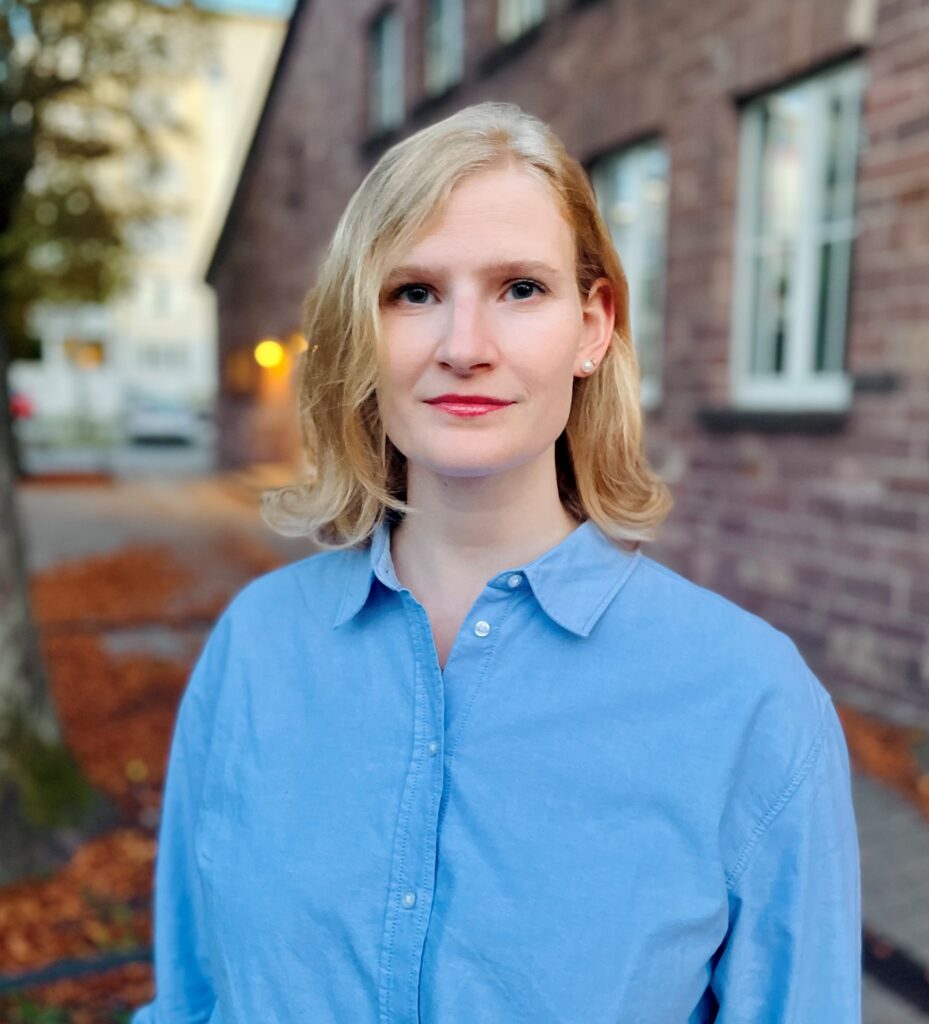
Alena Karina Lagmöller In 2026, she will host all five events in the „Let’s Talk About Law“ discussion series in Karlsruhe—and can also be heard on the podcast of the same name.
A lawyer by training, she has been an editor and reporter in the ARD legal news department since 2023 and covers stories for television, online, and radio. Since 2025, she has also been moderating panel discussions on legal topics.

The host of the 2026 Leipzig editions of „Let’s Talk About Law“ is Susann Böttcher. She is a host on a news radio station and can be heard on podcasts and on stage.
As a law graduate, she is well-versed in a wide range of topics: from politics and health to business and sports.

Marie-Elisabeth Miersch She hosted the podcast and the corresponding live events from February through October 2025 and developed the concept for the event series. A fully qualified lawyer, she served as a research associate at the Forum Recht Foundation until the end of 2025.
Do you have any questions or suggestions?
We look forward to receiving messages to social[at]stiftung-forum-recht.
Click here for the Imprint >>
„Let’s Talk About Recht“ is a live-on-tape podcast produced by the Forum Recht Foundation.