The rules of everyday life
A pop-up exhibition by the Forum Law Foundation
You & the law
How did our visitors experience the law? Fair or unfair, helpful or a hindrance? Here you can see their answers, questions and stories about our exhibition and the website.
Create a video & become part of the exhibition!
All you need is your cell phone and 3 minutes!
Our exhibition
Whether it's disputes with neighbors, conflicts in traffic or arguments on the Internet - we encounter rules everywhere that govern how we live together. But how does the law help us to find fair solutions? What limits are there, and how can we ourselves help to settle disputes? The pop-up exhibition "Law - the rules of everyday life" by the Stiftung Forum Recht invites you to explore these questions in a playful way.
We also have a legal quiz that can be played in the exhibition. If you visit our website via laptop, tablet or PC, you can take part in the quiz digitally.
Law
The rules of everyday life
Law is everywhere. It governs many areas of our everyday lives. It regulates how we live together and has answers for almost all conflicts. We have become so accustomed to it that we often don't notice the law.
Law is a collection of rules,
that we have democratically agreed on. It says how we should behave. This does not mean that these rules are always observed by everyone.
Law helps to avoid conflicts.
By setting out rights and obligations in contracts before anything goes wrong. If conflicts do arise, the law helps resolve them. In doing so, it takes all parties seriously—regardless of who you are. Sometimes the law isn’t fair and doesn’t come up with a good solution. That can be frustrating.
Law is applied by people.
Lawyers, judges and other professionals bring the law to life. Without people who use the law, the law is just an empty shell.
Law gives us freedom.
It enables us to shape our lives freely, without fear of arbitrariness by the state.
LAW APPLIES TO ALL PEOPLE
and also for all state institutions: Authorities, police, courts and parliaments. No one is allowed to set themselves above the rules. That is called the rule of law.
LAW IS THE FOUNDATION OF THE RULE OF LAW & DEMOCRACY.
A society without the rule of law would be a pretty bleak place: Without the law and the security it provides, we could not live in freedom and prosperity.
What can law do and where do we encounter law in everyday life?
Functions of the law & case studies
Law regulates, sets boundaries, protects and can achieve much more. Here you can find out what functions the law has for our democratic coexistence using everyday situations as examples. Click through the yellow panels on the functions of the law and then read the example case by opening the blue infographics! Want to find out more about the functions of the law? Then click on the button to access all four cases and functions on the overview page.
ELIAS, 25, CYCLIST
STRESS ON THE ROAD
ELIAS & THE BICYCLE ACCIDENT
Elias cycles to work every day on his racing bike. ...
ONCE NOT PAYING ATTENTION...
Das ist Passiert
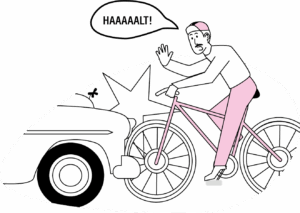
One morning, an accident happens: Clara hits him with her car. Elias crashes. He breaks several vertebrae in his back, has bruises and his bike is also ruined. Elias seeks help from a lawyer. At first, Clara's insurance covers his medical costs and compensation for pain and suffering. When the costs rise, the insurance company no longer wants to pay: Elias and his lawyer file a lawsuit.
ELIAS GETS JUSTICE IN COURT
So hat das Gericht entschieden
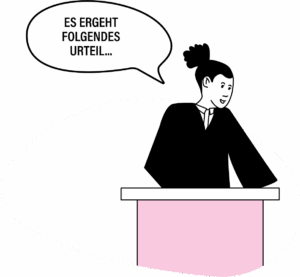
The Regional Court ruled that Clara was at fault for the accident. Therefore, her insurance company must cover all costs that Elias has incurred—and will incur in the future—as a result of the accident: medical expenses, compensation for damage to the road bike, compensation for pain and suffering, and his loss of earnings. This is because Elias can no longer work as much as he did before due to his injuries. The total comes to around 40,000 euros.
THE DARMSTADT REGIONAL COURT MADE A SIMILAR RULING IN ITS JUDGMENT OF 21.08.2019 (REF. 4 O 122/17).
The law provides structure and creates solutions. When something happens on the road, the law determines who is responsible for damages. It protects those who have been injured—and ensures that they are not left to bear the costs. At the same time, it limits liability: Not every accident automatically results in liability. If, for example, Elias had been driving in the dark without his headlights on, the court would likely have held him partially responsible. He would then have been awarded only a portion of the total amount. In this way, the law seeks to strike a balance and share responsibility.
Knowing where you stand: law organizes
Without rules, chaos threatens. Law gives us reliable rules that help to avoid conflicts and resolve disputes fairly.

Is that true?
THE QUIZ ON JUSTICE IN EVERYDAY LIFE
True or false - How well do you know your way around? Solve our quiz and test your knowledge of the law in everyday life. Good luck!
You can play our legal quiz on your PC, tablet or laptop - unfortunately not yet on your cell phone. Even better: come to the exhibition and solve the quiz on site!
Hidden object
LAW IN EVERYDAY LIFE
Click through our hidden object city and discover everyday situations that are characterized by law or questions of law.