

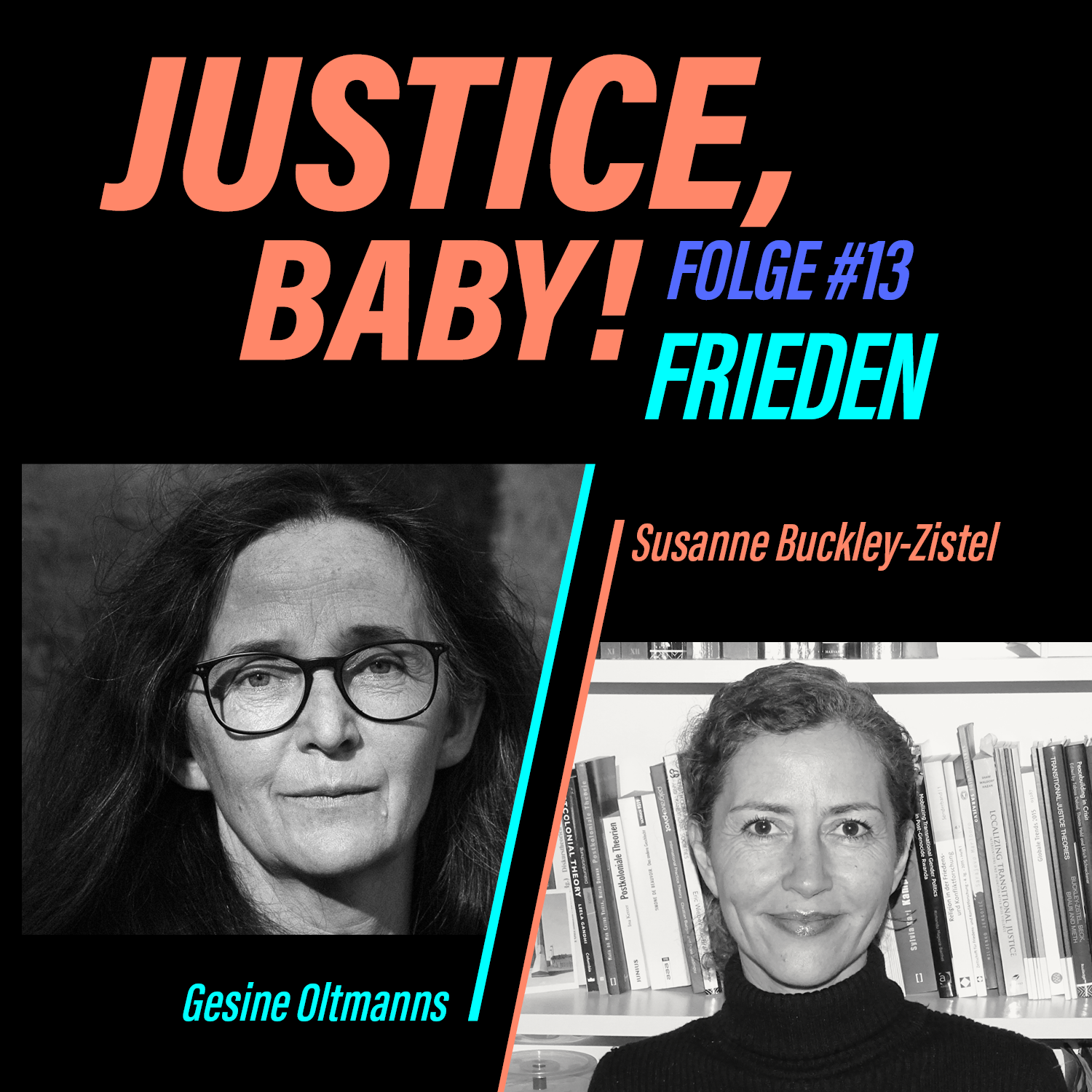
#13 Peace: How do you end a war?
The most important function of law is to ensure peace, because wherever people live together, conflicts are unavoidable. However, the law ensures that they are resolved peacefully and in a regulated process.
But what happens when states overstep (legal) boundaries? When is it time for a revolution? How far can we go for peace?
Podcast host Kathrin Schön from the Stiftung Forum Recht talks about this in the latest episode of Justice, Baby! The podcast on law and justice with Gesine Oltmanns. She has been a civil rights activist for over 30 years, was herself involved in the Monday demonstrations and the Peaceful Revolution in Leipzig and is now a board member of the foundation of the same name: https://www.stiftung-fr.de/
How can state injustice be dealt with and peace restored after violent crimes? Prof. Dr. Susanne Buckley-Zistel knows. She conducts research at the Philipps University of Marburg on the legal dimensions of transitional justice and political violence: uni-marburg.de
In this episode, Vera Strobel explains the role of international law and the rulings of the International Court of Justice in The Hague in the struggle for peace. She is wResearch assistant and doctoral candidate at the Chair of Public Law and International Law at Justus Liebig University Giessen: uni-giessen.de
Want to know more about peace, law and justice?
Here you can find our reading and movie tips for the current and, for the time being, last episode of Justice, Baby!
🏛️Regeln for the war? That's what international humanitarian law is all about:
https://www.bmvg.de/de/themen/friedenssicherung/humanitaeres-voelkerrecht
🤝The Vacation from War project allows young people from war zones to get to know supposed enemies personally and exchange ideas: https://ferien-vom-krieg.de/
🌡️Das Heidelberg Institute for International Conflict Research publishes the annual Conflict Barometer, which presents wars around the world.https://hiik.de/konfliktbarometer/
🕊️Was is peace? asks the short article by the Federal Agency for Civic Education https://www.bpb.de/mediathek/video/506416/was-ist-frieden/
🎞️Ein Apocalypse Now, set during the Vietnam War, is a classic anti-war film. It was awarded two Oscars. https://www.imdb.com/title/tt0078788/
💡Transitional justice or dealing with the past? The Federal Agency for Civic Education gets to the heart of what "transitional justice" is: https://www.bpb.de/themen/kriege-konflikte/dossier-kriege-konflikte/54742/vergangenheitsarbeit/
[You can download the transcript of the episode as a PDF here]
Justice, Baby! The podcast on law and justice
Transcript
Episode #13 Peace: How Do You End a War?
Scenic introduction
[The podcast begins with different voices.]
Interviewee 1 [feminist connotation]: The connection between justice and peace is often made, and the point is really that there is a prevailing notion that there can be no peace without justice.
Interviewee 2 [with feminine connotations]: The longing for a just society shaped us in the GDR and inspired us to take action to bring about change.
Interviewee 1 [with feminine connotations]: Well, just because we’re coming to terms with the past—and I don’t mean to say we shouldn’t—that doesn’t mean this is the path that will lead to peaceful coexistence. And sometimes I also think that people don’t have to reconcile; they should also have the right not to reconcile.
[cheerful, upbeat intro plays and continues in the background]
Presentation
Podcast host Kathrin Schön: The most important role of the law is to ensure internal peace—in other words, to ensure that, for example, the law of the strongest does not prevail in society, and that there are no arbitrary convictions or acts of vigilantism. The fact is, however, that wherever people come together, conflicts are inevitable—and actually quite normal. The law, however, ensures that these conflicts are resolved peacefully through a regulated process, without war or violence. But what if states and governments simply trigger conflicts anyway, crossing legal or even geographical boundaries in the process? Who mediates violent conflicts or wars? How effective is the law when it comes to establishing or securing peace? What do we even mean by „peace“? And is every peace always just? Today, I’m discussing these questions with three wonderful guests: Gesine Oltmanns, Susanne Buckley-Zistel, and Vera Strobel. It’s great to have you tuning in again today for the final episode of this season. My name is Kath-rin Schön, I’m a program curator at the Forum Recht Foundation, and this is “Justice, Baby! – the podcast on law and justice.”.
[Intro fades out]
How Do Peace and Revolution Go Together? – An Interview with Civil Rights Activist Gesine Oltmanns
Schön: The concept of peace is relative. In everyday life, many of us might say, “Yes, peace—that’s the opposite of war and violence.” When peace prevails, people can live in society in peace and security. But that’s only because there simply isn’t any
Just because there is no open war does not mean that a society is free from indirect violence—for example, in the form of unequal treatment, discrimination, or oppressive structures. Peace and conflict studies therefore distinguish between negative and positive peace. But how far should one actually go for the sake of peace? That’s probably what many people in East Germany were asking themselves in the summer of ‘89 as they took to the streets to demand fundamental democratic rights—such as freedom of travel, freedom of expression, freedom of the press, and freedom of assembly. On paper—that is, in the GDR’s revised constitution of 1968—these rights were guaranteed to citizens in vague terms, but for many, reality was quite different. What then happened in the summer and fall of ‘89 has gone down in our history books as the Peaceful Revolution. But peace and revolution? How do those two actually go together? I’m very pleased to be speaking now with Gesine Oltmanns. She was an activist at the first Monday demonstration in Leipzig in 1989, remains committed to civil rights to this day, and serves as a board member of the Peaceful Revolution Foundation. Ms. Oltmanns, welcome, and it’s wonderful to have you here.
Oltmanns: Hello, I'm really happy to be here.
Beautiful: Today's episode—and, for now, the last one—of the podcast is about peace and justice. What does "justice" actually mean to you?
Oltmanns: I have to pause there. [laughs] I’ve always seen justice as a major goal. The longing for a just society shaped us in the GDR and motivated us to actively work for change there. For me, justice is deeply connected to my own personal experiences. Growing up in the GDR, as a child I witnessed my brother being arrested for political reasons. That was a truly life-changing experience for me in coming to terms with the kind of society I was growing up in and living in. And this observation of fair treatment—of experiences and perceptions of justice—actually accompanied me throughout my entire youth and increasingly drew me into active, oppositional work. It was practically self-evident that the GDR was unjust from the very beginning. It affected our everyday lives; it affected everything around us. And that’s why the struggle for justice was such a central focus of my active political work in the GDR.
Beautiful: That sounds as if the struggle for justice had also been a struggle against arbitrariness.
Oltmanns: Freedom is, after all, never possible unless there is justice in society. And the silence surrounding injustice was, of course, what surrounded me. So we saw things that were not allowed to play a role in conversations, debates, or discussions in the GDR. So there was a silence surrounding injustice, and of course, under such conditions, a just life in society cannot exist. Realizing that was the pivotal moment for me—and also for my own rebellion in the GDR.
Beautiful: The Peaceful Revolution is often mentioned in the same breath as the fall of the Berlin Wall and German reunification. Were those also the goals for which you and other activists took to the streets back then? Or was it about something else?
Oltmanns: I also think the fall of the Wall didn’t just happen out of the blue. It was rooted in a stable context and a long history that actually began on June 17, 1953, in the GDR. It was a long road to freedom from a communist dictatorship. And I believe that this is precisely what the history of the Peaceful Revolution is all about. After all, we’ve seen that the Peaceful Revolution—as it’s called today—was by no means entirely peaceful. It was a long struggle—one marked by state repression, met with fierce resistance from the state, and accompanied by a great deal of injustice. And for me, that journey itself was more formative than the actual fall of the Wall. After all, that’s what it was all about in the fall of ‘89. It was about freedom, democracy, and reforms in the GDR. And that was also what the Monday demonstrators on the streets of Leipzig and throughout East Germany had agreed upon. That was the basic consensus. And in that sense, the opening of the borders from one day to the next came as a total surprise to us—and to me personally. And ultimately, for us, it was also an event that limited our own democratic and political self-discovery in the GDR.
Beautiful: On paper, the former GDR—or rather, the SED government—did, in fact, profess its commitment to civil rights and a democratic system. The reality, however, was quite different. How aware were you of your own rights back then? And when did the desire for change first arise in you and your fellow activists?
Oltmanns: The desire for change naturally stemmed from what we were experiencing—from everyday life, from social dissent, and above all, from the political leadership that governed us. These were elderly, eighty-year-old SED cadres who ruled an entire country. In that respect, it was clear to us that we didn’t want to go on living like that—with all those circumstances, with the prevailing conditions, but above all with the hopelessness that dominated the mood in the country.
Beautiful: Was there, after all, something like the proverbial straw that broke the camel's back?
Oltmanns: That single drop slowly turned into a stream and then a river—that’s the beauty of a movement that succeeds. For us, the situation in the fall of ’89—after the summer of the embassy occupations and the whole political situation and debate in the GDR, the founding of the new Forum—all of that was, in a way, a sign of hope that things were starting to move and that they were happening in a more purposeful way. By then, there was a structure in place that an incredible number of people quickly rallied behind—and at the same time, right up until October 9, there were the repressive measures that we felt on a daily basis, which had even led to violent clashes on the streets in Dresden as recently as October 8. In that sense, October 9 was truly the pivotal moment—perhaps not the straw that broke the camel’s back, but the pivotal moment of peaceful consensus that the demonstrators reached together. What’s interesting is that it was actually a small group of opposition activists who, over the course of years, had built this network and this grassroots foundation, which is why the movement became so effective. They were the ones who stuck their necks out, who were practically always at risk of being arrested. Perhaps this can be illustrated quite well by looking at September ‘89 in Leipzig. On September 4, there was essentially the first truly proactive demonstration by opposition activists. That is to say, I was with
A few friends and I were there at the Nikolaikirchhof, and for the very first time we had banners with a clear message: that’s what this is all about for us—that’s what we want—an open country for free people. Freedom of assembly, freedom of association—all those fundamental rights we missed so much in the GDR—were right there on the banners, on the signs. And the Stasi cracked down brutally. And the following Monday—a week later, again after the Monday Peace Prayer—our friends were arrested; right in the midst of the Peace Prayer attendees, about 30 people were arrested at the Nikolaikirchhof. And that was practically such a brutal crackdown on peaceful demonstrators—that people would no longer tolerate. As a result, many people across the GDR showed solidarity with the detainees through peace prayers and intercessory services, and suddenly something began to gain momentum—it was truly the straw that broke the camel’s back.
Beautiful: How did you view the reform movements back then? Above all, how confident were you that the citizens' movement would actually bring about change?
Oltmanns: Well, I believe that a movement can truly be successful only if it’s not just driven by anger, but also by hope. And that hope has been with us and has repeatedly given us courage during the many actions I mentioned earlier. We’ve also always gotten back some of what we’d hoped for. An alternative street music festival in Leipzig, for example. There was no street music in the GDR, and here we managed to fill downtown Leipzig with music. That was amazing for us, and people had so much fun with it. So it wasn’t just this combative march forward, but rather these many different forms. They also gave us courage time and again—the knowledge that we could reach people, that we could encourage them, and that we could show them: it depends on you; it depends on every single person to stand up, join the demonstration, and walk with us along the Leipziger Ring.
Beautiful: When you hear the term “Peaceful Revolution,” it does sound like a contradiction at first. What are your thoughts on that? Is it even a contradiction?
Oltmanns: Well, the special thing really is in the name. “Peaceful Revolution” is something that confuses a lot of young people and makes them wonder, “Is that even possible?” A revolution isn’t exactly a peaceful thing, in that sense. A revolution overthrows a system—and that inherently involves violence. And yet I think it’s a good term for this “Autumn Revolution” in East Germany. Because it shows that there really was a pivotal moment when everything was decided—for us, for the movements of that autumn, and for the GDR. That was October 9, 1989, in Leipzig, and it was precisely the moment that was a true stroke of luck for us, because it proved—in light of what the previous days had shown, namely the violence on the streets of Leipzig, Berlin, and Dresden—that it was indeed possible to create a moment in which people could move forward together peacefully and by consensus. We were standing on Leipzig’s Ring, facing a force of authority; in the side streets, everywhere, the police and the army had been deployed, along with water cannons, and people realized they had no choice but to demonstrate peacefully. Any provocation would have sparked a violent outburst, and the moment of joy for me is truly that we were able to show such solidarity with one another—solidarity and nonviolence. For me, those are truly the values that emerge from this historic moment.
Beautiful: You’re talking now about a stroke of luck. Was the Peaceful Revolution perhaps also, to some extent, a stroke of historical luck? I mean, a situation where the stars were aligned and the pressure on the SED government—including from outside—was so great that it simply had to act? After all, a lot could have gone wrong, as we saw with the violence against the demonstrators in Dresden.
Oltmanns: I think that the fall of ’89 was really shaped by many international factors: the run-down GDR, the neglected socialism—which, in a sense, wasn’t really socialism anymore—in the sense that people were no longer willing to stay silent; instead, they saw that many were now fleeing to other countries, and here we felt a bit like the ones who were still left behind. In that sense, it was also a way of reassuring ourselves—to come together, stand up as one, and say, ‘No, things can’t go on like this!” So overcoming that sense of powerlessness was, I believe, also a key aspect of the activism in the fall of ’89.
Beautiful: Was leaving for personal reasons ever out of the question for you?
Oltmanns: For a while, it was a double-edged sword for me—I felt I was in serious danger. I thought to myself, ‘Actually, if you end up in jail now, you wouldn’t want to spend years behind these walls in the GDR.” In that regard, I’d even submitted an application to leave the country, but I withdrew it in the spring of ’89 because hope was beginning to sprout that more was possible in this country after all, and that people could get away with more than perhaps the generations before them, because the circumstances in the ’80s—allowed for different behavior, different forms of dissent, and different revolts than in the 1950s and 1960s in the GDR.
Beautiful: What do you think we can learn from the Peaceful Revolution today?
Oltmanns: The great thing is that there really is a message—one that always stems strongly from ‘89—that it is possible to bring about change if people truly dedicate themselves to a cause together or stand together in solidarity, then the unimaginable can truly happen—namely, that you can put an end to a system of injustice, to injustice itself, and possibly even to violent conflicts through a peaceful consensus. For me, that’s a message—one for the future as well, and for those who come after us.
Beautiful: What role, would you say, does the law—in the sense of fundamental rights, but also the rights and obligations agreed upon in peace treaties—play in reaching a consensus that is acceptable to all sides? In short, what role does the law play in peace work today?
Oltmanns: For me personally, the rule of law was at the very heart of my longing. Experiencing that lack of legal rights in a state like the GDR—and going so far as to be arrested and cut off from the outside world—having gone through all of that is, for me, the moment when I say: justice and the law are the foundation of everything. However one defines it—whether as human rights, social justice, or peace. We simply cannot achieve peaceful coexistence if there isn’t this legal structure, this legal foundation, that is reliable for all people living in society. I myself have
I always felt a strong connection to this call for the rule of law in the GDR. For me, that was the most important cause I fought for.
Beautiful: What are your hopes for ongoing and future peace processes? What lessons should people who listen to our podcast draw from history—and especially from the Peaceful Revolution?
Oltmanns: The Peaceful Revolution has left us with a great deal to draw upon. And I believe these include both the forms of engagement—which can range from civil courage to highly creative and large-scale actions—and the processes of dialogue that we fostered together in the fall of ‘89 and into the winter through the Round Tables. These were very significant and important processes for fostering and redefining discussions about the future and democracy. I think roundtables have a chance again today. Through the Peaceful Revolution Foundation, we’ve initiated an international roundtable that brings NGOs from all over the world here to Leipzig to discuss processes, human rights, and the work of NGOs. This is also a sign that the symbols of the Peaceful Revolution—such as the round tables today—are truly more important than ever. In that sense, I think what is associated with the Peaceful Revolution and the democratic awakening in the GDR is simply a call for communication and understanding—for reaching out to one another and listening. That is what I would like to see as a defining moment in society. In other words, this is where we should—and must—get involved in order to protect our democracy.
Beautiful: Thank you very much, Gesine Oltmanns, for the wonderful conversation and for your time here on our podcast on law and justice.
Oltmanns: You're very welcome! I wish you all the best in your work.
Beautiful: Thank you! The idea of peaceful resistance and nonviolent protest is not new. But what exactly is the legal status of civil disobedience? First, the good news: civil disobedience is not, in and of itself, a criminal offense or an administrative violation. However, the situation is different when protests involve violations of laws or regulations—for example, in cases of property damage or trespassing—in which case they are, of course, punishable by law, even if the demonstrators repeatedly insist that their actions are nonviolent. But let’s get back to the topic of this episode: peace and justice. Under national law, at least we know there are courts where violations of the law can be heard. Things get more complicated when it comes to international conflicts—and, as we know, there are plenty of those. The Heidelberg Institute for International Conflict Research publishes its annual Conflict Barometer on this topic, and my goodness, wars and conflicts are raging all over the world! Last year, the number of highly violent conflicts rose across all categories monitored. Apparently, it’s not that hard to stir up a war. But how do you end it, and is there even such a thing as a just peace after violent conflicts?
[short musical interlude]
Is There Such a Thing as Just Peace? – An Interview with Conflict Researcher Susanne Buckley-Zistel
Beautiful: I am very pleased to be speaking with Susanne Buckley-Zistel today. Susanne Buckley-Zistel is a professor and executive director at the Center for Conflict Research in Marburg. Her research focuses on political and legal tools and methods that can be used to facilitate the transition from violent conflict to peace. Welcome, and it’s great to have you here!
Buckley's thistle: Thank you very much for the invitation!
Beautiful: Ms. Buckley-Zistel, what do you consider to be fair?
Buckley's thistle: That’s a big question. It’s also a difficult question, because justice can take many different forms. There’s political justice, social justice, and then there’s justice that—in the context of this podcast—focuses more on criminal law aspects. But when I think about what justice means to me personally, I see it as having to do with equality, participation, recognition of all different perspectives, and, above all, suffering.
Beautiful: How are justice and peace actually connected?
Buckley's thistle: The connection between justice and peace is made very often, and it really comes down to the prevailing notion that there can be no peace without justice. But what I find particularly fascinating is that we can also reconsider different conceptions of justice. And when we here in the West—in Europe—think of justice, we often have a conception of justice that has to do with punishment, but in other contexts, the restoration of social relationships is a very important element of justice. Rebuilding coexistence in whatever form, especially after violent conflicts. And that can also be a very important prerequisite for living together in peace.
Beautiful: When do we actually talk about war and peace? I mean, how are these terms defined legally? And how does peace differ from a ceasefire, for example?
Buckley's thistle: There’s quite a bit of literature that deals with war and considers when a war is truly a war—not just a bit of violence here and there, „a little bit of violence,“ in quotes, of course, because violence is always terrible. But there are different approaches, most of which base the definition on the number of deaths. That’s kind of—maybe even a slightly creepy definition—where you say that once the death toll reaches a certain number X, it’s considered a war. But many sources, including databases that track military conflicts, use this logic to define war. Of course, war involves various forms of violence. We can think of interstate conflicts—and, unfortunately, more recently, intra-state conflicts as well. Peace is a word, a term, or a concept that’s extremely difficult to pin down. And that’s why so many people refer to a distinction made by Johan Galtung, one of the pioneers of peace and conflict research. He distinguished between positive peace and negative peace. Positive peace… or
Perhaps we should start with the negative: For Galtung, negative peace is simply the absence of violence. And positive peace means much more to him. For him, it is the absence of structural violence. That would also mean that there is equality among the parties to the conflict and, in Galtung’s words, that they can realize their potential to lead a good, fair, and just life. And a ceasefire is simply the moment when the guns fall silent and, with a lot of luck, a peace treaty can then be concluded to achieve negative peace for the time being.
Beautiful: You just used an important term—a peace treaty. How does one actually end a violent conflict? And what comes next?
Buckley's thistle: Of course, it’s very difficult to end violent conflicts, and if we had some kind of master plan for that, there would be less war in the world, or armed conflicts would be resolved more quickly. In most cases, at some point there are negotiations between the parties to the conflict, and an arrangement is worked out that everyone can more or less live with. Of course, there’s also “victory peace,” in which one party wins and more or less crushes the others. That, of course, isn’t ideal either. Of course, war itself isn’t ideal either, but most of the time it’s through negotiations and the rules that are established—including those concerning future forms of government. And then there’s the hope that the peace treaty will hold. In reality, many peace treaties are broken again shortly after they’re signed, and new violence breaks out.
Beautiful: But why is that? After all, they agreed on a common set of rules. To what extent does violence play an important role in establishing this equality? And why are these peace treaties called into question and dissolved so soon after they’re signed?
Buckley's thistle: An important factor—indeed, a key group—in peace treaties is often external mediators and individuals who, through various means, can compel, persuade, or force the parties to the conflict to come to the negotiating table. Of course, we immediately think of major powers with their bargaining power—the U.S., for example—which can simply exert pressure on the various parties to the conflict. We’re seeing this now in the case of Ukraine, where Erdoğan is playing a role in smaller-scale negotiations, such as those regarding grain shipments. This means it’s always important to have a party that intervenes from the outside, and ideally, this party is seen as impartial and accepted by all parties to the conflict. That’s not always the case; there are often spoilers who don’t want to participate in the negotiations in the prescribed manner—perhaps by not participating at all—and then sabotage the entire peace treaty project from the outside. Both metaphorically and in a real sense. But at the same time, they may also be involved in the negotiations—at least to some extent—and then later fail to abide by the rules.
Beautiful: Is it actually possible to begin or prepare for a criminal investigation while a conflict is still ongoing?
Buckley's thistle: In some cases, that happens. One of the ideas behind international criminal jurisdiction is that it does not merely punish violations of norms. One hope is that bringing these matters to justice will prevent future crimes. Unfortunately, we see that since the establishment of the International Criminal Court in The Hague and the various tribunals, this has not led to a reduction in violent conflicts. So, unfortunately, the preventive aspect doesn’t work that well, but sometimes it helps simply to bring individuals who, for example, commit war crimes to The Hague via an arrest warrant and remove them from the theater of war—that alone takes one less aggressor out of the picture. And international criminal law always deals with individuals. It concerns individual persons, not parties. And in this way, the conflict can indeed be easily reduced.
Beautiful: What forms can the process of coming to terms with a violent crime take, and who is actually involved in it?
Buckley's thistle: We have the parties to the conflict themselves; we have people who are directly affected by the violence—including victims in the form of bereaved family members, as well as individuals who have experienced physical violence. These groups all have very different attitudes, including toward coming to terms with the past. For the victims, it is a matter of great importance that their dignity be restored through law and justice. And this can take various forms, including criminal justice, because one could also think of remembrance projects, truth commissions, and so on. For the parties to the conflict, it’s often the case that, depending on their current political position, they have an interest—or a lesser interest—in coming to terms with the past. So especially among the so-called “winning parties”—in quotation marks—who then go on to govern the new country when we’re talking about a civil war, there’s a strong interest in to somehow start over from scratch and, ideally, let the past rest so as not to reignite new political conflicts. This might mean that there’s a tendency to prefer softer transitional justice mechanisms—such as memorial sites—rather than approaches that are more confrontational, like criminal justice-based reconciliation. The international community has a strong interest in ensuring that these issues are addressed. Since the 1990s, it has essentially been impossible to resolve a conflict without some form of reckoning being necessary and expected. From a German perspective, this may come as a surprise, since we have devoted considerable effort—with varying degrees of success—to coming to terms with National Socialism and the Holocaust. But on the international stage, it’s actually only been since the early 1990s that coming to terms with the past has been pursued so intensively and vigorously through tribunals, truth commissions, and so on.
Beautiful: There are actually two German transitional justice projects: one after 1945 and one after 1989/1990, following German reunification. When is a transitional justice process actually considered complete? And when is it deemed successful?
Buckley's thistle: So, of course, the question of success—like everything else—always depends on the eyes of the beholder. What some people consider successful might not be enough for others, or might be too much, or—more often than not—might even seem unfair. So there’s also this…—well, I don’t want to call it “victim competition,” but a feeling that only the crimes
to be addressed more thoroughly in one group or a few groups, but perhaps not in the other group. I believe that one of the central motives behind this tendency toward transitional justice is to perpetuate the suffering. In other words, „preventing forgetting“ is a very, very strong and powerful guiding principle that is championed by many, especially victim groups and their relatives. I’d also like to disagree with you a little. We have three—at least three—phases of transitional justice in Germany; at the national level, there are other issues to consider as well. It’s not just National Socialism, the Holocaust, and the GDR, but also Germany’s colonial legacy. A very, very important aspect—which, fortunately, has received a bit more attention over the past 10 years—is that genocide was committed against the Herero and Nama in the former German South West Africa, now Namibia; it is now…—so, fortunately, it’s now publicly recognized as genocide and debated as such. The question of reparations from Germany to these ethnic groups remains unresolved, and there are ongoing legal proceedings regarding this. And I think that’s the first step. But Germany didn’t just have a colony in Namibia; there were also violent crimes committed in Tanzania, in some way perpetrated by German colonial powers. In a way, the scope is broadening here in Germany to address the colonial legacy—and not just in Germany, thankfully. So in our neighboring countries—which, in so-called “more successful” colonial histories than Germany’s, such as France, the UK (Great Britain), and Belgium—the first steps are also being taken, thankfully, to address this issue.
Beautiful: That’s another important point. Thank you very much for the correction. Is there a recommended sequence of steps that should ideally be followed in transitional justice processes?
Buckley's thistle: So this question of sequencing is also frequently raised in transitional justice research. I think a more pragmatic or down-to-earth answer is that what is possible and what is not often depends on the political circumstances. A very good example is Argentina after the military dictatorship in the 1980s; criminal justice proceedings could not be carried out because the political climate at the highest levels of government did not allow for it. It actually took—I’m not entirely sure—about 10 years or so before the first trials could take place. But that doesn’t mean nothing happened before that. There was a truth commission that wasn’t organized by the state but by civil society. There were memorials and sites—so sometimes it’s not so much a question of stringing things together or finding the best combination, but rather of what’s actually possible and permitted in a particular country. And things like remembrance, in particular, can be made relatively accessible. That’s another important aspect. For example, through graffiti on walls, murals on Tahrir Square in Cairo, or—since I live in Frankfurt—the memorial to the nine victims of the Hanau shooting under the Friedensbrücke. These are also places where people can go—where people gather now, just as they did yesterday on the anniversary, for example—and then commemorate in that very moment. So, as I said, these are often more questions of what’s possible rather than of the correct order.
Beautiful: How important is the process of coming to terms with the past for establishing a lasting, sustainable peace? Is a legal reckoning sufficient for this, or does it require more than just a verdict handed down or a sentence carried out?
Buckley's thistle: Here in Marburg, we take a fairly strong empirical approach and conduct research in countries where transitional justice measures are being implemented. And sometimes we come to the conclusion that perhaps transitional justice isn’t actually the best thing for peace, because it also involves a great deal of…—which doesn’t mean one shouldn’t do it…—perhaps one should lower expectations a bit, because all these processes also perpetuate many lines of conflict between the parties to the conflict. And they also raise questions about why, from my group’s perspective, these crimes aren’t being addressed—Rwanda is a very good example of this, and Yugoslavia is another good example of how people convicted by the Yugoslavia Tribunal were celebrated as heroes back home. So the war criminals before the tribunal are national heroes back home. That means just because these cases are being addressed—and I don’t want to say they shouldn’t be—it doesn’t mean that’s the path to peaceful coexistence, depending on how one understands justice. That brings us back to your original question—perhaps it is a more just way of living together.
Beautiful: As a peace and conflict researcher, what would you say is the key to achieving sustainable and lasting peace?
Buckley's thistle: I’m very much in agreement with Galtung—whom I briefly mentioned earlier—on the concept of positive peace, the absence of structural violence. And that means that social, economic, and political exclusion of marginalized groups must not occur. This is a form of equality that must exist. In practice, but also in the literature, this has shifted in recent years and decades toward liberal peace, democracy, participation in governance structures where human rights are upheld, non-state actors are supported, and women have a say and can participate in line with the Women, Peace, and Security Agenda.
Beautiful: How can we strengthen trust in democratic institutions and trust in the rule of law?
Buckley's thistle: Trust is, of course, fundamental, and we have to ask ourselves why some groups lack this trust and on what basis. And we can…- Unfortunately, I really don’t have a silver bullet for how to solve this, but when we look at the processes and dynamics in Germany—and also in neighboring European countries—and see how trust in democratic structures is currently being undermined, that is, of course, a very urgent problem. I think my first reaction would also be to try, through civil society institutions, political education, and public awareness campaigns, to bring people on board and encourage them to act and work in this way. This isn’t anything new, and these are rather conventional measures aimed at restoring trust among the population—which, after all, is ultimately the one affected.
Beautiful: For me, the Peaceful Revolution achieved something truly special—it sort of established the “jack-of-all-trades” as a process of change, a real revolution, but one that was completely nonviolent. That was an incredibly empowering historical event. What can we learn from this special event?
Buckley's thistle: That’s, of course, a wonderful example—and a very important one. And it’s great that you brought that up, because we should always keep it in mind. We might tend to think of negative examples first. But there are also many success stories. As you say, I believe it has a lot to do with the fact that it grew from the grassroots, has endured over a long period of time, and that the people who took to the streets showed tenacity, a will to bring about change, and perhaps also a confidence that things would turn out well. They certainly took quite a risk by taking to the streets. And at the same time…—There were indeed some moments during the Peaceful Revolution in Germany when the GDR government could have launched a military attack, but it didn’t. And that, too, is another example of how this must be a two-sided story. If we look at Iran now—the protests there aren’t going so well at the moment—or the Arab Spring in some countries. But perhaps we should make more of an effort to look for positive examples and draw lessons from them, rather than focusing solely on the negative ones.
Beautiful: I think that's a lovely closing remark. Thank you very much, Ms. Buckley-Zistel, for the fascinating conversation and for your time!
Buckley's thistle: Thank you very much for the invitation, and I'm glad I was able to participate.
What Is Transitional Justice? A Phone Interview with Lawyer Vera Strobel
Beautiful: In our conversation with Susanne Buckley-Zistel, the term “transitional justice” has come up several times. Literally translated, it means “transitional justice,” but in German it refers more to something like “coming to terms with the past.” This encompasses a wide variety of measures, all of which share the same goal: To address, acknowledge, and, above all, punish injustices committed during a dictatorship or a war. You’ve just heard about the role society plays in this, but what does the legal side of this process look like, and can law and justice truly secure peace? I called Vera Strobel to discuss this. She conducts research at the University of Giessen on international humanitarian law—or, to put it simply, the rules of war. Hi Vera, thanks for taking the time! What exactly is transitional justice from a legal perspective?
Strobel: Yes, you just hinted at that. If you translate the term “transitional justice,” it refers to the justice system during a transition or transitional justice. So it’s meant to describe processes and organizational structures that serve to address past crimes, as well as a process of change—in forms of government and within a state. For example, after a civil war, or when a country transitions from a dictatorship to a democracy. In general, it refers to the transition to peaceful processes and peaceful conditions within a country. And if you look at where this actually comes from legally, it stems, first, from international law with its human rights provisions, which are guaranteed there, and from constitutional law, which also contains fundamental and human rights guarantees for the protection of the civilian population.
Beautiful: Where does this principle come from? Has it ever been applied anywhere?
Stroble: That’s an interesting question. We don’t really know exactly when it all began. In any case, we can say that the Nuremberg and Tokyo Trials after World War II were an important starting point. In the 1970s and 1990s in Latin America, too, there were many initiatives involving truth and reconciliation commissions that helped shape the transition from authoritarian regimes to democracy. And such commissions were also established at the end of apartheid in South Africa. So, overall, this attempt to uncover the truth is a fundamental conviction. That’s very important here.
Beautiful: After all, this episode is about peace and justice. What do you think—can peace be established or secured through legal means?
Strobel: I’d say yes. Well, there are many legal means, such as peace treaties, but there are also other means. And, of course, these are always more or less successful. For example, reparations or truth commissions. And the German Constitution, too—it emerged, in a sense, from a peace process and was part of it. Criminal trials and judgments, as well as institutional reforms—all of these can be included in that category as well. And just how effective these measures are in each case varies greatly. But what’s very important here is this: of course, legal means definitely help to establish and secure peace, but many conflicts have deep-rooted political, social, and cultural causes. And you can’t resolve those with the law alone. So one can say that legal means are an important foundation for peace, but they are not sufficient on their own.
Beautiful: When it comes to peace, is it really about justice, or is it first and foremost about nonviolence?
Strobel: To explain this, let’s take a look at the concepts of negative and positive peace. These are quite interesting because the concept of negative peace describes something like the absence of violence and the absence of fear of violence. But if you look at the concept of positive peace, it requires more than that—namely, institutional guarantees that ensure a certain degree of stability and security for the affected population. This means social justice and equal opportunity, a fair distribution of power and resources, equal protection for all, and impartial enforcement of the law.
Beautiful: Who makes sure the treaties are upheld, and why do we even need them? I mean, we have international law, don't we?.
Strobel: Exactly—treaties between states are also an important source of international law; they are part of international law. And when it comes to ensuring compliance with these international treaties, there are various actors and mechanisms that closely monitor this, depending on what was agreed upon in the treaties. And when it comes to international disputes—which is quite fascinating—there are international courts, such as the International Court of Justice, that have the authority to rule on treaties and breaches of treaties.
Beautiful: Will the International Court of Justice then be recognized by all the nations of the world?
Strobel: Unfortunately, that’s not the case. And that’s also a major problem. In theory, all United Nations member states that have signed the Statute should have access to the International Court of Justice. But unfortunately, only 74 of the 193 member states have generally recognized the Court’s jurisdiction; in other words, outside of specific provisions in treaties, only these states have generally granted the Court jurisdiction. The others could recognize the Court’s jurisdiction on a case-by-case basis, but unfortunately, they usually do not.
Beautiful: The International Court of Justice in The Hague is located in a building called the Peace Palace. I looked into it and read that the first international peace conference took place in The Hague as early as 1899. I believe 26 countries participated back then, and even at that time they were already discussing disarmament and international jurisdiction. But what I’m wondering is, how effective are international law and the International Court of Justice, if not all nations in the world recognize them?
Strobel: That is one of the biggest challenges. Unfortunately, international law and even the International Court of Justice have only limited effectiveness, because states are actually the most important actors in international law—they are the ones who can shape and change it. But very often, they simply refuse to recognize court rulings and international law, even though it contains important principles—such as the prohibition on the use of force between states—which states, unfortunately, violate. I can cite a very recent example: Russia’s war of aggression against Ukraine. Russia relies heavily on arguments based on international law, even though these are usually incorrect both in terms of the facts and in terms of the interpretation of international law. While this demonstrates that international law does have a certain authority, it was unable to prevent this war and is currently unable to end it either. Even the International Court of Justice has intervened and ordered Russia to refrain from all military hostilities against Ukraine, but Russia simply ignored this ruling. And that, of course, undermines the authority of international law, since its actual function is to secure peace. However, it is unable to fully fulfill that role. What was very important here, though, was that the issue was also debated at the United Nations, where an overwhelming number of states condemned this Russian war of aggression and thereby strongly upheld the principles of international law.
Beautiful: You're conducting research on international humanitarian law. What, in your view, constitutes a just peace?
Strobel: For me, just peace encompasses several elements, such as sustainable security, but also respect for human rights and the rule of law within a country. And international humanitarian law—which is the focus of my research—contains important rules governing both international and non-international armed conflicts. For example, it contains a great many provisions designed to protect civilians and prevent their suffering during armed conflicts. So if peace reigned throughout the world, international humanitarian law would never be applied, but unfortunately that is not the reality in which we live. That is why it is all the more important to work toward peaceful
Conflict resolution—and that’s exactly what law is all about. It uses legal tools to resolve conflicts between people, but also between nations. In addition to legal means, there are, of course, many other tools, such as mediation, for resolving conflicts.
[Use upbeat podcast outro in the background]
Closing & Credits
Beautiful: Okay. So what does that mean for this episode on peace and justice? I’d say, basically, that society, politics, and the judiciary must play their part in finding—and, above all, preserving—peace. And that there’s a kind of toolkit that can be used to facilitate the transition from wars and conflicts to at least a negative peace. Now, of course, one might ask: Why do we even go through all the stress and trouble of pursuing international legal proceedings if not all perpetrators are ultimately convicted and punished? The answer is that, through these proceedings, we continually uphold the rules for living together as a society and remind those who violate and disregard them that it is not okay. Because as soon as we start thinking, „Well, okay, it doesn’t matter anyway whether someone is held accountable for war crimes or a war of aggression,“ we put the rules that safeguard our values—freedom, security, and equality—at risk. Or how do you see it? Reach out to us on Instagram, Facebook, or via email. We look forward to your comments and feedback. If you enjoyed this episode and this podcast, click the bell icon and leave a few hearts. That’s it for now with „Justice, Baby! – the podcast on law and justice.“ Over the course of 13 episodes, we’ve explored different perspectives on law and justice, broken down unfamiliar words and technical terms, introduced fascinating people who are advocating for more justice in everyday life and in our legal system, and highlighted which laws play a key role in this. Is that all a bit much? Then check out the show notes for book and movie recommendations to explore further. Many thanks to all the podcast guests from the last 13 episodes, and also to the team at the Forum Recht Foundation—especially my colleagues Vanessa Mittmann, Franziska Walter, and Hannah Schelly. Thanks to you all for listening, and see you next time. My name is Kathrin Schön, and that was “Justice, Baby! – the podcast on law and justice.”.
A podcast project by the Forum Recht Foundation. Editors: Vanessa Mittmann and Kathrin Schön. Legal counsel: Vera Strobel. Production: Axel Seyboth and Anna Kunzmann of L’agence. Communications and distribution: Silke Janßen, Franziska Walter, Romy Klemm, Sabine Faller, and Hannah Schelly.
[Outro fades out]
Transcript: Felicia Stahnke
Abonniert uns auch auf euren Lieblings-Podcast-Playern und verpasst keine Folge!
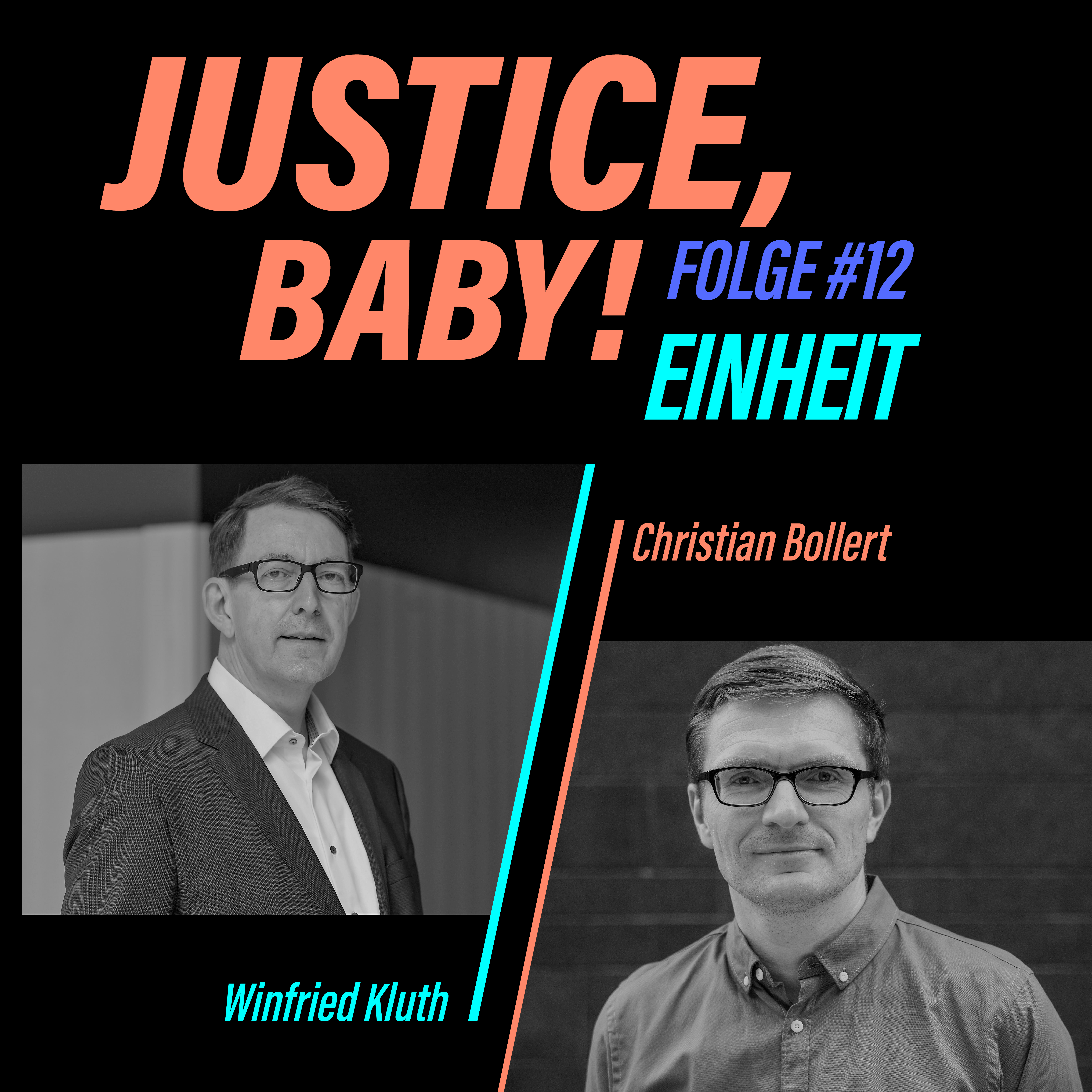
#12 Unit: How do two countries become one?
The Berlin Wall fell on November 9, 1989. Nine months later, representatives of the Federal Republic of Germany and the German Democratic Republic signed a treaty on the dissolution of the GDR and its accession to the Federal Republic of Germany. A story with a happy ending? Over 30 years later, podcast host Kathrin Schön talks to her guests Prof. Winfried Kluth and Christian Bollert about structural differences and similarities between East and West, a plan B for reunification and what it takes for two societies and countries to become one.
Prof. Winfried Kluth is a lawyer and historian and researches German unity and justice at Martin Luther University Halle-Wittenberg: https://kluth.jura.uni-halle.de/kluth/
Christian Bollert is a journalist, managing director and founder of the podcast radio station Detektor.fm. Together with Melanie Stein, he launched the "We are the East" initiative in 2019, which campaigns for a differentiated perception of the East in the German public sphere: https://wirsindderosten.de/
Want to know more about the path to German unity?
💡Who sat at the GDR round table and what was worked out there? The Haus der Geschichte gets to the heart of the matter in an article on its online portal: https://www.hdg.de/lemo/kapitel/deutsche-einheit/weg-zur-einheit/der-runde-tisch.htm
🫂2 + 4 = peace? Without international treaties such as the "Two Plus Four Treaty", German unity as we know it today would not have existed: https://www.bpb.de/themen/deutsche-einheit/zwei-plus-vier-vertrag/
📽️Im Film "Buschka discovers Germany - Show me your East" a reporter discovers with contemporary witnesses and celebrities what really defines the East.
https://www.bpb.de/mediathek/video/316440/buschka-entdeckt-deutschland-zeig-mir-deinen-osten/
🎬Ostalgie: Good Bye Lenin. The award-winning comedy from 2003 is a true classic that deals with the changes in East Germany after the fall of the Berlin Wall.
https://www.themoviedb.org/movie/338-good-bye-lenin?language=de-DE
💪The underestimated - How the East determines German politics
Among other things, the non-fiction book deals with how society in a united Germany can benefit from the East German character:
https://www.bpb.de/shop/buecher/schriftenreihe/507526/die-unterschaetzten/
🎞️Bingen: In the five-part series documentary "(K)Einheit - Wie die Generation Z über den Osten denkt", produced by young East Germans, 10 GenZers describe their perspective on the realities of life in East Germany: https://www.keinheit.de/
[You can download the transcript of the episode as a PDF here]
Justice, Baby! The podcast on law and justice
Transcript
Episode #12 Unity: How do two countries become one?
Scenic introduction
[The podcast begins with different voices.]
Interviewee 1 [female connotation]:
What is typically Wessi? And what is typical Ossi?
Interviewee 2 [female connotation]:
We simply have a relatively large number of crèche and kindergarten places.
Interviewee:r 3 [female connotation]:
For example, it has always been a matter of course for me that my mother worked full-time and that I went to kindergarten when I was just one year old.
Interviewee:r 4 [female connotation]:
That the West Germans are much, much more self-confident than the East Germans.
Interviewee:r 5 [male connotation]:
I believe that people in eastern Germany have been somewhat disadvantaged in recent decades since reunification. At the end of the day, we simply earn less money. The regions are still structurally weaker.
[cheerful, upbeat intro plays and continues in the background]
Presentation
Podcast host Kathrin Schön: On November 9, 1989, the Berlin Wall came down. Germany was no longer divided and people from East Germany could easily travel to West Berlin. But how did two countries become one? What happened there? Organizationally, socially, but also legally? That's what this episode of "Justice, Baby! - the podcast on law and justice". It's been over 30 years since the fall of the Berlin Wall and it still seems as if there are still differences between East and West. Why is that actually the case? What does this have to do with our rights and what can we still do today for a fair or fairer unity? I'm about to talk about this with my guests Winfried Kluth from the University of Halle/Wittenberg and Christian Bollert from detektor.fm and We are the East. My name is Kathrin Schön, I work at the Stiftung Forum Recht and I'm saying hello from our pop-up studio - this time in Leipzig.
[Intro fades out]
How was reunification legally regulated? - Interview with lawyer Winfried Kluth
Beautiful: November 9 is the date that most of us might think of when we think of German reunification. But it was actually just the start of a whole series of talks and negotiations on the way to a new way of living together. A new, yes or not so new, constitution. So let's look back to the 1990s, to August 31, 1990, when representatives of the Federal Republic of Germany and the German Democratic Republic signed a treaty on the dissolution of the GDR, its accession to the Federal Republic and German unity. A historic date, but not everything went so smoothly back then. With the signing of the treaty, some peculiarities of GDR law that were not so bad were pushed into the background. Just like the commitment of citizens' initiatives that campaigned for a new common constitution after the fall of the Wall, but also for their own. I will now talk about the consequences of this with my first guest, Professor Winfried Kluth, a lawyer, historian and expert in modern political science. His research at Martin Luther University Halle/Wittenberg includes German reunification and justice. So he's a great fit. Hello Mr. Kluth, welcome and good to have you here!
Kluth: Yes, with pleasure!
Beautiful: Our podcast is about law and justice, Mr. Kluth, and we ask all our guests one question at the beginning: what does justice mean to you personally?
Kluth: For me, justice means that every individual receives the appropriate attention from the state, the law and society. This is immediately based on human dignity, from other points of view, but because of the diversity of individual people, of individual life situations, it would not be enough to lump everything together. And that is where appropriateness comes in, and that is the great challenge for the law, but also for each and every one of us, as to what situational appropriateness and appropriateness in relation to life spheres looks like.
Beautiful: We have already talked a lot about justice and law in this podcast and have always come across structural injustices, or rather inequalities. Today we want to take a closer look at the relationship between West and East Germany and talk about reunification. That was over 30 years ago now. And the majority of our listeners didn't experience the reunification themselves or can no longer remember it. When I hear the term reunification, I always immediately think of pictures and videos of the Peaceful Revolution, the Monday demonstrations and the fall of the Berlin Wall. How did it even come about that the FRG and the GDR became one state? Open the borders and off you go?
Kluth: Yes, it had a history that had to do with the developments in Poland, with Solidarnosc, the policy of perestroika through Gorbachev and then with the civil movement in the GDR, but also in other eastern states. And that is also a very important aspect. Reunification was initiated to a large extent by the citizens' movement in the GDR due to certain favorable international conditions.
Beautiful: When the Wall came down and reunification actually took place a year later, a so-called Unification Treaty was signed. This was certainly not easy, as there were two political systems, two economic systems and two currencies facing each other. What was actually supposed to be regulated in this unification treaty?
Kluth: Yes, you made a very good point about this year. The year between 1989, the late fall, and 1990. And this year is very important in order to understand what happened back then and where the problems exist from today's perspective. Because the Unification Treaty, just like the 2 + 4 Treaty with the victorious powers, were treaties under international law. To a certain extent, this was the last time that the GDR negotiated with the Federal Republic on how the process of reunification was to be legally and then actually structured. And in that year, an important change took place, the original idea of the civil rights movement and also in the People's Chamber was to develop a separate model of statehood, to develop new forms and to bring about change in the beautiful We are the people to We are one people also expresses where this whole development went astray. Namely, from the initial idea of drawing up a new democratic constitution for the GDR to replace the GDR constitution to the adoption of the Basic Law for the entire then united German territory. And the Unification Treaty was practically the answer to this second stage, in that it was said that we would now make use of the possibility of accession to the Basic Law with a view to the German constitution. Even if it gets a bit confusing, you have to realize that the original version of the Basic Law always had three statements on the subject. In the preamble, the goal of reunification was described in abstract terms and in the constitution there was the possibility of accession, i.e. the adoption of the Basic Law for the western occupation zones not originally involved, and there was the possibility of a new constitution, Article 146, which we still have today. And the focus of the civil rights movement was this second path for a united Germany, a new constitution. And in reality, the accession, i.e. the extension of the validity of the Basic Law to the new federal states, as we like to say, remained the same. And that was a disappointment from the point of view of the civil rights movement, which we are still discussing today.
Beautiful: Why did they decide against a new constitution and for the, well, perhaps somewhat more pragmatic path of accession? Or was it about pragmatism at all?
Kluth: Yes, it was indeed about pragmatism and time windows. We have to remember that the international situation was not such that everyone was happy to see the great Germany again. The United States was open to it, but Great Britain and France were very critical. And that is why, from this international legal perspective, the Federal Government had to use this window of opportunity, because a new constitution would have taken much longer. The clear strategy of the Federal Government at the time was to carry out reunification with the tried and tested and internationally recognized Basic Law and to quickly obtain approval, i.e. the 2 + 4 Treaty, which were two treaties internally and externally, and then also the peace treaties with Poland and other neighbouring states, and the economic aspect of the introduction of the D-Mark was then the pragmatic side at the economic level.
Beautiful: How did the various sides react to this? Especially the citizens of the former GDR? They were committed to reform, to a change of system, in the hope of being able to help shape it themselves and were then disappointed.
Kluth: This disappointment and the more far-reaching expectations are also reflected in the Unification Treaty. I always tell my students that the Unification Treaty was the last situation in which the Federal Republic and the GDR were on an equal footing, i.e. because it was a treaty under international law and the same two states were able to negotiate something politically. After that, the new federal states were in the minority, simply in terms of the number of citizens represented. And they were no longer able to assert themselves. The civil rights movement was then swallowed up, so to speak, by the established parties. And the established parties were always so critical of grassroots democracy.
This was different with the civil rights movement, which wanted more direct democratic elements, which wanted more innovation. The constitutions that then emerged in the new federal states are also much more modern than what we have in some of the state constitutions and also in the Basic Law. However, you have to be honest about this, with the exception of the Bavarian constitution, among others. We always think Bavaria is rather conservative. Bavaria is the federal state where direct democratic elements have the greatest breadth and depth, especially at municipal level.
Beautiful: Now there were also codes and laws in the GDR that were quite progressive compared to those in the FRG at the time. I'm thinking of family law, for example. What happened to them?
Kluth: This process, which was then steered by the Unification Treaty, led to some things falling under the jurisdiction of the federal legislator, i.e. when you talk about family law and things like that. We can actually see some of the impetus there. One very well-known impetus was a new debate about the criminal law on abortion. As we say today, this has been liberalized as a result of reunification. In family law and other areas, too, there have certainly been such impulses with a limited scope that have been taken up, and in other areas, too, i.e. in school law and so on, there have certainly been things that have been taken up. Essentially, however, the law from the Federal Republic of Germany or at the state level of the partner countries has been adopted.
And the Unification Treaty is a huge achievement in terms of the transfer of rights, because the Unification Treaty had to clarify for each individual law what the transition process would be for vocational qualifications, for example. The GDR had a system of training, of vocational training, which was more or less specifically oriented to the existing company structures and was very fragmented. The Federal Republic had a very general, abstract system, which took many years to bring together and also led to many distortions. There is also an anecdote that I think is significant, namely that it was only after 9 to 10 years that the Federal Administrative Court had to bang the table and tell the authorities and administrative courts that they were on the wrong track, that they were applying far too strict standards for the recognition of professional qualifications. And there is a very important decision by the Federal Administrative Court which, in my view, has ensured much more justice because, due to the small-scale nature of the system, it was necessary to be very generous in order to unify the systems.
Beautiful: Do you have any other examples of everyday issues that had to be legally regulated as a result of reunification?
Kluth: We could talk about that for a whole day. [laughs]
Beautiful: Make a whole podcast about it. [laughs]
Kluth: Although there was a relatively modern civil code in the GDR, it was not exactly in line with the German Civil Code and there are now many points that had to be transferred in the Unification Treaty and afterwards, and we had to catch up on many things, for example the restitution of properties from the National Socialist era. So it was a huge process that affected many different areas of life.
Beautiful: Does Article 146 of the Basic Law still offer the possibility of developing a common constitution? And do you think that is realistic? Would that perhaps be the fair vision for the future of the next generation in the long term?
Kluth: Yes, there are indeed a few legal scholars who say that Section 146 only had a claim to validity at the immediate time of the establishment of German unity. The prevailing opinion, however, is that we could do the same today. And here we now have to discuss the question of what is an appropriate time for a constitutional revision? And here we have...- well, we have the option of amending the constitution, of changing individual parts of the constitution, and making a constitution from scratch also requires an appropriate occasion and an appropriate vision. Personally, I very much regret that reunification was not used to go down the path of Article 146.
When we talk about this today, we must also be aware that at the moment, even if we take the state constitutions, we are in agreement on so many points that we have to ask ourselves what we actually want to fundamentally change.
We also have the European Union as a second point. The primary law of the European Union also lays down so many fundamental things that are binding for us and that we consider to be right. In other words, high standards for the protection of fundamental rights and human rights, high standards for environmental protection, high standards for market freedoms. You really have to give a lot of thought to where the journey should go with a new constitution, i.e. what is really new there. And in this respect, I can also understand my colleagues who say that we also need a corresponding situation. And this situation would actually have been there in 1990. I believe that at the moment, in this difficult world situation, the uncertainty both domestically and in foreign policy would be so great that I would not advise anyone to initiate a constitutional revision now in this world situation.
Beautiful: You have just explained how two states became one with the help of an international treaty. In a united Germany, the same federal laws applied and still apply today in Rostock and Chemnitz as in Bremen and Augsburg. Nevertheless, there are still structural differences between East and West that lead to dissatisfaction and inequality of opportunity. How do you explain this?
Kluth: There are many reasons for this. For example, if I stick to my starting point of drawing attention to the fact that many things have been implemented so slowly, i.e. professional recognition of qualifications. We have a lot of closures when a company is doing badly, initially in the new federal states, the branches that have just been bought or acquired are closed, and this is only changing slowly. A small example: most Porsche vehicles are built in Leipzig, not in Stuttgart. But of course Porsche is based in Stuttgart and Wolfsburg, because that belongs to VW, and that's where the taxes flow, and that's a problem that can't simply be reversed. Because that's what I always call the economic perspective. A lot of things have been done from the perspective that we are compensating through money transfers, but it makes a difference whether people receive a money transfer or whether they see the things that they have helped to build being continued. And this has been greatly underestimated and many serious mistakes have been made because too little thought has been given to the situation of the people and only ever considered the economic perspective of what leads to good balances in economic development and other things. And today we see this with much more critical and attentive eyes. This is a legacy of the period after 1990 that we will have to deal with for some time to come, because it is still passed down from generation to generation in the families affected as a narrative, as an experience, and it is also justified.
Beautiful: Let's change our perspective once again. We often talk about inequalities and how the East is at a disadvantage compared to the West. But surely there are also things that are significantly better in the East than in the West?
Kluth: Yes, the childcare options are clearly better here. Women's autonomy in the world of work is also a different matter of course here. The distribution of tasks in families is also different. And of course we have also benefited greatly, for example as a university here in Halle we have a very modern campus, which is the envy of many western universities that are crumbling apart. So that is undoubtedly the case. We have a great world cultural heritage here that we can live and work with again today. Ultimately, it's also an idea that people think everything is better in the West, but when you come from the West and come here to Halle or Leipzig, you think, oh, everything is so much better here. And all the fantastic historical and current infrastructural things here. In this respect, of course, it's also a question of comparison. Do people here in the East also know the West, i.e. do they know the Eifel, where I come from, which is not particularly rich and abundant? These are educational processes that we have to deal with, and there are also different points of view, so the assessments of good, bad or progressive or regressive are also relative in themselves.
Beautiful: What does unification justice still mean this year? Is it something where you would say there is still work to be done? Or where does unity justice or justice and unity stand this year?
Kluth: Yes, I think there are still unresolved issues. We are now in the process of devaluing many professions and professional skills in the context of digitalization, saying that we no longer need them. I believe that we can learn a lot from this if we take a critical look at these processes, because we are facing further transformation processes that are taking place in other areas but will be at least as fundamental. And in this respect, my view is that reunification or the process that we have gone through together has resulted in an incredible amount of progress and therefore also an incredible amount of development and growth opportunities for everyone involved. And that is also good and fair in that sense. But when it comes to debates about justice, there is always more attention paid to injustice than to progress. And that's why there are also organizations that always contrast the progress indexes with the debate on injustice. So we have enormous progress in terms of freedom and opportunities for development in the new federal states, which in some cases is much more dynamic than it was in the old federal states in a comparable period, but this is taken for granted, and in this respect we must always take this into account when we talk about injustice.
Beautiful: Thank you very much for the interview, Winfried Kluth.
Kluth: You are welcome!
[short musical interlude]
What needs to be improved so that East and West have the same opportunities? - Interview with moderator and initiator Christian Bollert
Beautiful: In the conversation just now, paragraphs from our Basic Law were repeatedly dropped, which were super important for the question of what happened after the fall of the Wall. Articles 23 and 146, two numbers, two different paths. Either, that was the path of Article 23, the GDR accedes to the Basic Law and the FRG as it is, or, that was the option of Article 146, the FRG and GDR together adopt a new joint constitution. This would have guaranteed West and East Germans the chance of a genuine new start together. Well, but the fact that the two German states wanted to become one again at some point was even written into both constitutions, at least for a short time. In the Basic Law right at the beginning in the preamble, but also in the first constitution of the GDR from 1949. It was only valid for around 20 years and was amended, but hey, at least it was.
However, finding the right path for a new coexistence was not so easy at the time. Especially because there was also a third option - a new constitution just for the GDR. A working group of the so-called Round Table was working on this. For the draft of the new constitution, it drew inspiration from all corners of the world, not only from the FRG, but also from the constitutions in Nicaragua and Spain. The draft was then presented to the public on April 4, 1990, but was unfortunately not considered further by the newly and, above all, first freely elected People's Chamber.
But back to the present. We have 34 years of Basic Law and Article 3 states that all people are equal before the law. Nevertheless, there are still numerous differences between East and West. Is it fair, for example, that people from East Germany have worse starting conditions than people from Bremen, North Rhine-Westphalia or Bavaria? Do we need to improve the law so that everyone has the same opportunities? This is exactly what we are now clarifying.
My next guest is Christian Bollert. He is not only a journalist, presenter, co-founder and managing director of podcast radio detektor.fm, but also co-initiator of We are the East an initiative that makes people in and from East Germany visible.
Hello Christian and nice that we can talk today!
Bollert: Hello and nice to be here!
Beautiful: My listeners already know that I always ask all my guests the question of all questions right at the beginning of every interview, and of course I'm doing the same today. Christian, what is actually fair for you personally?
Bollert: That's really not such an easy question to answer. Personally, I would say that my main concern is that, if it is really fair, all people have the same possibilities, opportunities and development potential and that no one is somehow not allowed to start at the same moment as others for systemic and other reasons. And that the starting position is similar for everyone. And then there can also be differences for very different reasons, but please not for external systemic reasons. And I believe that if this basis is there, it would be fair. Unfortunately, it rarely works.
Beautiful: Today's episode of "Justice, Baby!" is about unity and justice and we still hear in the news, but also in scientific studies, that the East is still worse off than the West in some respects, for example in terms of wages or unemployment, and that more than 30 years after reunification. You yourself live in Leipzig and the detektor.fm office is right there. What do such assessments do to you? Do you notice the difference between East and West in your everyday life in some places? And if so, where?
Bollert: I think you have to differentiate a bit here too. Personally, I don't really notice the difference that much because I'm in a pretty privileged situation. We produce podcasts and I travel quite a lot in Germany. It doesn't really play such a big role in my everyday life. At the same time, however, I see that when I talk to people who are in other social environments, from my family, friends and acquaintances, that many of them still perceive it very, very clearly. You've mentioned a few aspects, but one aspect that keeps popping up for me from the outside is the question of elites. Who is a lawyer? Who is a notary? Who is a director? Who is a judge? And so on and so forth. And it's noticeable that a lot of people...- or who do I pay my rent to? When we were students in Leipzig, we had a drinking game where the first person to pay their rent to an East German got a free round. Nobody made it because everyone transferred their rent to the Ärztebank in Stuttgart, Munich, Hamburg or Frankfurt. And that's...- that does something to people, of course, when they realize, oh, it's amazing, the city doesn't even belong to us, but to people from other regions. And I don't think that's necessarily a question of East and West, but then we're back to the issue of justice, if everyone in Hamburg were to transfer their rent to Munich, people might ask themselves if there's something wrong. And that is definitely a point that always leads to debates and discussions and, of course, equalization of wages, equalization of pensions and so on. I think we're on the right track here. But of course it still leads to a feeling of insecurity, because people still have the same or sometimes even more expenses in other areas for water, sewage, electricity and so on, or even for shopping. So this is still a big issue that you should definitely address.
Beautiful: Basically, it's about a kind of glass ceiling. Especially when you talk about elites. Do you have any idea how this could work, that more people with a family history that starts in East Germany or where a station is in East Germany can get into exactly these positions? And how to deal with the shortcomings of the last 30 years? Because the fact that a lot of property is in the hands of people who live in West Germany or not in East Germany, let me put it this way, because it doesn't matter where they live, we can't say that about everyone, but these are missed opportunities from the past. Can they simply be undone or what measures do you think are needed to correct the course?
Bollert: In an ideal world, all positions and roles in society would be distributed in the same way as they are proportionately in the population in eastern Germany or in all other regions. I think that's actually the key difference. If only 2% of judges or university professors and so on in East Germany have an East German biography, then that doesn't work. I'm not saying that it has to be 100%, but it has to be at least as many as the proportion of East Germans in the total population, and that actually applies to all social groups. In other words, that's where you have to start. Of course, I don't have the perfect solution for exactly how to do this, but I believe that we must first of all acknowledge that this is the case. I think that's where we are right now and we need to raise awareness of the fact that this should somehow change in the future.
But of course I also see that you also mentioned the word Elitesthat elites are not necessarily open to becoming more diverse. But I have a very good example: because we run this podcast radio, we have to go to the notary relatively often. And really 90% of the notaries I've dealt with so far all come from the same university in Bavaria, which obviously recognized at the beginning of the 90s that there were notary seats in the east, in Leipzig, which is somehow a good thing and the young people, they are all people who did their training at this university, which means that the elites are reinforcing themselves and they are not looking for new notaries in Cottbus or Magdeburg, but they are getting their young people from the Bavarian university again and of course you have to start there and say, people, that could perhaps be problematic.
Beautiful: Structural differences are one thing. Attitude, mentality, way of life and experiences are the other. I myself grew up in the south-west of Germany, and I notice that the view from the west of the east, especially when it comes to these softer topics, is strongly influenced by external attributions. The initiative We are the Eastwhich you founded together with Melanie Stein, seems to me as if it wanted to correct this external attribution to a certain extent. But I would now like to hear what triggered you and yourselves to found this initiative in the first place? And what do you want to achieve with it?
Bollert: The trigger was clearly, you could say, the European elections at the time. Melanie Stein called me shortly afterwards, because that's when the media started investigating the causes again. And then came this blanket argument, yes, the East Germans, they're all Nazis and populists anyway, and they just didn't understand democracy, and this blanket condemnation was just too flat for us, because it also misses the reality, because why is it often the case in life, it's complicated, there aren't these simple truths. And what I have experienced in the years where we are now We are the East The fact that the individual stories, what was it like for you, what did you experience, what was it like in your family, what was it like with your parents, what was it like with your grandparents, that this is now getting more attention, that many East Germans are now also talking more openly about the problematic times in the 90s. Kati Witt, for example, somehow gave a very interesting interview in the taz, I thought at the time, where she said that she hardly talked to her parents for 20 or 30 years about what it was like in the early 90s. She was in a completely different situation. She was a big international star and her parents were living in a new apartment in Chemnitz and she sent them money and they were embarrassed and uncomfortable about it. But to talk about it, because in the 90s so much happened all at once in the East German states. I don't think many people with a background in the old federal states can imagine that. Job losses, Treuhand, new laws, new systems, new media, everything was turned upside down from one day to the next and you have to develop an understanding of that and not with the sweeping debates that logically took place in the 90s: was it a dictatorship or not? What about the Stasi and so on? These are all real debates, but of course they also take place on a huge abstract macro level and people's personal stories have been somewhat lost.
That's also what I've heard again and again from many East Germans in recent years. Nobody was interested in our history and it wasn't all dark and Stasi, so to speak, but we also somehow went to the Baltic Sea and had cool parties. That may sound a bit banal at first, but it's all about perception, about a bit of attention, and I think that was simply neglected a bit in the first few years after the fall of the Wall. Perhaps logically, I can't say, but in any case it was neglected and in the last 5 or 6 years there has definitely been a change and a much greater interest. And I also think that we Germans as a whole have perhaps become a bit jaded and somehow, by the 2000s at the latest, everyone thought, yes, we know everything, we know what it was like, we don't need to talk about it so much and curiosity has disappeared a bit on both sides. I can remember in the 90s, all my friends and their parents were constantly driving through all the West German cities and somehow checking it out. That didn't happen the other way around, it has to be said. So many West Germans have only ever been to Berlin and haven't even made it to Leipzig, Dresden or Rostock. But that flattened out at some point and I noticed that myself when I was abroad, French, Italian, Spanish, English, they were totally interested and asked what it was like, what did you experience there, what was it like with your parents and this interest, this mutual interest, that was a bit gone. And I have the feeling that these personal stories really do lead to people having more understanding.
Beautiful: And it is precisely these personal stories that find a place on the platform We are the East. What I find really exciting about it is that you say you bring together biographies that begin in the East, that are currently taking place or happening in the East and reflect on arrivals and departures. But I wanted to ask how the platform actually works in practice, i.e. how is it used? Is it also a kind of agency for new, young voices from the East?
Bollert: In principle, I think it's mainly the latter, that we simply show that three-quarters or 80, 90%, you can discuss exactly how high the number is, but the absolute majority of East German people are in favor of democracy, want to move forward somehow, are happy to be in the European Union and are also somehow firmly on the ground of the Basic Law and also do great things and give these people a face and a voice and also show that they are also very different. Of course there are somehow people who do something in Görlitz and they may or may not be different from those in Leipzig. And then there are also initiatives somewhere in Brandenburg, and I can say this as a citizen of Brandenburg, in Wiesenburg or somewhere like that, that want to establish new village life with city dwellers and that bring things together that perhaps don't yet exist in other states like Lower Saxony or Schleswig-Holstein. Some of them are really thinking ahead and trying out new things. And to give these many different people a voice, to give them visibility, that is the aim or one of the aims of We are the Eastquite clearly.
And to be honest, I'm still totally amazed that it works so well. We really do get a lot of requests from the media, from organizations such as parliaments, social organizations, foundations, podcast invitations and so on, because it was obviously exactly what was needed, namely to show how diverse the people in the eastern German states are. And that's no secret either. Of course, someone who lives in Mecklenburg is probably very different in temperament or type to someone who lives in the Ore Mountains.
Beautiful: We were just talking about the experiences of injustice immediately after reunification. For the people you introduce on your platform or who introduce themselves, does the experience of injustice that they, their families, their friends or relatives had in the immediate post-reunification period still play a role in how they see themselves today?
Bollert: I think the majority of people actually do. But there are also enough people who say, no, it doesn't matter to me anymore, but it might to my parents. And I notice that in any case - and that's a bit dangerous, of course, because I have to generalize a bit now, out of these almost 5,000 people who have their biographies... - but for the majority it's true that there is a sounding board, that there is a common experience that people had in the early 90s, late 80s, which is also a very positive one, by the way. I mean, where was there a worldwide peaceful revolution by the population without bloodshed, and of course with a lot of luck? But it really is historically unique in a way. And when I see pictures of 1989, I still get goosebumps at certain moments, because I think, it's amazing, our parents and grandparents somehow managed to do that, because they simply took to the streets every Monday with a candle. Not all of them, of course. But there was a big movement that obviously stood for progress and modernization, but of course, a lot of things happened afterwards that hurt people, where hopes were destroyed that perhaps weren't so clever from today's perspective and that remains. I think that's just a personal wealth of experience that you have to deal with somehow and it's just different to someone who grew up in Stuttgart. That's just the way it is.
I once podcasted a series about children who were born on November 9, '89, and there was a really cool moment for me when the father of one of the protagonists, who lived in Dortmund, said, "Yeah, the fall of the Wall and all that was really great, we opened a bottle of champagne and the next day I went back to work. And then I realized, yes, that was cool and he also said it was like winning the World Cup in 1990, it was a great evening. But for the people in the East German states, nothing was the same the next day, they no longer had any work. And so much had changed for them and the others simply moved on. Of course, they somehow paid a solidarity tax and so on, which the East Germans also paid. But there wasn't such a drastic change and that had a very, very big impact on families. I mean, I know a lot of people ... - and we've often discussed this in my circle of friends and acquaintances - parents were busy with completely different things from, let's say, the beginning of '90 to '93. Many children were left to their own devices a bit and were like, oh well, what are the parents doing now? Others took full advantage of it, they had just finished their A-levels, they suddenly went out into the world, they went to Australia, they went to New York and discovered the world for themselves and are now some big founders or live in London or do something else. So there are many, many different facets of the 90s. But in the end, they all have the same trigger, namely the fall of the Berlin Wall. And that does something to people and I also realize...- I said this at the very beginning, that I myself am privileged, but that this translator function is very important, because many people don't feel taken seriously on the one hand and on the other say, what's going on. And somehow, I think it needs people, and there are many biographies that we have on our site, who stand there pars pro toto, who simply show, okay, this is a way. And then there's this one and this one too.
Beautiful: From the experience you also smile and think, yeah, rad cool, just cool. One thing or a problem I see when we talk about justice in the context of reunification is that we are actually talking about injustice and inequality and things that divide us. But actually we should also be talking about things that unite us, because it is reunification. Is that also a topic that concerns you?
Bollert: Definitely. Of course, this is also a question that we are working on all the time and that somehow plays a major role for everyone involved in the initiative. Namely, as I've already hinted at a little, the vast majority are huge fans of Germany, of reunification. The vast majority have benefited from reunification rather than having had any kind of negative experience overall. But I think you have to take them seriously. And the absolute majority also want to think European, develop further, digitize, develop new ideas, advance society. There is also a very strong progressive spirit here that is leading the way forward and I think that is not entirely untypical when you look at Leipzig and Berlin, where many people want to move to these cities because so much is happening there and because there is so much movement and because things are somehow moving forward. So I don't think that's necessarily a contradiction.
And of course, I can only speak for myself personally here. We are the East actually founded this initiative a bit paradoxically so that it would no longer be needed at some point. So the big goal is that we realize that different origins, no matter in what form and I mean the East German biography is perhaps one of them, should play a role and could ultimately lead to a fairer society if you take them into account and if you don't just have one perspective. I believe that we have somehow experienced in many social debates in recent years that it can be very enriching if you don't just have one perspective. And that is actually, I personally believe, that the central goal is simply to create a bit of awareness for different perspectives and then to realize that this can ultimately be very, very enriching if we also perceive them and give them a certain amount of space. But the basic direction is actually very clear. We want to develop somehow, we want to become more modern, we want to somehow position ourselves more fairly as a society, and I believe that the East German perspective can simply be very, very helpful.
Beautiful: That's a wonderful conclusion. Thank you Christian Bollert for your time and for the insight into the initiative We are the East!
Bollert: Very, very much so!
[Use upbeat podcast outro in the background]
Closing & Credits
Beautiful: What Christian Bollert said gives me pause for thought. And it reminds me of a discussion from 2019, when the Bundestag actually debated and voted on a quota for East Germans in top positions. The idea wasn't implemented, but it still exists today.
Well, what do you actually think? Do you think there needs to be a quota for East Germans in top positions and what do you actually know about the stories, lives and ideas of people who come from East Germany? I mean really without clichés. And would you have liked to have been involved in writing a new common constitution back then? If so, what would have been different for you, e.g. between East and West or in your everyday life? Write to us on Insta, Facebook or in the traditional way by email. And if you liked this episode, please leave us a few hearts and subscribe. My name is Kathrin Schön, that's it for today with "Justice, Baby!".
And what can I say, it's almost time for season 1 of our podcast project to come to an end. But before that happens, let's take a look in the mirror with our last episode in two weeks' time. How strong is our right when people disregard it? You guessed it, it's about war and peace. I look forward to listening to our showdown in two weeks' time and say goodbye for now and see you next time.
"Justice, Baby!" is a podcast by the Stiftung Forum Recht.
Editors: Vanessa Mittmann and Kathrin Schön.
Legal advice: Marie-Elisabeth Miersch.
Production: Axel Seyboth and Anna Kunzmann from L'agence.
Communication and distribution: Silke Janßen, Franziska Walter, Romy Klemm, Sabine Faller and Hannah Schelly.
[Outro fades out]
Transcript: Felicia Stahnke
Abonniert uns auch auf euren Lieblings-Podcast-Playern und verpasst keine Folge!
#11 Money: Are taxes closing the gap between rich and poor?
What actually keeps a constitutional state running?
In addition to a reliable separation of powers, peace and committed citizens, there is one thing above all: tax money. As soon as we buy something, taxes are due. 7 percent VAT on food, 19 percent on other goods and so-called luxury items. And a proportion of our wages also goes to the state, namely income tax.
While Germany levies relatively high taxes compared to other European countries, social inequality is increasing at the same time. But why is that?
This is being researched by business lawyers and political scientists such as Julia Jirmann from Netzwerk Steuergerechtigkeit and Martyna Linartas from ungleichheit.info.
Podcast host Kathrin Schön talks to them about tax justice, a basic inheritance for all and the question of why social inequality is a threat to our democracy.
Fancy a deep dive on the topic of tax justice after this episode?
💸 The Federal Agency for Civic Education provides facts and figures on the subject of taxes in Germany: https://www.bpb.de/system/files/dokument_pdf/bpb_Spicker_28_Steuern_chronologisch_DINa4_web.pdf
⚖️Auf Ungleichheit.info Martyna Linartas shows how wealth is distributed in Germany: https://ungleichheit.info/
👨⚖️Das Netzwerk Steuergerechtigkeit provides information about taxes and reports on current issues: https://www.netzwerk-steuergerechtigkeit.de/
💰 The Tax me now initiative was launched by people who expect a large inheritance and find it unfair that they are hardly asked to pay for it by the state. https://www.taxmenow.eu/
🧓Value added tax was introduced more than 50 years ago. You can read about what this meant for people back then at the bpb: https://www.bpb.de/kurz-knapp/hintergrund-aktuell/262186/seit-50-jahren-einschliesslich-mehrwertsteuer/
🦸 Movie time! Robin Hood is actually a movie about social justice. The hero steals money from the rich and gives it to the poor. Coincidence? https://www.imdb.com/title/tt4532826/
🎒In various federal states, such as NRW and Saxony, there are school programs on the subject of taxes and finance: https://www.lsf.sachsen.de/finanzamt-macht-schule-5436.html
[Here you can download the transcript as PDF]
Justice, Baby! The podcast on law and justice
Transcript
Episode #11 Money: Are taxes closing the gap between rich and poor?
Scenic introduction
[The podcast begins with different voices.]
Interviewee 1 [female connotation]:
I think that too much is paid for the wrong things and too little is paid for important things. Keyword care.
Interviewee 2 [male connotation]:
The fact that different work is paid very differently and that the difference between the sexes is far too great should not make any difference.
Interviewee:r 3 [female connotation]:
The biggest injustice I see is that families are disadvantaged. I know a lot of people who have children and where things are really, really tight, while married people are very much pimped.
Interviewee:r 4 [male connotation]:
Inheritance tax, for example. I don't think it's right that it's handled like this and that so much money remains with the rich.
[cheerful, upbeat intro plays and continues in the background]
Presentation
Podcast host Kathrin Schön: Have you heard the saying: You don't talk about money? We're doing it today anyway, because talking about money is important. Money keeps a constitutional state running and we all pay for it. And that is through taxes, which are due when we receive a wage or salary or as soon as we buy something. Although we have relatively high tax rates in Germany compared to other European countries, social inequality is increasing and this has consequences. Today, I talk to Julia Jirmann from the Tax justice network and Martyna Linartas from Inequality.info.
You're listening to the latest episode of "Justice, Baby! the podcast on law and justice". My name is Kathrin Schön, nice to have you with me again today!
[Intro fades out]
What is tax justice? - Interview with lawyer Julia Jirmann
Beautiful: As soon as we buy something in Germany, taxes are due. 7% VAT for food, 19 for books or luxury items, for example. There are around 40 different types of tax and they are all fundamentally regulated in the tax code. This is something like the basic tax law. The state uses these taxes to finance its public spending, from hospitals, schools, highways and cycle paths to social and assistance services. However, governments can also use taxes to influence the economy, for example by lowering taxes so that people spend more money on certain items.
But how long has our tax system actually existed? The basis for it was laid over 100 years ago in the Weimar Republic. A lot has happened since then. After the end of National Socialism, many tax reforms were carried out to support reconstruction after the end of the Second World War and to stimulate the economy again. And with the founding of the Federal Republic of Germany in 1949, the tax system was developed further again. This was particularly noticeable in the case of income tax, which since then has always been graduated according to income in order to promote social justice.
Nobody knows better what role this plays in German tax law than my next guest Julia Jirmann. She is a lawyer and economist and works for the Tax justice network.
In this podcast episode, I talk about an explosive topic that I learned in my childhood that you don't really talk about - money. Either if you have too much of it or too little. Welcome, it's great to have you here.
We have just agreed to use the first name and Julia, I ask all guests the same question at the start of every interview. What is fair for you personally?
Jirmann: First of all, I can say what is not fair. I don't think tax justice or what is fair is about everyone paying the same amount to the tax office at the end of the year or everyone contributing the same amount to the community. Rather, it is about all of us making a contribution according to our ability to pay, and I believe that behind this is the idea that not only those who have a lot can pay a higher share, but that each of us is in a different position in the system and benefits differently from the system. And there is the entrepreneur who benefits greatly from many employees and from the infrastructure and then perhaps makes a high profit in the end and can then also make a larger contribution. Whereas the nurse, for example, who is in a different position in the system, benefits less from employees or from the infrastructure, but makes a very important contribution in night shifts, but is not remunerated in the same way in the end. And then it is fair if we look at performance and a little bit at who draws how much from the system and calculate the tax burden accordingly, and that would be fair for me.
Beautiful: You have just spoken about the system and we live in a welfare state in Germany, which is even regulated by the constitution. Article 20, paragraph 1 of the Basic Law states that the Federal Republic of Germany is a democratic and social federal state. And in order for social benefits and other forms of state services to be financed, money is needed. In many a public debate, we hear again and again, oh, there are so many taxes in Germany, people are taxed so heavily. Is that even true and where do we actually stand in a European comparison?
Jirmann: Yes, it depends on what kind of person you are and where you live and what income you earn. And there is a very big difference. In a European comparison. And also, let's say, you always look a bit at the OECD countries, because these are the western industrialized countries. And Germany, for example, is relatively high up there, in second place, in terms of the level of taxes and contributions on earned income. So if you earn a medium or low income in Germany, you are relatively heavily taxed in an international comparison. But we also have a very good social system, so we also benefit from it. It's not that it's only bad that we're at the top, but in Germany you also get relatively good health insurance in return.
However, if you do not draw your income from work, but from assets, then Germany is an absolute low-tax country, even in a European and OECD comparison. In other words, hardly any other western country taxes assets and asset-related income as low as Germany. And that is perhaps not necessarily fair and, above all, does not correspond to the actual ability to pay that we actually take as a basis in tax law.
Beautiful: How should I imagine this, what does an asset-related income actually look like? That sounds so abstract. What does it mean?
Jirmann: Wealth in Germany is not taxed at all, which is basically what we call wealth tax. So nobody has to declare how much wealth they own at the end of the year in their tax return and then pay a fixed amount at the end of the year, which has not been the case since 1990 because wealth tax has been suspended since then. This no longer exists. Another wealth tax is inheritance tax, for example. We still have this, but it has been eroded until there is actually nothing left of it, especially for very large inheritances. And then, of course, if I have real estate that I rent out, then I receive rental income. There are also many, many privileges in Germany, so that a lot of money flows into the real estate market because the income is taxed relatively low compared to other incomes. And then, of course, we also have... - an asset-related income is, of course, if I now have shares or capital gains, then they are subject to a capital gains tax, which is a flat rate and fixed, and that's fine to a certain extent. However, there is again the problem that people who have very high capital gains often don't pay this tax because they don't have to pay it, because there are again structuring options.
Beautiful: With so many complex rules and differentiation options, the question arises as to how useful such taxes actually are. And are taxes always a good thing or are they a bad thing?
Jirmann: Yes, I think you can break taxes down into two important tasks. We generate revenue so that we can all invest in infrastructure and services of general interest, and at the same time we have a debt brake that applies. This means that we can only take on debt to a certain extent, which means that we need taxes as revenue. So anyone who likes driving on the road or who wants to have a hospital there when they are ill must actually be in favor of taxes.
And then there is the second point. We have extreme or very high wealth inequality in Germany and taxes also have the task of cushioning these extremes. So you can perhaps imagine it a bit like a game of Monopoly, which we all remember. The first three throws decide who is lucky enough to win in the end. The first round is fun, the second round is fun and the other 16 rounds you just watch as one player empties the bank. In Monopoly, there's no tax office, there's no correction, it's pure capitalism. And we also live in a capitalist system, which is why we need taxes to correct this, because we have to somehow compensate for these inequalities and balance them out. The market can't do that. If we were living under socialism now and had a lot of state property, then we would need few taxes. But we don't. That's why we have to make corrections with taxes. So taxes are actually something very, very important and the basis for our coexistence.
And unfortunately, many people, and of course a large lobby group has contributed to this, have the impression that the state cannot handle the money, that taxes are a bad thing. But in principle, they are the basis for everything we organize and do together.
Beautiful: How exactly did this come about?
Jirmann: So when it comes to inheritance tax, to break it down like this, the business lobby has really succeeded and, above all, the Family Business Foundationwhich sounds like the nice craft bakers' club, but represents the very largest companies, BMW and so on, has managed to make the general public think it would be negatively affected if we introduce this tax. So your job would be at risk if the entrepreneur paid the inheritance tax. So great work has been done over many years, from the perspective of the business lobby, so to speak, so that many people believe they would be affected, even by a wealth tax. At the same time, I think you have to say that when it comes to inheritance tax, most people don't know exactly what will happen, but the negative feeling towards inheritance tax also stems a little from the fact that you don't like paying the taxes that you might have to pay for the inheritance that you will probably never receive, because people in Germany don't inherit anything. So there's also a psychological component to inheritance tax, the fact that the state wants something even though someone dies, even though the big fortunes are transferred via gifts during their lifetime. And in the same way, I think there are various things involved in inheritance tax that are not quite so prominent in wealth tax. But yes, effective lobbying ahead.
Beautiful: What options are there to make the tax system fairer overall and what would they be from your point of view?
Jirmann: I believe that there is definitely an opportunity in Germany for middle and low incomes. With social security contributions, for example, which do not directly tax them either. But there is a need to reduce the burden on middle and low incomes and, in return, of course, to reactivate the wealth tax for wealth-related income, but conversely, tax justice does not necessarily mean that we only have more revenue, but that we also reduce the burden on middle and low income earners. Because we have a very, very large proportion of people in Germany who have no assets at all, over a third in Germany have no net assets. And these people are not in a good position to help themselves during the crisis. That's why we have to work on every nook and cranny with subsidies of some kind. And if these people are relieved and supported in building up assets, that would be a very important point in terms of tax justice. In other words, it's not just about the fact that a very few people have a lot, but also that a very large proportion have nothing and therefore don't feel so well represented in democracy.
Beautiful: If someone wants to get actively involved now, for more tax justice, who can people turn to? Is it also institutions like the Tax justice networkthat you work for yourself?
Jirmann: Exactly. So of course people can remember the Tax justice network turn. There are now also, for example, the Citizens' movement for a financial turnaround. But above all, I believe that tax justice is also about all of us talking about the issue, about us not seeing the issue as boring and dusty, because it is actually such a fundamentally important issue for us, for our cohesion and for our community.
Beautiful: One question I have is, doesn't more tax justice actually include more education about tax law?
Jirmann: Yes, I can definitely answer that in the affirmative. I am firmly convinced that if everyone understood the tax system we currently have, we would have a different one. So this is also based on the fact that the voters and the people in our country who are not business economists, who are not tax lawyers, do not understand it all. Otherwise we would have a wealth tax, otherwise we would have an inheritance tax that takes effect. So I am firmly convinced that if the exceptions and if there were not so many special regulations for assets and for the wealthy, then we would have a different tax system. And I think that perhaps it wouldn't hurt to have learned something about tax returns and taxes at school, of course...- I either don't remember it when I was at school because it was presented in such an uninteresting way or it didn't actually happen. But I can't remember it at all. And of course I believe that education can help, as it does in all areas.
Beautiful: That is an excellent closing statement. Thank you very much, Julia Jirmann from Network for Tax Justice.
And if you want to know more about the topic of tax justice, then take a look at our show notes.
[short musical interlude]
Fun facts - Top 3 curious tax types
Beautiful: Tax law in Germany is a complex collection of laws, regulations and provisions. And this also includes a whole range of different, and I would say curious, types of tax. [Cash register noise] We've picked out our top 3 most bizarre highlights here.
The beer tax [Sound made when a bottle is openedThey have been around since the Middle Ages. Back then, the brewing rights and brewing monopoly were mainly held by large cities. However, they had to pay a lot of money to their respective sovereigns. However, the beer tax still exists today and, at the suggestion of the Free State of Bavaria, it does not end up in the federal coffers but in the coffers of the respective federal states.
[Dog barking sounds] If you want to get a barking four-legged friend, you have to pay dog tax to your local authority. And this can vary depending on the breed of dog. Municipalities use it to finance cleaning costs, for example, and to control which dogs are kept where and in what numbers. The world's first dog tax was introduced around 230 years ago, in Great Britain.
[Ship's horn sounds] We have already heard that governments use taxes to fill their coffers. In 1902, the Reichstag in Germany needed money to finance the imperial navy. The solution: a tax on the number one trendy drink of the time: sparkling wine, also known as champagne. This tax still exists today, but it is no longer used to finance the German armed forces, which would probably require a lot of corks to be popped.
How unequal are things in Germany? - Interview with doctoral student Martyna Linartas
Beautiful: Let's move on from curious taxes and get back to the question of this podcast episode: are taxes closing the gap between rich and poor? My next guest has a clear opinion on this. Martyna Linartas is a PhD student at the FU Berlin, where she researches inequalities in liberal democracies and has launched the initiative Inequality.info was founded. On the website of the same name, it provides information about the consequences of growing inequality in Germany for us as a society, but also how this could be changed with different tax rates.
Hello Martina, nice to have you here.
Linartas: Hello, I'm happy too, thank you.
Beautiful: What is fair for you personally?
Linartas: For me personally, justice is still directly linked to the question of democracy, because it is simply the form of society in which I live and would like to live, and for me some principles of justice simply go hand in hand with this. Number one in any case is democratic equality. If this is not established, then we cannot speak of democratic justice or of democracy at all.
Beautiful: What do you mean by democratic equality? Because I'm thinking of Article 3 of the German Basic Law, which states that all people are equal before the law. Is it the same in our society?
Linartas: Article 3 is extremely important, especially in case law, for example when it comes to tax policy, where this article is also used very secretly. And it is also important because it is about the principle of equal participation, which also makes it possible for everyone to be truly equal before the law or to be taxed equally in terms of taxes and wealth, for example, and then to be taxed fairly. And according to John Rawls, for example, he also speaks of democratic equality in the sense that this democratic equality also requires a broad distribution of capital so that wealth as a source of political power dries up.
Beautiful: How equal is German society? What do you mean?
Linartas: I can say that for sure [laughs]. Because I deal with inequality, that's really my main focus, my heart's desire. When it comes to wealth inequality, Germany is one of the most unequal democracies in the world. And the vast majority of people are not aware of this because when people talk about inequality, they talk about income inequality. And there is this wonderful Gini index. It runs between zero and one, if it were 0.0, then everyone would have the same amount, if it were 1, then one person would have everything. And after taxes and transfers, it's 0.3 for income, so it's closer to zero and that's okay. Before taxes and transfers, it is 0.5, which means that taxes and transfers alone in our system manage to reduce 40% of income inequality.
But the really big inequality, the one that really matters, is in terms of wealth, and wealth inequality in Germany is extreme. According to the latest estimates, we have a Gini of 0.83, making Germany one of the top democracies in the world.
Beautiful: How does this inequality come about? What is the problem behind this unequal distribution of resources?
Linartas: There is a lot of good research on how this comes about. For example, Thomas Piketty, but also Gabriel Zucman and Emmanuel Saez, these are three economists who have worked out, and there are also German researchers who have worked out, that it was mainly about the fact that we had an extreme change in tax policy.
Taxes are generally a topic that people don't particularly like to talk about. Taxes are not sexy, they are boring, they are complicated and, above all, they go hand in hand with this narrative that taxes are a burden. And this change in the perception of taxes as a burden and in our, I'll use the buzzword right at the beginning, our neoliberalism, in our economic paradigm, in our neoliberalism, led to these debates because taxes were perceived as a burden, as inhibiting innovation, as not good, they would endanger jobs and so on and so forth. Lots of fairy tales, lots of narratives. As a result, taxes have been cut further and further in recent decades and scientists have worked out that this is the main reason why inequality has risen in Germany. We used to have much higher taxes, both on income and, above all, on wealth. And these taxes have really been stamped out, to such an extent that inequality is simply going through the roof at the moment. The gap is getting bigger and bigger.
Beautiful: You have the initiative Inequality.info founded, with what goal?
Linartas: Exactly, the ultimate goal of Inequality.info is to bring the topic of inequality into social debates in the first place. Because inequality is one of the biggest challenges of our time. But, and as an academic, I noticed that whenever I talked to friends or my family about inequality, I constantly found myself using technical terms, talking about things that they just couldn't follow, where I realized, okay crass, there's just no way to deal with inequality outside of the academic ivory tower. And very importantly Inequality.info We call it a collection of valuable knowledge, which means you can find out what's going on about inequality on the website, Instagram or Twitter, along topics or on different media. For example, you can say, "I'm only interested in specialist literature" or "I'm only interested in art" or "I'm only interested in videos or music". And it's also very important that we do this translation work, so that it's easy to understand, that it's above all, that's why I'm so grateful to Luzie, our infographic designer, she makes these wonderful graphics, where you have a graphic like this in front of your eyes and then you immediately realize, okay, wealth inequality is so blatant, only two families have more wealth than the poorer half of the German population? Insane!
And so you understand it straight away, without having to look at a paper or go any further into the debate. And I'm also noticing that people are really becoming more and more interested in it and news keeps coming in, okay, I wasn't even aware of how extreme the problem actually is. Because if you don't recognize that there's a problem, then you can't look for a solution. And there are currently so many crooked, false narratives that are still circulating, especially of this neoliberal nature, for example, everyone is the architect of their own fortune, neoliberal narrative or taxes are a burden, also neoliberal. And we want to clear this up in a general and easily understandable way.
Beautiful: And actually based on facts first. So then, when you look at the data, the question of how to interpret it is actually one that is asked in the second step. And you actually want to create a knowledge base first. If I've understood you correctly.
Linartas: Absolutely. So even for me, for example at university, I give a seminar on inequality, theory and practice is what it's actually called. It's really important to me that my students also understand that it's not somehow about how I perceive emotional inequality, whether I think it's good or bad, but that there always has to be this scientific basis and foundation. So that we really know, okay, this is the ground on which we stand, from which we can look around for solutions to the problem, but it really is scientifically sound.
Beautiful: Germany has the welfare state principle, which is also enshrined in Articles 20 and 28 of the Basic Law. This means that the legislator must take care of social justice and the social security of its citizens. Tax law is an important lever here, as you have just started to talk about. How fairly are burdens and obligations actually distributed in tax law?
Linartas: This is such an important issue and I think it's a real shame and I really hope that we will see another turnaround in the near future. Taxes are simply the most important democratic instrument of all. Quite simply because we live in a capitalist system, you can't deny it, that's just the way it is and capitalism accumulates capital. So, if we don't counter capitalist logic with democratic logic, in the form of taxes, so that we really counteract the accumulation of capital and really distance ourselves from our democracy and say goodbye to it, because it is being eroded further and further, then we have a problem. What do I mean by that? The current tax system is designed in such a way that a lot of taxes are levied on income at a relatively early stage and the top tax rate also starts early, but what we are not doing is taxing wealth. And I have already mentioned that the greatest inequality is not in terms of income, but in terms of wealth. In other words, in order to counteract inequality and to really be able to speak of fairness in the system, we would actually have to tax income much lower, because we really are a high-tax country. And tax wealth much more heavily. But we don't do that. In fact, we don't do that for all important taxes. Be it wealth tax, which was suspended at the end of the 1990s. Be it the capital gains tax, which was made flat, in 2009 it was changed from a progressive rate to a flat 25, which means that it is no longer progressive, progressive in the sense that the more you have, according to the ability-to-pay principle, the more you should pay, but we no longer do that. Inheritance tax, which is also the tax I am researching, is as full of holes as a Swiss cheese. It has been completely hollowed out and no longer works at all as an instrument to tackle the growing and extreme inequality.
Beautiful: Let's take a closer look at inheritance tax. What exactly is going wrong in Germany?
Linartas: It is very important that inheritance tax is not only understood as a means of generating revenue, but also as a way of actually tackling inequality. And it is not currently doing that. Inheritance tax is actually designed to be progressive. This means that the more you inherit, the more you should pay in tax. It is also important to note that there are three different tax brackets in Germany, which means that the family relationship is taken into account. So you pay less inheritance tax for your children and spouse than for someone else. And there are very high allowances for children, for example €400,000, on which you pay nothing, for the spouse €500,000 nothing and only above that does inheritance tax slowly start to kick in. [unintelligible] with 7%, then rises slowly.
Now we have the problem that inheritance tax should actually have a progressive effect, but as the German Institute for Economic Research, or more specifically Stefan Bach, has shown, inheritance tax has a regressive effect above 10 million. This is similar to Matthew's principle: if you have a lot, less is taken from you. It should actually be the case that you then pay more, but de facto you don't. And the reason for this is actually, as I have just indicated, that inheritance tax is extremely loophole-ridden and allows a lot of exceptions, especially when it comes to very high net worth individuals and business assets. There was recently a very interesting study that showed that inheritance tax has been the biggest tax subsidy of all every year since 2009. It's not just paraphrasing and saying, hey, we're subsidizing the richest of the rich, no! According to the German government's subsidy report, we are currently subsidizing the richest of the rich in Germany with up to 10 billion euros a year. This means that since 2009, we have actually relieved the richest of the rich to the tune of over 75 billion euros.
And it's just that if you look at the figures, I could give you a few more examples of what has happened, different cases, how it was handled. Matthias Döpfner, for example, who was simply given a billion as a gift. He got a billion because he is the CEO of Axel Springer, precisely because he is not related to Friede Springer, Axel Springer's widow, he would actually have had to pay 500 million euros in taxes on this one billion according to the tax rate and because it is a lot. But because of all the exemptions currently in the law, he pays exactly zero. Because he can be counted as needy. And that is totally perverse. Our inheritance tax is really just full of holes.
Beautiful: Do other countries do it differently? Are there any international examples that Germany could learn from?
Linartas: There are countries that have higher tax rates, there are also countries that, for example, do not have an inheritance tax like we have, but rather an estate tax, for example in the USA, and there are various models. Nowhere is the inheritance tax so high and progressive that it would really work as a really strong instrument. Rather than looking beyond the national borders now, it is even more helpful to take a look at the history of how it was handled in the past. For example, in Germany or in the USA directly after the Second World War. When particularly high inheritances of between 60 and 80, or even at the time of Matthias Erzberger in 1919, were taxed at up to 90%. And currently, as I said...- so the tax rates are almost at 30% according to the tax rate itself. The effective tax rate, i.e. how much of what you inherit is taxed in total, is less than 3% in Germany. So that's nothing. 400 billion euros are inherited every year and not even 3% is effectively taxed [laughs]. So even smokers pay more into the state coffers through tobacco tax than we do through inheritance tax.
Beautiful: We should take another look at the laws that actually regulate this. If it's so unfair and so unequal, why isn't there a bigger outcry? And why haven't the laws changed since the 1990s?
Linartas: There was actually, I would say, no great outcry in the socio-political debates. There has always been the discussion that has arisen because the Federal Constitutional Court and the Federal Fiscal Court have criticized the inheritance tax or have classified it as unconstitutional. So there was certainly a reform, but these reforms were again decided in favor of the richest in society, unfortunately there is no other way to put it. So in '92, business assets were treated in a very privileged way and then in 2006 the Federal Constitutional Court said for the first time, no, that's not how it works. Inheritance tax law cannot really be used or applied in such a privileged way. Even according to Article 3, in fact, as we have just touched on. Then came the inheritance tax reform in 2008 [laughs], but this was then reprimanded once again by the Federal Constitutional Court in 2014, whereupon another reform was introduced in 2016. A few changes were made in each case, but privileges for the very richest were actually cheated back in again and again. And financial associations, for example, are also very strong in this regard, saying that tax privileges or lobbying by big money are also important. And a lot of lies were simply spread. For example, it was actually said, well, higher inheritance taxes would endanger jobs or grandma's house would be gone. In other words, people were frightened. And there is also a very interesting study on this, co-authored by Achim Truger, among others, Why is it so difficult to tax the rich? Why is it so difficult to tax the rich? And one of the particularly important results was actually that the long-lasting communication strategies are from the lobbyists of big money, who manage to give people the feeling that they are suddenly the ones who will suffer. Taxes are a bad thing and if we change something here now, you'll lose your granny's cottage. That's nonsense. And it's really about the multimillions, the billions and also, for example, the little house, the family home, that's protected, so as long as it's not a villa of over 200 square meters and if you move into the house, you don't pay any taxes on it at all.
Beautiful: Now you have just tax the rich addressed. There are indeed initiatives by entrepreneurs and heirs of entrepreneurs who are saying of their own accord, please tax us more. Tax me now is one such initiative. Are these pioneers in the minority?
Linartas: I can't say exactly whether they are in the minority or not, because I honestly don't have any data on this. But what is definitely strong and important is to see that it is not according to our, I would also say Marxist, understanding that class determines consciousness, that one also notices that even the very richest in our society may well realize that the democratic form of society is more important to them than accumulating even more wealth. And I find that particularly strong and particularly important. So awareness is growing all the time. Even very rich people say that they don't want to go back to the days of feudalism, where it depends on which family you are born into, but also on the fact that you can work your way up. In Germany, for example, we always talk about being a meritocracy, but it increasingly depends on whether you inherit and what your parents earn. And I find that very blatant, because nowadays more than half of all wealth is not earned, but inherited and given as a gift. And when these rich people say, hey, that's wrong, it doesn't fit in with my understanding of democracy at all, and it's not the way I would like us to develop as a society, then I think that's strong and I think that's important.
Beautiful: In addition to taxing wealth and the wealthy or rich, there are other ways to ensure greater fairness. There has recently been a public debate about a basic inheritance tax. What do you think of the proposal?
Linartas: I think it's fundamentally important anyway that if you look at our society as a whole, you always need more than just one instrument. So when you're building a house, you need more than just a hammer. And it shouldn't just be a question of somehow, for example, changing taxes in the sense of finally making a fair contribution at the top and taking something away, but you can also actually push wealth creation and actively build it up, and there are a number of proposals. I also believe that this would, for example, have a much more positive connotation for inheritance tax as a whole and simply for reforms in society. People would then also be more interested in it, would get to grips with it, would say, oh yes, why not, I think it's important. Because you have to remember that 40% of all Germans have no savings at all, no assets built up. And wealth doesn't just somehow mean that I have money and can buy myself something nice, it also goes hand in hand with power and if you want to address this question of power in society better, then you should also redistribute wealth better and you can do that by redirecting and redistributing it downwards. And there are ideas, basic inheritances, there are some that start at €20,000 or €30,000. Piketty, for example, advocates, I think, €120 or €125,000. Anthony Atkinson, who unfortunately passed away in 2017, was the Grand Father of Inequality, and he calculated the whole thing for the UK. And he also said that there should be a basic inheritance for everyone and he also argued for this in a completely different and interesting way, namely if you look at who is affected by poverty in Germany? Above all, it is many children. In Germany, every fifth child is at risk of poverty, every fifth child in one of the richest countries in the world. And if we were to establish a basic inheritance, then this issue would also be addressed directly.
So yes, I am in favor of a basic inheritance in any case, should we rather talk about it.
Beautiful: Why are there so few people who recognize the inequality that you see in Inequality.info describe, denounce? And what does it take for more people to get involved in equality?
Linartas: This narrative that everyone is down on their luck also suggests that you yourself are responsible for the situation you find yourself in. And I don't want to negate the fact that hard work and talent and dedication and so on are of course also involved, but these structural factors are simply ignored in this narrative. And as long as we believe that everyone is the architect of their own fortune, we don't see the structural problems that need to be tackled. And that inequality is actually understood as a political phenomenon. It's not a purely individual problem, it's not God-given, it's not natural, it's political. And this perception of inequality as a political phenomenon is relatively new.
It was only in 2015 that inequality was included in the canon of the United Nations' 17 Sustainable Development Goals. Before that, inequality was only ever framed as something that even some neoliberals saw as something productive, necessary and good for the development of a country, because then the pressure would be increased, innovation would be promoted and it was also something that could really only be attributed to individual talent and individual performance. And now that we have had this discursive turn, now that we have been able to address inequality as a political phenomenon, as a political issue for a few years, we can also talk about how to reduce inequality.
Beautiful: If you want to get involved now, where can people go? Where can people who want to find out more about inequality and how can they become active?
Linaratas: So if it's simply a matter of getting smart, then I can really recommend our website. If you can also look at whether I'm actually interested in economic inequality, i.e. wealth, income, finances, or whether I'm more interested in the climate or racism, you can look at everything, because these forms of inequality are really interlinked, and that's also important.
There are various initiatives, but what I find particularly strong and important is that we are starting to get more and more actively involved, for example by going to demonstrations. We have now seen that England has become a big player, and we Germans have now also started, enough is enough for example demos. Or when demonstrations are also held by I am affected by poverty and so on. So there are already many initiatives. And then it's simply important to show that you're not alone. This individualism, which is also denounced in neoliberalism, to break it down and say, no, Margaret Thachter was talking garbage when she said that, there is not such thing as society. There is a society! And we want society and we want solidarity, and we show it! And we also understand this interconnectedness of the problem, whether it's racism or a blatant climate catastrophe, which is also directly linked to issues of inequality. You show your face, you show that you stand up for it. And you take part in demonstrations, for example. Yes, that would be one option.
Beautiful: We now know that the law shapes our lives in many different ways. What do you wish for the future, also from a legal perspective, what do you wish from the legislator for a future that is less unequal?
Linartas: Above all, I would like legislators to uphold Article 20, as you have already mentioned, Article 20 and Article 3, but above all Article 20. And I thought that was so strong the last time the Federal Constitutional Court criticized the inheritance tax reform, they also explicitly pointed out that it is precisely in terms of law and the tax system that we as a democracy also have a responsibility to ensure that too much wealth is not accumulated, that too much wealth is not accumulated in the hands of too few. We currently have an extremely high level of tax privileges. I have the feeling that the Ministry of Finance is making a lot of policy for the very richest in society anyway. And I simply wish that we would start to question taxes as a whole as the most important democratic instrument, that we would finally overturn the tax privileges, because we are really talking about billions of euros here. And that we simply try to do away with tax privileges overall, reduce income tax on lower incomes and then introduce higher amounts at the top.
Beautiful: Thank you very much for the interview, Martyna!
Linartas: Thank you!
[Use upbeat podcast outro in the background]
Closing & Credits
Beautiful: I don't know about you, but editing this episode of "Justice, Baby!" really made me want to get a little more involved with tax justice, even though the episode is now in the can. If you want to do the same, check out the show notes for today's episode for some reading and movie tips, cool educational programs that are of interest to people working in schools, and of course, info on my guests today.
In this episode, we have honestly allowed two rather critical voices to have their say. Many lawyers and, above all, politicians have agreed for years that our tax law needs an upgrade to make it simpler and, above all, fairer, regardless of their political convictions. But what does fair mean? How knowledgeable do you think you are on tax issues? Should wealth be taxed more? And would you be prepared to pay even more tax for a good cause and, above all, why or why not? And what do you think of the idea of a basic inheritance? Write to us on Insta, X or Facebook or, even better, discuss it with your friends. We look forward to hearing your ideas.
I'll say goodbye for now, thank you and thank you for listening to this episode of "Justice, Baby!". If you enjoyed it, please spread the word, subscribe and leave a review on the usual podcast platforms. My name is Kathrin Schön from the Stiftung Forum Recht. I would like to thank the entire podcast team and say ciao and see you next time.
"Justice, Baby!" is a podcast by the Stiftung Forum Recht.
Editors: Andrea Wojtkowiak, Vanessa Mittmann and myself, Kathrin Schön.
Legal advice: Karolina Hanisch.
Production: Axel Seyboth and Anna Kunzmann from L'agence.
Communication and distribution: Silke Janßen, Franziska Walter, Romy Klemm, Sabine Faller and Hannah Schelly.
[Outro fades out]
Transcript: Felicia Stahnke
Abonniert uns auch auf euren Lieblings-Podcast-Playern und verpasst keine Folge!
#10 AI: Are algorithms the better judges?
All people are equal before the law. But even judges are not free from prejudice. Can algorithms make the legal system fairer and ensure more fairness?
In episode 10 of Justice, Baby! podcast host Kathrin Schön talks about artificial intelligence in the courtroom and the regulation of AI in everyday life. Artificial intelligence is no longer just something we encounter on social media, but has long been used in various legal proceedings: whether in tax law, digital contract construction kit systems or legal chat bots. The use of these technologies raises questions: What value do equality and individuality have? And how meaningful is the data that artificial intelligence uses to learn?
Guests are Victoria Guijarro Santos, research assistant at the Chair of Public International Law and International Human Rights Protection at the University of Münster https://www.jura.uni-muenster.de/de/institute/imr/team/weitere-personen/victoria-guijarro-santos/ and Lajla Fetic, expert for tech governance and digital policy at the Bertelsmann Stiftung. https://lajlafetic.de
This episode is also about:
🏛️Faire Rules for the design of algorithmic systems: https://algorules.org/de/startseite
💁♀️Personalisierte Newsreaders from Kuwait https://www.faz.net/aktuell/feuilleton/medien/ki-fuer-kuwait-news-virtuelle-sprecherin-liest-nachrichten-vor-18813107.html?xing_share=news
🏝️Radio Helgoland, the first AI-controlled radio station:
https://www.radiohelgoland.de/
🚓Data bias and racial profiling.
We recommend the documentary "Programmed injustice" in the ZDF Mediathek, which is online until 12.08.2024. https://www.zdf.de/dokumentation/digital-empire/algorithmus-ki-programmierung-vorurteile-diskriminierung-rassismus-social-media-100.html
🤖Robot applications in the USA:
https://www.basicthinking.de/blog/2023/01/14/k-roboter-anwalt-gericht/
👾And of course ChatGPT: You can find out exactly how the AI behind it works and overwhelms the government at Golem: https://www.golem.de/news/kuenstliche-intelligenz-so-funktioniert-chatgpt-2302-171644.html and with funk: https://www.zdf.de/funk/die-da-oben-12030/funk-chatgpt-so-ueberfordert-ist-die-regierung-102.html
[You can download the potion as a PDF here].
Justice, Baby! The podcast on law and justice
Transcript
Episode #10 AI: Are algorithms the better judges?
Scenic introduction
[Keyboard noises in the background]
Podcast host Kathrin Schön: Hello ChatGTP!
Computer voice [female connotation]: Hello, how can I help you today?
Beautiful: Write me an introduction for the podcast "Justice, Baby!". The topic: AI and justice. The target group: Gen Y. We are on first-name terms with our listeners. We have two guests. So, period. Bring a current example with AI and justice. And try to write short sentences.
Computer voice: Sure, no problem: Hi and welcome to the new episode of "Justice, Baby!", the podcast for people interested in law and justice. Today we have two great guests with us who will help us shed light on the topic of AI and justice. But what does AI actually have to do with us? Quite simply, AI is becoming more and more part of our lives and is also influencing the judiciary. Today we want to talk about what impact this can have and how we can ensure that we are treated fairly in the future.
A current example of this is the controversial Kompass risk assessment system used in the USA. It is claimed that it reinforces unfair prejudices and thus exacerbates inequality in the justice system. But is this really the case? We will find out together today.
[cheerful, upbeat intro plays and continues in the background]
Presentation
Beautiful: Questions upon questions. And actually I would be superfluous now, but I hope you have a bit more fun listening to me than an AI.
There's no getting around ChatGPT and the discussion about the advantages and disadvantages, but also the dangers of artificial intelligence. That's why today we're taking a closer look at the possibilities and use of AI in the justice system and checking how it is regulated. I'll be talking to Victoria Guijarro Santos from the University of Münster and Lajla Fetic from the Bertelsmann Stiftung.
My name is Kathrin Schön, you are listening to "Justice, Baby! - the podcast on law and justice"! I'm glad you're listening again.
[Intro fades out]
Can artificial intelligence make court proceedings fairer? - Interview with legal scholar Victoria Guijarro Santos
Beautiful: Everyone is equal before the law. But in some cases, the personal impression made in court tips the scales in a judge's decision. For example, is there remorse or was the offense just a slip of the tongue? When determining the level of the sentence, judges can recognize mitigating circumstances. Of course, they are not free from prejudice. So depending on where you commit a crime in Germany, the sentence may actually be harsher than elsewhere. We've already done an episode on this. If you want to find out more, just listen to episode 2 on the subject of punishment.
But back again, if judges are not entirely free of prejudice, could technological innovations perhaps help to judge more comparably and fairly? That's what I want to find out from Victoria Guijarros Santos. She is a research assistant at the Chair of Public International Law and International Human Rights Protection at the University of Münster, where she researches the use of AI in decision-making processes.
Hello Victoria, welcome and nice to have you here.
Guijarros Santos: Hello, I'm looking forward to it! [laughs]
Beautiful: Victoria, what is fair for you personally?
Guijarros Santos: That's a very big question. [laughs] If I think about it in terms of artificial intelligence and data, then I think it would be fair for us to decide in democratic processes how we want to live with technology. And not just those who happen to hold data infrastructures in their hands and use them to push already marginalized people even further to the margins of society.
Beautiful: This brings you straight to the topic of today's episode. We now encounter artificial intelligence everywhere in our everyday lives. From, I don't know, targeted advertising on social media, to speech recognition software, chatbots or our Spotify playlist. And I think that's pretty blatant, because on the one hand, AI should be used to better tailor offers and services to the needs and preferences of users. And on the other hand, when we think or talk about the use of AI, i.e. where decisions are to be made, there is always the expectation that AI could ensure more neutrality and thus more equality and justice. But is that even possible? Can an AI even do that?
Guijarros Santos: You would get very different answers depending on the person. Google, Microsoft and Facebook would of course tell you that it works. But if you take a closer look at it and look behind the scenes, you quickly realize that it doesn't work. And I think I need to make a few qualifications and say a bit more about what AI actually is and what I mean by it here in the podcast. First of all, I'm dealing with systems that classify people, which are developed by companies so that other companies or the state can classify people and then allocate goods, services, advertising or participation accordingly. And these systems are often machine learning models or very simple statistical models. It is then crucial that these systems are developed based on data. And this data does not come out of nowhere, but someone else, some company in most cases, has decided that we should generate this particular data, that we should store it, that we should label it. And then decides how we use it, for whom and against whom we use it.
And this understanding that data is derived from a socio-economic process and that it doesn't come from nowhere is really important to understand, because then you can also understand much better that the very question of whether we only have data on poor people, for example now in the area of social benefits, where automated decision-making processes are also used, lays the foundation for the fact that if you want to uncover social fraud, it's often about uncovering social fraud among poor people and not about uncovering tax fraud among rich people.
And now with regard to Amazon, for example, the advertising that is displayed to us, that in these cases is data from our reality and if our reality is permeated by gender, race, disability, by these power relations and is so powerful that it also controls our preferences, then this is reflected in this data and if we then train the models on it, then these models also reflect these power relations. And that's why this whole idea that AI would be neutral, that it would be fair, that it would be objective, is nonsensical from the outset. And it's actually a huge PR stunt by these big data companies that want to sell us these models.
Beautiful: The justice, the fairness, the potential of AI stands and falls with the data with which it is trained.
Guijarros Santos: Exactly, but not only that. And it's not just a question of what data I use. It's also the question of what questions I actually ask this data. So I think this example of what crimes do we want to uncover by using AI is really illustrative.
And there is also an example that has been used or is being used in the Netherlands, where there is an algorithmic system called SyRi, like the iPhone only with a Y, and the aim is to predict who will commit social fraud. So there are a lot of questions that you can ask yourself. Is it even possible to use data and what this machine learning model can capture from the data to find out whether an individual is committing social fraud? Because what these models do and what they want to find in the data are patterns, namely patterns in this past data on a large number of people. And this is then used to make an individual decision about individuals in the present. So there is a relatively large gap between what we want from this system and what this system can actually do.
And with these issues of social fraud in particular, there's also the fact that it's about things like being flagged as a risk if you have to fill out these thousands of forms by the authorities, if you've somehow made a few mistakes, then it's already suspicious. And that is of course even more precarious if you think about it... - So SyRi was also used in the Netherlands, especially in neighborhoods where migrants live, i.e. people who may not necessarily speak Dutch perfectly and can make several mistakes.
Beautiful: Now you are already talking about a very specific application scenario. I would like to know in which other decision-making processes machine learning systems are already being used and how exactly they work, perhaps also in German-speaking countries?
Guijarros Santos: Mhm, so this question is always a bit tricky and I also think it's important to emphasize that many of these systems are developed by private companies. And are also used by companies or the state and nobody in this chain has a particularly great interest in disclosing that. That's why it's often relatively difficult to find out who is actually already using these systems and to answer the question anyway, [laughs] there are...- and it's possible, you can answer this question because there are investigative journalists, because there are NGOs, because there are researchers who make the effort to find out something anyway. And based on that, I know that in Germany, for example at the Federal Office for Migration and Refugees, a speech recognition tool is used that is supposed to recognize the dialect of refugees and then determine before a person arrives. And the big problem is that this speech recognition system only works with a statistical accuracy of 80%. And it's not entirely clear what this statistical accuracy of 80% actually means.
So what was the data basis, what dialects were in there, were they different Syrian dialects, different Egyptian dialects or was it somehow once High Arabic and then Syrian and then 80% was correct? And even if it was somehow just High Arabic and a Syrian dialect, 20% is still wrong. And then many refugees don't just come from countries where people speak Standard Arabic or another dialect. So it often doesn't work and that's quite dramatic because the credibility of refugees is often crucial in asylum procedures. And if an AI somehow says that the person says they are from Syria, but they are not, they are from Syria, but they were just one of these negative cases, then the whole procedure is determined by software like this. And otherwise we also know privately that one very well-known example is application algorithms, i.e. systems that are used to screen and sort out applications. And here, too, we know very little about who is actually using them. There are an incredible number of offers, but it is still relatively unclear whether companies are actually doing this, but we do know that they are already preparing for it.
Beautiful: Basically, it's about facilitation and efficiency. But who actually benefits from these algorithms?
Guijarros Santos: Yes, I think that's a really important question. Especially how they are used. Do they benefit those who already have a lot of power in their hands and are they used to push migrants, racialized people, women, queer people even further to the margins of society? And why is this happening? Is the BAMF inherently evil? Probably not. The BAMF wants these asylum procedures to be as efficient as possible and, of course, asylum seekers have an interest in this. Nobody wants to live in accommodation like this for several years. And not knowing what will happen in the future. It's a totally precarious situation and everyone wants to change it. So there is a strong interest in these procedures being completed as quickly as possible. But you don't necessarily have to use this technology for that. You can also hire more translators. In any case, there are many other ways instead of using software that is wrong in 20% of cases.
Beautiful: There are already a number of areas where AI is being used in legal proceedings, whether in tax law or in digital modular contract systems or legal chatbots. Algorithmization is therefore in full swing, including in the judiciary. We heard in episode 2 that there are regional differences in Germany when it comes to determining sentences. And wouldn't it be fairer if an AI at least accompanied the sentencing process and judges in Frankfurt, like judges in the same case, judged in similar cases in Munich or Schleswig-Holstein? Because personal biases towards defendants play a major role there too.
Guijarros Santos: Yes, in any case. So there is an awareness that decisions are different. That they give the impression that decisions are somehow arbitrary, that it totally depends on which judge is sitting in front of you, i.e. where she comes from, what biases she has. All these things. And then we put AI in there again and it solves the problem for us. And I think we just have to be really, really careful about what kind of system we use and what we use it for. And how much the judges are trained to understand these systems.
I think it's great when algorithmic systems or AI systems are used to analyze and support decision-making processes. And by that I mean, for example, that all these court rulings are simply translated into data, i.e. data is made readable so that it can then be evaluated. And that we then have a good basis for saying, watch out, Chamber X in Court X, you often decide like this and like that. But chamber Y in court Y often decides this way and that way. Why does that actually happen? Why do we decide so differently? What are our decision parameters for the same case?
I think it would be great if algorithmic systems were used for this kind of thing. But instead, what's happening now is, also guided by this efficiency paradigm, which we've already mentioned, criminal proceedings also take ages, people have to wait ages to find out what will happen in their future, will they live in freedom or not, how much money will they have to pay or not? Will they be punished or not? All these things, all these proceedings take ages, and of course the defendants have an interest in them being completed quickly. The courts are overloaded, so that should also be made easier now. And now software is simply being implemented that will help the judge make a decision in the sense that it will indicate yes or no to the judge. Or a custodial sentence, one way or the other, or guilt, one way or the other. And I find it difficult to say otherwise, but that's just nonsense. What they're doing, the way they're being used right now, is recognizing patterns in the data about the past, about a large group of people. And this is then used on the individual in the present, in individual case decisions. And as a result, stereotypes and patterns are also applied to this individual.
Beautiful: How can you defend yourself if you are affected by a wrong decision made by an artificial intelligence? What is the current legal situation in Germany and in the EU?
Guijarros Santos: There is a standard in the General Data Protection Regulation that generally prohibits automated decisions from being made if they are of high personal relevance. I'm formulating this a little differently than the law says, but it's more or less there. Criminal proceedings, asylum proceedings and application procedures have a high personal relevance. But then the procedures must also be fully automated, i.e. the software must decide completely, yes or no, and not just make a recommendation. And this is where the application of this standard often fails, because it only applies to fully automated procedures and not to partially automated procedures, i.e. when a caseworker, a judge or a human resources manager sits between the output of the software and the final decision. And if it were fully automated, then the regulation would be that you have a right to your own point of view. Which I also find very critical, because then a single person has to explain that I am completely different from the norm. I am completely different from the pattern that this algorithmic system has recognized in the data. Which I don't think will convince anyone to say that I'm completely different from what this super-fancy AI has just spit out. That's why I find this GDPR standard, even if it were applicable to these systems, very critical.
And then there is the General Equal Treatment Act, which implements EU anti-discrimination directives and applies whenever a person concerned suspects that they have been discriminated against, i.e. that they have been individually disadvantaged in a particular case. On the basis of designated anti-discrimination categories such as gender, race, age, disability, religion. In these cases, I first have to know that I have been assessed by an algorithmic system, then I have to suspect that I have been discriminated against, i.e. that I have been individually disadvantaged on the basis of these named categories, but it is not enough for me to have this feeling, I also have to convince a court that I suspect that I have been discriminated against. So access to justice is already an incredibly high hurdle. And once you have overcome this hurdle, once you are involved in these court proceedings, then the courts in Germany tend to only ever deal with this individual case and only ever talk about whether in this decision, where the HR manager, i.e. if you think of an application algorithm, where the HR manager had to decide whether the applicant was yes or no, whether she was also guided by this software at that moment and therefore made a decision against the applicant, and then it depends again on whether this software, as it says in the Machine Learning Research means, whether it had a bias or not, then the whole thing becomes mega technical and complicated. And then it's not a question of whether, as the courts often interpret it, the use of this algorithmic system is not discriminatory in itself. And whether you should therefore refrain from doing so.
And then there is now also the EU's draft AI regulation. For example, there is a standard that follows on from the fact that the GDPR only applies to fully automated decisions and the AI Regulation proposes that there should always be some form of human supervision for each of these decisions, i.e. for all systems that are supported by AI, and that it should therefore also be possible to intervene in some way. So if a data subject thinks that I am different, they could say so and then the user of this AI could also intervene on the basis of the AI Regulation. Overall, I don't find this GDPR standard particularly helpful because I don't think it's convincing and I also find it problematic that the decision-making pattern itself is legitimized as a result.
Beautiful: Is that why you are super critical of AIs in principle or do you actually find it exciting that this technology exists? And what do you wish for the future in dealing with AI?
Guijarros Santos: I also have a positive attitude towards technology, even if it didn't come across that way. I believe that technologies can also unleash a lot of creativity, so there are all these text-to-image AI systems like DALL-E or Stable Diffusion right now and it's also great fun to do that, to enter something and then you get funny pictures, to try out all these things. I also think that AI systems can be used in a really useful way. As I mentioned earlier, in criminal proceedings, for example, you can analyze the decision-making patterns and then have a proper discussion on an evidence-based basis about what is actually going wrong here, do we think it's wrong or not, and then start to correct it and reform the institutions. I believe that there is a lot of potential in this.
But that's not happening right now. The way this data is being used right now, it is being used much more frequently to push marginalized people further to the margins of society, not at all intentionally. But by reproducing our power relations. I also find it problematic that this infrastructure, which is needed to generate data, to store data, to label data, that the infrastructure is in the hands of a few private companies, that the public has no access to it at all, that we have no say in what kind of relationships we actually live in with technology. The only small decision we have is cookies, yes or no. And I believe that all of this can be organized differently. I believe that we should enter into a process in which we discuss much more openly in public what kind of relationships we want to live in with which technologies, whether we want that at all.
Exactly, so when I ask what my outlook is, I hope that we talk about it more openly. And that we find a way to use technologies such as AI systems in such a way that they detach socially marginalized people from the margins of society, that they benefit us all and that we decide on them democratically.
Beautiful: Thank you for the insight into the legal dimension of AI in decision-making processes and thank you for taking the time!
Guijarros Santos: Yes, I would love to! Thank you very much for the invitation.
[short musical interlude]
Can artificial intelligence act morally? - Interview with tech governance expert Lejla Fetic
Beautiful: Phew, I have to let that sink in first. I find it astonishing that it has not yet been made transparent where decisions are prepared with the help of artificial intelligence, for example in public administrations or on the labor market. We notice how easy it is to follow or not follow a recommendation in our everyday lives. Social media portals or companies that sell clothes, books or electronics specifically suggest products that may interest us. And let's be honest, it's pretty hard not to be influenced by one piece of information or another. I understand the promise behind this - individually tailored solutions for us - but it can also be used in a completely different context, for example a news portal in Kuwait is currently trying it out. They have recently introduced a virtual newsreader, Fedha, as the woman is called, is said to have been created with the help of artificial intelligence and there is even a short introductory video of her on the internet in which she speaks classical Arabic. Kuwait News is currently testing her and hopes that she will be able to present personalized news to users in the future, for example with a Kuwaiti accent.
But we don't actually have to look abroad, there is also plenty of AI-generated content in Germany, for example Radio Helgoland. This is an online radio station that claims to be the first radio station in the world to be controlled and hosted exclusively by artificial intelligence. Even the presenters only exist virtually. It's kind of funny, but Victoria Guijarros Santos also makes a good point. We shouldn't blindly rely on algorithms and, above all, we should help determine the possible uses of artificial intelligence in our everyday lives. Because so much is happening in this area at the moment, our laws are lagging a little behind, as is always the case with innovations, and we don't actually have a good solution for the ethical problems associated with AI. But that's exactly what I'd like to talk to Lajla Fetic about now. She is co-head of the project Ethics of algorithms at the Bertelsmann Stiftung and was recognized for her work as one of the One Hundred Billion Women in AI in 2021. I am very happy that you are here! Welcome, dear Lajla.
Fetic: Thank you very much! Thank you very much for the invitation.
Beautiful: What is actually fair for you personally?
Fetic: Yes, how much time do we have? [laughs] I hope a few days. Nah, that's a totally good and right question and I think about it a lot because basically the project I'm working on, what I'm allowed to lead, is always indirectly implicitly dealing with justice and so the question of what I mean by that is very relevant. And I probably can't give a satisfactory answer. And why is that? It's probably because I find Amartya Sen's ideas particularly fascinating at this point; he captured the idea of justice in a book and described something in it that has been very, very influential on me ever since. And that is that we basically can't really describe what justice means, but can rather describe what is unjust. And that this is something that, in case of doubt, is also the key to many questions. Because at the very beginning, as he describes in his book, even children develop a sense of injustice and that lasts into adulthood and that is what should guide our actions at the end of the day, namely to tackle this injustice and make the world a little bit fairer. And in this respect, it also shapes me in my daily life and in my working world that I don't necessarily have an image of an absolutely just society in my head, but I would like to reduce injustice a little with my actions and contribute a little to making the world a fairer place. So in this respect, I have a very dynamic understanding of justice at this point and that shapes me accordingly in the context of algorithms.
Beautiful: In our conversation with Victoria Guijarros Santos just now, we heard that machine learning systems do not make better decisions, but can uncover structural inequalities in the system. What role do ethics and morals play in the use of AI in your opinion?
Fetic: So first of all, the concept of ethics. For me, this is the doctrine of good action and helps us to think analytically about the normative concepts of the world at this point and to question them to a certain extent. Morality, in turn, describes good action as such and is normative at this point, if you like. And in the context of algorithmic systems, ethics is indispensable. Because algorithmic decision-making systems, as I call them - I rarely talk about artificial intelligence - algorithmic decision-making systems are tools that we use to make our lives better, easier, faster and more enjoyable in the best case scenario, and in doing so we make implicit and explicit assumptions about what makes our lives better, more enjoyable and faster, and we should talk about these assumptions. Because sometimes they are not the same for everyone. In this respect, I can only agree with the previous speaker, Victoria, that algorithmic decision-making systems can uncover decision-making patterns and values, but only if we consciously develop and use these systems, these tools, and in practice this is sometimes not the case, which in turn leads to the reproduction of social inequality and prejudices. And this can sometimes lead to people being systematically discriminated against or exploited.
Beautiful: How do ethical rules have to be built or constructed for the use of algorithmic decision-making systems, as you have now called them, in order to avoid exactly this kind of thing?
Fetic: In the best case scenario, we develop rules that apply not to the systems, but above all to the people. Because what I often experience in the discussion - and this is why we no longer talk about the ethics of algorithms - is that these systems are given a degree of responsibility that they cannot assume. Ultimately, only humans can be responsible for their actions or for actions as a whole, and that includes developing technological innovations. Consequently, in my view, the rules should primarily apply to the people who develop the systems, but also use or evaluate them. And that's where the image of socio-technical systems helps me in my head. So we're not just talking about purely technological systems when we talk about algorithms and artificial intelligence, but about socio-technical systems. This means that these are tools that are also embedded in a social context. And if we include the wider social context of algorithms, then we have to design rules that accompany the development from the outset and also keep the social context in mind.
To get away from the abstract a bit and become more concrete, because that is also what drives my work or our work at the Bertelsmann Stiftung, there are algorithms that help, for example, to analyze traffic flows and make recommendations on how to deal with these traffic flows. For example, to relieve the afternoon traffic jam in the city. That has a major social impact. If I'm stuck in a traffic jam in my car, then I'm annoyed if the traffic jam is right where there's a play street or a cycle lane, then that also has a big impact on how people live together. And when we develop such systems, we have to think at the very beginning about what we actually want to use this system for. And in this respect, the first thought for the development of such a system is an important rule, such as talking transparently about why, why, why we are developing at this point. Basically, my aim is that when we develop technological innovations, we should think about the social implications from the outset, where we could raise certain ethical questions and how these should then be widely discussed.
Beautiful: Now you're already in the middle of the topic of rules and regulations, which brings me to the point that I really want to discuss with you, because you have basically developed a set of rules for the use of algorithms, the so-called Algo.Rules. These are ethical design principles for AIs in companies or machine learning systems in companies. What is included in these rules? And what rules must be observed when developing machine learning systems?
Fetic: I was not alone in this development, more than 500 experts were involved in the development of the Algo.Rules and we are not alone with the Algo.Rules, because even the European Commission has considered in a High Level Expert Group which ethical principles would be important for the development of such systems. And the Algo.Rules are still a bit different from most ethical regulations at this point, because we basically manage without ethics and that is confusing or irritating at first. However, these new design principles are deliberately not ethical or prescribe moral standards. During the development process, we realized that we are not interested in saying when an algorithmic system is good or bad, because we can't judge that from the outside. However, we want the people involved in the development process and the deployment process to ask the right questions in order to think about the ethical and social dimensions of their work.
That sounds abstract again. Let me make it concrete. The first algo.rule is about building competencies. This first rule sounds easy peasy at first. In practice, however, I believe it is one of the most important and difficult goals to achieve that we can imagine at this point. Because what we mean by building competence is not that the IT nerds become even better at coding, but that the IT people, the developers, should get a feeling for the social implications of their actions, i.e. build up skills so that they know for which context I am actually developing. And those who use algorithmic decision-making systems need a certain amount of expertise in the technical development aspects of algorithmic decision-making systems and they also need to build up skills in order to communicate the decision-making systems well, to be able to classify them and to be able to interpret the forecasts that such a decision-making system provides well, for example, and that is one of the rules.
Beautiful: At the same time, most algorithmic tools are developed by private companies, which also have a financial interest in their tools being bought and used, and ethical or social issues are not necessarily a priority. How do you deal with this discrepancy?
Fetic: Of course, the question of what is the incentive for companies to comply with such additional rules is totally important. And to some extent, this question has not yet been fully answered. But perhaps an insight into the current situation. I believe that it is becoming increasingly clear to us users and consumers that such systems are not neutral, that such systems are also associated with dangers and risks, and that is why there is growing pressure on companies to be able to prove that we take these concerns seriously and that we are currently developing our systems under special quality standards. And in this respect, I believe that there is definitely pressure from consumers and users, which in turn has a convincing effect on companies. And at the same time, I also see that many companies are taking the topic very seriously in order to better assert themselves in the market of many applications and also in a market that is characterized by monopoly companies. Many companies that develop algorithmic decision-making systems, which we use frequently, especially in the context of social platforms, do not come from Germany or Europe. And in this respect, it is almost a sales argument for European companies to make progress here with particularly high value, i.e. intensive value concepts.
Nevertheless, there are also companies that don't take this quite so seriously and, fortunately, are now being given an incentive that is not entirely voluntary, namely through the AI regulation that is currently being discussed at European level, which basically also imposes a degree of responsibility on unwilling companies, But in the end, even that may not be enough, because if a company develops such a system and it is then used by organizations or people who are not aware of the risks and the various aspects of proper use, a lot can go wrong. So in this respect, I would like to reiterate my appeal - I always call it the AI life cycle - to keep the entire life cycle in mind. And the development of such a system is a totally important component. However, the application of such an AI system is almost just as important and we know that we humans often make really big mistakes because we are not the rational thinking beings we would like to be, but make decisions based on biases, i.e. distortions in our heads, and even with the support of algorithms, we are guided to a certain extent by these biases and sometimes make the wrong decisions despite automatic support. So in this respect, there are many moments when things can go wrong. At the same time, I remain optimistic because awareness of the potential dangers is so high that I believe we will come to a good end.
Beautiful: What are the cornerstones of the European AI Regulation? Could you go into more detail?
Fetic: The AI Regulation is generally concerned with the development and use of AI systems because we have seen that certain dangers and risks arise time and again, regardless of the specific application. We can see that algorithmic decision-making systems can be technically flawed and thus lead to dangers in the actual application. We can also see that ethical errors or discrimination can occur. For example, certain user groups are discriminated against or their concerns are not sufficiently taken into account in the development of the systems. Take facial recognition technologies, for example. Such systems are not flawless; we know, especially from people of color from the United States who have done scientific work on this, that such systems do not recognize the faces of black women well or equally well, and in this respect these facial recognition technologies are discriminatory, especially towards certain population groups or certain characteristics.
And as an individual, I can sometimes fail to notice this, which is why it is important that we have a regulation that fundamentally ensures that such major fundamental errors are also addressed, and that is what the AI Regulation is there for. And what it does is oblige companies to meet certain requirements. Sounds totally abstract. Let me make it clear. So if a system entails a particularly high risk, for example because it is used in the personnel recruitment context, then the company that develops these systems and the company that uses such systems must ensure that the requirements we have in the AI Regulation are also met. These are requirements such as transparency, which means that information must be provided about the fact that the system is being used, that these systems can do their work under human supervision, so to speak, and basically this should then ensure that such systems make decisions or prepare decisions in particularly risky areas that we simply do not want to have unseen.
Nevertheless, the current AI regulation already has a few gaps, because the big question will of course be, what do we actually mean by AI, what is actually being regulated and also how exactly can the risk be measured? And this is currently being hotly debated at European level. So how broad, how narrow is the definition, is it only systems that learn or is it perhaps also systems that are more static, i.e. that are given rules and then simply implement them and basically, what does risk mean, who actually has to indicate this, who is actually allowed to determine which systems are high-risk systems and which do not represent such a high risk?
And then the third step is when, for example, requirements such as human supervision are in place. What does human supervision mean? Is there someone sitting next to it and watching the machine systems learn? Is that human supervision? Or is it rather the person who uses it at the end of the day? Have they received training? And is then the supervisor of the decision-making system, so to speak? Many things are still unclear.
Beautiful: But how are those actually affected involved in the development of these regulations? So is there a kind of citizens' council or a kind of council of those affected?
Fetic: For example, when it comes to European regulation, there is always the opportunity to participate in the consultation processes. However, we also know from other policy areas that in the end it is mainly company representatives who participate and not my mother and father, who somehow want to feedback European regulations. They usually don't have the time and, in case of doubt, perhaps also the skills. And even civil society organizations that do have the expertise often don't have enough time to deal with all the regulations and directives in detail. As a result, these consultation processes are often very entrepreneurial when it comes to regulation. This is a shame, because civil society often advocates for the interests of affected groups, marginalized groups, and in this respect I would like to see some kind of balance, a mechanism that ensures that civil society voices are also sufficiently heard. AI systems are currently taking place in so many areas of life and I keep noticing that most people are not even aware of this. According to the manufacturer, my latest toothbrush comes with AI, which tells me when to change the toothbrush head. Then I open the social media platform to find out more. These are also based on recommender systems and recommend personalized articles and tweets for me to read. Then I usually enter the quickest route to work and use Google Maps, i.e. navigation systems. These are also based on algorithmic decision-making systems and calculate the fastest route for me. For example, you could also use algorithms that calculate the most beautiful route or one that has a lot of sunshine, but that just shows once again that algorithmic decision-making systems are also there to improve our lives in the best case scenario. And that's why it's actually so important that these applications are not developed without the users in mind. And as a rule, companies also invest in user experience tests and so on. But what often happens is that these companies often have mysterious ideas about people. And if I think of the Global North right now, i.e. Europe and America, then it's often ideas of a white cis man, 40+, who then uses the application and so as a young woman with a migration background, that's not the best anchor point for my usage behavior and unfortunately some companies miss that and that's why these applications are sometimes not of interest to users.
Beautiful: Since 1 January 2023, self-driving cars have been allowed to drive up to 130 kilometers per hour on German freeways. The law is already in place, but not a single car has been registered for this yet. But there is still one pressing question: assuming an accident happens, who takes responsibility?
Fetic: And that is a question that is very exciting and is probably also asked very often, because autonomous driving makes it so tangible what machine learning makes possible and yet this basically means that we often get a little too caught up in the hype surrounding AI, because autonomous driving in particular is often talked about, but we are not that far along. And that's why it's such an interesting aspect of this discussion that we often assume that algorithmic decision-making systems are more magical than they actually are in the end.
It's statistics and we often assume that we are much further along than we actually are in the technical sense. In the case of autonomous driving, five stages have been defined to describe where we are in terms of technological progress, and the fifth stage represents fully autonomous vehicles, so to speak, and we are simply not there yet. Given the poor data infrastructure, sensor technology and so on, I would question whether we will ever get there. At least for the foreseeable future. And I would say that we are currently at level 3, according to some manufacturers. That's highly automated driving. So that means that a kind of automation can take place under certain conditions. And that's where the question you asked comes into play: what happens if a highly automated system also makes a mistake? I would say that the current legal situation is not yet entirely clear. We currently have a situation where vehicle manufacturers are liable for certain things, vehicle owners or even those who use the vehicle are liable for certain aspects. And that would also apply in this case. This means that as soon as a system makes a mistake, it would have to be checked to a certain extent whether the manufacturers have implemented all the safety requirements that they currently have to implement and then it would be looked at what the vehicle owner and the users basically did to prevent the accident, or what the causal connections of the accident were. In the end, that doesn't really mean much new here either. In the end, people are liable and those who use the systems are not completely exempt from their responsibility, which means that they must also familiarize themselves with the limits and possibilities of a technical system. This does not mean that all vehicle owners must now understand how the engine works or how the AI system works, but they must know how to control these systems, when to intervene and when there are certain limits that should not be exceeded. And to that extent, the answer is, in the end, the human being is liable. The manufacturers will probably have to do this to some extent. But this is also being discussed at European level, precisely because the topic is so new.
Beautiful: Let's take a look into the future together. How do you envision AI ideally being used for and with the people it is made for? What do you wish for?
Fetic: Ideally, I would probably no longer have my job, because then I would no longer have to talk about the social implications of AI or algorithmic decision-making systems, because we have all understood that these are simply technological tools and that technological tools also have a lot of potential to make our lives easier and more enjoyable, but they are also not completely free. In other words, development costs money, it costs strength and energy to drive it forward in such a way that it best and most closely meets our wishes and needs. Then there would be no need for people like me to point out that these technological tools are only as good as the people who develop and use them - that would be my dream.
And if I could dream of anything else, it would be that we are no longer jumping on technological bandwagons. ChatGPT is a big buzzword right now. Even my mother talks to me about it, who doesn't usually have much to do with technology. And I would like to see a more enlightened attitude towards it. So that we're not always really shocked that something technologically new comes along. Often these are really great life-saving systems that you just have to know how to use really well. And that's my wish, that we use AI systems as more intelligent hammers and that when we bang our fingers, we don't shout at the hammer, but instead think more carefully about how we want to use the hammer in future.
Beautiful: Thank you very much for your insight and the interview, dear Lajla.
We've now heard a lot about artificial intelligence, algorithms and machine learning. It's great fun to play around with it, but AI can also be dangerous if we rely on it completely. What is true and what is real? This is no longer so easy to answer. For example, when fake photos of real people are generated through the use of AI. You probably have the fake picture of Pope Francis with the thick Balenciaga down jacket on your screen or other deep fakes such as the video of German Chancellor Olaf Scholz in which programmers have put words from a Russian action film into his mouth. Algorithmic decision-making systems are also always about responsibility, i.e. that we consciously deal with the images and information that algorithms suggest to us in everyday life, but also have a say in how AI is used as a tool in everyday life in the future.
[Use upbeat podcast outro in the background]
Closing & Credits
Beautiful: What do you think about the use of AI? Especially after this episode. Have you ever made a decision with the help of artificial intelligence or played around with it? Write to us on Insta, Facebook, by email or simply leave your feedback here on Spotify. In any case, I look forward to your comments.
Next time, "Justice, Baby!" will be about coal, cash and money. Yes, we'll talk about money and how fair our tax law actually is. Tax law but make it cool, let's see if we can manage that next time. In any case, I look forward to hearing from you again. My name is Kathrin Schön. Many thanks to my colleagues in the podcast team and see you soon.
"Justice, Baby!" is a podcast by the Stiftung Forum Recht.
Editors: Andrea Wojtkowiak, Vanessa Mittmann and myself, Kathrin Schön.
Legal advice: Karolina Hanisch.
Production: Axel Seyboth and Anna Kunzmann from L'agence.
Communication and distribution: Silke Janßen, Franziska Walter, Romy Klemm, Sabine Faller and Hannah Schelly.
[Outro fades out]
Transcript: Felicia Stahnke
Abonniert uns auch auf euren Lieblings-Podcast-Playern und verpasst keine Folge!
#9 Inclusion: Why don't people with disabilities get a minimum wage?
In episode 9, host Kathrin Schön talks to her guests about inclusion and the right to participation. Article 3 of the German Basic Law prohibits discrimination against people on the basis of disability and is the basis for many subsequent laws. These regulate the right to education, access to the world of work and participation in cultural and social life. So far so good in theory. But in everyday life, the path to independence is often blocked for people with disabilities.
We talk to Andrea Schöne, journalist and consultant for inclusive media services, and Stefan Flach-Bulwan, project manager of an advice center for people with disabilities, about equal opportunities, inclusion and claiming your rights.
💡You can also listen to Lukas Krämer in this episode. On his YouTube channel, he talks about current issues affecting people with disabilities, such as the minimum wage: https://www.youtube.com/c/sakultalks
💻 Get involved! According to the BGG, the digital services and websites of federal authorities must be accessible. The association Sozialhelden e.V. is conducting a reality check until September 8, 2023. You can easily take part under the following link: https://sozialhelden.de/blog/deine-erfahrungen-sind-gefragt-wie-barrierefrei-sind-unsere-bundesbehoerden/
📖Read more! You can find the book on disability and ableism by Andrea Schöne here: https://unrast-verlag.de/author_herausgeber/andrea-schoene/
🎥 Creepy! Not for the faint-hearted. A deaf woman plays the leading role in the horror film "A quiet place". Her strength: deafness. https://www.imdb.com/title/tt6644200/
🏅 Learn! In the documentary "My way to the Olympics", director Niko von Glasow presents five disabled athletes who are preparing for the Olympic Games in London. https://www.imdb.com/title/tt2669646/
Bingen! The series "Game of Thrones" shows how it's done: The character Tyrion Lannister is of small stature, but the story does not revolve around his disability. He plays one role among many. https://www.imdb.com/title/tt0944947/
[Download the transcript as PDF here]
Justice, Baby! The podcast on law and justice
Transcript
Episode #9 Inclusion: Why don't people with disabilities get minimum wage?
Scenic introduction
[The podcast begins with different voices.]
Interviewee 1 [male connotation]:
I find it very exciting that we are having a lot of discussions about diversity in the insect world and in flower meadows and that we are sorting it out for ourselves, for people. We obviously don't want so much biodiversity.
Interviewee 2 [female connotation]:
When I was at school, I can't remember us having a wheelchair user at school, for example. And it certainly wasn't because there wasn't anyone in my age group. These people who actually belonged there must have stayed somewhere else. I know where.
Interviewee:r 3 [male connotation]:
Disabled people have more rights than non-disabled people. However, this only partially compensates for the disadvantages they have due to their disability.
Interviewee:r 4 [male connotation]:
1.35 - is the hourly wage for people with disabilities fair? I say quite clearly: no, it's not fair!
[cheerful, upbeat intro plays and continues in the background]
Presentation
Podcast host Kathrin Schön: We asked people in the pedestrian zone what they think about inclusion in Germany. And you've just heard: invisibility, more rights, but still less pay for an hour's work. Is that fair?
In this episode, we talk about inclusion and the rights of people with disabilities. These are clearly regulated in Article 3 of the German Basic Law. It states that all people are equal and no one may be disadvantaged because of their disability. But if you look around, for example on the street, how many kerbs are actually lowered so that people with walking disabilities or people in wheelchairs can move around easily? How accessible are restaurants, public transport or public buildings? And what about the housing and job market? Do you live in an accessible apartment? Or do you have a colleague with a disability? What rights can people with disabilities claim and where do laws reach their limits?
That's what I'm talking about today with my two guests Andrea Schöne and Stefan Flach-Bulwan. My name is Kathrin Schön, and I'd like to welcome you to a new episode of "Justice Baby! - the podcast on law and justice", and send you greetings from the pop-up studio of the Stiftung Forum Recht in Karlsruhe.
[Intro fades out]
Does the General Equal Treatment Act work in practice? - Interview with journalist Andrea Schöne
Beautiful: Article 3 of our Basic Law is the linchpin when it comes to equal rights in our society. The Basic Law is something like our unshakeable foundation on which so many other laws are built, which interpret what is written in the articles and also clarify what they actually mean in concrete terms for our everyday lives.
The sentence from Article 3 of the Basic Law: No one shall be disadvantaged because of their disability, therefore has real consequences and is translated into specific subsequent laws. For example, Social Code No. 9 regulates the assistance to which people with disabilities are entitled. The General Equal Treatment Act is intended to protect against discrimination in access to education, housing or the labor market and the Disability Equality Act basically stands for more accessibility, i.e. that buildings or public transport, for example, should be built in such a way that they are accessible and usable without outside help.
That all sounds great at first, I think. But I ask my first interviewee today, Andrea Schöne, whether it always works in practice as the law promises.
She is an author, journalist and consultant for inclusive media offerings. In her texts, she mainly deals with feminism and education, but always in the context of the lives of people with disabilities.
Dear Ms. Schöne, welcome and thank you for being here, and thank you for taking the time.
Beautiful: Hello, thank you very much for inviting me to the podcast. I'm delighted to be talking to you about these topics today.
Beautiful: Greetings go out to Italy. If I have understood you correctly, you are sitting in the south of Europe today.
Beautiful: Exactly, but in northern Italy, not in the very south. [laughs]
Beautiful: [laughs] Everything is more southern than Karlsruhe is today.
Beautiful: [laughs] That's true.
Beautiful: I ask all my guests the same question at the beginning of every podcast episode and I want to do the same today. What is justice for you personally?
Beautiful: This is actually a very interesting question and not so easy to answer. Fair - many people think that if everyone is given the same resources with the same opportunities - opportunities in quotation marks - then that would be fair. In reality, however, the starting conditions are different for all people and especially for people from disadvantaged groups. And therefore it is fair to create a balance of resources. In other words, to be clear about what equal opportunities mean, to have the same opportunities to do the same thing.
For example, now that I'm studying abroad at the University of Bologna, I haven't really met many other disabled people who are doing the same thing.
About one percent of students with disabilities take part in the Erasmus program. I did that too, in 2015/16, and there are almost no students studying abroad, i.e. studying completely abroad. This also shows that the starting conditions are not the same here. It's not that I've never met anyone from Germany here at the University of Bologna, there are actually a lot of Germans here. But I can't find anyone who also has a disability. And I find that quite striking. And I also notice that a lot in my everyday life as a student.
Beautiful: Does that mean you don't even meet Italian people who have physical limitations?
Beautiful: Sometimes, but not that often. Of course, this is also due to the fact that my faculty is also on a hill, which is not particularly good for people with a walking disability, not necessarily for me either, it's very strenuous. And it's probably also related to that.
But it also has to do with the fact that everyday university life is very stressful and very strictly timed, which is of course much more difficult for disabled students. To be honest, it's almost impossible for non-disabled students. But then, of course, when a disability is added to that, things have to be done differently, a lot of time has to be spent finding out whether I can get into the lecture hall, whether it has to be changed. And then I have to take care of that.
And that brings us to equal opportunities and what fairness means, I alone don't have any fairness when it comes to the time factor. During this time, other students can rest, work or study for their exams or even sleep, which is also very important.
Beautiful: We are talking about inclusion and justice today. You said in the previous interview that the term is a bit soft these days. What annoys you about the fact that everyone is talking about inclusion today?
Beautiful: One thing that annoys me is that it is mainly people who talk about the concept of inclusion who are not affected by it themselves and then appropriate it for themselves, even though it is not intended for them. It should be noted that I also represent the comprehensive concept of inclusion because I am a disabled woman, which means that issues relating to gender also affect me at the same time, of course, and these cannot be separated from each other.
It's almost become a fashion term, like a kind of trend. We are all so inclusive. And I once read, for example, where a child with and without a disability played together in the sandpit. That would be an inclusive friendship. Firstly, the two children simply got on well and played together, or perhaps there was simply no one else there. You shouldn't read too much into that. Maybe the children didn't even notice the differences between them, in quotation marks. When I think back to my kindergarten days, my disability sometimes played a role among us children, but later a much bigger role than when I was still in the sandpit.
And secondly, something is interpreted into it that is not necessary in this case. Two children are playing together, are perhaps friends with each other or are making friends in the sandpit.
The other point is that inclusive games also give the impression that you have to be particularly progressive or modern. Which is just as wrong in itself. For me, inclusion also means when two people simply don't get along. I don't have to like everyone, even if they have a disability. Then that's just the way it is.
It has something to do with the fact that I experience participation, that I have access to every room and that I have the same access as everyone else in the room.
Beautiful: That would also have been my question. And what does it have to contain if it says inclusion on it?
Beautiful: When something is labeled inclusion, it is important to remember that feedback is always possible. Because inclusion is also a process in the sense that the process of including people is never complete. New factors can always be added and situations can change.
We have also seen this as a result of the Covid-19 pandemic. That is actually a good example of inclusion. Online services were suddenly created because they were necessary for everyone to be able to participate. Now, in 2023, nobody is talking about Covid-19 anymore, not even about the risk group that still exists and whose protection is no longer in place. It is also a question of inclusion that is not being asked.
Another point is that these online offers no longer exist. It is also celebrated that they no longer exist in many rooms. And that shows that, in principle, it was only there so that non-disabled people could continue to have access, but that access should not be created for everyone.
So, even if it hurts, the will must always be there. It hurts in the sense that I have to become active myself, learn something new, change my own behavior, take myself back, then it also means that I am on an inclusive process.
Beautiful: During the coronavirus pandemic, we have noticed that many people have benefited from being able to take part in educational opportunities from home and that examination formats have changed. But now I'm also thinking about public spaces, for example, if there are fewer thresholds, more ramps, then people with baby carriages, people with walking frames, people with walking aids will benefit just as much, but also skateboarders or inline skaters. So this idea of inclusive design, from which everyone benefits, just doesn't seem to have really sunk in yet.
That's why you published a book last fall entitled "Disabilities and Ableism". I wanted to ask you how to pronounce it correctly, ableismpronounced in English or rather in German? Ableism? I have to admit that sometimes I'm biased myself and try not to use terms so as not to use them incorrectly.
Beautiful: I can actually hear both pronunciations. I can explain the background. Ableismwhich comes from the English word to be able. It is about describing and evaluating people's abilities and placing them in a hierarchy and linking them to performance and productivity.
Ableism is not wrong in that sense either. I am also strongly in favor of a discussion, because when I think about it in Italian, there is the term abilismomeans exactly the same thing. But an Italian word has been created for it.
I think it's inclusive in the sense that English as a foreign language also creates a barrier. We can't assume that everyone knows English. And it is also classist to assume that everyone can understand the language in the same way.
Beautiful: What is your book about?
Beautiful: My book is about making scientific and activist connections to disability and ableism, Ableism [pronounced in English] together. I have also included some of my own experiences, but I have deliberately not written an autobiographical book. For one thing, my work is based on academic research. I am also a lecturer, I give a seminar on media education and ableism, Ableism [pronounced in English] and disability for student teachers. Where there is actually a great need because there is hardly any material in German. I felt the same way about my own book. Because there aren't that many books on this topic yet.
Ironically, there is the word ableism since the 1980s and since about - I think the first book where the term appeared and also created scientific foundations by Mika Murstein is from 2018. The term really came into the discussion in 2020. There was the hashtag #ableismTellsMe. So basics to describe what is Ableism [Ableism, disability. I also went a bit into the concept of inclusion and different dimensions of what the Ableism [Ableism means how it expresses itself.
Beautiful: Can you give us a few examples of what Ableism [pronounced in English], ableism in everyday life? You said that you described several situations in it. Perhaps you could introduce us and our listeners to a few that are particularly striking for you.
Beautiful: Yes, very much so. On the one hand, microaggressions - the term was coined by psychologists who have dealt with the topic of racism, i.e. black people, people of color, and describes small actions that most people don't even notice, which are also very subtle but hurtful. These are certain looks, let's perhaps take the topic of staring. Why do I stare at one person and not the other? What does it do to a person to be stared at everywhere in a public space? There are certain comments and actions that people make or don't make and these also have an impact on how people are treated in institutions, i.e. structural consequences. Be it in the education system or the healthcare system. It is assumed that the experiences of black people or people of color are very similar to those of people with disabilities, including the psychological consequences.
Beautiful: What has happened in the area of inclusion in recent years, perhaps also due to the pandemic?
Beautiful: There have already been some changes. Interestingly, the pandemic has had a very positive impact on me professionally because everything has gone online, including lectures and some moderations. And of course they were all online. And it was much easier for me, the institutions also found it quite good. It wasn't as if the topic suddenly disappeared from the scene. Certainly not online.
In public spaces, on the other hand, completely, because most disabled people had to try to protect themselves in some way or were simply afraid of the consequences if it had come to the triage situation, in which category I would then actually be placed, so to speak. And aggression in public spaces has also increased.
Beautiful: You have just described very vividly what it is like to be a student abroad and to observe the restrictions you have to overcome in order to participate. I wonder what the current situation in Germany is like. As you have just described, there are these microaggressions, there are OtheringThese are phenomena that people with disabilities encounter in many places in their everyday lives. Where should improvements be made? On the one hand, there are legal frameworks that are supposed to promote inclusion and enable participation. Are these laws not being fully utilized or do we need more concrete instructions from politicians?
Beautiful: What needs to change in Germany? Yes, very, very much. First of all, the fact that we have a three-tier school system is a big problem in itself, as children are basically categorized from the outset and don't meet each other. That alone is not inclusive.
When I think back to my primary school days. I had to make a decision at the age of ten, basically, to put it bluntly, whether I would go to university or not. Because the path to university is of course much easier and probably quicker with the Abitur at grammar school than if I had to take a different path now. And there are also certain circles that value this path via the Gymnasium much more highly. But to stay with inclusion for children with disabilities, it is a human right that...- and was actually also named to the public for the first time last year, on Human Rights Day, which is not named in public as this, but rather it is discussed which children could be educated inclusively or not.
When I was a child, I started school in 2000, I was told that I wouldn't be able to attend an inclusive school either. I was a bit lucky and had parents who fought hard for me to go to a mainstream school. It was in no way a matter of course. What particularly frustrates me is that the experiences I had before the UN Convention on the Rights of Persons with Disabilities even existed are still being experienced by children today, and even in exactly the same way, which shows that the law is there, as a human right, an ideal that I can claim, perhaps in certain ways, but the ways to achieve it through institutions that stand in the way are extremely difficult. And without the same access to education, I naturally don't have the same access to an income that I can then use to support myself, so I don't have access to being able to rent an apartment or a house at all. But while we're on the subject, disabled people are also extremely restricted because only 2% of German housing is accessible at all. And therefore, of course, their employment opportunities are also restricted. In other words, I can't just move across the country for job XY, which of course restricts all my options and means that one thing causes another.
Beautiful: What you're describing here is really exciting. At the weekend, I helped a couple I know who were moving with a child and a baby carriage into an apartment owned by a public building cooperative. And I was totally amazed and shocked that there wasn't a single ramp, that this new building complex didn't have an elevator and that there were only stairs everywhere. And I found that astonishing, because it's a housing cooperative, it's publicly owned. Accessibility was not an issue in this new-build project. Do you have the impression that the legislator needs to make adjustments or is it more a case of trying to use the loopholes that exist in order to save costs?
Beautiful: Saving costs is definitely an important point. That also happens with the school system. But there is also a lot of distortion. Because if we now consider how much money is spent on the special or special school system and two school systems are maintained at the same time. Staff and buildings also have to be maintained, which also costs money. Nobody discusses this issue with inclusion either. The fact that you could save money there too if the money was used elsewhere. Which would also benefit all children at the same time. It's the same with housing, people have to move out of their homes when they're old because they need care and can't stay there. Or what do I do now if I break my foot or I have an accident and I'm paraplegic, it's not as if a person who moves into an apartment and is not disabled will stay that way for the rest of their life. Most disabilities are actually acquired in the course of life.
Beautiful: I would now like to switch to another topic. You are a journalist and also a consultant for the implementation of inclusive media concepts, for example inclusive podcasts. What is the general situation regarding accessibility on the internet?
Beautiful: So when it comes to accessibility online, it depends on what we look at. When it comes to social media, there have already been some improvements. On Twitter, it is possible to insert alternative texts. Instagram has that too. And of course I pass on things like that. Or that it's important to add subtitles to videos that are actually important for everyone. If we look at social media now, we watch videos on Instagram that usually have subtitles because people listen to videos without turning on the sound. What's missing are transcripts, to a large extent. And that's also often a problem. How do I even find accessible content? And this is also often a problem with public service media, where accessible content can only be found somewhere at the very bottom of the homepage.
Beautiful: How does inclusion actually work in the media world? Are there many people with a disability who report on their living environment or from their living environment? Because in my view, many people lack an understanding of and contact with precisely these perspectives.
Beautiful: That depends entirely on which media we are looking at. If it's community media, then definitely yes. But also only people, disabled people, who have access to the internet, which again excludes people in disabled facilities, because they don't have access, i.e. their own internet access. Then, of course, depending on the disability, there are also separate community magazines or also by activists, "Die Neue Norm" should also be mentioned here, which is an important magazine that is made by people with disabilities and where usually only disabled people are authors. I have also written there before.
And if we now look at the mainstream media, it becomes difficult. For one thing, there are very few journalists with disabilities. This is very much due to access to education. A university degree is usually required for the journalistic profession, or to have attended a journalism school or completed a traineeship. And that is very difficult because these requirements are linked to the performance of non-disabled people, not disabled people. This means that I now need things like physiotherapy on my own or I have to keep to certain times because otherwise I won't get a mobility service from the train. I can tell you from my home town that it's maybe 10:30 p.m. until 10:00 p.m., then it's over. If I'm at journalism school now and I have to work a night shift and arrive at 2 a.m., I can't get off the train. That can fail simply because of things like that, where non-disabled people simply don't have to think about it, or that certain rest periods simply have to be observed in order to preserve the body's resources.
What often happened when I started working as a journalist was that I was asked to write field reports. It's actually quite traditional for disabled people to write about what they have experienced here or there with their disability. And here is a problem that often arises ableist [ableist phenomena come out or I'm expected to write things that I, as a disabled person, don't even see, to be perceived as inspiration. There is a term called Inspirationporn, The term was coined by disability rights activist Stella Young from Australia. And means; a banal example: I take the bus and then get on my tricycle, which I use to get around, and a person says it's so great that I also take the bus. In principle, the person isn't interested in me doing anything special, because for me it's nothing special, but to elevate myself, so to speak. When I see the big problems you have in your life, I realize that everything in my life is great. And that's just very patronizing.
So when I meet someone, I can't just assume from the outset that they can't do it. This also means that I am considered to have a deficit.
Beautiful: What needs to change in society in the future? Above all through legislation. Because one thing is that laws create the framework with which politics can become effective. But the other is that these laws are then also implemented or demanded, or that the laws are put into practice, including by civil society. What would you like to see in the future?
Beautiful: Comprehensive accessibility would be the point. People must be able to meet and then discuss things with each other and also argue. One of the biggest problems is that non-disabled and disabled people hardly ever meet in everyday life, which is why there are all these fears of contact on the one hand. Disabled people are constantly in the role of having to explain themselves what they can or cannot do and are therefore burdened with emotional work that should not be the work of disabled people alone. Inclusion and accessibility is not a one-way street.
Non-disabled people also need to get involved, for example in getting the café around the corner a ramp. That's not just my job now. I also have to ask myself why I don't actually see any disabled people here. It doesn't mean that they don't want to be there, but if there are steps in front of it, why should a disabled person necessarily choose the café when I might find one in the next street without steps. These questions answer themselves.
Beautiful: If our listeners now want to get involved and say, okay, legal equality and participation laws are all well and good, but I want to campaign for their implementation in everyday life. Are there any initiatives that you can recommend that our listeners can get involved in if they want to do more for inclusion and accessibility in their everyday lives?
Beautiful: In any case the Social heroes from Berlin, who have created a wide range of initiatives. There is the app WheelmapAnyone can download it to their cell phone and mark places as to whether they are accessible or not. Another important thing, of course, is to first reflect on what you understand by barrier-free or not. What one person may perceive as a threshold does not mean that it is one for another. But yes, 20 centimetres is simply a problem if I use a wheelchair. A non-disabled person might not perceive that.
Another point is directed at young people, when we talk about inclusion or forms of discrimination in principle, that the people who are affected by it must also have the upper hand, what topics are addressed and who is on the stage. And not that non-disabled people end up talking about disabled people again, as it was the whole time before. This is not the stage of non-disabled people, non-disabled people have to realize that.
Beautiful: I would like to thank you very much for the nice conversation and wish you a nice afternoon and will be happy to link all the information again in our show notes on the initiatives for our listeners. Thank you very much Ms. Schöne!
Beautiful: With pleasure.
[short musical interlude]
What influence do laws have on participation? - Interview with specialist consultant Stefan Flach-Bulwan
Beautiful: Do you still remember the survey from the beginning of this episode? Then you've also heard Lukas Krämer. He is a YouTuber and has launched the 2021 #SPutIn! started.
Krämer: 1.35 - is this hourly wage fair for people with disabilities? I say quite clearly: no, it's not fair!
Beautiful: This was about paying people who work in sheltered workshops the statutory minimum wage for their work. Lukas Krämer himself worked for five years in a sheltered workshop for €1.35 an hour. At the end of the month, he went home with up to €250, despite having a full-time job. Lukas is not alone in his concern. However, it is not so easy to simply increase his wage, because people who work in a workshop for disabled people are not legally considered employees, but have a special status under labor law. You receive an allowance plus state assistance for living expenses and rent. Working in a workshop should actually qualify people with disabilities, and those who want to, for the general labor market, where there is a minimum wage. Realistically, however, they have little chance of doing so, even though public and private employers have to fill at least 5% of their jobs with people of equal status or people with severe disabilities if they have 20 or more employees. For a team of 20 people, that would be one person. You can see for yourself that many companies are still a long way from meeting this quota if you take a look at your own teams.
But still, it's really important to know your rights and stand up for them. Stefan Flach-Bulwan can tell you a thing or two about that. He runs the project "Being right, getting right", the advice center for people with disabilities in Magdeburg. Charitable and social institutions such as these are often the first port of call for those affected. We would now like to talk about the questions they have when seeking advice and where the influence of laws may be limited.
[short musical interlude]
Beautiful: Dear Mr. Flach-Bulwan, I am very pleased that you are with us today. Our listeners already know this from me. I always ask my guests one and the same question at the beginning of every episode and of course I'm doing the same today. What is fair for you?
Flat Bulwan: Hello everyone! Obviously the most difficult question at the beginning. I'll try to keep it short and sweet. For me, fair means that all people are treated equally. However, the difficulty is that not all people are equal. For our topic today...- 11 million people in Germany live with a disability and that's pretty unfair.
Beautiful: In Germany, people with disabilities have a legal right to full and equal participation. But what does this entitlement actually look like in reality? So is participation really made possible?
Flat Bulwan: I think that the Basic Law enshrines both the prohibition of discrimination - people with disabilities must not be disadvantaged. It also describes dignity and every person has the same dignity, whether disabled or non-disabled. This means that the laws must ensure that everyone has their rights, regardless of any disability.
Beautiful: And what does it look like in reality? You work at an advice center that is explicitly aimed at people with disabilities and explains what rights people with disabilities have and how they can assert them. What concerns do those affected turn to the advice center in Magdeburg with and what topics and everyday experiences are the main focus?
Flat Bulwan: You've already said it. Having a right doesn't mean you'll get the right. Yes, what issues do people come to us with? It starts with the recognition of a disability, i.e. the issuing of a severely disabled person's pass, for example, and the entry of what are known as markers, which are then intended to help compensate for disadvantages that people have because of their disability. People come to us for recognition of their need for care, i.e. the determination of a degree of care. And they already realize that these recognitions always have something to do with the fact that the person is entitled to benefits or wants to implement them. People may be looking for a barrier-free home, i.e. without thresholds, with wider doors, without steps, with a level shower. Other people have rare diseases, but because these diseases are rare, they are not listed in any regulations. Nowhere does it say what entitlements these people have, what services they can claim and then they get nothing. Some people need help in dealing with the authorities, making an application or, if they receive a decision, they need someone to explain to them what the decision actually says and what it means. Sometimes they want to defend themselves because they feel they have been treated unfairly. Others need tips on how to find a good job or how they can perhaps keep a job and whether it can be specially equipped.
Beautiful: In other words, they advise people with disabilities on how to organize their everyday lives independently and according to their own ideas with the support they are entitled to. How important is independence for participation?
Flat Bulwan: As long as large welfare organizations took care of people with disabilities, mainly from a welfare perspective, applications were made, decisions were issued and benefits were granted. People come to my advice center and after someone has done all this for them for the last 20 years, they don't even know that an application has to be made, that a funding agency has to be found. This means that they have no insight at all or often no insight into how the procedure actually works. That is, of course, perhaps kindly understood care, but it is paternalism, it has been taken away from people. And it has also made them helpless.
Beautiful: You want to take action against this helplessness and have just mentioned the fundamental right to participation. The legal basis for inclusion measures for people with disabilities can be found in our Basic Law in Article 3, Paragraph 3, Sentence 2. How have the rights of people with disabilities developed over time and how is the mandate in Article 3 translated into concrete measures?
Flat Bulwan: In fact, this Article 3 in the Basic Law, which you have already mentioned, i.e. the sentence: no one may be disadvantaged because of their disability, has been there for almost 30 years now. That's a long time. It was taken over from the Physically Disabled Persons Act. But even before this Article 3, Paragraph 3 was introduced, dignity had of course long been included in the Basic Law. The question is rather, why is this differentiation necessary? Once again, a distinction had to be made that a person with a disability must not be discriminated against because they had obviously been discriminated against until then, because no one had said that they were an equal person with equal dignity. And even today, almost 30 years after Article 3, people who don't want to live there are still living in institutions. Today we call this "special forms of housing". These people may live in a double room and not even have a say in who lives in the room with them. Imagine coming to a hotel, checking in and being allocated a four-bed room with three complete strangers, not for one night or a weekend, but for the next 20 years.
These people often cannot decide who they live with, who cares for them, who accompanies them. They often have no access to the internet or other information technology, they don't have a job with minimum wage and they can't go to the bakery in a wheelchair because the store has three steps and they can't get on the streetcar.
Beautiful: The UN Convention on the Rights of Persons with Disabilities came into force in Germany in 2009. It makes it clear that people have a right to self-determined participation in all areas of life. What has happened since then?
Flat Bulwan: In Germany, this is implemented by the Disability Equality Act, the Federal Participation Act. This makes it clear that discrimination against people with disabilities must be eliminated, prevented or, where this is not possible, compensated for in order to enable people to lead a self-determined life that is as self-determined as possible. For example, no one can be forced to live in a home if they don't want to. But no one can be forced to live in their own home if they say, "I've been in a home for 30 years and that's okay for me, I feel comfortable there, I know my way around, I want to stay there. There must be this possibility to decide for yourself.
Beautiful: Did the laws achieve anything or was it a fig leaf for the politicians?
Flat Bulwan: I wouldn't call it a fig leaf. I think that before these laws, it was often not at all clear where people with disabilities were being disadvantaged. These laws have made us aware of the incompetence we have in dealing with people with disabilities in public.
Beautiful: Which also brings me to the fact that of the 11 million people in Germany who live with a disability today, 11 million were not born with a disability, but only acquire one in the course of their lives. Would you say that this unexpected impact triggers a rethink in many people?
Flat Bulwan: First of all, I agree that most disabilities are actually acquired in the course of life, only a very small proportion are actually congenital or acquired at birth. This means that we live in an ageing society. It is getting older, not necessarily healthier, and of course we all live with a risk. We are sometimes just one small diagnosis away from a severe disability, sometimes just one car accident away from no longer being able to move, sometimes just a short time away from developing dementia. The risk of acquiring a disability in the course of life, of becoming disabled, is of course greater the older people get, yes.
Beautiful: Depending on what kind of limitations you have, there are various tools available to facilitate participation and enable you to make your own decisions. What kind of participation tools are there that people are entitled to?
Flat Bulwan: On the one hand, there are support measures because someone needs support. There are aids, a wheelchair, glasses, a cane for the blind. There are benefits in kind, where someone pays for my treatment. There are also models where I receive cash benefits, the so-called personal budget, from which I can buy the services I need and decide which provider I buy from. And finally, compensation for disadvantages, because you will never be able to fully compensate for disability with aids, benefits in kind and cash benefits. In other words, sometimes compensation is needed. In English, by the way, the beautiful word Handicapthat used to be a compensation in sport, if someone competed with an unequal condition, then they got a few bonus points from the outset. This is actually a handicap, a compensation for disadvantages that cannot be compensated for.
Beautiful: Are these compensations tied to conditions or degrees of disability?
Flat Bulwan: Until not so long ago, support for participation was almost entirely financed by social welfare and was of course immediately tied to income limits, asset limits or the question of whether the benefit could be obtained in another way, namely in a cost-neutral way. That is currently changing. The tax-free amounts have been much higher, but they have not been abolished. So a process of change is taking place here, but it is very laborious, because it is so ingrained that a person with a disability first loses grandma's house, then their own car and then very quickly becomes a welfare recipient.
Beautiful: What those affected and their relatives repeatedly criticize are parallel structures. There are still separate special schools, there are residential care homes, a lack of ramps - we've just talked about this - and elevators in public spaces. What do you think is needed for inclusion and participation to actually become possible?
Flat Bulwan: I believe that inclusion needs to become even more of a part of the neighborhood, of my normal everyday life. It goes without saying that there is also a swing on the playground that I can use to move around in my wheelchair. But I don't need a new playground at the special school for that, it would be much more expensive.
When people are educated in special schools, when children and young people are educated in special schools, it is very, very expensive. If someone exercises their right to go to a normal school or parents demand this, then it is also expensive. But if we were to think further, the special schools could be extremely reduced, perhaps even closed down completely at some point. Then there would also be a lot of buildings and a lot of staff available, then I could integrate this remedial teaching, which is still necessary, into the normal schools and everyone would benefit. Not only the child with an impending or existing disability, but also others would learn that there is diversity and that support is important and that emotions have their place and not just performance, which would certainly be helpful for everyone involved. Helpful doesn't mean that it would always be easy, it might also be difficult for the disabled person because they are more likely to feel discriminated against or that they don't meet the requirements or don't perform well enough.
However, it is also a reality, so this reduction, I'm not talking about abolition, but the reduction of these double worlds would certainly free up a lot of money, which would then be used to strengthen inclusion.
The question is always, do I renovate a large home for the disabled because the new location means a single room with its own bathroom, or do I use this money to support a self-determined shared flat, to convert apartments in the district to make them suitable for the disabled, so that when the person moves in and lives there for a while and perhaps moves out again, the apartment is also available for someone who is old or who has not been in a home at all, so that someone else can also enjoy a low-barrier apartment.
Beautiful: What concerns me again when it comes to money, of course, is the issue of the labor market. What about equal rights for people with disabilities in the workplace, in terms of sheltered workshops and minimum wage? Is it fair that people with disabilities, for example, only receive a wage of €1.35, even though there is a minimum wage in Germany that is significantly higher?
Flat Bulwan: You are right. If you earn €1.35 an hour, as you said, you can't live on it, you can't pay for housing, shopping or leisure activities, so you need social assistance. If this person with a disability were to receive the minimum wage, they would be able to pay for their own housing, food and clothing. In other words, it would not be more expensive economically. Would he receive it as a transfer payment via social welfare or would he receive it as a wage payment and need less social welfare in return? The apartment has to be paid for, the clothes have to be paid for, the food has to be paid for. But of course it's a completely different self-image to say I earn money and use it to go shopping than, well, I was in the workshop, I earned €8 today, but now I have to buy €20 worth of food for the weekend. This perspective alone, which is shifting, I don't think it would be that much more expensive. On the contrary, workshops for people with disabilities are at an advantage, simply because they have a reduced VAT rate, not 19%, but 7. This means that they can offer a service more cheaply, produce a product more cheaply, so that a client, I'm thinking of the technology industry in particular, has a great interest in placing orders with workshops for people with disabilities because of the price and because of the opportunity to compensate for their obligation to employ people with disabilities.
Now it would certainly be a goal that people with disabilities should perhaps be accompanied to the primary labor market and find a job there. But then the workshop for disabled people would lose the best people.
Beautiful: But that is actually one of the tasks of the workshops for people with disabilities, that they support people with the aim of placing them in the so-called primary labor market.
Flat Bulwan: The workshop has a vested interest in employing people who can also generate a performance that can be measured in monetary terms. However, these are precisely the people who might be the most likely to be placed in another job on the primary labor market. There is still a major contradiction in the system.
For a long time, there were even very specific typical jobs for people with disabilities, such as basket weavers, and in the past also piano tuners, and later these were typically telephone operators in switchboards or jobs at the gate of some industrial company.
We now know that sometimes what we describe as a disability can even be a characteristic that qualifies someone. There are certain autistic disorders, and these people often have fascinating insular talents in the field of information technology, train as systems IT specialists and then explain my computer to me. Of course, that's quite exciting, although we have to be careful, these are of course individual cases. And when I said earlier that nobody should be forced to live in a home, I also said that nobody should be forced to move out if they want to. If someone with a disability says, the working world out there is too rough for me, I can't stand it, I need a protective shield, I want to work in a workshop, then they should be able to do so, but with minimum wage, please.
Beautiful: What do you observe at the advice center? Do those affected and their relatives recognize their rights and know how to claim them? And what about the current debate on the minimum wage, for example? Is there a lobby? Is there a movement or are there hardened fronts?
Flat Bulwan: I don't even know whether it's movement or hardened fronts. I think there are a lot of habits; oh, it's the disabled, people tend to react with pity and that also creates a high hierarchy, not being on an equal footing. The only question is, where do we start to define disability? Is it when someone can earn €12 or will they have to be 18 or 37 in the future? So we are getting into a very dangerous imbalance of defining the value of a person by their ability. And that makes the world smaller and smaller. I said earlier that children and young people with and without disabilities learning together in a school is also helpful and beneficial for the children without disabilities because they learn and practise many qualities and skills, making society a little more humane.
Beautiful: What do you think is needed for inclusion and social participation to really be realized in a fairer and better way? If you could now imagine a dream scenario?
Flat Bulwan: Oh yes, with pleasure. [smiles] I would like everyone to have a voice. That's actually a basic idea of democracy. In other words, we are even in danger of excluding people with disabilities from democracy. So everyone must be allowed to express their opinion. That presupposes that everyone needs someone who listens, who wants to listen.
Beautiful: Many, many thanks Mr. Flach-Bulwan!
Flat Bulwan: Thank you too!
Summary and concluding remarks
Beautiful: When I think about the two conversations again, I realize that laws are really only half the battle for successful inclusion. And that, above all, we need a new way of working together. A way of working together that takes people with disabilities into account in all areas of everyday life as a matter of course. And perhaps it would really help if parallel structures in the school system came to an end and children with and without disabilities attended school together. Perhaps this will also create an attitude and thus a new society in which all people can live on an equal footing. But this is only possible if everyone participates, of course. Andrea Schöne summed it up quite well earlier, and I've written it down again: She said that inclusion and accessibility are not one-way streets. Non-disabled people also have to get involved.
[Use upbeat podcast outro in the background]
Closing & Credits
Beautiful: A look at our pop culture shows what this can look like. People with disabilities are becoming more and more present in the media, and that's a good thing! As authors, but also as performers and as artistic figures. This year, for example, a new resident moved into Sesame Street. Elin, the girl, is seven years old and uses a wheelchair. She is the first character with a disability in the puppet ensemble and I think it's a great thing, because it makes it totally normal for children to be different. You can find more movie and series tips in our show notes again today.
Next time on "Justice, Baby!", we'll take you with us on our foray into the depths of artificial intelligence and ask whether machine learning and algorithms can make our lives a little fairer. I look forward to you joining us again. Thanks for listening in and see you next time!
My name is Kathrin Schön from the Stiftung Forum Recht, thank you to my team and see you soon.
"Justice, Baby!" is a podcast by the Stiftung Forum Recht.
Editors Andrea Wojtkowiak, Vanessa Mittmann and myself, Kathrin Schön.
Legal advice: Karolina Hanisch.
Production: Axel Seyboth and Anna Kunzmann from L'agence.
Communication and distribution: Silke Janßen, Franziska Walter, Romy Klemm, Sabine Faller and Hannah Schelly.
[Outro fades out]
Transcript: Felicia Stahnke
Abonniert uns auch auf euren Lieblings-Podcast-Playern und verpasst keine Folge!

Summer trailer
What is justice? That's what we talk about here on "Justice, Baby!" the podcast about law and justice, with exciting guests from society, justice, science and culture. In recent weeks and months, we have received a lot of feedback and interesting questions from our listeners. We definitely want to address these in the next episodes of this season.
–
WHAT IS FAIR?
That's what we talk about here on "Justice, Baby!" The podcast on law and justice with exciting guests from society, justice, science and culture.
In recent weeks and months, we have received a lot of feedback and interesting questions from our listeners. We definitely want to address these in the next episodes of this season.
That's why we're taking a short break and will be back on 02.08.2023.
Have a great summer!
Your podcast team of the Stiftung Forum Recht
[The interview will be available here in text form shortly]
Abonniert uns auch auf euren Lieblings-Podcast-Playern und verpasst keine Folge!
#08 Health: How do patients get their rights?
Nadja Rakowitz is Managing Director of the Association of Democratic Doctors, which campaigns for a solidarity-based insurance system. Dörte Busch is an honorary professor of medical law (unternehmeranwaelte.de) and, together with her colleague Esther Meyer (unternehmeranwaelte.de) as a lawyer and mediator for the concerns of patients and doctors.
In this episode, podcast host Kathrin Schön talks to Nadja Rakowitz, Dörte Busch and Esther Meyer about the privatization of the healthcare sector and the rights of patients and doctors. How does the law shape our healthcare system? How does it shape basic healthcare? What rights do patients and doctors have? Especially if something goes wrong? Is there such a thing as a right to recovery and are there actually structural factors in Germany that promote the risk of illness?
This episode also deals with gender medicine and the experiences of POCs in the German healthcare system. The #blackinmedicineDE campaign draws attention to the difficulties and gaps in medical research: blackinmedicine.com
The VDÄÄ has also taken up the topic of racism in medicine in its magazine "Gesundheit braucht Politik": gbp.vdaeae.de
Would you like to take your time to read about how the German healthcare system is actually regulated?
The Federal Foreign Office presents various aspects of medicine in Germany on the deutschland.de website: germany.com
Want to find out more about gender medicine?
In the scientific podcast "Nachgefragt", an entire episode revolves around this topic: nachgefragt-podcast.de
Want to know more about the clash between solidarity and privatization in the healthcare sector?
In his book "Krankenhaus im Ausverkauf", author Thomas Strohschneider vividly shows how hospitals are having to focus more and more on profits and less on their patients: bpb.de
[Download the transcript as PDF here]
Justice, Baby! The podcast on law and justice
Transcript
Episode #8 Health: How do patients get their rights?
Scenic introduction
[The podcast begins with different voices.]
Speaker:in 1 [male connotation]:
Yes, I think the solution is relatively fair in that there is basic provision for everyone and a few extra options for people who can afford it.
Speaker:in 2 [female connotation]:
I just think this difference between private insurance and statutory insurance is unfair, because civil servants, for example, always get private insurance and then snatch appointments away from those with statutory insurance.
Speaker:in 3 [male connotation]:
I also think it's pretty unfair that high earners have the opportunity to go into private health insurance and that the people who could bring money into the healthcare system have the right to opt out and buy better services. I don't think that's really possible.
[cheerful, upbeat intro plays and continues in the background]
Presentation
Podcast host Kathrin Schön: Have you ever been annoyed that you had to wait a super long time for an appointment with a specialist? Then you're like many people who have statutory health insurance in Germany. But is private insurance really that much better? That's what I'm discussing with my guests today.
But what does statutory health insurance actually mean? What rights do patients and doctors have? Is there such a thing as a right to basic medical care and how fair is our healthcare system anyway?
Questions upon questions that we will hopefully answer today. My name is Kathrin Schön from the Stiftung Forum Recht and this episode of "Justice, Baby!" is all about health and justice. Nice to have you with us again. Here we go!
[Intro fades out]
Advantages and disadvantages of the German healthcare system - Interview with sociologist Nadja Rakowitz
Beautiful: In Germany, basic medical care is legally regulated in Social Security Code No. 5. In principle, everyone has access to medical services, which is ensured by the statutory health insurance funds. Compared to other countries, we are pretty well covered in terms of inclusive services, but there are still limitations to treatment and, despite all the praise, there is still room for improvement.
[short jingle sounds and subsides]
Beautiful: I am very much looking forward to Nadja Rakowitz, my first interviewee today. She is a sociologist and is the managing director of the Association of Democratic Doctors in Germany. She was a research assistant at the Institute for Medical Sociology at the University of Frankfurt and is now committed to a democratic healthcare system.
Dear Ms. Rakowitz, welcome and thank you for coming.
Rakowitz: Yes, good afternoon. I'm pleased to be here.
Beautiful: Ms. Rakowitz, what is fair for you?
Rakowitz: Just... [smiles] Justice is a category of bourgeois society and within this it is just that there is a possible equality of people, that they have equal rights and equal duties.
Beautiful: I ask all my guests this question and that's why I didn't want to make an exception today. But today's topic is health and justice. What constitutes a democratic healthcare system for you?
Rakotwitz: For me, a democratic healthcare system would mean that all people living in this society receive the same level of care. This does not mean that they receive the same level of care, but that they can receive the same level of care according to their needs, which can be very different. This does not depend on a right of residence, a passport or all kinds of categories, but they must be treated equally well. Furthermore, a democratic healthcare system would mean that it is planned democratically. This means that those affected, the experts, the political representatives, the company representatives, i.e. trade unions, would also plan together what the needs are and how the structures should be accordingly. You'll notice that I'm talking in the subjunctive, because that's not the case in Germany at the moment.
If you had such a plan, you would then have to create structures in which medical decisions are not linked to financial decisions. This is also something that is very different in reality at the moment. But in my opinion, professionals, and not just doctors, should be put in a position where they can decide what is medically good and right for patients, virtually free from economic considerations regarding their own income and, if possible, the costs to society. These structures should not be profit-oriented, but should be oriented towards the common good. Whether they are state-run or social, cooperative and the like is debatable. Under no circumstances should profit interests play a role.
Beautiful: In Germany, the healthcare system today largely functions according to the principle of solidarity. This means that a large proportion of healthcare expenditure is borne by the statutory health insurance funds, which in turn are paid into by the insured. All insured persons receive the same care, regardless of age, gender or risk of illness. However, there is now a debate about the fact that some people deliberately damage their health, for example by smoking, taking too little exercise or drinking too much alcohol. Others, on the other hand, live super healthy lives and are fit. What would it be like if lifestyle actually had consequences for health insurance?
Rakowitz: In my opinion, that would be a catastrophe and a relapse into conditions that we overcame 150 years ago. I think it is an absolute step forward for statutory health insurance that it does not make these distinctions. We allow ourselves the luxury of solidarity. And let people live the way they want to as far as health insurance is concerned. And we manage to provide good care for everyone, regardless of whether it's their own fault or not.
In my opinion, it would be fatal for social solidarity if we were to start looking at where someone is to blame for their illness. Of course, you could also turn the discussion around and say, well, what is the main cause of illness? It's the working conditions, which are often not your fault, but a form of forced relationship that you are subject to and that you cannot freely determine. So this discussion should always be linked immediately to the circumstances and not to behavior. I would reject this completely and would reject any attempt to soften this, which does exist. We can afford it and we are practically a global example of how it can be done. Look at the USA, where it is regulated differently, what a barbarity that means for people who have no health insurance or are underinsured because they can no longer afford it.
Beautiful: This principle of solidarity is actually not a bad idea. And yet you and your association are trying to close the gaps and improve solidarity. Because when I just said again how things are regulated in Germany, I got the impression that you winced a little. Why?
Rakowitz: Well, first of all, only 90% of the population are covered by statutory health insurance. 10% are insured in private health insurance, which works according to a logic where you pay your contributions based on your individual illness or health status. It is only as solidary as any insurance company is solidary, but does not participate in this large project. That's the one thing that makes the picture a bit skewed.
And the other thing is that we also have people who are not in this system. We do have compulsory insurance. But there are still people who fall outside. On the one hand, there are homeless people who, as long as they have no contact with the healthcare system, are often not included in this system. These are people who have no residence status, who are living here illegally. We have people who only have a limited right of access, such as asylum seekers. All of this is, so to speak, an erosion of this principle of solidarity. And of course we have erosions within the statutory health insurance system, which are already laid down in the regulations, the compulsory insurance limit, the income threshold, there are now co-payments, additional contributions, there are such tariffs, deductible tariffs, where you get part of your money back if you have not visited the health service. All of these are actually restrictions or undermining of the principle of solidarity.
Beautiful: You have just mentioned private insurance. People with statutory insurance often feel like second-class patients compared to those with private insurance. Why is there private and statutory health insurance at all?
Rakowitz: There are historical reasons for this in Germany. We introduced the first social insurance in Germany with Bismarck, back in the 19th century. And at that time it was only for workers in principle, as many people were still excluded. And it was in this context that private insurance was established for civil servants and the self-employed. I would say that this is long outdated. Look at Austria, where there is simply statutory health insurance. Which doesn't mean that there has to be insurance, but a system that covers everyone. And I think that makes much more sense.
Beautiful: What is the problem with this dual structure? For example, doctors or their deputies.
Rakowitz: So the problem with this dual structure is that it favors higher earners. The official medical profession would tell you that we absolutely need the privately insured because they are paid differently. Payment between doctors and patients is regulated differently than with statutory health insurance. Private patients pay directly by invoice, which means that doctors get the money they need to provide care more quickly. Many doctors think that's great. But you can see that the money has a direct impact on the doctor-patient relationship. And since there are hardly any regulations with private insurance companies as to which services are paid for, which new services, whether they are monitored, whether they are quality-assured and so on, doctors tend to provide more care to private patients, more than is actually necessary, because every handshake brings in money. And that is a logic that really has no place in medical care, in my opinion. That is a problem.
And when people with statutory health insurance today complain that they don't get some of the services that privately insured people get, it's a double-edged sword. Because that means they don't get things that are virtually unsecured, where there is no quality assurance. As people with statutory health insurance, we have a bit more of a guarantee that there is quality assurance. There are institutions such as the Joint Federal Committee of the Institute for Efficiency and Quality, which first set standards, which set quality standards. And only then is the statutory health insurance fund allowed to pay for something. And I don't see that as a disadvantage, but as an advantage. Of course, it can also be a disadvantage in individual cases. If the famous cancer drug is only available in the USA and is not yet approved by the statutory health insurance and so on, then that can also be a disadvantage. On the whole, privately insured people certainly run the risk of being overtreated.
Beautiful: And this overprovision sometimes gives rise to a feeling of, I'm being excluded here. So I think this feeling of unequal treatment is not just about privileges, but also about the unpleasant feeling of being the cash cow for a doctor.
Rakowitz: And also for the hospital. It happens in the hospital too.
Beautiful: When we talk about health and justice, we also have to talk about the social conditions of health and illness. Are there social factors that make people more likely to fall ill than others?
Rakowitz: Yes, of course, poverty. Poverty, if you measure it by income levels, which is not the only criterion, then it is quite clear that poor people become seriously ill earlier, die earlier. The difference is up to 10 years. On an international scale, however, this is still relatively small, but it is growing in our country. In countries with greater social inequality and less socially equalizing systems, as we have here, these differences are much greater. So if you are poor, you die earlier. That also applies here.
Beautiful: What about access to knowledge about health in general? My impression is that the coronavirus pandemic has made the public extremely aware of mental illnesses, for example. Does this also mean that the general public is thinking much more about health? And that people have access to knowledge about health? Or is this access distributed very differently again?
Rakowitz: I can only speculate, I'm not an expert on that. I think that this access is unevenly distributed. But I wouldn't have too many illusions about the knowledge of well-educated people about health or health policy contexts or even epidemiology. If the coronavirus pandemic has shown us anything, it's that everyone who studied medicine thought they could talk about epidemiology, which is something they never learned as a doctor. That's another special course of study or further training. And medicine is first and foremost behavioral, in other words the care of an individual. And epidemiology is something completely different. But everyone acted as if they knew all about it. I think this should all be taken with a grain of salt.
Beautiful: In our society, performance and health are really high on the agenda. How does this mindset change the perception of illness?
Rakowitz: So not only is this very popular, but it is also built into the structures, so to speak. This system must first of all keep the commodity of labor healthy, so to speak. And that is one of the purposes of this healthcare system: people must be able to work so that they can keep the economy of this society running.
I have the impression that people have often internalized this goal, so to speak, even though it is one that is often alien to them and actually harms them, they have nevertheless internalized it. So you try to be fit for work, even if it damages your own health in the long term. There's a nice book by Wolfgang Hien, who wrote it two years ago or so, called "Die Arbeit des Körpers", I think it's called, where he describes it again, i.e. how damaging our working conditions are to our health, even though we're no longer characterized by big industry and mining work and so on is rather rare and we have a lot of computer and office work and so on. But work is still something that is massively damaging to health. And I don't think the majority of people see this as something that needs to be addressed politically. Instead, people are trying to internalize these ideals themselves and become tough, to optimize themselves.
Beautiful: And when we talk about justice and equality in the healthcare system and we assume that this healthcare system also wants to care for people regardless of their gender. In order for there to be equal treatment in healthcare, we first need gender-specific research into diseases. Are women-specific illnesses researched in the same way as men's illnesses today?
Rakowitz: I still don't think that's the case. But it is increasing. Sensitivity is increasing at this point. I think the claim to treat people equally well, as I said at the beginning, also means treating them unequally. And the awareness that men's bodies and women's bodies are perhaps different in certain aspects is slowly coming, you get the impression. So we know from these heart attack symptoms that they are different in women and men. The whole group of people who can't be categorized in a binary way is another, special, very small group, but still. This is another area where we are starting to take a closer look. But it's certainly not yet what it should be.
Beautiful: Our state has the task of providing basic medical care. This means that people everywhere in Germany, not only in conurbations, but also in rural areas, have access to medical care centers and medical services. Now we keep hearing about hospital closures and a shortage of doctors in rural areas. What could be done to counteract this structural change?
Rakowitz: That's a bit more complicated. It is not the state directly, but the state has regulated it in such a way that it is organized by the self-administration, by society. So as far as outpatient medical care is concerned, the Association of Statutory Health Insurance Physicians is responsible for providing what you have just described, namely equally good care throughout the country. That's the deal they made for having the contracts with the health insurance funds.
The Association of Statutory Health Insurance Physicians has the mandate to ensure that doctors are equally distributed or distributed according to demand. I would say that they have failed in this task. They can't do that. The reason they can't do it is because they also represent the interests of small businesses.
Most doctors still work as small entrepreneurs in their own practices. And there are conflicts of interest between a social care mandate and individual business interests. If you wanted to regulate it differently, I think you would have to disempower the associations of statutory health insurance physicians and think about it politically...- there are such considerations at the moment, but of course they don't use words like disempowerment and so on...- you would have to think about a primary care system. As is the case in many countries with state healthcare systems, where you would then have primary care centers, if that were to happen, which would be based on the size of the population or according to which criteria you have to go...- that would be good if there were also social criteria, how to distribute it according to need, which would ensure outpatient care. There's no getting around regulating it in the same way as teachers. If you say, yes, we need a nationwide healthcare system, then it can't be regulated in such a way that everyone can somehow choose what they want. If that suits you, that's fine, but if not, there have to be rules on how to provide appropriate care in rural, poor regions. It's a special profession and not something I can set up as a master painter wherever I like.
Beautiful: If you want to campaign for change in the healthcare system or for a democratic healthcare system, what opportunities are there for people who are perhaps not doctors?
Rakowitz: I'll start with the hospitals. Since 2015, we have had at least one strong movement in hospitals from professional groups that were not really considered capable of striking and fighting. Nursing, but not only nursing, has been fighting for collective agreements and relief in various hospitals since 2015. Which means nothing other than collective agreements that regulate staffing ratios so that there are more staff in hospitals. As a citizen, I can't get involved in this at the moment because these are company disputes. But whenever there are strikes, whenever there are actions, there are always citizens' alliances, support alliances in these different cities. I think that's definitely something you can get active in. I think we should actually do more as a society, as citizens. And perhaps take an example from the UK or Spain, where masses are taking to the streets against privatization and for better care. We should organize the same here in Germany. I'm a bit at a loss as to how we can do that, to be honest, but it would be important.
With the health insurance funds, there is, well, the opportunity to get involved in the social elections. Ultimately, the health insurance funds are actually our self-governing organizations, which we as employees should actually determine. There's no question of that at the moment, and I think it's difficult to reappropriate that.
Beautiful: These are great ideas, which we are happy to link to again in the show notes. Thank you very much for the interview, Ms. Rakowitz, and for your time!
Rakowitz: Here you go! Thank you.
[short jingle sounds and subsides]
Things to know about gender medicine
Beautiful: I think what Nadja Rakowitz said about social elections is super important. Because there is a legal framework for getting involved, making a difference and also taking action against inequality. You just have to use it.
If we want to talk about inequality in medical care, then there is no getting around the topic of gender medicine. The term itself is still relatively new, but it points to a huge problem, namely that medical research and diagnostics have so far only been geared towards male bodies, and to some extent still are. Drugs are mainly tested on men. When women take them, the dosage is often wrong, there are other side effects or, in the worst case, they don't work at all. I spoke to the author Rebekka Endler about this. She has written the book "The Patriarchy of Things", which is about gendered design in the public sphere, and she also touches on the subject of health. But listen for yourself:
Endler: I found it astonishing that it starts so early that even in laboratory rats and mice, either only male mice are tested or the female mice have their ovaries removed. This is because hormone-related or cycle-related hormone fluctuations could distort the results and the comparability of the results. But if you think the sentence through, then you would have to come to the conclusion that what applies to mice should possibly also apply to humans with a menstrual cycle. And the fact that the way in which active substances work depends on hormones should actually only increase the urgency of testing them on as many different people as possible. On the one hand, it was decided not to do this out of laziness and frugality. On the other hand, it was out of fear of lawsuits for damages, as was the case after the tragic thalidomide scandal in the mid to late 1970s. Pharmaceutical companies then said that before we bring drugs back onto the market that pregnant women take and then get hit with lawsuits for damages again, the best thing to do is to stop testing on potentially pregnant women, i.e. cis women, so to speak.
But the two most important points for me are that very many, almost all of the drugs that are approved on the market have never been tested on cis women. In other words, we know - or there is now data available - that many active substances have a different effect on a cis female body because the metabolism works differently. And there are also many morphological differences, the retention time of an active substance in the body is different due to metabolism etc., so these differences do exist.
But just as important, and actually hardly discussed, is that there could be many active substances that were promising, but where the desired effect was not achieved in the first studies using cis men, whereupon it was then decided that it was not worth pursuing them further. But that doesn't mean that these active ingredients don't have desirable effects for cis women.
What rights do patients have? - Interview with the lawyers Dörte Busch and Esther Meyer
Beautiful: If you want to know more about this, listen to the "Justice, Baby!" episode on gender injustice.
It's really quite blatant. Only since the 1990s have researchers realized that women's bodies function differently and need to be treated differently. Fortunately, life-saving discoveries have been made since then. The best-known example is the symptom of a heart attack or the symptoms of a heart attack, of which there are several. They look completely different in men and women. But it is not only women who are often overlooked in medicine, but also people of color. This is because medicine is not only geared towards men, as I have just said, but also towards white men when you get right down to it. We know from the USA, for example, that skin cancer is detected much later in people of color than in those with lighter skin. This is somehow explainable up to a certain point, but if doctors have this in mind, they have to be more precise in their diagnosis. The only question is whether every dermatologist and family doctor keeps this in mind.
So there is still a lot that needs to be improved in diagnostics too. But how can I assert my rights as a patient in a situation like this? And how does this system actually work?
So let's come back to the structures that make the whole thing possible in the first place. Isn't it amazing that, despite a comprehensive social insurance system, access to medical care is unequally distributed? I would therefore like to understand exactly how our healthcare system works. What rights do doctors and patients have? And is there such a thing as a fundamental right to medical care? I'm going to talk about this with two lawyers who specialize in medical law. The lawyers Dörte Busch and Esther Meyer.
Welcome and thank you for coming!
Bush: Thank you very much!
Meyer: Thank you, hello.
Beautiful: In this podcast, we talk about law and justice in everyday life. Ms. Busch and Ms. Meyer, what do you personally consider to be just?
Bush: Then I'll start. For me personally, it is fair when the same things, i.e. the same circumstances, are treated equally. In relation to the healthcare system, it would be very important to me that we respect the self-determination rights of patients and people. Keyword in the form of consensus. I must be properly informed before I can even consent to a treatment measure. But I also have the right to refuse it. None of us has to submit to compulsory treatment. These are very high legal rights and, for me, the epitome of justice.
Beautiful: And you, Ms. Meyer?
Meyer: I would say that, for me, fair is always when the interests of one person are not placed above the interests of another person or group of people. In other words, when there is ultimately a fair balance. That doesn't always mean that everyone gets the same amount or that everyone gets the same amount, but that there are good reasons why one person might get more than another in one particular case, but then has to take a back seat at another point.
Beautiful: Today we are talking specifically about health and justice. How exactly does justice actually shape our healthcare system?
Meyer: Ultimately comprehensive, I would say. It starts with the fact that we already have the principle of the welfare state in the Basic Law itself, for example, which means that the state also has a duty of care, a duty of care for its population. And this then runs from the top down through the entire sub-legal levels to the SGB, the Social Code. Volume 5 deals with statutory health insurance. And that's where it actually says who can and must care for whom, when, how and where.
Beautiful: Ms. Busch, would you like to add to that?
Bush: We are practically on Sesame Street. All W questions are clarified legally, at least in terms of the framework. On the one hand, we are creating the framework to say under what conditions I am allowed to provide services, how can I study medicine, what are the contents, what about other professions in the healthcare sector, what requirements and qualifications do I need to have in order to be allowed to care for patients in Germany. And at the same time, all the regulations. What services am I allowed to use? So it's so diverse and we actually have a really great healthcare system as far as our healthcare system is concerned, even if we want to point out injustices, but in principle we have a really great healthcare system.
Beautiful: What makes the healthcare system in Germany so special and so good?
Bush: So from my point of view, there are various starting points for praising our system instead of always just bashing it, knowing full well that there are certainly some things that could be improved. We have a comprehensive right to access to medical care. If I couldn't afford healthcare from my own financial resources, I have a right to have my individual suffering cushioned by the community, i.e. to have access to medical care. And it's not just the outpatient doctor, the clinic, it's medicines, remedies, all of that also plays a part. And I have, even if you're going to smile right now, pretty prompt access to it. So I don't have to wait months, if not years, for medically necessary treatments. When I spent a few years in the UK, the care situation was very different. You might be lying in the corridor for days waiting for treatment or even have to go to other countries because the operating capacities are simply exhausted. We don't have that. Sure, we sometimes have to wait, especially longer for specialist appointments. But it's more common to get an appointment within a reasonable amount of time than not, in my opinion.
Beautiful: Is there such a thing as a right to medical care? In other words, that everyone has access to this healthcare system?
Meyer: Yes, basically yes. Ultimately, this is supported by the state's idea of welfare, that you can say that here in Germany, at least in an emergency situation, everyone who lives in Germany really does have a claim and a right to medical care. So even someone who has no health insurance, such as the homeless or people with unsecured residence status, will also receive medical care in hospital, at least in an emergency.
Beautiful: When we talk about inequality in the healthcare system, we often talk about the distinction between statutory health insurance and private health insurance. What are the specific tasks of statutory health insurance and how does it differ from private health insurance?
Bush: Let's start with what they have in common. Both systems ensure that I have an entitlement to healthcare, namely to medically necessary care. That is the common denominator across both systems.
When it comes to the differences, they actually run through all levels, starting with, does an insurance company have to accept me as a policyholder? If I look at the statutory insurance, they can say, "Gee, Mrs. Busch, that's not going to work with obesity, it's too expensive for us. No, they can't in statutory health insurance. They have to accept me as a policyholder if I want to.
It's different with private health insurance, which checks my age at entry, looks at how ill I am, what underlying conditions I have, i.e. what risks I have that I will trigger services in the future as a policyholder, i.e. make use of services that are expensive, and my premium is then calculated on this basis. Or if I am a high-risk person, then the insurance company can also say, we wish you good luck with another insurer, but not with us.
In statutory insurance, we pay a fixed percentage of our income. This means that those with a higher income naturally pay more net than people with a lower income. 14% of, I don't know, 5000€ is more than 14% of 1500€, obviously. Whereas in private health insurance, everyone pays an individual amount that is calculated based on their own risk of illness. At a young age, this can lead to lower premiums being paid for private insurance because, thank God, I'm not that ill yet and have a lower risk. However, this is reversed in old age, with insurance premiums rising accordingly.
Another important difference between the two systems is simply how do I access the benefits? As a person with statutory health insurance, I have my insurance card, which is like the golden key to healthcare. So now I hand it in at the doctor's office and that basically opens up the entire range of services covered by statutory insurance. And I don't have to worry about, oh God, how expensive is this going to be? Because my health insurance will cover it. I don't get a bill either.
It's different with private health insurance, where we also have the insurance card, but I have to pay in advance, i.e. as a privately insured person I receive the invoice from the service provider, which I then pay first, regardless of whether my insurance company reimburses me for these costs. As a privately insured person, I bear this risk of cost loss.
Beautiful: You are now painting a picture that puts statutory health insurance in a wonderful light. If it's so great, why is there private health insurance at all? And from a purely legal point of view, why does the legislator allow private health insurance to emerge to the right and left of the solidarity-based statutory health insurance?
Meyer: We have indeed now sung the praises of statutory health insurance, I freely admit that, because I still consider it to be a very good system. But of course it is not the case that there are only advantages and in reality, as we also admit, there are many hurdles and obstacles and also injustices.
Statutory health insurance was introduced at the time of Bismarck. And actually not only with the good ulterior motive of providing care and social security for workers, but rather with the ulterior motive of pacifying social unrest. Industrialization was in full swing. The workers in the cities were getting worse and worse, there was social unrest and Bismarck ultimately tried to bring peace back through his social legislation. This resulted in compulsory health insurance, but only for workers in industrial cities. And many groups of people were excluded from this, for example all the self-employed, craftsmen, civil servants, teachers and so on and so forth. And for these groups of people, the private health insurance companies were then responsible at the very end, they offered themselves and said, you are not actually allowed to join the statutory health insurance, but we can insure you. And so private health insurance only came into being after statutory health insurance.
Beautiful: If private health insurance is so attractive, especially for healthy young people, because the premium is so low, then it could lead to an imbalance in the patient structure, meaning that all healthy and fit people are more likely to go into private health insurance and all those who can afford it and all those who don't have the resources to pay in advance or have a health problem are stuck in statutory health insurance. Of course, that becomes a bit difficult with the solidarity principle if we have such a disbalance. Is it a problem that is actually being addressed in health policy and that you are also aware of in your work?
Bush: These risks will certainly be seen both legally and, above all, politically, there is no question that what you have emphasized so positively in the private sector at a young age, paying fewer premiums, then you just go into the private sector, which of course also has a downside, because we don't all stay young. The day comes when we get older, frailer and the premiums in private insurance adjust accordingly. And remember, we have compulsory insurance here, so many people have to take out statutory health insurance. For example, if you are below the insurance threshold, which at the moment is, I think, €66,000 annual income, then I have no choice but to take out statutory insurance. Accordingly, we all have statutory insurance up to this amount, which is already clearly a high-income amount. The question is, of course, if we were all put into the same model, would that make it fairer?
Meyer: If someone has left the statutory health insurance scheme for private health insurance, they will not always come back at any time. It is not the case that they were in private health insurance until they retired, so to speak, I just had low contributions there and as soon as it gets too expensive, he calls again, oh now I want to go back to statutory health insurance, where I now have lower contributions and a nice range of benefits. But then at some point the door closes. At the age of 55, when you're older, you can't go back. And that is actually a problem for many people who actually have to pay these high contributions in old age and who may no longer be able to make advance payments on their small pension.
Beautiful: I find it very exciting that you also tell these stories related to private health insurance. After all, the public debate is already asking whether it is justified for privately insured patients to be treated better and faster than patients with statutory insurance. What is the legal basis or what defines this room for maneuver that many patients who are not privately insured, for example, exercise when it comes to the issue of equal treatment for medical conditions?
Bush: Nice question, I'll play it back. You have chosen a nice pair of terms: people with statutory health insurance feel that privately insured people are treated faster and better. I immediately go along with faster, so we actually have a tendency quite often that as a privately insured person I get treatment appointments at shorter notice than those with statutory insurance. But will I then also be treated better? What makes it better? Am I entitled to other services? Not necessarily. I've already said that, especially in statutory insurance we have a huge catalog of benefits.
But always under the umbrella of the principle of economic efficiency. I am only entitled to medically necessary services. That means luxury treatment, now let's be heretical, I'm not entitled to that. How could you, when you look at the healthcare landscape. There is still the Rolls-Royce of prostheses or the good average model that does its job. But if we were always entitled to the best, we would no longer be paying 14% in health insurance premiums, but probably 99% and it still wouldn't be enough. We have to strike a balance somewhere between financial viability and the legal entitlement we actually have to appropriate care that corresponds to the state of the art. And then we have to cut back somewhere.
Beautiful: What rights do doctors have in their business management? If they have a practice, are they only allowed to treat a limited number of private patients or are they free to do so? Are doctors also allowed to choose their patients?
Bush: Basically, if I'm licensed, I can hang a sign on me and say, yay, Busch, doctor, please come and see me. But then I would only be allowed to treat privately insured patients and self-pay patients. In order to be allowed to treat people with statutory health insurance, who are in an even better position, I need a license under statutory health insurance law, which is issued by the Associations of Statutory Health Insurance Physicians. Only if I have such a license can I treat people with statutory health insurance. And then, by the way, on the subject of quality, I can only treat them in the specialist area in which I am licensed. So let's assume I'm a specialist in internal medicine, cardiology, then I'm only allowed to treat people with statutory health insurance in cardiology. Unlike a private doctor, where I am a doctor, I can treat patients in all of these areas, from rheumatology to orthopaedics, ENT and general medicine.
The other one to your question, what is the situation? Do I then have to treat 90% of my patients with statutory insurance and then 10% with private insurance? That would be a logical conclusion given the 90:10 distribution, but it's not the case. If you have a license under statutory health insurance law, there are minimum consultation times that you have to meet. And at the moment, with a full license, you are obliged to offer 25 consultation hours, i.e. real availability for patients per week. That is the absolute minimum you have to do.
Beautiful: You two are not only specialists in structural issues in the healthcare system, but you also represent the concerns of patients and doctors, including in arbitration proceedings. Let's assume that you have found a specialist, you have presented your concerns, you have been treated and now there are complications or unforeseen health consequences. What rights do patients have in this situation and what rights do doctors also have?
Bush: Treatment errors are a classic case where those with statutory insurance are in a better position than those with private insurance. If I am concerned that a treatment has actually gone wrong, that a medical error has occurred, I can contact my statutory health insurance company, tell them about it and ask them to support me. They can do this by commissioning the medical service to draw up a medical malpractice report. All the documents, all the treatment records, which every patient has the right to demand a copy of from their practitioner. These are then handed over to the medical service, which then checks whether the treatment in question is correct, lege artis or whether there was a deviation from the specialist standard owed. If we have that, then as a patient I have this expert opinion and then as a person with statutory health insurance I would have the option of using this expert opinion to instruct a lawyer who, if the expert opinion shows a treatment error, would then contact the practitioner and their liability insurance, which is always brought on board, and try to settle the claims peacefully out of court. If that works, that's great.
If it doesn't work, you also have two options. You could go to the arbitration board, which is based at the regional medical associations. There, too, you can ask for a further expert report to be drawn up and then have it legally assessed by lawyers from the arbitration board. In contrast to these expert opinions from the medical service, there is a catch with the arbitration boards. The doctors or service providers and their professional liability insurance must agree to the arbitration procedure. If they don't, then I have no right as a patient to have the arbitration procedure carried out.
In other words, it is an opportunity, but it depends on the reaction of the other party in the case. And both statutory and privately insured patients can call these arbitration boards, so they are on a more or less equal footing, except for the medical service, to which privately insured patients have no access.
This would be the case with medical malpractice proceedings. And if this does not lead to success out of court, you have the option of filing a lawsuit in civil court and then pursuing your claims for damages and compensation for pain and suffering.
Beautiful: How can I find out for myself whether there has been malpractice in my treatment? Is there such a thing as a right to recovery, because I imagine that would be very difficult to enforce or prove?
Meyer: So there is no right to recovery. This is actually something very important. Ultimately, a treatment contract is concluded between the doctor and the patient and health is not owed. No doctor can do that, he can never guarantee that you will really be cured of the disease afterwards, that you will feel better, that the operation will go really well. Success is never actually owed, as with the repair of a car, for example. Instead, a service is owed, namely the medical treatment, which must be lege artis. In other words, a specialist...- the specialist standard must be adhered to, you have to adhere to the guidelines, for example, you have to treat and diagnose professionally. And only that is owed, but not the success, that would even be unfair. Doctors, for example, are not allowed to advertise that they can cure something perfectly. It would be a violation of the professional code of conduct.
Beautiful: You mentioned a contract, a treatment contract that doctors conclude with patients. Before I sign a contract, I usually read through the terms and conditions. What role does explaining the risks involved in health treatments play, especially when conflicts arise?
Meyer: Information is indeed a very central issue in treatment. Remember, even the best-performed medical intervention is first and foremost a bodily injury. Because the moment something is done to our body, even if the intention is good and we even want the treatment, it is in fact a bodily injury. And this unlawfulness of bodily harm is nullified by the fact that I as the patient give my consent. Keyword informed consent, formerly still paternalistic, what the doctor says is done. Quite clearly, we put ourselves in the hands of the doctors and look and trust that the best will be done for us. We have moved on from that. We have the right and also the obligation of doctors to inform the patient before any treatment measure, be it diagnostic or therapeutic, about all the factors that are important for the decision and only if I have been fully and correctly informed do I have the information I need to weigh up the options. Do I do this or not? Only this consent, which I then give, means that we no longer have bodily harm. Or at least justifiable bodily harm. So yes, information is a central element.
Beautiful: I think we have now shed light on an incredible number of questions and aspects of the healthcare system, as well as the legal obligations and entitlements of doctors and patients. Do you think our healthcare system is fair? And if not, how would you like it to be in the future?
Bush: In principle, I think I said at the beginning that we have a pretty good and fair system in terms of the legal framework as it is designed. In practice, there are a number of weaknesses, even if I have a legal right to care, if it's not there in practice, I can fry an egg on my claim, I get nothing out of it. That's the big challenge that we really have to solve together now. And that involves a lot. On the one hand, perhaps a little more personal responsibility, also on the part of the patient, consideration for others. The keyword here is overloaded emergency departments. And on the other hand, perhaps rethinking medicine a little by really reserving the core medical activities for doctors and simply extending other activities to solid and well-qualified other professional groups. We certainly still have a long way to go when it comes to digitalization. There are so many technical things that could offer significant improvements if they ever got off the ground. So we certainly have plenty of potential for development.
Beautiful: Ms. Meyer, what do you wish for the future of the German healthcare system? For a fair German healthcare system?
Meyer: [laughs] We have a wonderful legal system from the top that is really well thought out. It's simply a great system where everything could actually work together. If we also had the manpower, i.e. the people who could fill this role. And we are simply lacking more and more people, nursing is on fire, medicine is on fire, because we simply don't have the people any more and because some of them have been maliciously rationalized away. But it's not the legal framework that needs to be changed, it's health policy. More justice really does need to be restored.
Bush: We have to shape the working environment again in such a way that committed people feel like taking up this profession or these professions again. And yes, to make healthcare possible for all of us here.
Beautiful: Many thanks, Dörte Busch and Esther Meyer, for the interesting interview and have a wonderful afternoon.
Bush: Thank you very much!
Meyer: Thank you too!
Closing & Credits
[Use upbeat podcast outro in the background]
Beautiful: And with that, the latest episode of "Justice, Baby!" on the subject of health comes to an end. Although, to be honest, there are still a whole range of topics we could discuss. What did you like most in this episode and what did you miss? But above all, how do you feel about our healthcare system after this episode? What do you think needs to change and what is actually quite well regulated?
Let us know on Insta, Facebook or in the traditional way by email. I look forward to your messages and comments. And if you like, please leave us a review on the platform you use to listen to our podcast. My name is Kathrin Schön.
I'm glad you listened again today. Thanks to the whole team who worked on this great episode, I say ciao and see you next time.
"Justice, Baby!" is a podcast by the Stiftung Forum Recht.
Editors: Andrea Wojtkowiak, Vanessa Mittmann and myself, Kathrin Schön
Legal advice: Karolina Hanisch and Fraence Grethe
Production: Stephan Wiesner and Anna Kunzmann from L'agence
Midwife for this podcast Sue Holder.
[Outro fades out]
Transcript: Felicia Stahnke
Abonniert uns auch auf euren Lieblings-Podcast-Playern und verpasst keine Folge!

#07 Border: How does a passport determine our human rights?
In this episode of "Justice, Baby!" on borders and justice, podcast host Kathrin Schön talks to Karlsruhe lawyer Caroline Schäfer about how complex asylum and immigration procedures are in Germany and how you can actually get a German passport. Our second interview partner is Dr. Dana Schmalz. She researches refugee and migration law at the Max Planck Institute for Comparative Public Law and believes that migration in Europe should not be banned, but rather shaped.
Photos: Schmalz (private), Schäfer (private)
The fact that some citizenships are associated with more privileges - such as freedom of movement - is reflected in the annually published Henley Passport Index. It shows which passports open the most doors - or borders - worldwide and makes it clear that the question of origin determines and limits the possible destination. But is this fair?
henleyglobal.com
In this episode of "Justice, Baby!" on borders and justice, podcast host Kathrin Schön talks to Karlsruhe lawyer Caroline Schäfer about how complex asylum and immigration procedures are in Germany and how you can actually get a German passport. Our second interview partner is Dr. Dana Schmalz. She researches refugee and migration law at the Max Planck Institute for Comparative Public Law and believes that migration in Europe should not be banned, but rather shaped.
- If you want to find out more about immigration stories in Germany, we recommend the documentary "Gleis 11" in the media library of the Federal Agency for Civic Education: bpb.de
- You can read about how people reflect on their migration biography in Germany today in the anthology by Alice Bota, Khuê Pham and Özlem Topçu "Wir neuen Deutschen - Wer wir sind, was wir wollen": rowohlt.de
[Download the potion as PDF here]
Justice, Baby! The podcast on law and justice
Transcript
Episode #7 Border: How does a passport determine our human rights?
Scenic introduction
[The podcast begins with different voices.]
Speaker:in 1 [female connotation]:
I think we have to help people who are on the run. People need shelter, they need to be fed, they need medical care - it should be a matter of course for us.
Speaker:in 2 [male connotation]:
It is much more important to tackle the causes in the countries of origin and give people there a perspective. And to be honest, I see far too little work being done in this direction. It's always glossed over, but nothing is actually done.
Speaker:in 3 [female connotation]:
I think that's very natural. Everyone wants to have a better life, a better quality of life, which is very natural for me.
[cheerful, upbeat intro plays and continues in the background]
Presentation
Podcast host Kathrin Schön: For many people, crossing a country's border is associated with vacations, freedom and getting to know new countries and cultures. But not everyone crosses borders voluntarily. Take refugees from war zones such as Ukraine or Syria, for example. And it is not equally easy for everyone. There are huge differences in the right to freedom of movement around the world. In this episode of "Justice, Baby!", I talk to my guests Dr. Dana Schmalz and lawyer Caroline Schäfer about where these differences come from and how border crossings could be made fairer.
My name is Kathrin Schön. I'd like to welcome you from the pop-up studio of the Stiftung Forum Recht and say hello from Karlsruhe.
[Intro fades out]
Are passports fair? - Interview with lawyer Dana Schmalz
Beautiful: Traveling is now considered more of a socially acceptable hobby. And I recently went on vacation by train, ferry and on foot and took a short trip through France and Italy. I had a great time and, with this podcast episode in mind, I paid close attention to how visible the national borders were and how easy or difficult it sometimes is to cross them.
Thanks to the Schengen Agreement from the 1990s, people in Europe have the great good fortune of being able to visit EU member states with little effort and stay for up to 90 days without any bureaucratic hassle. In principle, the Schengen visa is valid for everyone without having to do anything. But if we want to go to other countries, for example the USA, Australia or India, then we need a passport and a visa. The Henley Passport Index shows how easy or difficult it is to open borders for someone. It shows how powerful a passport is, i.e. how many countries we can visit without a visa. Germany does quite well every year. This year, we came in behind Japan, Singapore and South Korea. People with a German passport can visit a total of 191 countries without a visa.
But how fair is that really? Especially towards other passports and people traveling with these passports? I'm going to talk about this with Dr. Dana Schmalz. She is a lawyer and researches refugee and migration law at the Max Planck Institute for Comparative Public Law and International Law in Heidelberg.
[short jingle sounds and subsides]
Beautiful: Dear Ms. Schmalz, welcome and thank you for coming.
Lard: Hello, thank you very much for the invitation.
Beautiful: Our listeners already know this from me. At the beginning of every episode, I ask all my guests what justice means to them, and of course I'm doing the same today. Ms. Schmalz, what is justice for you?
Lard: It's not such an easy question to start with. I think justice is when everyone gets what is appropriate for him or her. That means equal treatment, treatment where people have the bare essentials. And for me, justice is also closely linked to the fact that this can always be argued and negotiated. So in a way, it is also the opportunity to address the issue of justice and to defend oneself against unfair treatment. All of that.
Beautiful: Today's episode is about borders and justice. And during our research, I first came across the Henley Passport Index. This is a kind of ranking of the most powerful passports compiled by the consultancy firm Henley & Partners in London. It analyzes how freely citizens of a country can move around the rest of the world thanks to their passport. I checked again and the German passport is currently in third place together with Spain. I would like to know, because you are an expert in asylum and migration law, how such differences in freedom of movement come about in the first place?
Lard: Countries decide independently for which other countries, other states they impose which entry requirements. In other words, when you need a visa to enter the country, because you may need a visa for short stays or only for longer ones. All these regulations on international freedom of movement are initially made by states independently or often bilaterally, i.e. between two states. But the people with the passports who are affected by this have no say in the matter. In other words, whether you can travel visa-free with a passport to a large number of countries or how high the requirements are to obtain such a visa is initially entirely up to those who want to travel with the passports.
And in fact, depending on the prognosis as to whether a person wants to apply for asylum, for example, the rules on freedom of movement are designed. So you could say it's actually crazy. It is precisely those who need to be able to travel the most, for example because they are fleeing a country, for whom the chances of being able to enter without a visa are usually the worst. Conversely, countries such as Germany, where generally few people flee, where the level of prosperity is relatively high, tend to have passports that are associated with fewer visa requirements and offer greater international freedom of movement.
Beautiful: Is it fair to say that countries with a similar understanding of values, with a similar economic performance, tend to reach visa agreements more quickly than others? Or how is it that some countries don't make great visa agreements with everyone, but only with selected ones? So how is it that some passports are more powerful than others?
Lard: There are very different reasons why such visa regulations are made. There are considerations of interest, for example, there are reasons for saying that you want tourism from certain countries and that is why you deliberately design visa-free entry.
However, this is also repeatedly used to put together packages together with other issues, to say that we are now somehow concluding a trade agreement or we are now making regulations on other transit migration and at the same time we are giving a certain bonus here and saying that there is now visa-free entry from these countries.
In fact, this is often simply done out of self-interest by the countries, i.e. by the countries of entry, those that impose visa requirements or not. But it is also often the subject of negotiations between countries, so that certain advantages are then granted to the citizens of the other country.
Beautiful: When it comes to freedom of movement, as a European I naturally always think first of the Schengen area and the fact that I can travel from Lisbon to Bucharest without border controls. But not only that, that I can also stay if I want to, that I can settle down and even work. How exactly is mobility in Europe regulated? We no longer need our passport to cross borders within the Schengen area and what freedoms and obligations are associated with this great mobility in Europe?
Lard: In fact, the freedom of movement within the European Union, or as you say the Schengen area, goes very far indeed. So not only can you travel freely, you are not checked, there are no internal border controls, but you can actually also make use of many of the rights that citizens otherwise have in the respective countries as EU citizens.
The basic rule in the Schengen area is that internal border controls are abolished. This not only means that you can move freely, but that you are also not checked. In other words, if you show your passport or identity card, you can continue your journey and there are no checks at all. There are exceptions. From the outset, the regulation has stipulated that countries can reintroduce such internal border controls in exceptional cases. And for a long time this was done in really narrow exceptional cases.
Then there's the soccer World Cup, for example. Then it is said that we now want to control who enters the country. And then somehow internal border controls are reintroduced for 20 days between countries in the Schengen area.
That was the case for a long time, and it changed in 2015. That was actually the beginning, when many countries reintroduced internal border controls due to what you might call the refugee crisis, the larger movements of asylum seekers within the European Union. In order to simply check directly there, to have an overview of who is entering the country. And some states, six in particular, have still not abolished them. This means that controls are still being carried out at certain borders. For Germany, the border with Austria is particularly important. There have already been proceedings before the European Court of Justice because it has been said that the rule actually states that there are no internal border controls and that there are very narrow exceptions. There is actually something there, which means a maximum of several extensions of up to two years, but it has now been almost eight years that we have repeatedly... - So there is a dispute about this and this is also something where, despite the last decision of the European Court of Justice in April last year, some countries have said that we will continue to do this now.
And then there are other special cases, such as Corona, where this is being reintroduced.
And I think, as is so often the case, when something works well and the benefits have become self-evident, we also forget that we have to preserve it somehow. And we actually have to ask ourselves what our understanding is, how much we want to extend the exception further and further, or is it not actually important at some point to say that we are now sticking to the rule that these controls have actually been abolished.
Beautiful: You have just mentioned immigration and the crossing of borders in the Schengen area by non-EU citizens. And if we think about it again, mobility across national borders has somehow increased dramatically in the last eight years, mainly due to violent conflicts and wars. But migration has always existed, and yet many people have set off in recent years to seek refuge in Europe and build a new life here. As an expert in migration and asylum law, what is the legal framework for flight and immigration in Europe?
Lard: There are essentially two regimes, i.e. two sources of law that regulate the whole thing across Europe. One is European Union law, the other is international law and in particular the European Convention on Human Rights. So you could say that international law is also the Geneva Convention on Refugees with its fundamental principle of non-refoulement, i.e. no refoulement of refugees. But the Geneva Refugee Convention is first of all the generic term, the heading, and there is no court that enforces it and the rule is also very general. This means that what is relevant in practice is above all the European Convention on Human Rights, which regulates a little more precisely what states are allowed to do or what states are obliged to do vis-à-vis individuals. And there is the European Court of Human Rights, which hears individual complaints and then sometimes condemns states and says that what you did there in terms of refoulement was unlawful, a violation of the Convention. So that is the one main source where something happens.
And the other part is the law of the European Union. Because border controls have been abolished in the European Union or, above all, in the Schengen area, it was also clear that we need common rules for asylum; you can't have freedom of movement on the one hand, but then somehow have national rules for people seeking protection. You somehow need a framework that defines this together for the time being. And a lot has developed in this area since '85, but especially in the last 20 years. This means that there is a responsibility regulation as to which country in the European Union has to examine an asylum application. And there are many regulations that define the rights of people seeking protection, i.e. access to an asylum procedure, accommodation, these details. And the member states still have leeway to shape this. And the practice is also very different in the Member States. But there are these common guidelines as to what the minimum standards should actually be.
Beautiful: What rights can people on the run actually claim in the EU?
Lard: The list is long. But to start with the most important one, it is access to an asylum procedure. And this is also where the law of the European Union goes much further or is at least much clearer than anything else we have in international law, namely that the Asylum Procedures Directive says quite clearly that if someone is already on the territory of a Member State or at the border, including in the waters, then as soon as there are any indications that the person wishes to apply for asylum, it is necessary to create this access. In other words, to grant them the right to make a formal asylum application, to allow them to stay on the territory while this asylum application is being processed, to provide accommodation and so on during this period. But above all, this first access is something that is always the subject of much controversy.
Beautiful: What does this theory look like in practice? And who actually decides what is a legitimate reason for flight and asylum?
Lard: So who decides is also regulated more in the EU by the Qualification Directive. This means that in addition to the requirements of the Geneva Refugee Convention as to who is a refugee, there are also those entitled to subsidiary protection, which is defined, i.e. this particularly affects people fleeing indiscriminate violence, for example wars. In other words, the question of who is actually entitled to it is subject to very detailed guidelines and then, of course, case law, and this continues to develop.
The question of practice is more complicated. If I concentrate, I see the cases where it doesn't work. So it should also be said that it works very well in many places. And that is actually the expectation that the law, as it is laid down, will be enforced for the most part. But increasingly, there are not just individual violations of the law, but a systematic deviation from the standards that Union law actually provides for. In many places in the European Union, there are unlawful push-backs, i.e. precisely not access to an asylum procedure. Instead, people come into the country or to the border and are pushed back without their circumstances being examined in any detail, often with great violence. This happens in Greece, this happens in Bulgaria, this happens in Croatia, in Poland. So we have documented these cases of refoulement in many places, and they have already been dealt with in case law. And it has often become so systematic that you can no longer say, yes, the law is always violated, but then there are court proceedings to deal with it. And there may be compensation and then it happens less afterwards, but it happens so systematically and very little is done about it that you actually have to say that the states themselves and also to a certain extent the European Union actually accept it.
It is the same with accommodation. There have now been many judgments denouncing the detention-like or prison-like conditions, which simply denounce the complete lack of care for people in refugee camps, who have no proper access to sanitary facilities and so on. Minors in particular, who are affected by this, have already been condemned in several proceedings. But you also get the impression that little is changing. And in such a political mood, where it's always about not making it too attractive in Europe, that's sometimes the impression you get. But there is little interest in actually implementing the standards set by EU law.
Beautiful: How do countries justify deviating from EU law? After all, especially in the case of illegal push-backs, what is basically their justification for doing this?
Lard: There are a bit like two tracks. One is that there is a lot of denial and it often happens, so it happened in Croatia, it also happened in Greece, then it is often the case that although research has also proven that it is actually linked to state structures, it does not happen through official border officials, but through masked thugs who then come and take all the personal belongings of refugees or people seeking protection who arrive on the boats and put them back on the boats. So these cases are frequent and somehow demonstrably linked, or you could say that it's actually impossible for the state not to stop this if it wants to. But it is actually denied and it remains a bit of a gray area. That's one track.
But then there is also outright denial. That it is simply said that in Poland towards the... - in this particular phase, also in October 2021, when very many asylum seekers suddenly came to the Belarusian-Polish border from Belarus, of course also with politically bad motives from Lukashenko. Poland said quite openly that we would now close the border, we would deploy the military there, we would not let anyone in. So these are situations where there is still a legal obligation to let people into the country and to grant an asylum application. After all, they can't help it if they are instrumentalized.
Beautiful: The time factor also often plays a role here. In Germany, we have seen how long it takes the BAMF to examine asylum applications. A constitutional state is also always an administration, many people forget that. To what extent does an administration, perhaps in Germany using the BAMF as an example, but also in other parts of the EU, need to become faster or more efficient? In other words, on the one hand and on the other, without making sweeping judgments or wrong judgments, wrong assessments?
Lard: Clearly, a speedy procedure is also in the interests of those seeking protection. It is important that it is clarified relatively quickly whether there is a right to stay or not.
For example, the new reform proposals that have now been proposed, which will probably not be implemented, but the screening regulation is currently being negotiated. Screening in the sense that you first take a rough look and pre-sort and those who have better prospects are looked at more closely and otherwise, in case of doubt, not so closely. So on the one hand, there are always these ideas where you want to do it even faster, but on the other hand, what should be the regular procedure shouldn't actually take very long if the administrations were well equipped and simply made enough decision-makers available and carried it out.
The Dublin procedure is also a huge time factor; wherever they arrive, it is checked which country is actually responsible. And very many cases are such that people do not stay in the first country where they entered the EU, but travel on. And then the question often arises, for example, has someone arrived in Germany via Greece, is Germany responsible at all? Then, in case of doubt, it is checked whether it is possible to send them back to Greece at the moment or whether the circumstances are too bad, and then it is perhaps said that it is possible, but then you have to clarify with Greece whether they will take the people back and often many months, if not longer, pass with this procedure, i.e. the preliminary procedure before the actual asylum procedure begins. That means it's a huge factor there too and it's a big problem. And that is actually a burden for both sides, if you like, i.e. for those seeking protection, but of course also for the national systems. Where you can say that the sooner a person knows they can stay, they can learn the language, they can build their own structures, perhaps have their own accommodation, perhaps gain access to the labor market and really support themselves.
The longer you keep people in this dependency and also this provisionality, that they actually want to know, should we learn Greek or German now, should we send our children to school here now, if there is the possibility at all and so on, the longer there is actually also a state responsibility, responsibility for care and so on. So yes, that is a major shortcoming at the moment.
Beautiful: When thinking about borders and justice, it is fair to always keep both sides of a border in mind, i.e. the outside and the inside. And a sovereign state has the right to decide for itself who is within its borders. We discussed this at the beginning when we asked what passports and visa procedures actually regulate. Within the EU, these borders have become invisible and should remain so for the time being. At the same time, however, there are different roles and responsibilities within the international community. There are countries that are on Europe's external border and bear responsibility for registering immigrants and those seeking protection. Asylum procedures should actually be carried out there somehow. However, there are also some countries that are particularly attractive for immigration due to their solid social system and people continue to travel illegally within Europe. Both scenarios regularly cause conflict and animosity. Some therefore call for tougher controls at the EU's external border, others for a regulated immigration procedure. What actually covers the reality of the people who come to Europe and who also come to Germany in some way or does not create a theoretical scenario that is not applicable in practice is something I find totally exciting. But of course I wonder what a legal solution could look like? Because you are dealing precisely with how migration could work in a socially acceptable way and somehow in accordance with the values of democracy and the rule of law.
Lard: I would like to put it into perspective a little and say that I think this has been allowed to develop to such an extent that a system has been created where the responsibility actually lies almost entirely with the states at the external borders. That is of course not a fair distribution and then the better way would be...- So now there is an informal redistribution because people simply can't take it anymore and then move on and then ultimately a lot of initial asylum applications end up in Germany or other countries in the center of Europe, for example. Of course, it would be better to have a system from the outset that distributes people more evenly, where all countries have more or less the impression that it is fair. What we actually need is a good reform of these rules of responsibility.
But the other is a bigger question. How can we actually shape migration, away from the panicked, we must somehow keep more human rights commitments. But it's actually a huge influx that we want to stem and we're actually worried that Europe won't succeed either way. That Europe will either be overrun or that it will completely abandon its human rights commitments. So what you have to say now is that what happens at the external borders is affecting the very substance of Europe's values.
And I think we can get away from that if we accept migration as a reality much more. That it has always taken place, that it will continue to take place and that migration is actually very welcome in Europe's ageing societies, even in shrinking societies. In other words, much more as a fact that does not need to be prevented, but that needs to be shaped.
I think that's the first thing. And that really also means taking a decisive stand against resentment and moving the debate a little away from these questions of how Europe is changing culturally and how societies look different. And really to the question of how immigration can be shaped in such a way that those who come can also arrive in the best possible way, can contribute and find the places where they can thrive best. And I believe that in the end, if you manage to shape this, it benefits both: those who arrive and the societies in which they arrive.
This includes creating more generous rules for entry that does not involve crossing the Mediterranean or other really hard, degrading routes. In other words, instead of allowing people to pay €30,000 for a smuggler because it's simply the only way to Europe, give them the opportunity to apply for a visa instead and use this €30,000 to build something for themselves. Then it's better for all sides.
And I don't think that will somehow put a complete stop to migration, which also arrives at the borders in a very regular way, of course not. But I think it would be an important first step to expand these regular routes, where people can apply for a visa and take a plane or otherwise enter the country regularly. And I believe that this kind of positive approach instead of a defensive stance can change a lot.
And then it doesn't work without a certain amount of negotiation and conflict. So we live in a very, very unequal world. The places that people flee to, such as Europe, are simply also places of security and prosperity. There are many reasons why other regions or other countries do not have this security or prosperity, and we can talk about historical responsibility in all sorts of ways. But quite apart from that, I think we simply have to acknowledge that migration is also a form of equalization. People seek refuge in the sense of security, but of course also in the sense of opportunities, if the countries simply have very poor conditions for working, growing up and education for various reasons. And yes, I believe that migration is also a major equalizing factor that can actually ensure more justice globally.
Beautiful: That's a great closing statement. Thank you Dana Schmalz for the insight into migration law and thank you for your time.
Lard: Thank you very much for the interview.
[short jingle sounds and subsides]
What regulates residence law? - Interview with asylum lawyer Caroline Schäfer
Beautiful: Dana Schmalz has just said that she thinks it would be good if migration law in Europe was shaped and no defensive stance was taken. After all, migration is part of our everyday life and also our history. Germany has been a country of immigration since the end of the Second World War. Refugees from all over Europe came to the western occupation zones with the aim of continuing their journey from there to the USA, Canada or Great Britain. Some succeeded, others were stranded and simply stayed, for example in Frankfurt or other larger cities.
In the 1950s, the German government of the time agreed recruitment agreements with other countries such as Italy, Spain, Greece and Turkey in the search for workers for German industry. They were followed in the 1980s and 1990s by so-called late repatriates from Poland and countries of the Soviet Union. At the same time, many refugees also arrived from what was then Yugoslavia and later from Syria, Afghanistan and currently Ukraine.
People from all over the world immigrate to different countries every day and the strange thing is that Germany does not have an immigration law for this, only a right of residence. This regulates whether people are allowed to enter, stay and work here. But the problem is very individual. So what training does the person have, what life situation is he or she in? How can we find a solution that is reasonably fair and uniform? I ask my next guest Caroline Schäfer this question. She is an expert on this topic. She lives in Karlsruhe, is a lawyer for asylum law and is professionally and privately committed to a society in which all people can live with equal rights and self-determination.
[short jingle sounds and subsides]
Beautiful: Welcome Caroline. Nice to have you here.
Schäfer: Hello!
Beautiful: This podcast is about law and justice. Caroline, what is justice for you personally?
Schäfer: So for me, justice is, actually, I think you said it quite well in the description, that it is important to me that people can live self-determined and equal lives. And for me, that is also justice, that people simply have the opportunity to build something for themselves, to live, and that applies equally to everyone.
Beautiful: We are talking about borders and justice today. And when we talk about geographical borders and the crossing of borders, we actually always have to talk about three different phenomena. Crossing borders in the course of, so if I have a citizenship and I cross a border with a passport. But there are also border crossings that are related to asylum law and also to the law on foreigners. In all three cases it's about the same thing, you cross a border, but depending on the context in which you do it, it has very different consequences. Can you explain to us what the legal differences are? And why do these differences exist at all?
Schäfer: Exactly, there are the differences that people come to Germany, for example, illegally across the border in order to find protection here and these are the people who arrive in Germany and apply for asylum. So it is initially illegal when they then apply for asylum, but this is not something that is then prosecuted in any way, normally. And that's one of the ways that people go about applying for asylum and trying to find protection here.
Then there is the possibility that people simply come, for example EU citizens, I would say, who do not need a visa, but can come to Germany with their citizenship to stay here, for example as visitors. There are people who come to Germany, including EU citizens, who want to work in Germany, they don't need a visa either, but they have to register and of course provide proof that they are working, which they then do in Germany.
Then there are the people who come with a visa. There are also different purposes, there is the purpose for work, which of course has to be applied for beforehand, there are also different options.
And then there are also people who come to Germany with a visa as visitors, but who then have to apply for a visit visa, which is not the case for EU citizens, for example.
Beautiful: I spoke to Dana Schmalz earlier about the fact that some passports are easier to get into many countries than others. The German passport is doing particularly well this year and opens quite a few doors. How do you actually get a German passport?
Schäfer: In Germany, we do not have the law of the soil, i.e. the territorial principle, but the principle of descent. And that means that if one parent has German citizenship, then the child receives German citizenship. And there is one exception: if one parent has a permanent residence permit and has lived in Germany for eight years, then the child acquires German citizenship by birth.
And in order to obtain a permanent residence permit in Germany, many requirements have to be met, which is also not easy to obtain. Because I have the feeling that many people think that as soon as someone is born in Germany, they get German citizenship. That's not the case.
And then there is the option of becoming a naturalized citizen, which also has various requirements that have to be met. You have to take a naturalization test, provide proof of an integration course and language certificate, and be able to earn a living. So there are also many requirements that have to be met. And then you can also be naturalized. Or adoption is also a possibility.
Beautiful: Depending on which passport you use to cross a border, including within the EU, even if it is an invisible border or one that you can no longer feel, there are very different ways of participating socially and politically. What are the most important things or everyday issues that are regulated in Germany by the so-called aliens law?
Schäfer: Aliens law is another term for residence law. And this actually regulates the residence of people, foreigners, in Germany. And there are actually various rights and obligations that are regulated in the Residence Act. It starts with what residence options are available, i.e. what kind of residence permits can be applied for, depending on the purpose of residence. And then there are also the obligations that are somewhat related to this, i.e. which requirements must be met in order to obtain a residence permit.
Beautiful: What role does a passport or proof of identity play in an asylum procedure?
Schäfer: Basically, you don't have to present a passport or anything during the asylum procedure because you have actually fled and are seeking protection in Germany and then you don't have to make any effort to contact your country of origin or the embassy of your country of origin because that is simply not possible. And then, depending on how the asylum procedure turns out, it does play a role that the person has to present a document and that again in different areas. For example, if an asylum application is rejected, the person receives a tolerated stay. And with a tolerated stay permit, they can continue to work. At some point, they also have to present identity papers and if they don't have any identity papers, then there is the possibility that their employment, their permit, will be revoked because they don't fulfill their obligation to cooperate. And that is of course a big problem for many people, because it is also difficult for their residence prospects if they cannot work here.
Beautiful: One problematic discussion in the context of asylum law is that people come to Germany specifically because the social benefits here are so good. But doesn't the law then perhaps create the wrong incentives or does it still have incomplete aspects in some places that make it more difficult to arrive?
Schäfer: Yes, so there are definitely many points that have improved, I would say. There are a lot of new laws in the Residence Act that give people the opportunity to get a residence permit through work. In other words, they have changed and then also really take into account the fact that procedures have taken a long time, that they are tolerated and then create new opportunities. But it's precisely the fact that this actually creates the wrong incentives or that you don't actually want people not to work and then receive social benefits. Where it would be better for them to actually be able to secure their own livelihood and that they also want to do this is very difficult and I think there is simply a...- So I can't really explain it to myself, because it's really the case that it doesn't really make sense that the person is then no longer allowed to work, many after many years in a job.
I think in connection with the proof of identity, it's actually supposed to be a bit of a deterrent function, I have the feeling. So that people don't say, well, you can come to Germany without ever presenting a passport or proof of identity and nothing will happen or it's not a problem, you can continue to work, build a life for yourself, it shouldn't be that simple.
Beautiful: What I find exciting about our topic of asylum is that the right to asylum in Germany is regulated in Article 16a of our Basic Law. And that it is the only basic right that only foreigners are entitled to. I didn't realize that at all. But paragraph 1 states that politically persecuted persons enjoy the right to asylum in Germany. How exactly does asylum law interpret Article 16a of our Basic Law?
Schäfer: So I think what's really important on this point is that Article 16a of the Basic Law is now almost never applied to people who apply for asylum in Germany. Because it only applies if you have not entered Germany via a safe third country. So 16a can only be applied to people who have arrived by plane. All the cases that I've had now, or even in court, are never actually applied for. Rather, it is actually primarily according to the Geneva Refugee Convention and then §3 of the Asylum Act, which is an application for asylum for the granting of refugee status or then §4 of the Asylum Act is subsidiary protection or then a ban on deportation according to the Residence Act. These are actually the points that really play a role in our country when someone applies for asylum.
Beautiful: What are these three laws you just mentioned about?
Schäfer: Refugee recognition is about the fact that a person has been persecuted. And a reason for persecution is, for example, political conviction, religion, race, gender or membership of a social group. So subsidiary protection is when, for example, there is an internal conflict in a country and you can no longer return to the country for this reason because there would be a high risk of becoming a victim of war or something like that.
And the ban on deportation, there are two possibilities. One is if someone is very ill, for example, and it is assumed that the person would be in immediate danger to life and limb if they were to go back to the country, i.e. for health reasons or because, for example, the conditions in the country are so bad that it must be assumed that if they were to go back, they would not be able to secure their livelihood and would then be exposed to the risk of homelessness.
Beautiful: How likely is it that the applications for asylum in Germany will then be granted?
Schäfer: So it's difficult to... [smiles] Yes, well, I say it depends on the country they come from and it depends on whether it's a young, healthy man. The chances are not so high if it's a single woman with a child, then she has better chances, a family with small children. That depends very much on many individual points and really also on the country they come from.
Exactly, Afghanistan is now a country where they say, okay, at least there is a ban on deportation. It used to be the same for women with children, but now it's the same for everyone. What is always a controversial issue, for example, is that in Nigeria, a single woman with children, with girls, has quite good chances because there is also the risk of genital mutilation. That's why she has even better chances. If she now has a son, her chances are a little worse again. Most women who apply for asylum from Nigeria are also victims of forced prostitution. Unfortunately, this is almost never recognized.
Beautiful: Dana Schmalz spoke earlier about the need to resolve asylum and migration issues at European level. The so-called Dublin Regulation has been in place for several years now. What exactly is the Dublin Convention all about? And what is the idea behind it? How does it work?
Schäfer: So the idea of the Dublin Regulation came about once, even after the Schengen Agreement opened up the borders, so to speak, and there were no more controls, and so it was said that a regulation was still needed to check and regulate the situation with people from third countries. The Dublin III Regulation is simply an improvement or change from the previous ones. So the idea behind it is actually that people don't necessarily apply for asylum in every country without knowing what happened in another EU country, that you simply have a bit of a regulation so that you can check this. Has anyone been to another country? What was the situation there?
Beautiful: How is the Dublin Regulation applied in practice?
Schäfer: So the Dublin Regulation is applied in such a way that...- So the regulation basically says that when people arrive in an EU country, they have to give fingerprints and then apply for asylum. There are also cases where only fingerprints are given and people travel on directly. But that is more or less sufficient to say that the EU country is then responsible for the asylum procedure. In the case of Italy, for example, the people there are... - so I have often seen in the past that they have only given fingerprints and traveled on directly and then they apply for asylum in Germany. And then there is first of all, that is to say identification treatment, it is first checked, fingerprints are taken again in Germany and then a comparison is made as to whether fingerprints have already been given in another EU country. And if it is then established that this is the case, then the Federal Office for Migration and Refugees makes an application for admission to this EU country, so to speak, and then they wait two months to see whether the other EU country, Italy, responds. And if they don't respond, then responsibility is automatically transferred, because it is actually enough for them to see from the comparison that fingerprints have been submitted elsewhere. And then it means that the person has to go to Italy, the asylum application in Germany is rejected as inadmissible and then the person is normally deported to the other EU country.
Beautiful: Let's look back to Germany and take a look at the living situation of the people who have already arrived. According to statistics from the Federal Statistical Office, Syrians in particular have been seeking protection in Germany since 2015. The situation back then was really drastic. I still remember there were emergency shelters in gymnasiums, there were super-strict residency requirements and even work bans. The Russian war of aggression against Ukraine has now triggered a new exodus of Ukrainians, who seem to enjoy different rights to the Syrian refugees around eight years ago.
How does this unequal treatment come about and what has changed in legal terms?
Schäfer: There are two answers to this. On the one hand, I say to myself, yes, we simply learned from the situation in 2015. At that time, it was simply new and we didn't know how to deal with it and we simply didn't...- of course, we also managed a lot and made many gyms or rooms available where people could sleep.
But perhaps this experience has simply taught them once again what has been set up in the authorities and how it can be better implemented. And among other things, they may have said to themselves, yes, it may not be integration if people are allowed to live with people in their own homes and not necessarily all in reception facilities or all in large halls together. That's simply a point where you can say positively that you've learned from it and that's why you could do it this way now. But unfortunately, I actually believe that it's not just something that we've learned from and that's why we're doing it, but I also believe that it's simply being discussed a lot and we're hearing a lot about it, but not much has really been said about it by politicians yet, that there are a lot of women who have come to Germany with children.
There are many who, let's say, are perhaps more accepted from the outside, from here too, by many in the population. And again, as far as Western values are concerned, perhaps many have the feeling that integration will be easier and that's why this difference is unfortunately made.
Beautiful: But justice is blind, at best. And the same laws that applied to Syrian refugees now also apply to Ukrainian refugees.
Schäfer: There is a difference in that Ukrainian refugees, for example, did not go through the asylum procedure when they came to Germany. They were directly assured that they would receive a residence permit under the Residence Act. And accordingly, when they registered, they also received a fictitious certificate directly, with which they were allowed to work. And the people from Syria back then, that all went through the asylum procedure, they had to apply for asylum, were then given a temporary residence permit and were not allowed to work with that for the time being. Everything that made working a bit easier only happened over time. And that makes a difference. As far as accommodation is concerned, people from Ukraine were allowed to stay in private accommodation, whereas people from Syria were not allowed to do so at the time.
Beautiful: This brings me to my last question: what do you wish for the future when you think about immigration opportunities in Germany and Germany as a country that offers protection?
Schäfer: I would actually like to see equal treatment for everyone, for everyone to have the same rights. That the visa procedures are made a little easier, or at least the bureaucratic side, that somehow the procedures are shortened a little or that everything is made a little more transparent. And that's what I'm hoping for the people and the people here who are seeking protection, that perhaps it will be possible to deal more with the individual case and really look at the individual person and what happened to them and what led to them coming to Germany.
Beautiful: Many thanks to Caroline Schäfer for the interview and the insight and perspective on the topics of citizenship, border crossings, asylum and right of residence.
Schäfer: Thank you very much.
Closing & Credits
[Use upbeat podcast outro in the background]
Beautiful: What do you think about your passport and the freedoms it offers? Or the limits that come with it? And how fair are borders anyway?
We are looking forward to your opinions. Write to us on Insta, Facebook or by email or, even better, discuss it with your friends and families.
If you liked it, please leave a rating or a heart and subscribe to our podcast so that you don't miss any future episodes.
Today it's time for "Justice, Baby! - the podcast on law and justice". Next time, we'll be looking at our healthcare system, the differences between private and statutory health insurance and the rights we actually have as patients. I would be delighted if you could join us again. My name is Kathrin Schön, ciao and see you next time.
"Justice, Baby!" is a podcast by the Stiftung Forum Recht.
Editors: Andrea Wojtkowiak, Vanessa Mittmann and myself, Kathrin Schön
Legal advice: Karolina Hanisch and Fraence Grethe
Production: Stephan Wiesner and Anna Kunzmann from L'agence
Midwife for this podcast Sue Holder.
[Outro fades out]
Transcript: Felicia Stahnke
Abonniert uns auch auf euren Lieblings-Podcast-Playern und verpasst keine Folge!

#06 Gender: Are men the measure of all things?
Whether it's crash test dummies, the design of cars and office chairs or the testing of medicines: In many areas of our everyday lives, men are the measure of all things. One size fits all? No way! How does this fit in with the principle of equality in the German constitution?
Rebekka Endler is the author of "The patriarchy of things" and Selma Gather and Dana Valentiner are podcast hosts of "Justice's daughters".
Photos: Endler (private), Gather and Valentiner (private)
How do laws ensure greater gender equality and what does gender equality actually mean? Editor Andrea Wojtkowiak presents a historical example that has to do with a hatpin. Sara Köser tells us how gender-equitable language works. The Study on children's perception of the professions referred to can be found here.
The Expert opinion on gender-inclusive wording in official language by Prof. Dr. Ulrike Lembke can be found here.
Want to know more about gender and justice?
We recommend that you read the article "Quite uncomfortable: Feminist jurisprudence for self-reading" by Prof. Dr. Nora Markard and have a few reading recommendations for you:
- "What men cost" by Boris von Heesen
- "Invisible women" by Caroline Criado Perez
- "Equal Pay Now" from Birte Meyer
[Download the transcript as PDF here]
Justice, Baby! The podcast on law and justice
Transcript
Episode #6 Gender: Are men the measure of all things?
Scenic introduction
[The podcast begins with different voices.]
Speaker:in 1 [female connotation]:
Well, I'm a woman myself. And I have the impression that women are not given the same rights as men. I've often been asked, what do your children do when you go to work? My husband is never asked that.
Speaker:in 1 [male connotation]:
Yes, take a look at the salary slip, it varies greatly what you get out of it.
Speaker:in 1 [female connotation]:
It's not fair at work either, because we don't yet have the framework conditions that allow women to return to work when they have children and, for example, to climb the career ladder again straight away.
Speaker:in 1 [female connotation]:
But I used to work in a company and I got paid the most in my office and so for me it was like, wow, cool, I can do this!
[cheerful, upbeat intro plays and continues in the background]
Presentation
Podcast host Kathrin Schön: One has made it, but gender equality should not be a coincidence, but the rule, even in the workplace. After all, women and men are equal before the law. This is ensured by Article 3 of our Basic Law and a whole series of other laws that build on it.
On average, women earn significantly less than men with the same training, performance and tasks. It's really quite striking when you think about it. But things are changing. For example, the Federal Labor Court issued a ruling in February 2023 that makes it easier for women to achieve equal pay. But even in everyday life, women and people with vulvas still get the short end of the stick. For example, in the design of cars, buses, office chairs and laws. Structural inequality despite Article 3? That can't be right!
That's why we're taking a closer look today. So let's get started with a new episode of "Justice, Baby! - the podcast on law and justice". My name is Kathrin Schön. Hello and best regards from Karlsruhe.
[Intro fades out]
A standardized male world, a danger for women? - Interview with author Rebekka Endler
Beautiful: Article 3 (1) and (2) of our Basic Law states that all people are equal before the law. Men and women have equal rights, the state promotes the actual implementation of equal rights for women and men and works towards the elimination of existing disadvantages. Great, right? Formally speaking, people of all genders are equal before the law. However, this does not mean that people in our society are treated equally. This is also known as the conflict between formal and material equality. Rebekka Endler can sing a song about this - or write a book. And that is exactly what she has done. Rebekka Endler is a journalist, author and podcaster.
[short jingle sounds and subsides]
Beautiful: Her book "The Patriarchy of Things" was published in 2021. In it, she shows how the world, whether office furniture, cars, bicycles or buses or even the room temperature in offices, is actually perfectly tailored to male bodies. Women have to freeze, are in pain or even have a higher risk of dying in car accidents. That sounds pretty blatant and I'm looking forward to discussing these issues with Rebekka Endler.
Hello Rebekka and nice to have you here!
Endler: Yes, thank you very much for the invitation.
Beautiful: I ask all my guests the same question at the beginning of every episode. What is fair for you?
Endler: [laughs] For me, justice is when a person, regardless of their age, their gender identity, their physical condition, their religion, has the same opportunity to participate in life and has the same opportunity to live a, yes, a successful life, a life that makes them happy, a satisfying life, that's just.
Beautiful: How does the idea of justice, but also the principle of equality from our Basic Law, fit in with what you found during the research for your book?
Endler: Surprisingly little. So when I finished my research, which was not investigative research at all, but as a journalist I actually just collected and gathered knowledge that either already existed from a wide variety of academic publications or studies, or testimonials, i.e. people who had already given interviews. I interviewed experts. But none of it was investigative research and I just swept everything into a big pile or put it between two book covers.
The most shocking or astonishing thing at the end was how great the injustice is. And it ranges from inconveniences to life-threatening differences in terms of our everyday design. The fact that the world is standardized for the average cis man. I was shocked that this is so tangible in statistics and that this has not only been the case for so long, but is actually well known, but that politicians pay so little attention to it. And also disillusioned to a certain extent in a sustainable way.
Beautiful: In your book, you also write quite beautifully: "Design is the form we give to our ideas. Everything that is man-made is designed." Then you differentiate between material things such as everyday objects and non-material things such as language, laws and politics. I'll talk to you about laws again later Justitia's daughterstwo podcasters, who will also provide a legal perspective on the equality issues that we are now raising here. But let's take a look at the material things now. In your book, you write about senselessly gendered and senselessly ungendered design. What exactly is this about?
Endler: The distinction is important because there are heaps of items that have been marketed in quotation marks specifically for women, specifically for girls. When ultrasound examinations became so much better in the 70s and 80s and suddenly it was possible to supposedly determine the sex of a baby before it was born by simply seeing whether the child had a penis or a vulva, then it really started to create such an extreme divide from what was initially gender-neutral clothing for children and unisex toys. And all of a sudden people, right up to today's gender reveal parties and everything must have been designed in pink or blue somehow, but that's how it started.
And with the result that of course you can also find a pink drill or a glittery screwdriver in a DIY store. And these are these senselessly gendered things where you simply make an extra sausage for the woman. And in the vast majority of cases, this extra sausage is simply of inferior quality, has fewer functions, less power and is made of material that shows signs of fatigue more quickly. And that in many cases, when we go out and look at sports equipment or sports accessories, the risk of injury actually increases because there is also the very gendered assumption that the person, the woman, who does this sport is doing it as an amateur rather than a professional. And that runs like a red thread through these, yes, pointlessly gendered things that nobody needs. Unless it's an aesthetic decision, in which case they are perfectly legitimate.
But I also wish that the quality was simply the same as the normal version in quotation marks, which is male.
Beautiful: Fortunately, pink screwdrivers are the exception, but you have found many other examples in your book where design is adapted to male bodies, even though women with other body shapes also use things. Cars, for example. Why is it important that engineers also think about women?
Endler: So perhaps to start with, I didn't find a single area that was free of gendered design or male normalized design. And I looked, because I would have thought it would have been nice to have a chapter at the end where it says that everything is actually okay from this perspective. But that didn't happen.
One area that is of course extreme, because it is a matter of life and death, is that of vehicle safety. This is also one of the areas that actually came to the fore with the publication of the book by Caroline Caro Perez Invisible Women was also increasingly discussed in public, fortunately, it's mainly the crash test dummies. Because vehicle safety, which I hadn't realized until then, has a relatively short history. So it's only in the last 50 years or 60 years, I can't remember exactly, that the fact that car design has a major influence on whether people survive an accident has been recognized. And there have been huge improvements since then. We have airbags, we have seat belts, we have the retractable steering wheel and safety glass. So it's hard to imagine that the windshield used to be made of normal glass [laughs].
All these things have already improved things enormously. However, the crash tests, which were intended to increase safety, also introduced the crash test dummy into practice. And it is still the case today that the EU stipulates five crash tests for the registration of new cars. And of these five crash tests, four are carried out exclusively with an average cis-man dummy, because he is, I believe, a little over 1.70 tall. And this is the crash test dummy that sits best in the standard seating position, which all vehicles have, that is the position in which the seat is not moved and in which the steering wheel is not moved further down or up, that is the standard seating position. And it's called Sierra Sam and it corresponds to an average cis man. The one test that is carried out with a, yes, the ADAC likes to say with a female crash test dummy, but that is basically window dressing. Because it is simply a smaller type, i.e. a smaller calculated crash test dummy. And it only sits on the passenger side, because that's the position in which the woman sits the most, apparently.
And so this is simply much more than just a doll, there is an incredible amount of technology built into it, it is a reflection of, for example, body fat percentage, bone density and that is why it is not enough to simply make it smaller or larger, there are many more factors that are important. And that leads to the fact that in traffic accidents, cis women are 17 percent more likely to die in an identical accident, 73 percent more likely to be injured, i.e. more likely to be injured. And yes, we have only known all these things since the early 2000s. The Swedish industrial and vehicle safety engineer and designer Astrid Linder researched and presented the first cis-female crash test dummy last year. But it will be some time before this goes into series production and before it is somehow legally stipulated that it must also be used for testing.
Beautiful: Now we've talked a lot about individual transportation with cars. What about public transportation?
Endler: Yes, that was also a similar black box to the car for a long time. Simply because no gender-segregated data was collected. And that always has the practical effect that we don't know, we can't denounce it and it rarely results in a call to action to improve anything.
However, in Switzerland, for example, gender-segregated data on public transport has now been collected for the first time. And it was found that women are twice as likely to be involved in accidents and also have serious accidents. This was then attributed to the fact that women are also more likely to be the clients. But that should actually mean that we would have to build especially for them and make sure that buses and trains are specially designed for this clientele. But they are also very standardized and designed for men. And what I found particularly interesting was that after the figures were published last year, it was said that women are to blame because high-heeled shoes are a problem on buses and trains, handbags that you can get tangled up in are a problem and, of course, baby carriages or walking frames prevent you from holding on to them safely. But what does that mean? It means that the responsibility has been taken away from the operators and designers of buses and trains, so to speak, and placed on the individual consumer. And says that they are simply behaving incorrectly in there and that's why they have an accident.
Beautiful: Around 14.8 million people in Germany work in an office. So they spend several hours at their desks. What design fails have you noticed?
Endler: So the world of work is, regardless of whether we're looking at a factory or an office or even the ISS space station, the entire world of work is... - I was just wondering whether the ISS is the world of work, because it's no longer the world, but the work universe... - is completely cis-male in design and geared towards cis men. Again, with varying degrees of devastating effects.
So let's take a look at the office world, because you just mentioned it. In any case, in the vast majority of office contexts, everything is geared towards this, from the body temperature, i.e. the room temperature, to the way keyboards work. So the range you need to have to operate a standardized keyboard is also based on the average cis-male hand. About, yes, the furniture, the way offices are designed. It's still usually the case that the bosses are the ones who have lockable doors, while many others work in cubicles. There are also studies that show that the workload and the ability to concentrate in these cubicles varies depending on gender, because the sensitivity to hearing or noise is also different. And all these things naturally lead to cis-female people being at a disadvantage. Because if I spend my whole life freezing at my workplace, for example, and my body reacts to the cold by redirecting blood to the organs that are vital for survival. And that means I have cold limbs and my head is also supplied with less blood because it is needed for my heart, lungs, intestines and stomach. This also reduces my ability to concentrate and my performance decreases.
Even the most absurd examples where I think, but that doesn't even make sense from an economic perspective, that we have male standardized design there. So carpet weaving factories in Iran, which were staffed with female workers up to 70%, where all the machines are also standardized for an average cis man, which means that accidents at work happen much more frequently. They have much worse consequences.
Beautiful: When it comes to occupational safety, construction site shoes also spring to mind. A few years ago, I worked at a museum that was getting a new building. As employees, we also had appointments on the construction site from time to time. It was super exciting, but I remember what a struggle it was to find suitable protective clothing. I don't want to imagine what it's like for women who work in the manufacturing industry, it must be a daily dilemma for them if they have to protect their bodies somehow but don't have the right tools to do so.
Endler: I had a woman at a reading a few months ago who came up to me and said that she retired last year, but she was an industrial mechanic and she had spent her entire career wearing work shoes that were two sizes too big and that she had to stuff the front of them. That was so normal that she didn't even question it. So of course she felt disadvantaged and we can also imagine that a whole career in shoes that are two sizes too big is associated with discomfort and certainly also with a loss of protection, because the steel toecaps are not just randomly long in there, they are actually designed for a foot that fits. And the same with bulletproof vests, which are still available today in smaller sizes, but they are simply calculated smaller, similar to the crash test dummy, on a design that is optimized for a cis-male body.
This means that the protection of clothing, which is simply necessary depending on the industry, is still not fair.
Beautiful: What can people do to defend themselves against being overlooked? And also demand that everyday products and even such basic things as local public transport are designed with needs in mind?
Endler: To be honest, I find it really difficult to give the people a mandate to act, because I realize that the fact that I now know so much about it is somewhat due to the fact that I got paid for it, had the privilege of writing a book and researching it all. And I don't think you can expect people to do this research and to have this knowledge, this specialist knowledge, or expect them to make all these decisions for themselves, that's utopian.
And I also don't think that people who are interested in this already know a lot of things and know where to find them. So, I wouldn't say bottom-up, of course it's nice when people are activists and when they form gangs and demand things. At the same time, I believe that this is something that really has to come from the top... that knowledge has to seep into politics, that current decision-makers have to take this seriously, put it on their agenda and not be afraid of being bombarded with smear campaigns by newspapers, because that's kind of their job too. So I really see the power to act as lying with politicians, with lawyers, with people who can actively change things.
Beautiful: Are there any initiatives that you found during your research that you can tell our listeners about? Who are now looking for a gang to join? [laughs]
Endler: There are many, especially when it comes to gender-appropriate design. There are really great websites by design students that also offer solutions...- So the problem is rarely that there is no better design, because there really is already a suitable design for almost everything in the world. The problem is that there is no political will to simply implement it or to say that we are now promoting it.
The thing is that crowdfunding campaigns, where you can raise money for something simply because people are really interested in it and then implement it, that's the beauty of the internet with all its negative aspects, makes it possible. So there are much better design options. Maybe it's not something you can find at Kaufhof, but you can find it on the Internet by searching.
Beautiful: So it's basically a call to actually take your own needs seriously and not get into doubts. It's not you, it's the design.
Endler: It's patriarchy!
Beautiful: Thank you very much for the great interview and the insight into your book. I'm really looking forward to talking to Selma Gather and Dana Valentiner about the examples you mentioned. And how they will talk to us, especially with regard to the immaterial perspectives, which can also be quite patriarchal in terms of the law.
Thank you very, very much!
Endler: I'm really looking forward to hearing what they have to say!
Beautiful: The book "Das Patriarchat der Dinge" by Rebekka Endler has been published by DuMont Verlag. You can find the link in the show notes.
[short jingle sounds and subsides]
Discussion with colleagues about the hatpin ban
Beautiful: My colleague Andrea Wojtkowiak also researched the topic of law and gender again and threw me a keyword that really surprised me. Hatpin.
Andrea, what is this about? And what does a hatpin somehow have to do with gender and justice?
Wojtkowiak: [smiles] Yes, of course it's about a fashion accessory that is no longer so fashionable today, but between 1890 and 1925, women in Germany, but also in England or the USA, liked to wear these hat pins. And you have to imagine that they were 20, sometimes even 30 centimetres long, thick needles similar to a knitting needle, but with pretty decorations at the end. And you used them to fix the huge hats that were in at the time to your head or hair so that it would stay in place. So these pins were something very sturdy and metallic.
Beautiful: Okay, but what do these hatpins have to do with a law or with law and justice?
Wojtkowiak: There is a very exciting story. It all started with a young woman, Leoti Blaker. She was sitting in a horse-drawn omnibus in New York with a smartly dressed older man. That was in May 1903, and it has to be said that it was just the beginning of a time when women were not only supposed to or wanted to stay at home, as was appropriate, but also went out on the street, to work, to stores, shopping, concerts, political events and not always accompanied by a man, but also completely alone. And that was a provocation for many men at the time. The woman was supposed to be the good little housewife and not be out on the street.
But back to Leoti. She was only visiting New York, actually from Kansas. And this gentleman was getting closer and closer to her in this horse-drawn carriage. At first, I'm sure she didn't think anything of it. A carriage like that wobbles quite a bit, but when he put his arm around her waist, she knew he was doing it on purpose.
Beautiful: And was probably not particularly taken with it, I can imagine.
WojtkowiakNo, you probably wouldn't be either. Neither would I. And then she had the idea that in order to fight back, I would just take my hatpin and force it into the man's arms. And then she is said to have shouted loudly: "New York women might put up with it, but not a girl from Kansas!" so that everyone would hear. And with this action, Leoti made it into the newspaper and apparently some women took the report as an example.
Beautiful: It's also really practical. Then you always have your defensive weapon against advances on your head ready to hand. The idea has probably caught on, hasn't it?
Wojtkowiak: Exactly, right! [laughs] So, you might think that it's a good thing that women can defend themselves and always have their weapons with them, because in those days they also put robbers to flight and saved people from thugs. But then demonstrating factory workers also attacked police officers with hatpins. And yes, when this gradually became public knowledge, a judge in England, for example, banned hatpins in his courtrooms. He was afraid that the suffragettes, i.e. the feminists at the time, might attack him. So the alarm went off everywhere.
Beautiful: I can already imagine that this probably led to the law you're about to tell me about. And I suspect that in the end it was the women who got the short end of the stick with their hatpins.
Wojtkowiak: Very well combined! [laughs] And indeed, in 1910, many cities banned hatpins. Chicago, Berlin, Zurich, Sydney...- in Australia, 60 women are even said to have been jailed for wearing hatpins without permission. So we're actually talking about the fashionable accessory. And especially on public transport, the argument was always that hatpins endangered safety, so get rid of them. The argument that was already made back then, and is still valid today, was to please make the streets safe so that I can move around there as a woman without fear. Of course, that wasn't heard.
However, the giant hats were out of fashion at some point, and with them the hatpins.
Feminism and law - Interview with legal scholars Selma Gather and Dana Valentiner
Beautiful: Thank you very much, Andrea! That's a great example of the perspective we've already discussed with our guests today. Who makes the law and for whom? And I would say that the hatpins were actually not the problem in this whole story.
Now let's move on from historical hatpins back to the present. What Rebekka Endler said earlier about public space and even our office furniture really shocked me. How can there be so much structural inequality?
I'm glad that I can now talk about this with two podcast colleagues and the makers of Justitia's daughters can speak, Selma Gather and Dana Valentiner.
Dana studied law and gender competence and recently became a junior professor at the University of Rostock. Selma is a legal scholar, doctoral candidate and research assistant at the Free University of Berlin.
[short jingle sounds and subsides]
Beautiful: Hello to Berlin and Rostock.
Both: Hello, nice to see you today!
Beautiful: Great to have you here! We start every interview in our podcast with one and the same question. What does justice mean to you? And that's exactly what I'd like to hear from you now, of course. Dana, would you like to start?
Valentine: Yes, so of course I associate justice very strongly with the topic of today's episode, namely with equality issues and feminism. So I would say that for me, a just society is actually one in which gender equality is realized. And that is something we are also working on.
Gather: Yes, very nice answer Dana. I would also say that for me, justice has a lot to do with equality and equal rights, and gender justice is of course one facet of many. Because gender is of course still a criterion that is used to determine unequal opportunities, but also somehow unequal outcomes in our society, alongside many other criteria, such as ethnic origin, religion, age, ideology, things like that.
Beautiful: In your podcast Justitia's daughters is not only about law, but also about the female and feminist perspective on these two topics. How did you come up with the idea for this podcast?
Valentine: So we both got to know each other with and through the German Women Lawyers' Association, the podcast Justitia's daughters is also a production of the German Women Lawyers' Association. And it has to be said that it is perhaps also a coronavirus product. We started in May 2020 and had actually had the idea for some time that an audio format could also be something that would enable us to reach a new audience with the topics, to make more people aware of the work we do in the German Women Lawyers' Association, the topics we work on. And that then came together, I would say, a bit favorably, wouldn't you say Selma?
Gather: Yes, yes, totally, definitely. So I think that was the impetus, so to speak, to actually do it. The idea has definitely been around for a while. And I think it goes back even further. We both went through a law degree course where gender issues didn't really play a role at all and the impression was given that law, law and somehow exactly this facet of justice that we were trying to outline, namely equality issues and perhaps also gender equality issues. And Dana and I started to take an interest in it anyway, even back in our law studies. And what I find nice is when I realize that we also reach students with the podcast, for example, or young listeners who then perhaps discover for the first time that feminism and law actually go together somehow and that many justice issues or many equality policy issues are also legal issues and can be negotiated there. Must.
Beautiful: Why did you come to the conclusion that you need a podcast on feminist topics? So especially a right-wing podcast on feminist topics?
Gather: I believe that many, yes, equality policy issues or many inequalities, injustices that interest you as a feminist are also legal issues and it has added value, so to speak, to address them as legal issues. Because then it is perhaps raised to a more neutral level. So we're no longer talking about politics or ideology or attitudes, we're talking about legal issues. And it is a fundamental promise of the German legal system, so to speak, that we are all equal and all equal and free. We know that the constitution states that men and women have equal rights. And to demand this again from a legal perspective, so to speak, is different from simply talking about it in a political or opinion debate.
Valentine: Law is also an instrument of power. And that's perhaps why it's not surprising that we deal with feminist and equality issues in the podcast, because law also upholds certain power relations, upholds certain hierarchies. And we are always very much concerned with the question of how we can actually break this up. Law has a dual function if you look at it from an equality perspective. Selma has already alluded to this: on the one hand, law can make things possible and we can keep asking ourselves the question and keep coming back to the point of asking ourselves how we can enforce certain social demands, feminist demands, with the instrument of law and thus contribute to more justice, more gender equality. On the other hand, of course, we can also ask ourselves at what points the current law actually manifests certain social conditions and how we can break them down.
Beautiful: I find that very exciting, because in the previous contribution in the conversation with Rebekka Endler, we also saw this aspect of power quite clearly. In her book "The Patriarchy of Things", she talks about various areas in our everyday lives where, according to the motto "one size fits all", the needs of people who do not have male bodies or are not read as male bodies are not taken into account. And that even has health consequences. So I find it quite fascinating that such a hierarchy of power has consequences for life and limb. I wonder how that can be. Because it actually contradicts the principle of equality in our Basic Law. Are there no legal solutions?
Valentine: I think it depends very much on the subject matter. So you can deal with the question in a very abstract way and I think what unites things and the law is this idea that somehow everything is actually quite neutral and fair. And if you take a closer look, you can see that, as with things, the law is also geared towards the male gaze, that it is geared towards men. First of all, the law was conceived in this way. And ultimately, there are simply historical reasons for this, it is an evolved law. Of course, the law always somehow reflects social conditions and, if you want to work on creating a new, fairer society, it may also need to be a bit more flexible and can certainly make an active contribution. But it also lingers in some places.
And I would say that it always depends very specifically on which topic you look at. And if you look at tax law, for example, we did an episode with Ulrike Spangenberg on this and both of us actually thought beforehand, oh, tax law, that's not perhaps the most exciting, lively subject matter. And in the episode we learned, for example, which gender images are actually manifested by the current tax law. In other words, that we should abolish the so-called "splitting of income between spouses", which I would almost say is a feminist demand. In other words, a certain tax system in which the taxation of opposite-sex married couples in particular can have such a tax effect if one person is the main earner and the other is the additional earner. And I have just assumed the gender ratios that we still predominantly find. Then this contributes to the fact that precisely these relationships are also favored and maintained by tax law. And no matter where we look, whether it's tax law, whether it's gender-specific violence, whether it's equal pay, whether it's working hours or the issue of time in general, no matter where we look, we see the same patterns again and again. So on the one hand, law, which is inscribed with certain gender relations, social relations, but on the other hand, ideas, feminist ideas, forward-looking ideas on how to contribute to equal treatment through law.
Gather: So when it comes to the fact that yes, in road traffic or local public transport this is also geared towards male norms, then I cannot answer this specific case now, whether there is already a legal instrument that can help, because as far as I know, this has not yet landed anywhere in court or has not yet really been dealt with as a legal issue. Which doesn't mean that it can't be dealt with as a legal issue, because, and this is another facet, law is also an instrument for addressing this and anti-discrimination law is the main tool for doing this.
And what is already an issue, for example, is so-called gender pricing, i.e. when different prices are charged for different services for men than for women. You can see this particularly with hairdressers. Women are actually charged more than men for the same haircut. And the same goes for dry cleaning shirts. Men's shirts are cheaper to clean than women's blouses. This is something that is actually not okay in terms of anti-discrimination law and that you can take action against. And that's also where the anti-discrimination law as we have it today has been developing - it hasn't been around that long, but only since 2006 - so that we really do have an instrument to take action against these things in everyday life.
Here, too, it is something that shows that the law also, and perhaps also, follows social developments.
Valentine: These issues in particular, which we have now addressed, perhaps also show that it is not at all easy to always say clearly that this is a political issue and that this is a legal issue. I would say that almost all of the issues that we are now discussing at Justitia's daughters are issues that should be negotiated by society and that also belong in politics. And then, of course, law is also a tool that can be used by politicians. In our work, however, we also see that law is also a tool that can be used by civil society.
And I also think it's very important that the law can also be used as an instrument of empowerment, for example by taking strategic legal action. Nevertheless, this of course does not relieve politicians of their responsibility. And that, I think, is also a question of tension that we keep coming back to. So where should the pressure actually come from civil society, and where should politics be called upon? And it often goes hand in hand, I would say.
Beautiful: But as a member of civil society, you first have to know how to gain access to possible legal remedies. For many, it's a huge hurdle and I totally understand if some people feel powerless at first. Especially if you let what you've just explained sink in. Namely, that there are hidden opportunities for discrimination against people of different genders at various points in our legal system, despite Article 3 of the Basic Law. So how can these structural inequalities be corrected and is that even possible?
Valentine: So perhaps I would like to say something more about the perspective, because of course we have now addressed problems and this is also a perspective that we very often adopt when we campaign for gender equality and gender equality. Because we naturally look at where this is not yet fully realized and what does it actually take to achieve it?
Nevertheless, I would like to defend the rule of law once again and say that, of course, we also have many things in law that work very well in the area of anti-discrimination law and equal treatment. We have an anti-discrimination law, we have above all the promise in the constitution in Article 3, paragraph 2, which states quite centrally that men and women have equal rights. The state promotes the actual implementation of equal rights and works towards the elimination of existing disadvantages. This is also a very strong formulation of the state's obligation. These are all points of reference that we keep coming back to, which is why it is possible for us, as a legal-political association that is active in Germany, to use law as a means of empowerment. That is why I would like to say that again, so to speak.
On the second question about access to justice. Of course we have many barriers to access, we have a whole series of hurdles to legal mobilization. Ultimately, individualization is a problem of discrimination, which means that the solution cannot be that individuals always have to sue in order to help ensure that everything gets better in society at some point. But Selma can probably explain this even better, because she is our anti-discrimination lawyer.
Gather: [laughs] I think you've summed it up perfectly.
Another topic that I deal with a lot is tenancy law and we have exactly the same problem there. We also have a situation where tenants are usually not in a position or do not know their rights and do not have the resources to defend themselves against exploitative practices on the rental market against their landlords, so to speak. We have structural inequalities and I think it's fundamentally wrong that individuals are burdened with this hurdle. So I can somehow complain about my individual discrimination, which requires a lot of strength, resources and so on. But in itself, it's always about structures that I'm addressing and about a bigger picture and actually social grievances. And I think that's another point where the right is called upon to develop further and recognize this. For example, by accepting a class action in German law. This means that it is no longer just individuals who can sue, but that associations with the resources, the know-how and also the power, so to speak, have the authority to sue against structural discrimination and that it is not just the individual who has to bear this burden.
Beautiful: Over the past few months, years in fact, there have been various public debates about gender and justice. For example, it has been about gender-equitable language, the so-called women's quota on the boards of listed companies and, at the beginning of the year, the equal pay debate. What you can see from these examples is that the law is on the move and a lot has already been achieved on the way to implementing gender equality. This can be seen, for example, in the planned Self-Determination Act, which is intended to improve the everyday lives of intersex and transgender people, but which is still causing resistance and heated debates, as is the right to reproductive self-determination. Dana, you wrote your doctoral thesis on this. What is this fundamental right about and how is it currently limited and implemented in German law?
Valentine: I have dealt with the fundamental right to sexual self-determination on a very theoretical level. And there are a number of current issues. The discussion about the abolition of §218 is a demand that was already made very, very strongly in the second wave of feminism in the 60s and 70s and which is now resurfacing after we have lived for years with the idea that we have a kind of legal compromise that is actually socially acceptable for everyone. Well, we all know so vaguely that if an unwanted pregnancy occurs, it is possible to terminate or abort it up to the 12th week of pregnancy in Germany. And somehow we also know in such a vague way that you have to go to a consultation, see a doctor, meet a few requirements, and perhaps some people still know that you usually have to pay for it yourself. But if you take a closer look, and this is also something that is of course very exciting for us from a legal perspective, then you can see that the so-called compromise, ultimately the right to self-determination of women and unborn life, which is also an important constitutional position, I am a constitutional lawyer. Both are very worthy of protection, that the considerations and the regulations as we have them today are based on the protection of unborn life. And our approach is to say that the right to reproductive self-determination should perhaps be made even stronger. And it is precisely the criminal law regulation that goes hand in hand with many different problems, with the stigmatization of abortions, with the question of financing, which I have just alluded to. In the context of the so-called counseling solution, which is the overwhelming majority of cases, we have no funding from statutory health insurance. We have a very poor supply situation that needs to be improved, and all of these are of course also consequences of the fundamental criminalization. And in the German Women's Lawyers' Association, we are committed to ensuring that the criminalization of women in particular is subjected to very critical scrutiny. In December, for example, we presented a proposal that is intended to re-regulate the entire law on abortion. And I think this is also a very exciting idea for us because we want to replace the existing legal regulation with a more differentiated legal regulation. In other words, not simply to say that this must be deleted, but to recognize that it is not a simple question, this balancing of the protection of life and the right to self-determination of pregnant people. But it is perhaps an issue that could be resolved differently in legal terms.
Beautiful: We have just talked about §218. Would you say that criminal law is also characterized by gender bias in other areas and that women lose out legally as a result?
Valentine: I think one question that can be asked well in criminal law is what does criminal law punish and how? And perhaps I can elaborate a little on that, or perhaps it's worth going a little further, namely on the big question that is also occupying us here, namely how gender-equitable is the law as a whole?
And I think it's important to make it clear that a lot has already been achieved in law. If we remember, for example, what women actually had to fight for a little over 100 years ago. They actually had to fight for equal rights in the narrower sense. In other words, they had to demand equal rights as women. And it was a milestone, for example, to fight for the right to vote and stand for election. So that was not so long ago. So a little over 100 years ago, women weren't allowed to vote and weren't allowed to be elected.
Another example that I always like to give is that until the 1960s, women were not allowed to work without their husbands' consent. To enter into an employment contract, they needed their husbands' consent. That was abolished at some point.
And all these things have gradually fallen away, so that we are now actually at a point where I would say that the law has actually fulfilled this promise of equality as far as possible.
For the most part, there are still points where the law actually treats people unequally. In the recent past, we are thinking of the unequal treatment of heterosexual married couples and same-sex married couples in the situation where they have a child. We've even talked about this twice in the podcast, because it's a blatant inequality, even under the law. But in principle, you can say that everyone actually has the same rights and can exercise them equally freely.
And now, if you still ask, well, why are we dissatisfied? Why do we have this podcast that somehow keeps scandalizing the fact that perhaps this promise of equality or even this fundamental promise of equality in law is not being properly fulfilled?
On the one hand, there is the finding that these supposedly equal regulations can have very unequal effects in reality. And then, and I think this is a particularly good question to ask in criminal law, you can really ask yourself, yes, okay, but the law, by regulating things, regulating facts, also punishing and punishing things, makes certain decisions. And these decisions are not neutral and objective, they always have a certain background, and they often come from a very specific perspective.
And there was the example of abortion, where we are fortunately now talking about it again and where the German Women's Lawyers' Association has, I think, made a very well-balanced proposal on how it could be solved differently. Because the current legal situation, which criminalizes abortion, punishes it in principle, says that it is a criminal offence to terminate a pregnancy. In my opinion, this cannot be explained in any other way than that it is really strongly influenced by a non-female perspective, but actually places too much emphasis on the protection of unborn life and ignores what it means to be able to make decisions about one's own body, to actually have to carry a pregnancy to term.
Another example...- criminal law, which for a long time, in my opinion, also had a very clear patriarchal perspective...- was the regulation of sexual criminal law. We have only really had a reform in this area for a few years. No, means no. So any non-consensual sexual intercourse is also rape. Whereas before it was the case that if it was recognizably against the woman's will, the woman actually granted that it could be said to be rape. This is now also a perspective that is written into criminal law, which is really anything but feminist, let's put it that way. So in this respect, it's simply worth taking a closer look and questioning this idea that the law is somehow neutral and objective and treats everyone equally. No, by regulating certain things and protecting certain things, for example, or protecting certain people or groups of people and not protecting others, the law makes decisions and helps to ensure that either really unjust conditions don't change or clearly inscribes patriarchal ideas into the law.
Beautiful: Everyone in this society would actually benefit from such a gender-equitable transformation of the law. However, I have the impression that the debate about this is mainly being led by women or marginalized social groups. How do you see this, does it have consequences for the acceptance of legal changes?
Valentine: So what I find particularly unfortunate about this framing of particular rights or particular interests being cast in law is that it is then delegitimized again. Because the law is there for everyone and not just for individuals. But if you understand law differently, namely as a fundamental structure of our society that is actually supposed to create justice, then it has to be evaluated differently. And I totally agree with you. It's also a legitimization strategy to always say that it's only for this one group, so to speak. It loses sight of the fact that ultimately everyone benefits from a fairer society, even if for some it may initially feel like something is being taken away from them. Because that's how we've always done it, and that's how it's always been, and that's why it's normal. And what is supposed to happen now is somehow a transformation against the acquired status quo or something. But I think these are simply reflexes that are always brought up in the face of progressive and emancipatory concerns.
Gather: Yes, it's also a somewhat cheap objection, so you've already put it in a nutshell. A gender-equitable society is ultimately a better society for everyone and that's why all the smaller changes that you might bring about, which is often simply due to the fact that you have to start at a certain point and tackle a certain problem and think about how you can perhaps bring about reforms here, social reforms, but also legal reforms. This simply has to do with the fact that you simply pick up on specific points. Often out of strength, out of the level of commitment and how many resources you can put into it. And that's why I would also say that you have to keep promoting the fact that it's not a matter of pitting men against women or somehow pitting the sexes or marginalized groups of people against each other, but that we all make a contribution to realizing the legal promise of equal rights.
Beautiful: Perhaps we can conclude with an appeal to all those who would like to get involved in changing the law. How can we find out about ways to demand legal measures for more justice and more equality? Can you give us another tip?
Gather: Of course we have to respond! For example, to the German Association of Women Lawyers, at least for those who are lawyers and want to get involved. But basically, I would say that there are actually so many civil society players everywhere, so many associations that deal with these issues, that you can actually look at what is the most important issue for me, where I can perhaps make a contribution with my expertise, with my personal experience. And then I think there are many, many possibilities. Many, yes, that will certainly also be addressed here in the podcast, not just in this episode, but in other episodes, but especially for the female lawyers, of course, we cordially invite you to the DJB. [laughs]
Beautiful: Many thanks to Dana and Selma from the podcast Justitia's daughters. The two talk about legal issues from a feminist perspective. If you would like to listen, you can find the link in the show notes.
[short jingle sounds and subsides]
Things to know about equality before the law and gender-appropriate language
Beautiful: In this episode, we have repeatedly talked about Article 3 of our Basic Law and about equality. But what does equality before the law actually mean?
Basically, it is quite simple that the law applies to all people, regardless of their gender. But there is also the equality of the law. This is just as important because legislators are not allowed to make rules that treat one group of people differently to others without an objective factual reason. And to ensure that this really works and that someone checks that this is being adhered to, for example in the workplace, there are equality officers at federal and state level, even by law.
But we are also legally protected against unfair treatment outside of public institutions by the General Equal Treatment Act (AGG). This applies not only to the world of work, but also to our leisure time and is intended to prevent any form of discrimination. In 2015, for example, a disco-goer took a club to court because he was sure the bouncers wouldn't let him in just because of his dark skin. A case of discrimination, in other words. The Hanover district court heard the case and found in favor of the plaintiff. The disco had to pay €1000 in compensation.
But let's move on from dancing to talking, because the question of whether or not to use gender has been a hot topic of discussion for years. Sara Köser, Professor of Business Psychology at the Nürtingen/Geislingen University of Applied Sciences, has a clear answer to this question. And she has been studying gender-appropriate language and what it actually does to our minds for almost 20 years. Because even if it might be easier to write or speak, simply using the masculine form or the generic neuter does not work. And that's the real problem!
Köser: There is a very, very wide range of psycholinguistic or psychological studies that all unanimously show that we just don't think about it, you won't hear it. So if I don't use men and women or any other form to address several people, then it just doesn't work in my head.
Beautiful: Women are included. It's official, it just doesn't work and that has consequences, especially for women and young girls.
Köser: If children are given different professions, girls are more likely to feel attracted to them and would be more likely to choose such a profession if they are mentioned in both endings. Women are more likely to apply for jobs that are titled with, for example, managing director.
Beautiful: Gender-equitable language would change many things and also make them fairer. But not everyone wants to see that. Even as an expert, Sara Köser encounters resistance.
Köser: What really annoys me about most people is that they say it's somehow ideologically blinded, because it's not. It's actually just what we have from research and what has been clearly documented in German and English for 50 years now, and the languages are related. And then I find it quite nasty when someone denies me scientific expertise because it's also a politically charged topic.
Beautiful: That's why the best argument for gender-inclusive language is, as so often, science. And if you haven't dared to do it yourself yet, just give it a try.
Köser: Yes, nothing bad will happen. [laughs] So maybe someone will say, hey, that's stupid, but then the person just says it. And then I've already had lots of discussions about why I'm doing it that way. And then I can always stand up and say, well, I just know the scientific findings and no matter how hard I try to define it, it just doesn't work and then the simple solution isn't the right one from my point of view.
Beautiful: To make sure you are well prepared, we have linked the studies here in the show notes. And what about our official language? I asked my colleague Karolina Harnisch this question. She sent me a legal opinion from 2021 from the Humboldt University of Berlin. It says that our official language must be gender-equitable. There is not yet complete agreement on how exactly this should happen. But one thing is certain, regardless of whether you express diversity with a gender star, gender gap or colon, a gender-equitable or better gender-inclusive official and legal language also recognizes trans, inter and non-binary people, addresses them and makes them visible. This makes our official language even more compatible with the constitution. Actually a cool thing.
Closing & Credits
[Use upbeat podcast outro in the background]
Beautiful: What do you think about gender equality? And where do you think it is already being implemented? And where is it perhaps still lacking? Have you ever been discriminated against because of your gender and what have you done about it? Write to us, we look forward to hearing from you.
And if you want to delve even deeper into the topic, take a look at the show notes. We have linked a whole series of book and movie tips there.
If you enjoyed today's podcast and don't know our podcast yet, why not listen to previous episodes, for example about revenge, climate and the question of how our sense of justice actually comes about.
And what happens now? In the next few episodes, we'll be taking a closer look at our passport and talking about borders and justice. It's going to be super exciting. I'm already really looking forward to it because we have two great guests.
But for today I'll say ciao. I'm glad you listened in today, my name is Kathrin Schön and this is "Justice, Baby! - the podcast on law and justice".
"Justice, Baby!" is a podcast by the Stiftung Forum Recht.
Editors: Andrea Wojtkowiak, Vanessa Mittmann and myself, Kathrin Schön
Legal advice: Karolina Hanisch
Production: Stephan Wiesner and Anna Kunzmann from L'agence
[Outro fades out]
Transcript: Felicia Stahnke
Abonniert uns auch auf euren Lieblings-Podcast-Playern und verpasst keine Folge!

#05 Sport: Do rules ensure more fair play?
Episode 5 is about fair play, rules and justice in sport. Sport can empower, is fun and creates community. At the same time, cases of discrimination have repeatedly triggered calls for new solutions through sports law. So how does the law ensure more justice in sport?
Tuğba Tekkal talks about the social power of sport and what access to sport has to do with justice and human rights in an interview about her own career as a professional footballer and her aid organization hawar.help. We talk about how accessible some sports are for young girls in particular, but also whether things are right in professional sport, for example when it comes to paying female and male players, and how sports fans can get involved
In "Gateway to freedom" Tuğba Tekkal tells her life story from childhood to professional footballer.
You can find out more about her and the projects of her aid organization hawar.help at your website.
Martin Nolte explains that sports law cannot regulate everything in sport. He is Professor of Sports Law at the German Sport University Cologne and researches the rules of the game and equal opportunities in (inter)national sports.
Photos: Tekkal (Paul Küster), Nolte (Marilena Werth)
Episode 5 is about fair play, rules and justice in sport. Sport can empower, is fun and creates a sense of community. This is precisely why team sports play an important role not only in our leisure time, but also in the prison system and in rehabilitation. We also talked about this with Melanie Wegel in episode 2 of "Justice, Baby!".
Tuğba Tekkal talks about the social power of sport and what access to sport has to do with justice and human rights in an interview about her own career as a professional footballer and her aid organization hawar.help. We talk about how accessible some sports are for young girls in particular, but also whether things are right in professional sport, for example when it comes to paying female and male players, and how sports fans can get involved
In "Gateway to freedom" Tuğba Tekkal tells her life story from childhood to professional footballer.
More about them and their projects You can find the aid organization hawar.help here.
Martin Nolte explains that sports law cannot regulate everything in sport. He is Professor of Sports Law at the German Sport University Cologne and researches the rules of the game and equal opportunities in (inter)national sports.
This is exciting and controversial, because in recent years trans people, Paralympic athletes and discrimination cases, among others, have repeatedly demanded new solutions through sports law. So how does the law in sport ensure more justice?
[Download the transcript as PDF here]
Justice, Baby! The podcast on law and justice
Transcript
Episode #5 SPORT: Do rules ensure more fair play?
Scenic introduction
[The podcast begins with different voices.]
Speaker:in 1 [female connotation]:
Oh, I think sport is a good way of practising justice. In boxing, for example, you fight, but afterwards you hug each other again, no matter who won or lost.
Speaker:in 2 [male connotation]:
In soccer there is video evidence and then you look and the referee on the pitch tries to do it well, but you can't always do it, that's just the way it is.
Speaker:in 3 [female connotation]:
When the women play, a ticket in the best category costs €10, for men's soccer it's practically unaffordable and you can't get tickets anyway. So there's no justice there.
Speaker:in 4 [male connotation]:
Nothing is as corrupt as the sports officials of this world. This is actually the worst octopus there is.
[cheerful, upbeat intro plays and continues in the background]
Presentation
Podcast host Kathrin Schön: Nowhere do we accept rules as easily as in sport. And nowhere do we question them just as quickly. And we do so when we realize that we really have doubts about a fair and just decision. So it's actually quite a good blueprint if we want to talk about the rules in our constitutional state. And, above all, about our trust in good cooperation.
But are things always right in sport too? Which rules and laws actually apply to whom and who makes them anyway? And at the end of the day, what does sport have to do with our constitution?
Put on your sneakers and tie your shoelaces, because this episode of "Justice, Baby!" is all about sport and justice. My name is Kathrin Schön and I'm delighted that you're with me again today.
[Intro fades out]
Inequality in sport - Interview with soccer player Tuğba Tekkal
Beautiful: If you've ever played team sports voluntarily, then you might know that you have to organize yourself really well as a team in a game, you have to talk to each other, come up with a strategy to score points and celebrate the joint victory at the end of a game or, if it didn't work out, you get along together as a team.
Sport can be more than just a hobby, which is why I am not surprised that various types of sport are used as a means of resocialization in the prison system, especially in juvenile detention. I spoke to Melanie Wegel about the importance of this in episode 2 of Punishment and Justice. You can also find a link to the episode here in the show notes.
But I'm now talking to my first guest Tuğba Tekkal about how sport can also empower people and help them settle into a completely new environment.
[short jingle sounds and subsides]
Beautiful: Sport, and playing soccer in particular, has changed her life. She was a professional footballer, works as a coach and, together with her sisters, founded the charitable aid organization HÁWAR.help a human rights organization founded with the aim of drawing attention to the genocide of the Yazidis in Iraq and Syria, but which now operates worldwide and implements multiethnic and multicultural projects.
Welcome and great to have you here today!
Tekkal: Thank you very much for the invitation!
Beautiful: In this episode, we talk about sport and justice. What is actually fair for you personally?
Tekkal: It would be fair, for example - because we all know that things are not fair, quite often - but it would be fair if everyone was treated fairly. And that sounds very simple at first. But it isn't, because people are sometimes treated very unfairly because of where they come from, their religion, the color of their skin or their gender. And for me, a just world is more a world in which everyone is treated equally, regardless of all the things I have just mentioned. That would be justice for me.
Beautiful: We're talking about sport and justice today and you were a professional footballer for many years, playing for HSV and 1 FC Köln in the Bundesliga. How fair was it in organized sport? Especially in light of what you've just said?
Tekkal: Of course, things weren't always fair in sport. My passion drove me to play this sport and to want to play soccer as a woman. I realized that it wasn't fair when, even though I was a professional footballer and had a professional contract, I sometimes had to really worry about the money. I couldn't live a normal life, I had to do lots of jobs on the side, alongside my soccer career. And I actually had two jobs alongside my soccer career. And I think that makes you realize how unfair it often was in these soccer structures. And yes, and I trained like a professional, but earned like an amateur. And that actually sums it up quite well.
Beautiful: That's amazing. And what was the reason for this unequal treatment of female athletes? Is it down to the association or how was it regulated back when you were still active?
Tekkal: Well, in my time when I was still active - and fortunately that has now developed in a completely different direction, in a positive direction. There's more attention now. But in my time, it really was the case that many people didn't necessarily want to watch women's soccer. It wasn't appreciated, perhaps it wasn't appropriate in some way. People would say things like, you belong in the kitchen or something. And those were just things like that. Of course, the fact that there was no attention meant that no money could be made and salaries couldn't be adjusted accordingly.
And yet I am convinced that clubs should be able to pay players at least - I'm not talking millions here - but at least a salary where they don't have to worry at night about how they might be able to pay the rent the next day or, or, or, or. And these are things that are very important, even existential. And of course I would actually like to see a bit more responsibility at club level. But we all know that I'm not naive enough to believe that women can or should earn as much as men. In Germany, soccer in particular is male-dominated, it is what it is. But as I said, we are seeing a great development and I would like to see it at association level at least. Equal Pay. I would really like to see that. Because it's actually the same effort, because the German women have also achieved a great deal of success. And I would really like to see equality there, yes.
Beautiful: It's exciting that you're mainly referring to the association level, because when I think of sport and justice as a layperson, I have to be honest and say that I somehow naturally think of rules for players, for referees, but also for fans, especially in soccer. How is this unequal treatment of male and female athletes justified or how was it justified back then? Was it always just because of the audience's viewing figures or were there other reasons?
Tekkal: There were no ratings back then because it wasn't even televised. We mustn't forget that either. In other words, there was no interest from the media. And there simply had to be a fundamental change, namely the interest of the media, the interest of the clubs themselves, to treat their women's team in such a way that they really stand behind it and say, we don't have the women's team because we have to, but we have the women's team because we really stand behind it and believe in this success. And I think that also makes a difference. But then you have to find ways and means of perhaps making it a bit more economical. Maybe draw a bit more attention to the women. Maybe how to fill women's stadiums. For example, by doing something like introducing the women at a men's game or, or, or.
The World Cup was here in Germany in 2011 and it was only then that a lot of clubs took it on board and said, okay, we need a women's team now too, and after that there were a lot of years where there was more of a decline and no boom in women's and girls' soccer where a lot of girls weren't playing.
And that is actually also a structural problem. Of course, it's also about the access that clubs have to create. They are very difficult, some of them don't even exist and some girls have to travel miles or parents have to travel miles to register their girls in any club at all. And of course we also have to talk about these access points.
Beautiful: If you're talking about inequality in sport, then of course you're now talking about the Gender pay gap in professional sport. But what other structural differences are there that prevent young women in particular from discovering soccer as a hobby or actually developing a passion for it, or perhaps other sports?
Tekkal: The offer is simply not there. You think the girls or women just aren't there. And that's a great, great pity. Back when I started out, I also had to travel ages with my brother to various clubs, only to find out that the girls' or women's section no longer existed, that it had been abolished. But we also traveled a long way and there were simply no offers in that direction.
I mainly coach young girls who can't afford to play soccer. Who don't have the financial means to do so. But they also have completely different challenges due to their background. And these girls and women also need to be considered. And that doesn't happen either. That's why it's very, very important to me personally that we not only talk about gender equality, but also that all girls and women are considered.
Beautiful: In addition to gender equality, however, there are also concepts of justice that aim to achieve fairness in performance, i.e. equal work, equal pay. But then it's also about equal opportunities and participatory justice. With these terms and these various aspects of justice, I naturally also have to think about SCORING GIRLS* think, this is a project close to your heart, which, if I've read it correctly, was particularly aimed at young refugee girls and women, but has now also become a more inclusive format. Perhaps you can tell us again how the idea for the project came about and what makes the project special?
Tekkal: So SCORING GIRLS* was founded when I was still an active player at 1. FC Köln and at the same time the genocide against my religious community was taking place and many people were coming to Germany, fleeing war. When we founded our human rights organization, I asked myself what my personal contribution was. And I knew that soccer had given me a lot and I was also once a young girl who somehow lost herself completely and didn't know what to do with herself. Who had the feeling that the whole world was against her. And soccer simply showed or proved the opposite. And above all the people around her, who carried her with this soccer or around this soccer. And also gave me the feeling that I could achieve anything.
And that's why it was really important to me to create a place where all is right with the world or where young girls have the feeling that they can be exactly who they want to be in this place. And still be supported and still be empowered and led to a self-determined life. And with the SCORING GIRLS* It is indeed about refugee girls, yes, but also about German girls with and without a history of immigration, who are in the IDP camps at several locations, now nine locations, we are in Berlin four times, we are in Cologne three times and twice in Iraq. Because I believe that even children at war have the right to be children. And yes, at the SCORING GIRLS* It's not just about playing soccer, but soccer is the door that is opened, so to speak, to gain access to this girl. And then it's about much, much more. We have role model dialogs, we have educational programs, we have a lot of great educational staff who look after these girls day and night. And we are talking about over 1000 families that we have reached, over 500 girls that we have reached, from over 15 nations. And what happens to these girls on this soccer pitch cannot be put into words. But it's similar to me in that I developed very positively on this soccer pitch and the belief in myself was then very, very strong. And that's what we want to convey to the girls.
Beautiful: And how exactly does a soccer group differ from SCORING GIRLS* from a women's soccer club in Berlin? What makes you special?
Tekkal: So we also look at the big picture. Namely the fact that, of course, many girls train with us who wouldn't be allowed to train anywhere else, the parents also say that because they have a lot of trust in us. And it's a kind of safe space that we've created for the girls, but also for all the families. And what we do, I think that also makes a difference, is to actually take the parents with us on this trip. Nevertheless, we also focus on the personal needs of the girls. In other words, soccer is one way, but we also support them in their private lives. That means we also accompany them when they go to the authorities and help them find accommodation. In the meantime, it's also about the girls getting older, looking for apprenticeships, internships, all these things. And we look after... - it's simply a holistic support concept, I would perhaps call it that. What we do is clear the obstacles out of the girls' way and they really do have a lot of obstacles in their way.
Beautiful: What potential do you see in sport in general when it comes to discovering your own potential, over and above pure sporting performance?
Tekkal: I am firmly convinced that it is no longer just about sport. I believe that if we also look at the stages of this world, then sport is also a cross-section of society, quite simply.
And I am also convinced that sport and politics cannot and should not be viewed separately. And anyone who says that is not looking at it properly. And that's why I believe that the responsibility of professional footballers or professional athletes or associations is also very, very important to me. The responsibility that they also bear, because we know the integrative power of sport, so we know it. And I think it's important to me that we not only draw out the positive aspects of it, but also talk about things when things don't work out, for example. And that we can also speak up when injustice happens.
I'm also referring specifically to last year's World Cup in Qatar, for example. And I am firmly convinced that sport is not allowed to do everything. And even when it comes to our beloved sport, soccer, I keep scratching my head because there is a huge association, a world federation, that actually puts this sport or economic purposes above humanity, above human rights. And I think that's where it stops for me to say that sport is allowed to do anything. So that's where I...- that's where I get out and consciously put my finger in the wound. And I believe that unfortunately many people have not yet understood that. That this sport, world sport or sport in general, has a huge responsibility on the one hand, but also the power to change things. And also the power of the images that are created at that moment, in those moments. And I actually believe that it can't just be human rights organizations or people like you and me who somehow draw attention to injustice, but that this must be clearly addressed at association and club level. And that there must also be consequences.
And if I break that down, here to the SCORING GIRLS*I mean, they come from countries, some of them have fled from countries where human rights have been violated, where their parents have been murdered, where their mothers, brothers and sisters have been enslaved, raped, where unjust regimes have done precisely that to their families. And they ask me, how can it be that a World Cup is taking place in a country that tramples on human rights? And I don't want to be in a situation where my SCORING GIRLS*ask something like that and I don't know what to answer them. And I think it's damn important that we understand that sport also has a responsibility.
Beautiful: How did you actually get into soccer? And what did your journey look like from trips with your brother to soccer clubs at the end of the world to the founding of SCORING GIRLS* out?
Tekkal: I didn't actually start playing in a club until I was 16 because my parents didn't allow me to play soccer. I started playing football on the pitch when I was 7, 6, 7, and when my parents found out that I was always playing with boys, they forbade me to do so. Then I did it in secret and it was a very long journey and a very long struggle, I'd say. Until I was officially able to pursue this passion of playing soccer. And when I played for the club, I even hid it from my parents for six to nine months and my brothers protected me. I have to say that I come from a large family, I have ten siblings. And I was very lucky that we were always in the majority and were able to convince my parents that it was okay for me to play soccer. And in the end, they allowed it. But I have to say that it was a bit of a gut-wrenching experience, because many of the people around my parents didn't understand why I was going from Hanover to Hamburg to play soccer without being married. So for many of them it was somehow like, you're letting your daughter go to Hamburg to play soccer, someone has to understand that first. So it was often the case that they were afraid that people would talk. And that's how it is today with the SCORING GIRLS*too. And at some point I became a club player and with the support of a lot of people, not just my siblings, but also my teammates and coaches. And at some point, my parents accepted my passion for soccer and also came to games and are now very proud of the fact that I'm now passing on to other young girls what I've somehow picked up from soccer.
Beautiful: What has changed since then? So 20 years have passed, there are SCORING GIRLS*, There are more and more female soccer teams or soccer teams in which young women can play, let's put it that way. That's actually a good start. If you were thinking about the future and had one wish, what would a fairer world of associations or a fairer world of soccer look like? What else would need to happen?
Tekkal: Oh, I really believe that we have already achieved a lot, definitely. But we mustn't forget that 50 years ago, it was still forbidden for women to play soccer in this country. And you have to remember that. And today we fill stadiums, we break records with spectator numbers and yet we're still not where we want to be.
And in the future, I would simply like it not to be so much about whether it's women's soccer or men's soccer, but that it's about soccer being played. And that it shouldn't be so much about where someone comes from and that it should be more about where someone wants to go. And representation is very, very important to me in any case. One in four people in this country has an immigrant background. But that's not always the case, even in large clubs or at association level. And I would simply like to see us create access and that when we talk about equal opportunities, we don't just pay lip service to it, but that we actually manage to live this equality of opportunity. And I simply hope, not just in relation to soccer, but to the world in general, and this may sound pathetic, but that the world simply becomes a fairer place. And I will continue to fight for that every day.
Beautiful: That's a great final word. Many thanks to Tuğba Tekkal for being our guest and all the best for the next projects!
Tekkal: Thank you very much, thank you!
What does sports law regulate? - Interview with legal scholar Martin Nolte
Beautiful: Tuğba has just talked about how the increased coverage of women's soccer and women's sport in general, as well as the growing interest from spectators, has made a huge difference to the working conditions of female athletes. The power of the public really shouldn't be underestimated.
In order to make some sports even more attractive to a large audience, regardless of whether they are watching from home on TV or live in the stadium, some rules have even been changed in the past. In the 1990s, for example, the duration of a cricket match, which could go on for five days, was limited to three hours. Simply so that spectators had a bit more fun and didn't have to interrupt their entire lives.
But sport is not just about fun, competition and entertainment, it is also about responsibility for the athletes, for referees, but also for those without whom there would be no stadiums or safe venues.
I will now talk to my next guest, Martin Nolte, about what rights athletes have in sport and what exactly sports law actually regulates. He is a passionate sportsman, legal scholar and professor and heads the Institute for Sports Law at the German Sport University in Cologne.
[short jingle sounds and subsides]
Beautiful: Mr. Nolte, welcome to "Justice, Baby!". I am delighted that you are our guest today and that we can talk about sport and justice.
Mr. Nolte, we always ask each of our guests a question at the beginning of the interview. What does justice actually mean to you as an athlete, but also as a sports lawyer personally?
Nolte: So justice, I would say, is a basic principle that we now know from jurisprudence, from constitutional law, of course. But also in the social sphere with sport, at least initially, equality means equal opportunities, fairness, the principle of performance, which is part of it, these are basic parameters that we know in sport. Both as an athlete and as a sports lawyer, these concepts are relatively close to me.
Beautiful: What exactly does sports law actually regulate?
Nolte: Sports law is based on two pillars. On the one hand, you have the rules, which are the self-imposed regulations of the private sports organizations, which is not state law. Some also say that it is not law at all because, from a legal perspective, we have a monistic understanding of law, according to which law is only the law originating from the state. And according to this, all rules established by private organizations, the social sphere, are not law at all. However, as a sports scientist, one certainly represents a dualistic or pluralistic concept of law, according to which such agreements by private communities can also be understood as law. And according to this, sports law in the narrower sense would initially concern the rules of the sports organizations. In other words, the sports rules in the narrower sense, the rules of the game, the sports rules in the broader sense, conditions of participation, etc. This is the first pillar of sports law. This is the first pillar of sports law and the second pillar of sports law is the sports-related norms of national and intergovernmental law. All the regulations that also apply to sport. After all, sport is not a system outside the state legal system. Rather, it operates within the respective legal systems of the states, and therefore state and interstate law also applies to sport.
Beautiful: In the interview I conducted with Tuğba Tekkal before our conversation, she talked about the opportunities that lie in sport, i.e. that sport can also empower. How do you see that? Is sport about more than just fun and money? Do you also learn something about fair play off the pitch?
Nolte: Absolutely! Rules apply in the subsystem of sport, just as rules or legal norms apply in state law, generally binding rules and prohibitions that must be adhered to. So that what we learn in sport as children and young people, namely that we abide by rules, that we accept them and, above all, that we accept dispute resolution bodies, authorities, whether that is the referee on the pitch or the association courts or sports courts, in the event of disputes about the interpretation of rules and their application. All of this is, I would say, a kind of reference area, a laboratory in which you basically learn what is actually expected of the state. That you abide by the road traffic regulations, that you observe criminal law and that you accept state jurisdiction as such. So basically, what we have in the state in general can be learned on a small scale in sport.
Beautiful: Although I immediately think of angry footballers on the pitch who sometimes question the referee's decision with physical vehemence and indignation. Is that also part of sport, that you want to question the rules?
Nolte: In any case. And there are also review bodies for this. I'm thinking of many of the rules that sport has established, where you can have doubts as to whether the rules themselves are even permissible. I'm thinking of the bikini rule in beach volleyball, for example, which stipulates a maximum width of 7 centimetres at the hips, where you can ask yourself, is that even compatible with religious freedom? Or if we have a ban on demonstrations at the Olympic Games. What about freedom of opinion, and, and, and?
So there are many rules where the question always arises as to whether they are permissible or not. But there are procedures, organizations and responsibilities where you can raise doubts as to whether the rule as such or its application was permissible. This does not mean vigilante justice here either. So if you question the referee's decision, there is a review body. But it is of course not a solution to then violently attack the referee. In the same way, you wouldn't throw a book at a state judge if you disagreed with the decision, but you can appeal or lodge an appeal.
Beautiful: How does it work when athletes want to campaign for a change in the rules? You said that there are bodies. Do they exist for every sport? Are there representatives of athletes' interests? How should I imagine that?
Nolte: If we now look at a specific decision that was made on the basis of a rule, then there are internal, let's say, sports association courts. There is the club and association jurisdiction of the individual sports organizations. In some cases, there are also arbitration tribunals. We speak of genuine arbitration courts when state jurisdiction is largely excluded. For example, we have the German Court of Arbitration for Sport based in Bonn and the International Court of Arbitration for Sport based in Lausanne, which are genuine arbitration tribunals with independent, expert lawyers. They then decide on the application of the rules, for example in cases of doping offenses or conditions of participation in the Olympic Games. However, the entire state jurisdiction cannot be completely excluded. So, for example, when it comes to decisions by club and association courts, a review before state courts is always permissible. As a rule, the civil courts have jurisdiction here. In the case of genuine arbitration tribunals, we have a standard of review similar to that of state courts. In other words, there is an appeal process here, a legal guarantee, where we can review the application of the rules.
Beautiful: Wow, that sounds pretty abstract and I'm amazed at how much institutional wealth there can be behind a phenomenon as entertaining as sport. Perhaps it will help our listeners if we take another concrete example.
Nolte: In soccer, for example, let's take the exclusion of a club from a competition due to the misconduct of its fans. It happens from time to time that a team has been excluded from the DFB Cup in the past, for example, because its supporters have been violent at the team's matches. And as a club, you could then come up with the idea of taking action against this exclusion. There is the sports court and the federal court, which are two successive instances. The first instance is the sports court and then the federal court with clear responsibilities, with judges who then decide on the admissibility of this committee. And if the federal court, which is the higher-ranking court within the soccer association, has made a decision, it may be possible to appeal against this decision again. And an independent arbitration tribunal would then be responsible for this.
Beautiful: You mentioned a point at the beginning that I would now like to discuss in more detail. You said that sports law regulates the rules of a sport in the narrower and broader sense. In other words, it basically clarifies how the game works and who is actually allowed to play or compete against whom. Now there are different entry categories for different sports, even though the performances are quite comparable. For example, there are women's and men's categories, there are the Olympic Games and there are the Paralympics. And it is precisely in the latter that, thanks to modern prostheses, the performances are now genuinely comparable with the performances of athletes who compete without prostheses. Wouldn't it be fair to allow people with and without disabilities to compete in the same competition? Or what speaks against it? And what do you have to consider as a sports lawyer, for example, when it comes to such physiological peculiarities?
Nolte: So you are absolutely right. The performances achieved, the absolute performances of disabled athletes and non-disabled athletes may be similar in terms of size, length and height, but the conditions that led to this are not comparable in many areas.
So take, for example, the prosthetic runner Pistorius or the long jumper Markus Rehm with prostheses, the German long jumper Markus Rehm, who currently jumps further than any non-disabled German long jumper. But from a biomechanical point of view, we have to say that the conditions that lead to this are different and are not essentially the same as those of non-disabled athletes.
We also carried out tests at the German Sport University, for example, with the South African 400 meter runner Pistorius, who had different conditions in the 400 meter race with lower leg prostheses than non-disabled athletes. For example, on the last straight stretch of the 400 meters, the lower legs of disabled athletes are not fatigued by the prostheses, whereas non-disabled athletes have clear signs of fatigue in the last 400 meters that have to be overcome. And if you look at the running pattern now, you can probably speak of prosthetic runners jumping rather than running like, let's say, non-disabled athletes. And you can now also think of other disabilities, so we always try to form categories that are essentially the same. And the basic differentiation, which is hardly ever seriously questioned in any sport, is the distinction between men's competitions and women's competitions. So the only competition in sport that does not differentiate between men and women competing against each other is equestrian sport.
Beautiful: The separation of male and female categories in sport poses real challenges for trans athletes and also causes a lot of discussion. In which category do you think they should compete and are there any answers yet?
Nolte: So you are addressing a very problematic issue of intersexuality among athletes. For example, the athletics association has identified certain running categories in which intersex athletes in particular, or female athletes who compete, have clear advantages over their all-female competitors in women's competitions. So I'm thinking of the 800-meter race, the 1500-meter race, the classic middle distances. And the whole thing came under fire about 15 years ago with the South African middle-distance runner Caster Semenya. At the World Championships in Berlin in 2009, she finished, I think, 30 or 40 meters ahead of her rivals in the 800 meters with a time of 1:55, which is quite impressive, even for men.
I was there myself on the sidelines, watching the competition, and from the running image, the outward appearance, it was more the appearance of a male runner than a woman. And then in Rio de Janeiro at the 2016 Olympic Games, there were three intersex female runners who dominated the entire field and also finished 30 or 40 meters ahead of the rest of the field. The athletics federation said, well, they might have a competitive advantage that is so great that we have to take precautions and set up procedures to ensure equality of competition. And as a result, there were also regulations that stipulated, for example, that intersex women could compete in women's competitions again after a certain period of time if they had undergone surgery or medication.
You can imagine that this has led to a huge legal dispute. At the International Court of Arbitration for Sport, where these regulations, which I believe were originally only based on a few parameters, were overturned and it was said that a comprehensive assessment had to be made, particularly with regard to the sexual identity of the athletes. And that it was said that surgery could not be demanded under any circumstances and that in the case of medical treatment, the health of the athletes must of course also be taken into account, and, and, and. So it was a huge conflict that resulted from this.
My personal opinion, however, is that the number of disputes in this area is somewhat overestimated and that the excitement associated with them could, in my opinion, have been handled more confidently by the associations. In my opinion, they could have literally just let it run its course, without perhaps even thinking about creating a third category, intersex athletes, which has now also been discussed to some extent, but which is not enforceable. That would be a stigmatization that is certainly not in the interests of intersex athletes. So you have to imagine that the media publicity would be particularly high. And I think that, unlike the eligibility of disabled athletes to compete in non-disabled competitions, the association could have simply allowed intersex runners to compete.
Beautiful: Let's perhaps come back to the rules. How do sports rules influence state law?
Nolte: Yes, that is a very fundamental question as to how the system of regulation, the sports rules, relates to the sport-relevant norms of state law. So in my understanding, both are sports law. So we can't just say that sports law is the rules and everything that is state law is not part of sports law. Rather, sports law is based on these two pillars. And there are many, many interactions between these two pillars, the rules and the state legal norms. And that is what actually characterizes sports law, that is what sports law is all about. And what we find again and again in many, many disputes. What do I mean by that? That sport is allowed to set its own rules, that it has the power to regulate, that it is an expression of the freedom of association granted by the state to give sports organizations the opportunity to set rules. This is constitutionally guaranteed in the freedom of association, in Article 9, but sports organizations are also allowed to regulate internationally - most of them are based in Switzerland - a right granted by the Swiss Federal Constitution.
However, this regulation is not limitless, but the state has a control and monitoring function to a certain extent, in that the limits of state law, for example the fundamental rights of athletes, freedom of religion, freedom of opinion, but also equality, which we have discussed, naturally already apply. And sport must observe these external limits when setting rules. For example, sporting rules that would stipulate that victory over an opponent could also be achieved by killing them, as was the case at the Olympic Games in ancient times, pankration, which is a kind of multi-fight, would no longer be compatible with human dignity. Human dignity would prohibit degrading the athlete as a mere object. And that is why, for example, dwarf throwing events, where tall people, giant-like people, people of small stature are thrown around in a high arc, are not permitted in Germany, because human dignity speaks against it.
And that is why there are rules that repeatedly come into dispute, with regard to the question of whether the outer limits of the constitution are being exceeded. But conversely, and this is perhaps even more interesting, the creation of rules and the observance of rules also has an impact on the application of state law. What do I mean by that? If, for example, we have a normal sports competition and someone sticks to the rules, for example in a boxing match, and punches their opponent in the face in accordance with the rules, then the opponent who receives these punches in accordance with the rules and suffers damage to their health as a result, agrees that they will not subsequently claim liability in a civil court or criminal court and say, "I want to sue you now". So that has an effect, this regulation on the application of state liability standards, for example.
Beautiful: Do athletes and referees actually know what rights they have and how they can claim them? For example, when it comes to discrimination against athletes.
Nolte: Yes, exactly. There are so-called bans on discrimination that are formulated within the regulatory system of sport. For example, the German Football Association has a general ban on discrimination in its legal and procedural regulations, according to which statements and actions that relate to certain characteristics and have a derogatory, discriminatory or denigrating character are prohibited and violations are then subject to legal consequences within the sports system. And of course there are also anti-discrimination provisions under state law. So those involved in sport must of course know which rules apply, whether they are the athletes or, let me say, the referees, who are the persons directly subject to the rules. But of course there are also organizations in Germany, such as Athletes Germany, where there is an organization that also provides legal advice for top athletes, squad athletes or mediates with expert lawyers. And where, for example, appropriate information can also be passed on about legal positions and state law.
But I generally have the impression that the understanding, and in particular the legalization of sport, has increased significantly in recent years. And these conflicts between rules and state law have gained more and more momentum in recent years due to the professionalization, commercialization and social significance of sport, the politicization, also of sporting events, if we think of the human rights debate right now. And I predict that it will not become any quieter in the coming years.
Beautiful: We have now talked a lot about athletes. Finally, let's take another look at the referees. What is their special function?
Nolte: So the referees on the pitch have a very fundamental role in ensuring that the rules are applied. And in the way that the rules require. This means that the referees' responsibility for understanding and accepting the rules should not be overestimated. And if, conversely, referees are corrupted, as we have already seen in Bundesliga scandals where they took money for wrong decisions, this function is reversed. And thus, of course, the special role that sport has, namely to provide a showcase by accepting rules, by accepting disputes between arbitration bodies, would then be reversed.
But on a positive note, sport also offers the ideal opportunity to learn about the acceptance of a state legal system on a small scale, and for this purpose the referees and also the club courts subsequently have a very, very central role.
Beautiful: That's a nice way to end. Mr. Nolte, thank you very much for the interview.
Nolte: With pleasure, Ms. Schön.
[short jingle sounds and subsides]
Worth knowing: The Gunnarsdottir case
Beautiful: Incidentally, men and women can also compete against each other in chess because it's all about mental performance and physical differences don't play a role.
However, one topic that has somehow always resonated in the discussions on sport and justice with Martin Nolte and Tuğba Tekkal is the issue of discrimination. The rules of sport do not exist in a vacuum, but within the framework of our legal system. A recent case we picked out for you shows just how important it is to know your rights and how to claim them.
It's about a female footballer from Iceland. At the end of 2020, FIFA decided that if a professional player becomes pregnant, she is entitled to maternity leave of at least 14 weeks, which is similar to that of salaried women. During this time, her club must pay at least two-thirds of her salary even though she is absent. In addition, players may not be discriminated against or even dismissed during pregnancy and may return to playing as normal after giving birth. That's actually quite good.
The only problem is that not every club has implemented these new rules. This is what happened to Sarah Björk Gunnarsdottir. The Olympique Lyon player became pregnant and her soccer club simply stopped paying her salary. What happened next? The professional footballer probably thought to herself, not with me, and successfully sued for her rights at the FIFA tribunal. At the beginning of 2023, the decision was made that the club had to pay €82,000 in back pay.
Gunnarsdottir, who incidentally now plays for Juventus Turin, also thinks it's a great sign against discrimination.
Closing & Credits
[Use upbeat podcast outro in the background]
Beautiful: I have to say that I learned a lot from producing this episode, because you can draw a lot of parallels between something as concrete as sport and the rest of society and our legal system. Did we talk explicitly about justice? I would say no. On the one hand, we have heard what a game changer sport can be, be it in terms of resocialization or arriving in a new place and overcoming obstacles. At the same time, it is the same in the sports bubble as everywhere else. There is still a lot to be done when it comes to applying the law, especially in sports associations. After all, existing rules are only as good as the people who implement or demand them.
But how did you like this episode on sport and justice? Do you think the rules in sport are always fair? And what do you think should actually change? Send us a DM on Insta or Facebook or leave a comment and a few hearts.
In any case, we are always happy to receive your suggestions and are already waiting in the wings for the next episode. It will be about gender and justice and the question of whether men are the measure of all things.
But that's it for today with "Justice, Baby! - the podcast on law and justice". Thanks to my guests and also to you for listening in again. My name is Kathrin Schön and I say ciao and see you next episode.
"Justice, Baby!" is a podcast by the Stiftung Forum Recht.
Editors: Andrea Wojtkowiak, Vanessa Mittmann and myself, Kathrin Schön
Legal advice: Karolina Hanisch
Production: Stephan Wiesner and Anna Kunzmann from L'agence
[Outro fades out]
Transcript: Felicia Stahnke
Abonniert uns auch auf euren Lieblings-Podcast-Playern und verpasst keine Folge!

#04 Climate: What rights does nature have?
Can environmental and climate protection be put on the back burner at the expense of future generations? The Federal Constitutional Court found a clear answer to this in spring 2021: No. And justified this with the freedom rights of younger generations.
This episode deals with the legal status of nature conservation in Germany, climate justice and Article 20a of the German Basic Law.
How can effective climate and environmental protection be achieved? And what rights does nature need?
Program director Kathrin Schön talks about this with Dr. Volker Stelzer (Institute for Technology Assessment and Systems Analysis/KIT), Dr. Greta Reeh and Dr. Kate MacKenzie (Institute for Climate Protection, Energy and Mobility). Kate has her own climate law podcast that is well worth listening to "Climate Discourse".
Photos: McKenzie (@strathclydeinspire), Stelzer (private), Reeh (IKEM/private)
Can environmental and climate protection be put on the back burner at the expense of future generations? The Federal Constitutional Court found a clear answer to this in spring 2021: No. And justified this with the freedom rights of younger generations. https://verfassungsblog.de/ein-grundrecht-auf-generationengerechtigkeit/
This episode deals with the legal status of nature conservation in Germany, climate justice and Article 20a of the German Basic Law. Environmental protection and nature conservation are so-called state objectives in the Basic Law. This means that the state attempts to implement these goals with an effective strategy. However, the rights of nature are not enforceable. Because it has none.
This is precisely what lawyers from the Global South are questioning. The debate about whether rivers, springs or entire stretches of land should have enforceable subjective rights is in full swing - and has now also reached Europe. The Mar Menor, a small lagoon on the Mediterranean coast in Spain, was granted its own enforceable rights in the fall of 2022. Find out more in the News report on ARTE!
How can effective climate and environmental protection be achieved? And what rights does nature need?
Program director Kathrin Schön talks about this with Dr. Volker Stelzer, Dr. Greta Reeh and Dr. Kate MacKenzie. Kate has her own climate law podcast that is well worth listening to "Climate Discourse"!
Want to know more about the legal side of climate protection?
- In the book "Welche Rechte braucht die Natur - Wege aus dem Artensterben" edited by Tanja Busse and Frank Adloff, scientists from various disciplines discuss what impact nature rights could have. A good introduction to the topic: https://www.bpb.de/shop/buecher/schriftenreihe/514272/welche-rechte-braucht-die-natur/
- The documentary is also highly recommended and moving "Invisible Hand" by Joshua B. Pribanic and Melissa A. Troutman, which we are showing in our film series with the Kinemathek Karlsruhe: https://stiftung-forum-recht.de/calendar/film-und-gespraechsreihe-recht-und-gerechtigkeit-invisible-hand/
- You can listen to Greta Thunberg's talk in Davos, which we quote at the beginning of this episode, here: https://commons.wikimedia.org/wiki/File:Greta_Thunberg-_Our_House_Is_On_Fire.webm?uselang=de
[Download the transcript as PDF here]
Justice, Baby! The podcast on law and justice
Transcript
Episode #4 CLIMATE: What rights does nature have?
[Original sound collage by Greta Thunberg]
"I am here to say, our house is on fire."
"At places like Davos, people like to tell success stories, but their financial success has come with an unthinkable price tag and on climate change, we have to acknowledge that we have failed."
"Yes, we are failing, but there is still time to turn everything around. We can still fix this. We still have everything in our own hands."
Presentation & introduction to the topic
Podcast host Kathrin Schön: At the age of 16, climate protection activist Greta Thunberg speaks at the World Economic Forum in Davos. The world's powerful people meet there every year. Among them is a young woman who holds up a mirror to them.
The economic success and prosperity of many countries has been and continues to be at the expense of the environment. However, many people still don't realize how close we are to collapse, says Greta Thunberg, but she also has hope. Two months later, she and many others organized the first global climate strike - Fridays for Future was born. From then on, many young people, but also adults, took to the streets every Friday for climate protection and climate justice.
[cheerful, upbeat intro plays and continues in the background]
Beautiful: And welcome back to "Justice, Baby! - the podcast on law and justice"! You guessed it, this episode is all about climate and justice. That's why we're starting today with original sound bites from Greta Thunberg, which the World Economic Forum has made available to us. You can find the link to Greta's full speech in our show notes.
Most people have now realized that there is no Plan B for our planet. For many people, however, the measures to protect natural resources do not go far enough. They are taking to the streets, protesting loudly in German cities and even filing lawsuits against the government - with success!
But how is the protection of our environment actually legally regulated in Germany? To find out, we first need to take a look at our Basic Law. Article 20a states that the state, also in responsibility for future generations, shall protect the natural foundations of life and animals within the framework of the constitutional order, through legislation and in accordance with law and justice, through executive power and jurisdiction. This means that the state should enact appropriate laws for environmental protection. And if these are not complied with, it should also punish them. In addition, the protection of nature must also be taken into account in court disputes. In other words, where environmental protection plays a role. So far, so good.
However, the whole thing has a catch, because the environment and nature conservation are so-called state objectives in the Basic Law. And the state should try to implement these state objectives with an effective strategy. The emphasis here is on try.
After all, these state objectives and the rights of nature are not enforceable. Strictly speaking, it does not have any, at least not yet. More on this later.
How to protect nature and the environment is not only a question asked by climate activists and lawyers, but also by scientists, of course. And it is precisely these perspectives and voices that have their say in this episode.
So you can look forward to an exciting episode of "Justice, Baby!". My name is Kathrin Schön. Nice to have you back. Let's go.
[Intro fades out]
Interesting facts about the history of climate research
Beautiful: Climate protection is a huge issue and the commitment to it has increased enormously in recent years. There are initiatives such as the Last Generation, Extinction Rebellion, Fridays for Future, Scientists for Future and, incidentally, Lawyers for Future. They are all about taking action to protect our environment. But if you look at it this way, you might think that until recently we didn't even know how harmful we are to the climate in the global North. Yet scientists have been experimenting and researching how we are changing the climate for a long time. My colleague Andrea Wojtkowiak took a look at just how long.
[short jingle sounds and subsides]
Beautiful: Andrea, I would guess at least 60 years of climate research.
Wojtkowiak: I was thinking along the same lines - acid rain in the 1980s, the Greens were founded in 1980, so maybe a bit earlier. But the greenhouse effect, for example, was discovered 200 years ago. Without it, the earth would be very cold. And around 1850, the American Eunice Foote experimented with water vapor and carbon dioxide and discovered that CO2 causes the temperature to rise. So she laid the first foundations so early on and then other greenhouse gases were identified. And then in the 1930s it became clear that we humans were responsible for the fact that it was slowly but steadily getting warmer. This was the first research into this. At that time, however, science was still divided into two camps. Some said, yes, humans are to blame and others said, no, it's not so clear yet.
Beautiful: When will it become clearer? So when did the researchers really react and warn the politicians?
Wojtkowiak: Yes, the first thing people thought was that a warming climate was a good thing. So a better climate, nicer weather, and then in 1940 the German meteorologist and climatologist Hermann Flohn looked into global warming. And he was much more pessimistic. He was in the "man is causing global warming" camp. And more than 80 years ago, he said that something had to be done. And unambiguous measurement data and computer technology in the 1960s, when the first climate models were created, brought even clearer results. And then in 1971 came the first major warning from the German Physical Society.
Beautiful: And a few years later, the first World Climate Conference was held in Geneva. I think that was in 1979?
Wojtkowiak: Yes, exactly right. But it took place without politics. So the scientists got together. They then had more and more precise data and were concerned. And the first climate conference was, so to speak, the first major official call from the scientific community for more climate research. Yes, and then a few years later in 1985 came the first clear warning: if things go on like this, the climate will rise by several degrees and then the sea level will rise and that will be really dangerous.
Beautiful: Was this also known to the public outside of science or in politics?
Wojtkowiak: Yes, at the moment it's just getting started. In 1986, for example, Der Spiegel ran the headline: "Climate catastrophe". And slowly something is happening in politics. Commissions were set up, the Intergovernmental Panel on Climate Change was established, the United Nations adopted the Framework Convention on Climate Change and then in 1997 the Kyoto Protocol was signed. This was the first time that the industrialized nations committed themselves to reducing greenhouse gas emissions. And 10 years later, after further research, climate change became official, so to speak. The 2007 climate report states that climate change is unequivocal.
Beautiful: However, thanks to research, knowing about climate change is actually only half the battle. What is also needed are concrete, effective measures and, above all, a legal basis to protect the climate and the environment, i.e. the basis of our existence. And that's exactly what people are taking to the streets for. And in court. Because, according to the credo of activists and, above all, scientists, what we do is not enough to stop climate change.
[short jingle sounds and subsides]
Technological innovations and social experiments for climate protection - Interview with geographer Volker Stelzer from Scientists for Future
Beautiful: The problem with climate change and nature conservation is the finite nature of our natural resources. But also how we deal with them.
But this is exactly what can be changed, with legal tools, technological innovations and social experiments. I will now talk about the last two points with Dr. Volker Stelzer. He has a doctorate in geography and is working on a very special project at the Institute for Technology Assessment at KIT, namely the "Karlsruhe Transformation Center for Sustainability and Cultural Change". We'll talk about exactly what he does there and what it has to do with climate justice in a moment. Volker Stelzer is also a member of Scientists for Future and co-leader of the Karlsruhe regional group. Scientists for Future support the climate activists of Fridays for Future with scientific data, facts and figures.
We have agreed on the "you", hello Volker and nice to have you here!
Stelzer: Hello Kathrin, nice to be here!
Beautiful: Volker, what is fair for you?
Stelzer: Yes, justice and fairness is a very complex concept and can be applied in very different contexts in very different ways. So this performance justice, in other words that you attribute as much as possible to the person who achieves as much as possible. There is distributive justice, there is justice...- equality, that everyone should get the same, there is justice based on needs, that everyone gets what they need. And so I think that the different terms have different functions and also their justification in different contexts.
For me, the most important concept of justice, when I apply it, is that everyone should be able to satisfy their basic needs. That everyone should have the opportunity to satisfy their basic needs. I think this justice is actually the most important thing.
Beautiful: As a geographer and geoscientist, how do you actually define climate justice?
Stelzer: Yes, climate justice has two different facets. One is that global warming, which is caused by humans, causes major damage, property damage, but also personal injury and deaths and injuries. If we think of Pakistan, if we think of East Africa, if we think of the Ahr valley, many people have died there. And that was unjust in the sense that we are now talking about causation and attribution of consequences as being just. Because many of these people did not contribute so much to this very specific event, especially not in Pakistan and East Africa. Because these people have contributed very little to this global warming, which has played a very, very large part in these disasters. Because there is a big difference in the world. Per capita, how many people have contributed to creating or causing the climate crisis, then it is the case that we in the industrialized countries and the Arab states, for example in the USA, have a much greater share than, for example, in developing countries. So when I consider that we emit 10 tons of CO2 per capita per year in Germany and 0.7 per capita in Bangladesh, that's a huge difference. That's just the current contribution. In the past, too, we have actually built up our prosperity by emitting very, very much, namely since the industrial revolution. And it is precisely the industrialized countries that have been able to build all their buildings, create their infrastructure and their value, their wealth, including the fact that our children now have it so well, but with a lot of CO2 emissions that are still contributing to these disasters happening and people being harmed by all kinds of things that have contributed very little so far.
Beautiful: It's a huge dilemma if, on the one hand, you want to enable everyone to live a certain level of prosperity, but this then means that natural resources have to be used up again to achieve this, while emissions actually have to be reduced in the industrially developed parts of the world. How can science help here? And are technical innovations now the solution?
Stelzer: What science can contribute to this is quite a lot. After all, these figures that I have just mentioned are very impressive and can be used as a basis for argumentation and legal reasoning, but they first had to be collected by science, otherwise it would be a gut feeling. But above all, you can also work on the solutions, and that's where science is very important.
I work here at KIT, I'm a scientist, and this is a point where we are working on both technical solutions and social solutions in order to move into this new world, which can manage with significantly fewer resources than is the case today.
Beautiful: You are a research associate at the Institute for Technology Assessment at KIT. You also work in the specialist group of the "Karlsruhe Transformation Center for Sustainability and Cultural Change". These are great-sounding titles, but what exactly is being researched there?
Stelzer: So at KAT, the "Karlsruhe Transformation Center for Sustainability and Cultural Change", we deal with the fact that, on the one hand, there must be technical solutions, that we need them. But that they can only really have an impact if they are also used in society. And this social aspect is actually very, very important to us.
We have been running a real-world laboratory in Karlsruhe, for example, since 2014. As scientists, we have realized that we have considered, well, we always say that we do research for society and do something for society, but well, what use is that to them? As a scientist, can I really define it, or do I have to communicate with society in order to know what they actually need? And we then raised funds, looked for a district, Karlsruhe's Oststadt, and then rented a store, for example, which we converted with unemployed people, for example, and with very simple means, since 2014. And now we have this real laboratory there and have part of our research and are thus in contact with society, with the exchange and try to offer and develop solutions that really reach the grassroots.
Beautiful: For example, what kind of solutions are these or what kind of issues do you discuss with the people who come into your store?
Stelzer: For example, one story from the very beginning was that we found out that there was such a thing as cargo bikes in Germany. They practically didn't exist here in Karlsruhe yet. Very old ones, like Dutch bikes, but they didn't actually exist. And we noticed that and then we bought cargo bikes and made them available to the public. And suddenly, there was a real run on using them. Or repair cafés, when we started there were none in Karlsruhe and the surrounding area. And then we found people who liked to repair things, and the first repair cafés were held in our store. I can't remember, every two or three months, and then more and more people came and then these people who liked to repair things found it very exciting and got together. Then they founded an association and are now somewhere else entirely and are self-employed. And I don't know, there are now three or four Repair Café associations in Karlsruhe.
Another example is that of balcony solar modules, for example, which was not very widespread until now. And then we provided 22 households here in Karlsruhe with balcony solar modules and researched what this actually does to them, for example, does it change their lives? Or do they become electricity wasters? Because simply, I have my electricity from the sun and can use it up or something. And then look at the group dynamic processes that form, so a community...- a community has really formed of people who didn't know each other before, who were selected by chance and have now formed a community. All these exciting projects really try to have an impact on society, that's our field of research.
Beautiful: There is sustainable fashion and food, there are sustainable financial products, even sustainable construction. And what strikes me is that there isn't really a clear definition of sustainability. So everyone adorns themselves with this label. Can sustainability really be measured and described in concrete terms? And would that even make sense? How do you see it?
Stelzer: We have been working on sustainability at the institute for a very long time. Living in a way that meets the needs of the present without compromising the needs of future generations. That is a basic definition.
On the positive side, the term is being adopted and we are not simply living in, well, a world that doesn't even try to dock onto it. As a minimum, that could be seen as positive. I see it that way too. And there's also a lot of, let's say, scams being played with it. But there are also positive developments in the area of sustainability. And there are also good trends. And now with the measurement - there is not one indicator system that can be used everywhere. That you take the 20 indicators and the one methodology and then you measure whether you or I are behaving sustainably or whether Karlsruhe is sustainable, whether the industrial company is sustainable or so on for all areas of application. Instead, we say that we have this IKONE, this integrative concept of sustainable development, but actually we always have to contextualize it, place it in its context. And even if I'm in Bangladesh, in the USA or in Nepal or in Germany, you have to summarize the whole thing differently. And then you can measure sustainability in a certain way. And I think that makes sense, because if we were all human beings who had such a basic sense of good and evil and that was really so pronounced that it really guided our actions, then we wouldn't need it. But unfortunately, if we look around us, the world is not like that. We are not all angels and I believe that it helps most people if they then have either numerical values or images or stories of something that is perhaps worse and something that is better, in order to orientate themselves, which gives them guidance.
Beautiful: So in the debate about stopping climate change, there is always talk of individual and structural measures. Is it possible to slow down or even stop climate change with technical innovations?
Stelzer: Yes, I am firmly convinced that we need technical products. I don't think we can stop climate change without them. Because we have a certain level of prosperity and have become accustomed to certain things. And if we were now to try, let me say, to suddenly establish an eco-dictatorship that said, no, all very energy-consuming products are banned, prohibited, taken off the market and all products that somehow cause emissions, then we would have an uprising among the population. And then there would be forces that want exactly the opposite, because that would overwhelm many people and ultimately achieve the opposite. Because other forces would then assert themselves, which would then no longer pay any attention at all. That is why I am firmly convinced that we need these other solutions.
But I am also convinced that we actually have almost everything we need in terms of products to tackle the climate crisis. Of course, we have to somehow become a little more efficient, a little more cost-effective and so on. We have the wind turbines, the solar panels, we have the storage systems, we actually have all the technical artifacts that are needed in principle, we can produce them, we have the widespread factories, the technologies and so on. And we actually also have the money.
So when I think about how much money was suddenly available during the financial crisis. For me, I'm not an economist, but for me it actually felt like money suddenly appeared out of nowhere to save the banks when I think about what was suddenly there during corona. So in principle, there is money.
So we have the possibility, we have the technical possibilities. But the fact is, it's now about getting the population on board and making them want to buy. And with electric cars, for example, when the German government said it wanted to have one million electric cars by January 2020. Tesla had proven that it was possible, that they had the range, the speed and the comfort. Other manufacturers have followed suit. Nevertheless, I don't know exactly, I think we had 200,000 or something like that in 2020, so nowhere near the target. The population didn't go along with it. The government wanted it, there were the technical possibilities and there was the money, it doesn't work here. That's a striking example of how society didn't go along with it. Or the energy transition. The current government in particular, which includes parties that really want this very much and very quickly. But you can tell it's not going to happen that quickly. And we have to take society with us and that is what we are researching at ITAS or KAT to see how we can make this possible.
Beautiful: I think energy is now the linchpin or one of the central linchpins of the climate transition, because our everyday lives simply cost energy. So I mean even our microphones, which we use for this podcast, they don't just work by themselves, they need electricity. What will energy generation look like in the future? Because you're also researching this at KAT and KIT.
Stelzer: So that's exactly my specialty. You can see from about 60 different aspects where the new energy world and the old energy world will differ. And we are heading towards this new energy world, that's what it boils down to, it will happen. So it's no longer a question of... - for me it's not a question of whether. It's not a question of if. It's a question of when and how quickly. We are in a race. Climate change is intensifying, global warming is intensifying and we are suffering more and more damage and we will manage to get to this new energy world that we need before certain tipping points and points are reached. But it's so logical, because at the end of the day it's... - it's almost a bit trivial, but the wind doesn't charge, the sun doesn't charge, there's so much energy potential in the environment, underground, geothermal energy and so on. It's more of a democratic process. And I'm also sure that there won't be one solution, different countries will take different approaches, more hydrogen, less hydrogen, things like that. We have a variance in that. But for me, there is no way around this basis on renewables.
Beautiful: Could new laws for this energy transition be something like drivers of innovation? For example, by better protecting natural resources or giving nature its own subjective rights.
Stelzer: Nowhere does it say that nature has a right of its own. And where is nature, where does nature begin, where does it end? It's always about the benefits for humans and, if you take a broad definition, the restrictions on human use, that has to be taken into account. I think then you can get very, very far without going into this conflict, what do you take as worthy of protection? I don't know... - the lignite seam, I really have great difficulty with that, it's no longer alive, it used to be alive, it's no longer alive, what's worth protecting about it? Animals also create their own habitats to some extent and support themselves in the way they can survive. And if you look at it this way, we will always have to live with extractions from nature and also that we produce waste products, that is part of our lives. And I also believe that it is legitimate, as a human being, as a species, to use and change nature. Because now, on the other hand, if we change our own livelihoods as a result and for many, many people and argue about it, I think we also have to come to the point where we make such compensation payments, that we now say stop to certain things that people are not allowed to change, simply because of this benefit calculation.
Beautiful: How do you envision a sustainable future? And what framework conditions are needed for this in human coexistence and also in coexistence with nature, which we must not use up?
Stelzer: It needs more love, it needs more mindfulness, it needs more appreciation for other individuals, for other people. I believe that if we were to really anchor this, we would gain a great deal. Because then even people who know that they are destroying the environment, that they are destroying our livelihoods, would act differently.
One example is Exxon. It has now been discovered, something has been published, that they already knew in the 1970s exactly how climate change was taking place and how they were contributing to global warming with the emissions they were causing through the oil products they were selling. And if the managers...- if they were much more empathetic now, they would have acted differently. It's a bit like me saying: "We're not all angels". And that's not easy to implement and not easy to achieve quickly, it's not going to be a beautiful utopia that we should make progress in this area, but it would help a lot if, for example, there were courageous governments that make decisions where these structures, which, as I've just tried to explain, have the power, which earn a lot of money from the old world, the world that takes the risk that we support global warming, to curtail their rights, to work with bans. So we need a courageous policy in order to implement the legal norms, precisely the legal norms, which can then help us. So that is very, very important, I don't think it works without the legal standards. So I think it's fundamental that something is done in this area.
Beautiful: Thank you very much for the interview.
Stelzer: Thank you very much, Kathrin.
Legal foundations for environmental protection - Interview with legal scholars Greta Reeh and Kate McKenzie
Beautiful: As you have just heard, Volker Stelzer has a clear stance on the issue of nature's own rights. First of all, the scope that is already legally defined should be used before we create new legal foundations for environmental protection. But what exactly does this scope actually look like? I am now talking about this with two experts in international climate law, Greta Reeh and Kate McKenzie. Both are legal scholars at the Institute for Climate Protection, Energy and Mobility, or IKEM for short. Greta heads a section of the research academy there and Kate is the institute's managing director. Among other things, their research focuses on state responsibility and due diligence in the context of climate change.
[short jingle sounds and subsides]
Beautiful: Hello Kate, hello Greta. Nice to have you here.
Both: Hello Katrin!
Beautiful: Today's episode of "Justice, Baby!" is all about climate and justice. But first, the question we ask all our guests at the beginning: What is justice for you personally?
Reeh: [Wow, so...
McKenzie: [laughs] That's a good question right at the beginning. A really tough question. Greta would you like to start?
Reeh: So I think that's a very difficult question for lawyers in particular, because we're so used to it. When I think back to my first law lectures, you actually hear every day: "You don't hear anything about justice here and don't think you're studying justice. You're studying law, that's something completely different!" And I think justice is a bit of a moral counterpart to what we do. So law is very often a neutral order that is unemotional and that tries to outlast moral and other social ideas. And justice is often something more momentary, but also something much softer, which can respond much more to individual circumstances. And something that perhaps needs a bit of heart, unlike justice.
McKenzie: I would add that, for me personally, justice has a lot to do with feelings. And with a person's own morals and their own basic ethical views. For example, I didn't study in Germany, I studied in America. And I had a slightly different experience there. Because there it was more about yes, Justice in many subjects during my law studies. I grew up in Germany and in the late 80s and early 90s I campaigned a lot for justice here. Of course, it was about many different things, it was about the war in Iraq and about apartheid, the anti-apartheid movement in South Africa, but it was always about justice. And that's where I always got the feeling that justice doesn't always have everything to do with justice. And justice is not always right. And justice is often outside the law and that really has a lot to do with feelings and morals.
Beautiful: Today's episode is all about Climate Justice or climate justice. And the term has been a topic of global debate for years. Now you've both said that justice and law don't actually belong together, but what would still be just in relation to the climate? After all, the term does exist.
McKenzie: Yes, the term exists especially in the German-speaking area, it's been around since mid-2006 or 7, I think. It came..., so the movement that Climate Justice The movement as we know it now came from America, from the USA. And a bit from the original environmental justice movement, Environmental Justice...came before that and it's about..., so in the global context of climate justice, it's about the fact that the opportunities and the effects of climate change should be felt and accepted fairly, so in the global sphere.
Beautiful: In other words, those who are particularly, I don't want to say demanding, but particularly burdening the climate should take more responsibility for the consequences of this burden. Do I understand that correctly?
McKenzie: Yes, that's the idea, but that's not the case.
Beautiful: That brings me to my next question. What are the conflicting interests when it comes to climate justice? On the one hand, there are these issues of responsibility, but there are also other ingredients in this big cocktail.
Reeh: Yes, there are many. But climate is not just about climate law, it's also about the economy and it's really about everything that affects life, it's about survival, especially in many countries and situations, and you can't really rule anything out.
Beautiful: In other words, issues ranging from social justice to intergenerational justice and the legitimate interest in doing business for the current generation.
McKenzie: In the USA, it was mainly about racist and socially unjust situations, which were transformed into environmental law, but mainly into climate law. In Germany, specifically, intergenerational justice is very, very important. Because the youngest generations, who have really contributed nothing to climate change, have to pay for it. And that really is a big issue in Germany when it comes to climate justice. But I'm sure Greta has something to say about that too.
Reeh: Yes, so back to your question, Kathrin, what are the conflicting interests? It's getting more and more blatant. So if 30 years ago I could still say that this was about certain minorities having different access to freedoms and also to economic freedoms than other groups, if it was about certain industrialized countries having already reached limits, so to speak, and having used up what other countries can no longer develop, then these are completely different dimensions than when I have to pay for it today, as Kate has just said. When people in our generation don't dare to have children because they believe that their lives are no longer worth living, even in Germany. And if there are countries that are sinking into the sea, where no one can live, then of course there are much more blatant and simply all interests at stake.
Beautiful: In other words, when it comes to the climate and nature conservation, we actually have exactly two issues. One is the protection of resources and the other is dealing with the consequences of failing to protect resources. How exactly is it regulated in Germany? Are governments, now in Germany, obliged to protect the climate and how does that compare internationally?
Reeh: So let me start with German law. So if German law were to stand in a vacuum, which is not the case, we are bound by international law and, of course, this results in other obligations, including only German obligations, but assuming we only had German law, then we have only had this Article 20a, which you have already mentioned, since the mid-1990s. It says quite clearly what the German state's ideas are, what our national objectives are, namely that the preservation of what we have and protection is important to us and that we strive for this. But it is also true that even before that, the German state was of the opinion that the environment, nature conservation and resource protection were part of the state's remit.
What is special about Germany is that we have such a clear provision in the Basic Law that sets out the objectives of the state. It is also interesting, for example, that the article was written in 1994, I believe, and at that time there was also a debate about whether to introduce a fundamental right instead, another one. So instead of today's Article 20a, which says we have a right to a healthy environment that you and I can sue for, which works in a similar way to a fundamental right to property, for example. The decision was made against this because it seemed to entail too many state obligations.
Beautiful: Kate, you know the international comparison from your work and research in the USA. Are the regulations in other countries similar to those in Germany?
McKenzie: Yes and no, that is a.... International law, and the Paris Agreement in particular, means that all countries now have a duty to legally regulate climate protection in their own countries. And of course Germany is doing that too, and most countries are. Now the question is, does that go far enough? And then we come to the climate disputes and climate lawsuits. And here, of course, we are now seeing worldwide that climate... - the number of climate lawsuits, especially climate lawsuits where the state is being sued, even by its own inhabitants, because climate protection does not go far enough legally, so these climate lawsuits - we are now seeing relatively many of them, including in Germany. And the change since 2015, i.e. since the Paris Agreement, where all countries have committed themselves to this, is that more and more climate lawsuits are being filed in the countries themselves. Not just against the state, but all kinds of different climate lawsuits. Basically, you can say that climate lawsuits that go to court in this way are, for the most part, lawsuits... - can have all kinds of legal bases, but if there is a link to the climate here in Germany that can also be legally evoked, then you can call it a climate lawsuit and of course there are now a relatively large number of them in Germany.
Beautiful: Climate lawsuits are a way of reminding the government of its commitment to nature conservation. But, thank God, we live in a democratic constitutional state and we can also influence the implementation of environmental protection through elections and civil society involvement.
Reeh: Ever since paintings were pelted with food, especially in Germany, we have had a debate in which it seems as if the entire climate context is the first time that civil society has spoken out about anything. And that is sometimes very irritating. [So of course, as citizens, we all have the opportunity not only to use our parliamentary elections to influence who implements climate protection in the future, but of course we also have the opportunity to make use of our freedom of opinion and our freedom of assembly and to say out loud what we want, what should change.
McKenzie: That's quite interesting that you mention that, Greta. These...-, the ones in the last few months, these paintings that are bombarded with different things, with food and with all kinds of things. The question is often; is that right and is that a productive way of protesting? I think that's the wrong question. The fact is that we are talking about it and that people who may not necessarily have anything to do with climate law and climate change in their everyday lives are also talking about it. So that means it's productive. [laughs] It brings the issue back into the spotlight and it's in the news and you hear about it and no matter what you think about it, people talk about it.
And that's the goal, this appearance, this putting yourself out on the street and saying, no, I'm not taking part. That's incredibly important and it also achieves a lot. And you can see that at Fridays for Future. You see it everywhere now. It's not just in one country and it's not just one person, but Fridays for Future now exists in every country. And these are young people who take to the streets and say, no, my future is not guaranteed here and something has to change.
Beautiful: In another podcast episode, we talked about the fact that legal texts, even if they claim to be neutral, can never actually be completely neutral because law always conveys a perspective on the world. And I asked myself, how does the law in Germany actually look at nature? Is nature totally in need of protection? Is nature more of a resource? And if so, for whom? Or is it a kind of property?
Reeh: That's a really exciting question and of course it's totally true, so in Germany, for example, you can see that the wording of why someone has a right to preserve nature, for example, whether in the constitution or in our state constitutions, is always formulated in such a way that it's clearly about resources. In other words, that I can use the land to exploit it in some way, I don't mean in a negative sense, but that I can use the resources.
And we are now seeing more environmental lawsuits, i.e. climate lawsuits, especially in the area of human rights, which have been working against this since the 1980s and which actually always have to do with indigenous peoples. In other words, with minorities in individual countries who say that we live very differently, that we don't need industrial use of our river here, that we have cultural rights, that our original ways of life should be preserved. And that also means that we have a right, for example, to preserve the diversity of fish species in the river. And this then leads to changes in the legal systems in those states where such proceedings have been initiated, because suddenly everyone realizes that, yes, it's true, we all actually need the river. And we would have to look at it with a completely different eye. This is not yet particularly advanced in Germany, although we certainly have the means, in terms of the population.
McKenzie: Quite an exciting question. Because these rights of nature originally started in New Zealand. It started with the indigenous population in New Zealand, with a river. In the meantime, I would say there are quite a few cases, especially in South America, where different parts of nature have been given their own rights, now also through various court cases. A river, a jungle, a pasture on a mountain, that doesn't exist here in Germany either. But well, it didn't exist in New Zealand or in various South American countries either, before they did.
Yes, well, someone has to start. And the way it goes on, once a part of nature has its own rights, then people can sue for these rights on behalf of nature and can also go to court.
Beautiful: That's exciting. I can't help thinking about the big climate lawsuit of 2021, which was also widely discussed in public. It wasn't about the rights of nature being sued for, but the rights of future generations or the rights of future generations. But if nature were now given its own rights that could actually be enforced, then that would be a completely different legal process, wouldn't it?
Reeh: I had already talked a little about the history of Article 20a earlier, when people were really considering whether we should simply say that everyone has the right to a clean environment. That would still not be like giving the environment its own subjectivity, so to speak, and saying that I am now going to court as an advocate for the environment and taking care of the environment for the environment. Then it would still be the case that I have the subjective right to a clean environment. Now we have gone one step further, so to speak, and have to say that there is a state objective to protect the environment and there are individual freedoms as to how I can organize my life if I live in Germany, which basic rights I can then fall back on. And if I know that the state has set itself this goal, which then means, for example, that we have to massively reduce greenhouse gases, then that totally restricts my freedom in the long term, because then I can no longer choose the profession I want, for example, or because I know that I will radically change other things in the state that restrict my freedom. And that was the only thing that could be argued before the Federal Constitutional Court in this case. Which then follows from the right to freedom in conjunction with Article 20a that I would be massively restricted.
McKenzie: And when it comes to the rights of nature, that would be the case, for example, let's say a forest has a forest that... - A court gives a forest its own rights and then someone comes and tries to cut down part of this forest. Then the forest could sue that the freedom or the rights of this forest have been restricted, that is, that is the difference.
Beautiful: We've just been talking about commitment to nature and commitment to climate protection. And we also mentioned Fridays for Futures. In other words, young people who have really taken to the streets every week or activists from the last generation who are sticking to the streets. Climate protests have been in the media a lot recently and are also on the rise, and it's not just climate lawyers who are dealing with them, but now also criminal lawyers. How has the topic developed over time?
Reeh: Let me start again from the German perspective. There are many things that were not so clear in terms of criminal law at the beginning of the 1980s, but which have since been very clearly defined, particularly by our constitutional law. On the one hand, this concerns constitutional case law on the right of assembly, which says a lot about what freedom from violence means, for example, and when an assembly is still to be regarded as non-violent, even if an individual becomes violent, for example, and when an assembly is to be banned because individuals are, shall I say, misbehaving, very roughly. So we have really developed 40 years of case law that is also very solid. And that of course has a huge impact on the criminal proceedings that follow. And above all, it has an impact on the fact that we are now being asked by Bavarian politicians, for example, to lock up individuals who are even planning to take part in a climate demonstration. So our right of assembly is strong enough to prevent such things from happening, legally speaking. Nevertheless, the interjections are exactly the same as in the 1980s and every time in between. So the ideas, the heckling, saying that this is all coercion. Or that should be banned for this or that reason. We've heard it all before. [smiles]
McKenzie: [laughs] And outside of Germany, criminal law is actually used in some countries to prevent climate activists from making their voices heard. Quite simply.
Beautiful: If we're already in the 80s, then let's really take a trip back in time together and somehow think about what happened in the 80s in terms of commitment to the environment. Like you said, I'm thinking of the anti-nuclear movement. But there were also many protests against dying forests and there were also protests against nuclear waste repositories. And then there was the Chernobyl nuclear disaster. Do we need disasters for the law to react to a changing social zeitgeist?
McKenzie: Mhm, apparently yes. We've known since the 60s and 70s that climate change is coming [laughs] and we started to enshrine it in international law in '92. And now we're in 2023 and now it's becoming critical and something is finally happening. So it seems that humanity needs disasters to act. Unfortunately.
Reeh: And perhaps to add to that. I also said at the beginning that the law is something that is very solidly made and not so easily subject to trends. I think it's a good thing that we don't constantly throw our legal system out of kilter because some trend emerges, be it moral or for other reasons. However, especially with such massive changes as climate protection requires, with such massive rethinking throughout society, I also believe that such massive crashes are needed for something to actually happen.
So first of all, I believe that the basic structures we have created for climate protection, with this Climate Protection Act, with the anchoring in constitutional law, I don't see that you have to throw that overboard in order to get anywhere at all. However, it is not being taken seriously enough at the moment and in Germany, for example, we have the peculiarity that we are 16 states, not just one. And as long as very few federal states have their own climate protection laws and very few federal states understand that this must also be passed on to the local authorities and that we all have to pull together, a federal climate protection law is simply not nearly enough. And then, of course, there is the fact that the Climate Protection Act is not being complied with at the moment. So it's not enough for me to write figures for the transport sector, for example, into a law. But if I then act in such a way that it is foreseeable that I will not achieve the figures only this year, but also not in the next three years, then writing down figures is useless.
McKenzie: There is often a long way between writing the law and actually complying with it.
Beautiful: But the question that arises for me as a layman is, who then takes care of it?
McKenzie: Yes, so all of us, Fridays for Future, activists, institutes that do research and deal a lot with climate protection, that's all part of it. But yes, you have to act.
And now back to justice, one problem is that, regardless of whether the law is actually complied with here in Germany, you can still argue about whether it goes far enough or not, but one thing, in terms of justice, especially climate justice, on a global scale, the industrialized countries, and Germany is of course one of them, should actually do a bit more. Each country does its part and then hopefully we will all somehow manage to get below the 1.5 temperature increase, which we probably won't manage at all. But part of justice is that the industrialized countries have to do a bit more. So we have to do even more. And that is the specific question here in Germany and in other industrialized countries. If we only look at Germany, then perhaps we have enough climate legislation here in the country, but if you look at global justice, then it doesn't go far enough.
Beautiful: Perhaps it will help if we not only finally have subjective rights for nature in Latin America and New Zealand, but if they are also introduced in the EU soon. Just like the first pilot project in Spain. We will be happy to provide you with a link in the show notes.
Thank you, dear Kate and dear Greta, very much for the interview and thank you also for the classification and understanding of what climate law and climate justice actually mean from a legal perspective. Thank you very, very much!
Reeh: Thank you!
McKenzie: Thank you too!
[short jingle sounds and subsides]
Closing & Credits
Beautiful: Kate mentioned in the interview that current climate lawsuits in Germany can have very different grounds and legal starting points. Incidentally, this is also due to the fact that environmental law in Germany is scattered across many individual laws in different areas. From the Federal Nature Conservation Act to the Animal Welfare Act, the Federal Soil Protection Act, the Water Resources Act, the Circular Economy Act [Voice consumed and enumeration is fast-forwardedand so on.
Getting through this jungle of individual laws is not so easy. Perhaps it would be better to simply give nature its own subjective rights. What do you think?
Let us know in the comments on Insta or leave us a message by email or on the social media channel of your choice.
And if you now feel like getting involved or finding out more about climate rights, we have compiled a list of books, films and links in the show notes. Including an article on ecosystems in Europe that have already been granted their own subjective rights, e.g. a lagoon in Spain.
[Use upbeat podcast outro in the background]
Beautiful: But that's it for today with "Justice, Baby! - the podcast on law and justice". If you enjoyed it, please leave a few hearts and subscribe to our podcast so that you don't miss the next episode. We look forward to your suggestions and feedback. My name is Kathrin Schön, I say goodbye with a big thank you to my team and look forward to seeing you again next time. See you soon.
"Justice, Baby!" is a podcast by the Stiftung Forum Recht.
Editors: Andrea Wojtkowiak, Vanessa Mittmann and myself, Kathrin Schön
Legal advice: Karolina Hanisch and Fraence Grethe
Production: Stephan Wiesner and Anna Kunzmann from L'agence
Midwife for this podcast Sue Holder.
[Outro fades out]
Transcript: Felicia Stahnke
Abonniert uns auch auf euren Lieblings-Podcast-Playern und verpasst keine Folge!
#03 Revenge: Sweeter than justice?
In Germany, the state has a monopoly on the use of force. This means that vigilante justice for injustice experienced is prohibited by law. Nevertheless, revenge fantasies and acts are omnipresent in our pop culture and everyday life. But how does the desire for revenge arise? How does it differ from justice? And how does the justice system in Germany actually deal with revenge? Is revenge always a low motive, or does it also lead to understanding for an act - and a more lenient sentence - depending on the perspective?
Manfred Schmitt is a retired professor (RTPU) and an expert in the field of justice research. His research focuses on social justice, solidarity and morality. In one of his projects, he found out what makes people aware of the injustice of others and how they deal with it: https://www.uni-landau.de/schmittmanfred/forschung/sbi/index.html #Rache
Frank Bräutigam is a legal expert and head of the ARD legal editorial team in Karlsruhe. He and his team report on the judgments of the high courts in Germany, Luxembourg and Strasbourg. He talks to Kathrin about vigilante justice, low motives and mitigating circumstances and explains why it's a good thing that emotions don't play a role in the sentencing process in court.
Photos: Private (Schmitt), SWR (Bräutigam)
If you don't want to miss any important court decisions, you can find out more in the Podcast of the ARD legal department listen in.
The episode is also about the Ludwigshafen crime scene "Lena's aunt" and people who have turned revenge into a legal business.
There are of course numerous books and films on the subject of revenge. Here you will find a small selection.
- Book:
If you would like to read more about the dark side of justice, we recommend the book by Reinhard Helle: Revenge - Caught between power and powerlessness and by Fabian Bernhard: Revenge - On a blind spot in the modern age - Audio:
If you are not familiar with the case of Marianne Bachmeier, you can find out more about the audio feature on NDR here: The Marianne Bachmeier case: A mother's vigilante justice | NDR.de - History - Chronology - Movie:
Martin McDonagh's "Three Billboards Outside Ebbing, Missouri" (2017) deals with the topic of revenge in a particularly clever and multi-layered way.
What does pop culture do to our idea of justice?
On April 26, together with the Kinemathek Karlsruhe, we will be showing the film Invisible Hand as part of our film series, followed by a discussion with journalist Wolfgang Janisch from the Süddeutsche Zeitung about climate protection and the rights of nature:
https://stiftung-forum-recht.de/calendar/film-und-gespraechsreihe-recht-und-gerechtigkeit-invisible-hand/
[Download the transcript as PDF here]
Justice, Baby! The podcast on law and justice
Transcript
Episode #3 RACHE: Sweeter than justice?
Scenic introduction
[The podcast begins with different voices.]
Sprecher:in 1 [female connotation, laughs]:
Oh God, good question!
Speaker:in 2 [female connotation, laughs]:
I'd have to think about it in peace first. I think I'm rather out of it today.
Speak:in 3 [female connotation, laughs]:
I'm not at all suited to that sort of thing.
Speaker:in 4 [male connotation, stammers]:
Whew, oh. That's... [laughs] sorry, ehm!
Speaker:in 5 [female connotation]:
They always say you shouldn't mess with women when it comes to love and revenge. [laughs] But I took revenge...- well, no, that's really difficult for me. I'd have to go down to the level of the other person I want to distance myself from. Why would I do that?
[cheerful, upbeat intro plays and continues in the background]
Presentation
Podcast host Kathrin Schön: Have you ever had a desire for revenge? That's a super personal question and you don't really want to come out with it.
Yet revenge as a motif is quite present in films, series, books and even in the courtroom. So why do we find it so difficult to talk about revenge and what does revenge have to do with justice and the justice system?
That's what I'm talking about today with my guests Frank Bräutigam and Manfred Schmitt. And with that, welcome to "Justice, Baby! - the podcast on law and justice".
My name is Katrin Schön. I am responsible for the program at the Stiftung Forum Recht and welcome you today from Karlsruhe.
[Intro fades out]
How does revenge come about? - Interview with revenge researcher Manfred Schmitt
Beautiful: In principle, revenge is nothing more than vigilante justice. In Germany, this is prohibited by law. This is because the state has a monopoly on the use of force. This means that only the state may punish someone. Article 20, paragraph 2 of the Basic Law states that all state authority emanates from the people. With this law, we are basically outsourcing our power. To representatives of the judiciary and the executive. For example, to the courts, the public prosecutor's office, the police, but also to bailiffs, who are all bound by our rules, i.e. our common laws.
By refraining from using force to enforce our supposed individual rights, we are creating something very special. And that is equal conditions for all before the law.
And yet [smiles] revenge is a frequent motif in our everyday lives. And not just in movies or crime thrillers, but also in the language of politicians from time to time. There is often talk of so-called military retaliatory strikes.
But how does the desire for revenge actually arise? How do we legitimize it morally? And what does revenge have to do with trust in the justice system and the rule of law? Especially when perpetrators perhaps don't get the punishment they hoped for?
I will pass these questions on to the psychologist Manfred Schmitt. He is Professor Emeritus at the RPTU Landau and a luminary in the field of revenge research.
Dear Mr. Schmitt, welcome and thank you for coming!
[short jingle sounds and subsides]
Beautiful: Let's start with the most important question of this podcast: What is fair for you?
Schmitt: If we want to understand why people take offense at injustice, strive for justice or make accusations that justice has been violated, then it is important that we understand what the people concerned understand by justice. And there is a great deal of psychological research on this. When principles of justice are violated, this leads to emotional reactions, such as indignation and anger. Or if you yourself are the one who violates a principle of justice, it also leads to feelings of guilt. These are the three most important emotions and they also serve as motives for taking action against injustice.
Beautiful: In episode 1, I spoke to Hannah Beißert about how our sense of justice actually develops. And we learned that even small children are born with a basic need for justice. But what I'm wondering now is how justice is connected to revenge? Because revenge is the topic of today's podcast episode. What do you think? Where is the connection or is there none at all?
Schmitt: This is not a simple relationship, but there is psychological research on it. And there is an article that deals with precisely this question, entitled: "Just = revenge?". Among other things, other studies acquired in this work show that people tend to take revenge when they are repeatedly treated unfairly. An important prerequisite is that they perceive the unjust treatment as serious, for example as a severe insult. And that a certain helplessness is involved. And this combination often leads to hatred arising when the stakes are really high. Hatred is an important emotional driving force that leads to revenge.
And when people successfully take revenge, it has a satisfying feeling. That's why we say "revenge is sweet" in everyday life. When we succeed in getting back at the other person for an unfair injustice, a serious injustice, then we find it satisfying. And this satisfaction of the need for revenge, so to speak, is something we observe.
And the second is that by taking revenge, people also re-establish control. This means that they have the feeling that they have the situation under control. They were not helplessly at the mercy of others as they were originally, but were able to show themselves and the person they are taking revenge on that they have power, that they have power.
Beautiful: If you are honest with yourself and listen very deeply, then perhaps everyone has had a revenge fantasy at some point in their life or somehow felt the need to take revenge for something stupid, but without actually taking action. What role do revenge fantasies play in the human psyche? The ones that come before you actually take action.
Schmitt: There are also a whole range of considerations on this, some of which are quite contradictory. There are theoretical considerations and studies that say that revenge fantasies can have the same function as real revenge. So if I imagine the terrible offender suffering pain or something bad happening to him, that he has to suffer a similar injustice, then that can have a satisfying effect. That is one view and there is evidence for it.
And the other view is that revenge fantasies damage the person's well-being because they repeatedly visualize this humiliating, hurtful, offending episode and then suffer each time. In other words, revenge fantasies can be perceived as satisfying, but at the same time they naturally remind the person concerned of what has happened to them.
And we don't yet know in which situations one is more effective than the other.
Beautiful: We started a survey at the beginning of this podcast episode and noticed that when asked about revenge, the people we interviewed were totally hesitant. So when it came to law or justice, to punishment, everyone was quite talkative. But when we brought up the subject of revenge, it was...- so there was an embarrassed silence, I would almost say.
Is it difficult for people to admit to a desire for revenge or rather for satisfaction and retribution? And if so, why is that?
Schmitt: Revenge is, as we say in psychology, socially undesirable. In other words, there is a norm that says you shouldn't be so petty and take revenge, but rather be magnanimous and forgive. Or try to work through the conflict with the other party to the conflict. So revenge is disreputable because it is seen as a primitive emotional reflex. And this is not the case with retribution and punishment, for example. Retribution is generally considered legitimate. That you do to the other person what they have done to you, so to speak. And punishment is also considered legitimate if it actually fulfills the purposes it is supposed to fulfill.
And revenge is therefore an ambivalent matter for the person concerned and also for those who observe it.
Beautiful: In some capital crimes, but also in other crimes, revenge sometimes plays a major role as a motive. From a psychological point of view, what triggers this turning point when fantasy becomes reality?
Schmitt: So first of all, revenge is...- or revenge fantasies and the need for revenge are likely if the damage you have suffered cannot be made good. So let's assume it's a capital offense, you've lost a family member, friend, partner through murder or gross negligence, then this damage cannot be made good. This means that even if the perpetrator asks for forgiveness and tries to make up for it somehow and the courts find in their favor, i.e. sentence the perpetrator to a punishment, it is never finally made up for and a bad feeling remains, which can lead to revenge. And of course, the less the person who has caused irreparable damage is punished, the stronger the feeling.
So when a murderer or alleged murderer is acquitted due to a lack of evidence, it is often very difficult for the people affected by this murder to bear because they have the feeling that justice has not been restored. And then revenge fantasies and the need for revenge are much more pronounced than when there is some form of retribution and punishment.
Beautiful: In other words, it's about finding an outlet for your own powerlessness and dealing with your disappointment in the means of the law. Do I understand you correctly?
Schmitt: That's exactly how you can put it. So if you have the feeling that the rule of law has failed, that the administration of justice has failed. You get justice, but no justice. This often leads to the need for vigilante justice. And this is of course intensified by the perpetrator's behavior, for example if the perpetrator reacts maliciously and gloats that the court has acquitted him, then the need for revenge is very pronounced.
Beautiful: Do people ignore the consequences of their actions when they...- or do they consciously accept them when they take revenge or plan acts of revenge?
Schmitt: So you have to differentiate between several cases. Sometimes revenge is taken very suddenly when the opportunity presents itself. So you meet the perpetrator unexpectedly, so to speak, and then react impulsively by inflicting something on them. And in such situations it is often the case that the consequences are not considered. When people plan revenge carefully, they also think about the consequences. In other words, sometimes people are prepared to accept unpleasant consequences because the need for revenge is so strong. There are some great experiments on this. So if you're interested, I can tell you about some of them.
Beautiful: Yes, with pleasure! If there are any studies, we'll be happy to link to them in the show notes. What would an experiment on satisfaction through revenge be, for example?
Schmitt: There is not one study on this, but many studies on these so-called economic games, which are about distributing something. And fairness principles can be violated and then you look at how those affected react. And the game I have in mind now is called the ultimatum game. It works like this: one person is allowed to hand out something, usually money, and the other person can only decide whether to take the money they are given or refuse it. And if they refuse, then the person who distributed the money gets nothing. And someone who is completely reasonable in such a situation would also take the smallest amount. So let's assume that the person who is allowed to distribute €100 keeps €99 for themselves and gives the other person one euro. Then this one euro is more than nothing. And a sensible person would keep this amount. However, we find that people in such situations refuse the amount, reject it, because they don't want the person who has violated the principles of justice to get away with it. Now that is... so to call that revenge is perhaps a little bold, but nevertheless the underlying psychological mechanism is quite similar to that of revenge.
Beautiful: Mhm and from what amount or distribution does the probability increase that the person who gets less is satisfied with what they get?
Schmitt: This varies between 20 and 35 and 40%. In other words, if you get a third, then it's just about okay and if it's less, then you'd rather do without the third than the other person getting two thirds. This is a very rough summary, but the interesting thing about these findings is that they can be replicated worldwide. This means that culture has an influence, of course, but it is astonishing that this behavior occurs regardless of the amounts involved, regardless of what other prosperity people have and enjoy or lack in their lives. And that also suggests that a very strong, indeed human tendency is being brought to light.
Beautiful: I find that super exciting. But I would now like to come back to the point that has to do with revenge fantasies. You said earlier that the idea of revenge can have a similar effect to the actual act itself. This podcast is also accompanied by the film series in Karlsruhe and when it comes to revenge, you can really draw on the full range of possibilities. Revenge is totally omnipresent in our pop culture. But I ask myself, what do these images do to us? Does it increase the danger of fantasy becoming reality? Are they a kind of outlet?
Schmitt: So if you take films in which revenge is taken as an example, then we know from research that the need for revenge not only arises when you yourself are the injured party, but also when you observe that others are treated unfairly. This means that you then feel the need to act as an avenger, and that is the theme in many, many films. And now media psychologists have asked themselves what is actually happening? And there is a lot to suggest that, firstly, watching someone successfully take revenge, i.e. that an avenger actually achieves their goals, is satisfying for us. Because it shows that justice can be restored in the world after all, even if it is constantly being violated. That is one thing, but there are also fears, and there is also evidence of this, that such acts of revenge observed in films have a legitimizing function, i.e. that they practically have a model effect.
In other words, if you find yourself in such a situation, you may feel legitimized to take revenge like the avenger did in the film. And that is... - so these are two different, two completely different consequences of observing negotiations in the movie. And one is desirable and the other is undesirable. And finding the right balance, so to speak, is, I think, still an unsolved problem, an unsolved task.
Beautiful: [laughs] But do viewers differentiate between the genre of the film, so do they understand, okay, this is a feature film, it's about fictional characters and figures, and the other is a documentary? Or does it not matter what kind of movie you're watching?
Schmitt: Well, I'm not the media expert and I'm not the movie expert. My guess would be that it makes no difference, because we can immerse ourselves in fictional stories and experience them as real, even if they are well told. Even if we know that it's a feature film. Yes, but if the movie is realistic, in the sense that actions that we know from real life are shown there, then it makes no difference whether this real life is acted out or takes place.
Beautiful: You have just mentioned a very exciting aspect, namely the connection between revenge and empathy, i.e. that you can also slip into the role of the avenger, even if no injustice has been done to you, but you are avenging the injustice of another person or another group on their behalf. That sounds to me at first as if revenge - and that's a deliberately pointed way of putting it - is also a blatant social skill if it goes hand in hand with empathy.
Schmitt: A distinction must be made between the revenge of the victim and the revenge of the observer. So the revenge of the observer naturally presupposes that you recognize that the victim is suffering and that the victim cannot defend himself. And then the need to take action yourself to protect the victim and get back at the perpetrator for what he has done increases. And that means that actual revenge not only requires that you are empathetic, but that you also have the competence to take action to get revenge, which is not so easy. So the many civil courage situations that are discussed in the media. Right-wing extremist or xenophobic incidents on public transport show that people in such situations are conflicted about coming to the aid of the victim. That would go in the direction of revenge, or not doing so because you don't trust yourself to do it successfully, because you're afraid, because you feel physically inferior and so on.
In other words, the avenger must also have the skills to put into practice what he experiences in his imagination, both as a victim and as a perpetrator. And the observer is different in that he needs empathy.
Beautiful: You said earlier that the emergence of feelings of revenge is also about having one's own perspective heard and seen. As a psychologist, how would you imagine a healthy way of dealing with the potential of revenge? Or is it even possible to turn this perception of injustice into something positive?
Schmitt: So I would take a step back and say that justice in life is so important to us, it has to do with the fact that human communities then function better. In other words, living together is easier if you stick to the rules of the game. And justice is a very important rule of the game. And if individuals or institutions in the community ensure that justice is upheld, then that is fundamentally good, because it makes living together more pleasant and easier. And that ultimately also applies to revenge or atonement. This is the case when revenge does not primarily have the function of reacting to one's own distress, but when revenge is linked to a message to potential other perpetrators or to the community. And there are also very nice experimental findings that show that if the person you are taking revenge on understands why what is happening to them is happening to them, i.e. why someone is taking revenge or who is taking revenge, then it is much more satisfying for the person taking revenge than if the person they are taking revenge on doesn't know what is actually going on.
This means that communicating the reason for revenge also fulfills an important function or fulfills the actually important function in the social community, that those who violate the principles of justice see that they will not get off scot-free and that one tends to observe behavior that is contrary to the norm and that has consequences.
Beautiful: Thank you very much for the insight into revenge research and thank you for the interview, Mr. Schmitt!
Schmitt: With pleasure!
Short article on revenge professional Thomas Wiele
Beautiful: A short disclaimer at the end: you've probably heard that one of the microphones didn't want to record the conversation like we did. I hope you were still able to follow the conversation.
What Manfred Schmitt said about the effect of revenge, i.e. that good revenge is always associated with a message to society, reminds me of the conversation with Tobias Singelnstein and Melanie Wegel in episode 2. Among other things, it was about punishment and prevention. I'll link the conversation again here in the show notes.
Incidentally, revenge can also be a business model and Thomas Wiele can tell you a thing or two about it. He founded a revenge agency in 2012. The former retail salesman came up with the idea after experiencing a major disappointment himself and wanting revenge. He now receives between 10 and 20 inquiries a day, allegedly mainly from women who want revenge. In most cases, it is because they have been cheated on by their partner and now want revenge. In such cases, the revenge professional then becomes active and targets the new relationship, for example, he tells us on the phone.
Wiele: We have two options, one is planning and the other is execution. Planning means that the customer comes to us, or the customer in this case. Then, when they commission us, we first give them a list of questions, which is around 30 to 40 questions. This also primarily indicates the goal and if she says that there is a relationship here that needs to be ended, we would implement it in exactly the same way.
Beautiful: The service costs at least €300, with no upper limit. In this case, an actress would try to seduce the cheating man. The evidence would then go to the new partner and ideally, for the client, the new relationship would be over, not nice, but all legal. That is important to the revenge professional.
Wieler: Of the inquiries we receive every day, we have at least a third where we can't do anything. They want to buy bitter acid from us. Yes, or of course, puncturing tires, the classic thing that comes to everyone's mind when they think of revenge, but we don't offer that.
Beautiful: Well, after all, the revenge agency is a normal legal business, but it's a bit different and a bit shady. Incidentally, the revenge pro himself cannot explain why his business idea is booming. However, there are now several revenge agencies on the market in Germany.
Thomas Wiele estimates his success rate at around 90%. But there is no guarantee of success. Will the customers who have taken revenge really feel better afterwards? To be honest, I'm not so sure. In any case, I find it exciting that revenge is actually a lucrative business model and a legal one at that.
[short jingle sounds and subsides]
How does the rule of law deal with revenge? - Interview with legal journalist Frank Bräutigam
Nice: "Law is coming," Jan Böhmermann aka POL1Z1STENS0HN, 2018, sang about the judiciary and the rule of law with this announcement. But what if justice does not come? How does the rule of law deal with revenge and how does the law prevent revenge? Is that even possible? I am now talking to Frank Bräutigam about this. He is a lawyer, journalist and has been head of the ARD legal department at SWR in Karlsruhe for several years. Together with his team, he reports on the high courts in Karlsruhe, Luxembourg and Strasbourg, but also on current legal issues.
Hello Mr. Bräutigam and nice to have you here!
Groom: Thank you very much for the invitation. I'm looking forward to it!
Beautiful: I ask all my guests the same question at the beginning of every episode. And I'm doing the same today. What is fairness or justice for you personally?
Groom: That's the hardest question to start with. [I don't think you can define justice in general terms in one sentence. I think justice is when you find a balance. So if you imagine that you're not the one involved in a dispute and you look at what the punishment is and say yes, that's okay, I think it's fair, but I don't know whether I'm the defendant or the defense attorney. Then that's okay.
But justice has many aspects and everyone sees it differently. So my two sons will see it completely differently to me and that's a good thing. There doesn't have to be one definition of justice. One point is important to me. I often hear people say that justice and fairness are two different things. And I emphatically don't see it that way. I believe that every judge has the right to judge fairly, and if that doesn't work out, then of course it happens. But law and justice shouldn't be artificially separated too far apart, that doesn't do the whole thing any good.
Beautiful: Today it's not just about this dream team of law and justice, but actually about a ménage à trois. There is also revenge, which plays a part in it. Revenge and the desire for retribution are probably the strongest emotions and the archaic basic needs of people who have experienced injustice. As a lawyer, how do you actually look at the issue of revenge?
Groom: Yes, of course I know this feeling from my own experience. This basic feeling that something bad has been done to you and you want to take revenge, I can understand that somehow, of course, but immediately in the second sentence after that I'm always really glad that we no longer do that ourselves, as we did in archaic times or until the early Middle Ages. There was still the feud, that's how disputes were settled back then. But I think it's really good that the state takes over and we no longer take revenge ourselves, because it takes these emotions out and perhaps leads to a fairer result.
Beautiful: You are actually alluding to Article 20 of the Basic Law. If I understand that correctly. It not only defines the basic order in Germany as a constitutional state, but also deals with the transfer of state power to democratically legitimized representatives, but also to state organs. Paragraph 2 states that all state authority emanates from the people. What is actually meant by state authority?
Groom: Ultimately, these are all three powers that we have. So there is the first power, the parliament, there is the second power, the executive, i.e. those who implement the laws, and in our case the third power, the judiciary, is the decisive factor, I believe, because it takes over what used to be solved by revenge. So we have the very concrete situation that if something, if someone has done something bad, then the public prosecutor comes and brings charges. I don't sue the other person for bodily harm, but someone does it for me and of course they have to be legitimized, ultimately by the voters, so all state power must ultimately come from the voters, that's how it's organized here and it's basically a very, very good system.
Beautiful: You spoke briefly earlier about the Middle Ages, about resolving conflicts, about feuds. Were conflicts always resolved non-violently or violently before there was a state solution for settling conflicts?
Groom: It was at least more normal to resolve disputes by force. So for many centuries there were feuds, i.e. disputes between different clans, also between different families, so to speak. And now for our latitudes, i.e. Germany in the broader sense, back then, but I have to look it up again, it was only in 1495, in the Eternal Peace of Land at that time, that the ban on feuding was at least established, that disputes could be resolved differently. There was also an Imperial Chamber Court for the first time at that time, so these were attempts that did not work immediately, of course. It took a long, long time to establish that it was really the state that punished and not the individual who took revenge.
Beautiful: But that's also a...- from my point of view, it's also something that always has to do with trust. As a person affected, you have to trust that the state will actually listen to your concerns and take action. That could perhaps also have been an issue in those early days, when you say that it took longer for this state authority to establish itself as an executive power.
Groom: That has something to do with trust and it also has something to do with this phrase "in the name of the people", which is used before every verdict in a criminal court. So in the name of the people doesn't mean that the courts have to judge according to polls, so do you want life imprisonment here or do you want 10 years or what do you actually want here. But it is a sign that, as you have said, all state authority emanates from the people, so the judge sitting there is a democratic body and dispenses justice. And trust is a very important point, which is also the basis for the work of the judiciary. In other words, the basic trust that the state will somehow do a good job. That is the basis for our constitutional state, so to speak. The fact that things sometimes go wrong in individual cases is also part of it. But there are always surveys asking how much trust you have in the justice system. It's still comparatively high, but it shouldn't fall too far, so if these figures get too bad, that would be an alarm signal.
Beautiful: What can be done to prevent these figures from falling?
Groom: It is always particularly important to me to explain how justice works. In other words, that judges don't just write their judgments in a quiet room, but that they take people with them during sentencing hearings and explain in simple terms what is happening. But they also go into school classes and invite school classes to visit them. That judges not only talk about their verdicts, but also explain how they work. And in my view, that at least contributes to a better understanding.
Beautiful: As ARD's legal editor, you basically contribute to this when you report on the court rulings from Karlsruhe and also make transparent how these court rulings come about in the first place.
Groom: That is also part of our job, to explain what is actually happening, what is the case behind it. Law is always best told through people. Why did they decide the way they did? But that's important; it's also part of our job to take a critical look: was it fair or not? As the media, our role is not only to explain, but also to classify. Was that...- at least when we express our opinion: was it good, was it bad? Where do such judgments fit in? So for this understanding of law, we do have a certain role, yes, that's true.
Beautiful: In the course of your career as a journalist and legal reporter, you have no doubt seen numerous court hearings and followed verdicts. In how many of them did revenge play a role?
Groom: Revenge always plays a role when it comes to murder.
Revenge played a role the other day in a Crime sceneI found it really exciting. Lena Odenthal in Ludwigshafen was about the late revenge of a person who was in a concentration camp and when he was in his mid-90s, then in a retirement home, he suddenly recognized a tormentor from back then. And then killed him. The motive was revenge. And each of our listeners can ask themselves: how bad is such revenge? Of course you can't kill people, but can you perhaps understand that the person who brutally killed this man's girlfriend in the concentration camp said, "I'm going to take the law into my own hands. We all know that's not possible here, but you can at least think about what thoughts were going through his head. So in practice, in court, in my job, I think about murder and revenge all the time. But also in films, in books and anywhere else where you're dealing with exciting things.
Beautiful: We have now talked about vigilante justice, that has come up again and again. What's the difference between vigilante justice and punishment? Because basically, in the case of vigilante justice, you anticipate the punishment, don't you?
Groom: You anticipate a punishment... Although the state punishes differently. So if I kill someone out of revenge - fortunately we have now abolished the death penalty - it is expressly stated in the Basic Law. And that is perhaps also a central difference between vigilante justice in the most blatant case and how the state punishes. In the highest case, it's a life sentence. That's also tough, so even the Federal Constitutional Court has said at some point that life imprisonment even for these people must generally be given at least another chance for someone to look at them and say, if they've improved, maybe they'll get out after 15, 20, 25 years.
And when the state punishes, it also has several aspects in mind. That is also important, not just personal revenge, but it also looks at the level of the punishment or as an overall aspect: prevention is important. So a punishment may be a deterrent for many, many things or for the person in question. I'm punishing you now. The state punishes someone and says you will hopefully never do this again. And that's all much, much more differentiated and better considered than if someone takes it into their own hands and I think that's an important difference.
Beautiful: I have the impression that there are a lot of promises, hopes and also certainties or hopes for certainties involved in this legal issue. But we have just talked about trust and I therefore ask myself what happens when people take or have taken the path of justice and the result at the end of this path is unjust? Not because they didn't get the verdict they were hoping for, but because there is still a deep psychological desire for satisfaction and retribution. I ask myself, does revenge arise when the means of justice are exhausted?
Groom: That can be the case. And that's a situation that you really often experience, even as a court reporter. Because we have a typical situation in a criminal trial. Yes, the public prosecutor brings charges, and on the other side sits the defendant, but fortunately the victims' representatives are also involved in the criminal proceedings, they are called co-plaintiffs. These are either the victims themselves, i.e. the woman who was raped, or the relatives of a murder victim.
I sat in the NSU trial and there were many, many people as co-plaintiffs whose sons, for example, were murdered by the NSU. And it's important that they are involved in a criminal trial, first of all this participation. So they have the right to speak, they can submit motions for evidence, they can also make a plea at the end and say, I think this should be punished in this way. And that impressed me in many ways, the role of these joint plaintiffs. For example, in the NSU trial, the father who lost his son, who found him in the pool of blood after he was shot in the family's internet store, and the father finds his son and then tells us about it in the courtroom, crying. Those are moments that really moved me.
Beautiful: You have just given us the example of the Crime scene describes the fate of a concentration camp survivor. I believe that the psychological situation is definitely different. And I can also understand to a certain extent that you suddenly feel sympathy for someone who has experienced so much injustice and then also had to learn that the rule of law does not prosecute injustice in the same way.
Groom: On top of that, he knew full well, and so did we who were involved in it, that so much had gone wrong after the war. How many people got away with it and that he perhaps had the feeling that he would have to take revenge later. And it would have been interesting, by the way, if the movie had continued to be filmed, whether he was really convicted of murder or, in quotation marks, only of manslaughter. Whether this revenge is a low motive or whether the court would perhaps have said, of course he wasn't allowed to do it, but you can understand it somehow, that's why it's only manslaughter. So this story could have been taken even further.
Beautiful: When is a motive for revenge treated as murder?
Groom: Where revenge is considered murder, or is often considered murder, are so-called honor killings. In other words, where a man has killed his sister because she was perhaps with someone, not married, and that didn't suit him and then vigilante justice is taken, in the truest sense of the word. That's also a kind of revenge. And it's often the case that courts have judged it as murder, so there's no mitigation, but they say, no, we don't understand that at all. That is then a low motive.
Beautiful: If I now imagine that someone is also affected by a judgment - as someone who receives the judgment, as a convicted person or as a convicted person - then a state must also ensure that their fundamental rights are protected.
Groom: Yes, that's an important point, so defendants or convicted persons also have fundamental rights. So during the trial, the accused still has a right to a defense in certain cases. And the state can't do what it wants, which is always a bit difficult for some people to observe. The idea is that they have done something bad, so they no longer have any rights. As a first reflex, we can perhaps all understand that if someone has raped a girl, why should they still have rights? But it's important to take a step back and detach ourselves from the specific case and perhaps we can all imagine that we ourselves might be sitting there and perhaps even wrongly. There have already been wrongful convictions and that is why it is important in the overall interest that there are procedural rules and protective rights for defendants. But you really have to take this step back from time to time and I understand if these thoughts are not so easy for you.
Beautiful: We have talked a lot about the state's monopoly on the use of force. Why does the state have a monopoly on the use of force at all?
Groom: So it is an achievement of the modern state to take this away from the individual and legitimize it democratically, so to speak. All state power emanates from the people, the judiciary speaks on behalf of the people. The fact that it is there and for everyone takes the emotions and vigilante justice away from the individuals and puts the whole thing on a general level. And I think that's a great achievement for the system as a whole and for the overall understanding. We all often have the feeling - an eye for an eye, a tooth for a tooth - it's best to give it right back. But the fact that emotions are taken out of it and that it is regulated by law and by procedures is a great achievement that also had to be fought for hard.
Beautiful: Are there any famous cases of revenge that come to mind ad hoc? On the subject of revenge and justice that you could tell us about?
Groom: There is a case from 1981, the Bachmeier case. If you google it, you'll find it straight away. A mother...- was involved in the trial because her daughter had been murdered. And there was a trial against the defendant and the mother took a gun into the courtroom and shot the defendant there. Quite deliberately. She practiced vigilante justice. And that really moved the public. There was a lot of discussion about the case. It was a very prominent topic at the time, exactly what we are talking about, vigilante justice. And in the end she was convicted of manslaughter and not murder. Because of course she was then put on trial, that's the consequence, if you take the law into your own hands today, that's not the solution, you have to go to court yourself. And she was then convicted, but didn't get the maximum sentence, life imprisonment for murder. And the reason could only have been that they said she wasn't allowed to do it, but they could understand what happened to her and her daughter. And that's a case where revenge played a role, but in this case at least led to a certain mitigation. I think she was then sentenced to six years.
Beautiful: Particularly serious crimes and offenses are hotly debated in public. There is soon talk of harsher punishments for offenders. How does public opinion on the level and severity of sentences influence the sentencing decisions of judges?
Groom: That's also true, yes. So there is a very emotional discussion about cases like rape or even a speeding case where someone killed someone in an illegal car race. And that's a good thing, I don't want to denigrate it at all. People should and must get upset about it because it's unjust what happened. Just because you somehow hit someone at the traffic lights and then start racing, a person died in the end. And yet at some point, at a certain point, it's important that the emotions are taken out and the state takes over. And because you said the death penalty, yes, that always plays a role.
I was in a school class the other day and a girl asked me - you just mentioned rape cases - why is there no death penalty in Germany again? And I flinched a little at first, but I thought, well, why shouldn't she ask that? And I then explained that the Basic Law states that the death penalty has been abolished and that it is a great achievement.
But in surveys, an alarming number of people are still in favor of it. So that is something that is completely incompatible with our basic understanding of human dignity. At least from my point of view. So the fact that it has been abolished is really good.
But it shouldn't be the case that you let your emotions out completely after bad things have happened. I also think it's important to get upset, to grieve, to be angry and to find something unfair from time to time. There can also be judgments that are perhaps too lenient and then you can get upset. We in the media also have to take a critical look at this. And this topic of how to punish, is it too much, too little, do we need to tighten the laws - that's something I deal with almost every day.
Beautiful: And is such a public debate perhaps also a kind of corrective in the long term for the verdict and the sentence?
Groom: Judges would never admit that. Officially, of course, I think they read newspapers, that's quite human. And they always have a certain range of punishment. So for every offense that you have committed, you can impose very harsh sentences, but you can also impose more lenient sentences, it always depends on the specific background of the person sitting in the dock. And that is also a major difficulty for a judge. Everyone can imagine that when the newspaper with the big letters screams that the maximum penalty must be imposed here, how much can you be influenced by that? So in the end, it shouldn't matter that you want to please the general public as a judge. But that is a very, very, very difficult task in this particular case.
Beautiful: Now we've actually come back to the topic of punishment. You can listen to it again in our second podcast episode. We'll link it here in the show notes.
That's it for "Justice, Baby!" for today. Thank you very much for the interview and I look forward to the next episode.
Groom: Thank you very much!
Closing & Credits
[Use upbeat podcast outro in the background]
Beautiful: What I take away from the first three episodes on the subject of law and justice is that it is always about balance and the right measure. Between freedom and security and between equality and justified differences. And it is not easy to find this balance. In so many everyday situations that affect us all, politicians are struggling to find rules for more justice.
That's why we've picked out a few of these everyday topics for the next few episodes to take a closer look at them with you from a legal perspective. Next time it's all about the climate. We'll take a look at who is actually obliged to protect the climate and what rights nature has.
I look forward to seeing you again then! In the meantime, if you want to find out more about our podcast and our podcast guests, why not take a look at our website www.stiftung-forum-recht.de?
And if you enjoyed this episode again, please leave us a few hearts and likes. We're always happy to receive your feedback and suggestions, so feel free to send us an email or a DM on Insta.
My name is Kathrin Schön, I say ciao and see you soon and thank you to my entire production team behind the scenes. Take care!
"Justice, Baby!" is a podcast by the Stiftung Forum Recht.
Editors: Andrea Wojtkowiak, Vanessa Mittmann and myself, Kathrin Schön
Legal advice: Karolina Hanisch and Fraence Grethe
Production: Stephan Wiesner and Anna Kunzmann from L'agence
Midwife for this podcast Sue Holder.
[Outro fades out]
Transcript: Felicia Stahnke
Abonniert uns auch auf euren Lieblings-Podcast-Playern und verpasst keine Folge!
#02 Punishment: What are the benefits of prison?
The Criminal Code regulates how severely people who break the law should be punished. In this episode, we take a look at what exactly it says and why we punish at all.
The guest is the Criminologist and lawyer Tobias Singelnstein. He researches criminal policy and criminal law and knows the purpose and consequences of punishment. And how penalties have developed over the course of time.
After that, the Sociologist and educational scientist Melanie Wegel takes a different perspective. She explains how prison inmates perceive punishments, whether they really have a deterrent effect and what it takes for people to feel genuine remorse during their sentence.
Photos: Private (Wegel), Uwe Dettmar, Goethe University Frankfurt (Singelnstein)
The victim-offender mediation scheme, a project of the Federal Ministry of Justice designed to bring both sides to the table in order to restore legal peace, will also be presented. You can find out more on the ministry's website.
There are numerous books and films on the subject of punishment.
- The lawyer and journalist Ronen Steinke uses current figures and cases to prove that not all defendants are treated equally before the law.
Ronen Steinke: Not everyone is equal before the law. Berlin/Munich 2022. - You want to know where the strictest judges in Germany sit? Volker Grundies has researched this: Regionale Unterschiede in der gerichtlichen Sanktionspraxis in der Bundesrepublik Deutschland. An empirical analysis, in: D. Hermann, A. Pöge (eds.): Kriminalsoziologie. Handbook for Science and Practice, Baden-Baden 2018, pp. 295-316.
- The lawyer Ferdinand von Schirach has also dedicated a volume of stories to the subject of punishment and collected 12 moving stories. You can find out more about the book on the publisher's website.
Some information on political projects at the end? You can have it!
Here you can find an article on the planned reform of the alternative custodial sentence by Justice Minister Marco Buschmann Justice Minister Buschmann wants to shorten the alternative custodial sentence - Politik - SZ.de (sueddeutsche.de).
You want to know how a law is created?
This is explained very clearly here on the Page of the BpB!
What actually happens after imprisonment?
This documentary follows three young men after their release from prison. You can find the movie on the Page of the BpB.
[Download the transcript as PDF here]
Justice, Baby! The podcast on law and justice
Transcript
Episode #2 PENALTY: WHAT DOES THE PRISON BRING?
Scenic introduction
[The podcast begins with different voices.]
Speaker:in 1 [female connotation]:
I sometimes find it a bit unbalanced somehow. I think that there are very severe penalties for some offenses and less severe penalties for others.
Speaker:in 2 [male connotation]:
It is unfair if there is only a fine if it is not adjusted as a percentage of the salary. It's really unfair.
Speaker:in 3 [female connotation]:
I don't know if it's fair, but it's humane. Look somewhere else, you won't be shouting on the street, you'll be arrested there.
Speaker:in 4 [male connotation]:
Well, I come from Italy, the fines there are a bit more expensive than here.
Speaker:in 5 [male connotation]:
Yes, but if you evade taxes in Germany, you'll be sentenced more harshly than if you're a child molester. Something like that. Sometimes it seems that way.
[cheerful, upbeat intro plays and continues in the background]
Presentation
Podcast host Kathrin Schön: Have you ever wondered whether penalties are actually fair in Germany? Opinions on this vary quite a bit. What is clear, however, is that when a constitutional state imposes penalties, it interferes massively with an individual's personal rights. The freedom of the individual is weighed against the safety of the general public. Whether this is always fair - that's what we want to clarify with our guests today.
It also looks at why we need punishments at all, how our punishment system has changed over time and whether punishments are as effective as we think they are. And that brings us right to the heart of today's topic.
Hello and welcome to "Justice, Baby! the podcast on law and justice"! My name is Kathrin Schön, I work here at the Stiftung Forum Recht and welcome you from Karlsruhe.
[Intro fades out]
What is the purpose of penalties? - Interview with Criminologist Tobias Singelnstein
Beautiful: How people are punished in Germany is of course regulated by law, because there is no punishment without law. Incidentally, this is also stated in Section 1 of the German Criminal Code.
And it's totally cleverly designed. It consists of two parts. The first part is about explaining the system of criminal law in very general terms, i.e. basically about finding definitions for actions and roles for framework conditions and external factors that can play a role in a criminal offense and also in sentencing. These are very basic points, for example, it is first clarified where, when and to whom German criminal law applies at all, what distinguishes a crime from a misdemeanor and who is even guilty. But it goes even further, because when is an act a criminal offense, when is non-action punishable, what kind of penalties are there and when is a criminal offense time-barred?
The second part is basically a kind of list of offenses. It describes specific acts that are considered punishable and are supplemented by so-called sentencing rules. These are criteria that can be used to determine the severity of the punishment. And it is precisely this part that is particularly exciting, because social concepts of morality naturally have consequences for what is considered punishable under the Criminal Code.
Since the Criminal Code came into existence, various criminal offenses have been added to or deleted. Either because some offenses were simply not possible before, such as cybercrime and hate speech, or because they restricted the values of the Basic Law. Let me give you a few examples. Section 175, which criminalized sexual acts between people of the same sex, but above all men, for decades, was abolished without replacement in 1994. That was a huge milestone. Just like the new law that was introduced in the same year, but which deals with a completely different topic. The denial or trivialization of the Shoah. Incidentally, the law was extended in 2022 and now makes any form of trivialization of genocide a criminal offence.
You don't always need a completely new criminal law to react to a new reality, but can also supplement or delete existing regulations. This was the case in summer 2021, when the rights of internet users were strengthened by tightening the penalties for hate speech and verbal violence on the internet. High five for the extension of §185 and 214 StGB.
But why do we punish at all? What is the purpose of punishment? I'm going to talk about this with Tobias Singelnstein. He is a professor of criminology at Goethe University in Frankfurt and researches criminal policy and criminal law.
[short jingle sounds and subsides]
Beautiful: Hello Mr. Singelnstein, welcome and nice to have you here!
Singelnstein: How do you do? I am very pleased!
Beautiful: Why do we punish at all?
Singelnstein: I think there are...- you can look at it in very different ways. I think that if we think of it in general terms, then it is obvious to us as a society... we have such a need to deal with situations that we perceive as misconduct in some way, to react to them in such a way that there is compensation. And I believe that this is a very old idea, centuries old, that is inherent in our societies, in our social ideas. We want to react in some way to behavior that we perceive as wrong.
And then, of course, there is also a jurisprudential, scientific answer to this, in the form of so-called theories of the purposes of punishment, some of which have also found expression in the law. In other words, what we use scientifically and as a justification as to what purposes punishment should fulfill.
And a distinction can be made between different purposes. For a relatively long time, the main idea was that punishment should serve as retribution, as atonement, i.e. to compensate for the legal damage caused by the crime. And this gradually changed over the course of time, especially with the Enlightenment. The idea that we want punishment not only as the infliction of evil, as retribution, as atonement, but that it should also have a positive purpose for the future, that it should achieve a goal, became more prevalent.
And today, this is essentially seen in general prevention and special prevention. General prevention is aimed at society as a whole. Special prevention is aimed at the convicted person.
Beautiful: Where does our idea of punishment come from and how has our system of punishment developed over time?
Singelnstein: So criminal law itself and the idea that we punish is very old, it's centuries old. It dates back to the Middle Ages. And for a long time, the focus was on corporal punishment and torture. In other words, people were tortured and executed in public ceremonies.
And that then changed in the course of the Enlightenment, the concept of punishment also changed and so we increasingly came to custodial sentences and fines as the main penalties, as sanctions. And that is a development that can be traced back to the 19th century in particular.
The Imperial Criminal Code has existed since 1871, which codified the essential ideas that we actually still pursue in criminal law today and which has been a very important basis for our current ideas of criminal law.
Back then, for example, prison was the main focus and fines were the exception rather than the rule. Today, this relationship has been reversed. Today, the fine is the main penalty, the one that is imposed most frequently. Prison sentences have become less common and we now also have suspended sentences, where you have a probation period and if you don't reoffend during this time, you don't have to serve your sentence in prison. This is a concept that only really developed in the Federal Republic of Germany.
Beautiful: You've just mentioned fines. That's super exciting, because it was also a topic in our survey at the beginning of the episode. How are fines actually assessed?
Singelnstein: I think it is important to know that the fine is made up of two components: daily rates and the amount of the daily rate. At some point, the legislator said that we don't just want to give out any amount, but that we want to take into account the fact that there are different incomes. And that means that the more wrongdoing is seen, the more daily rates are imposed and the amount of these daily rates, whether you pay €10 or €100 or €1,000 for a daily rate, depends on your income.
In this respect, the legislator has taken social inequalities in society into account to a certain extent, but firstly, it has only done so on the basis of income, i.e. assets are not taken into account. And, of course, it is also the case that it is much easier for economically stronger people to cope with a loss of assets, so the punitive effect is less effective there.
The second aspect is how well can judges actually clarify the income situation, what the income situation is? And they are actually legally obliged to do so, so they have to clarify them. But there are certain situations where it is difficult for the court. Either if the accused, the defendants, do not make a statement and if mistakes are made and the income is incorrectly assessed and an incorrect daily rate is issued, then that is of course problematic.
Beautiful: You briefly mentioned earlier that one aspect of punishment also serves as a deterrent. But how can this be measured? So how effective are punishments? Are there any statistics on this?
Singelnstein: If we take an empirical criminological look at this, then we have to pour a lot of water into the wine. Especially when it comes to the deterrent effect and the resocialization effect of punishment. Both of these have been relatively well studied empirically. And in any case, punishment does not achieve these two effects in the way we would actually imagine.
In terms of the deterrent effect, to start with, i.e. negative general prevention, it can be said that it certainly has some kind of effect, that there is a social reaction by the state to injustice, to misconduct. But this does not depend so much on the type and intensity of the punishment. That is why, for example, higher threats of punishment or harsher sanctions do not lead to a better deterrent effect. Whether people commit crimes and violate social norms depends on many other circumstances that are much, much more important than criminal law and criminal prosecution. So it depends much more on whether I myself have internalized these social norms in the course of my socialization, whether I think they are right and all things like that - that plays a much, much bigger role than punishment and criminal prosecution.
The second is resocialization. We have a very strong idea that punishment makes people better and this is now also very well proven by empirical research that the damage, the consequences of imprisonment in prison are actually much greater, much more intensive than the opportunities that one actually has and can achieve with such resocialization treatment in the course of imprisonment. And that is why we have to put a big question mark behind this second, major, important penal purpose, which actually plays an important role for us, namely resocialization. Because it is very questionable whether we can really achieve a treatment, a real improvement effect, a real resocialization effect with the punishments that we have, that we provide for.
Beautiful: What do the existing resocialization treatments, as you just mentioned, look like in the prison system? To be honest, I only have images in my head from series or movies where inmates can do sports or start an apprenticeship, but I don't know what the reality looks like.
Singelnstein: There are such offers, and they are also constitutionally required. There is a right to resocialization. So this deprivation of liberty is only permissible if there is this offer of resocialization at the same time. But this is fraught with all kinds of problems. For many things, you first need a sufficiently long period in custody. For example, if someone wants to do an apprenticeship or vocational training or if you want to implement certain training treatment approaches with them, then you need a certain amount of time for this. In other words, this doesn't happen with shorter prison sentences, for example with alternative custodial sentences, but it happens with longer prison sentences.
Beautiful: What consequences does a sentence have for the person concerned? Especially when it comes to deprivation of liberty?
Singelnstein: We have already seen that the punitive effect, the purposes that we are actually pursuing with the punishment, are often only insufficiently achieved. For those affected, however, it is often associated with serious consequences of very different kinds. The most serious, of course, is imprisonment, because it does not lead to resocialization, but to desocialization.
If you think about it, people go to prison for several months or even several years. That means they lose their job, all their social relationships suffer, family, romantic relationships, they may lose their home. In other words, everything that is actually a social bond, that keeps people in society, is more or less destroyed. And when they get out of prison, they are actually left with nothing, so they have no social ties at all, which is an important prerequisite for being able to lead a life without committing a crime. I think that's important to keep in mind.
And then penalties have a whole host of collateral consequences. Because they are recorded in all kinds of databases by the police, the public prosecutor's office and the Federal Central Criminal Register. And penalties simply have a massive stigmatizing effect. That means to the extent that it becomes public knowledge in your social environment that you have been convicted, that you may even have been in prison, you will naturally be looked at differently by those around you.
Beautiful: Let's talk about another aspect of punishment, namely the level of punishment. How is that actually determined?
Singelnstein: The legislator has initially defined a so-called penalty range in the criminal offenses. This is a very broad margin within which the judiciary can pass judgment, for example an offense provides for a prison sentence of up to three years or a fine. And then the court looks at the offense and considers it in comparison to other offenses of this type and then classifies it within this penalty range. It then decides, for example, whether to impose a fine or a custodial sentence and, depending on the penalty chosen, how high the sentence should be. Then there is a legal regulation, §46 paragraph 2 of the Criminal Code, principles of sentencing, where the law expressly states once again that the guilt of the offender is the basis for the punishment. So you have to look at the individual person and their crime. And the level of punishment should be determined on that basis.
And then the law mentions a whole series of circumstances that should be taken into account. It states that the motives and aims of the perpetrator, where the law mentions now also explicitly racist, xenophobic, anti-Semitic or other inhuman aims, the attitude that speaks from the act, the manner of execution, but also things such as the previous life of the perpetrator and his behavior after the act, in particular his efforts to make amends for the damage.
In principle, the court should make an all-encompassing assessment of the case and the person and take everything into account.
That is now the legal answer to this question. This is what the law provides for and the law naturally has the idea that this happens very uniformly and in a non-discriminatory way. But from a criminological and empirical point of view, it has to be said that in practice it is of course not that uniform. Firstly, because judges are different, they look differently at certain life circumstances, at other people. They also have cognitive distortions, biases. There are also studies that show that a judge's tiredness or whether they make a decision before or after their lunch break can have an influence on the level of the sentence.
And what the sentencing research, the empirical sentencing research, has also shown is that there are relatively large differences, systematic differences in sentencing in Germany, especially in the area of narcotics crime, i.e. criminal drug law, for example, much higher sentences are handed out in Bavaria than in Berlin. In other words, for the same offense for the same crime, you can possibly get twice as high a sentence in Bavaria as in Berlin, because the local judicial cultures in the federal states are obviously different in the various OLG districts.
Beautiful: But that's actually quite unfair. How can you defend yourself against it
Singelnstein: The jurisdiction of the courts is defined in abstract terms in the law. And as the accused, you have little influence on where charges are brought and where the case is heard. So under certain circumstances, it really is a bit of a gamble, because the public prosecutor's offices have different options for bringing charges in different places, the place of the crime, the place of residence, and if these differ, then it really has serious consequences for those affected, but you can normally appeal against such decisions and lodge an appeal on points of law. But that takes place in the same federal state.
Beautiful: We conducted a small survey on the subject of punishment for this episode and the result was that some people think our punishment culture is too lax. Where does Germany stand in an international comparison?
Singelnstein: Of course, there are major cultural differences internationally when it comes to punishments, ideas of punishment and the need for punishment. And we don't even have to go as far as the death penalty or corporal punishment under certain circumstances, but it would be enough to look at the USA and the deprivation of liberty there, where we have an insane expansion of the penal system and imprisonment rates that have really shot through the roof in recent decades. And they go far, far beyond our actual understanding of punishment, especially imprisonment.
And I think the whole thing is less a question of lawyers, it is more a question of social culture and cultural ideas, of what punishment should be, what it should achieve, what it should look like and what purpose it should have. If you ask the general question, are punishments too harsh or too lenient, then there are quickly majorities in favor of harsher punishments. But if you provide people with contextual information or ask them about specific cases in a more differentiated way, then very, very differentiated findings emerge and you can see that people deal with the cases and the problems in a very differentiated way and do not advocate harsher punishments to the extent that is often quickly suggested in such a public debate.
Beautiful: So do we need more empathy and a reality check on everyday life behind bars?
Singelnstein: So many people are aware that prison is a problematic place. As the saying goes, it's the school of crime and all that. I think people are actually aware that it's not a good solution if someone has misbehaved and perhaps also caused other people to be locked up, that this doesn't solve the problem for anyone involved. And that there actually need to be smarter answers. And if you ask people what smart answers are, they are quick to say that something like restitution or social work or something like that, i.e. doing something useful, something good for society, is actually what is favored, even though it is not even intended as a direct legal consequence, as a direct punishment in our German legal system.
Beautiful: One last point to conclude. In addition to general criminal law, there is also juvenile criminal law. Why is that actually the case?
Singelnstein: Juveniles and adolescents are treated specially under juvenile criminal law because the crimes they commit and their deviant behavior are special. From a juvenile criminology perspective, we speak of the ubiquity of juvenile crime. This means that it is virtually everywhere in society. All young people, or the vast majority of young people, break the rules and commit crimes in the course of growing up; it's a normal part of life, so to speak, that we commit crimes as young people, that we commit crimes as adolescents. In the vast majority of cases, these are minor offenses, damage to property, theft, drug use, fare dodging, but also possibly arson or simple assault.
It usually stops on its own. So it's not something that develops into what is often called a criminal career, but people do it in this phase of their lives, they try it out. And then when they become young adults, at the latest, it stops on its own. That's why criminal law intervention is not necessarily needed at all, firstly, and secondly, criminal law intervention can even be counterproductive because it has this stigmatizing effect and because it can lead to young people adopting this self-image for themselves and that they are criminals, that they commit crimes and can even lead to them committing further crimes in the future.
Beautiful: In some places you have already made it clear that the way we as a society or the state punishes us is not entirely ideal. What could alternative forms of punishment look like?
Singelnstein: In criminology, and particularly in other countries, much more intensive research is carried out than in Germany on models such as Restorative justice or Transformative Justice and also tried to try them out. In other words, instruments where there is more of a communicative process between those involved, i.e. the injured parties on the one hand, the accused on the other and, to a certain extent, society as a whole. And that you try to establish in such a communicative process that injustice has been done. And how can this actually be eliminated and resolved in a joint communicative process?
Beautiful: That sounds very much like victim-offender mediation, a tool that also exists in German criminal law.
Singelnstein: Victim-offender mediation is a kind of small-scale attempt that is really only being implemented to a limited extent. Especially in adult criminal law, it is only being implemented to a limited extent. It plays a much greater role in juvenile criminal law and is an element of this restorative justice movement. But the whole thing can of course also be applied much more broadly and outside of criminal law, because different perspectives and interests always clash, because criminal law already imposes one-sided sanctions and punishment and therefore stands in the way of a communicative process to a certain extent.
Beautiful: Thank you for the insight, Mr. Singelnstein, and thank you for coming!
Singelnstein: Thank you very much for the invitation!
Book launch: "Not everyone is equal before the law"
Beautiful: There can be very different reasons why people commit crimes. However, criminal law ensures that there is a comparable framework in which everyone is treated equally, at least in theory. In practice, judges always have a margin of discretion. As we have just heard, this can lead to a theft being punished more severely in Munich than in Dresden or Cologne, for example.
So how fair is our criminal law? Ronen Steinke has also asked himself this question. The author, journalist and lawyer has written a book on the subject with the provocative title "Not everyone is equal before the law". My editorial colleague Andrea Wojtkowiak has read it.
[short jingle sounds and subsides]
Beautiful: What exactly is Roland Steinke's book about?
Wojtkowiak: So he shows where there are injustices, where small crimes are punished particularly severely, where you can somehow still make ends meet with money and simply has a lot of good vivid examples and that makes it really good. So it's a non-fiction book, but it actually reads like a crime novel.
Beautiful: Andrea, you also worked as a court reporter for a while and followed a lot of trials. Was there anything new for you in the book?
Wojtkowiak: Yes, actually I have. At first I thought, "Wow, you've already seen so much, but I'm not a lawyer and that's why I've only accompanied a few rather serious cases. That's why I was particularly surprised that you don't automatically get a public defender in Germany. That's what I actually thought. But if you've only committed a minor offense, such as theft, the judge decides whether you get one. Otherwise you have to defend yourself.
Beautiful: You've just mentioned the issue of defense lawyers. I didn't realize that in Germany you're not automatically entitled to a public defender. But when I imagine that you're standing in court without any legal assistance. I can well imagine that your chances would be much worse than if you were defended by a lawyer.
Wojtkowiak: Absolutely, that's what I think too. If I imagine I had to defend myself, what would I have to do first...- do I have to pore over a few law books or something, how does that work? The book says very clearly that judges think they treat everyone the same, regardless of whether they have a defense lawyer or not, but if you look at the statistics, it quickly becomes clear that this is not the case. Those who defend themselves are often fined and those who have a lawyer get off scot-free.
Beautiful: If you look at the figures, you can see that fewer and fewer people are going to prison in Germany, but more and more of the alternative custodial sentences are being served. What exactly does Ronen Steinke say about this in his book?
Wojtkowiak: So these so-called substitute custodial sentences, you serve them if you can't pay a fine. So a fine is set according to so-called daily rates, for example 30 daily rates of so and so many euros, which depends on how much income you have. So if you have a lot of income, maybe €100 per day, if you have less, maybe €30 per day. So that adds up to quite a lot and if you can't pay it, you can go to prison and serve the time. Serving time, that means you go to prison for 30 days, for example.
Beautiful: Is there enough space for this in Germany's prisons?
Wojtkowiak: You keep reading that prisons are bursting at the seams and that's only one thing. The other thing is that it simply costs a lot of money, so a prison inmate costs around €150 per day. And even the prisons themselves say that it's actually nonsense to serve your sentence there. It would make much more sense to invest the money elsewhere.
Beautiful: That sounds as if social status in society has a huge consequence if you get into trouble or if you commit a crime. What solutions does Ronen Steinke propose to reduce this unequal treatment?
Wojtkowiak: At the end, he made a lot of suggestions for solutions, which I think is great. You can see how the whole thing could be made fairer and, for example, what we said at the very beginning, that simply everyone gets a public defender, that will ensure more justice, or that the judiciary simply gets more money, you often hear that some trials are not completed because some deadlines have expired. So that would work if there was simply more money available or, for example, fair fines. So if someone has a lot of money, then a fine hurts less than if someone has almost no money at all. So he has a few good suggestions for solutions and I think politicians should take a closer look at them.
Beautiful: Thank you for reading and talking to us, Andrea.
Wojtkowiak: Yes, thank you. It was also really good fun. I can only recommend it to everyone and maybe go to a trial, they are public in Germany, so that's super exciting, I can only recommend it to everyone.
How do sentences affect convicts? - Interview with Professor Melanie Wegel
Beautiful: As always, you can find the link to the book and the studies we mentioned in the interview in our show notes.
But now I want to change perspective with you. So far, we have looked at punishment from the perspective of society. But how do punishments affect those convicted? I'm going to talk about this with Melanie Wegel. She is a professor in Switzerland at the Zurich University of Applied Sciences, where she works at the Institute for Delinquency and Crime Prevention.
[short jingle sounds and subsides]
Beautiful: Dear Ms. Wegel, nice to have you here!
Wegel: Ms. Schön, thank you for the invitation. I'm very pleased.
Beautiful: Let's talk in general terms. What is actually fair for you?
Wegel: That brings us back to the change of perspective. It always depends on the perspective, I would say. If we're talking about criminal law, something that is just for a judge, for a public prosecutor, is probably not the same as a person who is to be sentenced or for the relatives of victims or victims themselves.
Beautiful: In this question, Tobias Singelnstein spoke about the purpose of penalties from the perspective of the justice system. And now I would like to change perspective with you. Some of your research projects deal with prisoners. What punishment is fair from their point of view?
Wegel: Well, if you go into the prison system, i.e. if you research convicted offenders, you will probably always get a different perspective if you ask many of them. In other words, the vast majority of people are aware that they have committed injustice, but of course they compare themselves with other inmates and most of the time they say; I'm in here rightly or; I've committed injustice, but I don't think my sentence is appropriate when I compare myself to others. So they often make cross connections.
And then, of course, there are techniques, you trivialize, you neutralize, you build up sideshows. So we also asked in our study how they see the causes of crime, how they see the contribution to their own crime. And out of 742 inmates surveyed, the vast majority said that it was my own fault. And then there was always the big but: but society, but friends, but the situation. So it's always relativized a bit.
Beautiful: Is there a difference in the assessment of the sentence? When you compare the assessment of those convicted with that of the victims or relatives of victims?
Wegel: We have mentioned various offenses as examples, driving without a license, assault, theft offenses, and we agree that in the case of the worst offense that can happen, a homicide or violent and sexual offenses with children perhaps involved, even people who are in prison always assess it as the worst, i.e. imprisonment is justified, life imprisonment is justified. So they differentiate very strongly between their own crime and crimes in general that they should assess. And in this respect, they are not so different from the average population.
Beautiful: What would you say is a just punishment anyway? Because you have just used the term justified how does it differ?
Wegel: Let's take a look at the juvenile area. So that's actually where the educational idea comes into play, and there is a certain minimum to maximum sentence for an offense a) whether it's assault or theft or robbery, and of course it depends on the general conditions, on the proportion of the offense. And especially in the juvenile area, of course, it also depends on the life history. Yes, well, you know that violent offenders always have a difficult childhood. And that is of course based on research. So we know that childhood experiences as a victim definitely have an influence on the mental state and actions of young people.
That's why we say that people in this phase are still changeable, they can still be influenced, and that's where educational punishments often come into play.
And what is just depends on each individual offense, the framework conditions. Is it the main offender, the main offender, did you provide assistance with a crime? What life situation was the person in? Although I'm not a criminal lawyer, criminal law offers some leeway here and this is also taken into account in court.
Beautiful: However, if I understand you correctly, this means that it is indeed justified to relativize one's own offence to the extent that convicted offenders know that their social environment is also a reason why they became offenders in the first place.
Wegel: Yes, there are certain theories that explain crime that have a tradition of over a hundred years. You always have to think about which crime phenomenon you want to explain. We have now reached the point in research where we can actually say that there are also risk factors that explain crime to some extent. If we look at the bright field of crime, it is of course youth crime, and it is male, it is young. And there are many factors involved. It's the family of origin, the social milieu, access to education, for example, and of course all of that plays a role. And these people are also aware that they are much less likely to have the opportunity to participate in prosperity, in a good life, due to more difficult access to education, fewer resources, social capital, for example. In this respect, it is perhaps more likely that they will also take illegal routes to achieve this goal. Of course, this does not mean that all people in such a situation will choose this route. So we are assuming risk factors here. And the more risk factors apply, the more likely problem behavior becomes.
Beautiful: Everyone reacts differently to a prison sentence. What do sentences trigger in convicts? Do feelings of guilt and shame play a role in the prison system or is that a cliché? Does imprisonment lead to remorse or atonement?
Wegel: That is a very difficult question. We also have a whole range of people in prison. Some people experience a turning point in prison, a time-out where they can reflect. But then you also have to be very clear: is it just a prison sentence? So with a daily structure, with an occupation that they pursue and perhaps also leisure activities. Or do they also reflect on a crime at some point? Because if you just lock people up who perhaps have no qualifications, no training, no work and then let them back out into the same situation without actually dealing with the causes, you can imagine that some people's situation, their life situation after prison is not much better than before.
Beautiful: Do I understand you correctly: something has to happen in the prison system so that inmates reconsider their actions and do not return to a precarious everyday life and difficult living conditions after the end of their sentence? What accompanying measures are there in the prison system and which are particularly effective?
Wegel: You have to make a fundamental distinction between punishment and measures for people who have committed more serious crimes, more severe crimes. A measure, a therapeutic measure, should not be understood as a punishment, but as help. There are therapies, there are individual therapies, group therapies. In Switzerland, for example, there is compulsory work in prison, which means that they have a daily structure, they receive further training, the person, they also have leisure activities, they have learning programs, there is already very intensive work, but as I said, although some inmates may also see therapy as a punishment, it is actually intended to help the person to cope better with life in the future.
Beautiful: You said earlier that punishment can be a turning point for convicts and yet there is always the risk of reoffending. What is the best way to prevent this?
Wegel: There are so-called iron rules of recidivism. The earlier you start committing crime, the more types of offense you have committed, the more often you have been sanctioned, the more likely you are to reoffend and the highest reoffending rate is actually after you have completed your sentence, that is a fact. But the question is actually, what does it take for them to accept and reflect on their punishment?
And that's where we actually found two criteria. And that was actually the situation in court, which played a huge role. If, in a causal model, the judge listened to their point of view, included it, and if you explained the sentence, the type of sentence, the amount of the sentence to the people, the offenders in court, in their responsiveness, then they were more willing to accept a sentence. The second observation was just that, so that the person feels that everything was fair, that they can also have their say during the trial and describe their view of things. Later, when working on the offense, it may also be a matter of relativizing one's own subjective view, working on it and working on this awareness of injustice with the person. In other words, it's important to be able to present your point of view in court. To have the feeling that it will be taken on board. And this second stage of responsiveness in communicating the verdict. So these are factors that were important for processing the verdict from the perspective of the offenders or inmates.
Beautiful: In cases of doubt, the judgment is also processed during the punishment itself. Can punishments change our values at all or is this an outdated cliché?
Wegel: There are also studies that suggest that critical attitudes could possibly be reinforced in prison by people who are also in prison. So the issue of radicalization in prison is also an issue and you can see that this educational aspect is difficult. An education in values happens throughout life, especially in childhood and adolescence. And you first have to talk about what values actually are. So when you work with people in social work, you often have to work on their values after they've been released. You have to convince the person that they can't afford a villa with a pool and a sports car. These are material values. That they first have to pay a huge pile of debts, court costs and legal fees. So these are values that are perhaps less dealt with in prison, where you really have to work on re-socialization. On the one hand, you have to give people a perspective, but on the other hand, you may also have to show them that they have to let go of some of their dreams.
Beautiful: You have just mentioned the topics of resocialization and education. Are punishments good educational methods?
Wegel: There is also a very long tradition of educational styles that were preferred. Whether it was the black pedagogy or the laissez faire pedagogy. In the meantime, I think we have come to the consensus that, regardless of whether it is in the school system or the parental home, clear rules combined with a sense of affection, empathy and a good bond lead to very good results in education.
And when it comes to criminal law, especially in the youth sector, it is particularly important that the penalties are imposed promptly after an offense has been committed. So let's take a young person who is in a critical phase of life, who gets involved in a fight, a difficult fight or a hard fight, and then it often takes months or even years before a sanction is imposed, by which time the person is perhaps already in a different phase of life, has caught up, has an apprenticeship and when a punishment is imposed, of course, the sanctions are very, very far removed from the offense. So it is always important that when the punishment comes, no matter what it looks like, it should take place as soon as possible.
Beautiful: What would you like to see in the prison system of the future?
Wegel: The fact is that society should be secured by a prison sentence. But within the prison sentence, the offender's life should be adapted to normal life as far as possible. What Covid-19 has shown us is the story of internet access. This is still very controversial, I think throughout the justice system. To what extent do you actually allow the person in custody to participate in the world they live in on the internet? Which is of course also a security problem. And it has been shown that video telephony has been introduced and maintained as a result of the lockdowns. And in some correctional facilities, it turned out that when inmates had their family abroad and hadn't seen them for many years, they were able to see their grandchildren again for the first time. So that was really, really important for people.
I think digitalization in the prison system is an important topic, also against the background of security measures, of course. But also with a view to release, because when people have been in prison for 5 or 10 years and are released, they have to learn how to buy a train ticket online, look for an apartment online, look for a job online. And then, of course, making the person fit for the Internet is an important task where you still have to find a procedure. That this is also possible against the background of a security aspect.
Beautiful: Thank you very much, Ms. Wegel.
Wegel: With pleasure. Thank you very much.
KShort contribution to victim-offender mediation
Beautiful: Tobias Singelnstein and Melanie Wegel have both addressed an area of criminal law that is moving away from the classic logic of retribution - Restorative justice. This refers to various methods of compensation, reparation and atonement between the injured party and the perpetrator outside the courtroom.
In Germany, victim-offender mediation is particularly well known. This is not about making amends, but about acknowledging responsibility and one's own mistakes, i.e. an ideal compensation. Victim-offender mediation creates a setting with clear rules, clear roles and a protected space in which perpetrators and victims can meet and exchange ideas. But how does this space come about? Imagine it's broad daylight, you're working in a store and suddenly this happens.
[ominous music in the background]
A voice with a male connotation: We were busy setting up the display case. Then the door flew open and two masked criminals stormed in. One of them immediately pulled out a gun and held it to my head. He shouted: "Robbery! Get down on the floor!" And his accomplice then started to clear out our till cabinet.
[Music stops]
Beautiful: A man from Baden-Württemberg describes this robbery in which his store is cleared out. The two perpetrators are quickly caught. They receive four-year youth sentences. Shortly after their release, one of the perpetrators wants to apologize to his victim.
[ominous music in the background]
A voice with a male connotation: He was made redundant a little earlier and he was just here in the store. He came in here and I didn't recognize him straight away. It was a short, not very satisfying conversation.
[Music stops]
Beautiful: And the second perpetrator also feels remorse and seeks a conversation. But this time the conversation is different, better. It is organized via victim-offender mediation and is well prepared.
[ominous music in the background]
Another voice with male connotations: It was difficult to talk to them at first. I was nervous myself and after a while it somehow worked. I talked to them about why I did it and how it made me feel. At some point you want to apologize, but you don't dare and living with it your whole life and not apologizing is difficult because it haunts you.
Beautiful: The victims also feel better afterwards.
A voice with a male connotation: It helped us. I also had the feeling that we were able to help the young man. It also takes away a bit of the horror of the crime.
[Music stops]
Closing & Credits
Beautiful: The sounds of perpetrator and victim are genuine. They were provided to us by the Ministry of Justice in Baden-Württemberg. From their point of view, victim-offender mediation is very successful there. However, the program is also running in all German federal states.
If you want to find out more, just take a look at the show notes for this episode. We've also put together a few movie tips for you today that deal with the topic of punishment. Parallel to this podcast, a joint film series on law and justice is taking place at the Kinemathek Karlsruhe.
One final note: we recorded this episode before the tragic events in Freudenberg and therefore do not go into this specific case or the limits of juvenile criminal law.
[Use upbeat podcast outro in the background]
Beautiful: Well, that's it for episode two of "Justice, Baby!". Thanks for joining us again today!
If you enjoyed it, please spread the word, like this podcast, leave us a few comments on social media and, above all, let's discuss law and justice together. By the way, next time we'll be dealing with the topic of revenge. Until then, me and my editorial team say ciao and see you soon.
"Justice, Baby!" is a podcast by the Stiftung Forum Recht.
Editors: Andrea Wojtkowiak, Vanessa Mittmann and myself, Kathrin Schön
Legal advice: Karolina Hanisch and Fraence Grethe
Production: Stephan Wiesner and Anna Kunzmann from L'agence
Midwife for this podcast Sue Holder.
[Outro fades out]
Transcript: Felicia Stahnke
Abonniert uns auch auf euren Lieblings-Podcast-Playern und verpasst keine Folge!

#01 Law: How does justice come about?
Are law and justice a dream team or not? How fair are things really in our country? And what does justice actually mean? We explore these questions in the first episode.
Our two guests are educational scientist Hanna Beißert and Nora Markard. Hanna Beißert explains when our sense of justice arises and how it changes over the course of our lives.
You can find more information about her research projects here at DIPF - Leibniz Institute for Research and Information in Education.
We also talk to the Lawyer Nora Markard about what role justice plays in our constitutional state and whether our laws are really as fair as we think.
You can find more articles by Nora Markard at Verfassungsblog.de.
In this episode, you will also find out what the "Gini coefficient" is and what the Basic Law says about justice.
We've also put together a few tips for you on reading, listening and watching:
- Lawyer Elisa Hoven and her colleague Thomas Weigand use authentic court decisions to show how fair our law is.
Book: Criminal cases - is our law really fair?
https://www.dumont-buchverlag.de/buch/hoven-weigend-strafsachen-9783832181987/ - In his article, sociologist Wolfgang Glatzer presents how justice is perceived from different perspectives.
Article: Perceived (in)justice
https://www.bpb.de/shop/zeitschriften/apuz/31607/gefuehlte-un-gerechtigkeit/ - In 1948, the Parliamentary Council that drafted our Basic Law began its work. The book presents the working group's deliberations with photos and an essay.
Book: For ever law and freedom - the parliamentary council 1948/1949
https://www.bpb.de/shop/buecher/schriftenreihe/510919/fuer-immer-recht-und-freiheit/
Need a little movie tip?
In The Green Mile (USA 1999, director: Frank Darabont), a prison guard questions the rules according to which the lives of inmates on death row in an American prison come to an end.
We show more films on law and justice once a month in cooperation with the Kinemathek Karlsruhe. Here you can find more information about the Film series.
[Download the transcript as PDF here]
Justice, Baby! The podcast on law and justice
Transcript
Episode #1 LAW: HOW DOES JUSTICE ARISE?
Scenic introduction
[The podcast begins with different voices, street noises can be heard in the background].
Interviewee 1 [female connotation]:
For me, fair means that resources are distributed in such a way that everyone benefits.
Interviewee 2 [female connotation]:
Probably when everyone lives according to the same standards that are established in a society.
Interviewee:r 3 [male connotation]:
That everyone has the same opportunities.
Interviewee:r 4 [female connotation]:
Justice - does it still exist?
Interviewee:r 5 [female connotation]:
Well, there's already a lot of injustice. Actually, there still is.
Interviewee:r 6 [male connotation]:
I haven't really experienced justice myself for a long time.
Interviewee:r 7 [female connotation]:
Yes, I actually think that we still have a lot of work to do in Germany.
Interviewee:r 8 [female connotation]:
Justice is simple, being honest is very important to me, honest. Just be fair.
[cheerful, upbeat intro plays and continues in the background]
Presentation
Podcast host Kathrin Schön: What is actually fair? Have you ever thought about this? It's not so easy to find a clear answer to this question. Because each and every one of us has our own idea of what is fair and just. Especially when it comes to living together in a society. But how fair are the rules for our coexistence? What does justice have to do with law and order? And how can we shape the law together?
That's what "Justice, baby! the podcast on law and justice". My name is Kathrin Schön. I do the program here at the Stiftung Forum Recht and in this podcast I talk to exciting guests about law and reality and about the expectations of our laws.
I'm glad you've tuned in: let's start with "Justice, Baby!".
[Intro fades out]
How does our sense of justice develop? - Interview with educational researcher Hanna Beißert
Beautiful: Why is justice so important to us? And why are we frustrated when we see injustice or are treated unfairly ourselves? These are questions that justice research investigates. Small spoiler: the scientists' theories are as varied as your answers.
But what's really exciting is that there are two different perspectives on justice. One is about defining justice and injustice. Philosophers, political scientists and economists in particular try to do this.
Another approach investigates what influences the personal perception of justice, from the social environment and financial opportunities to religion. But how exactly does our sense of justice develop and how can it be researched at all?
I'm going to talk about this with my first guest, Hanna Beißert. She is a developmental psychologist and educational researcher at the Leibniz Institute at Goethe University Frankfurt. There, she conducts empirical studies with children to find out when our sense of justice develops and how it changes over the course of our lives.
[short musical interlude]
Beautiful: Hello Ms. Beißert, welcome and thank you for coming!
Ms. Beißert, what do you actually consider to be fair?
Beißert: That is of course a very difficult question. But in most cases, I believe that justice means that everyone has a fair chance. So to speak, that everyone can get what he or she wants according to their possibilities and that is not affected by external things.
Beautiful: In your research projects, you are also investigating how and when justice and the sense of justice develop. How do you come to research the sense of justice in the first place?
Beißert: I think justice has always played a very important role for me. Even as a child, I had a very strong sense of justice or need for justice. Even as a child, I often went to the barricades at school when there were arguments between friends or when a teacher treated us unfairly in some way. I often helped out as a mediator when things were unfair in the school playground. And I think that paved the way a bit.
And when I started my doctorate, I actually slipped into the topic of children's moral development more or less by chance. And of course, in the context of morality, justice is a very important topic and that's where my personal interests in research came together a little.
Beautiful: What exactly is it like, how does our sense of justice develop?
Beißert: Basically, you could say that we are born with a certain sense of justice. There are studies with very young children, i.e. 12 to 18 months, but also with great apes, i.e. primates. Studies that suggest that even such young children or primates already have a preference for fair distribution. So a certain DispositionIn technical terms, this is a predisposition to like justice.
Of course, the studies are not entirely conclusive - it's always a bit difficult with such small children or monkeys. But the study results certainly suggest that we are born with a certain sense of justice. And this in turn is then developed further through upbringing and interaction with friends and yes, in our social world. Of course, upbringing is very important here, direct instruction, i.e. parents saying: "Look, that's unfair. / That's not nice / It's much nicer if you both have the same amount".
But it is also very important to recognize everything we do unconsciously, the so-called Socialization. In principle, socialization is everything that children experience and shapes them in some way. So that could be our behavior as parents, teachers, educators, how we behave as role models. But also what children see on television, what they see in advertising and so on - all of this further develops our understanding of justice. And, of course, friendships are very important, especially as children get older.
Beautiful: In other words, it's simply a process of negotiation and concepts of justice are somehow always changing as a result.
When you say that this is something that is also negotiated among friends, that you negotiate something together, then I spontaneously think that you really need a lot of social skills and that ideas of justice grow and develop hand in hand with social skills.
Beißert: Definitely! Above all, a very important skill for this is something like perspective-taking, being able to understand the other person in the first place or empathy, feeling the suffering of the other person. Only someone who understands or can really feel what it's like to be treated unfairly will understand why it's stupid and why you shouldn't do it.
Ideas of justice change in the course of development. We are born as infants with a certain preference for equal distribution, but not so much happens yet. An infant doesn't act that much yet. An infant absorbs a lot, perceives a lot, but not so much happens yet, apart from this innate thing. And then after that, in the very early - in English we call it Toddler, This is a term that does not exist in German, which basically means Tapser, the children who run around clumsily. From the age of two or three, it's basically fair if I have a lot. So my own interests. If I get lots of sweets, that's fair or it's fair what mom says.
And then in the course of kindergarten, around the age of three to four, which continues into elementary school up to seven or eight, there comes the primacy of equal distribution. So it has to be distributed in exactly the same way, everyone gets the same amount, regardless of whether they want it or not. So if you have a child of that age, it's actually very stressful because you might not want any more dumplings. But all the dumplings have to be shared out equally.
And it is only in the course of later primary school years and into adolescence that considerations are added, such as benefits or neediness. For example, it may not be fair if everyone gets the same amount, but the person who has helped more gets more. If, for example, there is a reward for tidying up and one person does a lot and another does very little, then perhaps it would be nicer or fairer, just fairer, if the person who tidied up more got more.
Or then there is also this consideration of neediness. So maybe I get lots and lots of sweets every day and my friend, I know he gets very few, they don't have that much money. Then maybe it's fairer if he simply gets more because he's more needy.
And then, in late adolescence, such considerations of maximizing benefits and efficiency come into play. For example, we get sweets here and I like them, but my friend likes them even better. So maybe the person who has the most should get the most and not just distribute it equally or according to performance or need, but to get the best out of it for individuals could then be fair.
Beautiful: How exactly do you research the sense of justice in children and young people? How should I imagine that?
Beißert: There are many different ways of doing this. One is actually with behavioral observations. We invite children and give them sweets, which they then have to share out with me as the experiment leader or with dolls, for example. That's always very impressive. Then you can talk to the children about why they have been given the sweets or, in other words, why the bear only got one sweet and I, for example, got five and things like that.
But most of what we use are actually little stories that we tell the children. Often accompanied by pictures. We present pictures and then simply tell a story in which, for example, unfair behavior happens. And the child should then tell me, was it okay or was it not okay and why was it not okay? Or how would you feel if that had happened to you? Or the perpetrator's point of view; how would you feel if you had done that?
And so you get a bit of an idea of why children make certain sharing decisions, but also what emotions they have and whether the whole thing differs, for example, depending on who it's about. For example, should I share with a stranger or should I share with my mom, with a friend, with a child I'm friends with, a boyfriend or girlfriend or with a stranger's child. For example, you are much more likely to share with friends or siblings and much more willing to share with them than with a stranger. And vice versa, if you compare siblings and friends, children expect siblings to share much more, for example. There's a much higher level of commitment, so if the friend doesn't share, that's okay, it's his stuff, he can decide. But if my brother doesn't share, that's not acceptable at all.
Beautiful: [So can you say that children's sense of justice is different from that of adults?
Beißert: Even if we make these performance or needs assessments in different contexts, we don't always manage to apply them in all situations. In educational research, there is a very typical cartoon image where somehow there are lots of different animals sitting in front of a teacher: a monkey, an elephant, a fish in a goldfish bowl and a tiger. And then the teacher says: "For the sake of fairness, you all get the same task. Please climb the tree."
And that makes it clear, of course, that this is...- although it's the same task, in terms of equal treatment, you might think at first that's fair. Even at school, everyone always cries out for equal treatment. But if you think about it further, you realize: well, people come with different prerequisites, they come with different needs, they need different things.
Beautiful: Is it then still the case that ideas of justice can develop or change in adulthood, as is the case with children?
Beißert: So in principle, yes, they are becoming more complex. So this flow chart with the various stages of egoism, equal treatment, performance, efficiency and so on, there's nothing more to it in that sense.
But more aspects are simply considered, more different perspectives are coordinated, more effects are taken into account. As an adult, you simply have... - thinking is simply more complex and we are then able to think bigger and further and that is what adults have over children, simply the foresight, the life experiences, the integration into other contexts and things like that.
Beautiful: Is it the case that most people only think about justice when they have been wronged?
Beißert: That's a very good question! With children in particular, you can of course use it as an educational tool when something unfair has happened. Whether it's actually between friends, in a situation like this, which happens quite often, you can use this to make children understand why it's stupid when something is unfair. To show the children their feelings, to say: "Look, that's really stupid, now you've kept all the sweets for yourself and Emil didn't get any. How would you feel if that was the case?" And that's how you get into a conversation with children and you can trigger precisely those skills that are necessary to really think about justice in the long term, that perspective-taking, that empathy, that compassion, so to speak. In other words, you can trigger children to make use of it in order to understand what it feels like when injustice happens.
You might think that someone who has experienced a lot of injustice in their life has a very, very strong sense of justice and wants to make everything better. But that doesn't have to be the case. It can be like that, it can go both ways. But it can also mean that this person, who has experienced injustice time and again from an early age, has stored it away as normal, so to speak. A bit of a belief that, yes, the world is like this and my place in the world is like this. And that the person then no longer perceives it as unfair, because that's just the way the world is.
But I don't think you can say that people only think about what injustice means when they themselves are affected. I think we all have a very good, intuitive sense of whether something is unfair or not, even children do. But if you look at it more deeply, it's not so easy, as we've already seen. What is fair now? When the needy person gets the most? When the person who has done the most gets the most or the person who has the most? That can vary greatly depending on the situation. And I think these are very philosophical questions to think about. The philosophy of justice has been dealing with this for centuries and has not come to any real conclusions. But I don't think we need injustice before we can think about it or live it.
Beautiful: In your current research project, you are investigating how cultural background and gender influence the educational opportunities of children and young people. Could you tell us again what solutions you want to develop with your research project?
Beißert: So in this research project that you have just mentioned, we are investigating the unconscious, one must say, stereotypical beliefs of teachers and children in primary school with regard to skills in the STEM area, i.e. math, computer science, natural sciences and technology. And we found that both the children and the teachers had lower performance expectations for girls in STEM subjects. So in math it is still largely the same and in math there is only a very small lead. In science, it's pretty much the same, but in technology and IT in particular, teachers expect boys to have significantly higher skills than girls.
And with regard to cultural origin, there are fortunately no differences among the teachers, but there are differences among the children. Children expect Turkish children to perform significantly worse in all STEM subjects than German children. I have to emphasize once again that these are unconscious expectations. I don't want to accuse anyone of intentionally discriminating, but especially in terms of gender, we are socialized that way, we grow up that way, we hear in the media, on TV, we hear everywhere: girls can't do math, girls think math is stupid and so on.
And these are just things that have become ingrained over a long period of time and are therefore unconsciously ingrained in us. And what's important now is the question: what can we do about it? You shouldn't fall into a state of helplessness. Children probably don't realize this yet. That's also quite exciting, a small side finding that makes it a bit complex - I just want to mention it: the girls don't think their abilities are quite as bad as the boys think the girls are, so the boys really do think the girls are catastrophically bad in technology and computer science and the girls think they are at least reasonably good in math and science.
But what is very important in order to take action against this is, as I say, unconscious expectations and to make people aware of them, i.e. to sensitize them, to simply show teachers that they have hidden stereotypes. And these stereotypes also guide their actions. This can manifest itself in the fact that they ask the boys much more difficult questions in math lessons, for example, which then challenge the boys again and thus stimulate and develop them. And they may only ask the girls very simple questions about reproduction. And then they don't develop any further.
And it's simply about developing interventions to train teachers a little. To question and reflect on their own stereotypical expectations and become aware of them. Only those who know what expectations they have can take action against them. And then, in the next step, simply practise counteracting this, really questioning again and again: what am I actually doing here, why am I doing this and is it still fair or do I somehow have a distortion here due to my unconscious expectations?
Beautiful: Basically, you are talking about unwritten laws. But our podcast is also about how and whether our values are reflected in laws. Do we need a legal framework to set unwritten laws in stone?
Beißert: Probably in many places, yes. So the problem is [laughs], firstly, people are creatures of habit and once, let's say, attitudes in the broadest sense, stereotypes, perceptions, expectations have become established, it's very difficult to overcome them independently and then the legal framework can simply help. If you think about the women's quota and so on, I don't want to discuss it any further, because there are pros and cons. But of course it can help if the women's quota is there, then nobody has to worry about whether it's good or bad. Then we have the legal regulation and that's how it's done. And of course it relieves the individual of having to make decisions, if the legal requirement is there, then that's the way it is, then you do it that way and then it's not even a question. Although of course, perhaps not in the women's quota, but in other areas, it is also very important to differentiate once again that fair and lawful in the sense of legal do not always have to coincide.
This is no longer entirely topical, but a few years ago we discussed the example of Uli Hoeneß being reinstated as president of FC Bayern after his imprisonment, but many people would say from a gut feeling that it wasn't really fair after everything that happened, that somehow it's not fair that someone does so much crap, goes to prison and then gets his job back. Conversely, going back even further, in the Third Reich it was absolutely not right to help the Jews, but the vast majority of people would say that what happened to them was unjust. Therefore, it was just to help them. These examples show that justice and legality do not always have to coincide 100% - even if they often go hand in hand.
Beautiful: I asked myself whether the way we deal with injustice also has to do with our idea of justice and lawfulness? In other words, whether we are more willing to put up with injustice, even in small everyday situations, such as someone pushing in front of me at the checkout in the supermarket. Am I more willing to tolerate this or deal with it in a certain way if I have a corresponding sense of justice or if it is not particularly pronounced? Is there an interaction between tolerance of injustice and one's own understanding of the law and justice... are they somehow connected?
Beißert: Yes, in various places. There is a construct called "belief in a just world". This measures a bit how much people believe that the circumstances in the world as they are are just. And if you believe that the world as it is is fundamentally just, then you are much more likely to be satisfied with what you have, whatever situation you are in. Then you might not see objective justice as so bad. So even if you think back to earlier times, for example when girls weren't allowed to go to school and so on, that's just how it was. And if you believed that the world is just the way it is, that everyone gets what God or whoever has planned for them. Then you didn't think it was unfair at all. But we also know from historical accounts and also - we know the course of history - that not all the girls were satisfied with this and believed that the world was just as it was.
Now, of course, you could say that they had a different sense of justice. Again, you could say they were more self-centered, but that doesn't necessarily have to be true, because they may have thought of other girls too. So basically, this belief in a just world leads us to perceive injustice as less bad. Which of course raises the question: is that a good thing? Because, in principle, it is of course nice if people suffer less from injustice, but it won't lead to change. That's why it's probably desirable to have what I'll call a rebellious sense of justice and not believe that the world is just as it is, but that you have to make sure that the world is just.
Interesting facts about the Gini index
Beautiful: I think it's really exciting that even small children develop a sense of justice, that it's linked to the fair distribution of resources. Even if it's only about sweets at first. Because that comes very close to the idea of social justice.
Incidentally, you can measure how fairly resources are distributed using the so-called Gini index. It was developed by the Italian sociologist and statistician Corrado Gini.
This index is used to show how values such as income or wealth are distributed in an economy. The Gini can have a value between 0 and 1. The closer it is to 0, the more evenly society's resources are distributed. In other words, according to the principle that everyone has the same amount of everything. However, if the value is closer to 1, this means that the majority of resources are concentrated in the hands of a few people. One therefore means total inequality. In Germany, the Gini for income in 2021 was 0.31. That doesn't sound too bad at first. The figure for wealth, however, was 0.76. This puts Germany in second place behind Austria in terms of inequality in a European comparison.
When we talk about the fair distribution of resources, we are not just talking about money, but also about rights, social participation and the opportunity to develop freely. And this is exactly where our legal system comes into play. How do justice and the law actually ensure fairness?
I am now talking about this with Nora Markard. She is a professor of public international law and international human rights protection at the Westfälische Wilhelms University of Münster and co-founded the Society for Civil Liberties in 2015. Which, according to its website, "helps the right to its right".
[short musical interlude]
How do justice and the law ensure fairness? - Interview with Professor Nora Markard
Beautiful: Dear Ms. Markard, welcome and thank you for coming!
Markard: Yes, I'm happy to be here.
Beautiful: I was told beforehand that I shouldn't ask lawyers about justice. I'm going to do it today anyway. Ms. Markard, what is justice for you?
Markard: Oh, what is justice for me? If you ask me now as a lawyer, and I think that is the question that interests us here, then justice is actually something that we are constantly renegotiating in law. Philosophically, ethically and so on, there are of course concepts of justice. In democracy, justice is basically what we have negotiated as fair with our very different interests in a democratic process. You can add a lot more to that. [laughs]
Beautiful: What is the difference between law and justice?
Markard: Justice is first and foremost a requirement for decisions. And the law actually sets, you could perhaps say, the framework for how such decisions are made, according to which criteria they must be made and so on. And that means that justice, if you like, is a yardstick that you can apply to the law and say, is the law itself fair in the regulations it makes or does it come up with fair solutions or do we have to adapt it to make it fairer? And that is why it is... - ideally it is the same. The law is fair, but sometimes it isn't and then you have to work on changing that.
Beautiful: How would you do that? How do you work towards a just law?
Markard: First of all, all power comes from the people, as stated in the Basic Law, in elections and votes. This means that we elect representatives to our representative bodies and make laws. And these representatives make them for us in our name in order to express the will of the voters, so to speak.
And then, of course, there are many political opportunities outside of parliament. For example, you can go on demonstrations, you can sign petitions, you can organize yourself and, for example, ensure that certain interests that have not been sufficiently taken into account are given more or better consideration in the legislative process. And then you can go to court, for example, and try to sue for this. Or sometimes you can invoke the constitution against unjust regulations. So there are also opportunities in law to address injustices. In the legislative process, if you like, but also in the application of the law by the administration or the courts, I can also try to achieve justice through the law in court proceedings and then ultimately through the Federal Constitutional Court.
Beautiful: Article 1 of our Basic Law states that we are committed to human rights, but also to justice. I ask myself, what role does justice play in our constitutional state? You have just said that we try to approach justice with our laws, it is a process of negotiation, but how should we imagine this in concrete terms? There is no law that contains the promise of justice per se.
Markard: Yes, I think that's because there are very different understandings of justice. That's just the way it is. We are a pluralistic society and we have different models of the good life and different ideas of what justice means. And that's why it's always controversial and that's why the law...- so perhaps the law shouldn't dictate that either, so that it can also change and so that it can always be renegotiated. But perhaps there are a few basic things that the law already stipulates and that the constitution also stipulates quite imperatively.
For example, I think we would all say that it is unfair if decisions are made arbitrarily. In other words, if it doesn't matter at all whether, for example, I have fulfilled certain requirements that the law actually expects of me or whether other people get the same decisions under the same conditions, but if it's simply a roll of the dice as to what I...- whether I get a certain benefit or not, whether I get a permit or not. We would always say that such an arbitrary decision is definitely unfair. Issues that are somehow essentially the same must be treated equally. And we have such fundamental principles of justice, for example, in Article 3 of the Basic Law, right at the beginning of the Basic Law. The provision that all people are equal before the law. So I'm not allowed to treat people in the same position unequally just because it suits me at the moment.
If I now have a legal regulation and I apply it to all people in exactly the same way, even though they are completely different and even though they are in completely different situations, then that is unfair to them. There's a great cartoon, there are so many animals on it, an elephant, a giraffe, a bird and a monkey or a goldfish, there's someone at the front saying: "Okay, so that it's fair, you all get the same task: climb a tree." And it's quite clear that the monkey will of course be able to do it easily. The elephant, the goldfish and the giraffe look pretty old with such a task.
And in this respect, the law must also take into account the diversity of people's situations. For example, with the prohibition of discrimination, which is also contained in Article 3, we naturally have regulations that say we must not treat people worse because they belong to certain groups that are already socially disadvantaged or are seen as such. And perhaps we even need to shape the law in such a way that their social marginalization or disadvantaged position is broken down and overcome at some point and that they really can develop their freedom like everyone else.
Beautiful: Now, moral values in a society are always changing. And justice has a lot to do with subjective ideas of right and wrong. Does the law in a democratic society always have to reflect these moral convictions of the majority? On the one hand, I can hear you saying that this should be the case, but there is also a huge potential for danger.
Markard: Yes, in principle, of course, democratic decisions are majority decisions. And that's why they are acceptable to us, someone like Jürgen Habermas would say, because we have negotiated them freely and equally together, according to the procedures we have given ourselves for this. And if we say that we agreed the procedures together and something has come out that I don't like, then I can still accept it because I was able to take part in the discussion, because my voice was heard and because I had every opportunity to participate. And there we perhaps already have a prerequisite where we can say, well, if not everyone can really participate in the process, then perhaps we already have a problem of justice, a problem of legitimacy. And the other...- the constitution, for example, safeguards this democratic process and that everyone is allowed to vote and so on. Those who don't have citizenship are already excluded, children are excluded and so on.
And the other thing is that in a democracy with a constitution, with a fundamental rights section, the majority should not rule everything. For example, Article 1 of the Basic Law states that human dignity is inviolable. So there must never be a legal provision that says we don't need human dignity. Or human dignity yes, unless, for example, we want to torture someone to find out something, then we consider human dignity to be dispensable. In that case, for example, the constitution says no way, no way.
You can't even change the constitution and abolish human dignity, even that is specifically forbidden in the constitution. And it's the same with the rights of religious minorities, for example. These are rights that I don't really need if I'm in the majority. Because then they are not endangered. Structurally, these are always minority rights that I can then hold against the legislator, but also against the administration and the courts.
Beautiful: Today, our Basic Law protects human dignity and the rights of minorities. However, German history has shown that the law can also be misused as a political tool, for example to undermine the rule of law and its fundamental values. How can we prevent this from happening again? So that the law is abused?
Markard: So National Socialism is an example of the fact that law and justice do not necessarily have anything to do with each other. And that the law can completely detach itself from ideas of justice, for example by completely disenfranchising entire groups of the population, i.e. Jews, homosexuals, Roma and Sinti, mentally disabled people and so on, by denying them the value of life.
And this protection of human dignity in the Basic Law, which is right there in Article 1, is a very clear reaction to this injustice. And Gustav Radbruch became famous for his so-called Radbruch formula, in which he said that if the law has become so unjust that it really is a screaming contradiction to our ideas of justice - I'm being very untechnical here, he said it a little more elegantly - then we can no longer accept it as law. And then we can no longer accept that people invoke it and say that I have only applied the law. When it is obvious that this law is unjust.
Of course, these are extreme cases. But the Basic Law shows that it has tried to learn from this and contains regulations to prevent this from happening again. And there is a whole range of regulations. For example, we have the option of banning parties that actually want to abolish the constitutional order in which they are supposed to participate. Because the NSDAP was democratically elected and then the Weimar constitution was abolished relatively quickly.
And we have, for example, the eternity clause, i.e. that certain, very, very minimum requirements of the constitution cannot be abolished, for example human dignity, for example the rule of law, for example the division into federal and state governments, which is intended to prevent so much power from being concentrated in one place, as was the case under National Socialism, and so on and so forth. So there is a whole series of protective mechanisms that are basically intended to ensure that the Basic Law is defensible against such processes of decay from within, which basically use the mechanisms of democracy to abolish democracy and minority rights.
Beautiful: Gustav Radbruch also used the term legal certainty. Perhaps you could explain to us again what the concept of legal certainty is all about?
Markard: Legal certainty means that I can rely on what rights I have. In other words, that I know what rights I have, that I can rely on them being granted to me and that I can enforce them. Maybe that's a good way of putting it in a nutshell.
If I don't even know what the legal regulations are, then I can't even adjust my behavior accordingly. Then I'm constantly living in such a state of uncertainty that I think someone could come along at any time and say you're going to jail for what you've done. And the regulations that the Nazis made, for example, were very often so totally open and vague and were then interpreted in a very, very hair-raising way, so that the smallest actions were suddenly huge crimes that were punishable by death, without anyone being able to foresee this beforehand.
And that is also part of this concept of the rule of law, which guarantees legal certainty, that I also know what the state requires of me and that I can then decide autonomously as, let's say, responsible citizens, which rules I adhere to and what risks I take if I don't adhere to them and what might then happen to me.
Beautiful: Would you say that people in Germany today know exactly what their rights are and also know how to assert them or stand up for them? Or is there still a great need for communication?
Markard: [Unfortunately, there is always a great need for communication. I think that's a bit of a fundamental problem in law or law in general. In order for the law to be as clear as possible for the people who are supposed to apply it, i.e. for the administration, the courts, a certain technical language is needed. There are terms that simply have a certain meaning and when you read them as a lawyer, you know what they mean. But if you read them as a citizen, you don't necessarily know what they mean.
So the fact that people know which law applies to them has, I think, simply certain structural limits that are simply linked to how law is made. And yet, I believe we can become much, much better at formulating the law more clearly. To at least have the requirement that laws are formulated in such a way that you at least know roughly what they are probably about when you read them. And that is, so to speak, a requirement of good legislation.
Beautiful: In recent years, there has been repeated talk of people in Germany losing confidence in the rule of law. I wonder whether this also has something to do with people's expectations of laws. In other words, on the one hand, that laws are understandable and, on the other, that laws ensure justice and somehow satisfy this individual sense of justice. Is that how you see it?
Markard: For example, we've had a lot of discussions about fundamental rights during the coronavirus pandemic. And people look at the constitution and say, yes, it says here that I have this right, but they don't see, for example, that it says, yes, but this right can also be restricted. Or even in the case of rights that are not specifically mentioned, there are other rights of other people that are just as valid and these rights have to be coordinated with each other. And that's what legislation does, that's what the administration does. For example, if I say I have the right to develop freely, I don't want to wear a corona mask now, I don't want to have to wear an FFP2 mask. But then the person next to me, who may have particular health risks, also has a right to life and has a right to have the state protect them and ensure, for example, that the healthcare system is not massively overburdened.
And these rights have to be reconciled somehow. And then you have to ask whether this restriction, which is now associated with mask-wearing on a massive scale for all people, is proportionate to who is being protected, how intense the risks are and so on. And these are considerations within the framework of proportionality. So even the Basic Law, which is very short, which tries to use such simple language in the fundamental rights section, even that is not so easy to understand how it works. And I think that's why it's so important to do something like this podcast.
That you try to explain a little bit about how it works, what the basic principles are, how fundamental rights work. And I would think that in a democracy it is also important that people not only know about the electoral system, for example, but also about their rights and how to enforce them and how the law actually works. Because if I don't know my rights, then I can't use them.
Beautiful: We live in a democratic constitutional state, somehow all state power comes from the people, we elect representatives in democratic procedures who can then initiate legislative projects as part of a government. How can citizens participate in shaping the law beyond democratic elections?
Markard: There are, of course, ways to improve the application of the law, for example. For example, if I get involved in, let's say, social counseling or refugee counseling or BAföG counseling or whatever and try to ensure that people receive the best possible support in exercising their rights. These are very small opportunities.
Then, of course, there are also ways of really trying to put pressure on parliament. For example, when young people who are not yet eligible to vote take to the streets with Fridays for Future or something like that and say: "Guys, are you crazy, how can it be that not enough is still being done here to combat climate change?" Then we realize that this has an influence on the political process.
As a result, legislative procedures are pushed differently, there is different pressure behind the whole thing and so on. Nobody goes to vote, so to speak, from these minors who are not entitled to vote and yet it has an influence. And then there are things like strategic litigation, which can also be done by civil society.
For example, I co-founded an association. This is the Society for Civil Libertieswhich, for example, tries to support individuals or civil society actors where, for example, the legislative process repeatedly leaves out individual interests. This is often the case with security laws, for example, where data protection or the protection of privacy or protection against discriminatory effects and so on are perhaps mentioned, but are then not properly enshrined in law with procedures and safeguards and so on, but instead a law is made that gives the police forces the most effective powers possible, for example, so that they can do as much as possible. But we are in a constitutional state, we have the constitution and we have fundamental rights, and we need regulations that do justice to these fundamental rights and strike the best possible balance with the interests of security.
Beautiful: Can initiatives or citizens also submit their own legislative proposals to Parliament in the form of petitions?
Markard: So we don't have so many direct democratic elements at federal level. There certainly are in the federal states. And in Berlin, for example, we now have an intensive discussion about the referendum on the socialization of very large housing groups, because there is such pressure on the rental market in Berlin. And that was also a kind of petition, so to speak, that arose from a political group that said we have to do something about it, there is something in the Basic Law that says you can socialize. But these are, for example, also ways in which such, shall I say, political movements or groups that are annoyed about something can then create really large majorities and also bring about a decision, yes.
Beautiful: What do you want for a law of the future?
Markard: For a law of the future, I would actually like to see a law that is fair in itself and that does justice to the diversity of people, perhaps. So in our pluralistic society, that we have regulations that do not fail because of the individuals and where they do not necessarily have to go to court to claim their rights, but find room in their diversity for their lives and for their ideas of life and for being together.
And that of course presupposes that this diversity is already part of the legislative process and that of course presupposes that everyone participates as intensively as possible afterwards. In other words, that we don't withdraw and say that the law is either boring or stupid anyway. Instead, we must insist that our voices are heard, that our interests are taken into account, that the law becomes fairer. So I think this is also a call to participate in democracy in the parties and outside the parties.
And then I would also like us to talk more about the law, so that people can be more informed and perhaps more directly involved in what the law is and can also participate in these negotiation processes, in this process of constant becoming law, and can also use their rights. That is what I would like to see.
Beautiful: Many thanks to Nora Markard for talking to us and answering our questions.
Markard: Thank you very much!
Beautiful: The most important legal statements on justice can therefore be found in our Basic Law. Article 20, for example, states that Germany is a democratic and social federal state. And that all state power is not only derived from the people, but is above all bound by law and justice. So nothing to do with arbitrariness and discretion.
However, the linchpin of justice is Article 3, where the principle of equality is enshrined. The article regulates equality before the law and prohibits the unequal treatment of people based on certain characteristics such as gender, religion or origin, to name just a few.
If it's up to our laws, then things should actually be pretty fair in our society. But of course, in real life things look a little different.
Or what do you think? What is actually fair for you? And have you ever felt unfairly treated before the law? Send us a DM on Insta or leave a comment.
[Use upbeat podcast outro in the background]
Closing & Credits
Beautiful: Sooo, that's it for the baptism of fire of "Justice, Baby! the podcast on law and justice". Thanks for listening and see you next time!
If you liked it, please subscribe, leave us a few stars and spread the word. But maybe you also feel like discussing the topics of law and justice with your friends.
So what's the next step?
The question of justice is debated particularly fiercely in criminal law. What punishment is just and why do we punish at all? This is the subject of the next episode.
"Justice, Baby!" is a podcast by the Stiftung Forum Recht.
Editors: Andrea Wojtkowiak, Vanessa Mittmann and myself, Kathrin Schön
Legal advice: Karolina Hanisch and Fraence Grethe
Production: Stephan Wiesner and Anna Kunzmann from L'agence
Midwife for this podcast Sue Holder.
[Outro fades out]
Transcript: Felicia Stahnke
Abonniert uns auch auf euren Lieblings-Podcast-Playern und verpasst keine Folge!

#00 Trailer
"Justice, baby! The podcast on law and justice"! And what can you look forward to?
Listen to our trailer!
–
"Justice, baby! The podcast on law and justice"! And what can you look forward to?
Listen to our trailer!
[The interview will be available here in text form shortly]
Abonniert uns auch auf euren Lieblings-Podcast-Playern und verpasst keine Folge!