


JUSTICE, LITERATURE AND REMEMBRANCE
An evening with Bernhard Schlink and Philippe Sands, moderated by Géraldine Schwarz
The reading room of the Academy for European Human Rights Protection of the University of Cologne was filled to the last seat last Wednesday, July 5, 2023, Philippe Sands and Bernhard Schlink to speak about justice, literature and memory.
Both are writers. Both have published bestsellers. Both have achieved international renown through the film adaptations and translations of their works, among other things. And, what made this evening so special: both are lawyers!
Philippe Sands, an expert in international law, has appeared as a lawyer before international courts such as The Hague, the European Court of Human Rights and the International Tribunal for the Law of the Sea.
Bernhard Schlink was Professor of Public Law, Social Law and Philosophy of Law at various universities in Germany and the USA. He was also a judge at the Constitutional Court of North Rhine-Westphalia in Münster for almost 20 years.
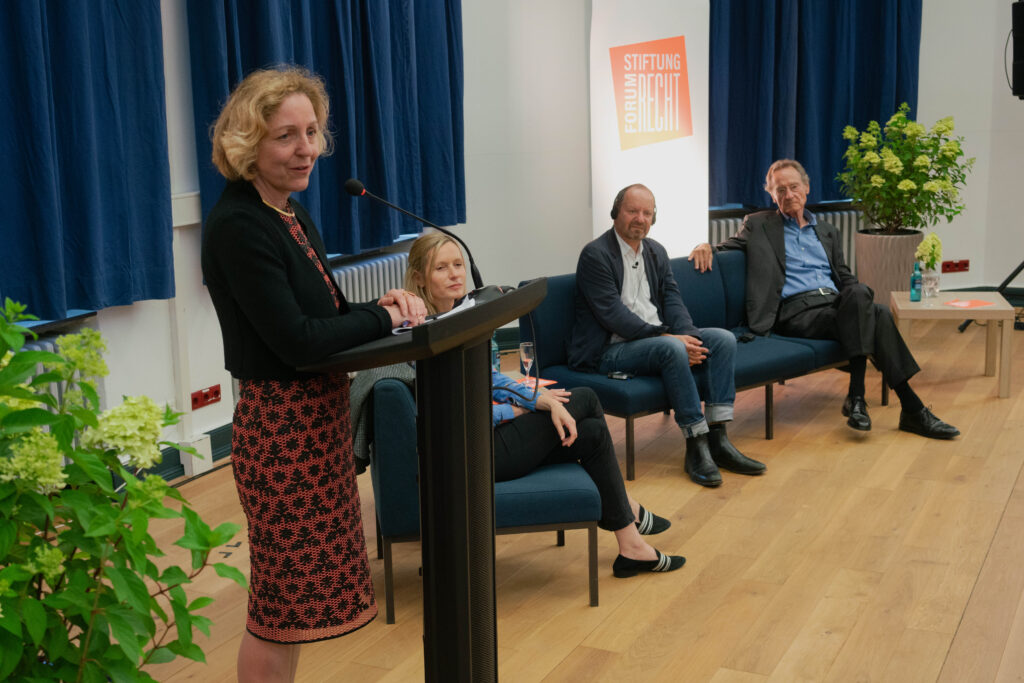
Law meets author
In addition to the two authors, the Franco-German journalist Géraldine Schwarz for the evening. In her own literary and cinematic work, including "Les Amnèsiques/Die Gedächtnislosen", Schwarz addresses the often painful - and frequently neglected - reappraisal of the past and pleads for a rethink in remembrance work. As moderator of the evening Géraldine Schwarz in this role and presents herself as a challenging discussion partner.
Schwarz will lead the audience through the evening for more than two hours, offering plenty of room for questions and an open discussion.
First of all, it deals with the tense relationship between court proceedings and justice on the one hand and remembrance and reparation on the other. To what extent can a guilty verdict erase the suffering and trauma experienced or atone for guilt?
The world bestseller "The reader", Bernhard Schlink dedicated his book to Germany's guilt for the past: according to the author, the failure to come to terms with the crimes of National Socialism, the Holocaust and the perpetrators as a "second guilt" of the people after 1945 "preoccupied his entire generation".
People and nations share secrets, things that are not talked about, says Sands. What appeals to him is the gap that arises when people or nations avoid dealing with reality. His research "The rat line" stands symbolically for this gap and reflects a universal history in miniature.
"Who do we get to talk about justice?" (Sands)
Later, the discussion focused on the limits and potential of literature and legal procedures in coming to terms with the past - for example in dealing with the aftermath of crimes, dictatorship or conflicts. It was interesting to hear the views of two lawyers who write - how do they assess their own influence through their literary work? Both agreed that literature can make a major contribution to coming to terms with the past. Stories, documentaries and the description of individual fates open doors because they offer a neutral space for different perspectives.
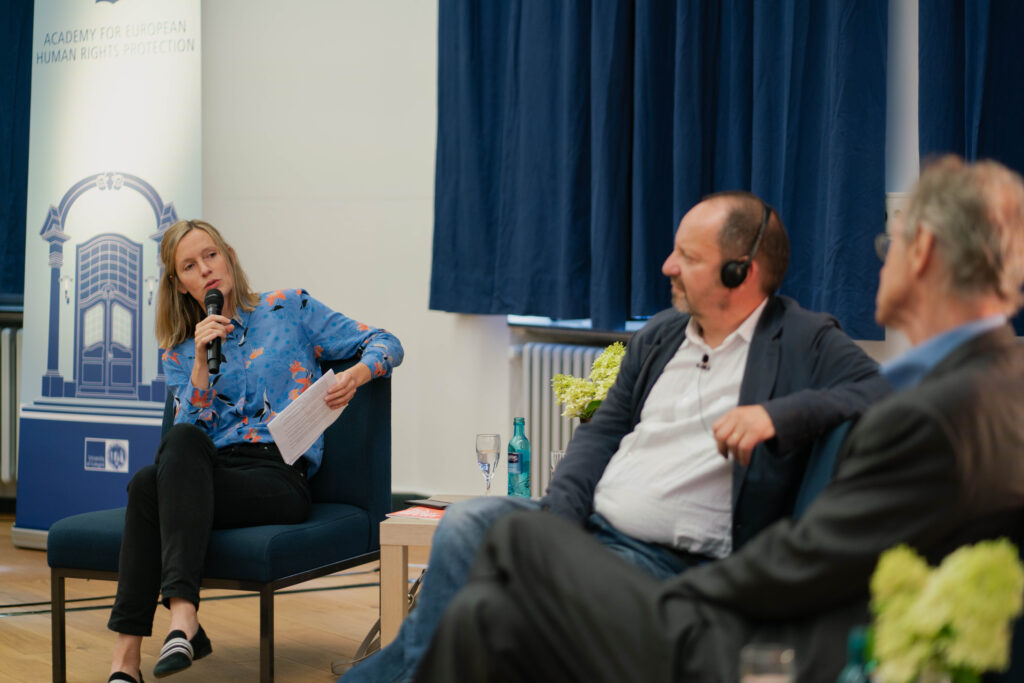
And from the perspective of the recipient: Courts interpret right and wrong, provide guidance for civil coexistence. Books provide a pleasant space for what was, what would have been, what could have been - without having to judge.
According to Schlink, the law supports both remembering and forgetting in equal measure. Both can be traumatic. It is therefore important to ask oneself: What can the law achieve? How do we want to remember past injustice?
Court proceedings play a decisive role in the process of reparation, Sands continues. And since more people read novels than court rulings, it is important to reflect on how literature and jurisprudence can be combined: "Whats the relationship between a trial and a novel?"
Sands, born in London as the son of a Jewish immigrant family, pursued a career for his work "Back to Lviv" (2016) followed the traces of his ancestors and linked them with the story of two lawyers who had a decisive influence on modern international law. In contrast to non-fictional texts, fiction has the ability to make the past accessible to readers through personal connections and to open the door to complex jurisprudence, according to Sands. He was Chairman of English PEN from 2018 to 2023 and this also underlines his stance: it is important to write about justice! Trials are only one aspect of this. However, the principle of truthfulness applies and authors must not ignore historical sources, adds Bernhard Schlink.
Géraldine Schwarz skillfully links the authors' biographies, especially their legal careers, with their oeuvre. Even if it is not a reading evening, the audience will gain an insight into her current prose work.
In his research "The rat line", Philippe Sands outlines the escape of an SS officer before his conviction. The source material was private letters and diaries of the Wächter family as well as conversations Sands had with his son Otto Wächters led.
The story "The granddaughter" by Bernhard Schlink deals with the motives and personal consequences of an escape - albeit under different circumstances:
"I never write because I want to write about a subject. I write stories that come to me and stay with me, that I deal with and then decide I want to write them."
Bernhard Schlink
Birgit flees to West Germany for love and sacrifices a life with her daughter to do so. This is also a historical investigation, the narrative bridges extend into the present and once again the protagonists wrestle with different world views.
After the discussion on the blue sofa in the packed historical reading room, there are numerous requests to speak from the audience, some of which are international.
We return from Cologne to Karlsruhe enriched and inspired - with plenty of literature tips for the summer in our luggage!
The discussion was held in English and German. The event was planned and organized as a cooperation between the Stiftung Forum Recht and the Academy for European Human Rights Protection of the University of Cologne. (academy-humanrights.uni-koeln.de)
We would like to thank the director Angelika Nußberger and her team for the inspiring cooperation.
Be part of our next event! You can find all dates in our calendar: stiftung-forum-recht.de/events