Looking back: Panel discussion "Poland after the parliamentary elections"
How can a constitutional state be rebuilt?
A new wind has been blowing in Poland since the electoral success of Donald Tusk's party alliance last fall. The newly elected prime minister is committed to nothing less than restoring the democratic rule of law in Poland, which had come under serious pressure during the previous eight years of government by the national-conservative PiS party.
Against this backdrop and as part of our multi-week photo exhibition SPRAWIEDLIWOŚĆ - JUSTICE at the beginning of March to a Panel discussionwhich dealt with Poland's rocky road to the rule of law. Alongside the four experts from the fields of political science, journalism and jurisprudence The evening was attended by almost 40 interested guests in the rooms of the Stiftung Forum Recht on Universitätsstraße in Leipzig.
Greeting from our acting director Dr. Stephan N. Barthelmess, Photo: Stiftung Forum Recht
Poland in transition
The moderator outlined Susann Böttcher (MDR) initially painted a picture of upheaval and change. According to Böttcher, the title of the Oscar-winning film "Everything everywhere all at once" can be taken literally for Poland, as the dismissal of numerous PiS judges, state media officials and public prosecutors who had dubiously taken office required a very prudent approach, which also had direct consequences at EU level. For example, Donald Tusk was able to release previously blocked EU funds after just a short time, further consolidating the consistently high EU approval ratings of the Polish population.
Competing jurisdictions
Panelists Thomas Guddat, judge and chairman of the German-Polish Judges' Association, made it clear that the question of Poland's future is always also a European question. The current simultaneity of three different legal areas - the one damaged by the PiS government, the one established by the Tusk government and the overarching area of European jurisdiction - are currently difficult to reconcile.
Also Viktoria Großmann, correspondent for the Süddeutsche Zeitung in Warsaw, emphasized the challenging simultaneity that currently prevails in Polish state operations. It is now very important, said the journalist in line with Bastian Sendhardtpolitical scientist at the German Poland Institute, "to keep up the pace of restructuring". However, this is easier said than done, as support for the PiS camp around party leader Jarosław Kaczyński and incumbent President Andrzej Duda remains strong. The latter holds a veto power that allows him to easily boycott the Tusk government's legislative proposals. The result is a blockade situation that makes the current competing understandings of the rule of law all too clear.
The panel guests Thomas Guddat, Susann Böttcher, Viktoria Großmann and Bastian Sendhardt in conversation (from left to right), Photo: Stiftung Forum Recht
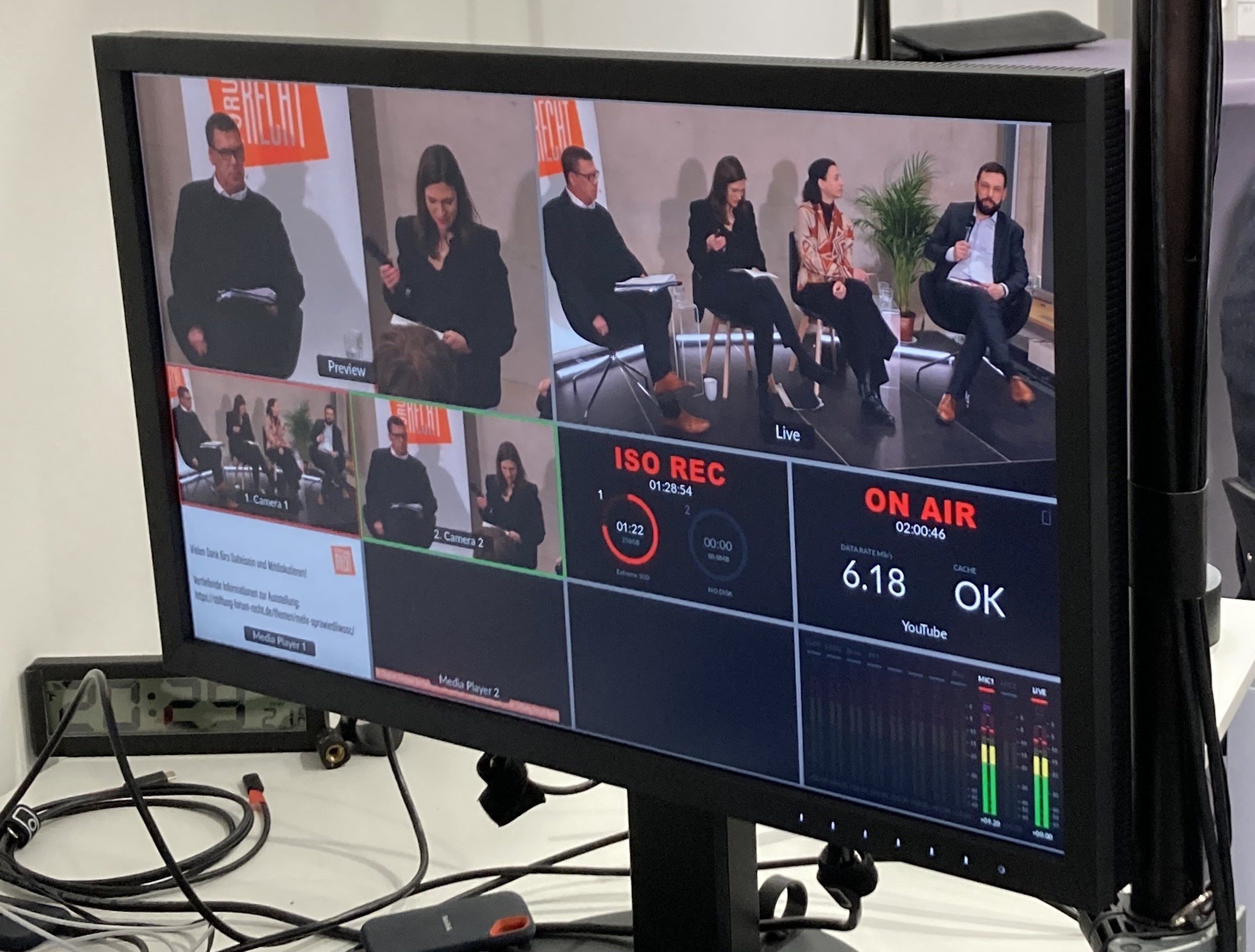
Recording of the livestream of the panel discussion, photo: Stiftung Forum Recht
A European question: Lessons from the neighboring country
Finally, the panelists agreed that the new Polish government has a difficult path ahead of it. A cautiously optimistic view on the part of German legal scholars, such as Mathias WeilandtState Secretary for Justice and Europe in the Free State of Saxony, nevertheless seems appropriate in view of the current political momentum in Poland. As a "liberal and democratic center", the Polish people have "made people sit up and take notice" with their decision to vote against right-wing populism and for Europe.
It can be seen that the latest developments in Poland stand in contrast to the right-wing authoritarian turn that is currently taking place in a number of European countries. For example, at the beginning of March - just a few days after our panel discussion - the far-right Chega party in Portugal emerged stronger from the parliamentary elections. And with a view to the upcoming state elections in Saxony, Thuringia and Brandenburg, Judge Thomas Guddat concluded by warning of a blockade situation in parliamentary-democratic day-to-day business, which could also have serious consequences for the rule of law in Germany. He also appealed to lawmakers to strengthen the Federal Constitutional Court as the guardian of the rule of law.
As the event could be followed live in the video stream, the subsequent Q&A session took place in hybrid form - in addition to the Leipzig guests, the digital viewers also had their say via the chat. The audience and panel generally agreed that we should learn from recent legal history in our neighboring country to understand the rule of law as a valuable part of a resilient democracy and to communicate it accordingly. The Stiftung Forum Recht also sees this as its task.
Rewatch of the Panel Discussion
Were you unable to attend the discussion either digitally or live in Leipzig? Then you can watch the recording of the event here!
You are currently seeing a placeholder content of YouTube. To access the actual content, click on the button below. Please note that data will be passed on to third-party providers.