

February 26, 2026
What does the Federal Constitutional Court do?
The Theme Day on April 17, 2026, offers insights into the work of one of Germany's highest courts
To mark the 75th anniversary of the Federal Constitutional Court, the Forum Recht Foundation is holding its first theme day of the year, focusing on the country’s highest court for constitutional matters. Following a tour of the building and a discussion with Dr. Yvonne Ott, a judge at the Federal Constitutional Court, the afternoon will feature two expert presentations and a workshop at the Forum Recht Foundation’s offices, which will explore the Federal Constitutional Court, its responsibilities, and the challenges it faces in greater depth. For more information, please see the Schedule.
The theme days are one-day training sessions that combine a visit to a location related to law and the rule of law with practical discussions, expert presentations, and exchanges in a workshop format.
The event is aimed at key influencers from schools, adult education centers, political education, and other educational institutions. Youth leaders and social workers, as well as media professionals and others with a professional connection to the subject area, are also warmly invited. The goal is to provide participants with practical insights and in-depth knowledge so that they can competently discuss the topics covered in their respective roles and dispel misconceptions among their target audiences.
The theme days are one-day training sessions that combine a visit to a site related to law and the rule of law with practical discussions, expert presentations, and exchanges in a workshop format. In this case, we’ll take a closer look at the Federal Constitutional Court from various perspectives: It does not stand at the head of the ordinary court system, but rather alongside it. Its decisions are binding on all other courts and state bodies. It is the ultimate authority when it comes to fundamental rights and the Basic Law. What did this mean when the court was founded 75 years ago, and what challenges does it face today? Learn more about this, bring your questions, and draw on what you learn from this training for your own work!
That's what the theme day is all about
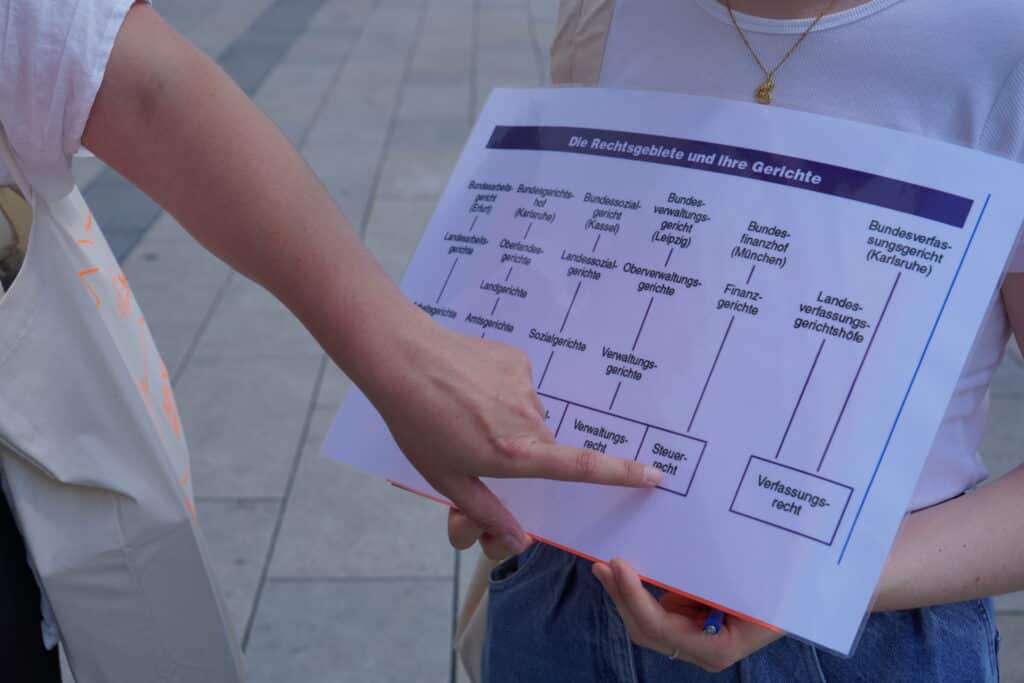
Since its establishment in 1951, the Federal Constitutional Court has held a special position among state institutions and has since served as a model for many constitutional courts in other countries. As a court that reviews the constitutionality of laws and regulations, it is not part of the court system but stands, so to speak, alongside the specialized courts and the ordinary courts. Given the Federal Constitutional Court’s significant influence, its relationship not only with other national and international courts but also with parliaments as legislators is a topic of recurring discussion.
The Federal Constitutional Court can also be examined in the context of its historical development: Have the role and responsibilities of the Federal Constitutional Court changed over the past 75 years? And with an eye to the present and the future: What challenges does the Federal Constitutional Court face today, and what role does it play in initiating and shaping societal transformations?
We would like to explore and discuss all of this with you.
Info at a glance
Date: Friday, April 17, 2026
Time: 9:00 a.m. – approx. 4:00 p.m. (Subject to change!)
Getting There: Participants are responsible for arranging their own travel to and from the event. The foundation cannot provide a travel allowance.
Meeting point: right in front of the Federal Constitutional Court (Schloßbezirk 3, 76131 Karlsruhe)
Additional venue: The event will end around 4:00 p.m. at the Forum Recht Foundation (Karlstraße 45A, 76133 Karlsruhe).
Target audience: This training program is aimed at key influencers in the education sector (schools, political education, adult education centers, and other educational institutions), the social sector (e.g., volunteer youth leaders; social workers), as well as journalists and individuals with a professional interest in the subject (e.g., lay judges).
Costs: Participation in the training is free of charge. Lunch is at your own expense.
Registration: Registration was open until March 17, 2026.
The number of participants is limited to 25.
In the event of very high demand, we reserve the right to select participants based on a number of criteria (role as an advocate in the context of political education, representation of various employers/institutions, quantitative gender balance, and regional distribution of participants). We will carry out this selection process shortly after the registration deadline (March 17, 2026).

DAILY SCHEDULE*
- 9:00 a.m.: Meet at the Federal Constitutional Court
- 9:30 a.m.–12:00 p.m.: Tour of the Federal Constitutional Court and discussion with Constitutional Court Justice Dr. Yvonne Ott
- 12:00–1:00 p.m.: Group lunch (at your own expense)
- 1:00 p.m.: Lecture by PD Dr. Frieder Günther (historian and Head of Research Coordination and Knowledge Management, Stiftung Forum Recht): „A Breathtaking Rise: What We Can Learn from the History of the Federal Constitutional Court," followed by a Q&A session
- 2:00 p.m.: Presentation by Prof. Dr. Werner Finger (attorney specializing in constitutional law): „‚If necessary, all the way to Karlsruhe…‘—Constitutional complaints and the role of the Federal Constitutional Court from a lawyer’s perspective,“ followed by a Q&A session
- 3:00 p.m.: Workshop & Closing Discussion
- 4:00 p.m.: Individual departure
- Subject to change without notice
Questions about the Theme Day
If you have any questions about our training courses, please feel free to email us at vermittlung(at)stiftung-forum-recht.de.
Registration for the Theme Day
If you have any questions about our training courses, please feel free to email us at vermittlung(at)stiftung-forum-recht.de.
*In the event of very high demand, we reserve the right to select participants based on a number of criteria (role as an advocate for political education, representation of various employers/institutions, quantitative gender balance, and regional distribution of participants). We will carry out this selection process shortly after the registration deadline (March 17, 2026).