April 11, 2025
Against the Tide—For Human Rights
Participants in the theme day „Human Rights Protection in Europe“ visited the European Court of Human Rights and the Council of Europe in Strasbourg
Heading toward the Rhine, the sightseeing boats travel upstream through Strasbourg—right between the European Parliament and the European Court of Human Rights (ECHR) through. For Lawyer Herbert Rosenfeldt That’s a familiar sight. When he looks out the window of the conference room, it reminds him of his day-to-day work: „We, too, often have to swim against the current when we’re fighting for human rights.“
It was precisely this commitment to human rights that was the focus of the theme day „Human Rights Protection in Europe“ the Forum Recht Foundation on March 28, 2025, who led a diverse group of about 25 interested individuals from the fields of education, journalism, and volunteer work on a visit to the European Court of Human Rights and the Council of Europe in Strasbourg led. Early in the morning at 7:00 a.m., the group set off from Karlsruhe Central Station—full of anticipation.
The Work of the European Court of Human Rights
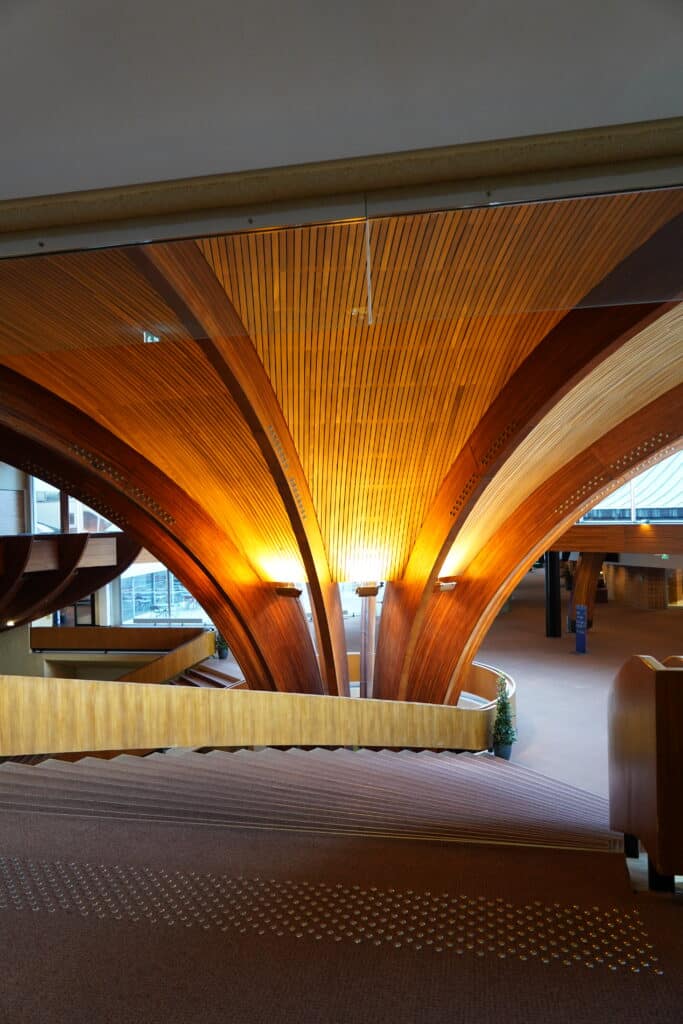
Upon arrival at the ECHR, we went straight through the security checkpoint. The imposing building made an immediate impression: It is stately without being intimidating—open, flooded with light, and featuring an architectural design that piques one’s curiosity. Viewed from above, it resembles a set of scales: The two circular meeting rooms symbolize the scales. At the same time, the waterfront setting, with its striking towers, is reminiscent of a ship.
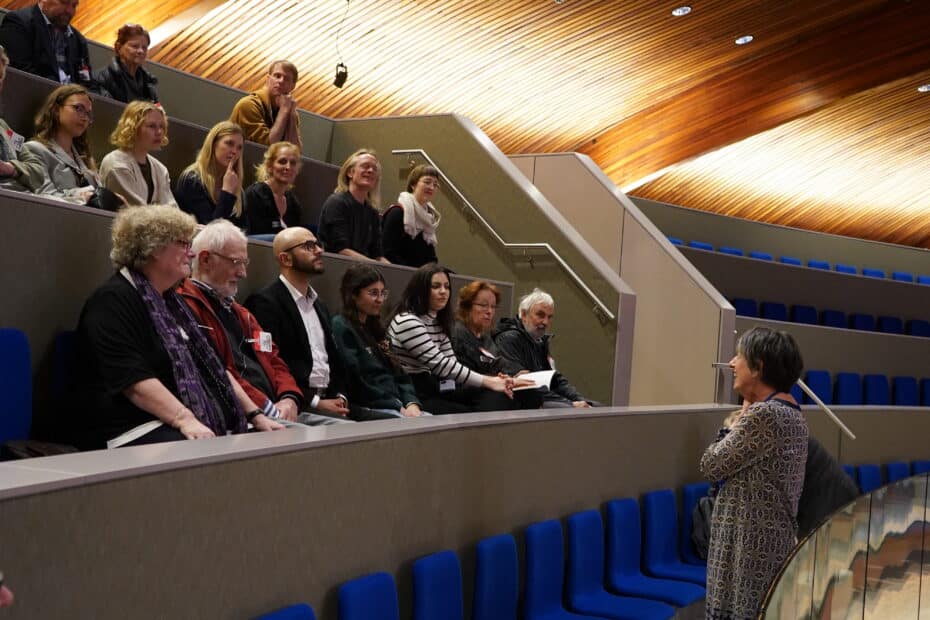
An introductory video provided insights into the day-to-day work of the ECHR. Afterward, [name] welcomed Herbert Rosenfeldt, a German lawyer at the Court, personally welcomed the group in the hearing room overlooking the European Parliament. In his presentation, he vividly explained how the European Court of Human Rights protects human rights and issues rulings—and how difficult, yet essential, it is to monitor their implementation in the member states.
The Work of the European Court of Human Rights
Upon arrival at the ECHR, we went straight through the security checkpoint. The imposing building made an immediate impression: It is stately without being intimidating—open, flooded with light, and featuring an architectural design that piques one’s curiosity. Viewed from above, it resembles a set of scales: The two circular meeting rooms symbolize the scales. At the same time, the waterfront setting, with its striking towers, is reminiscent of a ship.
An introductory video provided insights into the day-to-day work of the ECHR. Afterward, [name] welcomed Herbert Rosenfeldt, a German lawyer at the Court, personally welcomed the group in the hearing room overlooking the European Parliament. In his presentation, he vividly explained how the European Court of Human Rights protects human rights and issues rulings—and how difficult, yet essential, it is to monitor their implementation in the member states.
Countries in Focus – Between Aspiration and Reality
When asked how to deal with countries that struggle to implement human rights standards, Rosenfeldt was candid: It is a challenge. But through its rulings, the Court establishes clear facts that have an impact—both legally and symbolically. As members of the Council of Europe, modern European states have a self-image centered on the protection of Human Rights to represent. Of course, Rosenfeldt pointed out, there would also be member states that had not yet fully embraced this self-image.
The the largest number of Casesn, with which sI'm working on a case before the ECHR, so comet from the Turkey—the European Court of Human Rights„ “best client”, as Rosenfeldt notes, not without a touch of sarcasm. Although Turkey is not a member of the EU, it is a member of the Council of Europe, and therefore these cases are being heard before the European Court of Human Rights. Prior to its expulsion from the Council of Europe, Russia ranks first in the case statistics. Despite all the difficulties, communication with member states is generally constructive—the goal remains the consistent implementation of the European Convention on Human Rights.
Architecture Meets the European Ideal
After a question-and-answer session, the group was able to „European Court of Human Rights“ Visit—the bright blue carpets with the golden EU stars are truly memorable. The building's color scheme of blue, white, and red is also reminiscent of the French national colors – and thus to the host country of the Court.
During the lunch break, there was just enough time for an Alsatian tarte flambée; I quickly grabbed a pain au chocolat or a baguette for a little afternoon snack, and off we went again.
Visit to the Council of Europe
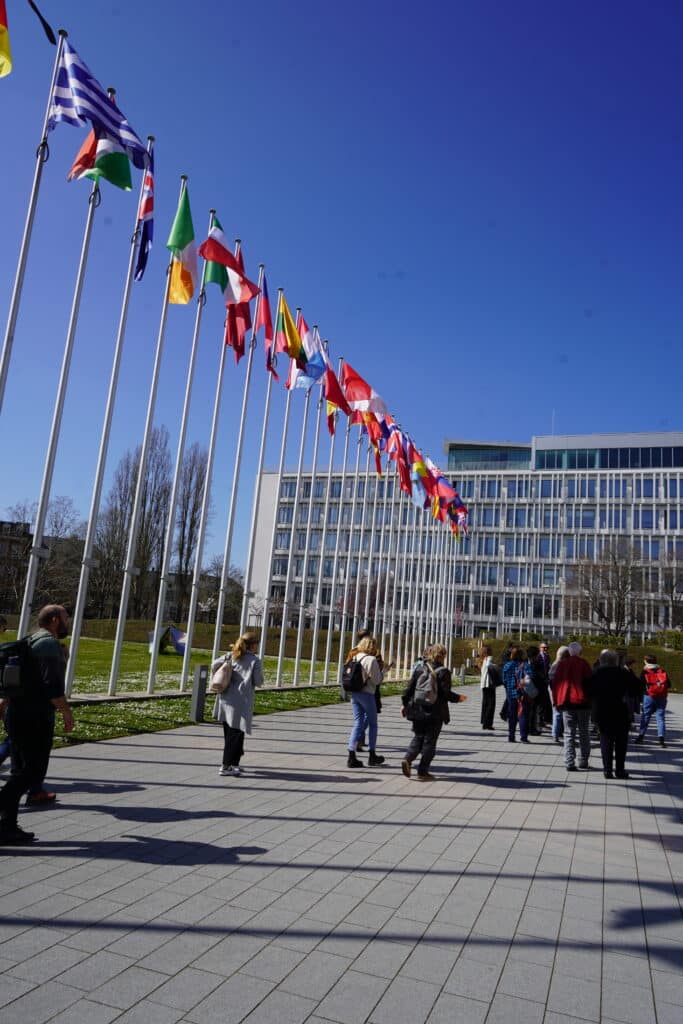
In the afternoon, a visit to the Council of Europe was on the agenda. Forty-six flags fly in front of the building—those of the member states, arranged alphabetically by their English names. In the hall of the Parliamentary Assembly, where, among other things, the judges of the European Court of Human Rights are elected and conventions are adopted, the political dimension of human rights protection became tangible. The sessions here are open to the public—to ensure transparency and enable democratic participation.
The three cornerstones of the Council of Europe—human rights, democracy, and the rule of law—run through all of its institutions. The European Court of Human Rights is closely linked to the Council of Europe and monitors compliance with the Convention on Human Rights, which entered into force in 1950.
Expert Input and a Diversity of Perspectives
The day was rounded out by two expert presentations: Irene Suominen from the Public International Law Division and Treaty Office and Prof. Dr. Marten Breuer Representatives from the University of Konstanz explained the work of the Council of Europe and the European Court of Human Rights in a very clear and practical way, using current and historical case studies. The group discussion was particularly enriching: the participants’ diverse professional backgrounds led to lively discussions that brought a wide range of perspectives to the table. In this way, the participants expanded on the knowledge they had gained by drawing on their own experiences and topics.
On the drive back to Karlsruhe, the lively discussion continued—about what they had heard and seen, as well as any remaining questions. The day provided many insights and pieces of information that the participants can take with them and apply to their professional practice.
The theme day in Strasbourg offered not only a wealth of information, but also inspiration and the realization that advocating for human rights sometimes requires swimming „against the current,“ but never fails to make an impact.
Here you can find out about upcoming theme days and other professional development opportunities.