
Interview: Justice on the big screen
Can a movie theater become a space for discussion and interaction on issues of justice?
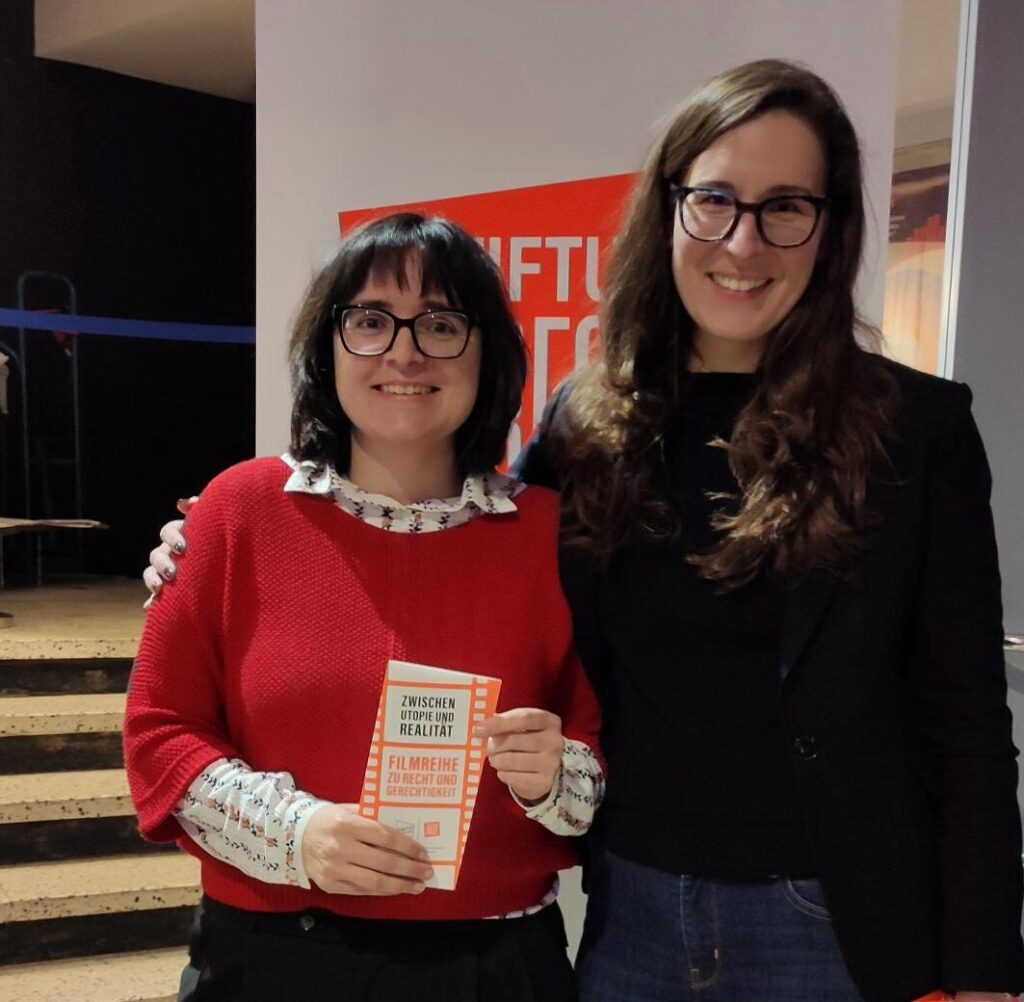
Can we discuss and reflect on law and justice—from the comfort of a movie theater seat? For one year—from November 2022 to November 2023—the Forum Recht Foundation and the Kinemathek Karlsruhe e.V. hosted a series of discussions and film screenings titled „Law and Justice: Between Utopia and Reality.“ Kathrin Schön, program curator at the Forum Recht Foundation, and Carmen Beckenbach, a staff member at the Kinemathek, look back on ten evenings during which experts and the audience explored concepts of justice on the big screen—beyond legal dramas and crime films.
SFR: From a Japanese feature film from the 1950s to a Hollywood blockbuster and documentaries from Germany—the film series has covered a wide range of topics. How did you make your selections?
Beautiful: There was a common thread running through the film series: the theme of law and justice. We wanted the topics we cover in our podcast „Justice, Baby!“ to be reflected in the following week’s movie lineup. That way, if you were interested in the topic, you could either go to the movies already well-informed or listen to the podcast again after an inspiring movie experience. It was important to me to showcase the full spectrum of film culture—not just films that get under your skin, but also those that challenge your mind. So I was especially pleased that the Kinemathek—Karlsruhe’s home for cinematic art—was eager to collaborate on this project.
Beckenbach: When Kathrin and I sat down together, it was really a back-and-forth exchange of ideas—always with the podcast topics in mind, of course. It wasn’t always easy to find a suitable movie. Take the topic of justice and sports, for example. I then suggested *Die anderen Plätze* by Simon Quack and Marco Kugel.
It was important to me to showcase the full spectrum of film culture—not just movies that get under your skin, but ones that challenge your mind as well.
Kathrin Schön
Both filmmakers and the production company have ties to Karlsruhe. In return, Kathrin contributed „König hört auf“ by Tilman König, which screened at the Dok Leipzig film festival, thereby establishing a connection to Leipzig. With „Rashomon,“ we deliberately chose a classic on the theme of justice. In the film, the trial itself plays a role—not just an injustice. And that brings us to what has always been a part of the experience and has always been enriching: the discussions that follow.
Foundation: What points from the expert discussions have really stuck with you?
Beckenbach: For example, our evening event on gender equality featuring the Swiss film *Die Göttliche Ordnung* and Verena Meister, the City of Karlsruhe’s equal opportunity officer. What I loved most about that evening was realizing that women all across Europe had taken to the streets to demand their rights and a voice in decision-making. Learning that the position of gender equality officer is mandated by law. We learned about the long history of the struggle for greater structural guarantees of equality in public offices.
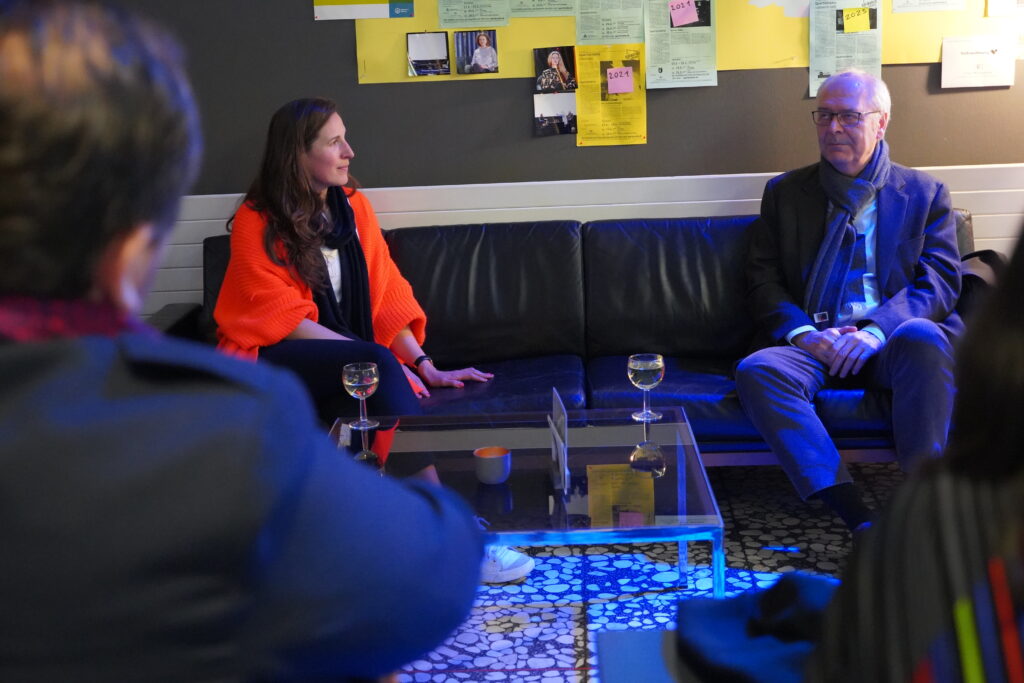
Beautiful: From the discussions and questions from the audience, I realized that law and legal issues are, above all, interdisciplinary topics. The guest for the first film was Prof. Dr. Manfred Schmitt—a psychologist and expert in the study of revenge and justice. That was fascinating because I realized that the question of values and norms—and of the rules we set for ourselves as a society—touches on every discipline.
When we launched this project over a year ago, I was still trying to figure out what the foundation’s program could achieve. It quickly became clear that the interdisciplinary approach is exciting—and that it works. And that goes for people with and without a legal background alike. The discussions have shown that the participants found many points of reference to their own lives.
Foundation: Were there any other films you would have liked to include?
Beckenbach: There are an endless number of films we could have included. „12 Angry Men“ by Sidney Lumet, for example, is one such classic. But the selection we made includes all the films that were important to us and that fit the themes. I also had the chance to watch one of my favorite films again—„Ariaferma“ by Leonardo Di Costanzo.
Beautiful: We deliberately chose not to include police or „Law & Order“-style films that obviously focus on courts, the justice system, or lawyers. We were more interested in exploring values and norms and the question, „What is the right course of action in situations that fall into a legal gray area?“ On the topic of „revenge,“ for example, we screened „Three Billboards Outside Ebbing, Missouri.“ Yes, it does deal with the legal investigation of a tragic death. But it’s also about how to cope when an investigation leads nowhere. That’s basically what made it so great: that we were able to bring human experiences of and with the law to the forefront in this film.
Foundation: In addition to the program and the discussions, the venue itself was also special. Can art-house theaters like the Kinemathek Karlsruhe serve as so-called „third places,“ where people can meet and exchange ideas outside of work and home?
Beckenbach: I believe that a movie theater offers a different emotional dimension for the audience. You can talk about right and justice in a lecture hall, too. But it’s a whole different experience when you’re sitting together in a movie theater, having that immersive experience, and then being able to discuss it afterward. We didn’t want to do a film analysis; instead, we wanted to invite experts to both examine the films closely and broaden our perspective. I thought that combination worked well.
Until a few years ago, most movie theaters selected films they assumed would appeal to their target audience. Kinematik is committed to taking a different approach. It looks at it this way: OK, this community wants to see the movie right now for a specific reason.
It may not be a classic film, an arthouse film, or an auteur film per se. But this kind of programming is on the rise and is very well received. We also still have our regular program featuring documentaries, classics, and so on, but community outreach is important. With the “Quartierskino,” for example, the Cinematheque had a project directly connected to the city and its people. That’s why I found it exciting that a different community would come out for each screening in the series—one that focused, for instance, on the rights of people with disabilities or on modern corrections. They came specifically for the topic or because of the invited experts.
I believe that a movie theater offers a different emotional experience for guests.
Carmen Beckenbach
Beautiful: I would agree with that assessment. I could also easily imagine a program curated by the „community“ if the foundation were to organize another film series. We could then also collaborate with clubs, youth groups, and municipal initiatives on the accompanying program. I see a great deal of potential there for the foundation’s future work. Co-created programs provide real added value—for everyone involved.

Foundation: The film series is subtitled „Between Utopia and Reality.“ What were you hoping to convey with that? And—how accurate are the visions of the future that may also be implied there?
Beautiful: The subtitle makes it clear that justice is a subjective matter and involves testing personal expectations against reality. All the films feature protagonists driven by a desire for justice, which can take very different and highly personal forms. That is the utopian aspect. The rule of law and the law, on the other hand, seek to establish rules that are as objective as possible for subjective experiences—and that’s where the “reality check” from the subtitle comes into play. Demonstrating that a state governed by the rule of law is precisely about this negotiation—and also about understanding the limits of the law—was of great significance for the film series.
The feature film „Happiness on a Scale of 1 to 10,“ which we included in our program as part of our focus on inclusion, has shown that utopias can inspire and spark a discussion about justice in everyday life.
This is a classic road movie with a touch of coming-of-age: Two people—one with a disability and one without—embark on a journey and arrive at their destination as happier people. The film paints a picture of inclusion in action that inspires hope, even though the discussion following the screening showed that we are still a long way from achieving this utopia, both legally and in terms of social policy. I hope that the film has stirred emotions and sparked a desire to find solutions for building a more just society. This requires positive visions—but also hard-nosed tools—and that, in this case, is the law.
Beckenbach: But if we actually try to envision utopia through the lens of film, we often end up in the realm of science fiction. We hadn’t really considered that at all, and I’ve been thinking about it quite a bit over the last few days. When I think about the topic of utopia, only very few films come to mind that depict a solution: the future is often depicted as withered, parched—a dystopia rather than a utopia. I actually think it’s a shame that solutions are so rarely portrayed.
Foundation: One final question: Has your personal view of justice changed as a result of the film series and the discussions?
Beckenbach: Short answer: Probably not. [They both laugh]
Beautiful: Me neither. But what I found truly beautiful and moving is that, despite the wide variety of definitions and individual notions of justice, there is a common denominator. Ultimately, it’s always about equality and ensuring that no one is disadvantaged due to unequal starting conditions. Research also supports this. Professor Manfred Schmitt has explained that there are universal principles of fairness—especially regarding the distribution of resources—that apply regardless of status, age, background, or gender. And this holds true all over the world. Amid all the conflicts and crises currently threatening to divide societies, this has a profoundly unifying effect.
Beckenbach: That's a great closing line.
Foundation: Thank you very much for the insights
The series provided an opportunity to explore various aspects of justice together with experts, drawing inspiration from a diverse selection of films. We would like to thank the attendees and experts who have embarked on a cinematic quest for justice over the past few months. The film series on „Law and Justice“ has now come to a close—all Podcast Episodes but they can still be streamed here. Would you like to discuss films about law and the rule of law? As part of the accompanying program for our current photo exhibition „Sprawiedliwość – Justice,“ we’re teaming up with the Kinemathek Karlsruhe on February 22 and April 7, 2024 the movie „Poland and Democracy – Judges Under Pressure“ (Poland 2022)
P.S.: With our newsletter, you and your loved ones will never miss any of our events again.
#LetsTalkAboutRecht
Movies in the series
October 19, 2022 Three Billboards Outside Ebbing, Missouri
(Martin McDonagh, USA 2017)
November 23, 2022 Toubab
(Florian Dietrich, Germany 2017)
February 22, 2023 The Divine Order
(Petra Volpe, Switzerland 2016)
March 22, 2023 Ariaferma
(Leonardo Di Costanzo, Italy/Switzerland 2021)
April 26, 2023 Invisible Hand
(Joshua B. Pribanic/Melissa A. Troutman, USA 2020)
May 24, 2023 Happiness on a scale of 1 to 10
(Bernard Campan/Alexandre Jollien, France 2022)
June 21, 2023 Economics
(Carmen Losmann, Germany 2020)
September 27, 2023 König is stepping down
(Tilman König, Germany 2022)
October 18, 2023 The other seats
(Marco Kugel/Simon Quack, Germany 2016/7)
November 29, 2023 Rashomon
(Akira Kurosawa, Japan 1950)