

In Review: Panel Discussion "War Crimes Trials at German Courts"
How can international crimes be solved?
War crimes - an abstract word that conceals suffering that is difficult to grasp. Since 2002, the Criminal Code for International Crimes has made it possible to prosecute crimes against international law in German courts. At the Revolutionale 2023 in Leipzig on Wednesday, October 11, 2023, Dr Somi Nikol, Marianna Karkoutly, Roman Avramenko and Katyerna Busol spoke about the hurdles and potential of applied international criminal law and gave insights into their work to investigate war crimes. The armed conflicts currently taking place around the world highlighted the topicality of the discussion and provided food for thought. The discussion round was moderated by Alexandra Kemmerer.
The panel brought together different perspectives and voices. Dr Somi Nikol opened with insights into the work of the Federal Public Prosecutor's Office in Germany. Due to the principle of universal jurisdiction and the Rome Statute of the International Criminal Court, crimes against humanity that violate international criminal law can also be prosecuted in third countries. In accordance with the Rome Statute, Germany has a committment to prosecute and punish crimes against humanity.
The nationally applicable International Criminal Code (Völkerstrafgesetzbuch) also states that the offense only needs to have a connection to Germany in exceptional cases in order to be prosecuted. In 2011, the Federal Public Prosecutor's Office filed the first indictment on the basis of the International Criminal Code - at that time against Rwandan rebel group leaders who had coordinated the murder of civilians in Congolese villages from Germany. The starting point of the work is often a so-called "Strukturermittlungsverfahren" (structural investigation proceedings), which initially focus on the crime complex itself and possible groups of perpetrators and only identify individual perpetrators and their involvement in the course of the investigation.
This illustrates the tremendous relevance of the early and detailed documentation and preservation of evidence of crimes in order to bring war criminals to justice worldwide. This was also emphasised by the reports from Mariana Karkoutly, Roman Avramenko and Kateryna Busol. Syrian lawyer Mariana Karkoutly spoke as a representative of the organisation Huquqyat, which promotes the prosecution of criminal offences in Syria. She reported on the particular challenges faced by survivors and witnesses of crimes. Her work focuses on documenting gender-specific violence in the context of war crimes. For the victims reporting what they have experienced is a particularly heavy and challenging burden. At the same time, the proceedings make it clear how crime complexes often harm overlooked groups in very specific ways.
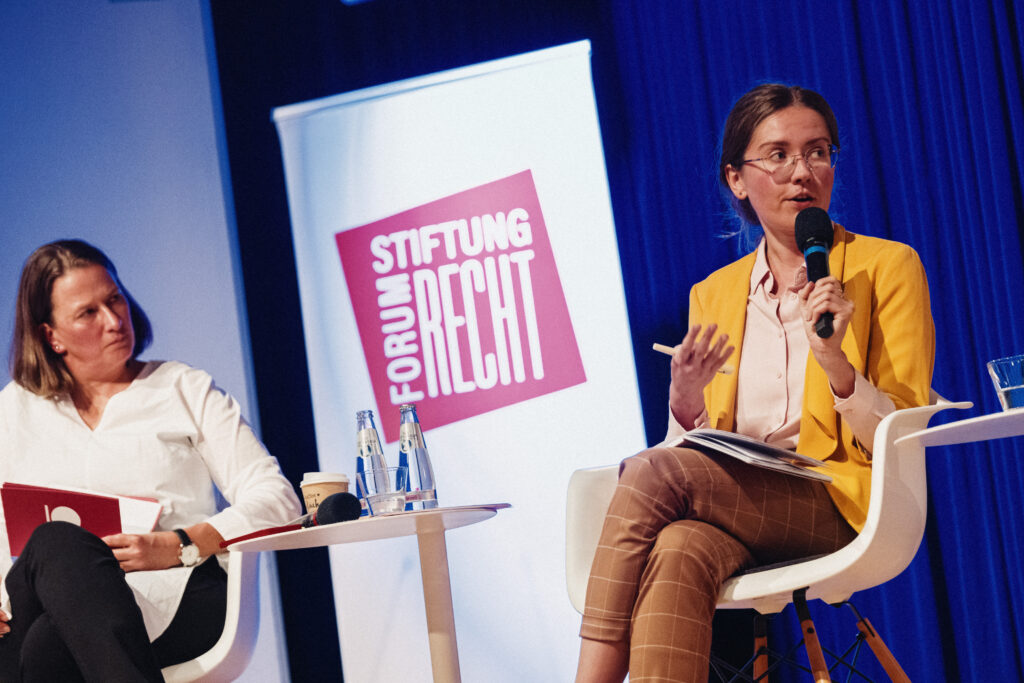
As cynical as this may sound at first, smartphones and the internet offer many people the opportunity to document crimes. At the same time, there is the challenge of the extent to which these can be admitted as evidence in court, says Roman Avramenko, Director of the Ukrainian NGO Truth Hounds. Especially with an increasing number of actors such as journalists, activists and researchers endevouring to document crimes, new challenges arise in the use of the material, but also on the part of the witnesses. Both Avaramenko and Karkoutly emphasised the psychological burden on victims and witnesses and the need for investigators to be able to cope with it.
Avramenko and international criminal law expert Katerny Busol, who works at the National University of Kyiv - Mohyla Acadamy in Ukraine, highlighted the challenge and the efforts of the Ukrainian civilian population to document violations of international law.

The Revolutionale team, which had organised a week of important spaces for exchange and debate for and with activists for human rights and democracy alongside this conversation, aptly summarised the debate and its findings on their X account: "All panelists agreed that war crimes investigations are highly relevant - not only for legal justice, but also for social justice, individual survivors and for civil resilience in Syria, Ukraine, Israel and everywhere in the world."
We would like to thank the participants on the podium and in the audience as well as our cooperation partners for the evening, the Revolutionale team (revolutionale.de) and Zeitgeschichtliches Forum Leipzig (hdg.de).
Rewatch of the Panel Discussion
Watch the recording from October 11, 2023 at Zeitgeschichtliches Forum Leipzig here.
The recording was kindly made available by Zeitgeschichtliches Forum Leipzig.
The discussion was held in English.
You are currently seeing a placeholder content of YouTube. To access the actual content, click on the button below. Please note that data will be passed on to third-party providers.
More informationMore information
[Please note that the links in orange below lead to third-party sites]
About the panelists:
- Kateryna Busol (International criminal law expert at the National University of Kyiv - Mohyla Acadamy, Ukraine)
- Roman Avramenko (Director of Truth Hounds Ukraine, an NGO documenting war crimes)
- Mariana Karkoutly (Syrian lawyer, human rights activist and member of Huquqyat)
- Dr. Somi Nikol (Federal Public Prosecutor's Office)
- Moderated by Alexandra Kemmerer, (Research Fellow and Coordinator, Max Planck Institute for Comparative Public Law and International Law)
Learn more
A glossary of key terms in the context of human rights protection can be found on the website of the European Center for Constitutional and Human Rights.
You can find more information on the work of the Federal Public Prosecutor's Office on the website of the Generalbundesanwalt.
