

February 18, 2026
On the Role of Courts in Climate Protection
Five Years Since the Climate Resolution: What's the Situation Regarding Heat and the Law?
Five years ago, the Federal Constitutional Court required the federal government to adopt more ambitious climate protection measures. In its widely noted ruling, the court made it clear that if emission reductions are not adequately regulated today, this could disproportionately restrict the freedom of future generations. Climate protection is thus not merely a political task for parliaments and governments, but also a matter subject to constitutional review.
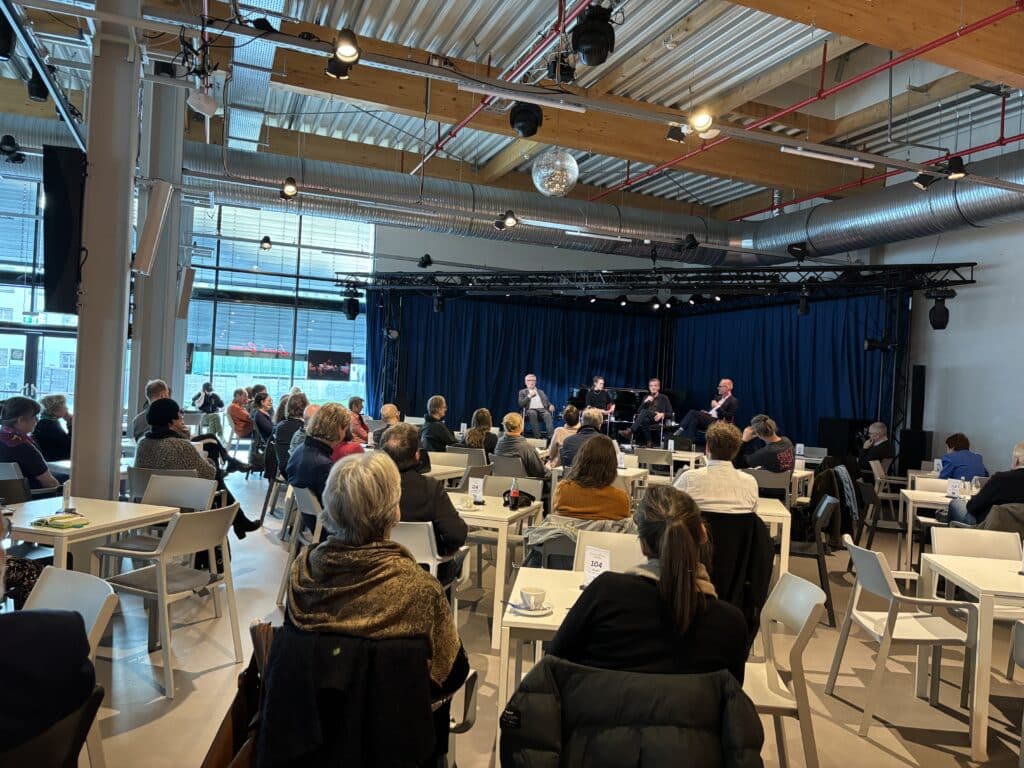
Five years after the resolution was passed, on February 8, 2026, in cooperation with the Badisches Staatstheater Karlsruhe, we invited participants and experts involved in the proceedings to take the stage to discuss the current challenges facing climate protection.

Climate Protection from a Legal Perspective
Dr Cord Brügmann, Director of the Forum Recht Foundation, moderated the discussion. The guests were Marissa Reiserer, Prof. Dr. Remo Klinger, and Prof. Dr. Joachim Wieland.
Prof. Dr. Remo Klinger As a specialist attorney in administrative law, he advocates for climate protection, including as counsel for the petitioners in the 2020–21 case.
Marissa Reiserer As a mobility expert at Greenpeace, she works on constitutional complaints and supports the people behind them, among other things.
Prof. Dr. Joachim Wieland acted as the Federal Government's representative in the 2020–21 proceedings.
Through discussions with the panelists, the event looked back and ahead at the possibilities and limitations of the law in the context of climate protection. It explored the often tense relationship between the law and its practical implementation and examined the significance of advocating for a right to climate protection for those who asserted it in court.
Courts versus Political Majorities
Together with the three panelists, Dr. Cord Brügmann took a look behind the scenes of the proceedings: What interests were at odds with one another? What standards did the Federal Constitutional Court establish in its climate ruling, and what developments followed as a result? Finally, the discussion focused on the role courts play in climate protection and the extent to which the law can serve as an instrument of social change.
The participants in the discussion had differing views on the consequences of the ruling. While Wieland spoke from a legal perspective and hailed the ruling as a „sensational blow“ and „wise reasoning by the court,“ Reiserer and Klinger criticized the government and administrative bodies for failing to implement the ruling: „It is not yet apparent,“ Reiserer said, “that, for example, the construction of a highway would ever be rejected in the interest of climate protection.” Klinger added that while the “political wake-up call” had sparked a legal debate, politicians were taking too much advantage of their remaining leeway. To make Germany climate-neutral by 2045, stricter measures are needed, said Klinger, who recently successfully argued before the Federal Administrative Court in Leipzig for a further revision of the 2023 climate protection program.
The panelists agreed that the law alone cannot drive climate action forward. While it can provide impetus, significant steps must come from the legislature. Courts have only limited scope for action and cannot replace political majorities. Accordingly, change must also come from civil society, which raises awareness and exerts pressure. Furthermore, court proceedings often take a long time, whereas in climate protection, every window of opportunity that is lost is critical.
On the Necessity of an Ecological Minimum Standard of Living
In a conversation with our social media manager, Gesa Vierkant, the three panelists shared their perspectives on the 2021 constitutional complaint. The interviews were conducted on the sidelines of the event on February 8, 2026, at the Badisches Staatstheater Karlsruhe for the Instagram account of the Forum Recht Foundation conducted.
We are continuously adding to the video collection.
You are currently seeing a placeholder content of YouTube. To access the actual content, click on the button below. Please note that data will be passed on to third-party providers.
More informationYou are currently seeing a placeholder content of YouTube. To access the actual content, click on the button below. Please note that data will be passed on to third-party providers.
More informationYou are currently seeing a placeholder content of YouTube. To access the actual content, click on the button below. Please note that data will be passed on to third-party providers.
More information„The legislature’s decision to permit the level of CO₂ emissions specified in (…) through the year 2030 has an anticipatory effect akin to an encroachment on the complainants" freedom, which is comprehensively protected by the Basic Law, and requires constitutional justification (…) is, however, unconstitutional to the extent that it gives rise to disproportionate risks of impairing future fundamental rights. (…) Under certain conditions, the Basic Law requires the safeguarding of freedoms protected by fundamental rights over time and the proportionate distribution of opportunities for freedom across generations. (…) As a means of safeguarding freedom over time, the fundamental rights protect the petitioners here from a one-sided shifting of the burden of greenhouse gas reduction—as mandated by Article 20a of the Basic Law—into the future (...)"
Federal Constitutional Court, Order of March 24, 2021 – 1 BvR 2656/18 –, juris, para. 183
Background: The Climate Protection Resolution and Its Consequences
In its 100-page ruling dated March 24, 2021, the Federal Constitutional Court found that the existing Climate Protection Act is incompatible with fundamental rights insofar as it lacks specific targets for further emissions reductions beginning in 2031. In order to safeguard the freedoms of future generations as well, the legislature must establish more concrete measures now. In its decision, the Federal Constitutional Court emphasized that the protection of freedoms must also be structured intertemporally (so-called „intertemporal protection of freedoms“): The state is obligated to encourage even today’s generations to adopt climate-friendly emission practices in order to protect future generations from a situation in which their rights to freedom are unreasonably restricted.
In short: If we don't do enough for the climate today, we'll be taking away young people's freedom tomorrow.
Following the ruling by the Federal Constitutional Court, the Bundestag passed an amendment to the Climate Protection Act (KSG). This addressed specific points that had been criticized. However, the amended law has also faced criticism for allowing CO₂ emissions to be too high. The law, which has since been amended once again—notably by eliminating individual sectoral targets—is now the subject of constitutional complaint proceedings, to which over 54,000 complainants have joined. A decision on this matter is still pending.
In addition, Prof. Dr. Remo Klinger supported Deutsche Umwelthilfe in an administrative lawsuit against the federal government, and this lawsuit was successful: The Federal Administrative Court in Leipzig ruled in late January 2026 that the federal government must expand its current climate protection program to ensure compliance with climate protection targets.
Sources and Further Reading
Federal Constitutional Court: Resolution of March 24, 2021
The Press Release Regarding the Resolution
The Climate Protection Act as stated
Campaign by the Forum Recht Foundation on Law & Reality
Article from Legal Tribune Online (LTO) Regarding the ruling by the Federal Administrative Court at the end of January 2026